
Quick Answer: What Does the Knight of Swords Mean?
The Knight of Swords is a court card in the suit of Swords, the suit tarot readers link with the element of air: thought, words, truth-telling and conflict.
- Keywords (upright): speed of thought, decisive action, courage, directness, ambition, a mind on a mission.
- Keywords (reversed): recklessness, rushing in, steamrolling, arguing before listening, scattered energy.
- Upright in one line: the card can point to a clear mind ready to act, and the nerve to move while others are still debating.
- Reversed in one line: readers often take it as speed without aim: charging in, cutting people off, or burning out before the job is done.
On The 9th King, tarot is a mirror for self-knowledge, not fortune-telling. The Knight of Swords doesn’t say what will happen. It asks a sharper question: I’m moving fast, but did I listen before I charged?
Table of Contents

The Knight of Swords at a glance
| Knight of Swords | |
|---|---|
| Arcana | Minor Arcana, court card |
| Suit | Swords |
| Element of the suit | Air |
| Golden Dawn pairing | Fire of air (Liber LXXVIII) |
| Zodiac span | 20° Taurus to 20° Gemini |
| Upright themes | Speed, decisiveness, courage |
| Reversed themes | Recklessness, steamrolling |
| Key question | Did I listen first? |
Below are the meanings commonly used with the Rider–Waite–Smith deck, then The 9th King’s own reading.
What the Knight of Swords card shows
The deck most people learn first is the Rider–Waite–Smith tarot, first published in December 1909 by William Rider & Son of London, based on A. E. Waite’s instructions and illustrated by Pamela Colman Smith (Wikipedia: Rider–Waite Tarot). Its Knight of Swords is the fastest rider in the pack.
The imagery, in words
Waite gives this knight one of the most vivid lines in his book. He is “riding in full course, as if scattering his enemies” (A. E. Waite, The Pictorial Key to the Tarot, 1910/1911, public-domain copy on sacred-texts.com).
Waite then adds a surprise. In the design, he says, the rider is really a hero of romantic chivalry, almost a Galahad, whose sword is swift and sure because his heart is clean (Pictorial Key). He’s an idealist who believes he’s right and moves like it.
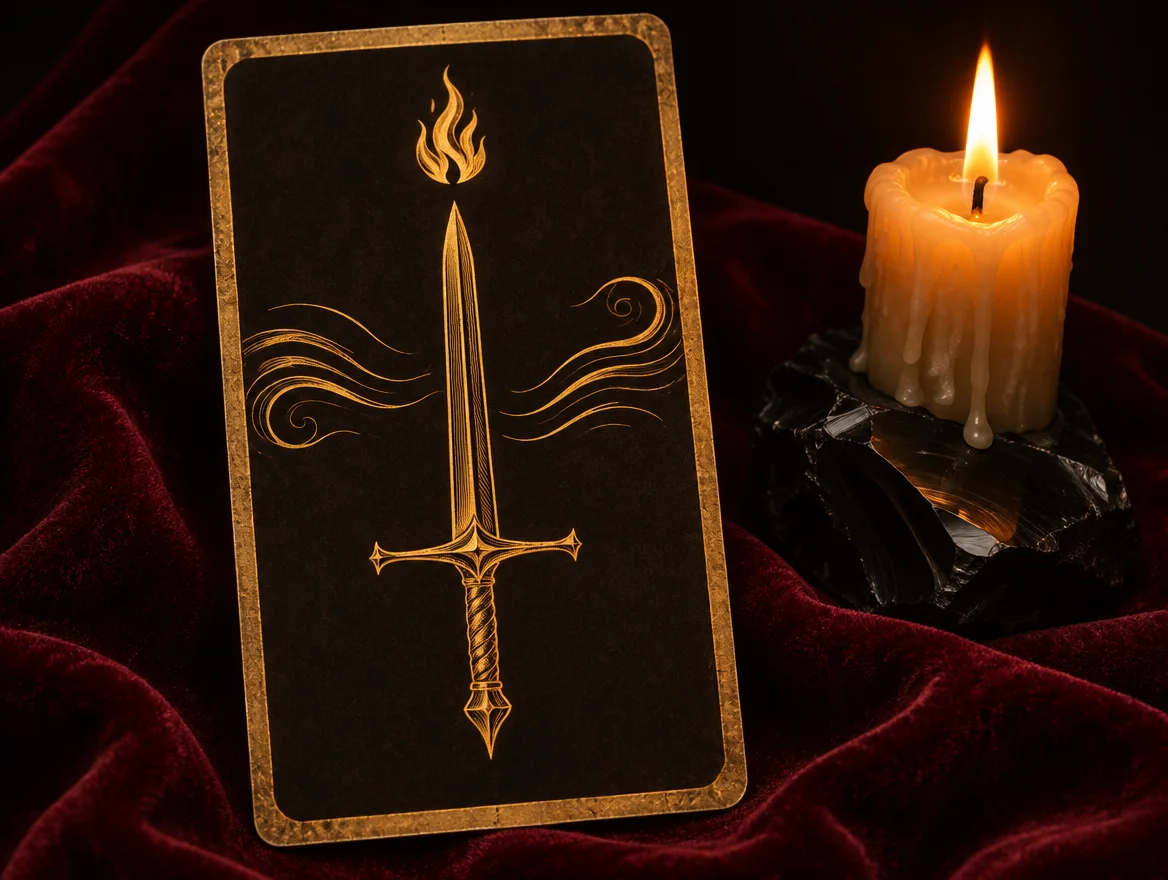
On the 1909 Smith card, the knight holds his sword raised high as his pale horse gallops hard, with wind-torn clouds overhead and small trees bent by the wind. That’s the card in miniature: a mind fully committed to one direction, at full speed.
The Golden Dawn’s picture of the same figure
Liber LXXVIII, the Golden Dawn text, pictures its Knight of Swords differently: a winged warrior in a crowned, winged helmet, riding a brown horse, holding a drawn sword, with dark stratus clouds driving beneath the horse’s feet (Liber LXXVIII). His crest is a winged six-pointed star, which the text compares to the stars shown on the heads of Castor and Pollux, the Gemini twins (Liber LXXVIII).
Why Swords? Blades and air
Tarot decks were invented in Italy in the 1430s, and they weren’t adapted for occult and fortune-telling use until France around 1780 (Britannica: tarot). In fortune-telling, Britannica notes, swords are associated with conflict (Britannica: tarot).
The element of air has been associated with the suit, and in divination it’s tied to intellect as well as sorrow and misfortune (Wikipedia: Suit of swords). Swords are about the mind: what you think, say and decide. A blade can cut through confusion or cut a person.
What a Knight does in the court
The court cards can be read as people, roles you play or stages of maturity. Knights are the movers who carry their suit into the world. The Knight of Cups moves at an easy pace; the Knight of Pentacles is slow and steady. This knight is the opposite of both.
Knight of Swords upright meaning
Waite’s upright meanings include skill, bravery, capacity, defense and address (meaning skill in handling things), but also enmity, wrath, war, opposition and resistance (Pictorial Key). Modern readers commonly add a quest for knowledge, changing thoughts or decisions, rushing into commitments or projects, and a confident, articulate person who may act on impulse (Wikipedia: Knight of Swords).
The upright card is the mind in motion: thought turned into action, fast.
In general
The card can point to a moment when you know what you think and you’re ready to move: a decision that’s suddenly clear, or something true that nobody else will say. The upright knight says that clarity is worth acting on, as long as you’re charging at the right thing.
As a person
As a person, readers often describe someone sharp, quick-talking, ambitious and direct. They cut to the point, love a debate and get bored by slow process. At their best they make the call; on a bad day they make it before hearing the whole story.
At work and in creative life
At work, the card can point to a sprint: a launch, a hard conversation, a pitch you need to make with conviction. The catch is that teams follow people they trust, and trust is built by listening. If a real job or money decision is involved, treat this as reflection, not career or financial advice.
Knight of Swords in love
In love readings, the upright Knight of Swords can point to directness: someone who says what they want and pursues with intensity, or your own urge to settle things now.
The card doesn’t tell you whether to move faster, slow down, stay or leave. It asks: Am I being honest, or just fast? Am I having a conversation, or winning an argument? For how two charts communicate, see Synastry for Beginners.
Knight of Swords as feelings
No card can read minds, so treat “as feelings” as a mirror for your own impression. Readers commonly take the upright card as feelings that are intense, direct and in a hurry: “I know what I want and I’m coming to get it.” Check that impression against what the person actually says and does, and ask them directly if it matters.
Knight of Swords reversed meaning
Waite’s reversed meanings are short: imprudence, incapacity and extravagance (Pictorial Key). Modern readers often add a clever liar, secrets, or a warning to reconsider a path before going further (Wikipedia: Knight of Swords).
On The 9th King, the reversed card is a question about how you use your speed. It tends to show up three ways.
1. The charge without a target
Energy everywhere, aim nowhere: three projects started, none finished. Waite’s “extravagance” fits here: spending force you can’t afford to spend.
2. The steamroller
Speed used against people. Interrupting, deciding for the group, treating questions as obstacles and slower thinkers as problems. It feels efficient from the inside and like not being heard from the outside.
3. The argument before the listening
You’ve already decided what the other person means, and you’re answering that instead of what they said. You win the exchange and lose the trust, or the information you needed.
Reversed in love and as feelings
In love, the reversed card can point to arguments that escalate fast, words said in heat, or someone who rushes in and rushes out. As feelings, readers often take it as feelings that are strong but reactive: frustration, impatience, a need to be right. The card can’t tell you what someone else feels; it can help you see what to ask before you react.
Element and astrology: fire of air (and a naming trap)
The 9th King uses the Golden Dawn–derived correspondences, the tradition the Rider–Waite–Smith deck draws on; both Waite and Pamela Colman Smith were members of the Hermetic Order of the Golden Dawn (Wikipedia: Rider–Waite Tarot). Other schools assign things differently, and not every card maps to a single sign. Court cards in particular work differently from the numbered cards.
The element pairing
The 9th King follows the court-card naming in Liber LXXVIII (the Golden Dawn’s Book T): Knights are fire of their suit, Queens water, Kings air, Pages earth. Liber LXXVIII calls the Knight of Swords “The Lord of the Wind and the Breezes: the King of the Spirits of Air,” and pairs it with fire of air (Liber LXXVIII).
Fire is drive and will; air is thought and speech. Fire of air is thinking that catches flame. It’s an unstable mix: air feeds fire, and fire burns through air fast.
For the Knight of Swords, Liber LXXVIII gives a character sketch that matches this page’s angle almost exactly: active, clever, subtle, fierce, courageous and skillful, but inclined to domineer. It adds that he tends to overvalue small things unless well dignified, and that ill dignified he is deceitful, tyrannical and crafty (Liber LXXVIII).
The naming trap
Here’s the confusing part. Liber LXXVIII heads this card “Knight of Swords” but gives it a Golden Dawn title that calls him a King, “the King of the Spirits of Air,” while its chariot-riding Prince carries the King of Swords title (Liber LXXVIII). Matching those Golden Dawn figures to the Rider–Waite–Smith court cards is the convention The 9th King uses, not something the source says about Waite’s deck. Other systems differ; if you use another, use it consistently.
The zodiac span
Liber LXXVIII says this figure rules from 20 degrees of Taurus to 20 degrees of Gemini (Liber LXXVIII). That’s the last decan of Taurus and the first two decans of Gemini. In the same text’s decan list, those three decans belong to the Seven of Pentacles (Saturn in Taurus), the Eight of Swords (Jupiter in Gemini) and the Nine of Swords (Mars in Gemini) (Liber LXXVIII).
So the Knight of Swords isn’t “a Gemini card” or “a Taurus card.” It straddles the two:
- Taurus: stubbornness, staying power, the weight of a mind already made up.
- Gemini: quick wit, fast talk, curiosity, the pull toward the next idea.
That blend suits a knight who thinks at Gemini speed and digs in with Taurus force. As a Swords card, it also shares the air element with Gemini, Libra and Aquarius. Both links are reflective, not labels. For the whole deck, see Tarot & the Zodiac.
The 9th King reading: speed with open ears
Here’s where The 9th King’s interpretation goes beyond the standard keywords: the card’s tension, its shadow and its lesson.
The tension: decisive vs. reckless
From the outside, decisive and reckless look alike: both move fast and sound sure. The difference shows up in what they did before they moved, and what happens to people after.

| Sign | Decisive (upright) | Reckless (reversed) |
|---|---|---|
| Before acting | Listened, then chose | Chose, then argued |
| Facts | Checked the key ones | Assumed the rest |
| Other people | Brought them along | Ran them over |
| Mistakes | Owns and adjusts | Doubles down |
| Over time | Trusted more | Trusted less |
Use the table on yourself first.
The shadow side
Shadow work means looking honestly at the parts of yourself you’d rather not see; Shadow Work, Plainly explains the idea. This knight’s shadow often looks like competence.
Common Knight of Swords shadow patterns:
- Arguing to win, not to learn. Treating every conversation as a debate you can’t afford to lose.
- Speed as superiority. Quietly looking down on people who think out loud, take their time or ask “obvious” questions.
- “I’m just being honest.” Using honesty as a cover for sharpness you could have chosen not to use.
- Addicted to urgency. Creating crises because calm feels like losing momentum.
- Deciding for others. Making the call on someone’s behalf because waiting for them felt unbearable.
If someone else’s bluntness or slowness gets under your skin, ask what it mirrors; psychological projection explains how that works. And if you’re on the receiving end of someone who regularly runs you over, that pattern is theirs to own. You’re allowed to name it, set limits or step away.
The self-mastery lesson
The Knight of Swords’ lesson is this: a fast mind is a gift only when it can also stop. Mastery doesn’t mean becoming slow. It means two habits:
- Listen at the gate. Before you ride out, take one breath to hear the other side fully.
- Choose your charge. Not every hill needs taking. Spend your full speed on what matters most, and let the small things stay small. (Liber LXXVIII’s warning about overvaluing small things lands here.)
Knight of Swords in a reading
A few patterns readers commonly notice, framed as questions rather than answers. (The 9th King doesn’t offer yes/no readings: one card can’t settle a yes-or-no question, and the reflection is more useful anyway.)
By position
- Present situation: your mind is made up, or almost. Who needs to be heard first?
- Obstacle: speed may be the problem. What are you rushing past?
- Advice: be direct and decisive, with your ears open.
- Direction: not a prediction. Is a bolder path one you’ll own?
If you’re building a spread to practice with, the Three-Card Tarot Spread is a simple start, and the Shadow Work Tarot Spread is built for exactly the shadow questions above.
Next to other cards
Next to the steady Knight of Pentacles, it can suggest speed meeting patience. Next to Temperance or Justice, it can ask you to balance speed with fairness. Code of Ascension’s Intuitive Tarot (Code of Ascension) covers reading combinations by feel.
A worked example (fictional)
The situation (fictional): Marcus leads a small design team. A teammate posts a new homepage concept, and within two minutes Marcus replies with five sharp points about why it won’t work. The thread goes quiet. That night he draws three cards for “What’s happening, what’s in the way, what helps?” and gets the Knight of Swords reversed in the middle.
A reflective reading: his points weren’t wrong. Reversed, in the obstacle position, the knight asks whether he answered before he understood. He never asked what problem the concept was solving.
The useful question: What did I skip so I could be first with an opinion?
What Marcus does with it: he decides it’s worth reaching out, and he asks his teammate to walk him through the thinking behind the concept before he weighs in again. The reading predicted nothing; it helped him see his pattern.
Myths and misreadings
- “The Knight of Swords means a fight is coming.” The card doesn’t predict events. Waite’s list includes war and opposition, but on The 9th King those read as a reflection on conflict and how you handle it, not a forecast.
- “It always means someone aggressive.” Court cards can stand for anyone, including you or a role you’re playing.
- “Waite says it means death.” Waite wrote that the card carries a sense of death only next to what he called cards of fatality (Pictorial Key). On The 9th King, that’s read symbolically, as something ending or being cut away, never as a literal outcome.
- “Reversed means someone is lying to you.” Some modern readers link the reversed card with deception, but it can just as easily point to your own rushing, your own sharp words or your own unfinished projects. A card can’t establish another person’s motives. Look at your own side honestly first.
- “The astrology is settled.” Only within one system. This page uses Liber LXXVIII: fire of air, from 20 degrees of Taurus to 20 degrees of Gemini, with no single sign.
Practical exercise: the Pause Before the Charge
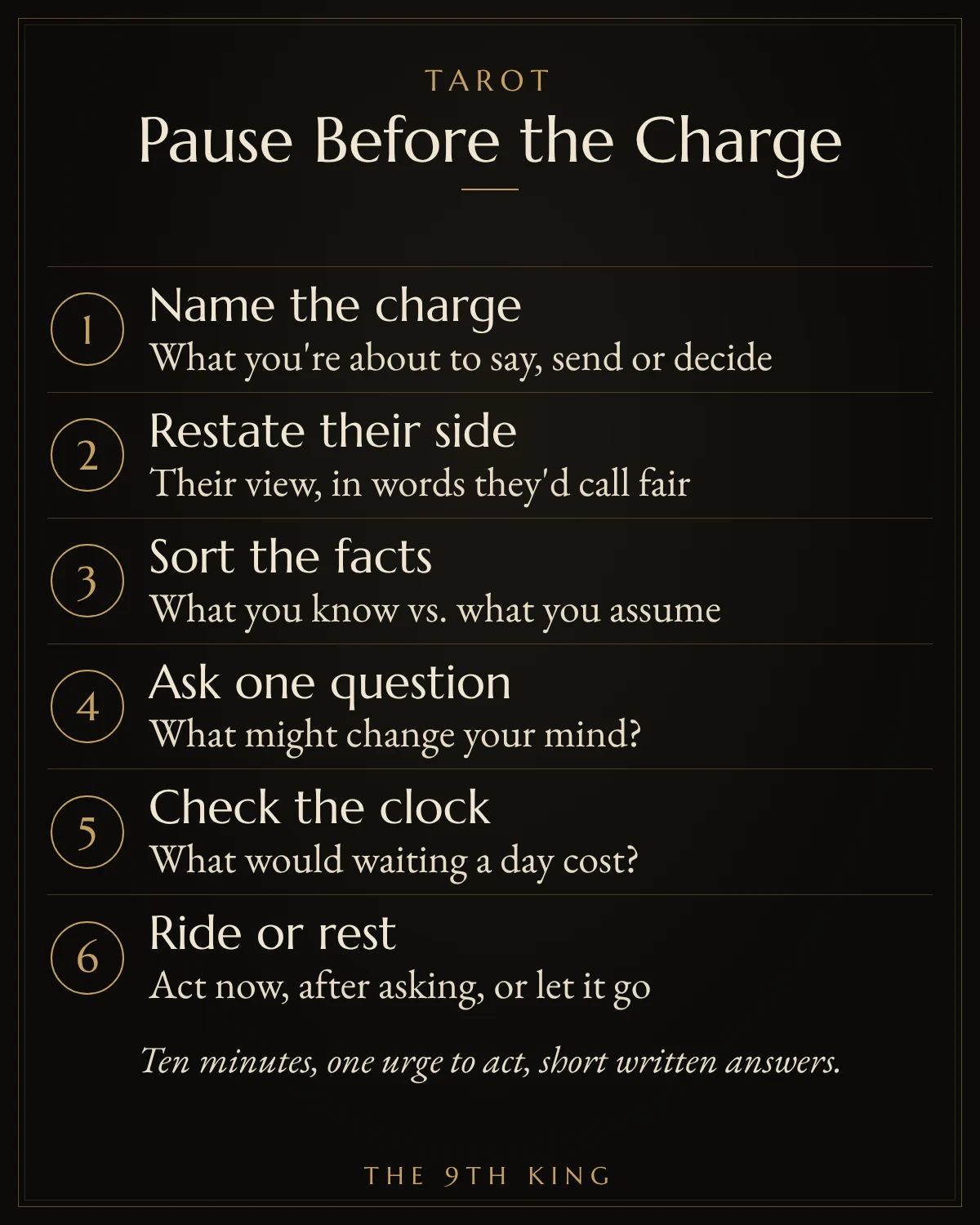
A ten-minute worksheet for any moment you feel the urge to reply, decide or act right now. Write short answers.
- Name the charge. What exactly are you about to say, send or decide?
- Restate their side. Write the other person’s view in words they’d call fair. If you can’t, you haven’t heard it yet.
- Sort the facts. What do you know for sure? What are you assuming?
- Ask one question. What’s the one thing you could ask that might change your mind?
- Check the clock. What would waiting a day actually cost?
- Ride or rest. Act now, act after you ask, or let it go. Then do it cleanly and own the choice.
The point isn’t to be slow. It’s to make speed a choice, not a reflex.
Journal prompts for the Knight of Swords
Take these one or two at a time. For more, try our shadow work prompts, and our zodiac shadow work guide looks at the air signs’ shadows alongside the rest.
- Where in my life have I already decided, and what’s stopping me from acting?
- When did I last answer what I assumed someone meant, instead of what they said?
- Do I argue to understand, or to win? How would the people closest to me answer that?
- What does slowing down feel like in my body, and what am I afraid will happen if I do?
- Whose speed or bluntness bothers me most, and what does that reaction show me?
- What is one thing worth my full speed this week, and one small thing I can let go?
A gentle note: these prompts are for reflection, not therapy. If you’re dealing with trauma, abuse, thoughts of self-harm or distress that feels overwhelming, please work with a qualified therapist. And it’s always fine to stop a prompt that feels like too much and come back another day, or not at all.
New to tarot? Code of Ascension’s Tarot for Beginners (Code of Ascension) covers the basics.

Knight of Swords: FAQ
What does the Knight of Swords mean?
The Knight of Swords is a court card in the air suit of Swords. Upright, readers commonly take it as speed of thought, decisive action, courage and directness. A. E. Waite’s original meanings included skill, bravery, capacity and defense, alongside opposition and conflict. On The 9th King, it’s a mirror for self-knowledge: it honors a fast, clear mind, then asks whether you listened before you charged.
What does the Knight of Swords reversed mean?
Reversed, the Knight of Swords often points to speed without aim: recklessness, scattered energy, steamrolling people or arguing before listening. Waite’s reversed meanings were imprudence, incapacity and extravagance. The card can point to someone else’s rushing, but it can just as easily point to your own. Ask which version honestly fits before deciding what it means, and remember a card can’t establish anyone’s motives.
What does the Knight of Swords mean as feelings?
Upright, readers often take it as intense, direct feelings in a hurry. Reversed, it can suggest strong but reactive feelings, such as frustration, impatience or a need to be right. Tarot can’t read another person’s mind, though. Use the card to examine your own impression, then compare it with what the person actually says and does.
What does the Knight of Swords mean in love?
In love, the upright Knight of Swords can point to directness, honesty and fast-moving pursuit, or your own urge to settle things now. Reversed, it can point to heated arguments, words said too quickly, or someone who rushes in and out. The card doesn’t tell you to speed up, slow down, stay or leave. It asks whether the conversations in your relationship are about understanding each other or about winning.
What element is the Knight of Swords?
Swords is the air suit. In Liber LXXVIII, the Golden Dawn text whose court-card naming The 9th King follows, Knights are fire of their suit, so the Knight of Swords is “fire of air”: thought with enough heat to act (Liber LXXVIII). The same text titles this card “the King of the Spirits of Air,” a reminder that Golden Dawn court names don’t match the familiar ones. Other systems differ.
Which zodiac sign is the Knight of Swords?
No single sign. In Liber LXXVIII, the Golden Dawn text The 9th King follows for court cards, this card rules from 20 degrees of Taurus to 20 degrees of Gemini (Liber LXXVIII). That’s the last decan of Taurus and the first two decans of Gemini. As a Swords card, it also shares the air element with Gemini, Libra and Aquarius. Treat both as reflective links, not labels.
Is the Knight of Swords a good card?
There are no simply good or bad cards on The 9th King. Upright, it can point to courage and clarity. Reversed, it points to the same speed gone off course. Either way, the useful question is the same: is your speed aimed at the right thing, and did you listen before you rode out?

Your next step: the next time you feel the urge to fire off a reply or make a snap call, run the Pause Before the Charge above first. Then look at your own chart: start with How to Read a Birth Chart, and read Gemini Personality Traits if a quick mind runs your show.
Explore Next
- The signs in the Knight’s span: Taurus Personality Traits · Gemini Personality Traits
- The other air signs: Libra Traits · Aquarius Personality Traits
- Go deeper on the shadow: Shadow Work, Plainly · Shadow Work Prompts · Psychological Projection
- More tarot on The 9th King: Tarot Card Meanings · Minor Arcana · Knight of Cups · Knight of Pentacles · Tarot & the Zodiac
- More cards in this set: Ace of Swords · Page of Swords · Queen of Swords · King of Swords · Knight of Wands

Final Thought: Aim Before You Ride
The Knight of Swords rides at full speed with his sword raised, and there’s something admirable in that. His one risk is mistaking speed for being right. Keep the fast mind and the courage, and add the pause where you actually hear the other side. That’s how a charge becomes leadership instead of a pile-up. Know your nature. Rule your life.
About the Author
King is the founder of The 9th King, where zodiac psychology, relationships and shadow work are explored as tools for self-knowledge rather than fortune-telling. He’s a Libra Sun, and writes about the personal side of astrology on King The Kemist. Astrology on The 9th King is interpretation and self-reflection, not prediction or established fact.
Leave a Reply