
Quick Answer: What Does the Knight of Pentacles Mean?
The Knight of Pentacles is a court card in the suit of Pentacles, the suit tarot readers link with the element of earth: the body, work, money, home and the material world.
- Keywords (upright): steady effort, patience, routine, reliability, responsibility, follow-through.
- Keywords (reversed): stagnation, the rut, inertia, overcaution, boredom, grinding without purpose.
- Upright in one line: the card can point to slow, dependable progress, the kind that comes from showing up and doing the next small thing well.
- Reversed in one line: readers often take it as routine that has stopped serving you, either stuck in place or pushing on out of habit.
On The 9th King, tarot is a mirror for self-knowledge, not fortune-telling. The Knight of Pentacles doesn’t say what will happen. It asks a useful question: Is my routine building something, or just keeping me busy?
Table of Contents
The Knight of Pentacles at a glance
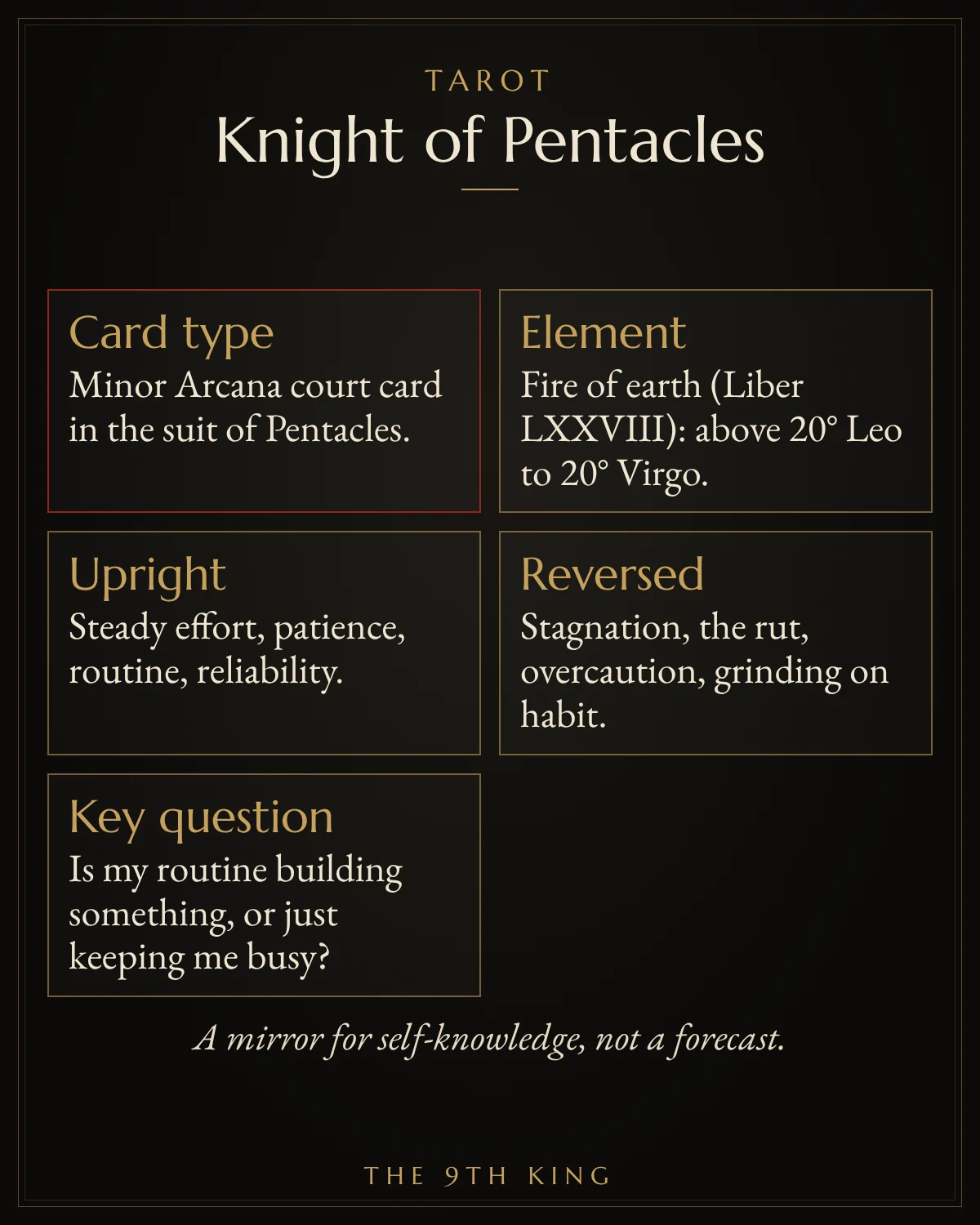
| Knight of Pentacles | |
|---|---|
| Arcana | Minor Arcana, court card |
| Suit | Pentacles (coins in older decks) |
| Element of the suit | Earth |
| Golden Dawn pairing | Fire of earth (Liber LXXVIII) |
| Zodiac span | Above 20° Leo to 20° Virgo |
| Upright themes | Steady effort, routine, reliability |
| Reversed themes | Stagnation, the rut, overcaution |
| Key question | Is my routine building something? |
Tarot meanings are a tradition of interpretation, not a fixed code. The meanings below are the ones commonly used with the Rider–Waite–Smith deck, followed by The 9th King’s own reading. Sources are linked as we go.
What the Knight of Pentacles card shows
The deck most people learn first is the Rider–Waite–Smith tarot, first published by William Rider & Son in London in 1909, designed under the direction of A. E. Waite and illustrated by Pamela Colman Smith (Wikipedia: Rider–Waite Tarot). Its Knight of Pentacles is one of the quietest images in the pack.
The imagery, in words
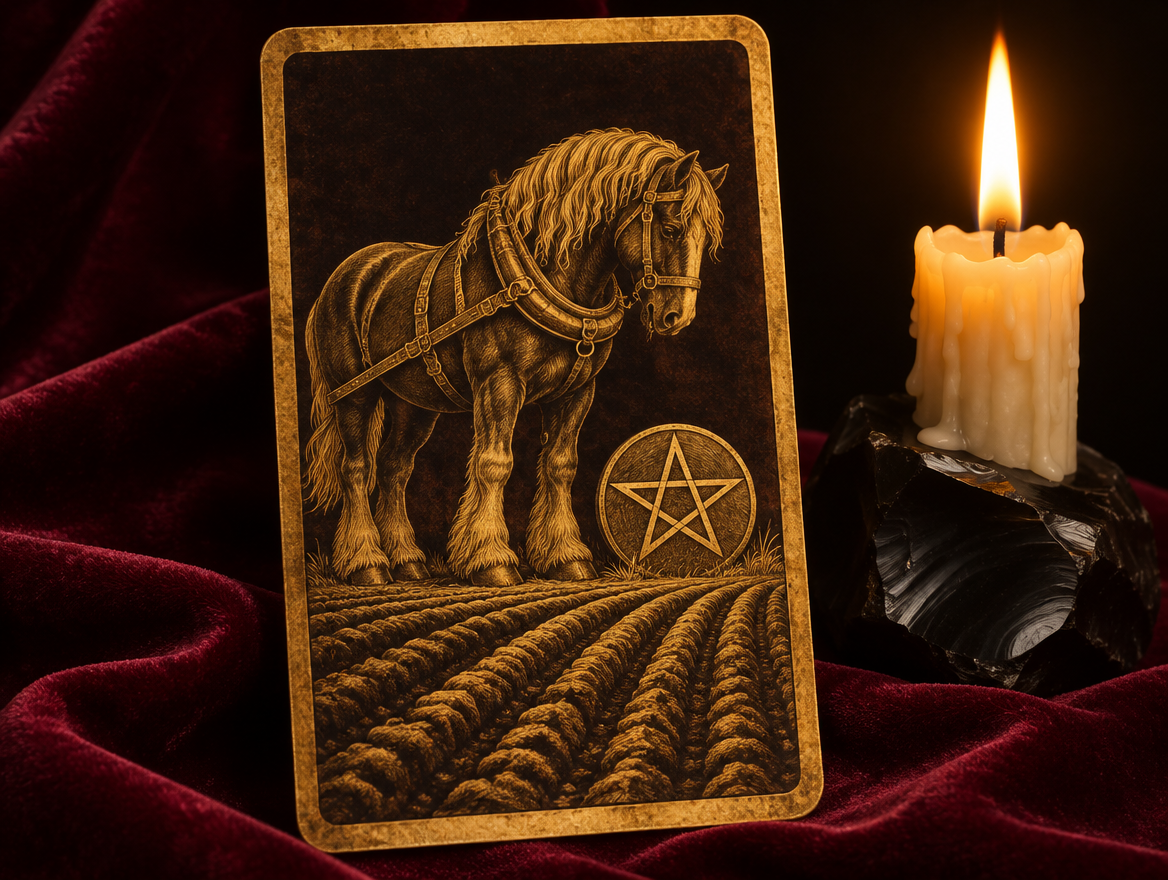
A knight in armor sits on a heavy dark horse that is standing still. Every other knight in the deck is in motion; this one has stopped. He holds a single pentacle, a gold disc marked with a five-pointed star, in front of him. Behind him lies open farmland, plowed and ready for planting. Sprigs of green leaves on his helmet and the horse’s head hint at growth.
In his own guide to the deck, Waite describes the knight this way: “He rides a slow, enduring, heavy horse, to which his own aspect corresponds” (A. E. Waite, The Pictorial Key to the Tarot, 1910/1911, public-domain copy on sacred-texts.com). He adds that the knight shows his pentacle but doesn’t look into it. That detail matters. The knight isn’t staring at the prize. He’s looking at the field in front of him.
The horse standing still is a consistent feature of the card across Latin-suited decks, and modern readers often describe the Knight of Coins as hard-working, serious and set in his ways (Wikipedia: Knight of Coins).
Why Pentacles? Coins, discs and earth
The Pentacles suit wasn’t always called that. Early tarot decks were invented in Italy in the 1430s, and their four ordinary suits included coins; the use of tarot for fortune-telling came much later, in France around 1780 (Britannica: tarot). The Morgan Library’s fifteenth-century Visconti-Sforza cards, one of the most complete early decks to survive, still show the suit as coins (The Morgan Library & Museum).
Waite himself notes, in his King of Pentacles entry, that in many old packs this suit stood for coin and money (Pictorial Key: King of Pentacles). In occult and divinatory use the suit is connected with the classical element of earth (Wikipedia: Suit of coins). That’s why the whole suit deals with practical, physical things: work, health, money, home, skill, time.
What a Knight does in the court
The court cards (Page, Knight, Queen, King) are often read as people, as roles you play, or as stages of maturity. Knights are the movers who carry their suit’s energy into the world. The Knight of Pentacles moves too, just at the speed of a plow.
Knight of Pentacles upright meaning
Waite’s own divinatory meanings for the upright card are short: utility, serviceableness, responsibility and rectitude, all on what he calls the normal, external plane (Pictorial Key). In plain modern terms: being useful, being dependable, doing the right thing in ordinary life.
Most readers today build on that and take the upright Knight of Pentacles as a picture of steady effort. Not talent, not luck, not a breakthrough. Effort that’s repeated until it adds up.
In general
The card can point to a season where the work is the point: training, a degree, a renovation, building a body of work. Nothing about it is dramatic. Progress is measured in sessions, pages, reps and days. The upright card’s quiet message is that this isn’t a lesser form of progress.
As a person
As a person, readers often describe someone methodical, loyal and hard to rattle, who’d rather do it right than fast. They can also be frustratingly cautious, private and slow to change their minds.
At work and with money
At work, the card can point to diligence, reliable process and the long middle of a project: the person who keeps the boring systems running.
With money, the card’s themes are patience and consistency. This is a reflective reading of a symbol, not financial advice; if you’re making real decisions about money, talk to a qualified professional.
Knight of Pentacles in love
In love readings, the upright Knight of Pentacles is about steadiness: the partner who shows love through actions more than speeches, or a relationship that grows slowly on routine and trust rather than fireworks.
The card doesn’t tell you whether to stay, go or commit. What it can do is ask: Do I value consistency, and do I recognize it when I see it? Am I offering it myself?
Knight of Pentacles as feelings
People often ask what the card means “as feelings,” usually about someone else. A card can’t read minds, so treat this as a mirror for your own impression.
Readers commonly take the upright card as feelings that are steady, serious and slow to be spoken: “I’m in this, but I’ll show you rather than tell you.” Check that impression against what the person does, and ask them directly if it matters.
Knight of Pentacles reversed meaning
Waite’s reversed meanings for the card are pointed: inertia, idleness, stagnation, placidity, discouragement and carelessness (Pictorial Key). The horse that stood still with purpose is now just standing still.
Modern readers usually take the Knight of Pentacles reversed in a few directions. Each is the same strength, pushed past its useful limit.
The rut: routine with no direction
The first reversed reading is stagnation. The routine continues, but nothing grows from it, and you’ve stopped asking what it’s for. The field is no longer being planted. It’s just being walked across.
The grind: effort without rest or review
The second is the opposite problem: pushing on out of habit. Overwork, perfectionism, refusing to change a plan that clearly isn’t working because changing it would feel like quitting.
Overcaution
A third reading is fear dressed up as patience: “I’m just waiting for the right time.” Sometimes that’s wisdom; sometimes it’s a way of never starting.
Reversed in love and as feelings
In love, the reversed card can point to a relationship on autopilot, or a conversation that keeps getting postponed. As feelings, readers often take it as stuck or guarded feelings: something is there, but it isn’t moving. The card can’t tell you what someone else feels; it can help you notice what you’d need to ask.
Element and astrology: fire of earth (and a naming trap)
Tarot and astrology have been tied together for well over a century, and The 9th King uses the Golden Dawn–derived correspondences, the tradition that the Rider–Waite–Smith deck draws on. Both Waite and Pamela Colman Smith were members of the Hermetic Order of the Golden Dawn (Wikipedia: Rider–Waite Tarot). Other schools assign things differently, and not every card maps neatly onto a single zodiac sign. Court cards in particular work differently from the numbered cards.
The element pairing
The 9th King follows the court-card naming in Liber LXXVIII (the Golden Dawn’s Book T): Knights are fire of their suit, Queens water, Kings air, Pages earth. Liber LXXVIII lists the Knight of Pentacles as “the King of the Spirits of Earth” and pairs it with fire of earth (Liber LXXVIII).
Fire is drive and will. Earth is matter and patience. Fire of earth is drive harnessed to something real: will expressed as work.
The naming trap
Here’s where it gets confusing. Liber LXXVIII heads this card Knight of Pentacles and also gives it a Golden Dawn title, “King of the Spirits of Earth”; its chariot-riding Princes carry the familiar King titles. Matching those Golden Dawn figures to the Rider–Waite–Smith courts is the convention The 9th King uses, not something the source says about Waite’s deck. Other systems differ: some modern astrologers, for example, read Rider–Waite–Smith Knights as air and give them different zodiac spans (Creekside Astro: court cards and decans).
The zodiac span: Liber LXXVIII says this figure rules from above 20 degrees of Leo to 20 degrees of Virgo (Liber LXXVIII). That’s the last decan of Leo and the first two of Virgo, so it’s a span across two signs, not one sign. It leans into Virgo, the sign of craft and routine, which suits a card about patient work.
Earth signs as element links
Because Pentacles is the earth suit, the card shares an element with the three earth signs of the zodiac. This is an element connection, not a claim that the card “is” any of these signs:
- Taurus: patience, comfort, the long view.
- Virgo: craft, routine, improving the process.
- Capricorn: structure, responsibility, building over time.
If your chart is heavy or light in earth, this is a useful card to sit with; how to read a birth chart shows how to count your elements.
The 9th King reading: patience as power
Here’s where The 9th King’s interpretation goes beyond the standard keywords: the card’s tension, its shadow and its lesson.
The tension: steady vs stuck
From the outside, steady effort and a rut look identical: same time, same place, same actions. The difference is internal: is there a direction, and are you still paying attention? The same still horse can mean “I’m rooted and patient” or “I’ve stopped and called it patience.” Only you can check which.

| Sign | Steady (upright) | Stuck (reversed) |
|---|---|---|
| Direction | You know what it’s building | You’ve forgotten why |
| Attention | You notice small changes | You’re on autopilot |
| Review | You adjust the method | Same method, same results |
| Energy | Tired but satisfied | Drained or numb |
| Change | Open to a better way | Change feels like failure |
The shadow side
Shadow work means looking at the parts of yourself you’d rather not see; Shadow Work, Plainly explains the idea if you’re new to it. The Knight of Pentacles’ shadow is subtle, because it hides behind virtues.
Common Knight of Pentacles shadow patterns:
- Busyness as a shield. Staying occupied so you never have to ask whether you’re on the right road.
- Duty as identity. Being “the reliable one” so completely that you can’t say no, rest, or want something different.
- Control through routine. Keeping every day predictable because uncertainty feels unbearable.
- Contempt for the fast. Quietly judging people who move quickly or take risks, when part of you envies them.
- Waiting as avoidance. Calling it patience when it’s actually fear of being seen to try.
If someone’s recklessness irritates you, ask what you’ve disowned; our guide to psychological projection covers how that works.
The self-mastery lesson
The Knight of Pentacles’ lesson is this: routine is a tool, not a destination. Patience is powerful when it serves a goal you’ve chosen and still believe in. It becomes a trap when it replaces the choosing.
Mastery here doesn’t mean working harder. It means two habits the knight in the picture already models:
- Look at the field, not the coin. Waite’s knight holds his pentacle but doesn’t stare into it. Keep your attention on the work in front of you, not on the reward you’re hoping for.
- Stop the horse on purpose. The horse stands still. Build regular moments where you stop, look around and decide again whether this is still the field you want to plow.
Knight of Pentacles in a reading
The Knight of Pentacles shows up in many kinds of spreads. A few patterns readers commonly notice, framed as questions rather than answers. (The 9th King doesn’t offer yes/no readings: a single card can’t settle a yes-or-no question, and the reflection is more useful anyway.)
By position
- Present situation: you may be in the long middle of something. Does it still fit?
- Obstacle: caution or routine may be slowing you down. Where has “not yet” become “never”?
- Advice: keep going, steadily. What small, repeatable action would help this week?
- Direction: not a prediction. Is steady effort a path you’re willing to walk?
Next to other cards
Next to fast, fiery cards, the Knight can suggest a needed brake. Next to other slow, earthy cards, it can amplify the risk of the rut. Trust your own associations here. Code of Ascension’s Intuitive Tarot (Code of Ascension) covers reading combinations by feel.
A worked example (fictional)
The situation (fictional): Dana has spent two years learning to code in the evenings after work. She’s competent but hasn’t applied for a single developer job. She draws three cards for “Where am I, what’s in the way, what helps?” and gets the Knight of Pentacles in the middle position, reversed.
A reflective reading: the effort is real, and that’s the upright card’s gift. But reversed, in the “obstacle” position, the knight asks whether the routine has become a safe place to hide. Studying feels productive. Applying feels exposed.
The useful question: What would I do this month if I believed the practice had already worked?
What Dana does with it: she swaps one study evening a week for applications. The reading predicted nothing; it helped her see the pattern.
Myths and misreadings
- “The Knight of Pentacles is boring.” It’s quiet, not empty.
- “It means things will be slow.” The card doesn’t predict timing. Readers take it as a reflection on pace, not a forecast of one.
- “It’s a money card, so it means money is coming.” Pentacles is the earth suit, and earth covers money, but also the body, home, skill and work. And no card predicts income.
- “Reversed means you’re lazy.” Waite lists idleness among the reversed meanings, but the reversed card can just as easily point to overwork or perfectionism. Read your own situation honestly.
- “It’s always a man.” Court cards can stand for anyone, or a role you’re playing.
- “The astrology is settled.” Only within one system. This page uses Liber LXXVIII: fire of earth, from late Leo to 20 degrees of Virgo, and no single sign.
Practical exercise: the Rut Audit
A ten-minute worksheet for any routine you suspect is drifting from steady into stuck: a work routine, a training plan, a habit in a relationship. Write short answers.
- Name the routine. What exactly do you do, and how often?
- Name the field. What is this routine supposed to be building? Be specific. “Fitness” is vague; “running 5K without stopping” is a field.
- Check the coin. What reward are you hoping for? Is your attention on the work or on the reward?
- Look for growth. What has changed, even slightly, in the last month because of this routine? And after you do it, do you feel tired but satisfied, or drained and numb? If nothing has changed, write that down without judgment.
- One adjustment. What single change to the method would you try for the next two weeks? Not a new routine. One tweak.
- Stop the horse. Put a date on your calendar two weeks from now to come back to this page and decide again.
If step 4 comes back flat on both counts, no growth and no satisfaction, that’s information, not a verdict. Sometimes a routine needs a tweak; sometimes it has done its job.

Journal prompts for the Knight of Pentacles
Work through these slowly, one or two at a time. They’re designed for self-reflection. If you want more, our shadow work prompts go deeper, and our zodiac shadow work guide looks at the earth signs’ shadows alongside the rest.
- Where in my life am I being patient, and where am I just waiting?
- What routine am I proudest of, and what has it actually built?
- When did “reliable” become part of who I am, and what does it cost me?
- What would I try if I weren’t afraid of looking reckless?
- Whose speed irritates me, and what might that say about what I want?
- What is one field I’m plowing out of habit rather than choice?
A gentle note: these prompts are for reflection, not therapy. If you’re dealing with trauma, abuse, thoughts of self-harm or distress that feels overwhelming, please work with a qualified therapist. And it’s always fine to stop a prompt that feels like too much and come back another day, or not at all.
If you’re new to tarot altogether, Code of Ascension’s Tarot for Beginners (Code of Ascension) explains the basics of how a deck is structured and read.

Knight of Pentacles: FAQ
What does the Knight of Pentacles mean?
The Knight of Pentacles is a court card in the earth suit of Pentacles. Upright, readers commonly take it as steady effort, patience, routine and reliability. A. E. Waite’s original meanings included usefulness, responsibility and rectitude. On The 9th King, it’s a mirror for self-knowledge, asking whether your routine is building something you still want.
What does the Knight of Pentacles reversed mean?
Reversed, the Knight of Pentacles often points to routine that has stopped serving you. That can look like stagnation and inertia, the meanings Waite listed, or the opposite problem: overwork, perfectionism and refusing to change a plan that isn’t working. Overcaution, calling fear “patience,” is another common reading. Ask yourself which version fits your situation, rather than assuming laziness.
What does the Knight of Pentacles mean as feelings?
Upright, readers often take it as feelings that are steady, serious and slow to be spoken: someone who shows care through actions more than words. Reversed, it can suggest guarded or stuck feelings. Tarot can’t read another person’s mind, though. Use the card to examine your own impression, then check it against what the person actually does and says, and ask them directly if it matters.
What does the Knight of Pentacles mean in love?
In love, the upright Knight of Pentacles is about steadiness: a partner who is consistent and dependable, or a relationship that grows slowly on trust and routine. Reversed, it can point to autopilot, where reliability remains but curiosity has faded, or a conversation that keeps getting postponed. The card doesn’t tell you whether to stay, leave or commit. It asks what consistency means to you.
What element is the Knight of Pentacles?
Pentacles is the earth suit. In Liber LXXVIII, the Golden Dawn text whose court-card naming The 9th King follows, Knights are fire of their suit, so the Knight of Pentacles is “fire of earth”: drive harnessed to practical work (Liber LXXVIII). Liber LXXVIII titles this card “the King of the Spirits of Earth,” a reminder that Golden Dawn court names don’t match the familiar ones.
Which zodiac sign is the Knight of Pentacles?
No single sign. In Liber LXXVIII, the Golden Dawn text The 9th King follows for court cards, this card rules from above 20 degrees of Leo to 20 degrees of Virgo (Liber LXXVIII). That’s a span across late Leo and most of Virgo. As a Pentacles card it also shares the earth element with Taurus, Virgo and Capricorn. Treat both as reflective links, not labels.
Why is the Knight of Pentacles’ horse standing still?
In the Rider–Waite–Smith image, every other knight’s horse is moving; this one stands still, and Waite says the rider’s bearing matches his patient mount. Readers often take the stillness as patience and groundedness. The 9th King also reads it as a reminder to stop on purpose now and then and decide whether you’re still plowing the field you chose.

Your next step: pick one routine in your life and run the Rut Audit above this week. Then look at the earth in your own chart: start with How to Read a Birth Chart, and read the Capricorn guide if structure and long-term building are your themes.
Explore Next
- The earth signs, for the Knight’s element: Taurus Personality Traits · Virgo Personality Traits · Capricorn Personality Traits
- All twelve signs in one place: The Zodiac Signs
- Go deeper on the shadow: Shadow Work, Plainly · Shadow Work Prompts
- More tarot on The 9th King: Tarot Card Meanings · Minor Arcana · Page of Pentacles · Tarot & the Zodiac · Three-Card Tarot Spread · Shadow Work Tarot Spread
- Another knight, in water: Knight of Cups
Final Thought: Plow, Then Look Up
The Knight of Pentacles isn’t the hero who charges in. He’s the one who’s still there next season, and the season after that. His power is ordinary: show up, do the work, keep your eyes on the field. His one risk is forgetting to stop the horse and ask whether this is still the field you want. Do both, and patience becomes one of the strongest things you own. Know your nature. Rule your life.
About the Author
King is the founder of The 9th King, where zodiac psychology, relationships and shadow work are explored as tools for self-knowledge rather than fortune-telling. He’s a Libra Sun, and writes about the personal side of astrology on King The Kemist. Astrology on The 9th King is interpretation and self-reflection, not prediction or established fact.
Leave a Reply