Quick Answer: How to Read a Birth Chart
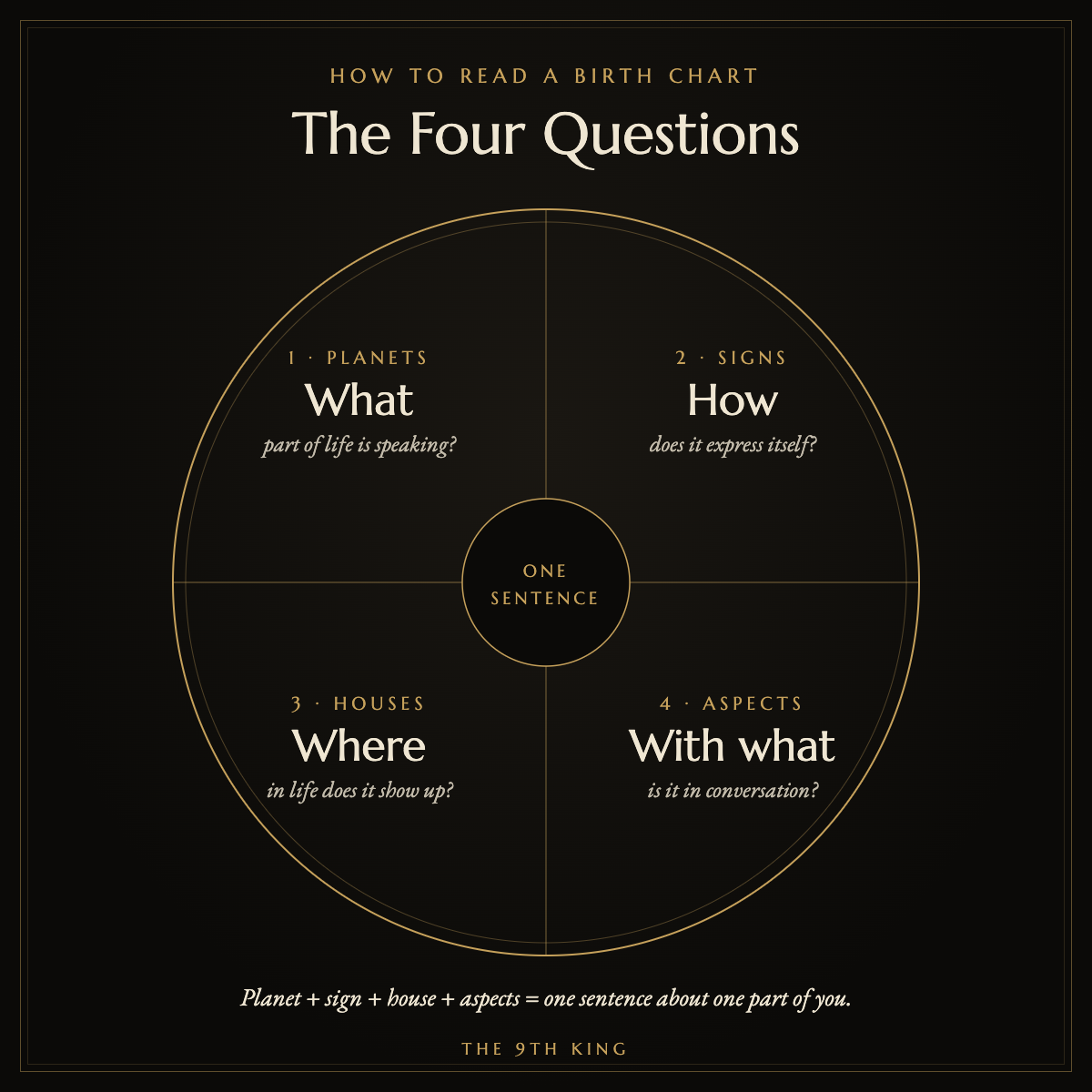
A birth chart is a map of where the Sun, Moon and planets appeared, from your birthplace, at the moment you were born. To read one, ask four questions in order:
- Planets: what part of life is speaking? (The Moon is your needs; Venus is affection.)
- Signs: how does it express itself? (A Moon in Cancer protects; a Moon in Aries acts.)
- Houses: where in life does it show up? (A planet in the 7th house shows up in partnerships.)
- Aspects: in conversation with what? (A square to Saturn adds pressure; a trine adds ease.)
Planet + sign + house + aspects = one sentence about one part of you. A whole chart is just a paragraph made of those sentences.
Table of Contents
Decoding the symbols on the wheel
The first time you open a chart, the glyphs are the hardest part. You don’t need to memorise them all at once. Most chart calculators let you hover over or tap any symbol to see its name, and many offer a table view that lists every placement in plain text. Start with the table. Learn the glyphs for the Sun (a circle with a dot), the Moon (a crescent) and the sign symbols of your own Big Three, and the rest will come with use.
Each placement also has a number, such as “14° Libra 22′”. That’s the planet’s exact position inside the sign: 14 degrees and 22 minutes into Libra. You’ll only need those numbers when you start checking how tight an aspect is.
What you need before you start
You need three things: your birth date, your birth time (as exact as you can get it) and your birthplace. Any reputable chart calculator will draw the wheel from those.
Birth time matters more than people expect. The Rising sign and the houses shift quickly — the Rising sign changes roughly every two hours — so a guessed time can move a planet into a different house. If you don’t know your time, you can still read the planets in their signs and the aspects between most of them. The section on reading a chart without a birth time, further down, explains what still works.
If you’re brand new, start with your Sun, Moon and Rising. Code of Ascension’s Big Three guide is a good doorway; this article picks up where it leaves off.
What a birth chart actually is
A birth chart, also called a natal chart or horoscope, is a diagram of the sky drawn from one place at one moment. Imagine standing where you were born, at the minute you were born, and looking up. Then imagine the band of sky the Sun, Moon and planets travel along, called the ecliptic, laid flat in a circle around you. That circle is the chart.
The circle is divided twice:
- Into twelve signs. In Western tropical astrology, the zodiac signs are fixed 30-degree slices of that band, counted from the point where the Sun sits at the spring equinox. They’re seasonal markers, not the constellations behind them, which is why the signs and the visible star patterns no longer line up exactly.
- Into twelve houses. These are based on the Earth’s daily rotation, so they depend on your exact time and place. The signs tell you how the sky was arranged; the houses tell you where it was sitting relative to your horizon.
The planets are then dropped into that double circle at the positions they held at your birth. Lines drawn between them show the angles, called aspects, that astrologers read as relationships.
A very short history
The kind of chart most people use today descends from Hellenistic astrology, which took shape in the Greek-speaking Mediterranean, especially Ptolemaic Egypt, in roughly the last two centuries BCE. It combined Babylonian sky-watching and its omen tradition, Egyptian ideas about time and the decans, and Greek geometry and philosophy. The astronomer Claudius Ptolemy summarised much of it in the Tetrabiblos in the second century CE.
Those are historical facts about where the practice came from. They aren’t evidence that the practice works. The 9th King treats astrology the way you’d treat any old symbolic language: something worth learning to read, and something to test against your own life rather than accept on authority.
The four angles
Four points on the wheel matter so much that they get their own name: the angles.
- Ascendant (AC), or Rising sign: the eastern horizon, where the sky was rising. It begins the 1st house and is read as how you meet the world and first impressions. Code of Ascension’s Rising Sign Meaning covers it in depth.
- Descendant (DC): directly opposite, the western horizon. It begins the 7th house and is read as what you seek and project onto partners.
- Midheaven (MC): the highest point of the ecliptic, near the top of the chart. It’s read as career, reputation and public direction.
- Imum Coeli (IC): opposite the Midheaven, at the bottom. It’s read as roots, home and private foundations.
If you remember nothing else about the wheel, remember this: the left side is the horizon you were born facing, the top is the most public part of the sky, and the bottom is the most private.
The Four Layers of a Birth Chart
1. Planets: what
Each planet stands for a part of life — a drive, a need or a function. In the astrological reading:
- Sun: identity, direction, what you’re growing toward
- Moon: emotional needs and what makes you feel safe
- Mercury: thinking, speaking, learning
- Venus: affection, values, what you find beautiful
- Mars: drive, desire, how you go after things and how you fight
- Jupiter: growth, faith, where you expand
- Saturn: structure, responsibility, where you meet limits and earn mastery
- Uranus, Neptune, Pluto: the slower “outer” planets, read as change, imagination and transformation — often shared by everyone born in the same few years
2. Signs: how
The sign a planet occupies describes its style. Two useful shortcuts sit under the twelve signs:
- Elements describe temperament: fire (Aries, Leo, Sagittarius) acts, earth (Taurus, Virgo, Capricorn) builds, air (Gemini, Libra, Aquarius) connects ideas, water (Cancer, Scorpio, Pisces) feels.
- Modalities describe how you meet change: cardinal signs start things, fixed signs sustain them, mutable signs adapt.
So “Mars in Taurus” reads as drive (Mars) expressed in a steady, earthy, fixed way: slow to start, very hard to stop.
3. Houses: where
The chart wheel is divided into twelve houses, each an area of life. The 1st house begins at your Rising sign, and the houses run counter-clockwise from there.
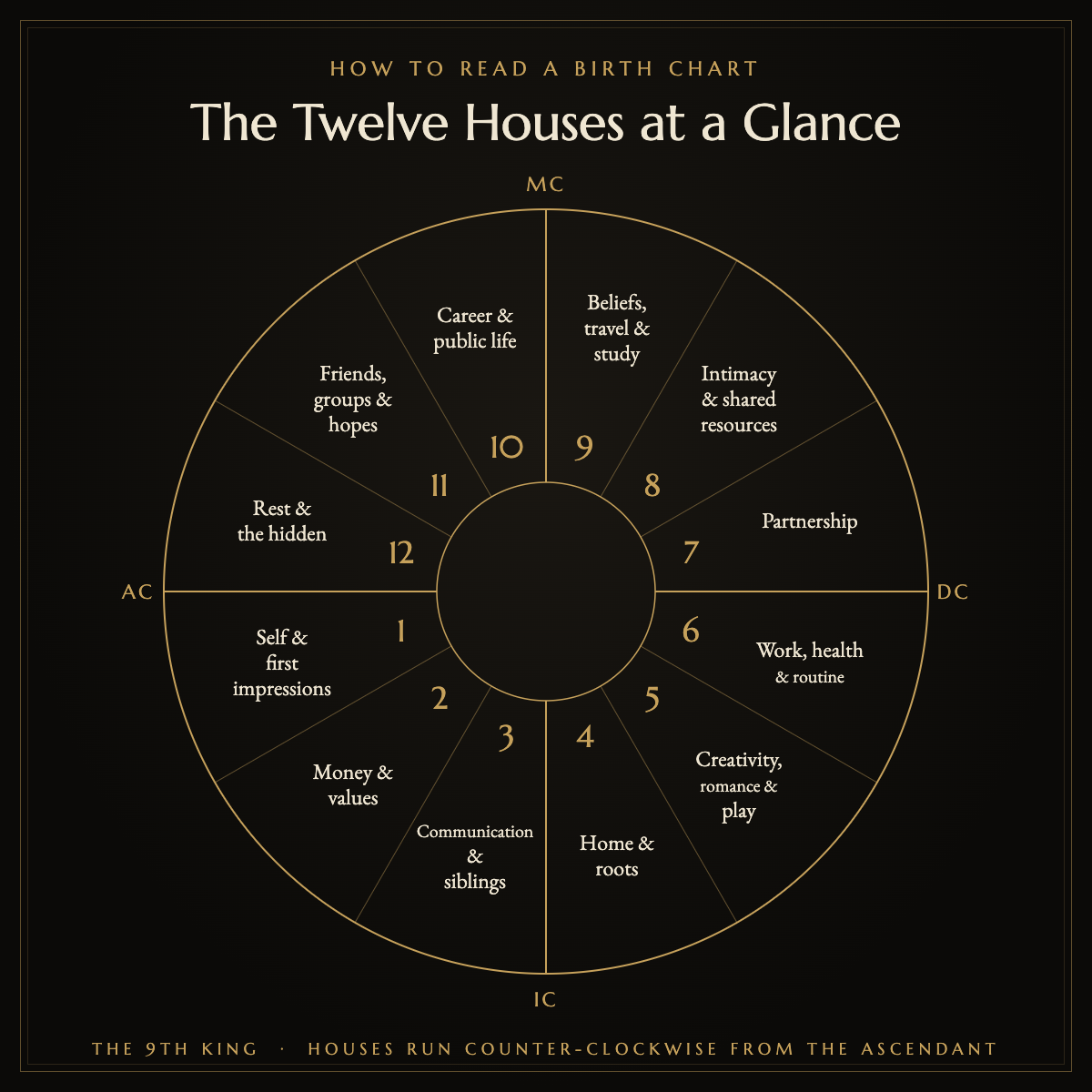
Different calculators use different house systems (Placidus and Whole Sign are the most common). That’s why two apps can put the same planet in different houses. Neither is “wrong”; pick one system and stay consistent.
4. Aspects: in conversation with what
Aspects are the angles between planets. Astrologers read them as relationships: some placements support each other, some challenge each other.
- Conjunction (0°): blended; the two act as one
- Sextile (60°): an opportunity that responds to effort
- Square (90°): friction that pushes growth
- Trine (120°): natural ease and flow
- Opposition (180°): a pull between two sides that asks for balance
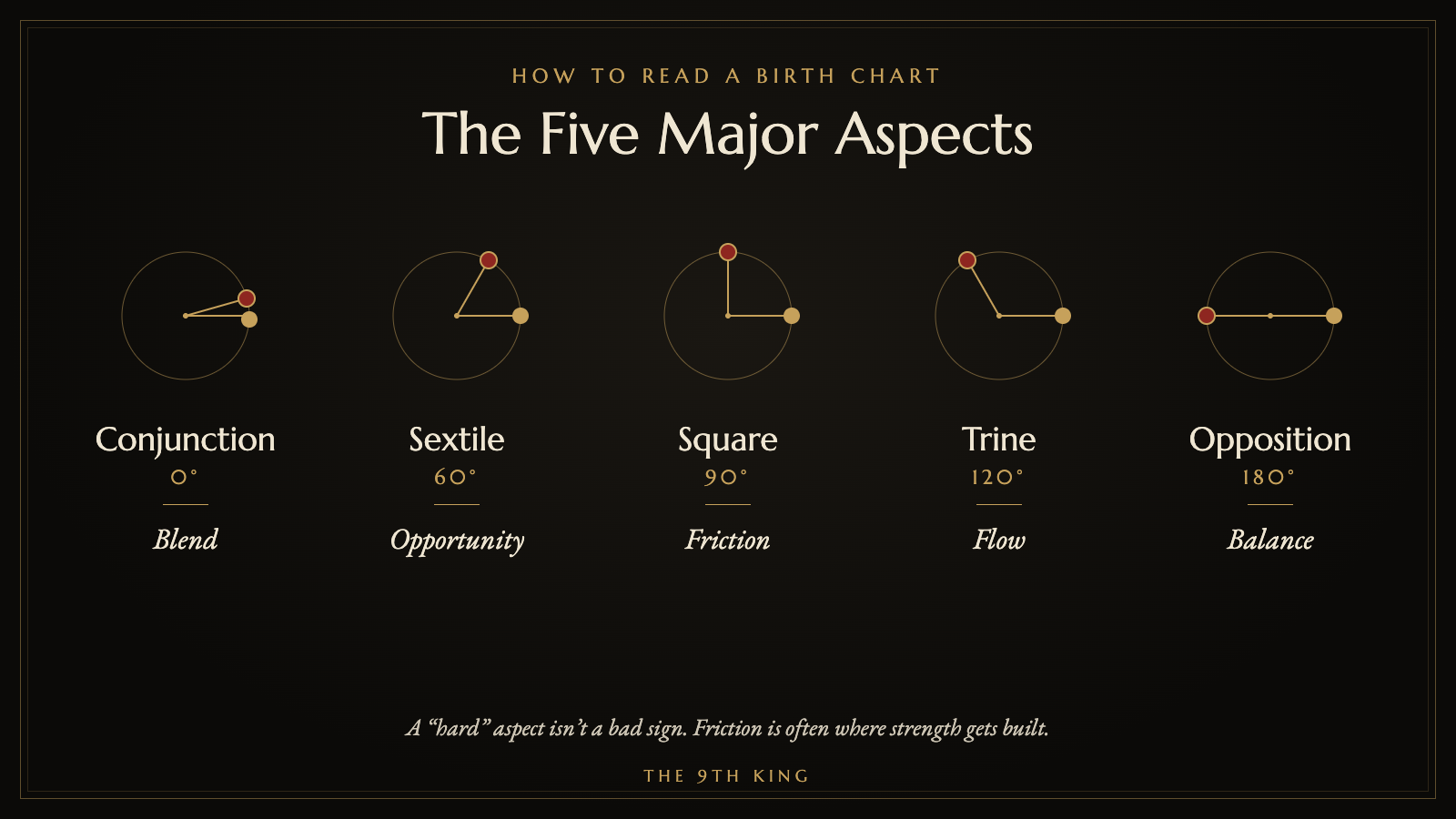
A “hard” aspect isn’t a bad sign. Squares and oppositions are often where people build their most useful strengths.
Reading one placement: the sentence method
Put the four layers together into one sentence:
[Planet] in [sign] in the [house] house, [aspect] [other planet].
“What, expressed how, showing up where, in conversation with what.”
Then translate it into ordinary language, and test it against your real life. The chart offers the symbol; your experience supplies the evidence.
How to Read a Birth Chart in Seven Steps
Once you can read one sentence, you need an order to read them in, or the chart turns into noise. Here’s a seven-step order that works for beginners. It isn’t the only correct order; it’s a practical one.
- Big Three first. Write the sentence for your Sun, Moon and Rising. If you’re new, the Big Three guide walks you through this step.
- Find your chart ruler. Look at your Rising sign and find its traditional ruling planet (see below). Write that planet’s sentence next. It’s often read as the “captain” of the chart.
- Count the elements and modalities. Tally how many planets you have in fire, earth, air and water, and in cardinal, fixed and mutable signs. A heavy lean, or a missing element, says a lot about overall temperament.
- Look for clusters. Three or more planets in one sign or one house is called a stellium. It marks an area of concentrated focus.
- Read the personal planets. Mercury, Venus and Mars describe how you think, love and act day to day.
- Read the social and outer planets lightly. Jupiter and Saturn move slower; Uranus, Neptune and Pluto are shared across whole generations. Their house placement is usually more personal than their sign.
- Finish with the tightest aspects. Aspects that are close to exact, within two or three degrees, tend to be the loudest themes. Start with those rather than trying to read every line.
Chart rulers, quickly
Each sign has a traditional ruling planet:
- Aries — Mars
- Taurus — Venus
- Gemini — Mercury
- Cancer — Moon
- Leo — Sun
- Virgo — Mercury
- Libra — Venus
- Scorpio — Mars (modern astrologers add Pluto)
- Sagittarius — Jupiter
- Capricorn — Saturn
- Aquarius — Saturn (modern: Uranus)
- Pisces — Jupiter (modern: Neptune)
If you’re a Libra Rising, Venus is your chart ruler, and wherever Venus sits in your chart is read as a key to how your whole chart “drives.”
Retrograde planets
Some placements will have a small “R” beside them. That means the planet was retrograde: from Earth’s point of view it appeared to move backward against the stars. It’s an optical effect of the orbits, not real backward motion. Astrologers usually read a natal retrograde as a function that works more inwardly or that you revisit over time. It isn’t a curse. For the transiting version, Code of Ascension’s Mercury retrograde guide is the place to start.
Empty houses
Most people have several houses with no planets in them. That doesn’t mean that area of life is missing. Look at the sign on the cusp, the edge where the house begins, and where that sign’s ruling planet sits. That planet tells the story of the empty house.
A worked example (fictional chart)
Take Moon in Scorpio in the 7th house, square Mars in Leo.
- What: the Moon, emotional needs.
- How: Scorpio, deep, private, all-or-nothing.
- Where: the 7th house, partnerships.
- In conversation with: a square to Mars in Leo, a proud, expressive drive that rubs against that privacy.
Plain-language reading: “I need deep, loyal closeness in partnership, but when I feel hurt, my pride wants to make a scene while my heart wants to go quiet. Learning to say ‘I’m hurt’ plainly may be my real work.”
That’s not a prediction. It’s a hypothesis you can check. If it rings true, it’s useful. If it doesn’t, move on.
A second worked example: putting several sentences together
Here is a fictional set of sign placements for practising synthesis. This is not a calculated birth chart: no birth data, house system or degrees are supplied, so we will leave houses and exact aspects out.
The chart: Sun in Capricorn. Moon in Pisces. Virgo Rising. Mercury in Capricorn. Venus in Aquarius. Mars in Gemini. Saturn in Capricorn.
- Big Three: “I’m growing toward responsibility and achievement (Capricorn Sun). I need imagination, compassion and emotional space to feel safe (Pisces Moon). I meet the world as careful, useful and observant (Virgo Rising).”
- Chart ruler: Virgo is ruled by Mercury, and Mercury is in Capricorn. The symbolic “captain” is a practical, strategic mind. Its house and aspects would need a calculated chart.
- Elements: a strong lean toward earth (Capricorn, Virgo), one strong water placement (the Moon) and a little air. Possibly very grounded, sometimes at the cost of play.
- Stellium: Sun, Mercury and Saturn are all in Capricorn: a sign-based concentration associated with structure, duty and persistence. Their degrees would tell us whether they form close conjunctions.
- Personal planets: Venus in Aquarius wants friendship-style, unconventional romance and room to breathe. Mars in Gemini acts through ideas, debate and learning.
- Check aspects last: Aquarius and Gemini are both air signs and are trine by sign, not opposite. We cannot claim a degree-based Venus–Mars trine without their exact positions and a chosen orb. For now, compare their themes without assigning an exact aspect.
Plain-language summary: “A serious, capable person who may run on duty and quietly need much more rest and softness than they show. In love they want a friend and an equal, and they’ll need partners who can keep up in conversation without making them feel caged.”
Again, that’s a set of hypotheses. The value is in the questions it raises: Do I let myself rest? Do I confuse being needed with being loved?
How to Read a Birth Chart Without a Birth Time
If your birth time is unknown, you can still do a lot.
- Planets in signs are reliable for almost everyone. The Moon is the exception, because it changes sign every two to two-and-a-half days; if it was near a sign boundary on your birth date, it could be in one of two signs.
- Aspects between the planets are mostly usable, though the Moon’s aspects may be a few degrees off.
- Houses and angles aren’t usable without a time. Avoid reading them.
Many astrologers use a solar chart in this situation, putting the Sun’s sign on the 1st house so that houses can be used symbolically. It’s a workaround, not a substitute.
Reading two charts together
Relationship astrology compares two charts. The simplest starting point is to compare the two Moons, what each person needs, and the two Venus placements, how each shows affection. For broad sign pairings, Code of Ascension’s zodiac compatibility chart is the reference; for deeper chart-to-chart comparison, read Synastry for Beginners.
Using Your Birth Chart in Love, Work and Shadow Work
Once you can read the sentences, you can point them at the parts of life you actually care about.
In love and relationships, start with the Moon (what you need on a hard day), Venus (how you give and receive affection), Mars (desire and how you handle conflict) and the 7th house (what you look for in a partner). If your Moon wants reassurance and your Venus wants freedom, you may send mixed signals without meaning to. Naming that is half the work.
In work and money, look at the Midheaven and 10th house (public direction), the 6th house (daily work and routine), the 2nd house (earning and values) and Saturn (where you build mastery slowly). A chart won’t tell you which job to take. It can help you notice whether you’re choosing work that fits how you’re wired, or work that fits what you were told to want.
In shadow work, look at your squares and oppositions, at Saturn and Pluto, and at the 12th house. Astrologers traditionally read these as places of pressure, fear and hidden material. Used carefully, they make good journal prompts: Where do I over-control? What do I hide even from myself? Code of Ascension’s shadow work guide covers the practice in general; The 9th King’s own Zodiac Shadow Work guide goes deeper.

Common Mistakes When Reading a Birth Chart
- Reading one placement as the whole person. A chart is many sentences; no single line tells the full story.
- Treating hard aspects as doom. Friction is where growth happens.
- Mixing house systems between apps and then wondering why they disagree.
- Using the chart as an excuse. “I’m a Mars in Aries” explains a style, not a behaviour you’re excused from.
- Reading every aspect at once. Start with the tightest few. A chart with fifty lines read all at once tells you nothing.
- Confusing signs with constellations. Tropical signs are seasonal slices of the sky, not the star patterns. That’s also why you’ll see claims about a “13th sign”. Ophiuchus is a real constellation the Sun passes through, but it isn’t part of the twelve-sign tropical system.
- Forgetting the person. The chart is a mirror held up to a life, not a replacement for one. Upbringing, culture, choices and circumstances shape who someone is far more visibly than any placement.
Four journal prompts
- Pick your Moon placement and write the sentence. Where did it show up this week?
- Find your chart ruler. Write its sentence. Does it sound like how you actually move through life?
- Find one square in your chart. What strength might it be pushing you to build?
- Which house has the most planets? Is that the area of life you think about most?
How to Read a Birth Chart: FAQ
Do I need my exact birth time?
For the Rising sign and houses, yes, as close as possible. Without it you can still read planets in signs and most aspects.
Why do two astrology apps show different charts?
Usually different house systems, a different time zone setting, or a typo in the birth time.
What’s the most important part of a chart?
There isn’t one. Many astrologers start with the Sun, Moon and Rising, then the chart ruler, then any planets that make many aspects.
What does it mean if I have a lot of planets in one house?
That’s a stellium. It’s read as a concentrated focus on that area of life. Look at which planets are involved to see what kind of focus.
What is a chart ruler?
The ruling planet of your Rising sign. Its sign and house are read as a key to how the whole chart operates.
Can my chart change?
Your birth chart doesn’t change. The sky keeps moving, though, and astrologers read those moving positions, called transits, against your birth chart. That will be its own guide on The 9th King.
How long does it take to learn to read a birth chart?
Most people can read their Big Three and a few personal planets within a week or two of practice. Reading whole charts fluently takes much longer, and that’s part of the pleasure.
Should I trust an app’s automatic interpretation?
Use it as a starting point. App text is written to fit everyone with that placement, so it can’t account for the rest of your chart or your life. The sentence method helps you read in context.
Is astrology scientifically proven?
No. Controlled studies haven’t shown that birth charts predict personality. On The 9th King, astrology is a symbolic language for self-reflection, not established science.
Explore Next
- Start with the foundations: Sun, Moon and Rising: your Big Three (Code of Ascension)
- Go deeper on your doorway sign: Rising Sign Meaning (Code of Ascension)
- Your emotional needs: Moon Sign Meaning
- Where it all happens: The 12 Houses Explained
- How the planets talk: Astrology Aspects Explained
- Comparing two charts: Synastry for Beginners
- The map and the weather: Natal Chart vs. Transits
- Coming soon on The 9th King: Don’t Know Your Birth Time?
- Going deeper on the history: Ptolemy, Tetrabiblos (2nd century CE); Chris Brennan, Hellenistic Astrology: The Study of Fate and Fortune (2017)
Final Thought: A Chart Is a Question, Not a Verdict
A birth chart doesn’t tell you who you have to be. At its best, it gives you sharper questions about who you already are and what you keep repeating. Read it one sentence at a time, test every line against your real life, and keep only what helps you see more clearly. Know your nature. Then decide what to do with it.

About the Author
King is the founder of The 9th King, where zodiac psychology, relationships and shadow work are explored as tools for self-knowledge rather than fortune-telling. Astrology on The 9th King is interpretation and self-reflection, not prediction or established fact.