
Quick Answer: What Does the Temperance Tarot Card Mean?
Temperance is card XIV (14) of the Major Arcana. On the traditional Rider–Waite–Smith card, a winged angel pours liquid from one cup into another, with one foot on land and one in water, while a path climbs toward a light on the horizon. It’s the card of blending: two different things, mixed slowly, until they work as one.
Keywords: balance, blending, patience, pacing, moderation, integration, the middle path.
- Upright, in one line: the card can point to steady, patient balance, where you combine opposites at a pace you can actually keep.
- Reversed, in one line: readers often take it as balance that has tipped: all-or-nothing swings, rushing, or “moderation” used as a way to avoid choosing.
- Astrology link: in the Golden Dawn–derived correspondences The 9th King uses, Temperance is paired with Sagittarius and the Hebrew letter Samekh.
On The 9th King, tarot is a mirror for self-knowledge, not fortune-telling. Temperance doesn’t promise that things will even out. It asks a slower, harder question: what am I trying to blend, and am I giving it enough time to mix?
Table of Contents

Temperance tarot card at a glance
| Temperance | |
|---|---|
| Number | XIV (14), Major Arcana |
| Core theme | Blending opposites, slowly |
| Upright | Balance, patience, pacing |
| Reversed | Swings, rushing, avoidance |
| Correspondence (Golden Dawn–derived) | Sagittarius |
| Hebrew letter (Liber LXXVIII) | Samekh |
| Golden Dawn title | The Daughter of the Reconcilers: the Bringer-Forth of life |
| 9K tension | The middle path vs the hiding place |
| Key question | What am I blending, and how fast? |
What’s on the card: Temperance tarot symbolism, piece by piece
Most modern decks follow the Rider–Waite–Smith design, illustrated by Pamela Colman Smith and first published by William Rider & Son in December 1909 (Wikipedia: Rider–Waite Tarot). A. E. Waite explained each trump in The Pictorial Key to the Tarot, now in the public domain. His Temperance entry is short and worth reading closely (sacred-texts.com: Waite, Temperance).
The winged angel
Waite describes a winged angel and adds something many readers miss: he uses the masculine pronoun for convenience, but says the figure is neither male nor female. Temperance isn’t one side of a pair. It holds both.
The angel comes from religious art, and you don’t need to share any faith to read it. On The 9th King we treat the figure as Waite frames it: a symbol of something in your own consciousness that combines and harmonizes.
The two cups
The angel pours what Waite calls the essences of life from one chalice into the other. This is the heart of the card: two vessels, one flow, a slow exchange that leaves neither cup the same.
One foot on earth, one in water
Waite notes that the angel stands with one foot on the earth and one upon the waters, illustrating the nature of the essences. Readers often take it as living in two worlds at once: the practical and the emotional. Temperance doesn’t choose one ground. It keeps weight on both.
The sun sign and the square and triangle
Waite describes the sign of the sun on the angel’s forehead and, on the breast, a square with a triangle, which he calls the square and triangle of the septenary (a septenary is a group of seven, and a square and triangle together give four plus three). He adds that the figure is an analogy of solar light, not a sun spirit (sacred-texts.com: Waite, Temperance).
The path, the light and the crown
Behind the angel, Waite writes, a direct path goes up to heights at the edge of the horizon. Above it is a great light, and through that light a crown is seen, faintly. The path promises direction, not speed. You can see where it goes, but not the whole crown yet. That’s how most real growth feels from the inside.
The irises
On the 1909 Smith card, flowers grow near the water’s edge, and they are usually identified as irises (Wikipedia: Temperance (tarot card)). Waite’s text doesn’t mention them, so treat any meaning you give them as your own reading.
What older decks showed instead
Waite records that older versions of the card showed a winged female figure pouring liquid from one pitcher to another, and that Papus, in his last work on tarot, drew a woman in an Egyptian headdress instead (sacred-texts.com: Waite, Part I, The Trumps Major). Pouring one liquid into another was a standard picture of the virtue of temperance, and in the oldest Italian decks the card was numbered VI or VII rather than XIV. The Thoth deck renames it Art (Wikipedia: Temperance (tarot card)).
One of the virtue cards
Temperance is one of the four classical cardinal virtues, alongside prudence, justice and fortitude, a list that goes back to Plato’s Republic (Wikipedia: Cardinal virtues). Three of them have their own trumps: Justice, Strength (which Waite’s book titles Strength, or Fortitude) and Temperance (sacred-texts.com: Waite, Pictorial Key chapter list). In that old sense, temperance means right measure, not denial.

Temperance tarot meaning: upright and reversed
Temperance upright
Common upright themes:
- Balance: not a perfect 50/50, but a mix that works for this moment.
- Blending: bringing two sides of a situation, or of yourself, into one workable whole.
- Patience: letting something develop instead of forcing it.
- Pacing: a rhythm you can sustain, rather than bursts followed by crashes.
- Integration: a hard lesson becoming part of how you live.
Temperance reversed
Reversed, readers tend to go one of three ways, and your situation usually tells you which fits:
- The balance has tipped. Life is running in all-or-nothing swings: everything at once, then burnout, then nothing.
- The pour is rushed. You want the result without the time it takes. Impatience is spilling the cup.
- Balance is the hiding place. “Moderation” has become a reason never to commit, choose or feel fully.
What Waite’s 1911 list said
Waite’s divinatory meanings for Temperance were plain and practical: “Economy, moderation, frugality, management, accommodation.” Reversed, he listed things connected with churches, religions and the priesthood, along with disunion, unfortunate combinations and competing interests (sacred-texts.com: Waite, Divinatory Meanings).
That’s the language of old fortune-telling. Britannica dates tarot’s invention to Italy in the 1430s and its adaptation for fortune-telling to France around 1780 (Britannica: Tarot). On The 9th King we turn Waite’s list into questions. Management becomes what am I trying to hold together? Competing interests becomes which two parts of me are pulling against each other?

| Position | Common reading | Question to ask |
|---|---|---|
| Upright | Balance, blending, patience, pacing | What’s mixing well? |
| Reversed (tipped) | All-or-nothing swings and burnout | Where am I swinging? |
| Reversed (rushed) | Wanting results without the time | What am I forcing? |
| Reversed (hiding) | Moderation used to avoid choosing | What am I not committing to? |
| Waite, 1911 | Moderation; reversed, competing interests | What needs managing? |
| 9K question | Two sides not yet blended | Which two parts of me are pulling apart? |
Temperance and Sagittarius: the Golden Dawn correspondence
Where the pairing comes from
The astrology links on The 9th King are Golden Dawn–derived correspondences, the tradition The 9th King uses. Waite and Pamela Colman Smith were both members of the Hermetic Order of the Golden Dawn, and their deck reflects that background (Wikipedia: Rider–Waite Tarot).
The Golden Dawn’s Book T, as printed in Liber LXXVIII, lists card 14, Temperance, with the Hebrew letter Samekh and the sign Sagittarius. It gives the card the title The Daughter of the Reconcilers: the Bringer-Forth of life (Liber LXXVIII, sacred-texts.com).
Reconciling isn’t erasing the difference between two things. It’s finding a way for them to live together.
Other schools differ
Other traditions use different attributions, and not every card maps to a single sign (court cards and Aces work on a different scheme). The Sagittarius pairing is a symbolic lens, not a law. Our overview of tarot cards and zodiac signs lays out the full Golden Dawn map.
What Sagittarius adds to the card
At first glance the match looks odd. As our Sagittarius personality traits guide explains, Sagittarius is a mutable fire sign ruled by Jupiter, and its symbol is the Archer, aiming up and away. A far-flying arrow and a fire sign don’t sound like moderation.
That’s why the pairing teaches something. Sagittarius aims far; Temperance is how you get there without burning out. The arrow needs a steady hand, and the fire needs measure. The card isn’t asking a big spirit to shrink. It’s asking it to pace itself.
If Temperance keeps appearing, look at where Sagittarius and Jupiter sit in your own chart; our guide on how to read a birth chart shows how to find them.
Between Death and The Devil: the order of the cards
After the ending, before the chain
Before Temperance comes Death (XIII), the card of endings and change. After it comes The Devil (XV), the card of attachment and the chains we keep.
As a map for self-knowledge, the order makes sense. After a big ending, Temperance is the slow work of mixing the old and the new. Skip that stage, and the next card shows what can happen: swinging hard into whatever fills the gap. Our Major Arcana guide walks through the full sequence.
| Card | Stage | What it asks |
|---|---|---|
| Death (XIII) | Something ends | What is finished? |
| Temperance (XIV) | The slow blend | What am I combining now? |
| The Devil (XV) | What binds | What am I clinging to? |
The 9K reading: the middle path or the hiding place?
The tension: blending vs avoiding
Temperance’s core tension is between the middle path and the hiding place. From the outside, they look the same: calm, measured, nothing extreme.
- The middle path is a choice. You’ve felt both sides, you know what each one offers, and you blend them on purpose.
- The hiding place is a dodge. You stay in the middle so you never have to commit, disagree or want anything too much.
The angel isn’t idle. It’s pouring, with full attention. Balance here is a practice, not a pose.
Most of us do both. “Let’s not rush into anything” can be wisdom or fear. The point isn’t to judge yourself; it’s to notice which one is driving.
The shadow side: when balance goes wrong
The shadow of Temperance shows up in a few familiar ways:
- Moderation as avoidance. Staying lukewarm so you’re never exposed, and calling it balance.
- People-pleasing balance. Keeping everyone else level while you tip over. Becoming the cup that only ever pours out.
- Splitting the difference when it isn’t fair. Some conflicts don’t have a reasonable middle. If someone is mistreating you, meeting them halfway isn’t balance, and the responsibility for the harm belongs to the person causing it.
- All-or-nothing swings. The opposite shadow: total discipline, then total collapse. The pendulum never rests in the middle long enough to learn from it.
These patterns often have a history. If keeping the peace once kept you safe, the “balanced” role can feel like your whole personality. Our guide to shadow work, plainly is a good place to look at roles like that without blaming yourself for having needed them.
Inner alchemy: the slow mix
Many readers link Temperance to inner alchemy, and the Golden Dawn title, the Bringer-Forth of life, fits the image. The Thoth name, Art, points the same way: craft, not luck. Keep it grounded. Inner alchemy here isn’t an overnight transformation. It’s practical:
- You take two things that don’t seem to fit, like ambition and rest, or anger and kindness.
- You combine them in small amounts, over and over, and watch what happens.
- You adjust the mix until it works for your life, not someone else’s.
Waite says the card’s rule “tempers, combines and harmonises the psychic and material natures” (sacred-texts.com: Waite, Temperance). In plain words: your inner life and your daily life start to agree.
The self-mastery lesson: pace is power
The self-mastery lesson of Temperance is simple: the right mix, poured slowly, beats the perfect plan poured all at once.
Self-mastery here means three things:
- Name both sides before you try to balance them. You can’t blend what you won’t admit is there.
- Choose a pace you can keep on a tired day, not just a good one.
- Commit to the blend. The middle path is still a path. Walk it on purpose.
You don’t earn Temperance by being perfectly calm. You earn it by coming back to the pour.
Temperance tarot card in love and work
These are reflections, not predictions.
Temperance in love
In love readings, Temperance often points to patience and blending: two different people finding a rhythm, or a connection growing at a steady pace. It can also point to who is doing the balancing.
Questions worth asking:
- Are we blending, or is one of us always the one who adjusts?
- Where am I keeping the peace instead of saying what I actually feel?
Temperance doesn’t tell you to stay or leave. It asks whether the mix is honest. If you and a partner are very different temperaments, our guide to fire and water relationships explores how opposite styles can learn to work together.
Temperance at work
At work, Temperance can point to sustainable effort: steady progress rather than sprints and crashes. It can also point to the person who keeps a team balanced at their own cost.
Try this:
- Look at your last month. Where did you push too hard, and what did it cost the following week?
- Pick one task you’ve been rushing and give it a slower, steadier schedule.
Waite’s list includes economy and frugality, but nothing here is financial or career advice. For money or contract decisions, talk to a qualified professional.
A practical exercise: the Two Cups Check
This takes about fifteen minutes to set up, then five minutes a day for a week. You need a notebook, two cups and some water, and, if you like, the Temperance card in front of you (pull it on purpose; no random draw needed).
The steps
- Name the two cups. Write down one area of life where you swing between extremes. Label one cup with each extreme. “Cup one: work all night. Cup two: do nothing for days.”
- Find the gifts. Under each label, write one real thing that extreme offers you. All-night work gives momentum. Doing nothing gives rest. Neither cup is the enemy.
- Make a small pour. With the cups in front of you, pour a little water from one into the other. Slowly. Then write one small step that blends both sides. “Work in two focused blocks, then stop before dinner.”
- Set a pace for one week. Choose how often you’ll take that step: daily, or on set days. Pick a pace you could keep on a tired day.
- Check the mix each evening. Write one line: did the blend hold, tip, or not happen? Adjust tomorrow’s step if you need to. Adjusting isn’t failing. It’s the pour.
Worked example (fictional)
Dana (fictional) names her two cups “say yes to everyone” and “cancel everything and hide.” Their gifts: connection, and quiet.
Her small pour is one sentence she can use: “Let me check and get back to you tomorrow.” Her pace is to use it at least once on weekdays, before agreeing to anything new.
By Wednesday she notices the pause itself is the blend: she cancels less because she over-promises less. On Friday the mix tips and she says yes on the spot out of habit. Her evening line is honest about it, and she adjusts next week’s step instead of quitting.
Using the exercise in a reading
If Temperance comes up in a spread, run the Two Cups Check for the area of life you asked about. A three-card tarot spread works well for this: one card for each cup and one for the blend. If you prefer to read by feel rather than the book, Code of Ascension’s guide to intuitive tarot (Code of Ascension) covers that approach.

Journal prompts for Temperance
Use one prompt per session. Write for ten minutes, and stop when you need to.
- Where in my life do I swing between all and nothing, and what does each extreme protect me from?
- When do I call something “balance” when it’s really avoidance?
- Who do I keep balanced, and who keeps me balanced?
- What two parts of myself feel like they can’t coexist, and what might a small blend of them look like?
- What am I trying to rush that needs more time to mix?
- After my last big ending, what did I skip in the rush to move on?
For more prompts on hidden patterns, see our full list of shadow work prompts, and our zodiac shadow work guide if you want to explore how the pull toward extremes plays out through your own signs.
A gentle note: this is reflective practice, not therapy. If you’re dealing with trauma, abuse, thoughts of self-harm or distress that feels overwhelming, or if questions of moderation for you involve alcohol, drugs or a habit that feels out of your control, please work with a qualified therapist or professional who can support you properly. And it’s always fine to stop a prompt that feels like too much.
Myths and misreadings about Temperance
- “Temperance means everything will balance out.” On The 9th King, no card predicts outcomes. Temperance points to a practice you can choose, not a guarantee.
- “Temperance is about denying yourself.” In the old sense of the virtue, it’s about right measure. Waite describes its rule as combining and harmonizing, not forbidding.
- “Balance always means meeting in the middle.” Sometimes the honest mix is uneven, and some conflicts have no fair middle at all.
- “Temperance reversed is a warning.” Readers usually take it as balance that has tipped, rushed or become a hiding place. It’s an invitation to adjust the pour.
Temperance Tarot Card: FAQ
What does the Temperance tarot card mean?
The Temperance tarot card, Major Arcana XIV, is commonly read as balance, blending and patience. The traditional card shows a winged angel pouring liquid between two cups, with one foot on land and one in water. On The 9th King it’s read as a mirror, not a prediction: it invites you to name two opposite sides of a situation and blend them slowly, at a pace you can actually keep.
What does Temperance reversed mean?
Readers usually take Temperance reversed in one of three ways: balance that has tipped into all-or-nothing swings, a rushed pour where you want results without the time, or “moderation” used as a hiding place to avoid choosing. Waite’s 1911 reversed meanings included disunion and competing interests. Treat it as a question about what’s out of measure, not a warning.
What zodiac sign is the Temperance tarot card?
In the Golden Dawn–derived correspondences The 9th King uses, Temperance is paired with Sagittarius and the Hebrew letter Samekh. Its Golden Dawn title, from Book T as printed in Liber LXXVIII, is The Daughter of the Reconcilers: the Bringer-Forth of life. Sagittarius is a mutable fire sign ruled by Jupiter. Other tarot schools use different attributions.
What does Temperance mean in love?
In love, Temperance often points to patience and blending: two different people finding a shared rhythm, or a connection growing steadily rather than all at once. It can also prompt you to ask who does the balancing, and whether you’re keeping the peace instead of being honest. It doesn’t tell you to stay or leave. It invites an honest look at the mix.
Is Temperance a yes or no card?
The 9th King doesn’t use tarot for yes or no answers. Treating any card as a verdict skips the useful part. A better approach is to ask what two sides of the situation need blending, what pace would be sustainable, and whether you’re choosing the middle path or hiding in it.
Why is there an angel on the Temperance card?
Waite describes a winged angel, and says that although he writes of it in the masculine, the figure is neither male nor female. The angel pours the essences of life between two chalices. Older decks showed a winged female figure pouring between pitchers. The angel comes from religious art, and you can read it as a symbol of your own capacity to combine and harmonize, whatever your beliefs.
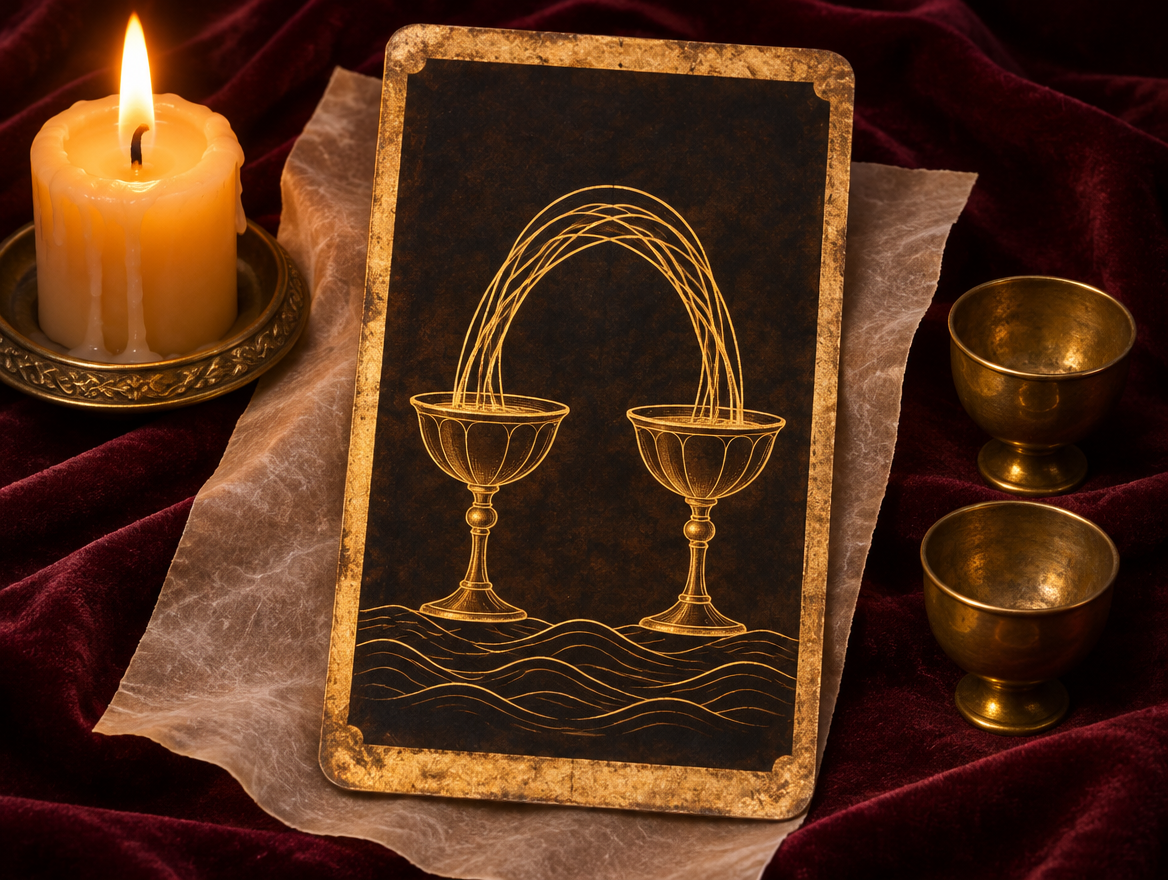
Your next step: set up the Two Cups Check tonight with one area of life where you swing between extremes. Then read our Sagittarius personality traits guide to see how the Archer’s big fire and Temperance’s steady hand can work together.
Explore Next
- The sign behind the card: Sagittarius Personality Traits
- The card that comes after: The Devil Tarot Card
- Another virtue card: Justice Tarot Card
- Opposites learning to work together: Fire and Water Relationships
- Looking at roles without blame: Shadow Work, Plainly
- Tarot basics in plain words: Tarot for Beginners: How Tarot Really Works (Code of Ascension)
- More tarot on The 9th King: Tarot Card Meanings · Major Arcana · Tarot & the Zodiac · Shadow Work Tarot Spread
- More Major Arcana: Death · Strength · The Tower · The Star
Final Thought: Pour Slowly, and Keep Both Feet Steady
Temperance doesn’t ask you to give up your fire or your feeling. It shows an angel with one foot on land and one in water, pouring with patience from one cup to the other. Name both sides, choose a pace you can keep, and come back to the pour when it tips. The middle path is still a path. Know your nature. Rule your life.
About the Author
King is the founder of The 9th King, where zodiac psychology, relationships and shadow work are explored as tools for self-knowledge rather than fortune-telling. He’s a Libra Sun, and writes about the personal side of astrology on King The Kemist. Astrology on The 9th King is interpretation and self-reflection, not prediction or established fact.
Leave a Reply