Quick Answer: What Does the Justice Tarot Card Mean?
Justice is a card of the Major Arcana. In the Rider–Waite–Smith deck it’s numbered XI (11); in the older Tarot de Marseille order it’s VIII (8), because the Rider–Waite–Smith deck swapped Justice and Strength.
Keywords: fairness, truth, accountability, cause and effect, balance, clear decisions.
- Upright, in one line: the card can point to seeing a situation honestly, owning your part in it, and choosing what’s fair.
- Reversed, in one line: readers often take it as imbalance: bias, avoiding responsibility, or being far harsher (with yourself or others) than the facts call for.
On The 9th King, Justice is a mirror, not a verdict. It doesn’t tell you what will happen. It asks: What actually caused this, what’s my share, and what would a fair next step look like?
Table of Contents

The Justice tarot card at a glance
| Justice | |
|---|---|
| Arcana | Major Arcana |
| Number (Rider–Waite–Smith) | XI (11) |
| Number (Marseille order) | VIII (8) |
| Main symbols | Sword, scales, two pillars |
| Golden Dawn–derived sign | Libra |
| Upright themes | Fairness, truth, accountability |
| Reversed themes | Bias, avoidance, harshness |
| Key question | What’s my share, and what’s fair? |
One honest note before we start: tarot began as a card game. Encyclopaedia Britannica dates the first tarot decks to Italy in the 1430s and notes that using them for fortune-telling began in France around 1780 (Britannica: tarot). The meanings below are traditions readers built over time, which is why they work as prompts for reflection.
Justice: VIII or XI? Why the number changed
If you’ve seen Justice numbered 8 in one deck and 11 in another, neither deck is wrong. They follow different orders.
The older order
In the historic Tarot de Marseille sequence, Justice usually comes straight after the Chariot as card VIII, and Strength sits at XI (Wikipedia: Justice (tarot card)). Many European decks still use this order.
The Rider–Waite–Smith swap
The Rider–Waite–Smith deck, designed by A. E. Waite with art by Pamela Colman Smith and first published in 1909 (Wikipedia: Rider–Waite Tarot), moved Strength to VIII and Justice to XI. Waite didn’t explain himself. In The Pictorial Key to the Tarot he simply says he swapped the cards “for reasons which satisfy myself” and adds that the change means nothing to the reader (Waite, Pictorial Key: Strength, sacred-texts.com).
The usual explanation (not Waite’s)
Waite never gave more reason than that. The explanation you’ll usually read comes from other sources, and it’s astrology. The Hermetic Order of the Golden Dawn, the magical society both Waite and Smith belonged to, matched each Major Arcana card to a Hebrew letter and to a sign, planet or element. Under that scheme the eighth card is linked to Leo and the eleventh to Libra (Wikipedia: Strength (tarot card)). On that reading, a lion card on Libra and a scales card on Leo didn’t fit, so the two were switched; the same page says the swap was first suggested in the Golden Dawn’s Cipher Manuscripts. An essay on psyche.com quotes the tarot writer Robert V. O’Neill making the same point: the cards were switched “to make the zodiacal signs come out right” (The Revived Tarot, psyche.com).
What to do with this: use the number printed on your deck. The meaning of the card doesn’t change with its position.
The imagery: what’s on the Justice card
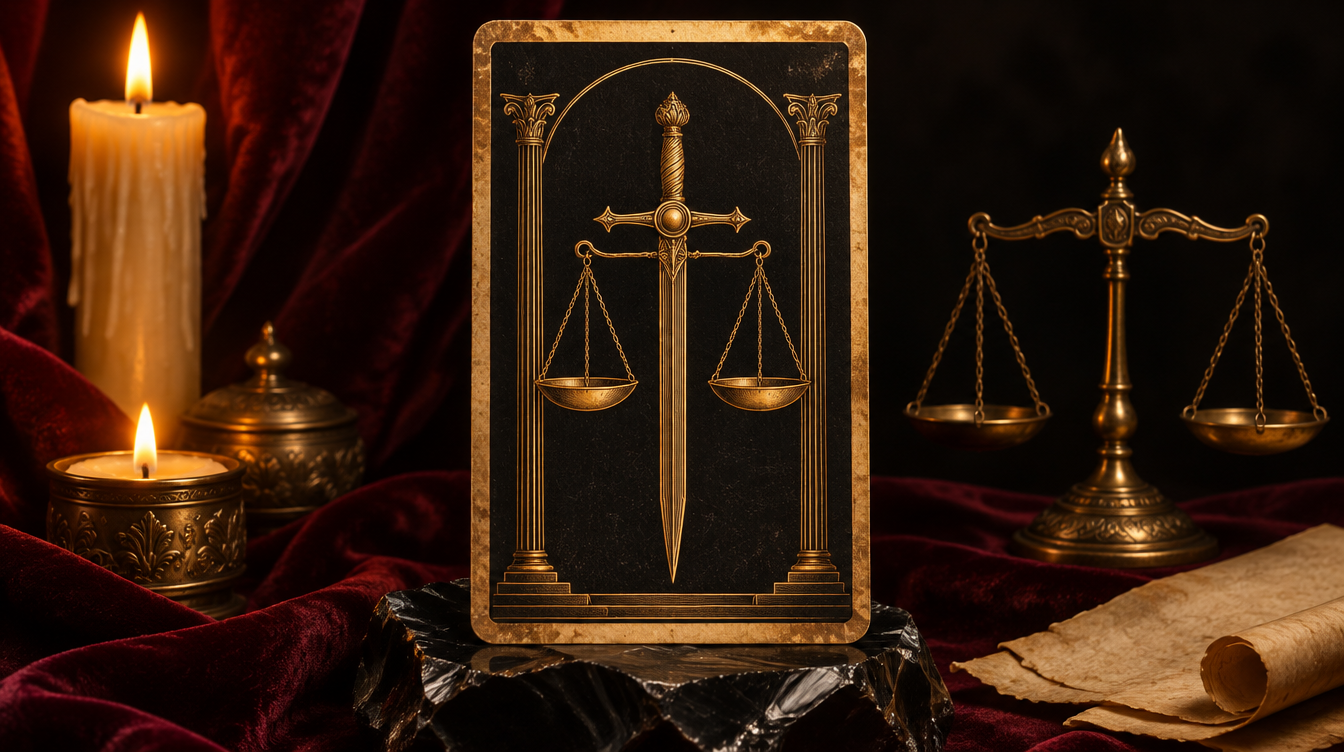
In the Rider–Waite–Smith design, a crowned figure in a red robe sits facing you, very still, between two stone pillars. A cloth or veil hangs between the pillars behind them. The figure holds an upright sword in the right hand and a pair of gold scales in the left (Wikipedia: Justice (tarot card)).
The sword
The sword stands for clear thinking and decisive action: cutting through excuses and naming what’s true. On the Rider–Waite–Smith card it points straight up, which readers often take as impartiality. (The original 9K art on this page shows it pointing down.)
The scales
The scales are the patient half. Before anything is decided, both sides go on the pan: facts, context, other people’s needs, your own. They show the moment of weighing, not a sentence already handed down.
The pillars
Waite points out that Justice is seated between pillars, like the High Priestess, and draws a careful line between them. Justice is the moral law, the principle “which deals unto every man according to his works,” while the High Priestess guards a more mysterious kind of knowing (Waite, Pictorial Key: Justice). He ends by saying the two pairs of pillars open into different worlds. Put simply: the High Priestess is about what you sense; Justice is about what you did.
Astraea, the star maiden
Waite also notes that the female figure has been identified with Astraea, the Greek maiden of justice, who is shown with the same symbols (Waite, Pictorial Key: Part I, §2).

Justice upright meaning
Waite’s own divinatory list for the upright card is short: equity, rightness, probity, an executive quality, and the deserving side winning in law (Waite, Pictorial Key: Part III, §3). Modern readers usually widen that into a few themes.
Seeing cause and effect
The upright card can point to a moment of clarity about why something happened. Not the story you’ve been telling, the actual chain of causes. Sometimes that’s reassuring; sometimes you see your own fingerprints on the outcome.
Owning your part, no more and no less
Readers often take upright Justice as a call to accountability. The key word is your part. Justice isn’t asking you to carry the whole weight of a situation, and it isn’t letting you off the hook for your share. It asks for an accurate measurement.
Fair choices
When you’re facing a decision, the card can point to choosing by principle rather than by mood, convenience or the loudest voice in the room. Ask yourself: If I had to explain this choice to someone I respect, would it hold up?
A note on legal matters: traditional meanings mention the law, and some readers draw Justice when they’re worried about a case or contract. A tarot card can’t tell you how a legal matter will go, and nothing here is legal advice. If you’re dealing with a real legal question, talk to a qualified lawyer. Use the card only to reflect on how you want to act.
Justice reversed meaning
Waite’s reversed list is blunt: legal complications, bigotry, bias and excessive severity (Waite, Pictorial Key: Part III, §3). In reflective reading, the reversed card describes the scales knocked out of balance, in one of three directions.
Avoiding accountability
The first reversed pattern is looking away: blaming circumstances or other people for something you had a real hand in.
Bias and unfairness
The second is a tilted scale. You’ve already decided who’s right, and you’re only collecting evidence for one side. This can be bias against someone else, or a quiet bias in your own favour.
Excessive severity, often toward yourself
The third pattern is the one 9K readers should watch most closely: the scale tipped against you. You see your mistake and then sentence yourself far beyond what it deserves. One missed deadline becomes proof you’re a failure. That isn’t accountability. It’s punishment, and it usually makes repair less likely, because shame tends to make people hide rather than fix things.
So when Justice appears reversed, ask yourself which way the scale is tipped: Am I avoiding my share, inflating someone else’s, or inflating my own?

| Theme | Upright | Reversed |
|---|---|---|
| Truth | Saying what happened | Convenient stories |
| Accountability | Owning your share | Dodging it, or over-owning it |
| Decisions | Choosing by principle | Choosing by mood or bias |
| Consequences | Learning from them | Ignoring or fearing them |
| Self-judgment | Fair and specific | Harsh and sweeping |
Justice in love, work and the self
These are reflection angles, not predictions.
Justice tarot in love
In a love question, Justice often brings up fairness and honesty between two people: who does what, who apologizes, whether agreements are kept, whether both people get to be heard.
Upright, it can point to a conversation where you both put the facts on the table and own your parts. Reversed, readers often see a ledger out of balance: one person always conceding, or an argument where nobody will admit anything.
The card doesn’t tell you to stay or leave. It asks a narrower question: Am I seeing this relationship accurately, including my own behaviour in it?
A useful habit here is the two-column repair:
- Write what you did that contributed to the problem. Be specific.
- Write what you need from the other person. Be specific there too.
- Lead with the first column when you talk.
If the issue is trust and secrecy, our guide to privacy without mixed signals helps you tell healthy privacy from hiding. And if you notice you’re furious at a trait in your partner that you also carry, psychological projection is worth a read.
Justice at work
At work, Justice can point to fair process: clear expectations, honest feedback, owning a mistake before someone else finds it. It often appears around decisions that need to be made on principle rather than on politics.
A practical test for a work decision: Would I accept this if I were on the other side? This isn’t financial or career advice, and the card isn’t a forecast about your job.
Justice and the self
Turned inward, Justice is the card of self-accountability without self-punishment. It asks you to measure your actions as fairly as you’d measure a friend’s, with the same scale in every area of life.
Justice and Libra: the astrology correspondence
The 9th King uses Golden Dawn–derived correspondences, the tradition the Rider–Waite–Smith deck draws on. In that system Justice is linked to Libra, the sign of the scales, and to the Hebrew letter Lamed (Wikipedia: Strength (tarot card); The Revived Tarot, psyche.com; Wikipedia: Thoth Tarot).
Other schools differ. Some older French systems assigned the cards differently, and some modern readers use no astrology at all. Not every card maps to a single sign, either: in the Golden Dawn scheme some Majors are linked to planets or elements, and the court cards work on a different system entirely. Treat the Libra link as a lens, not a rule.
Why Libra fits
The symbolism lines up neatly. Libra’s symbol is the scales, and astrologers read the sign as concerned with balance, fairness, partnership and weighing both sides. Our Libra traits guide covers the sign in full, including its shadow: the people-pleasing and indecision that come from wanting everything to be even.
That shadow matters for reading this card. Libra’s weakness is avoiding conflict to keep the peace. Justice’s sword is the fix. The scales weigh; the sword decides. A Libra lesson and a Justice lesson are the same lesson: fairness sometimes means saying the uncomfortable thing.
Using the link in your own chart
You don’t need Libra placements to use this card, but if you have the Sun, Moon or Rising in Libra, it may feel especially personal. Look up where Libra falls in your chart with our birth chart guide and ask: In this area of life, am I keeping things balanced, or just keeping things quiet?

The 9th King reading: tension, shadow and the self-mastery lesson
The tension: the scales versus the sword
Every Justice moment holds two pulls. The scales want more time, more context, one more perspective. The sword wants a decision now. Too much scale and you never act; you keep weighing to avoid choosing. Too much sword and you cut before you’ve looked; you decide fast and call it honesty.
The tension is knowing when you’ve weighed enough. A rule of thumb: once new information stops changing your view, it’s time to use the sword.
The shadow side: the inner judge
Every card has a shadow, and Justice’s is easy to name: the inner judge who never adjourns.
This is the voice that replays mistakes at 2 a.m. and treats every slip as evidence in an endless trial. It often grew up somewhere specific: a strict home, a school that ran on shame, a relationship where mistakes were never forgotten. Our inner child work guide explores where voices like this can come from.
The judge has a mirror-image too: the self-righteous judge, who measures everyone else with precision and exempts themselves. Both are the same scale, broken in opposite directions.
Shadow work with Justice isn’t about silencing your conscience. It’s about replacing a judge with a fair witness: someone who sees clearly, records accurately and is interested in repair, not punishment. If you’re new to this kind of reflection, Shadow Work, Plainly explains the idea and how to start gently, and our zodiac shadow work guide includes Libra’s shadow alongside the other signs.
A gentle note: looking honestly at your past can stir up painful memories. If you’re dealing with trauma, abuse, thoughts of self-harm or distress that feels overwhelming, please work with a qualified therapist rather than on your own. And it’s always fine to stop a prompt that feels like too much. Fair to yourself includes that.
The self-mastery lesson: accountability is a tool, not a sentence
The lesson of the Justice tarot card, as we read it at 9K: you can own your choices completely and still treat yourself with respect.
Accountability, done well, has three parts:
- Name it. What happened, in plain words, without drama or minimizing.
- Measure it. What was your share? What wasn’t?
- Move it. What’s the repair or the next fair choice?
Punishment skips step 3. It stays in step 1, replaying the event, or it jumps from step 1 to a verdict about who you are. Justice wants you to finish the process, because the point of seeing cause and effect is to change the next cause.
In Waite’s words, the pillars of Justice “open into one world”: the world of actions and their results. That’s good news. It’s the one world you can actually do something about.
Practical exercise: the Fair Witness ledger
This is the one exercise to take from this page. It takes about 15 minutes and is meant for ordinary, everyday situations: a late call, a tense meeting, a small falling-out. If it doesn’t fit what you’re dealing with, skip it.
Before you start: responsibility for abuse or violence always belongs to the person who caused it. This ledger isn’t for dividing up blame in those situations, and you never have to find your “share” of harm someone did to you.
Step 1: Choose one situation
Pick one specific event, not a whole relationship or a whole year. “The argument on Sunday,” not “my marriage.”
Step 2: Write the facts only
On the left half of a page, write what happened as a camera would have recorded it. No motives, no adjectives. I said I’d call by 6. I called at 8. She’d already gone to bed.
Step 3: Weigh the causes
On the right half, list every cause you can see: yours, other people’s and the circumstances. Next to each, write one plain sentence about what it contributed. No scores or percentages; you’re describing, not calculating.
Step 4: Check the scale
Read the right column back. Did I leave myself out entirely? Look again. Did I put everything on myself? Look again, kindly. Some events really do have little to do with you.
Step 5: Choose one repair
Write one action that answers your share. An apology, a corrected detail, a changed habit, a boundary. One action, doable this week.
Step 6: Close the file
Write one sentence that ends the case: I own my part, I’ve chosen my repair, and I don’t need to keep re-trying this. Then close the notebook.
Worked example (fictional): Dana drew Justice reversed after a falling-out with a coworker over a missed handoff. Her first ledger put everything on herself: “I’m useless with deadlines.” Looking again, she listed three causes: a vague request from her manager, her coworker’s late file, and her own choice not to flag the problem early. Only the last was hers to change. Her repair was one thing: next time, flag delays the same day. The heavy story shrank to a usable lesson.
Five Justice journal prompts
- Where in my life am I keeping the scales perfectly even just to avoid an argument?
- What’s one mistake I’ve already paid for, but am still charging myself for?
- Who do I judge more harshly than I judge myself, and what does that say about my standards?
- If a fair witness described my last week, what would they say I did well?
- What’s the next fair choice in front of me, and what’s stopping me from making it?
For more prompts in this style, see our shadow work prompts.
Myths and misreadings about the Justice card
- “Justice means karma is coming for you.” No. The card describes cause and effect as something to look at, not a cosmic punishment on the way. Nothing in the image is chasing you.
- “Justice predicts how a court case will go.” It doesn’t, and no card can. Traditional meanings mention the law, but for real legal matters, talk to a lawyer.
- “Reversed Justice means you’re a bad person.” Reversed Justice often points to the opposite problem: being far harder on yourself than the facts deserve.
- “Justice is a cold, emotionless card.” Fairness isn’t coldness. Weighing other people’s needs is an act of care.
- “You need Libra in your chart for this card to apply.” The Libra link is a Golden Dawn–derived correspondence, a symbolic lens. Anyone can learn from Justice.
If you’re still finding your feet with tarot in general, Code of Ascension’s Tarot for Beginners: How Tarot Really Works (Code of Ascension) covers the basics, and its Intuitive Tarot guide (Code of Ascension) shows how to blend traditional meanings with your own first impressions.
Justice Tarot Card: FAQ
What does the Justice tarot card mean?
The Justice tarot card stands for fairness, truth, accountability and cause and effect. Upright, readers often take it as a call to see a situation clearly, own your share of it and choose what’s fair. Reversed, it can point to bias, avoiding responsibility or being too harsh. On The 9th King it’s read as a mirror for reflection, not a prediction of what will happen.
Is Justice card 8 or 11?
Both, depending on the deck. In the older Tarot de Marseille order Justice is VIII and Strength is XI. The Rider–Waite–Smith deck of 1909 swapped them, so Justice became XI. Waite said only that he did it for reasons that satisfied him. Other sources usually explain it by the Golden Dawn’s scheme, which links the eighth card with Leo and the eleventh with Libra. Use whatever number your own deck prints.
What does Justice reversed mean?
Justice reversed usually describes a scale out of balance. It can point to avoiding accountability, judging with bias, or excessive severity. On The 9th King we pay special attention to the last one: being far harsher with yourself than the facts call for. Ask yourself whether you’re dodging your share, inflating someone else’s or inflating your own.
What does Justice mean in a love reading?
In love, Justice often brings up honesty and fairness between two people: shared effort, kept agreements, apologies and being heard. Upright, it can suggest an honest conversation where both people own their part. Reversed, it can point to an uneven ledger. It doesn’t tell you to stay or leave; it asks whether you’re seeing the relationship, and your own role in it, accurately.
What zodiac sign is the Justice tarot card?
In Golden Dawn–derived correspondences, the tradition the Rider–Waite–Smith deck draws on and the one The 9th King uses, Justice is linked to Libra, the sign of the scales, and the Hebrew letter Lamed. Other schools assign cards differently, and some readers use no astrology. Treat the Libra link as a symbolic lens rather than a fixed rule.
Is Justice a yes or no card?
The 9th King doesn’t use tarot for yes/no answers, because a single card can’t decide an outcome. If you drew Justice on a yes/no question, try reframing it: what would a fair outcome look like, and what’s your part in reaching it? That open question tends to give you something you can actually act on.
Can the Justice card predict a legal outcome?
No. Traditional meanings mention the law, and Waite’s own list includes the deserving side winning in law, but no tarot card can tell you how a real case or contract will turn out. For a legal matter, speak to a qualified lawyer. Use the card only to reflect on how you want to conduct yourself through it.

Your next step: pick one situation that’s been weighing on you and run the Fair Witness ledger above. Then read our Libra traits guide to see how the sign of the scales handles balance, conflict and fairness in everyday life.
Explore Next
- The sign behind the scales: Libra Traits
- Start shadow work safely: Shadow Work, Plainly
- More prompts for honest reflection: Shadow Work Prompts
- Privacy versus hiding in relationships: Privacy Without Mixed Signals
- When you judge others for your own traits: Psychological Projection
- Every sign’s shadow: Zodiac Shadow Work
- More tarot on The 9th King: Tarot Card Meanings · Major Arcana · Tarot & the Zodiac · Shadow Work Tarot Spread · Three-Card Tarot Spread · The Chariot · The Emperor
- From accountability to awakening: Judgement

Final Thought: Weigh It, Own It, Close the File
Justice doesn’t sit between those pillars to condemn you. It sits there to help you see. Look at what happened, take your fair share of it, make the repair, and then let the case close. That’s not being easy on yourself. That’s being just. Know your nature. Rule your life.
About the Author
King is the founder of The 9th King, where zodiac psychology, relationships and shadow work are explored as tools for self-knowledge rather than fortune-telling. He’s a Libra Sun, and writes about the personal side of astrology on King The Kemist. Astrology on The 9th King is interpretation and self-reflection, not prediction or established fact.
Leave a Reply