
Quick Answer: What Is Synastry?
Synastry is the astrology of relationships: comparing two people’s birth charts to see how they interact. Instead of asking “are Leo and Scorpio compatible?”, synastry asks how your Moon meets their Venus, where their Saturn lands in your houses, and which parts of you light each other up or rub each other the wrong way.
- The basic method: place one chart’s planets around the other chart, then look for aspects between them.
- What to look at first: Sun, Moon, Venus, Mars, the Ascendant and Saturn.
- Easy contacts (trines, sextiles, many conjunctions) are read as natural ease.
- Growth contacts (squares, oppositions) are read as friction that asks for work.
- House overlays show which area of your life a partner tends to activate.
Synastry doesn’t tell you whether a relationship will last. It’s a way to talk about how two people tend to meet, and where they’ll need patience.
Table of Contents
What synastry is, and what it isn’t
Most people start with Sun-sign compatibility: Aries with Leo, Taurus with Virgo, and so on. That’s a useful headline, and Code of Ascension’s Zodiac Compatibility Chart (Code of Ascension) is a good quick reference for it. But your Sun sign is one part of a chart with ten planets, twelve houses and dozens of aspects.
Synastry uses all of it. Each person’s chart is a map of their needs, drives and patterns. When two charts are laid over each other, astrologers read the contacts between them as a map of the relationship’s dynamics.
Three things synastry is not:
- It’s not a verdict. No contact guarantees a relationship works or fails. People with “difficult” synastry build long, happy lives together, and people with “perfect” synastry break up.
- It’s not only about romance. You can compare charts with a friend, a parent, a business partner or a child.
- It’s not science. There’s no evidence that planetary contacts between charts predict relationship outcomes. On The 9th King, synastry is a language for reflection and conversation.
What you need before you start
- Two birth charts. You need each person’s date, time and place of birth. Without a birth time, you lose the Ascendant, the houses and an accurate Moon position.
- Consent. Someone’s birth details are personal. Ask before you run their chart, and think about how you’ll share what you find.
- A basic grasp of one chart. If you can’t yet read a single chart, start with our guide to how to read a birth chart. Synastry is two charts talking, so you need to know what each one is saying first.
- The aspect basics. Synastry runs on aspects. Our guide to astrology aspects covers the five you’ll use most.
Most chart apps and sites have a “synastry” or “bi-wheel” option. It shows your chart in the inner wheel and the other person’s planets around the outside.
How to read synastry, step by step
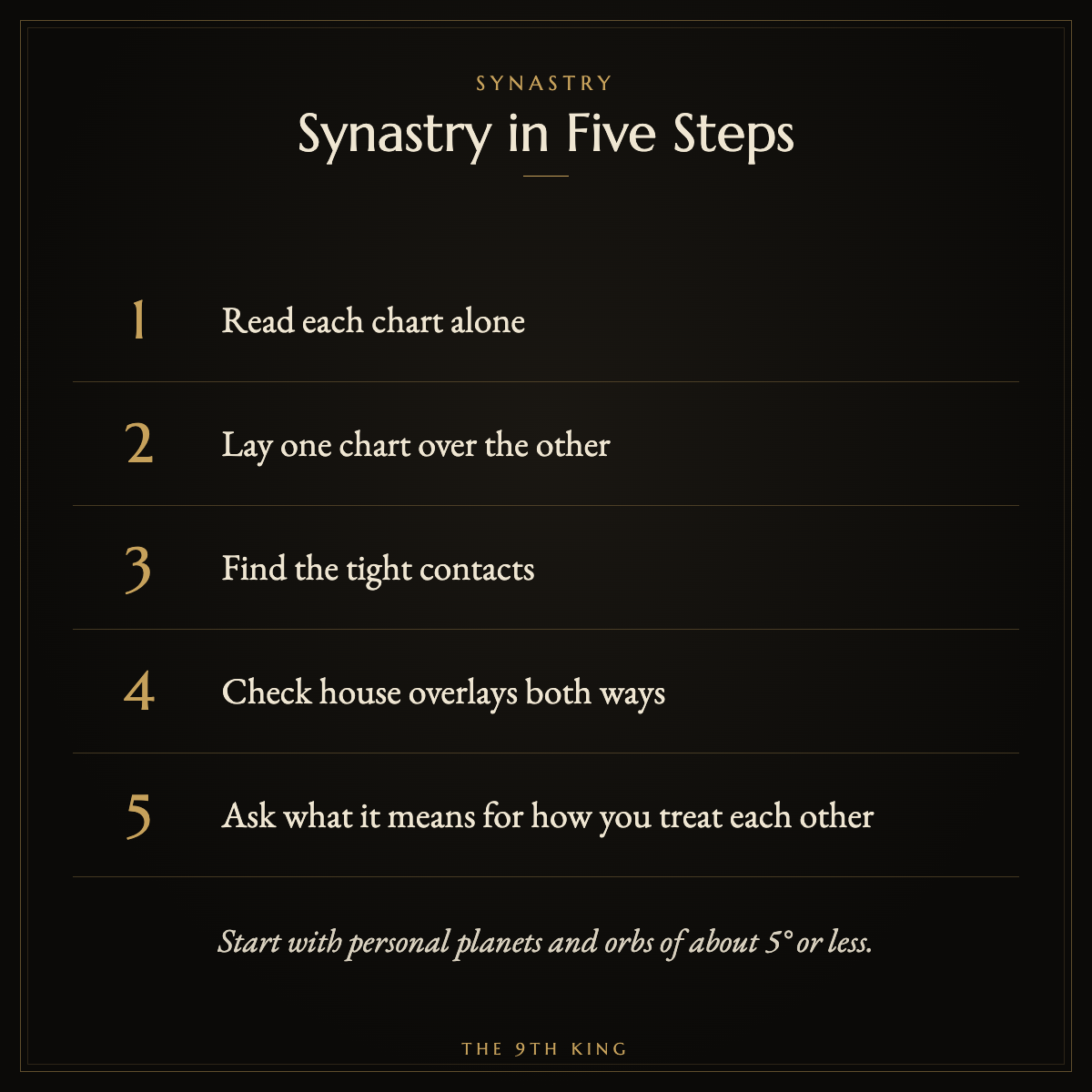
Step 1: Read each chart alone. Before comparing, note each person’s Big Three (Sun, Moon, Rising), Venus and Mars signs. Code of Ascension’s guide to the Sun, Moon and Rising signs (Code of Ascension) explains the Big Three in depth. You can’t understand a duet without hearing both voices.
Step 2: Lay one chart over the other. Use a bi-wheel. Your planets stay in your houses; theirs sit around the outside, falling into your houses.
Step 3: Find the tight contacts. List the aspects between your planets and theirs, starting with the personal planets (Sun, Moon, Mercury, Venus, Mars) and the Ascendant. Keep orbs fairly tight, around 5° or less for most contacts. The closer the orb, the louder the theme.
Step 4: Check house overlays both ways. Note which of your houses their planets fall into, then flip the wheel and do the same for them. Synastry is never one-directional.
Step 5: Turn it into questions. For each strong contact, ask: How does this show up when we’re together? What does each of us need here? Then test it against what you actually experience.
The contacts that matter most
Not every contact carries the same weight. Most astrologers start with these.
Sun–Moon contacts
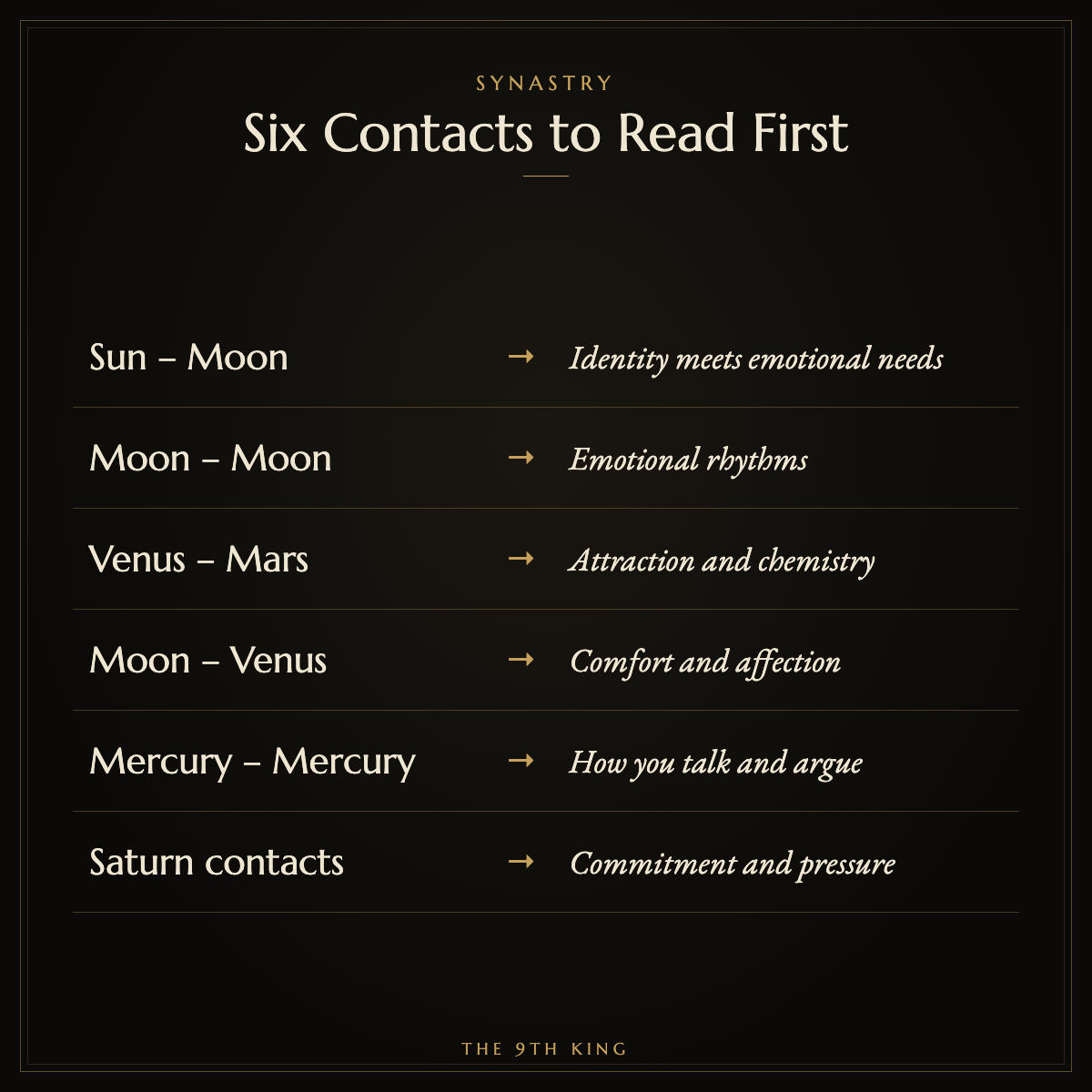
One person’s Sun aspecting the other’s Moon is one of the oldest markers of a strong bond in traditional synastry. The Sun person tends to light up the Moon person’s sense of safety, and the Moon person tends to understand the Sun person intuitively. A conjunction, trine or sextile is read as natural support. A square or opposition is read as a strong pull with some misunderstanding to work through.
Moon–Moon contacts
Your Moons describe how each of you handles feelings, rest and comfort. When the Moons are in harmonious aspect, or in signs of the same element, you may find it easy to share space and moods. When they square, one of you may want to talk it out while the other needs quiet. Neither is wrong. Our guide to the Moon sign meaning explains what each Moon tends to need.
Venus–Mars contacts
Venus describes what you find attractive and how you show affection. Mars describes desire, pursuit and drive. Venus–Mars contacts between two charts are the classic markers of chemistry. A conjunction is often read as strong magnetism. A square can feel exciting and frustrating at once.
Moon–Venus contacts
Where Venus–Mars is chemistry, Moon–Venus is comfort. One person’s affection (Venus) meets the other’s emotional needs (Moon). These contacts are often read as the “easy to be around” factor that keeps a relationship warm once the early excitement settles.
Mercury contacts
Mercury–Mercury and Mercury–Moon contacts describe how you talk, listen and argue. Harmonious contacts suggest conversation that flows. Hard contacts suggest you may need to slow down and check what the other person actually meant.
Ascendant contacts
When one person’s planet sits on the other’s Ascendant, the Ascendant person tends to feel strongly “seen” by that planet. Someone’s Venus on your Ascendant is often read as them finding you naturally attractive. Their Saturn on your Ascendant can feel like being judged, or like being taken seriously.
House overlays: where you land in each other’s lives
Each of your planets falls into one of their houses, and theirs fall into yours. Astrologers call these house overlays. They’re read as which area of life each person activates in the other.
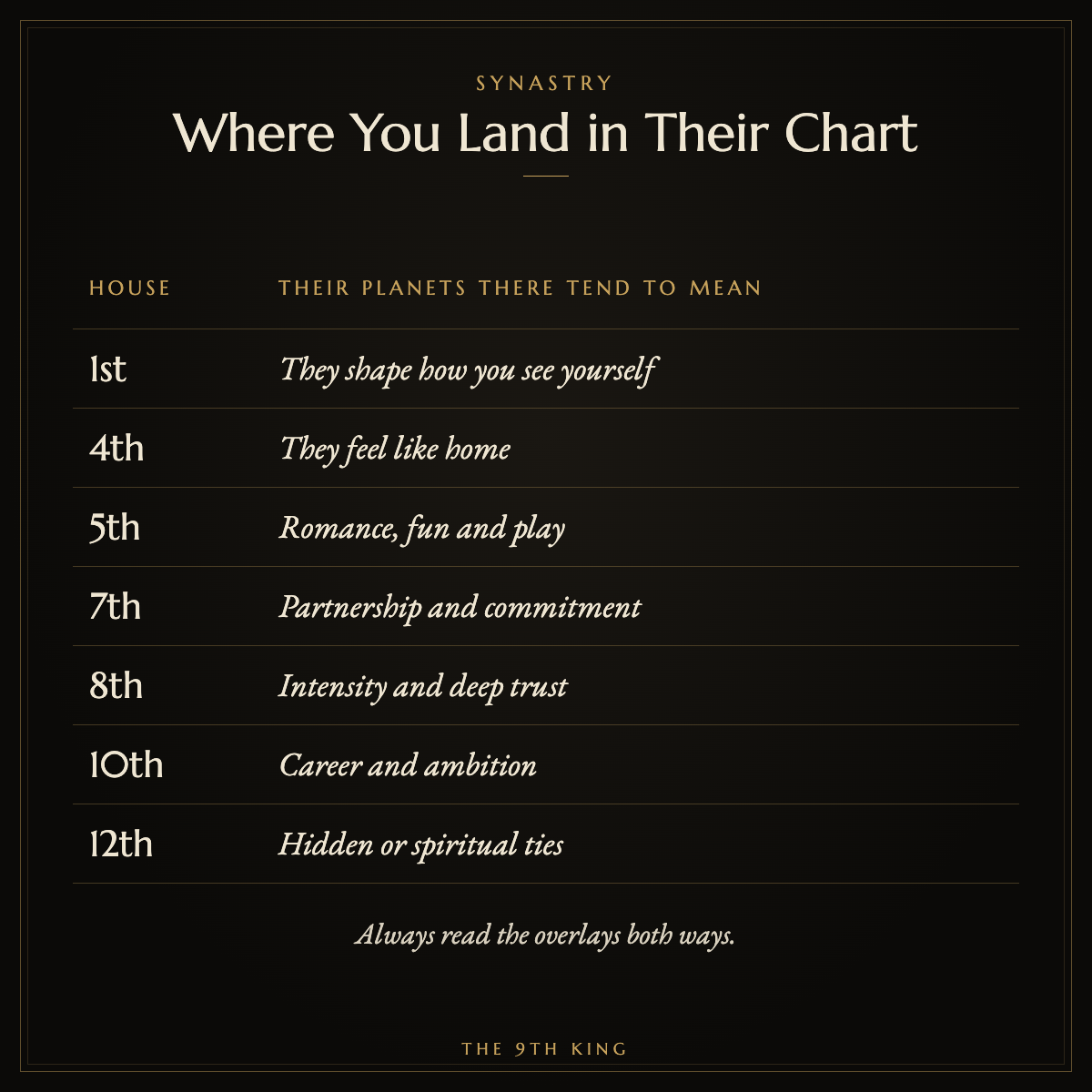
A few overlays to look for:
- Their planets in your 5th house: they bring play, romance and fun into your life.
- Their planets in your 7th house: they activate your sense of partnership. Many astrologers read this as a strong marker of commitment.
- Their planets in your 8th house: intensity, deep trust or power dynamics. Powerful, sometimes uncomfortable.
- Their planets in your 4th house: they can feel like family or home.
- Their planets in your 12th house: a bond that can feel spiritual, secret or hard to define.
Remember to read overlays both ways. If their Venus is in your 7th but your planets mostly fall into their 3rd, you may experience the relationship as a partnership while they experience it as a friendship. That’s useful to know, and worth talking about. For a fuller picture of what each house means, see our guide to the 12 houses in astrology.
Easy contacts and growth contacts
As in a single chart, synastry aspects come in two broad families.
Easy contacts are trines, sextiles and many conjunctions. They’re read as areas where you naturally understand each other. A relationship full of easy contacts can feel comfortable from the start. The traditional caution is that too much ease can mean a relationship that never challenges either of you.
Growth contacts are squares and oppositions. They’re read as areas of friction, attraction and misunderstanding. Hard contacts often create the “spark,” and they’re also where arguments start. Many astrologers say long-term relationships need at least a few of them, because friction is what makes two people grow.
The healthiest reading is not to count easy versus hard contacts and declare a winner. It’s to notice where you flow, where you snag, and what each of you can do about the snags.
Saturn and the outer planets in synastry
Saturn contacts are often called the glue of long-term relationships. When one person’s Saturn aspects the other’s Sun, Moon or Venus, it’s read as commitment, responsibility and seriousness. It can also feel heavy: the Saturn person may come across as critical or controlling, and the other person may feel judged. Over time, Saturn contacts are often read as the ones that build something lasting.
The outer planets (Uranus, Neptune and Pluto) move slowly, so everyone born within a few years of you shares roughly the same placements. In synastry, they matter most when they touch personal planets or angles.
- Uranus contacts: excitement, unpredictability, freedom. A relationship that wakes you up, and may not sit still.
- Neptune contacts: romance, idealism, compassion. Also a risk of seeing the other person as you wish they were.
- Pluto contacts: intensity, obsession, transformation. Powerful bonds that can include struggles over control.
Treat these as prompts for honesty, not warnings. If you notice Neptune idealism in your synastry, ask whether you know the real person in front of you. If you notice Pluto intensity, ask whether both of you feel free.
Composite charts: the relationship as its own chart
Synastry compares two charts. A composite chart goes a step further: it calculates the midpoint between each pair of planets and creates a single chart for the relationship itself. Astrologers read it as the personality of the partnership, separate from either person.
For beginners, synastry is the better place to start. It keeps both people visible. Once you’re comfortable with it, a composite chart can add a useful third perspective. Robert Hand’s Planets in Composite (1975) is the classic book on the method.
A worked example (fictional charts)
Person A: Sun in Taurus, Moon in Cancer, Venus in Aries, Mars in Gemini, Saturn in Aquarius, Libra Rising.
Person B: Sun in Scorpio, Moon in Pisces, Venus in Libra, Mars in Leo, Saturn in Taurus, Aries Rising.
Notable contacts:
- A’s Moon in Cancer trine B’s Moon in Pisces. Both water Moons. Emotional understanding comes easily; they can sit in silence comfortably.
- A’s Sun in Taurus opposite B’s Sun in Scorpio. A strong pull between opposites: steadiness meets intensity. They may each see in the other what they lack.
- A’s Venus in Aries opposite B’s Venus in Libra, and on B’s Ascendant (Aries). A finds B attractive on sight; B feels noticed. But they show affection very differently: A is direct, B wants harmony and courtesy.
- B’s Saturn in Taurus conjunct A’s Sun. Commitment and seriousness. B may steady A, or feel like a critic to A.
- House overlay: B’s Sun and Venus fall in A’s 7th house. A experiences B as a “partner” figure early on.
Reading: a bond with real emotional ease (the Moons) and strong attraction across opposites, with a Saturn contact that can make it lasting if both handle the pressure kindly. The growth area is affection: A may need to slow down; B may need to say what they want more directly.
Useful questions for this couple: How does each of us show love, and do we notice when the other does it? When B is critical, is A hearing care or judgment?
This is a hypothesis to talk about, not a forecast.
Synastry beyond romance: friends, family and work
Synastry is usually discussed for couples, but the same method works for any relationship. What changes is which contacts you pay most attention to.
Friendships. Look at Mercury contacts (how easily you talk), Moon contacts (whether you feel relaxed together) and overlays in the 11th house, the house of friends and groups. Jupiter contacts are often read as the friend who makes life feel bigger and more generous. Venus–Mars chemistry matters less here, and may simply show up as playful energy.
Parents and children. Look at Moon contacts and the 4th house, which describes home and family. Saturn contacts are common between parents and children and are often read as the parent’s sense of responsibility, or the child’s sense of being judged. These charts can be especially useful for adults trying to understand old family patterns with compassion rather than blame.
Work and business partners. Look at Mercury (communication), Mars (how you each push and compete), Saturn (reliability and structure) and overlays in the 6th and 10th houses, which cover daily work and career. A business partner whose Saturn steadies your Mars may be exactly the counterweight you need.
In every case the principle is the same: notice where you flow and where you snag, then talk about it. Synastry is most useful when both people are curious about it, and least useful when it’s used to win an argument.
Using synastry well
- Use it as a conversation starter. “My Moon squares your Moon. Does it feel like we handle stress differently?” is more useful than “our chart says we’re doomed.”
- Pair it with behaviour. How someone treats you matters more than any contact. Astrology can help you name a pattern, not excuse one.
- Look at your own chart first. Many synastry “problems” are really one person’s pattern that would show up with anyone. Our guide to shadow work, plainly explains how we project our own material onto partners.
- Compare elements, too. Our post on fire and water signs in relationships shows how element differences play out in real life.
Common mistakes in synastry
- Reading only Sun signs. It’s a start, not synastry.
- Using a guessed birth time. Houses, the Ascendant and overlays become unreliable.
- Reading one direction only. Always flip the bi-wheel and check overlays both ways.
- Treating hard contacts as deal-breakers. Friction can be the engine of growth.
- Treating easy contacts as guarantees. Comfort still needs effort and honesty.
- Running someone’s chart without asking. Respect their privacy, and think carefully before sharing what you find.
- Using astrology to excuse harm. No placement justifies disrespect, control or cruelty.
Five journal prompts for synastry
- Which contact between your chart and your partner’s (or friend’s) feels most true? What does it look like day to day?
- Find one growth contact. When do you feel that friction, and what does each of you need when it shows up?
- Look at where their planets land in your houses. Which area of your life do they bring to the surface?
- Is any of your synastry Neptune-coloured? Where might you be seeing the person you hope for rather than the person who’s there?
- What’s one thing you could tell this person about how you need to be loved that your charts suggest they might not know?

Synastry: FAQ
What is synastry in astrology?
It’s the comparison of two birth charts to explore how two people interact. Astrologers look at the aspects between one person’s planets and the other’s, and at which houses each person’s planets fall into.
How is synastry different from zodiac compatibility?
Zodiac compatibility usually compares Sun signs only. Synastry compares whole charts, including the Moon, Venus, Mars, the Ascendant, the houses and the aspects between them.
Which synastry aspects are most important?
Most astrologers start with Sun–Moon, Moon–Moon, Venus–Mars, Moon–Venus and Saturn contacts to personal planets, plus anything touching the Ascendant.
Do I need exact birth times for synastry?
For a full reading, yes. Without birth times you lose the Ascendant, the houses and the overlays, and the Moon’s position may be uncertain. You can still compare planet-to-planet aspects, with less precision.
Is a square in synastry bad?
No. Squares are read as friction and challenge, but they often create attraction and growth. Many lasting relationships have several.
What is a house overlay?
It’s where one person’s planets fall in the other person’s houses. It’s read as which area of life each person activates in the other.
What are Saturn contacts in synastry?
Aspects between one person’s Saturn and the other’s personal planets. They’re traditionally read as commitment and responsibility, and sometimes as pressure or criticism.
What’s the difference between synastry and a composite chart?
Synastry compares two separate charts. A composite chart combines them, using midpoints, into one chart for the relationship itself.
Can synastry tell me if we’ll stay together?
No. Synastry can suggest themes and dynamics, but it can’t predict choices, effort or outcomes.
Is synastry scientifically proven?
No. Studies have not found that chart comparisons predict relationship success. On The 9th King, synastry is a reflective tool, not established science.

Explore Next
- Read one chart first: How to Read a Birth Chart
- The angles between planets: Astrology Aspects Explained
- What each of you needs: Moon Sign Meaning
- Elements in love: Fire and Water Signs in Relationships
- Quick sign pairings: Zodiac Compatibility Chart (Code of Ascension)
- What you need vs what you want: Moon vs Venus
- Needing space, said clearly: Privacy Without Mixed Signals
- Going deeper: Robert Hand, Planets in Composite (1975)
Final Thought: Two Maps, One Road
Two birth charts never fit together perfectly, and they’re not meant to. Synastry shows you where you meet easily and where you’ll have to reach. The reaching is the relationship. Use the charts to understand each other better, then put them down and pay attention to the person in front of you.

About the Author
King is the founder of The 9th King, where zodiac psychology, relationships and shadow work are explored as tools for self-knowledge rather than fortune-telling. Astrology on The 9th King is interpretation and self-reflection, not prediction or established fact.