

Quick Answer: What Does the King of Swords Mean?
The King of Swords is a court card in the suit of Swords, the Minor Arcana suit linked with the element of air: thought, words, truth and decisions. He’s the suit’s mature figure, the mind that has stopped arguing with itself and started to judge.
Keywords: judgment, authority, clear thinking, fairness, principle, honest speech.
- Upright, in one line: readers often take it as a call to decide fairly, say what’s true and lead from principle rather than mood.
- Reversed, in one line: the same sharp mind turned against people: rigidity, cold logic used to dominate, or needing to be right more than being kind.
On The 9th King, tarot is a mirror for self-knowledge, not fortune-telling. The King of Swords doesn’t predict a court case, a verdict or a stern stranger. It asks a cleaner question: Am I using my mind to find what’s fair, or to win?
Table of Contents
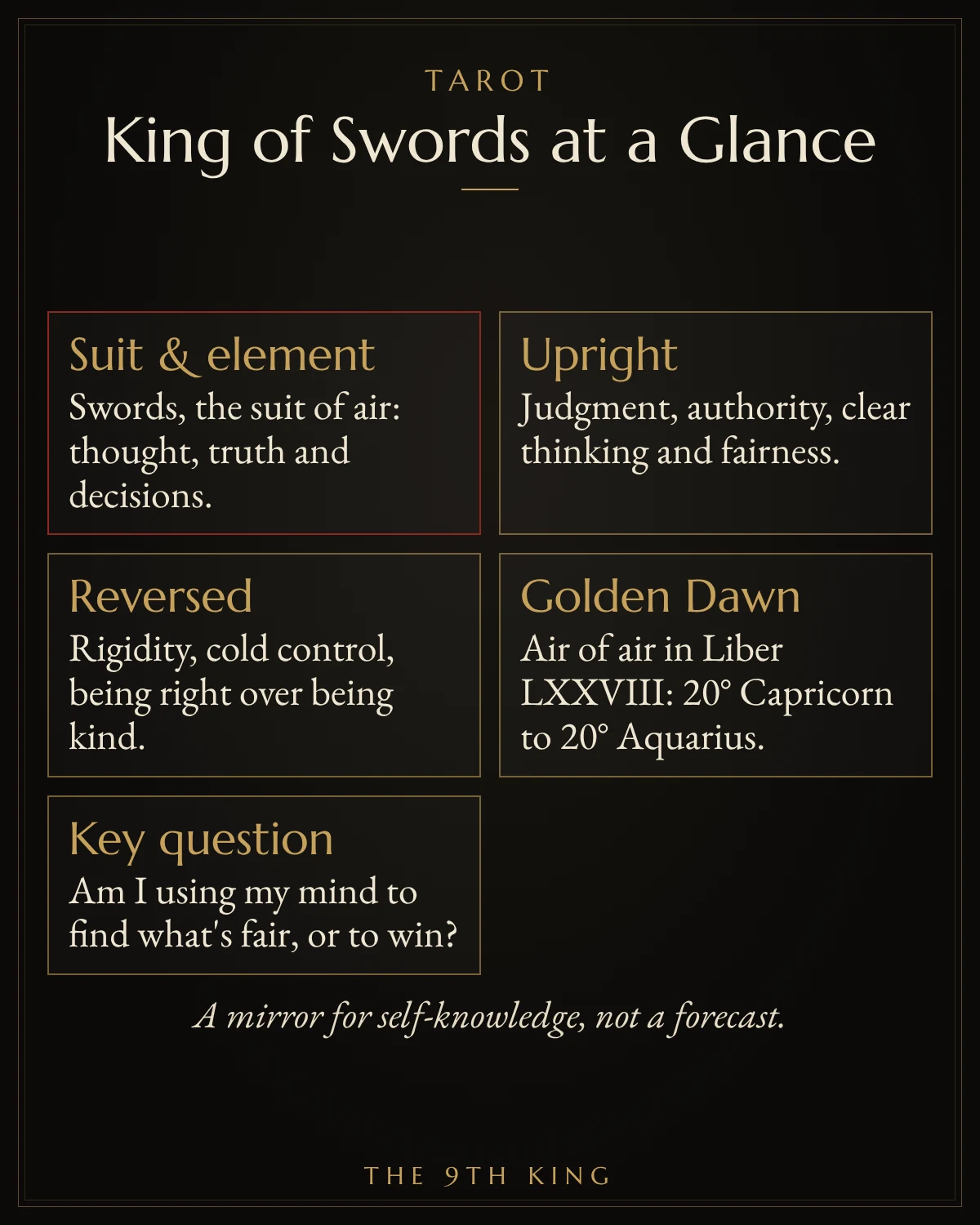
The King of Swords at a glance
| King of Swords | |
|---|---|
| Arcana | Minor Arcana, court card |
| Suit | Swords |
| Element | Air |
| Upright keywords | Judgment, authority, fairness |
| Reversed keywords | Rigidity, coldness, control |
| Shadow side | Being right over being kind |
| Self-mastery lesson | Judge the issue, not the person |
| Key question | Am I using my mind to find what’s fair, or to win? |
What’s on the card: the traditional imagery
The King of Swords most people picture comes from the Rider–Waite–Smith deck, illustrated by Pamela Colman Smith for the occultist A.E. Waite and first issued by Rider in 1909. Both were members of the Golden Dawn (Hyperallergic), which matters for correspondences.
Tarot itself is older. Decks were invented in Italy in the 1430s as playing cards and first adapted for fortune-telling in France around 1780 (Britannica). Britannica also notes the old shorthand that swords deal with conflict. We read that more broadly: Swords are where the mind meets hard truths.
The King in judgment
Waite’s description in The Pictorial Key to the Tarot is short and opens plainly: “He sits in judgment, holding the unsheathed sign of his suit” (sacred-texts.com). The sword is out of its sheath: ready and visible. Waite then makes two points, paraphrased here:
- He recalls Justice. The King reminds Waite of the figure of Justice in the Major Arcana, and he may stand for that virtue.
- But he’s more than a virtue. Waite says he is rather the power over life and death that his office gives him. In a reading, that’s the full weight of final decisions.
That second point is the heart of the card. Justice is the principle; the King of Swords is a person holding it, with all the strengths and risks a person brings. Our Justice tarot card guide covers the principle on its own.
On the 1909 Smith card, the King faces the viewer directly, and butterflies are worked into his throne. Neither detail is in Waite’s text. The butterflies suit an air card, and the Golden Dawn’s description of this court figure, covered below, includes butterfly-winged attendants, though we can’t say Smith or Waite intended the link.
How to read the picture
A seated king has arrived. The Page of Swords is still learning the suit and the Knight is still in motion; the King has settled on what he believes and taken responsibility for applying it. His drawn sword says he isn’t vague.
New to reading cards as scenes? Code of Ascension’s Tarot for Beginners: How Tarot Really Works (Code of Ascension) covers the basics.
King of Swords meaning: upright and reversed
Upright
Upright, readers often take it as mature judgment: a mind clear enough to see the whole situation and steady enough to decide. Waite’s divinatory meanings grow from that one idea: power, command, authority, a combative intelligence, law and offices of the crown (sacred-texts.com). Common upright themes:
- Fair judgment: weighing the facts before you weigh in.
- Principled authority: leading from a standard you’d apply to yourself too.
- Clear thinking: cutting through noise, spin and wishful thinking.
- Honest speech: saying the true thing plainly, without cruelty or fog.
- Responsibility: making the call that’s yours to make, and owning it.
A court card is most useful as a mirror for your own behavior. The upright King can point to a moment where you’re asked to stop circling and decide. Ask yourself: If I set my feelings about the people aside for one minute, what does fairness require here?
Readers sometimes take a court card as a person in your life: someone analytical, principled and direct. Hold that lightly. A card can’t tell you who someone is or why they act as they do. The useful question is what quality in that person am I being asked to notice, learn from or stop handing over?
Reversed
Reversed isn’t a “bad person” card. It’s the same sharp mind, pointed the wrong way. Waite’s reversed list is blunt: cruelty, perversity, bad faith and ill intent. On The 9th King we read that as a pattern, not a villain, in one of two directions:
- The mind turned hard: rigidity, harsh judgment, rules applied without mercy, logic used to corner people or shut them up.
- The mind turned crooked: clever arguments in service of what you already wanted, authority used for advantage, or decisions made coldly to avoid feeling anything.
Instead of fearing a harsh verdict, ask: Where has my clarity turned into control, or my fairness into coldness?

King of Swords in love, at work and as feelings
King of Swords as feelings
Asking about the King of Swords “as feelings” usually means how does someone feel about me? Tarot can’t read another person’s mind; what they say and do is the real evidence. The card can describe a kind of feeling worth reflecting on.
Upright, readers often take it as feelings that are respectful, serious and thought-through, shown through honesty and reliability more than poetry. Reversed, it can point to feelings that are guarded or critical: care that comes out as correction. The part you can read is your own: Do I feel respected around this person, and do I offer the same?
King of Swords in love
In love, the upright King can point to honesty, fairness and steadiness: keeping your word and arguing about the issue, not someone’s character. The catch: a sharp mind can treat a relationship like a debate. Ask yourself:
- When we disagree, am I trying to understand, or trying to win?
- Do I explain my feelings, or explain them away?
- Do I hold my partner to standards I don’t hold myself to?
Reversed, readers often see coldness, constant criticism or control through “being reasonable.” None of that tells you whether to stay or leave; only you can weigh that. If you keep falling for a “King of Swords,” psychological projection is worth a read: sometimes we’re drawn to the clarity we haven’t claimed in ourselves.
One plain line, because this card touches control: if someone uses logic or “just being honest” to belittle or dominate you, that’s their responsibility, not a debate you lost. You don’t have to out-argue anyone to leave a situation that isn’t safe.
King of Swords at work
At work, the King of Swords is the person trusted to make the hard call: the editor, the analyst, the manager who reads the whole report first. Readers often take it as encouragement to bring rigor, set clear standards or speak up about something that isn’t right.
The shadow version: the colleague who wins every meeting and loses every ally. This is reflection, not career or financial advice; the card asks how you judge, not what happens to your job or money. A quick check: After people disagree with me, do they feel heard, or just defeated?
Swords, air and the court-card naming trap
Swords as air
The Golden Dawn’s tarot teaching, printed by Aleister Crowley as Liber LXXVIII, calls the Ace of Swords “the Root of the Powers of Air” (Liber LXXVIII, sacred-texts.com). That’s the source of the Swords-air pairing this site uses. Air is the element of thought, language and decision, which is why the suit so often deals with hard conversations.
Golden Dawn–derived correspondences: the tradition The 9th King uses
Astrology links on The 9th King follow Golden Dawn–derived correspondences, the tradition the Rider–Waite–Smith deck draws on. Other schools differ, and not every card maps to a single zodiac sign. Court cards work differently: in the Golden Dawn system, each is read as an element within an element.
The naming trap
The Golden Dawn and the Rider–Waite–Smith deck don’t use the same court titles. The 9th King follows the court-card naming in Liber LXXVIII (the Golden Dawn’s Book T): Knights are fire of their suit, Queens water, Kings air, Pages earth. In that text, the card it labels “King of Swords” is the Prince, and the “Knight of Swords” is the Golden Dawn King (Liber LXXVIII). Matching those titles to the Rider–Waite–Smith cards is 9K’s convention, not something the source says about Waite’s deck. Other systems match them differently.
| Rider–Waite–Smith card | Golden Dawn title | Element pairing |
|---|---|---|
| Knight of Swords | King of the Spirits of Air | Fire of air |
| Queen of Swords | Queen of the Thrones of Air | Water of air |
| King of Swords | Prince of the Chariot of the Winds | Air of air |
| Page of Swords | Princess of the Rushing Winds | Earth of air |
So on this site the King of Swords is air of air: the element at its most concentrated. That fits a card about pure judgment, and it explains the risk. Air with nothing to ground or warm it can turn cold.
What Liber LXXVIII says about this Prince
Liber pictures a winged king in a chariot drawn by butterfly-winged figures above grey clouds, holding a drawn sword and a sickle (Liber LXXVIII). It calls him “full of ideas and thoughts and designs,” and, in paraphrase: suspicious, firm in friendship and in enmity, careful, observant, slow and over-cautious, ending things as fast as he creates them.
Ill dignified, it lists harshness, malice, plotting, stubbornness mixed with hesitation, and unreliability: close to the reversed meanings readers use today.
The same text gives this Prince a stretch of the sky: from 20° Capricorn to 20° Aquarius (Liber LXXVIII). That’s a span across two signs, so the King of Swords isn’t “the Aquarius card.” If you have planets in late Capricorn or early Aquarius, the Capricorn and Aquarius pages are useful context.
The air signs, as element links
The King of Swords also shares its element with the three air signs: an element link, not “this card equals this sign.” If you have strong air in your chart:
- Gemini personality traits: the quick mind, and the pull toward arguing both sides forever.
- Libra traits: the sense of fairness, and the risk of weighing so long you never decide.
- Aquarius personality traits: principle and perspective, and the habit of keeping people at a distance.
Not sure where air sits in your chart? How to read a birth chart shows where to look.
The 9K reading: tension, shadow and self-mastery
Here The 9th King’s reading goes beyond keywords. The King of Swords teaches how to be fair without becoming cold.
The tension: principle versus people
A fair decision needs distance: you step back from your feelings and loyalties to see what’s true. But decisions land on people, and people aren’t arguments. The further the King steps back, the clearer he sees, and the easier it is to forget someone is on the other end of the verdict. The closer he stands, the more his judgment bends.
Most people lean one way. Some go cold and call it objectivity. Others avoid judging anything and call it kindness, while the hard decision sits unmade.
The shadow side
Shadow work means looking at what you’d rather not see in yourself. Our zodiac shadow work guide describes the air signs’ gift as clarity, fairness and perspective, and their shadow as detachment, judgment, intellectualizing feelings and people-pleasing. The King of Swords carries a crowned version of that shadow:
- Being right over being kind: winning the point and losing the person.
- Logic as a weapon: using a calm voice and a tidy argument to make someone else’s feelings look foolish.
- Judging the person, not the issue: turning “that was a bad decision” into “you are a bad decision-maker.”
- Coldness as armor: staying in your head so you never have to feel the cost of what you decide.
If shadow work is new to you, Shadow Work, Plainly explains how to begin safely.
| Strength | When it’s overused | One way to rebalance |
|---|---|---|
| Fair judgment | Harsh verdicts | Ask what mercy would cost |
| Authority | Control | Explain the why, not just the rule |
| Clear thinking | Rigidity | Name one fact that could change your mind |
| Honest speech | Cutting words | Say it true, then say it kind |
| Responsibility | Carrying it alone | Ask the people affected first |
The self-mastery lesson: judge the issue, not the person
A sword separates one thing from another. Used well, it separates the problem from the person and the fact from the feeling. The lesson is to keep the blade on the issue. In practice:
- Before you decide, state the other side’s best case well enough that they’d agree with it.
- Separate what you observed from what you assumed.
- Hold yourself to the same rule you’re about to apply to someone else.
- Let new facts change your mind. A ruler who can’t be corrected isn’t fair; he’s just in charge.
Being right matters. But fairness that leaves no room for the person isn’t the King’s best self.
Journal prompts for the King of Swords
- Where am I avoiding a decision that is clearly mine to make?
- When did I last win an argument and lose something more important?
- Which rule do I apply to others that I quietly excuse in myself?
- Whose sharp mind do I admire, and what would it look like to claim that clarity kindly?
- Am I using my mind to find what’s fair, or to win?
Our shadow work prompts collection goes deeper.
A short, important note: these prompts are for reflection, not therapy. If you’re dealing with trauma, abuse, thoughts of self-harm or distress that feels overwhelming, please work with a qualified therapist who can support you safely. It’s always fine to stop a prompt that feels like too much.
Practical exercise: the fair verdict check
Use this before a decision, a hard conversation or a reply you’re tempted to send while certain you’re right. It takes about fifteen minutes and a sheet of paper.

- Name the call. Write one line: the decision you’re making or the conflict you’re judging.
- List the facts. Write only what you saw, heard or can check. Put guesses about anyone’s motives in a separate column.
- Make their case. Write the other side’s position as well as they would. If you can’t, you’re not ready to judge it yet.
- Check your motive. Ask honestly: is this about what’s fair, or about being proven right? Both can be present. Notice which one is driving.
- Count the cost. Who does this decision land on, and how? Not to soften the truth, but to see who lives with it.
- Deliver it whole. Decide what you’ll say or do, then shape it so it’s true, clear and kind. If one of the three is missing, rewrite it.
The aim isn’t to stop judging. It’s to make judgments you’d be willing to have judged. To pair this with a card pull, Code of Ascension’s Intuitive Tarot (Code of Ascension) shows how to combine traditional meanings with first impressions.
Two worked examples (fictional)
Example 1 (fictional): the manager who always wins the meeting. Priya pulls the King of Swords upright while preparing a performance review. Her first thought: I’m fair; I just say what’s true. The check slows her down. Her facts column is short and her assumptions column is long, and she’s never asked why two deadlines slipped. Her adjustment: one question before any verdict. The card predicted nothing. It showed her a step she was skipping.
Example 2 (fictional): the friend who won’t decide. Theo pulls the King of Swords reversed while stuck between two friends who’ve fallen out. He’s said “I see both sides” for weeks. At step four he notices his motive isn’t fairness; it’s avoiding anyone being upset with him. His adjustment: tell each friend what he thinks and that he won’t carry messages. His shadow question: Am I calling it neutrality when it’s really fear of being judged?
Both are reflections to test against real life.
Myths and misreadings about the King of Swords
- “The King of Swords is always a man.” Court titles describe energy and rank, not gender. Anyone can carry King of Swords energy.
- “It means a court case is coming.” A card can’t establish facts about the future. Waite links this card with law, but on this site it’s a question about how you judge.
- “Swords cards are bad news.” Swords deal with the mind and hard truths, and hard truths can be the most useful thing in a reading.
- “It’s the Aquarius card.” In Liber LXXVIII its span runs across late Capricorn and early Aquarius, and it shares the air element with Gemini, Libra and Aquarius. We don’t assign it one sign.
King of Swords: FAQ
What does the King of Swords mean?
The King of Swords is the mature figure of the Swords, the air suit. Upright, readers often take it as fair judgment, principled authority, clear thinking and honest speech. A.E. Waite describes him sitting in judgment with his sword drawn. On The 9th King it’s a mirror, not a prediction. It asks whether you’re using your mind to find what’s fair, or simply to win.
What does the King of Swords reversed mean?
Reversed, the King of Swords usually points to a sharp mind out of balance. Readers often see rigidity, harsh judgment, coldness, or logic used to control people. It can also point to refusing to decide at all. Waite’s reversed list is blunt, including cruelty and bad faith, but on this site it’s a pattern to notice. Ask where your clarity has turned into control.
What does the King of Swords mean as feelings?
Tarot can’t read another person’s mind, so on The 9th King “as feelings” is a prompt about the kind of feeling involved. Upright, the King of Swords suggests respectful, serious, honest feelings, shown through reliability more than romance. Reversed, it suggests feelings held at a distance or expressed as criticism. The most reliable guide is what someone says and does, plus your own sense of whether you feel respected.
What does the King of Swords mean in love?
In love, the upright King of Swords is often read as honesty, fairness and steadiness: a partner who keeps their word and argues about issues rather than character. The challenge is treating love like a debate. Reversed, readers often see coldness or control through being “reasonable.” The card doesn’t tell you whether to stay or leave. It asks whether you’re trying to understand your partner or trying to win.
Is the King of Swords a yes or no card?
The 9th King doesn’t do yes-or-no readings, because tarot here is a tool for self-knowledge rather than prediction. Try a reflective question the King of Swords is good at instead: “If I looked only at the facts and the other side’s best case, what would a fair decision be?” Your answer usually tells you more than a yes or no could.
What zodiac sign is the King of Swords?
In the Golden Dawn naming The 9th King follows (Liber LXXVIII), the King of Swords is the Prince of the Chariot of the Winds: air of air, ruling from 20° Capricorn to 20° Aquarius. As an air-suit card it also shares an element with Gemini, Libra and Aquarius. Read that as one tradition’s map and a set of themes to reflect on, not a single sign.
How is the King of Swords different from Justice?
Waite says the King recalls the figure of Justice in the Major Arcana. The difference is that Justice is the principle, while the King of Swords is a person holding it, with the authority of an office and all the human blind spots that come with it. Justice asks what’s fair. The King asks how you, specifically, are applying fairness right now.

Your next step: bring the King of Swords into your own chart. Find where the air signs sit in your birth chart, read the air-sign shadow in our Zodiac Shadow Work guide, then try one fair verdict check before your next hard conversation.
Explore Next
- The shadow side of every sign: Zodiac Shadow Work
- Start shadow work safely: Shadow Work, Plainly
- The principle behind the King: Justice
- Air that weighs both sides: Libra Traits
- Air that keeps its distance: Aquarius Personality Traits
- More tarot on The 9th King: Tarot Card Meanings · Minor Arcana · Tarot & the Zodiac · King of Wands · King of Cups · The Emperor · Shadow Work Tarot Spread
- More cards in this set: Ace of Swords · Page of Swords · Knight of Swords · Queen of Swords

Final Thought: Keep the Blade on the Issue
The King of Swords isn’t asking you to think less sharply. He’s asking you to point that sharpness at the problem, never the person, and to measure your judgment by whether it was fair, not whether you won. Know your nature. Rule your life.
About the Author
King is the founder of The 9th King, where zodiac psychology, relationships and shadow work are explored as tools for self-knowledge rather than fortune-telling. He’s a Libra Sun, and writes about the personal side of astrology on King The Kemist. Astrology on The 9th King is interpretation and self-reflection, not prediction or established fact.
Leave a Reply