

Quick Answer: What Is Shadow Work?
Shadow work is the practice of noticing the parts of yourself you’ve rejected, hidden or never developed, and getting curious about them instead of defending against them. The idea comes from the Swiss psychiatrist Carl Jung, who called those hidden parts the shadow.
- The shadow isn’t only “bad.” It also holds strengths you were taught to push away.
- You usually meet it in other people first. Strong reactions to someone else are often a clue.
- The practice is simple and uncomfortable: notice, question, find the useful version, and take one small step.
- Astrology can be a vocabulary for it, but it isn’t evidence about your psyche.
“Shadow work” is everywhere now, often sold as a 30-day journal challenge. The idea behind it is older and more demanding than that, and also more useful.
Table of Contents
Where the idea comes from
The term comes from Carl Gustav Jung (1875–1961). In Jung’s analytical psychology, the shadow is roughly the parts of yourself you don’t identify with: traits, impulses and feelings you’ve pushed out of your self-image because they felt unacceptable. Jung wrote about it in several places, most directly in Aion (1951).
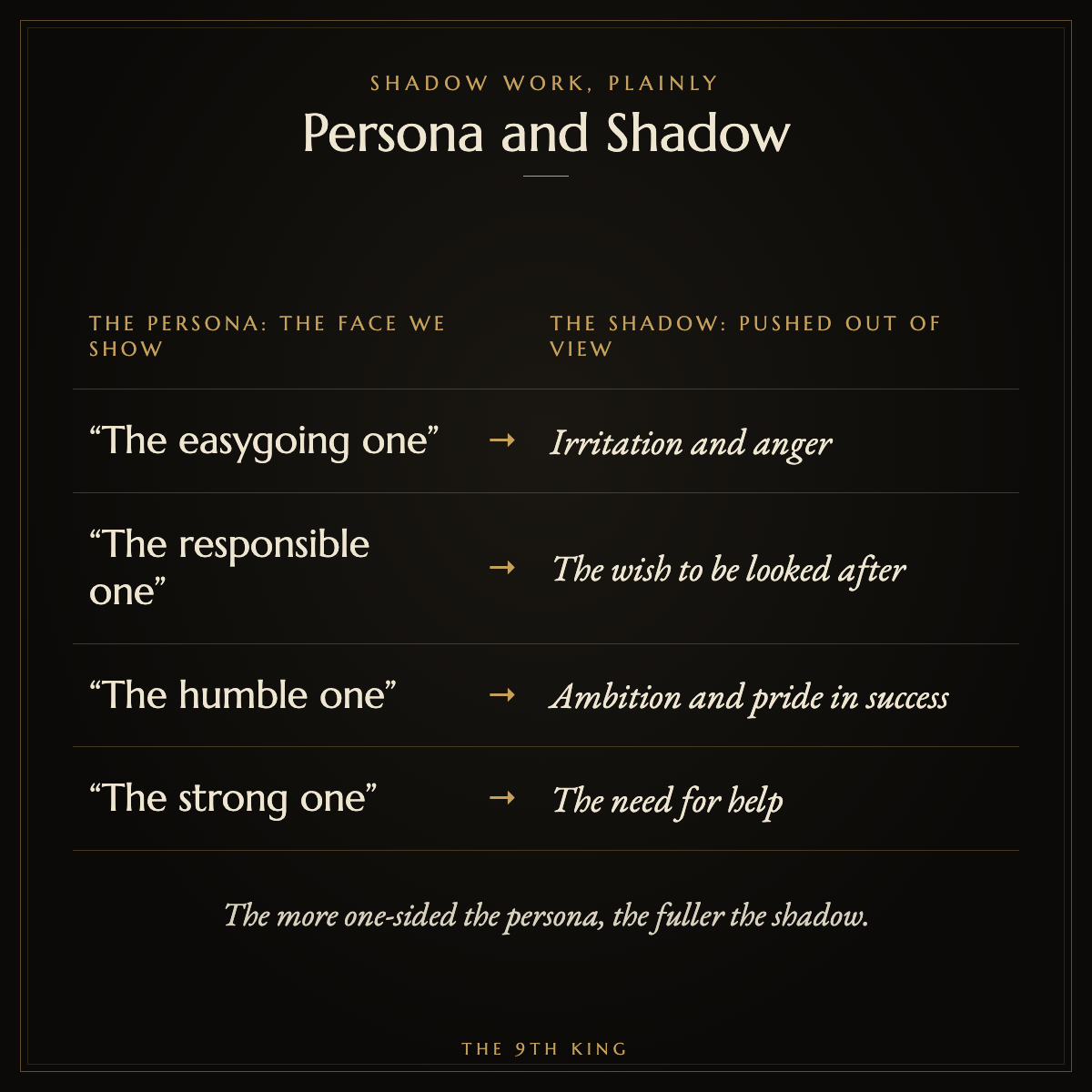
Jung set the shadow against the persona, the social mask we wear to fit in. The persona isn’t fake. It’s necessary. But the more tightly we identify with it, the more of ourselves ends up in the shadow.
Two of Jung’s points matter most here.
- The shadow isn’t only “bad.” It holds whatever got pushed aside, and that can include strengths, like ambition, anger that’s actually healthy, or creativity you were told was impractical. Later writers sometimes call this the “golden shadow.”
- We tend to see it in other people first. Jung called this projection. A trait you can’t stand in someone else is sometimes a clue to something you’ve refused in yourself.
That’s a summary of Jung’s ideas, not settled science. Analytical psychology is one school of thought among many, and “shadow work” as a self-help practice goes well beyond what Jung himself set out.
How the shadow forms
Nobody chooses a shadow on purpose. It forms gradually, usually in childhood, through thousands of small lessons about what gets love and what gets disapproval.
A child who is praised for being calm and scolded for being loud learns that loudness is dangerous. A child whose sadness makes the adults uncomfortable learns to hide sadness. A child told that wanting things is greedy learns to stop wanting out loud.
Those traits don’t vanish. They go underground and come out sideways: as sudden anger, as envy, as a harsh judgment of someone who does freely what you were not allowed to do.
The same thing happens later in life through school, religion, work, culture and relationships. Every group has rules about what’s acceptable, and every rule creates a little more shadow.
None of this means anyone did anything wrong. Families and cultures have to teach some limits. Shadow work is simply the adult job of looking at those old rules and deciding which ones still serve you.
What shadow work actually asks
Underneath the trend, the practice is simple and uncomfortable: notice what you reject, and get curious about it instead of defending against it.
In practice that looks like:
- Track your strongest reactions. When someone irritates you far more than the situation deserves, write down exactly what they did.
- Ask what it would mean if you did that. If the answer is “I’d be selfish” or “I’d be too much,” you’ve probably found a rule you live by, and maybe a part of you that rule cut off.
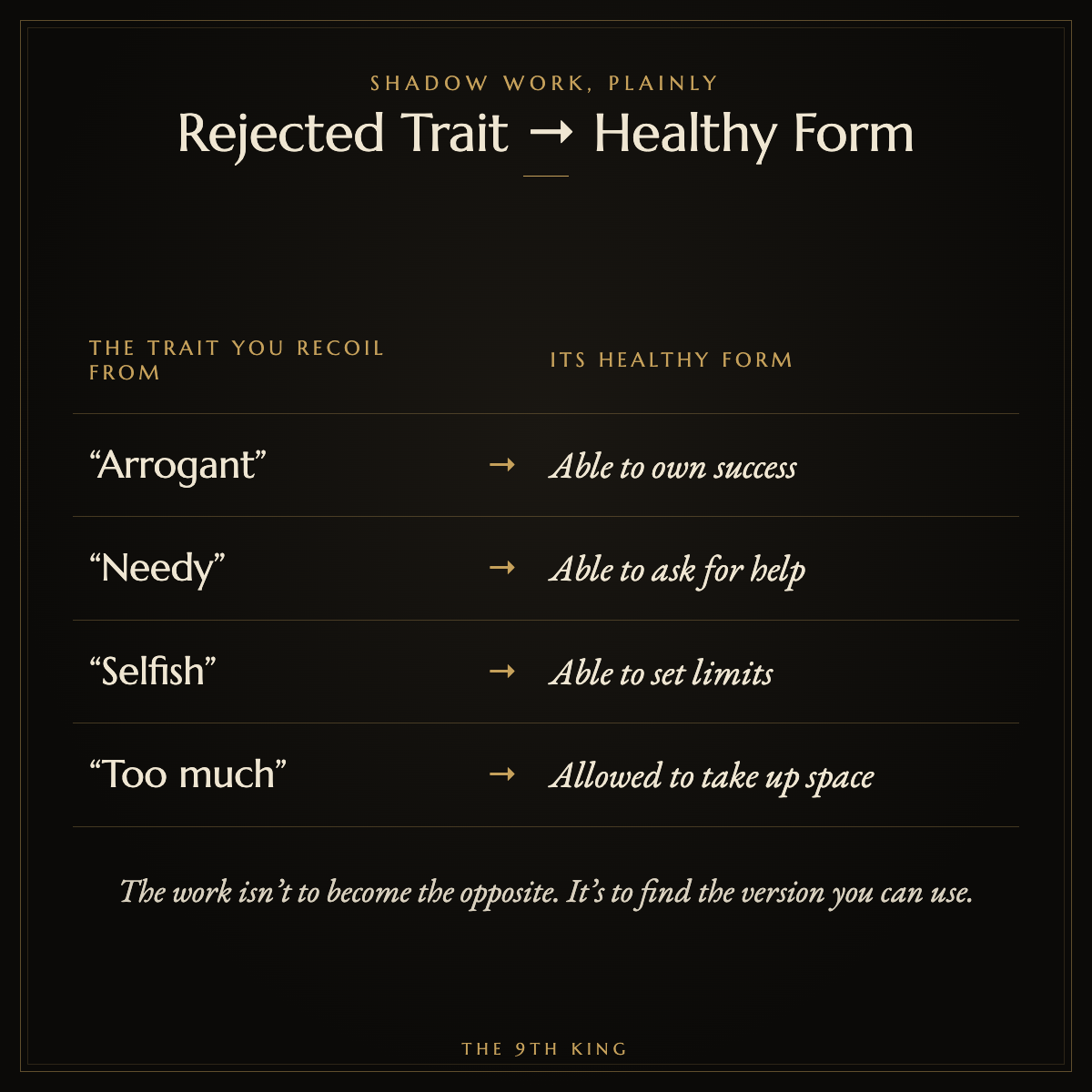
- Look for the useful version. Rejected traits often have a healthy form. “Selfish” might really be “able to say no.” “Too much” might really be “allowed to take up space.”
- Try the healthy version in a small way. Integration happens through behaviour, not insight alone.
None of this replaces therapy. If old pain comes up that feels like too much to handle alone, that’s a reason to talk to a professional, not to push through on your own.
Rejected traits and their healthy versions
Here are some of the most common shadow traits, and the useful quality hiding inside each one:
- Selfishness often hides the ability to say no and protect your time.
- Anger often hides healthy boundaries and the courage to object.
- Neediness often hides the ability to ask for care.
- Arrogance often hides self-respect and confidence.
- Laziness often hides the capacity to rest without guilt.
- Being “too emotional” often hides depth and sensitivity.
- Being “too much” often hides presence and the right to take up space.
- Ambition that was called greed often hides real drive and leadership.
- Coldness often hides the ability to stay calm and clear under pressure.
The aim isn’t to become selfish, angry or arrogant. It’s to reclaim the healthy version so it stops leaking out in unhealthy ways.
Projection: how you meet your shadow
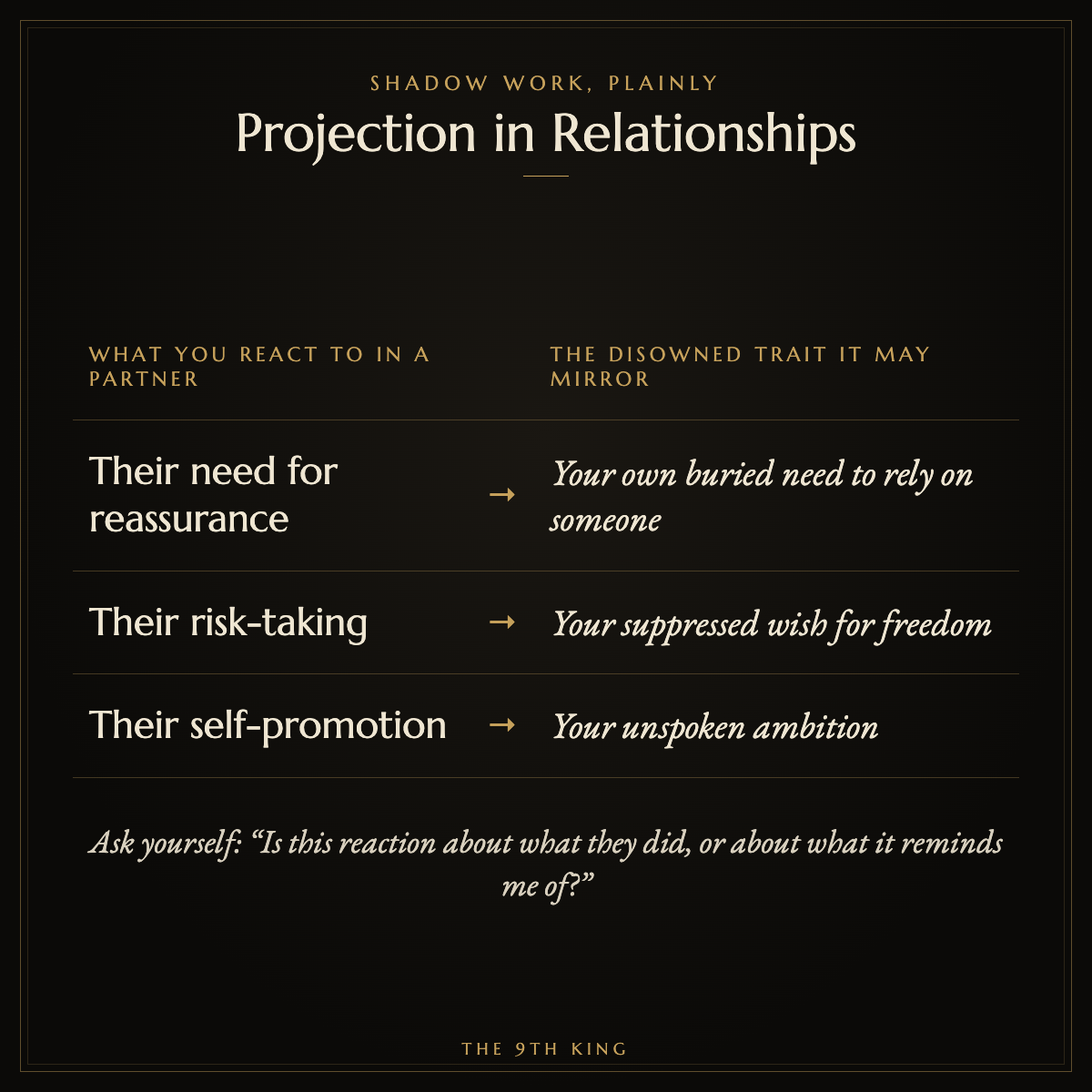
Projection is the shadow’s favourite hiding place. It means seeing a disowned part of yourself in someone else, often with an emotional charge out of proportion to what they did.
A few signs that projection may be involved:
- Your reaction is bigger than the situation. Someone is a little late and you feel furious.
- You keep meeting the same “type.” Different people, same trait, same irritation.
- Other people don’t see it the way you do. Your friends shrug at the trait that drives you mad.
- The feeling is moralised. It’s not just “I don’t like that.” It’s “people like that are wrong.”
Not every strong reaction is projection. Sometimes people really do behave badly, and your reaction is a fair one. The question isn’t “Am I wrong to be annoyed?” It’s “Is there anything of mine in this?”
There’s also positive projection: admiring someone so intensely that you overlook your own capacity for what you admire. That’s the golden shadow at work.
Shadow work myths
Because shadow work has become popular online, a few myths travel with it.
Myth: shadow work means dwelling on darkness. In practice, it’s mostly about noticing ordinary reactions in ordinary days, and many of the traits you find turn out to be strengths.
Myth: you can finish it in 30 days. A month of prompts can be a good start. But the shadow keeps forming as life changes, so the practice is ongoing.
Myth: everyone who annoys you is a mirror. Sometimes people are simply behaving badly. Projection is a possibility to check, not a rule that explains every conflict.
Myth: shadow work is spiritual bypassing in reverse. Done well, it’s the opposite of bypassing. It asks you to face uncomfortable feelings rather than rise above them.
Myth: you have to relive every painful memory. You don’t. Much of the useful work happens in the present, through small changes in how you react and what you allow yourself to do.
Myth: integrating the shadow makes you a worse person. Owning your anger usually makes you less aggressive, not more, because it stops coming out sideways.
A simple weekly shadow work practice
You don’t need a special journal or a 30-day programme. A short weekly routine is enough to start.
Once a day, note one strong reaction. A line or two is enough: who, what, and how you felt.
Once a week, read back your notes. Look for repeating themes. Is it always people who show off? Always people who seem lazy? Always people who say no?
Pick one theme and ask three questions.
What rule did I learn about this?
Who taught me that rule?
What would the healthy version of this trait look like in my life?
Choose one small action. If the theme is “people who say no,” your action might be to decline one request this week without over-explaining.
Notice what happens. Not every experiment feels good. That’s normal. What matters is that you’re bringing the trait into the open where you can choose what to do with it.

What astrology adds
Astrology isn’t evidence about your psyche. What it can be is a vocabulary for self-reflection: a set of images to test against your own experience. Jung himself was interested in astrology as symbolism, though that’s not the same as endorsing it as a science.
Used that way, a chart offers a few starting points:
- Your Sun sign’s shadow. Each sign has a strength that turns into a trap when it’s overused. Leo’s need to be seen can turn into needing proof. Virgo’s eye for detail can turn into feeling like nothing is ever good enough.
- Your Moon sign. It’s often read as your private, instinctive self, which makes it a natural place to look for feelings you learned to hide.
- The signs that annoy you most. If one sign “always” gets on your nerves, ask what it does freely that you don’t let yourself do.
- Saturn and Pluto placements. Astrologers traditionally read these as where we meet pressure, fear and transformation. They’re symbols, not destiny, but they make useful prompts.
- The 12th house and your Descendant. The 12th house is traditionally the hidden part of the chart. The Descendant, opposite your Rising sign, often describes what you project onto partners.
Our guide to zodiac shadow work goes through the gift and shadow of all twelve signs in detail, and our guide on how to read a birth chart explains how to find each of these placements.
The test is always the same: does this description help you see something true that you were avoiding? If it does, use it. If it doesn’t, drop it.
Two worked examples (fictional)
Example 1: The person who hates show-offs
The reaction: Maya feels a flash of contempt whenever a colleague talks about their achievements. Other people in the office find the colleague mildly annoying at most.
The rule: Maya grew up hearing that talking about yourself was vain. She learned to keep her successes quiet.
The healthy version: being able to name what she’s good at, without shrinking it or inflating it.
The small action: in her next one-to-one with her manager, Maya names one thing she did well this month. It feels uncomfortable. Her irritation with the colleague softens over the next few weeks.
Example 2: The person who never gets angry
The reaction: Daniel prides himself on never losing his temper. But he often feels drained after social events and sometimes snaps at small things when he’s tired.
The rule: in his family, anger led to frightening arguments. He decided early that he’d never be like that.
The healthy version: being able to say “I’m not okay with that” calmly, at the time, before resentment builds.
The small action: Daniel practises saying one small “no” or “I’d rather not” each day. He notices he snaps less, because less is building up.
In both cases, nothing dramatic happens. That’s what real shadow work usually looks like.
Shadow work in relationships
Close relationships are where the shadow shows up most clearly, because they’re where we feel most exposed. Partners, family and close friends see the parts of us that colleagues and acquaintances never do.
A few common patterns:
- Choosing partners who carry your shadow. A very agreeable person may be drawn to someone blunt and forceful, then spend years resenting that bluntness. Part of the attraction may be that the partner expresses something the agreeable person never lets themselves express.
- Repeating family roles. The “responsible one” in a family often keeps being the responsible one in every relationship, and quietly resents it. The shadow here is the wish to be looked after.
- Arguments about the same thing. If the same fight keeps coming back in different forms, it’s often touching something unresolved in one or both people.
The useful question in a relationship isn’t “What’s wrong with them?” It’s “What is this showing me about myself?” That doesn’t excuse genuinely harmful behaviour. Shadow work never means accepting mistreatment. It means taking responsibility for your own side.
Signs shadow work is helping
Progress tends to be quiet. Over weeks and months, look for:
- Smaller reactions. The same triggers still appear, but they pass faster.
- More choice. You notice the old pattern starting and sometimes choose differently.
- Less judgment of others. Traits that used to infuriate you become merely noticeable.
- More energy. Holding parts of yourself down takes effort. Many people notice they feel less tired once they stop.
- More honesty in close relationships. Fewer silent grudges, more direct conversations.
If things seem to get worse, or old pain becomes hard to manage, slow down and get support. That’s a sign to be gentler, not to push harder.
Common mistakes in shadow work
- Turning it into self-punishment. The goal is curiosity, not finding more things to hate about yourself.
- Treating it as a quick fix. The shadow integrates slowly, through repeated small choices.
- Using it to diagnose other people. “You’re projecting” is rarely a helpful thing to say in an argument.
- Only looking for darkness. The golden shadow, the strengths you disowned, matters just as much.
- Going too deep alone. Trauma, abuse and intense emotions deserve professional support.
- Confusing insight with change. Understanding a pattern is a start. Behaving differently is the work.
Five journal prompts
- Who irritates me more than they seem to irritate anyone else? What exactly do they do?
- What was I praised for as a child? What was I criticised or punished for?
- Finish the sentence: “I would never be the kind of person who…” What would the healthy version of that look like?
- Who do I admire so much that it feels uncomfortable? What quality of theirs might I have in myself?
- What is one small, safe way I could practise a rejected trait this week?

Shadow Work: FAQ
What is shadow work in simple terms?
It’s noticing the parts of yourself you’ve rejected or hidden, getting curious about them, and finding healthy ways to bring them back into your life.
Where does the idea of the shadow come from?
From Carl Jung, the Swiss psychiatrist who founded analytical psychology. He wrote about the shadow most directly in Aion (1951).
Is shadow work the same as therapy?
No. It’s a self-reflection practice. Some therapists use related ideas, but if you’re dealing with trauma or mental health difficulties, a qualified professional is the right place to start.
Is shadow work dangerous?
It can stir up painful memories and strong feelings. Go slowly, be gentle with yourself, and get support if it becomes overwhelming.
What is projection?
Seeing a part of yourself that you’ve disowned in someone else, often with a strong emotional reaction. It can be negative (irritation, contempt) or positive (intense admiration).
What is the golden shadow?
A term used by later Jungian writers for the positive qualities we disown, such as confidence, creativity or leadership. We often notice them first as intense admiration for someone else.
What is the difference between the persona and the shadow?
The persona is the social face you show the world. The shadow is what gets left out of it. The more rigidly you identify with your persona, the more ends up in the shadow.
How do I start shadow work?
Start by noting your strongest reactions to other people for a week. Then look for patterns and ask what rule you learned about that trait.
Do I need astrology for shadow work?
No. Astrology is one optional vocabulary. The practice works with or without it.
How long does shadow work take?
There’s no finish line. It’s an ongoing practice, usually done in small steps over months and years.
Is any of this scientifically proven?
Jung’s shadow is a psychological concept rather than a tested scientific finding, and astrology is not science. On The 9th King, both are tools for reflection, not established fact.

Explore Next
- Shadow by sign: Zodiac Shadow Work
- Start with the chart: How to Read a Birth Chart
- The sign of the hidden: Scorpio Season: What the Hidden Asks
- Needing space without mixed signals: Privacy Without Mixed Signals
- The wider practice: Shadow Work Meaning (Code of Ascension)
- Going deeper: C. G. Jung, Aion: Researches into the Phenomenology of the Self (1951), Collected Works vol. 9 part II, chapter 2, “The Shadow”
Final Thought: Whole, Not Perfect
Shadow work isn’t about becoming darker or more spiritual. It’s about becoming whole, taking back the parts of yourself you gave away to keep the peace. Know your nature, including the parts you’d rather not.

About the Author
King is the founder of The 9th King, where zodiac psychology, relationships and shadow work are explored as tools for self-knowledge rather than fortune-telling. Astrology on The 9th King is interpretation and self-reflection, not prediction or established fact. Jung’s ideas are summarised here for context; this article is not psychological or medical advice.