
Quick Answer: What Is the 9th King Shadow Work Tarot Spread?
The 9th King Shadow Work Tarot Spread is an original seven-card layout designed by The 9th King. It uses tarot as a mirror for self-reflection, not as a way to predict anything. The cards help you look at a part of yourself you usually hide, then guide you back to one small, practical step.
The seven positions:
- The Mask: what I show the world.
- What I Don’t Show: the part I keep hidden.
- Where I Project It: where I see it in other people.
- What It Protects: the job this pattern was doing for me.
- What It Wants: the need underneath.
- The Integrating Step: one small action I can take this week.
- The Gift: the strength hiding inside the shadow.
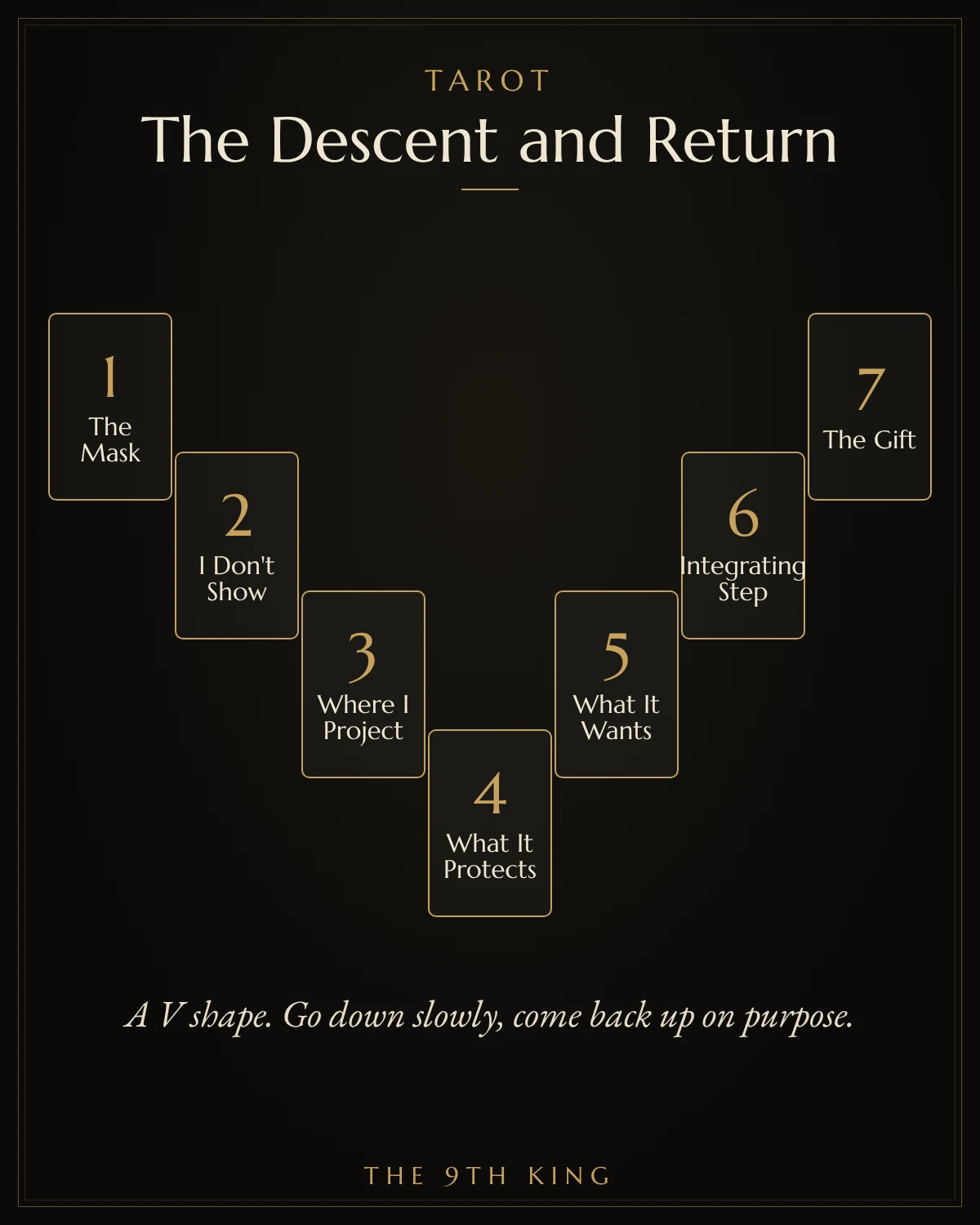
The cards are laid in a V shape: three cards down the left arm (going deeper), one at the bottom point (the deepest), and three up the right arm (coming back). For a quick version, pull only The Mask, What It Protects and The Integrating Step.
Go slowly, write things down, and stop whenever a prompt feels like too much.
Table of Contents
Shadow work, plainly: where the idea comes from
The shadow in one sentence
The idea comes from the Swiss psychiatrist Carl Jung, who founded analytic psychology, partly as a response to Freud’s psychoanalysis (Britannica: Carl Jung). In Jung’s thinking, the shadow is the part of your personality that doesn’t fit the picture you hold of yourself, so you push it out of view.
The Society of Analytical Psychology, a London-based Jungian organization, describes the shadow as “that hidden, repressed, for the most part inferior and guilt-laden personality” (SAP: The Shadow). The same page makes two points that shape this whole spread:
- The shadow isn’t only negative. It also holds good qualities, capacities and potential you haven’t let yourself use.
- You usually meet it in other people first. We tend to notice it through projection: the traits that irritate us most in others are often ones we struggle with ourselves.
It also contrasts the shadow with the persona, the side that faces the outside world, and links accepting the shadow with self-acceptance and becoming more whole. Those ideas shape The Mask, the Projection and The Gift positions.
Our guide Shadow Work, Plainly gives the longer version. One honest note: the shadow is a psychological concept and a useful way of thinking, not a tested scientific finding.
Why tarot fits shadow work
Tarot began as a card game. Decks were developed in 15th-century Italy, and the cards were first adapted for occult and fortune-telling use in France around 1780 (Britannica: Tarot). A standard deck has 78 cards: 22 Major Arcana and 56 Minor Arcana in four suits of 14.
On The 9th King, tarot isn’t about what will happen. It’s 78 images that give you something to react to, and that reaction is the material. That makes it a natural partner for shadow work, which is mostly about noticing reactions you’d normally skip past. Code of Ascension’s intuitive tarot guide (Code of Ascension) covers the “first impression” style of reading that works well here.
The spread at a glance: an original 9th King design
This is an original spread designed by The 9th King. Plenty of readers have built their own shadow spreads. This one is ours, and it follows the same arc as the practice in our zodiac shadow work guide, from noticing a pattern, to understanding what it protects, to finding its gift and taking one small action.
The layout: a V for descent and return
- Left arm (going down): Card 1 sits at the top left. Card 2 goes below it and slightly to the right. Card 3 goes below that, again slightly to the right.
- The bottom point: Card 4 sits alone at the lowest, central point of the V. This is the deepest card in the spread.
- Right arm (coming back up): Card 5 sits just above and to the right of Card 4. Card 6 goes above that, again slightly to the right. Card 7 sits at the top right, level with Card 1.
The Mask (1) and The Gift (7) sit at the same height, facing each other across the valley, because the face you show and the strength you’ve hidden are often two versions of the same energy. On a small table, a straight line works too; just keep the order.
The seven positions
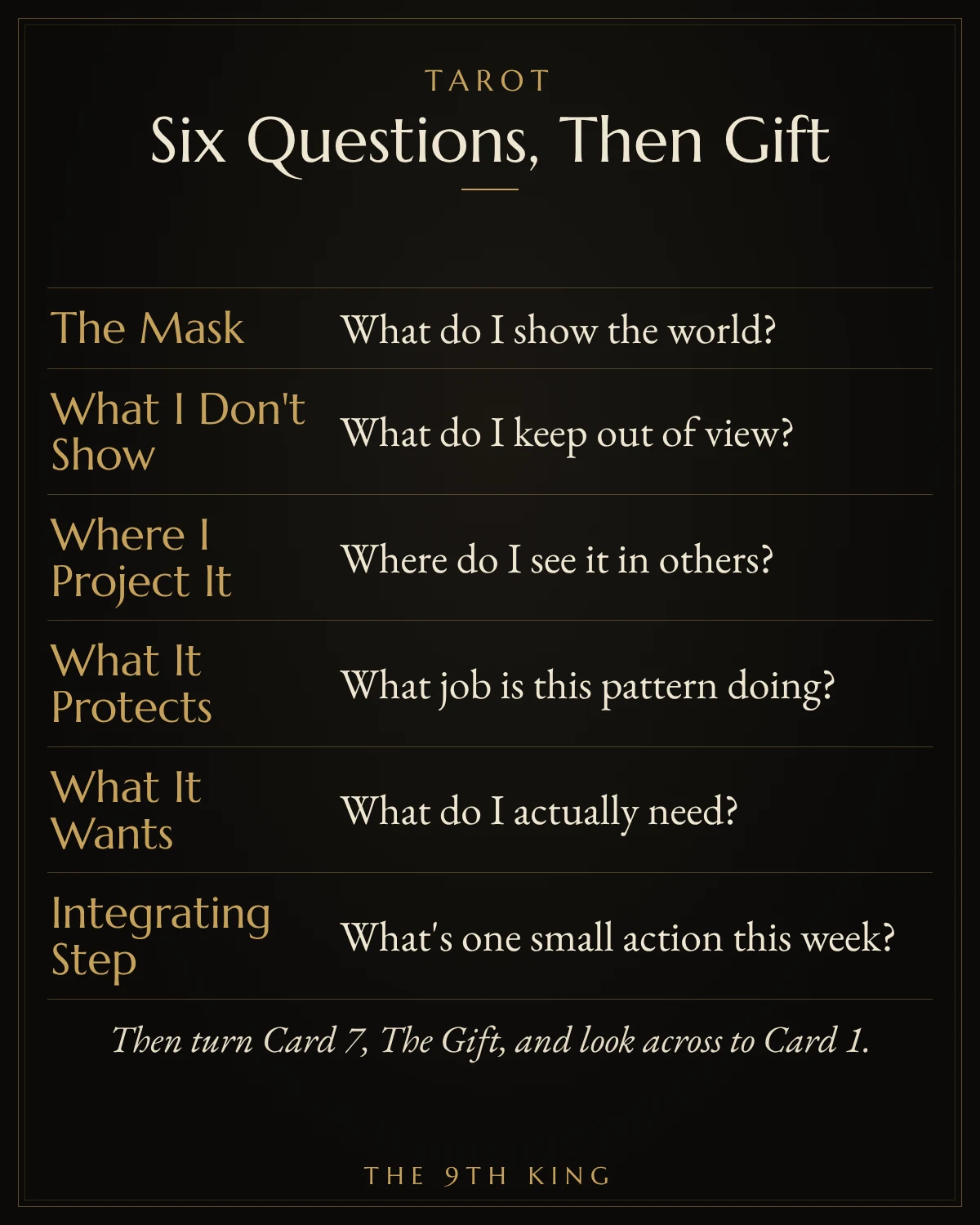
| # | Position | The question it asks |
|---|---|---|
| 1 | The Mask | What do I show the world? |
| 2 | What I Don’t Show | What do I keep out of view? |
| 3 | Where I Project It | Where do I see it in others? |
| 4 | What It Protects | What job is this pattern doing? |
| 5 | What It Wants | What do I actually need? |
| 6 | The Integrating Step | What’s one small action? |
| 7 | The Gift | What strength is hiding here? |
Before you begin: how to use this spread safely
A warm note first. This spread is meant to be thoughtful rather than heavy. But if you’re dealing with trauma, abuse, thoughts of harming yourself or distress that feels overwhelming, please work with a qualified therapist rather than on your own with a deck. And at any point in this spread, it’s completely fine to stop a prompt, set the card aside or put the whole deck away.
A shadow spread asks about patterns, not painful events. You never need to replay a hard memory in detail to do this work. If a card pulls you toward one, note a single word in your journal, then return to the present-day pattern you’re exploring.
Choose one question
Narrow focus works best. “What is my shadow?” is too big. Try:
- What’s behind my reaction to [a specific situation]?
- Why do I keep [one repeating behavior]?
- What am I not letting myself feel about [one area of life]?
Our shadow work prompts library has 60 more, grouped by theme.
Set the room
- Time: give yourself 45 to 60 minutes. The three-card version takes about 20.
- Privacy and state: read somewhere quiet, when you’re reasonably steady, not exhausted or mid-conflict.
- A journal and a pen: writing slows you down, which is the point.
- A closing plan: decide now what you’ll do afterward (see aftercare below).
Reversed cards: optional
Readers handle reversals differently. In this spread you can ignore them, or read a reversed card as the same energy turned inward, blocked or overdone. If you’re new, start upright only. You’ll get plenty from the images alone. Code of Ascension’s Tarot for Beginners (Code of Ascension) covers the basics of deck structure and simple spreads.
Shuffle with the question
Hold your question in mind while you shuffle. You’re not asking the deck what’s true, only for seven pictures to think with. Lay the cards face down in the V and turn them over one at a time, in order.
Position-by-position prompts
Turn over one card, write for a few minutes, then move on. For each card, start with the same three moves: describe what you see in the image, notice your first reaction (pull, resistance, boredom, irritation), and only then consider the meaning readers commonly give it. Your reaction often says more than the guidebook.
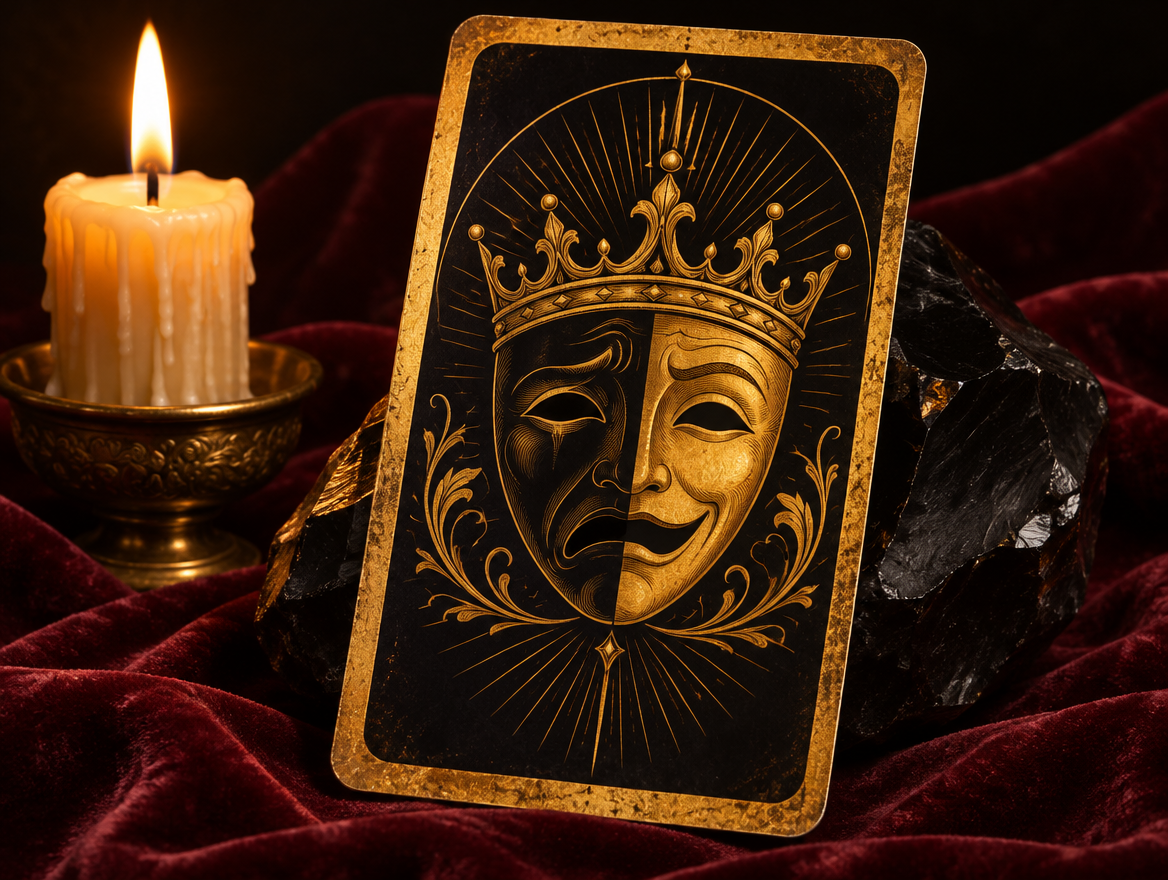
1. The Mask
This is your persona: the version of you that walks into rooms and handles things. It isn’t fake. It only becomes a problem when it’s the only version anyone sees, including you.
- What does this card show about how I want to be seen?
- When did I first learn that this was the safe way to appear?
2. What I Don’t Show
The part you keep out of view. It might be a flaw, or something tender, ambitious, angry or playful that once got you in trouble.
- What in this image do I recognize but rarely let others see?
- Is this hidden part actually “bad,” or was it just unwelcome somewhere?
3. Where I Project It
This position asks where you notice this same energy in other people, usually with a strong reaction. Projection is one of the most reliable doors into the shadow, and our guide to psychological projection explains how to tell what’s yours from what’s theirs.
- Who in my life does this card remind me of, and how do I feel about them?
- Is part of my reaction about them, and part about me? Which part is mine?
A caution: this card proves nothing about anyone else, and “you’re projecting” is never useful in an argument. Keep it pointed at yourself.
4. What It Protects
The bottom of the valley, and the key card. Most shadow patterns started as protection: they kept you safe, liked or in control at some point. This card asks what job it’s been doing.
- What would I be exposed to if I dropped this pattern tomorrow?
- Is that protection still needed now, or is it guarding an old door?
Be gentle. You’re looking for the purpose the pattern served, not a painful memory. “It kept me from being laughed at” is enough.
5. What It Wants
Underneath most shadow patterns is a plain, human need: rest, safety, respect, play, closeness, room to be wrong. This card starts the climb back up by naming it.
- If this hidden part could ask for one thing, what would it be?
- How could I meet it more directly?
Some needs here feel young, like wanting to be held or wanting to play. If that comes up, our guide to inner child work offers gentle ways to respond to it.
6. The Integrating Step
Integration isn’t a breakthrough. It’s giving the hidden part a small, safe place in your actual life.
- What is one action I could take this week that’s small enough to actually do?
- Where could I let a little of this hidden part show, with someone safe?
Keep the step tiny. “Say no to one request” beats “become a person with boundaries.”
7. The Gift
Jungian writers stress that the shadow holds potential, not just faults, and our projection guide covers the “golden shadow”: the good qualities we admire in others but haven’t claimed. This card points to the strength inside the thing you’ve been hiding.
- What positive quality does this card show that I’ve been underusing?
- Looking straight across at Card 1, how could The Mask and The Gift work together?
A worked reading (fictional)
The person and reading are fictional, and the card meanings are interpretations readers commonly use, not fixed definitions. Image notes are kept short; each card’s own page will describe it in full.
The reader (fictional): Dana, a team lead in her thirties. Her question: Why do I get so irritated when people on my team ask for help?
Card 1, The Mask: The Emperor
Readers often take The Emperor as structure, authority and control: the ruler who keeps order.
Dana laughs. “That’s me at work. I’m the one who has it handled.” Her mask is competence.
Card 2, What I Don’t Show: The Moon
In the Rider–Waite–Smith deck, The Moon shows a dog and a wolf howling at the Moon while a crayfish emerges from the water (Wikipedia: The Moon (tarot card)). Readers often link it with uncertainty, fear and what moves below the surface.
Dana feels uneasy. What she doesn’t show is how often she doesn’t know what she’s doing, so she covers the not-knowing with Emperor energy.
Card 3, Where I Project It: Page of Cups
In the Rider–Waite–Smith deck, the Page of Cups is a young figure holding a cup with a fish poking its head out (Wikipedia: Suit of cups). Readers often take it as openness, sensitivity and emotional curiosity.
This one stings. When colleagues openly say “I’m lost on this,” Dana reads them as needy. She realizes she judges in others exactly the openness she won’t allow herself.
Card 4, What It Protects: Nine of Wands
Readers often take the Nine of Wands as resilience, guardedness and holding the line after a hard stretch: tired, watchful, still standing.
Dana writes: It protects me from being caught unprepared. She doesn’t need details. Early in her career, admitting confusion felt risky, so she learned to look ready at all times. The pattern kept her standing. It’s also exhausting.
Card 5, What It Wants: Page of Pentacles
Readers often take the Page of Pentacles as study, patience and the willingness to be a beginner.
Her hidden part wants permission to learn in public, to be a student sometimes instead of the one with every answer.
Card 6, The Integrating Step: Justice
Readers often take Justice as fairness, honesty and clear accounting: weighing things as they really are.
Dana’s step: in her next team meeting, she’ll say once, plainly, “I don’t know yet; let’s figure it out together.” One sentence, one meeting.
Card 7, The Gift: King of Wands
Readers often take the King of Wands as vision, leadership and the kind of confidence that inspires others.
Looking across from The Emperor, Dana sees the difference: one leads by control, the other by energy and example. Her gift is a warmer, more honest leadership that can say “I’m figuring this out too.”
What Dana takes away: her irritation pointed at the beginner she won’t let herself be. Nothing was predicted. The cards gave her pictures for a pattern she already half knew.
The three-card short version
When you have twenty minutes, or the full spread feels like a lot, use three positions that keep the arc: one at the surface, one at the bottom, one coming back up.
| Card | Position | Prompt |
|---|---|---|
| 1 | The Mask | What am I showing right now? |
| 2 | What It Protects | What is this pattern guarding? |
| 3 | The Integrating Step | What’s one small step? |
Lay them in a small V: Card 1, The Mask, top left; Card 2, What It Protects, at the bottom; Card 3, The Integrating Step, top right. Turn them in that order and finish on Card 3.
A fictional example: Marcus asks why he always volunteers for extra work. He pulls The Chariot (The Mask: always driving forward, always in motion), Knight of Pentacles (What It Protects: steady, reliable effort that keeps him from feeling useless) and The World (The Integrating Step: finishing one cycle fully). His step is to complete his current project before saying yes to anything new.
Aftercare: closing a shadow work reading
How you finish matters. A reading that stirs things up and simply stops can leave you feeling raw, so take a few minutes to close. Grounding may help; it isn’t a guarantee.
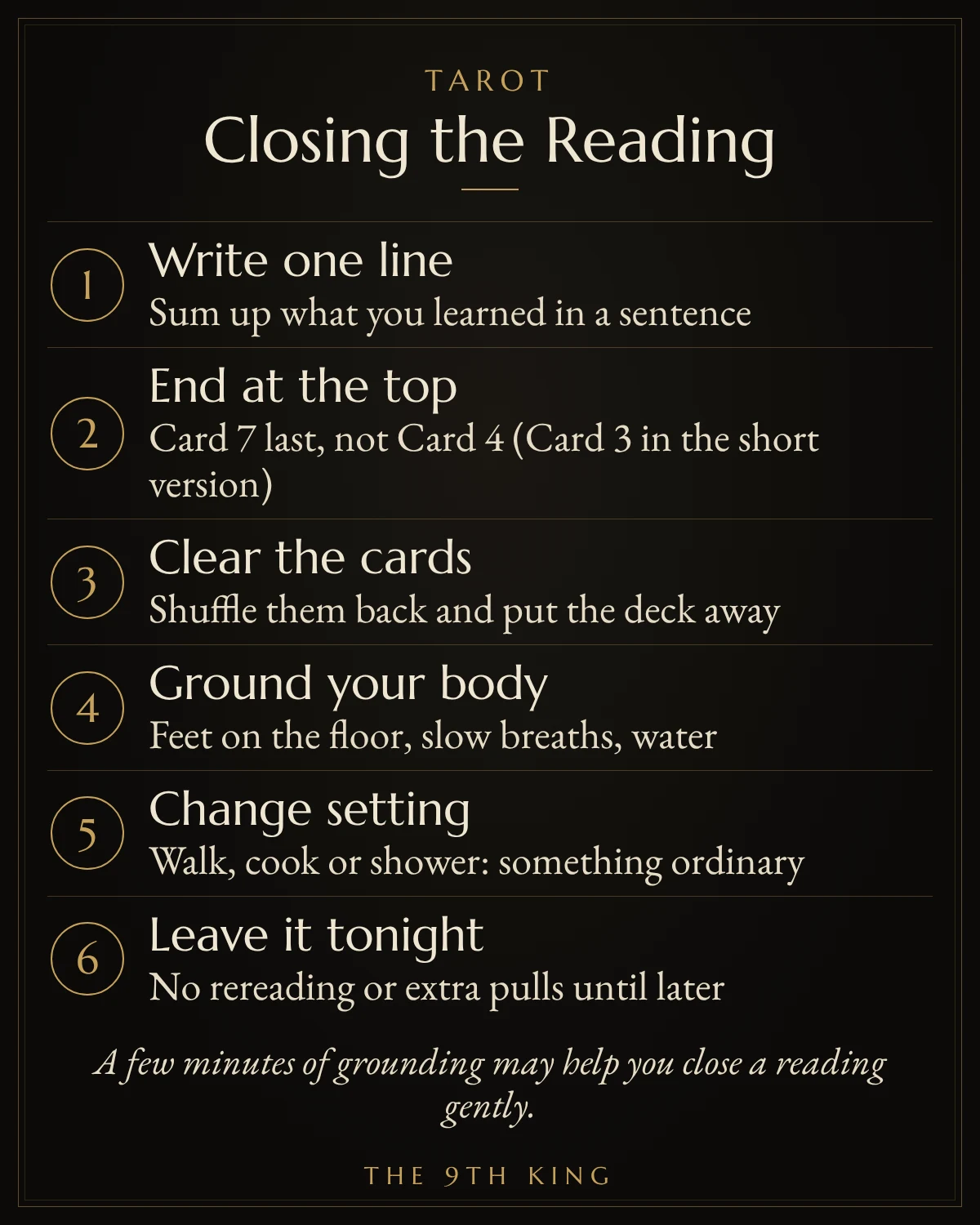
Six steps to close
- Write one line. Sum up the reading in one sentence, such as “My control is covering a beginner who wants to learn.”
- End at the top. Look at Card 7, The Gift, last, not Card 4. In the three-card version, finish on Card 3.
- Clear the cards. Shuffle them back into the deck and put it away. The reading is done for today.
- Come back into your body. Put both feet flat on the floor, take a few slow breaths, and drink a glass of water. Name five things you can see in the room.
- Change your setting. Walk, cook or shower: something ordinary and physical.
- Leave it alone tonight. Don’t reread or pull more cards on the same question. Come back in a day or two.
Signs to slow down
Pause the practice for a while, and consider talking with a professional, if you notice any of these after a reading:
- You feel shaken for more than a day.
- Old memories keep pushing in when you’re not reading.
- You find yourself pulling card after card looking for reassurance.
- The readings leave you feeling worse about yourself rather than clearer.
None of these mean you’ve failed. They mean you deserve more support right now.
Worksheet: your shadow spread journal page
Copy this into your journal for each reading.
Date:
My one question:
How I feel before starting (one word):
For each of the seven positions, write:
- Card drawn:
- What I see in the image:
- My first reaction:
- What it might be pointing to:
Then, at the end:
- Card 1 and Card 7 together: how could my mask and my gift work as a team?
- My integrating step this week: (one small, specific action)
- When I’ll do it: (a day and a time)
- How I feel after closing (one word):
The one-week follow-up
Seven days later, come back to the page and answer three questions:
- Did I take the step? If not, what got in the way?
- Did I notice the projection from Card 3 in daily life this week?
- Has my feeling about the original question shifted at all?
To bring astrology in, compare your reading with the shadow themes for your Sun, Moon and Rising in our zodiac shadow work guide; our Moon sign guide covers the needs side. Treat any overlap as a prompt, not proof.
Myths and misreadings
- “The cards reveal your hidden truth.” They don’t know anything about you. They give you images, and your reactions to those images are what reveal something.
- “A dark card means something bad is coming.” Not in this spread, and not on The 9th King. Cards like Death, The Tower or the Ten of Swords point to change, endings or a painful pattern ending. They aren’t predictions of harm.
- “Shadow work means digging up the worst memories.” No. This spread works with present-day patterns. You can learn a lot without reliving anything.
- “Card 3 proves the other person is the problem.” The projection position is about your reaction. It says nothing reliable about anyone else.
- “One reading should fix it.” Shadow work is slow and ongoing. Expect to revisit the same pattern several times, each time a little more clearly.

Shadow Work Tarot Spread: FAQ
What is a shadow work tarot spread?
A shadow work tarot spread is a card layout designed to help you reflect on parts of yourself you usually keep hidden, an idea that comes from Carl Jung’s concept of the shadow. Each position asks a specific question, such as what you show the world or what a pattern protects. On The 9th King, it’s a tool for self-reflection and journaling, never a way to predict the future or diagnose anything.
How many cards are in the 9th King shadow work spread?
The full 9th King Shadow Work Tarot Spread uses seven cards laid in a V shape: The Mask, What I Don’t Show, Where I Project It, What It Protects, What It Wants, The Integrating Step and The Gift. There’s also a three-card short version that uses The Mask, What It Protects and The Integrating Step, which takes about twenty minutes and works well for weekly check-ins.
Is shadow work with tarot safe?
A reflective spread like this is meant to be thoughtful rather than overwhelming, especially if you go slowly and close with aftercare. It isn’t a substitute for therapy. If you’re dealing with trauma, abuse, thoughts of self-harm or distress that feels overwhelming, work with a qualified therapist. It’s always fine to stop a prompt or put the cards away partway through a reading.
Should I read reversed cards in a shadow spread?
It’s optional, and readers disagree on the best method. In this spread you can ignore reversals completely or read a reversed card as the same energy turned inward, blocked or overdone. If you’re new to tarot or to shadow work, upright-only readings keep things simpler and still give you plenty to reflect on.
How often should I do a shadow work tarot reading?
Once every week or two is plenty for the full seven-card spread. Shadow work needs time between sessions so you can take your integrating step and notice what changes. The three-card version can be used weekly to check in on a pattern. Pulling card after card on the same question, especially for reassurance, usually means it’s time to pause.
What if I get a card that scares me?
Take a breath and describe the image in plain words before you think about meaning. On The 9th King, no card predicts harm. Cards like Death or The Tower are read as change and endings, not literal events. Ask what the card’s picture brings up for you. If the feeling is too strong, set the card aside and close the reading.
Your next step: pick one pattern you’d like to understand, and try the three-card short version tonight. Before you start, choose a prompt from our shadow work prompts library to sharpen your question, and plan how you’ll close the reading.
Explore Next
- Start with the idea itself: Shadow Work, Plainly
- Find a sharper question: Shadow Work Prompts
- Read Card 3 more clearly: Psychological Projection
- Respond to what Card 5 wants: Inner Child Work
- Bring in your chart: Zodiac Shadow Work
- More tarot on The 9th King: Tarot Card Meanings · Major Arcana · Minor Arcana · Three-Card Tarot Spread · Tarot & the Zodiac · The Moon · The Emperor · Nine of Wands · Page of Cups

Final Thought: Go Down, Then Come Back Up
The shadow isn’t a pit you fall into. It’s a valley you can walk through on purpose, with a lamp, at your own pace. Seven cards won’t change you overnight, but they can show you the face you wear, the part you’ve hidden and the gift waiting where the two meet. Take one small step, then climb back into your ordinary day. Know your nature. Rule your life.
About the Author
King is the founder of The 9th King, where zodiac psychology, relationships and shadow work are explored as tools for self-knowledge rather than fortune-telling. He’s a Libra Sun, and writes about the personal side of astrology on King The Kemist. Astrology on The 9th King is interpretation and self-reflection, not prediction or established fact.
Leave a Reply