
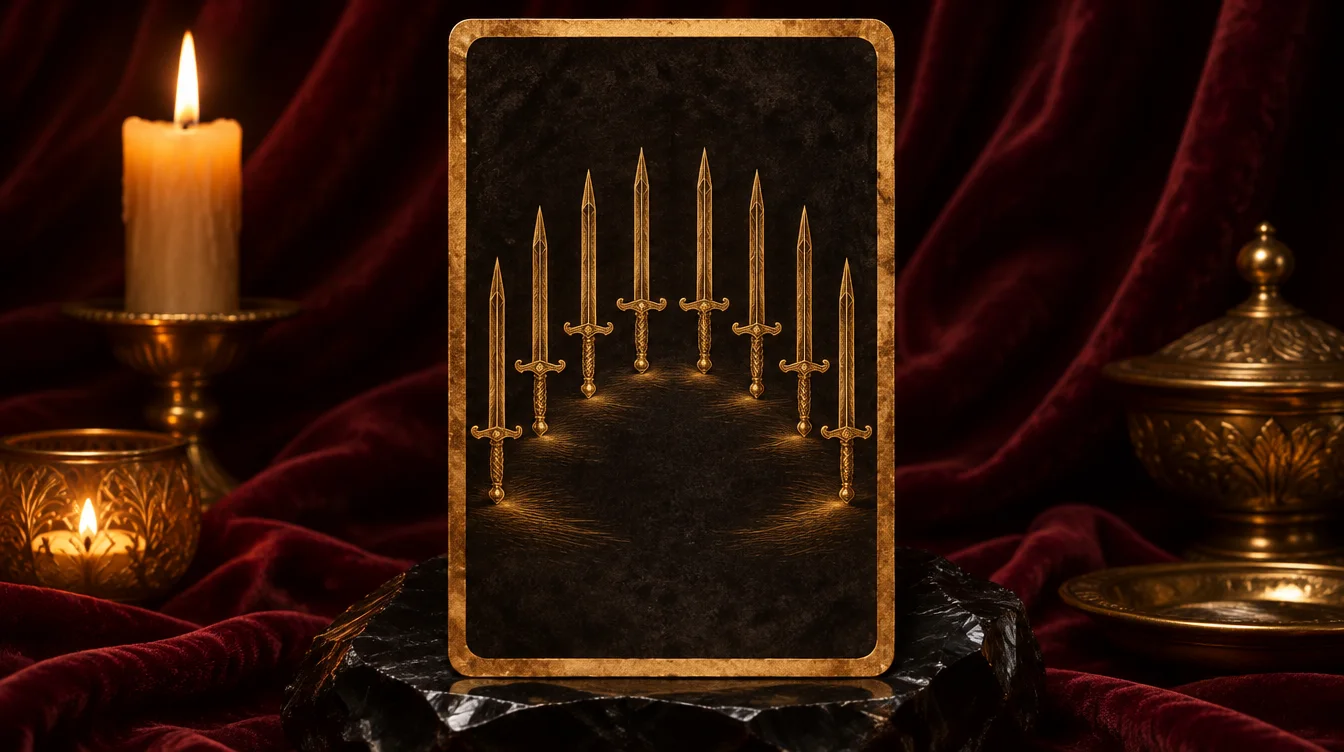
Quick Answer: What Does the Eight of Swords Mean?
The Eight of Swords (also written 8 of Swords) is a Minor Arcana card from the suit of Swords. A.E. Waite describes a woman, bound and blindfolded, with the card’s swords around her, and he adds that it’s a card of temporary restraint rather than permanent bondage. Readers often take it as the card of feeling boxed in, by circumstances, other people or your own thoughts.
- Keywords: restriction, feeling stuck, limited options, held-back strength, overthinking, a narrow view, the first small move.
- Upright, in one line: a prompt to notice where you feel boxed in, if you do, and to look honestly at which limits are real and which ones your mind may have added.
- Reversed, in one line: a prompt to notice where some pressure may be easing or where you’re starting to see more options, and what support would help you use them.
On The 9th King, tarot is a mirror for self-knowledge, not fortune-telling. The Eight of Swords doesn’t say you chose your situation or how long anything lasts. It asks you to see it clearly, including the parts that aren’t your doing.
Table of Contents
The Eight of Swords at a glance
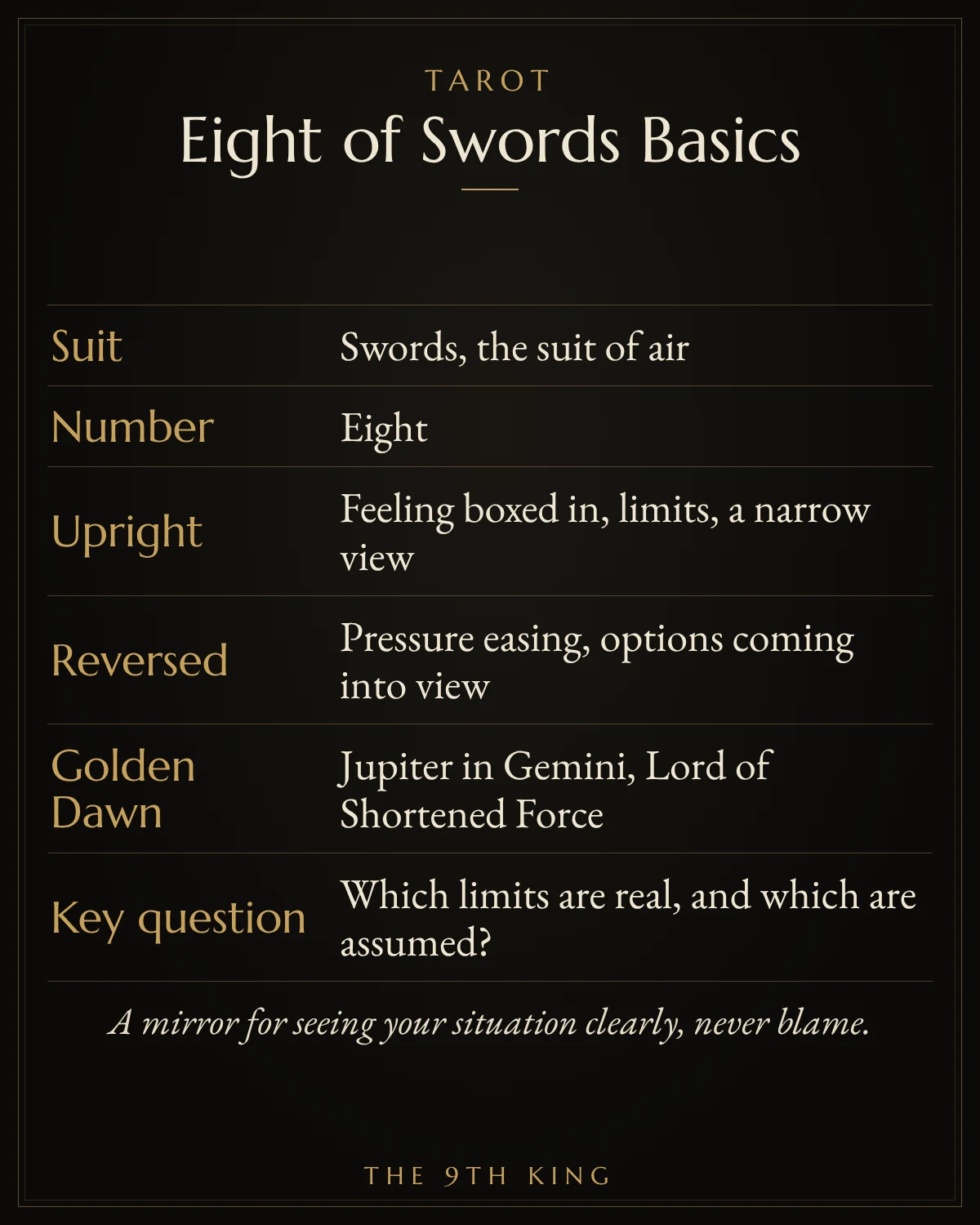
| Eight of Swords | |
|---|---|
| Arcana | Minor Arcana, a pip (number) card |
| Suit and element | Swords, linked with air |
| Number | Eight |
| Golden Dawn title | Lord of Shortened Force |
| Astrology (Golden Dawn) | Jupiter in Gemini |
| Upright | Feeling boxed in, limits, a narrow view |
| Reversed | Pressure easing, options coming into view |
| Key question | Which limits are real, and which are assumed? |
What the Eight of Swords looks like
Most people know this card from the Rider–Waite–Smith deck, with instructions by A.E. Waite and art by Pamela Colman Smith.
What Waite says
Waite’s description in The Pictorial Key to the Tarot is two sentences. He describes a woman, bound and hoodwinked (an old word for blindfolded), with the swords of the card about her. Then he adds the line that frames the whole card: it is “rather a card of temporary durance than of irretrievable bondage” (sacred-texts.com: Waite, Eight of Swords). Durance means confinement.
That’s all he gives us: a woman, a binding, a blindfold and eight swords around her. This guide keeps to his words for the traditional picture and doesn’t add scenery he doesn’t describe.
The binding and the blindfold
Waite doesn’t say who tied her, or why. A card can’t tell you how a situation came about, and The 9th King doesn’t read the binding as something she did to herself. On this page, the binding stands for any limit that’s really there: other people’s choices, money, health, work, family duties, the law. The blindfold stands for what’s hard to see from inside a tight spot: options, help or facts that pressure can hide from view.
The eight swords
Swords are the suit of thought, words and decisions. Eight around one person can stand for a crowd of pressures or thoughts pressing in. Some may belong to the situation; some may be thoughts that feel like walls. The card doesn’t say which is which.
Eight of Swords meaning (upright)
Waite’s divinatory list is heavy: bad news, deep frustration, crisis, censure, conflict, slander, and also sickness. In the middle sits a phrase worth keeping: “power in trammels”, meaning strength that is held back or tied up (sacred-texts.com: Waite, Eight of Swords). His list of Additional Meanings adds, for a woman, scandal spread about her and, reversed, a relative’s departure (sacred-texts.com: Waite, Additional Meanings).
These are old fortune-telling words. On The 9th King, we don’t read a card as a forecast of bad news, illness or gossip. We keep the image at the heart of Waite’s list: power that’s there, but held back.
The Golden Dawn’s teaching text, Book T, as printed by Aleister Crowley in Liber LXXVIII, calls this card the Lord of Shortened Force. Its meaning opens with “Too much force applied to small things”, and it describes attention to detail at the expense of the main points, great care in some areas alongside disorder in others. For the card’s place on the Tree of Life, it gives a short list of words for something narrow, restricted and petty, even a prison (Liber LXXVIII, sacred-texts.com).
Put together, the upright Eight of Swords has three layers.
Feeling boxed in
The card can point to a situation that feels tight: few options, many pressures, no obvious door. That feeling deserves respect. Ask yourself: Where do I feel most hemmed in right now?
Strength held back
Waite’s “power in trammels” fits a common experience: you have skills or energy, but something keeps them from moving. Sometimes that’s a real barrier; sometimes it’s exhaustion, which needs rest, not pushing. Ask yourself: What strength do I have that isn’t getting used, and what’s in its way?
Force spent on small things
The Golden Dawn’s “shortened force” adds a quieter layer: energy poured into details and worry loops while the main question waits. Ask yourself: Where is my effort going, and is that where it does the most good?
Eight of Swords reversed
Some readers use reversals and some don’t. Waite’s reversed meanings are a list of unease: disquiet, difficulty, opposition, accident, treachery, the unforeseen, fatality (sacred-texts.com: Waite, Eight of Swords).
A card can’t predict accidents or betrayal, and it can’t tell you anything about another person’s intentions. On The 9th King, the reversed Eight of Swords usually points to one of three patterns, offered as questions, not predictions.
Pressure easing
The reversed card can reflect something loosening: a deadline passes, a fact comes to light. Ask yourself: What has shifted, even slightly, that I haven’t fully noticed yet?
Options coming into view
You may start to see choices or help you couldn’t see before. Seeing an option doesn’t mean you have to take it right away. Ask yourself: What’s one option I can see now that I couldn’t see a month ago?
Unease that needs attention
Sometimes the reversed card mirrors Waite’s uneasy words: a restless sense that something isn’t right. That feeling isn’t proof of anything, but it’s a reason to look carefully at what’s actually happening. If what you see is that a situation isn’t safe, take it seriously and lean on people you trust.
| Pattern | Upright tone | Reversed tone |
|---|---|---|
| Limits | Pressing in | Starting to loosen |
| Sight | Options hard to see | Options coming into view |
| Strength | Held back | Ready for a small move |
| Mind | Thoughts circling | Unease asking for a look |

Eight of Swords astrology: Jupiter in Gemini
The 9th King uses Golden Dawn–derived correspondences, the tradition the Rider–Waite–Smith deck draws on. Other schools of tarot and astrology use different systems, and not every card maps to a single sign: the court cards and Pages, for example, are handled differently. What follows is one traditional framework, offered as symbolism.
How the number cards get their planets
In the Golden Dawn system, the Twos through Tens are matched to the 36 decans of the zodiac: ten-degree thirds of each sign, each with a ruling planet. Liber LXXVIII lists the Eight of Swords, the Lord of Shortened Force, as Jupiter in Gemini. In its table, the Eight, Nine and Ten of Swords take Jupiter, Mars and the Sun in Gemini, in that order, which places the Eight first among Gemini’s three decans in the order of Liber’s own table. Liber prints no degrees for this card, so this guide gives none (Liber LXXVIII, sacred-texts.com).
Liber also describes the Golden Dawn’s own design, not the Rider–Waite–Smith picture: four hands from clouds, each holding two swords points upward, all eight points touching near the top. Book T places all four Eights at Hod, the eighth sphere on the Kabbalistic Tree of Life.
What Jupiter brings
On The 9th King, Jupiter is the planet of growth, meaning, faith and the bigger picture. Jupiter is traditionally linked with Sagittarius and Pisces; our Sagittarius personality traits and Pisces traits pages explore those signs. If you want to find Jupiter in your own chart, start with How to Read a Birth Chart.
What Gemini brings
Gemini is mutable air, ruled by Mercury: the sign of the twins, questions, words and information. Our Gemini personality traits page covers its quick mind and its shadow side.
The tension in the pairing
Jupiter wants to grow and see the big picture. Gemini breaks things into pieces and details. Together they can describe big energy spread across many small thoughts, which fits the Golden Dawn’s “shortened force”. This is a 9K reading of the symbolism, not a rule about anyone born with Jupiter in Gemini.
The 9K reading: real limits and the story of no way out
The card’s tension
The Eight of Swords holds two true things at once: Some of what holds me is real and Some of what holds me may be a story I can question. Treat every limit as a story and you blame yourself for walls you didn’t build. Treat every story as a limit and you stop looking for doors. The card’s gift is the sorting.
The shadow side
The shadow of the Eight of Swords isn’t “you’re trapping yourself”. It’s the narrowed view that pressure creates, plus the habits that keep it narrow. It can look like:
- All-or-nothing thinking. “If I can’t fix all of it, there’s no point doing any of it.”
- Worry loops. Replaying eight problems until there’s no energy left for one.
- Assuming the answer. Deciding no one would help, without asking, because asking feels risky.
- Self-blame for real limits. Telling yourself you should simply walk away from something that, in fact, isn’t simple to leave.
These patterns aren’t weaknesses. They usually start as reasonable responses to something real. Our Zodiac Shadow Work guide explores how patterns like these show up by sign.
Real limit or assumed limit: how to tell
A real limit is a constraint that affects your capacity, options or safety, whether it’s inside you or outside you: another person’s decision, a health condition, exhaustion, grief, a caring duty, money, the law, or a situation that isn’t safe. An assumed limit is a belief about the situation that you haven’t yet checked. Many limits are a mix of both. Rest belongs here too: if you’re ill, exhausted or grieving, slowing down is meeting a need, not a trap you’ve built.
| Real limit | Assumed limit |
|---|---|
| It affects your capacity, options or safety | It lives as a belief or a guess |
| It stays when you check it | It hasn’t been checked yet |
| It needs planning or support | It may shift when you ask or test it |
| It is never your fault for having it | It is worth gently questioning |
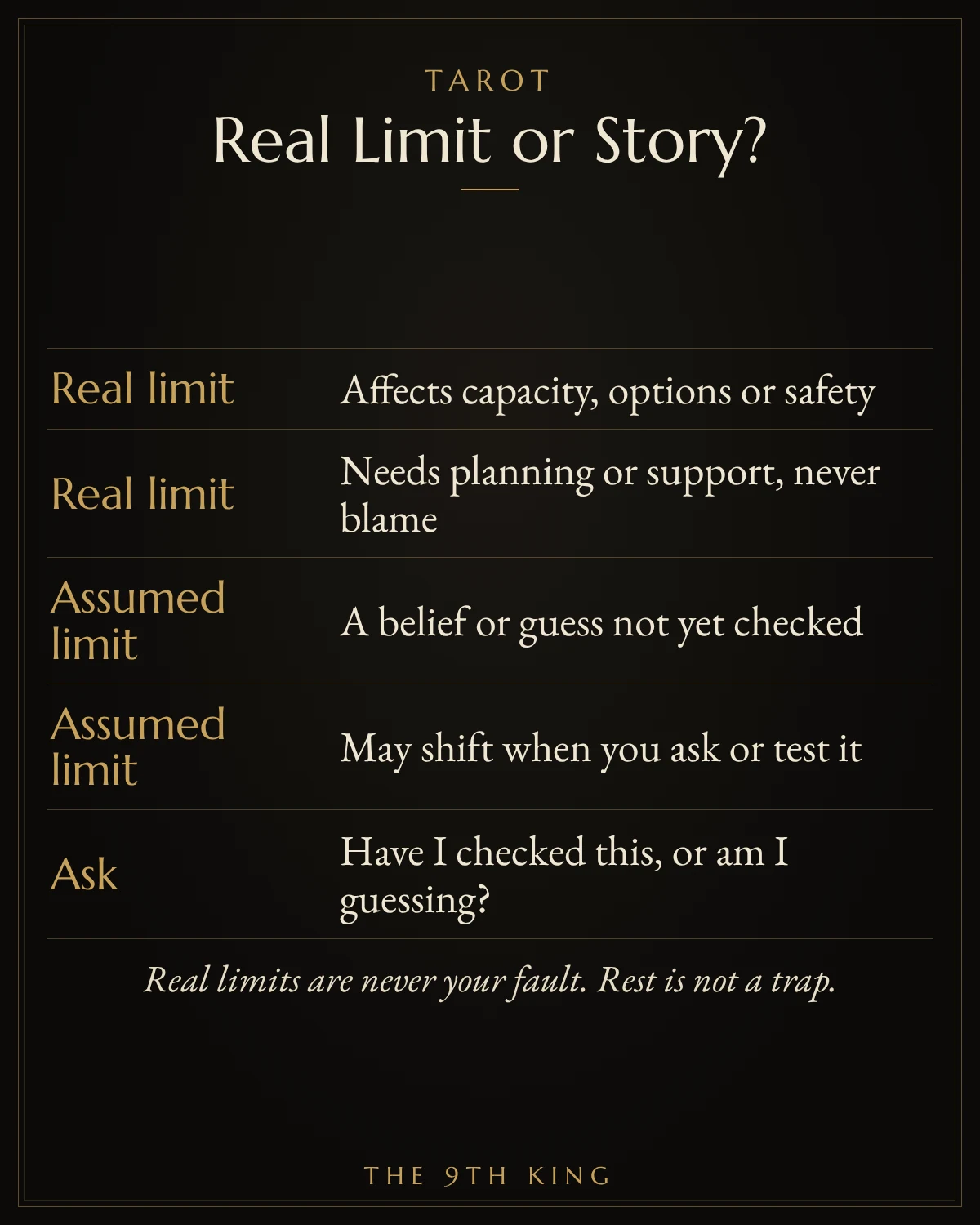
Feelings aren’t a reliable test: an assumption can feel like concrete. Use questions instead: Can I point to this limit? Have I checked it? Who would know more than I do?
Safety comes first. If what’s holding you in place is a person who controls, threatens or hurts you, the binding isn’t yours, and neither is the responsibility: it belongs to the person doing it. Leaving or changing an unsafe situation can take planning and support, and it may not be possible all at once. That’s not failure. Lean on people and services you trust, and move at the pace that keeps you safe.
The self-mastery lesson
The lesson of the Eight of Swords is to see clearly before you push. It isn’t escaping in one dramatic move. It’s naming each sword honestly (real and needs a plan, a guess I can check, a worry I’ve been feeding) and then spending your force where it counts most.
Often the first move is small: one question asked, one fact checked, one hour of rest.
Eight of Swords as feelings, in love and at work
Eight of Swords as feelings
When the question is “how does this person feel?”, readers often take the Eight of Swords as feeling stuck or hemmed in: seeing few options, pulled by pressures that are hard to put down. The card can’t tell you what someone else feels or will do. It can prompt you to ask: What have I actually seen in how they act, and what am I filling in? And, if the card is about your own feelings: Where do I feel most boxed in, and have I told anyone?
Eight of Swords love meaning
In a love reading, the upright card can point to feeling stuck in a pattern of arguments, an unmade decision, or worries that crowd out what’s actually happening. Reversed, it can point to more room to breathe.
Tarot can’t tell you whether to stay or leave, and this page won’t either. If you don’t feel safe with a partner, or a partner controls where you go, who you see or what you spend, that’s not a thinking problem and it isn’t your fault. Your safety comes first. Otherwise, the card can help you notice the pattern. Useful questions:
- Which worries about us are based on things that happened, and which are guesses?
- What have I stopped asking for because I assumed the answer?
- What’s one honest thing I could say, if and when it feels safe and useful?
Eight of Swords at work
At work, readers often take the card as feeling boxed in by a role, a workload or a set of rules, some fixed and some more flexible than they look. This is reflection, not career or financial advice. Ask yourself: Which part of this have I actually checked, and who could I ask about the rest?
Practical exercise: the constraint map
You need about twenty minutes and a notebook. This isn’t a test, and nothing you write commits you to any action. Stop at any point.

Step 1: Name the bind
Write one sentence: Where do I feel most boxed in right now? Pick the place you think about most.
Step 2: List the swords
Write each limit or pressure on its own line. You don’t need exactly eight; write as many as are true. Include practical ones (time, duties, other people’s decisions) and inner ones (beliefs, worries).
Step 3: Sort them
Next to each line, write one word: real, unsure or assumed. Real means it affects your capacity, options or safety, inside or outside you; unsure means you haven’t checked; assumed means it’s probably more belief than fact. Real limits are never your fault.
Step 4: Check one
Pick one “unsure” line to look into this week: read the policy, ask the question, or simply notice what actually happens. If checking would mean contacting someone, that’s your choice, and only if it’s safe and useful.
Step 5: Find one move
Within the real limits, write one small step: a short block of time for something that matters, a question to someone who can help, or a plan for later. If what you need most is rest, rest is the step.
A worked example (fictional)
Jordan (fictional) has wanted to write for years but feels completely stuck.
He names the bind (“I can’t write at all right now”), then lists and sorts six swords:
- “I work full-time.” Real.
- “Mom needs help every evening.” Real.
- “My brother won’t help with Mom.” Unsure: he’s never asked directly.
- “I need a quiet room to write.” Unsure.
- “There’s no point starting if I can’t do it properly.” Assumed.
- “Everyone in the writing group is better than me.” Assumed.
That’s two real, two unsure and two assumed. He chooses to check number 3 and asks his brother whether he could cover one Sunday afternoon. The answer is one Sunday a month. For his one move, he writes for twenty minutes on two lunch breaks a week. The two real limits haven’t moved, and he doesn’t blame himself for them. His force is simply going somewhere now.
Journal prompts for the Eight of Swords
- Where do I feel most boxed in right now, and how long have I felt this way?
- Which of my limits can I point to outside my own head?
- Which limits have I never actually checked?
- Where am I spending a lot of force on small things while the main thing waits?
- When did I first learn that asking for help wouldn’t work, and is that still true?
For more prompts like these, our shadow work prompts collection goes deeper, and Shadow Work, Plainly explains how to start safely. If the feeling of having no options goes back to childhood, inner child work can be a gentle next step.
A warm note: this is reflective practice, not therapy. If you’re dealing with trauma or abuse, thoughts of self-harm, or distress that feels overwhelming, please work with a qualified therapist who can walk with you. It’s always fine to stop a prompt that feels like too much.
Myths and misreadings of the Eight of Swords
- “The Eight of Swords means you chose to be trapped.” No. Waite doesn’t say who bound the figure, and The 9th King never reads this card as blame. Real constraints are real, and if someone else is causing harm, the responsibility is theirs.
- “Just walk away.” Some limits are more flexible than they look, and some aren’t. Leaving a hard or unsafe situation can take planning, support and time. That isn’t weakness.
- “It means bad news or illness is coming.” Waite’s list includes bad news and sickness, but on The 9th King, tarot doesn’t predict events, health or timing.
- “Jupiter in Gemini means this is about Gemini people.” No. It’s Golden Dawn symbolism. Anyone can draw this card.
Eight of Swords: FAQ
What does the Eight of Swords mean?
Waite describes a bound, blindfolded woman with swords around her, and calls it a card of temporary restraint rather than lasting bondage. Readers often take it as feeling boxed in or held back. On The 9th King, it’s a prompt to sort real limits from assumed ones, never a verdict that you trapped yourself.
What does the Eight of Swords reversed mean?
Reversed, the Eight of Swords is often read as pressure easing, options coming into view, or an unease that deserves a careful look. Waite’s reversed list includes disquiet and the unforeseen, but a card can’t predict events or prove anything about other people. On The 9th King, we treat it as a question: what’s shifting, and what support would help? Some readers skip reversals entirely.
What does the Eight of Swords mean as feelings?
As feelings, readers often take the Eight of Swords as someone feeling stuck, hemmed in or short of options. It can’t tell you what another person feels or will do. It can prompt you to separate what you’ve seen in their behavior from what you’re guessing, and to notice where you feel boxed in yourself.
What does the Eight of Swords mean in love?
In love, the upright card can point to feeling stuck in a pattern or a crowd of worries; reversed, to more breathing room. The card doesn’t tell you to stay or leave. If a partner controls or threatens you, that’s not a thinking problem and it isn’t your fault; your safety comes first.
What zodiac sign is the Eight of Swords?
In the Golden Dawn system, the tradition The 9th King uses, the Eight of Swords corresponds to Jupiter in Gemini, first among Gemini’s three decans in the order of Liber LXXVIII’s table. The Golden Dawn’s Book T calls it the Lord of Shortened Force. Other schools use different correspondences, so treat this as one traditional framework for symbolism, not a rule about Gemini people.
Does the Eight of Swords mean I’m trapping myself?
No. Waite doesn’t say who bound the figure, and The 9th King doesn’t read the card as blame. Some limits come from circumstances or other people, and those are real; some are guesses not yet checked. The card invites you to sort the two calmly. If someone else is controlling or harming you, the responsibility belongs to them, not you.

Your next step: make your own constraint map for one place you feel boxed in, and check just one “unsure” line this week. Then look at where Jupiter and Mercury sit in your birth chart with How to Read a Birth Chart: Jupiter shows where you tend to grow, and Mercury, Gemini’s ruler, shows how your mind handles pressure.
Explore Next
- The busy mind behind the card: Gemini Personality Traits
- The root of the suit: Ace of Swords
- The card before this one: Seven of Swords
- Another card about a held position: Two of Swords
- Chains and limits in the Major Arcana: The Devil · The Hanged Man
- Go deeper with questions: Shadow Work Prompts
- Reading by feel: Intuitive Tarot (Code of Ascension)
- New to the cards: Tarot for Beginners: How Tarot Really Works (Code of Ascension)
- More tarot on The 9th King: Tarot Card Meanings · Minor Arcana · Tarot & the Zodiac · Shadow Work Tarot Spread
- More cards in this set: Nine of Swords, Ten of Swords

Final Thought: See Every Sword, Then Choose One Step
The figure in the Eight of Swords isn’t foolish, and she isn’t to blame. She’s in a tight place with limited sight. Some of the swords around you are real, and they deserve respect, planning and support. Some are thoughts you can test. You don’t have to get free all at once. You only have to see a little more clearly, and spend your strength where it counts. Know your nature. Rule your life.
About the Author
King is the founder of The 9th King, where zodiac psychology, relationships and shadow work are explored as tools for self-knowledge rather than fortune-telling. He’s a Libra Sun, and writes about the personal side of astrology on King The Kemist. Astrology on The 9th King is interpretation and self-reflection, not prediction or established fact.
Leave a Reply