
Quick Answer: What Does the Ace of Swords Mean?
The Ace of Swords is the first card of the suit of Swords, the tarot suit linked with air and the mind. In the classic Rider–Waite–Smith image, a hand comes out of a cloud holding a single upright sword, and a crown circles the tip of the blade.
Keywords: clarity, a breakthrough idea, honest words, a clean decision, mental focus, force of will.
- Upright, in one line: something becomes clear, and the card invites you to name it plainly and use that clarity well.
- Reversed, in one line: the same clarity gets dulled, turned into a weapon or forced too early, so the card asks how you’re holding the blade.
On The 9th King, tarot is a mirror for self-knowledge, not fortune-telling. The Ace of Swords doesn’t promise a victory or warn of a fight. It points to the moment you see clearly, and asks what you’ll do with it.
Table of Contents
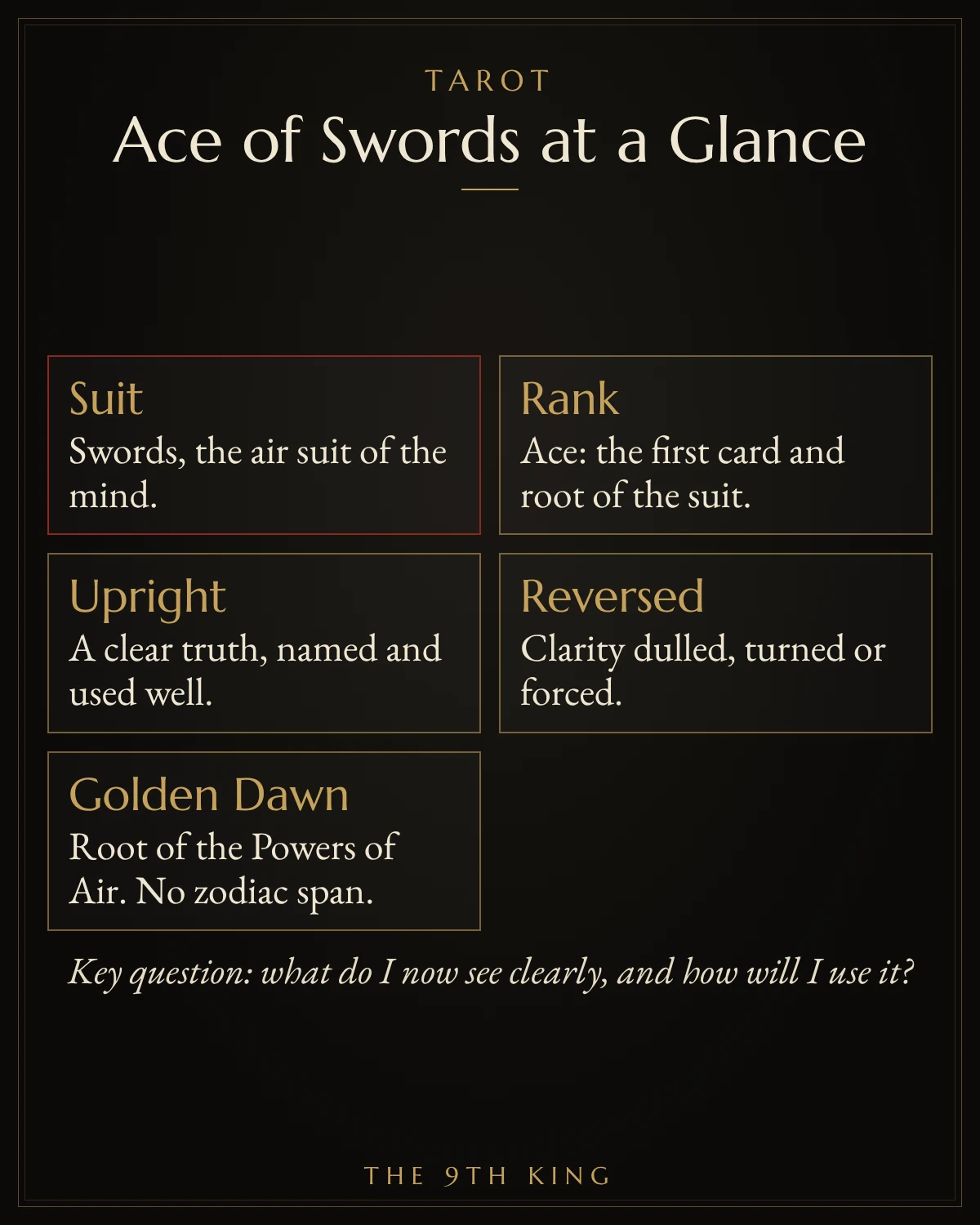
The Ace of Swords at a glance
| Ace of Swords | |
|---|---|
| Arcana | Minor Arcana, the Ace (one) |
| Suit | Swords (air) |
| Rank | Ace, the first card and root of the suit |
| Golden Dawn title | Root of the Powers of Air |
| Zodiac span | None (Aces don’t take one) |
| Upright themes | Clarity, truth, a clean decision |
| Reversed themes | Fog, sharp words, forced certainty |
| Key question | What do I now see clearly, and how will I use it? |
What the Ace of Swords shows: the traditional imagery
Most modern readers know the Ace of Swords from the Rider–Waite–Smith deck, first published by William Rider & Son in London in 1909. A.E. Waite gave the instructions and Pamela Colman Smith illustrated the cards, and both were members of the Hermetic Order of the Golden Dawn (Wikipedia: Rider–Waite Tarot). Britannica dates the first tarot decks to Italy in the 1430s and says tarot was first adapted for fortune-telling and occult use in France around 1780 (Britannica: Tarot).
The images below are described in words. The art on this page is an original 9th King line-art interpretation, not a copy of the traditional card.
The hand, the sword and the crown
In Waite’s The Pictorial Key to the Tarot, a hand comes out of a cloud and grasps a sword, and the point of the sword is circled by a crown (Waite, Pictorial Key, Ace of Swords, sacred-texts.com).
One hand, one blade, a crown at the tip. Nobody is being struck. The sword is raised, not swung.
Waite adds that the crown “may carry a much higher significance” than ordinary fortune-telling covers (Waite, Pictorial Key). On 9K, we read the crown as the idea that a clear mind can be something noble, not just something sharp.
What the 1909 card adds
On the 1909 Smith card, small sprigs hang from the crown and pale mountains sit low in the background. Waite’s text doesn’t mention either, so we treat them as part of the drawing rather than his written meaning.
What the Golden Dawn saw in the same card
In Liber LXXVIII, the Golden Dawn’s Book T as printed by Aleister Crowley, a white radiating hand comes out of clouds and grasps the hilt of a sword that holds up a white, radiant celestial crown. From the crown hang the olive branch of peace on the right and the palm branch of suffering on the left (Liber LXXVIII, sacred-texts.com).
Peace on one side, suffering on the other, from the same crown. A clear truth can bring relief, and it can also hurt. Often it does both.
Ace of Swords meaning upright
Upright, readers commonly take it as a mental breakthrough. Waite’s divinatory meanings begin with triumph, conquest, excess in everything and the triumph of force, and he calls it a card of great force (Waite, Pictorial Key). Modern readers usually turn “conquest” inward and gather the card into five themes:
- Clarity. The fog lifts.
- A breakthrough idea. The insight that makes a stuck problem simple.
- Honest words. Saying the true thing, plainly.
- A clean decision. Choosing, and letting the other options go.
- Focus. Attention gathered to one point.
On 9K, we add one thing: the upright card asks you to use clarity cleanly. A sword can open a path or leave a wound. Here it is raised and still: seeing comes before acting.
Ace of Swords reversed
Reversed, Waite says the meaning is the same force, but its results turn out badly. He also records another account that reads the reversed card as conception, childbirth, growth and multiplicity (Waite, Pictorial Key). The two lines don’t agree; older meanings were never one fixed list.
On 9K, we read the reversed card through three patterns.
1. The dull blade
You almost know something, and you keep it blurry. I’m not sure. It’s complicated. Maybe I’m overthinking it. The card can point to clarity you’re avoiding because naming it would mean having to act. What is the fog protecting you from?
2. The turned blade
You see clearly, and you use it to hurt. The true observation becomes a weapon: the comeback, the perfect criticism, the “I’m just being honest” that’s really about winning. A truth aimed to wound does a different job than a truth spoken to be understood.
3. The forced blade
You want clarity so badly that you invent it. You decide before you have the facts, or cut off a conversation because uncertainty feels unbearable. It can look like decisiveness. Often it’s fear of not knowing.
The check is simple: am I trying to see this clearly, or am I trying to be right? Seeing clearly sounds like Here’s what I notice, and I could be missing something. Being right sounds like There’s nothing left to discuss.
Swords, air and the Golden Dawn: the card’s correspondences
The correspondences below are Golden Dawn–derived correspondences, the tradition The 9th King uses, which is the system the Rider–Waite–Smith deck draws on. Other schools differ, and not every card maps to a single sign. Aces and court cards work differently from the numbered cards.
Swords are air
The element of air has long been associated with the suit of Swords, and in divination the suit is linked with intellect, as well as with sorrow and misfortune (Wikipedia: Suit of swords). Swords are often read as hard cards, but the hard part is usually what the mind does with pain.
The Root of the Powers of Air
Liber LXXVIII opens its list of titles with the four Aces. The Ace of Swords is called the Root of the Powers of Air (Liber LXXVIII). The text puts the Aces first in order and importance and calls them the radical forces of their elements. In plain terms, this card is the source of the whole suit.
Invoked force
The Golden Dawn describes the Ace of Wands as natural force, and the Ace of Swords as invoked force: power that is called up on purpose. Raised, the sword reaches toward the crown of spiritual brightness. Reversed, the text reads it as the same power called up for harm. It sums the card up as “very great power for good or evil, but invoked,” and adds that it represents whirling force and strength through trouble (Liber LXXVIII).
The point holds without the Golden Dawn’s worldview: a clear mind doesn’t choose its own direction. You do.
Why there’s no zodiac span
Many numbered Minor Arcana cards in the Golden Dawn system are tied to a decan, a ten-degree slice of a zodiac sign. Most court cards cover a wider span. The Aces don’t. Liber LXXVIII says the four Aces are placed on the North Pole of the universe, where they revolve and govern its revolution, acting as the connecting link between what it calls Yetzirah and the material universe (Liber LXXVIII). So the Ace of Swords isn’t tied to any birthday or dates.
The Ace and the Page of Swords
Liber LXXVIII says the four Princesses form the thrones of the powers of the four Aces, and it gives the Swords Princess the title the Princess of the Rushing Winds (Liber LXXVIII). The 9th King follows the court-card naming in Liber LXXVIII (the Golden Dawn’s Book T): Knights are fire of their suit, Queens water, Kings air, Pages earth. Under that convention, the Princess of the Rushing Winds is the Page of Swords. Other systems match the titles differently.
The Ace is the idea arriving. The Page is where it lands and starts learning to speak.
The air signs, as element links
You can read the card alongside the three air signs as an element link, not a claim that the card “is” any of them:
- Gemini personality traits: air as curiosity, quick thinking and talk.
- Libra traits: air as fairness, weighing both sides and finding the right words.
- Aquarius personality traits: air as ideas, independence and the bigger picture.
For how the whole suit fits together, see our Minor Arcana guide. Another card built around an upright sword is Justice, where the blade is about fairness rather than insight.

The 9th King reading: tension, shadow and self-mastery
The tension: clarity that cuts both ways
The Ace of Swords lives between truth spoken cleanly and truth used as a weapon. Both start with seeing something accurately. What changes is the aim.
A clean truth is said so it can be understood. I’m not happy in this job. That comment hurt me. This plan has a gap. A weaponized truth is said so it can land. It picks the softest spot and the sharpest words. It may be accurate. It’s still a weapon.
Clear thinkers can drift toward the second without noticing, because being right feels like permission. The card doesn’t ask you to be less clear. It asks you to watch where the point is facing.
The shadow side
The card’s shadow has familiar shapes:
- The blunt instrument. “I’m just being honest” as cover for being unkind.
- The verdict. Deciding what something means and refusing new information.
- The cutter. Ending relationships, plans or conversations fast, so you never have to sit in the unclear part.
- The critic. Seeing everyone’s flaws sharply while your own stay blurry.
If one of these stings, that’s information, not a verdict. Our zodiac shadow work guide covers the air signs’ shadows. If you often notice in others the sharpness you dislike, see psychological projection.
One plain note: if someone uses words to control, belittle or threaten you, that responsibility is theirs, not yours. You don’t owe them calm clarity in return. Your safety comes first.

| Strength | Shadow version | The rebalance |
|---|---|---|
| Honesty | Bluntness used to hurt | Say it to be understood |
| Clarity | A fixed verdict | Hold conclusions loosely |
| Decisiveness | Cutting off too fast | Decide, then check again |
| Insight | Sharp on others only | Look at your own story first |
| Speaking up | Needing to win | Aim to be heard, not to score |
The self-mastery lesson
The Ace of Swords teaches one skill: see clearly, then choose your aim before you speak.
The pause can be one breath and one question: Do I want them to understand this, or do I want it to hurt? If it’s the second, wait. The truth will still be true tomorrow.
You don’t control what you see. You do control what you do with it.
Ace of Swords as feelings and in love
What readers commonly say
Readers often take the Ace of Swords in a feelings position as clear, direct feeling: someone who knows what they think, or a feeling that has suddenly come into focus. Waite calls it a card of great force “in love as well as in hatred” (Waite, Pictorial Key).
What a card can and can’t tell you
A card can’t read another person’s mind, and it can’t establish their motives. A more useful question is: What is this card saying about what I already see clearly?
If you want to know how someone feels, and it’s safe to ask, you can ask them kindly. Whether you do is your choice.
Ace of Swords in love
In a love reading, readers commonly associate the card with:
- An honest conversation. Saying the thing that’s been circling.
- Clarity about what you want. Knowing your own mind about a person or a relationship.
- A clean boundary. Naming a limit without drama. Boundaries can be temporary or permanent, and sometimes clarity means leaving.
It helps to separate what you observe from what you assume.
The card doesn’t tell you to stay, leave, commit or wait. It offers a question: What do I already know here, and can I say it cleanly?
A worked example (fictional)
Dev (fictional) draws the Ace of Swords after realizing his partner has been making plans for both of them without asking.
Upright reading: the card can point to the clarity Dev has finally reached. He asks: What exactly do I want to change? He writes one sentence: “I’d like us to decide weekend plans together.” It’s specific and aimed at being understood. Whether he says it is up to him.
If it had come up reversed: is Dev keeping it foggy, telling himself it’s no big deal? Or sharpening a speech that lists every time it happened? Am I trying to be understood, or to be right?
Neither reading predicts how his partner will respond, or what will happen next.
Ace of Swords at work and in decisions
At work, readers often take the Ace of Swords as the moment a problem becomes clear: the insight that untangles a project, a decision you’ve put off, or honest feedback that needs saying.
The risk is the same as in love: the sharp email, proving someone wrong in a meeting, or a fast decision made to end the discomfort of not knowing. Clear isn’t the same as harsh.
Reversed, it often reflects fog, overthinking or a decision forced too early. Write down what you know, what you don’t, and what would settle it.
None of this is career or financial advice; it’s a prompt to notice how you’re using your own clarity.
Myths and misreadings about the Ace of Swords
- “The Ace of Swords means a fight is coming.” A card isn’t a forecast. On 9K, it’s clarity arriving in you now.
- “Swords cards are bad cards.” Liber LXXVIII calls the Ace power for good or evil, depending on how it’s invoked. Hard isn’t the same as bad.
- “It’s a yes card.” We don’t give yes-or-no readings.
- “It’s a pregnancy card.” Waite records one older account linking the reversed card to childbirth. We don’t predict health, pregnancy or any life event from a card.
- “The Ace of Swords is an Aquarius card.” In the Golden Dawn system we use, Aces don’t take a zodiac span. Gemini, Libra and Aquarius are helpful air-sign links, not official correspondences.
Journal prompts and a practical exercise
The prompts and exercise below are reflective practice, not therapy. If you’re working through trauma, abuse, thoughts of self-harm or distress that feels overwhelming, please work with a qualified therapist. And it’s always fine to stop a prompt that feels like too much and come back another day, or not at all.
Seven journal prompts for the Ace of Swords
- What have I recently seen clearly, and what did I do in the first few minutes after I saw it?
- When I know something uncomfortable, do I tend to blur it, sharpen it or force it?
- When was the last time I used a true statement to hurt someone, and what was I protecting?
- What truth have I been keeping foggy, and what would change if I named it?
- Where am I sharp with others but vague with myself?
- What would it sound like to say one hard thing cleanly, with no extra edge?
- What do I now see clearly, and how will I use it?
For more prompts in this style, see our shadow work prompts. New to shadow work? Shadow Work, Plainly explains how to start safely.
The exercise: the Clean Cut
A short practice for when you see something clearly and feel the urge to say it. You can do all of it on paper. Saying it out loud to anyone is optional, and only worth it when it’s safe and useful.

| Step | What to do | Example (fictional) |
|---|---|---|
| 1. Name the fact | One plain sentence of what you see | “I’m doing most of the planning” |
| 2. Check your aim | To be understood, or to win? | Honestly, a bit of both |
| 3. Strip the edge | Cut sarcasm, labels, “always” and “never” | Drop “you never help” |
| 4. Leave room | Add what you might be missing | “Maybe you didn’t notice” |
| 5. Choose | Say it, write it or let it rest | Bring it up calmly on Sunday |
- Step 2 is the heart of it. If the answer is “to win,” wait until it isn’t.
- Step 3 keeps the fact. Only the extra edge goes.
- Step 5 is a real choice. Letting it rest is allowed, and so is deciding the conversation isn’t safe to have.
If you like reading intuitively, Code of Ascension’s guide to intuitive tarot (Code of Ascension) covers pairing card meanings with first impressions.

Ace of Swords: FAQ
What does the Ace of Swords mean?
The Ace of Swords is the first card of the suit of Swords, the air suit of the mind. Upright, readers commonly take it as clarity: a breakthrough idea, an honest word or a clean decision. On The 9th King it’s an invitation to see clearly and choose how to use it, not a prediction of victory or conflict.
What does the Ace of Swords mean reversed?
Reversed, the Ace of Swords often points to clarity that’s been dulled, turned into a weapon or forced too early. A.E. Waite says the reversed card keeps the same force but with bad results, and records another account linking it to conception and growth. The useful question is whether you’re avoiding a truth, using one to hurt, or inventing certainty you don’t have yet.
What does the Ace of Swords mean as feelings?
In a feelings position, readers often take the Ace of Swords as clear, direct feeling: someone who knows their mind, or a feeling that has suddenly come into focus. A card can’t read another person’s mind or motives, though. Ask what it says about what you already see clearly, and if you want to know how someone feels and it’s safe, you can ask them kindly.
What does the Ace of Swords mean in love?
In love readings, the Ace of Swords is commonly linked with an honest conversation, clarity about what you want and a clean boundary. It doesn’t tell you to stay, leave, commit or wait; those choices are yours. It asks whether you can name what you already know about the relationship, and say it in a way that’s aimed at being understood rather than at winning.
What element is the Ace of Swords?
Swords are the air suit, linked with thought and communication. In the Golden Dawn system, the tradition The 9th King uses, the Ace of Swords is titled the Root of the Powers of Air. That makes it the source of the whole suit. Liber LXXVIII also calls it invoked force, power that can be raised for good or turned toward harm.
Does the Ace of Swords have a zodiac sign?
Not in the Golden Dawn system. Many numbered Minor Arcana cards are tied to decans of zodiac signs, but the Aces are described as placed on the North Pole of the universe, above the zodiac, as the roots of their elements. Because Swords are air, Gemini, Libra and Aquarius are useful element links, but none is an official sign for this card.
Is the Ace of Swords a yes or no card?
The 9th King doesn’t do yes-or-no readings. The Ace of Swords can feel like a strong, decisive card, but a single card can’t settle a decision for you. A better use is to ask what you already see clearly about your question, what you’ve been avoiding, and how you’d act if you used that clarity cleanly.

Your next step: the next time you catch yourself about to say something sharp this week, run the Clean Cut above and write down the one plain sentence from step 1. Then read the Ace of Cups to compare the root of feeling with the root of thought.
Explore Next
- The root of feeling, beside the root of thought: Ace of Cups
- Another card with an upright sword: Justice
- Seeing your own edge in others: Psychological Projection
- Air as curiosity and talk: Gemini Personality Traits
- Air as fairness: Libra Traits
- Air as ideas: Aquarius Personality Traits
- New to tarot: Tarot for Beginners: How Tarot Really Works (Code of Ascension)
- More tarot on The 9th King: Tarot Card Meanings · Minor Arcana · Tarot & the Zodiac · Shadow Work Tarot Spread
- More cards in this set: Page of Swords · Knight of Swords · Queen of Swords · King of Swords

Final Thought: Hold the Blade Upright
Clarity is a gift, and it comes with a choice. The same truth can open a door or close one hard, depending on how you hold it. The Ace of Swords shows the blade raised and still, crowned at the point, before anything is cut. That stillness is where your power is: you see clearly, you pause, and you decide what your words are for. Know your nature. Rule your life.
About the Author
King is the founder of The 9th King, where zodiac psychology, relationships and shadow work are explored as tools for self-knowledge rather than fortune-telling. He’s a Libra Sun, and writes about the personal side of astrology on King The Kemist. Astrology on The 9th King is interpretation and self-reflection, not prediction or established fact.
Leave a Reply