Quick Answer: What Does the Nine of Swords Mean?
The Nine of Swords (also written 9 of Swords) is a Minor Arcana card from the suit of Swords. In A.E. Waite’s description, a woman sits on her couch in grief with the swords above her. Readers usually take it as the card of worry, dread and sleepless nights: the mind running the worst version of things on repeat.
- Keywords: worry, dread, sleeplessness, guilt, shame, rumination, despair, fear that’s bigger than the facts.
- Upright, in one line: a prompt to notice where worry has grown louder than the facts, if your thoughts keep circling the same fear.
- Reversed, in one line: a fear that’s starting to ease, or one that’s been kept secret and stuck; a prompt to sort it and share it.
On The 9th King, tarot is a mirror for self-knowledge, not fortune-telling. The Nine of Swords doesn’t say your fears will come true, and it can’t tell you what anyone else thinks of you. It asks what you’re carrying in the dark.
Table of Contents

The Nine of Swords at a glance
| Nine of Swords | |
|---|---|
| Arcana | Minor Arcana, a pip (number) card |
| Suit and element | Swords, linked with air |
| Number | Nine |
| Golden Dawn title | Lord of Despair and Cruelty |
| Astrology (Golden Dawn) | Mars in Gemini |
| Upright | Worry, dread, sleepless thoughts |
| Reversed | Fear easing, or kept secret |
| Key question | What’s fact here, and what’s fear? |
What the Nine of Swords looks like
Most people know this card from the Rider–Waite–Smith deck, first published by William Rider & Son of London in December 1909. A.E. Waite wrote the instructions and Pamela Colman Smith drew the art. Both belonged to the Hermetic Order of the Golden Dawn (Wikipedia: Rider–Waite Tarot).
Waite’s own description
Waite’s text is short. He describes a woman sitting on a couch, lamenting, with the swords above her. She grieves as if no one’s sorrow could match hers, and he calls the card one of complete desolation (sacred-texts.com: Waite, Nine of Swords). That’s the whole picture in his words: a person, a couch, the swords and grief.
In Waite’s description the swords are above her, not in her. Whatever weighs on her hangs overhead, which is a fair picture of worry.
Wikipedia’s summary describes the figure sitting up in bed beneath nine swords and reads the scene as pain from within: worry, guilt and anguish (Wikipedia: Nine of Swords). That bedroom reading is why the card is so often linked with sleepless nights.
The older Golden Dawn image
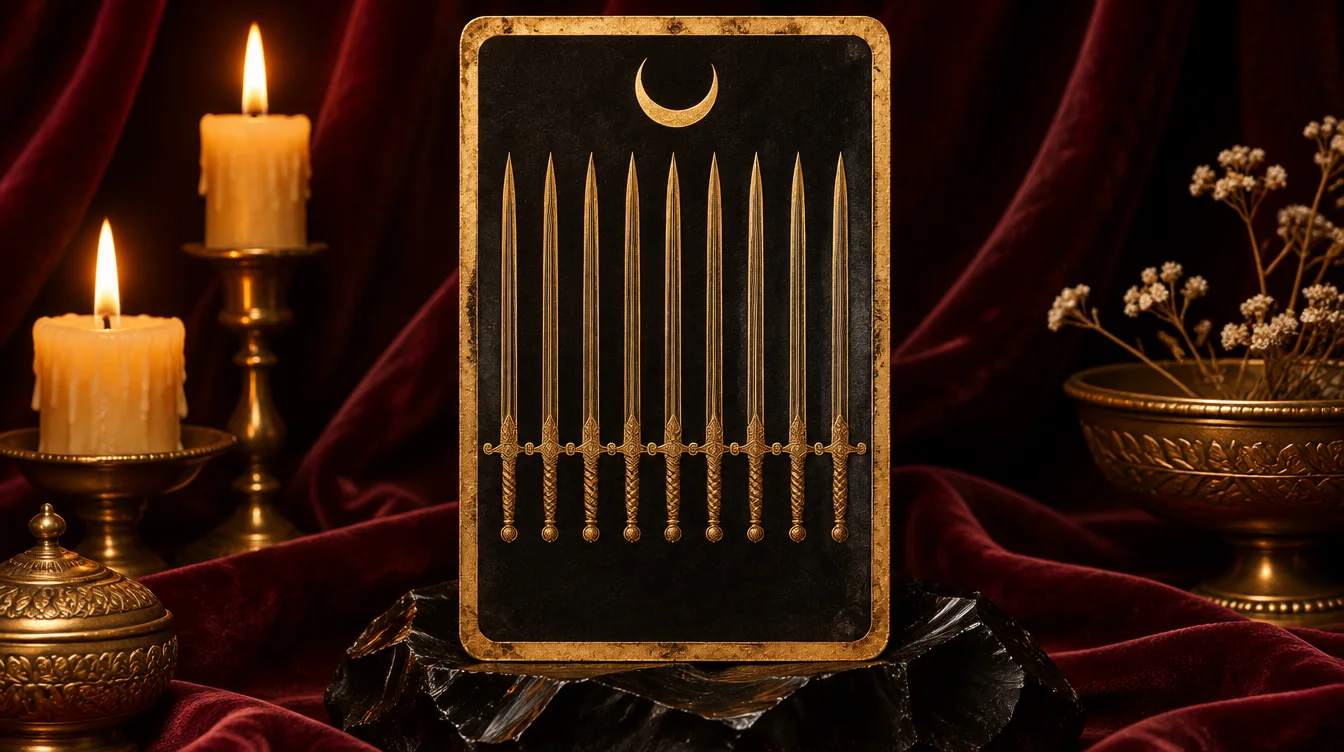
The Golden Dawn’s own description, in Book T as printed by Aleister Crowley in Liber LXXVIII, has no person in it. Four hands hold eight swords nearly upright, with their points falling away from each other, and a fifth hand holds a ninth sword upright in the center. No rose is shown at all (Liber LXXVIII, sacred-texts.com). Our 9K art keeps only the calmest part: nine upright swords in a quiet row under a small crescent moon.
Nine of Swords meaning (upright)
Waite’s upright list is one of the darkest in the deck. It runs through failure, delay, deception, disappointment and despair, and it also names death and miscarriage (sacred-texts.com: Waite, Nine of Swords). On The 9th King, none of these are read as literal events or predictions. What the list captures is the shape of dread: the mind reaching for the worst outcome it can imagine.
Liber LXXVIII names the card the Lord of Despair and Cruelty. Its list is heavy too, but it ends somewhere surprising: “Yet also obedience, faithfulness, patience, unselfishness, etc. According to dignity” (Liber LXXVIII, sacred-texts.com). “Dignity” here means the cards around it.
On The 9th King, the upright Nine of Swords usually points to one of three things.
Worry louder than the facts
The card can point to a fear that has outgrown the evidence. A late reply turns into a breakup; a small mistake turns into getting fired. Ask yourself: What do I actually know, and what am I filling in?
The night mind
Many people find worry heavier late at night, when it’s quiet and they’re tired. Readers often take the Nine as that hour. Ask yourself: Does this look the same to me in daylight, and if not, which version do I trust more?
Guilt and shame carried alone
Waite’s reversed list includes shame, and on 9K we often read guilt in the upright card too. Sometimes the swords overhead are regrets, or things you fear people would think if they knew. Ask yourself: Is there something I’ve been keeping to myself that I could share with one safe person?
Nine of Swords reversed
Readers handle reversals in different ways: some read the opposite meaning, some read the same energy blocked or softened, and some don’t use reversals at all. Waite’s reversed meaning for this card is “Imprisonment, suspicion, doubt, reasonable fear, shame” (sacred-texts.com: Waite, Nine of Swords). Wikipedia’s summary notes that in a positive spread the reversal may suggest the nightmare is ending (Wikipedia: Nine of Swords).
One phrase stands out: reasonable fear. Some worries are reasonable, and they deserve a practical response, not dismissal.
On The 9th King, the Nine of Swords reversed usually points to one of three patterns, offered as questions, not predictions.
The fear is starting to ease
The worry still visits, but it doesn’t run the whole night. The reversed card can point to the early, uneven stage of things getting lighter. Ask yourself: What has helped, even a little, and can I do more of it?
The fear is locked away
This is close to Waite’s “imprisonment” and “shame”. The worry hasn’t eased; it has gone underground. You tell no one and meet it alone at night. Ask yourself: Who could I let in on this, even partly?
The fear is reasonable
Sometimes the reversed card points to a fear grounded in real facts: a bill you can’t ignore, a health question that needs a doctor, a relationship that doesn’t feel safe. Then the lesson is to turn the worry into a next step. Ask yourself: If this fear is reasonable, what’s one practical thing it’s asking me to do?
| Pattern | Upright tone | Reversed tone |
|---|---|---|
| The fear | Loud, looping | Easing or hidden |
| The facts | Outrun by fear | Checked, or ignored |
| The secret | Carried alone | Shared, or locked away |
| The hour | Worst at night | Lighter, or still dark |

Nine of Swords astrology: Mars in Gemini
The 9th King uses Golden Dawn–derived correspondences, the tradition the Rider–Waite–Smith deck draws on. Other schools of tarot and astrology use different systems, and not every card maps to a single sign: the court cards and Pages, for example, work differently. What follows is one traditional framework, offered as symbolism.
How the number cards get their planets
In the Golden Dawn system, the 36 numbered cards from Two to Ten are matched to the 36 decans: ten-degree thirds of the zodiac signs, each with a ruling planet. Liber LXXVIII lists the Nine of Swords, the Lord of Despair and Cruelty, with the decan Mars in Gemini (Liber LXXVIII, sacred-texts.com).
The same text lists the three Gemini cards in order: the Eight of Swords (Jupiter in Gemini), the Nine (Mars in Gemini) and the Ten (Sun in Gemini). The Nine sits in the middle. Liber also explains that, with 36 decans and seven planets, one planet must rule an extra decan, and that planet is Mars.
What Mars brings
On The 9th King, Mars describes drive, heat, alarm and the urge to act: the part of you that wants to fix something right now. When there’s nothing to fix, that energy can turn inward and keep the mind on alert.
What Gemini brings
Gemini is mutable air, the sign of the quick mind, words and questions. Our Gemini Personality Traits page explores the Twins’ curiosity and its restless shadow. On this card, Gemini is the reason the worry multiplies: one thought branches into ten, each with its own “what if”.
The tension in the pairing
Gemini thinks in options. Mars wants a target. Put them together without a real problem to solve, and the mind can generate threats faster than it can answer them. The Nine of Swords sits in that gap. The lesson is to give the mind and the drive real work: checking facts, making a plan and setting the rest down.
The 9K reading: sort the swords
The card’s tension
The Nine of Swords puts a busy mind and a tired body in the same frame. The swords are thoughts; the couch is the place you go to rest. The tension is that rest and worry arrive at the same hour. The card doesn’t ask you to win an argument with your thoughts. It asks you to notice which thoughts are facts, which are fears and which are questions that need an answer.
The shadow side
The shadow of the Nine of Swords isn’t worry itself. Worry is a normal part of caring about things. The shadow is treating every fear as a fact and every fact as a reason to fear. It can look like:
- The worst-case jump. Going straight from a small sign to the most painful possible outcome.
- The loop. Running the same thought over and over, hoping that one more round will settle it.
- The secret burden. Keeping a worry or regret entirely to yourself, where it can grow with no one to check it against.
- The reassurance chase. Asking for reassurance, or checking again, then needing it all over again an hour later.
- Shame as a verdict. Treating one mistake or one fear as proof that something is wrong with you.
These patterns usually come from caring and wanting to be prepared.
A word on rest: worry is tiring. Lying down early, cancelling plans or doing very little after a hard night are often what a tired body needs. That’s care, not avoidance. Avoidance is something different: refusing to look at a reasonable worry at all, so it never gets a practical answer.
Fact, fear or question
| Kind | Sounds like | What helps |
|---|---|---|
| Fact | “The bill is due Friday.” | One practical step |
| Fear | “Everything will fall apart.” | Naming it as a fear |
| Question | “Are they upset with me?” | Asking, if safe |
| Out of reach | “What if it rains that day?” | Setting it down |
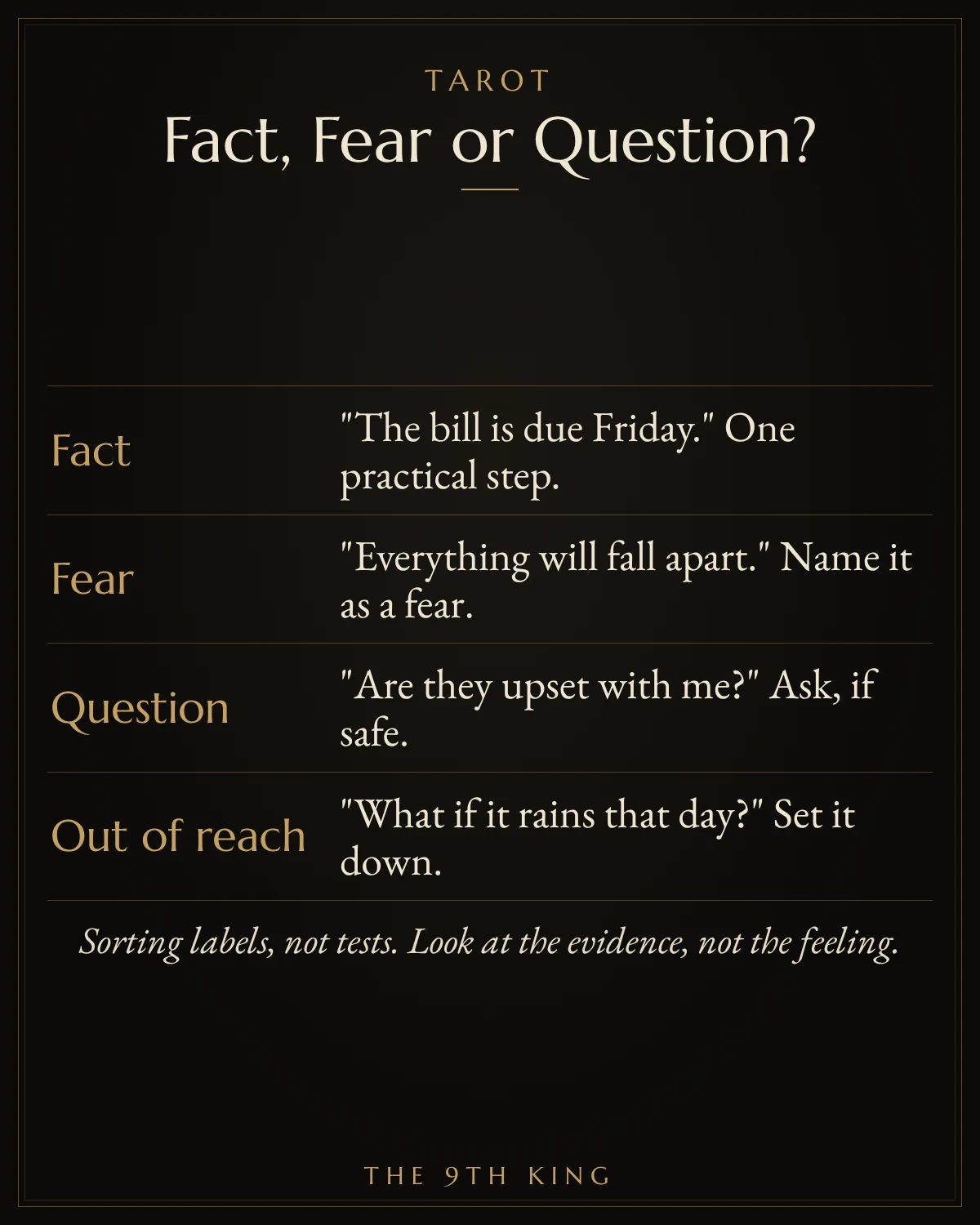
These are sorting labels, not tests. How a thought feels doesn’t prove which kind it is, and you can feel shaken and still sort it well. Look at the evidence instead.
The self-mastery lesson
The lesson of the Nine of Swords is to meet your thoughts as messengers, not as judges. Each sword brings something: a fact to act on, a fear to name, a question to ask or a worry you can’t control. Self-mastery means sorting them one at a time instead of letting all nine hang over you at once.
Nine of Swords as feelings, in love and at work
Nine of Swords as feelings
When someone asks “how does this person feel?” and draws the Nine of Swords, readers often take it as worry, guilt or distress. But a card can’t tell you what’s in another person’s mind; their words and actions are the real evidence. If the card is about your own feelings, it can be a prompt to ask: What am I afraid of right now, in one plain sentence?
Nine of Swords love meaning
In a love reading, readers often link the upright card with relationship worry: replaying a conversation or fearing someone is losing interest. The card can’t establish what a partner feels or intends; that belongs to honest conversation and observable behavior over time.
Tarot can’t tell you whether to stay or leave, and this page won’t either. If you’re anxious in a relationship, the card can help you notice what’s happening inside you. If you don’t feel safe with someone, put your safety first; fear in that case may be a reasonable fear, and the person who causes harm is responsible for it, never the person who was hurt. Otherwise, useful questions include:
- What exactly am I afraid of, and what have I actually seen or heard?
- Is this a question I could ask, kindly and directly, if it feels safe?
- What would help me feel steadier this week, whatever the answer turns out to be?
If the same worries follow you between partners, our guide to synastry for beginners can help you look at the pattern with curiosity instead of blame.
Nine of Swords at work
At work, readers often take the card as job worry: a mistake you keep replaying, or dread before a review. This is reflection, not career or financial advice. Ask yourself: What’s the real-world size of this problem, and what’s one step I can take toward it?
Practical exercise: sorting the nine swords
You need about twenty minutes, a notebook and a reasonably settled moment. It’s fine to do one step, stop and come back another day.
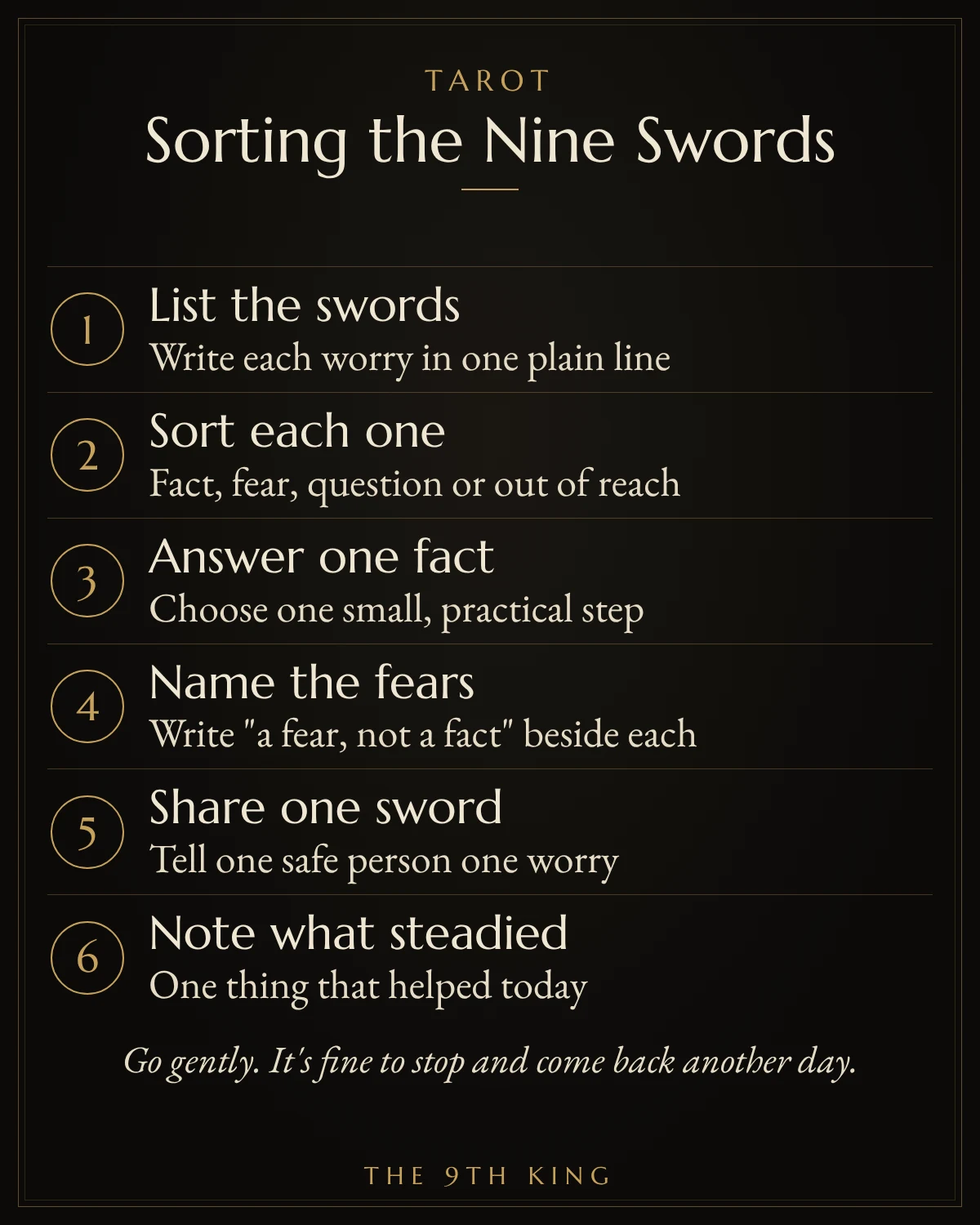
Step 1: List the swords
Write down each worry that’s been circling, one plain line each. There’s no right number; three is fine, and so is twelve.
Step 2: Sort each one
Beside each line, write one label: fact, fear, question or out of reach. If you’re not sure, write “not sure”.
Step 3: Answer one fact
Choose one item labelled “fact” and write one small, practical next step for it: a phone call, an email, a date in your calendar. Just one.
Step 4: Name the fears
Beside each fear, write “this is a fear, not a fact”. You’re not arguing with it, just labeling it accurately.
Step 5: Share one sword
Pick one worry and tell one safe person: a friend, a family member or a professional. You decide how much to say. If a worry involves another person, raising it with them is optional, and only if it feels safe and useful.
Step 6: Note what steadied
Once a day, note one thing that steadied you, even briefly. Over time, the list can show you moments of steadiness that are easy to miss on hard days.
A worked example (fictional)
Dana (fictional) has been replaying a tense week and draws the Nine of Swords upright.
In Step 1 she lists four worries: the rent is due on the 1st, her manager will think she’s incompetent, her sister seemed cold on the phone, and her flight next month might be cancelled. In Step 2 she sorts them: the rent is a fact, the manager worry is a fear, her sister is a question, and the flight is out of reach. For the fact, she sets up the rent payment that afternoon. Beside the manager worry she writes “this is a fear, not a fact”. For her sister, she decides to call at the weekend and ask how she’s doing. She tells her closest friend about the work worry. By the end of the week, her steady-things list has five lines.
Journal prompts for the Nine of Swords
- What worry have I been carrying that I haven’t said out loud?
- Which of my fears are reasonable, and what are they asking me to do?
- What story does my mind tell late at night that it doesn’t tell in daylight?
- What am I ashamed of, and would I judge a friend this harshly for it?
- Who could help me carry one of these swords?
- What would I say to a friend lying awake with exactly this worry?
For more prompts like these, our shadow work prompts collection goes deeper.
A warm note: this is reflective practice, not therapy. If worry or sleeplessness has been going on for a while, or it’s tied to trauma or abuse, or you’re dealing with thoughts of self-harm or distress that feels overwhelming, please reach out to a doctor or a qualified therapist who can help you through it. You deserve that support. It’s always fine to stop a prompt that feels like too much.
Myths and misreadings of the Nine of Swords
- “The Nine of Swords means something terrible is coming.” No. On The 9th King, tarot doesn’t predict events. The card reflects how you’re carrying worry, not what comes next.
- “It means your fears are true.” A card can’t confirm a fear. Wikipedia’s summary even describes its fears as, to a large extent, unfounded (Wikipedia: Nine of Swords). Some fears are reasonable; evidence tells them apart, not the card.
- “Reversed, it proves someone is lying to you.” In his additional meanings, Waite says the reversed card can mean good ground for suspicion against a doubtful person. He also warned that these extra meanings have little connection with the card designs and often disagree with his main meanings (sacred-texts.com: Waite, Additional Meanings). A card can’t establish anyone’s honesty.
- “Mars in Gemini means this card is about Gemini people.” No. The correspondence describes the card’s symbolism in the Golden Dawn tradition. Anyone can draw it, whatever their sign.

Nine of Swords: FAQ
What does the Nine of Swords mean?
The Nine of Swords is a Minor Arcana card in the suit of Swords. Waite describes a woman on her couch in grief with the swords over her. Readers commonly take it as worry, dread, guilt and sleepless nights. On The 9th King, it’s a mirror for how you’re carrying fear, a prompt to sort facts from fears, and never a prediction of bad news.
What does the Nine of Swords reversed mean?
Reversed, the Nine of Swords is often read as a worry that’s starting to ease, or one that’s been locked away and kept secret. Waite’s reversed meanings include doubt, shame and, notably, reasonable fear. Some readers don’t use reversals at all. Treat it as a question, such as “which of my fears are reasonable, and what do they need?”, rather than a verdict.
What does the Nine of Swords mean as feelings?
As feelings, readers often take the Nine of Swords as worry, guilt or distress. But a card can’t tell you what another person feels or thinks of you; their words and actions are the real evidence. If the card is about you, it can be a prompt to name your fear in one plain sentence and to share it with someone safe.
What does the Nine of Swords mean in love?
In love, the card is often linked with relationship worry: replaying conversations, fearing rejection or carrying guilt. It doesn’t predict a breakup, and it can’t establish what a partner feels or intends. It doesn’t tell you to stay or leave either. It invites you to separate what you’ve observed from what you fear, with your safety always first.
What zodiac sign is the Nine of Swords?
In the Golden Dawn system, the tradition The 9th King uses, the Nine of Swords corresponds to Mars in Gemini, the middle of the three Gemini decans. Liber LXXVIII calls the card the Lord of Despair and Cruelty. It’s a planet-in-sign pairing rather than a card for one sign, and other schools use different correspondences, so treat it as symbolism.
Is the Nine of Swords a yes or no card?
The 9th King doesn’t do yes or no readings, because tarot here is a tool for self-reflection, not fortune-telling. Instead of asking whether the card says yes, ask what it shows you: which worries are facts, which are fears, which are questions you could ask, and which you can set down for now.
Does the Nine of Swords mean anxiety?
On 9K, we often link the Nine of Swords with anxious, looping thoughts and nights of lying awake. But a tarot card can’t diagnose anxiety or any other condition. If worry or sleeplessness keeps returning or is affecting your life, a doctor or qualified therapist is the right person to talk to.

Your next step: try the sorting the nine swords exercise above with the worries you’re carrying this week, gently and at your own pace. Then read our Gemini Personality Traits guide: Gemini is the sign the Golden Dawn tied to this card, and its quick, questioning mind can show you how worry multiplies and how to put it to better use.
Explore Next
- The Twins and their restless mind: Gemini Personality Traits
- Start gently: Shadow Work, Plainly
- Go deeper with questions: Shadow Work Prompts
- Old fears that echo: Inner Child Work
- The shadow side of every sign: Zodiac Shadow Work
- Reading by feel: Intuitive Tarot (Code of Ascension)
- New to the cards: Tarot for Beginners: How Tarot Really Works (Code of Ascension)
- More Swords on The 9th King: Ace of Swords · Two of Swords · Three of Swords · Queen of Swords
- Fears in the dark: The Moon · Hope after the night: The Star
- More tarot on The 9th King: Tarot Card Meanings · Minor Arcana · Tarot & the Zodiac · Shadow Work Tarot Spread
- More cards in this set: Eight of Swords, Ten of Swords

Final Thought: Messengers, Not Judges
The Nine of Swords is honest about the hours when worry is loudest. But swords overhead are thoughts, and thoughts can be sorted: a fact to act on, a fear to name, a question to ask, a worry to set down. Do it one sword at a time, rest when you need to and let someone help you carry what’s heavy. Know your nature. Rule your life.
About the Author
King is the founder of The 9th King, where zodiac psychology, relationships and shadow work are explored as tools for self-knowledge rather than fortune-telling. He’s a Libra Sun, and writes about the personal side of astrology on King The Kemist. Astrology on The 9th King is interpretation and self-reflection, not prediction or established fact.
Leave a Reply