
Quick Answer: What Does the Knight of Wands Mean?
The Knight of Wands is a court card in the suit of Wands, the suit tarot readers link with the element of fire: drive, desire, courage and creative energy.
- Keywords (upright): passion, bold movement, adventure, departure, confidence, momentum.
- Keywords (reversed): impulsiveness, scattered energy, leaving before finishing, discord, burnout.
- Upright in one line: the card can point to a burst of energy and the nerve to move toward what excites you.
- Reversed in one line: readers often take it as speed without direction, or fire that burns out before the work is done.
On The 9th King, tarot is a mirror for self-knowledge, not fortune-telling. The Knight of Wands doesn’t say what will happen or where you’ll go. It asks a sharper question: I’m moving fast, but am I moving toward something?
Table of Contents

The Knight of Wands at a glance
| Knight of Wands | |
|---|---|
| Arcana | Minor Arcana, court card |
| Suit | Wands (staves, rods) |
| Element of the suit | Fire |
| Golden Dawn pairing | Fire of fire (Liber LXXVIII) |
| Zodiac span | Above 20° Scorpio to 20° Sagittarius |
| Upright themes | Passion, bold movement |
| Reversed themes | Impulsiveness, burnout |
| Key question | Where am I headed? |
Tarot meanings are a tradition of interpretation, not a fixed code. Below are the meanings commonly used with the Rider–Waite–Smith deck, then The 9th King’s own reading.
What the Knight of Wands card shows
The deck most people learn first is the Rider–Waite–Smith tarot, published by William Rider & Son of London in December 1909, with A. E. Waite’s instructions and Pamela Colman Smith’s illustrations (Wikipedia: Rider–Waite Tarot).
The imagery, in words
In Waite’s description, the knight is shown as if on a journey, carrying a short wand. He wears mail, but he isn’t riding off to fight. He passes mounds or pyramids in the background. Then Waite gives the key to the whole card: the motion of the horse reveals the character of its rider and “suggests the precipitate mood” (A. E. Waite, The Pictorial Key to the Tarot, 1910/1911, public-domain copy on sacred-texts.com).
Precipitate means rushed, headlong, done before it’s been thought through. That one word is the card’s gift and its problem.
On the 1909 Smith card, the horse rears up on its hind legs and the knight’s tunic is patterned with salamanders, the lizard-like creatures old lore tied to fire. Neither detail is in Waite’s text.
The Golden Dawn’s picture of the same figure
Liber LXXVIII, the Golden Dawn text, pictures its Knight of Wands as a winged warrior on a black horse with a flaming mane and tail, wearing a winged helmet with a rayed crown and a scarlet mantle. He holds a club with flaming ends, and waving flames rise beneath his horse’s rushing feet (Liber LXXVIII). It isn’t the Rider–Waite–Smith image, but this rider also runs on fire.
Why Wands? Staves and fire
Tarot decks were invented in Italy in the 1430s and weren’t adapted for occult and fortune-telling use until France around 1780 (Britannica: tarot). In the Golden Dawn system the Wands are the fire suit: Liber LXXVIII calls the Ace of Wands “the Root of the Powers of Fire” (Liber LXXVIII).
What a Knight does in the court
The court cards (Page, Knight, Queen, King) can be read as people, as roles you play or as stages of maturity. Knights are the movers who carry their suit out into the world. The King of Wands has learned to hold his fire steady and lead with it. The Knight of Wands hasn’t yet. He’s all launch and very little landing.
Knight of Wands upright meaning
Waite’s upright meanings are about leaving: departure, absence, flight, emigration and change of residence. He also lists a friendly dark young man as a person the card can stand for (Pictorial Key). Modern readers commonly add travel and progress, new ideas, challenge, determination, leadership and unpredictability (Wikipedia: Knight of Wands).
Put simply, the upright card is fire in motion: not just wanting something, but going after it.
In general
The card can point to a season of energy and appetite. Something lights you up and you want to move now. Upright, the Knight says that urge is worth respecting. The catch: a launch isn’t a journey.
As a person
As a person, readers often describe someone confident, adventurous, funny and quick to act, the one who says “let’s go” before anyone else has finished the sentence. Liber LXXVIII’s character note for the figure is five words: active, generous, fierce, sudden, impetuous (Liber LXXVIII). The same person can get bored fast and move on before the hard middle part arrives.
At work and in creative life
At work, the card can point to a bold pitch, a new venture or a project that needs someone to go first. The question is who finishes them. If a real job, move or money decision is involved, treat this as reflection, not career or financial advice.
Knight of Wands in love
In love readings, the upright Knight of Wands is about how passion shows up in behavior: excitement, directness, the urge to plan an adventure together, a burst of energy in a connection. It can also reflect your own fire waking up.
The card doesn’t tell you whether to start, stay or leave. It asks: Does this passion show up consistently, or only in bursts? When I’m the one feeling it, do I stay present once the novelty wears off?
Knight of Wands as feelings
People often ask what the card means “as feelings,” usually about someone else. No card can read minds, so treat this as a mirror for your own impression. Readers commonly take the upright card as feelings that are intense, eager and ready to act: “I’m excited, and I want to do something about it.” Check that impression against what the person actually does over time, and ask them directly if it matters.
Knight of Wands reversed meaning
Waite’s reversed meanings are short: rupture, division, interruption, discord (Pictorial Key). His additional notes give the reversed Knight one more word, irregularity (Pictorial Key, additional meanings). Modern summaries add insecurity and a fear of revealing your true self (Wikipedia: Knight of Wands).
On The 9th King, the reversed card is less a warning about others than a look at what happens when fire has no container. It tends to show up three ways.
1. The half-finished trail
You start strong and leave early: the abandoned project, the course you quit at week three, the plan announced to everyone and dropped in silence. The middle never gets lived.
2. The scorched room
Intensity that burns people out. Your pace becomes everyone’s pressure. Your urgency turns ordinary days into emergencies. If someone else’s intensity regularly runs over you, their choices are theirs to own. You’re allowed to name the pace you can keep.
3. The escape hatch
Leaving whenever things get uncomfortable and calling it freedom. Waite’s upright list includes “flight.” Reversed, it can point to flight as a habit, moving on so you never have to sit with boredom, conflict or the fear of being truly seen.
Reversed in love and as feelings
In love, the reversed card can point to stop-and-start energy, conflict that flares fast, or plans that change without warning. As feelings, readers often take it as feelings that are real but restless or unsettled. The card can’t tell you what someone else feels; it can help you see what you’d want to ask before you trust it.
Element and astrology: fire of fire (and a naming trap)
The 9th King uses the Golden Dawn–derived correspondences, the tradition the Rider–Waite–Smith deck draws on; both Waite and Pamela Colman Smith belonged to the Hermetic Order of the Golden Dawn (Wikipedia: Rider–Waite Tarot). Other schools assign things differently, and not every card maps to a single sign. Court cards in particular work differently from the numbered cards.
The element pairing
The 9th King follows the court-card naming in Liber LXXVIII (the Golden Dawn’s Book T): Knights are fire of their suit, Queens water, Kings air, Pages earth. Liber LXXVIII calls the Knight of Wands “The Lord of the Flame and the Lightning; the King of the Spirits of Fire,” and pairs it with fire of fire. It also names him King of the Salamanders (Liber LXXVIII).
Fire of fire is the hottest mix in the court: drive layered on drive, with nothing to cool it or give it shape. The lesson is giving your own fire a container.
When ill dignified, Liber LXXVIII adds, the figure turns cruel, bigoted and brutal (Liber LXXVIII). On The 9th King, that reads as force that stops caring who it lands on.
The naming trap
Here’s the confusing part. Liber LXXVIII heads this card “Knight of Wands” but gives it a Golden Dawn title that calls him a King, while its chariot-riding Prince carries the “King of Wands” label. Matching those Golden Dawn figures to the Rider–Waite–Smith court cards is the convention The 9th King uses, not something the source says about Waite’s deck. Other systems differ, and some modern readers assign the Knights a different element and different spans. If you work with another system, use it consistently. (The King of Wands page walks through the same trap from the other side.)
The zodiac span
Liber LXXVIII says this figure rules the heavens “from above the Twentieth Degree of Scorpio to the First Two Decans of Sagittarius,” a stretch that includes part of the constellation Hercules, who is always shown with a club (Liber LXXVIII). That’s the last decan of Scorpio and the first two decans of Sagittarius. In the same text’s decan list, those three decans belong to the Seven of Cups (Venus in Scorpio), the Eight of Wands (Mercury in Sagittarius) and the Nine of Wands (Moon in Sagittarius) (Liber LXXVIII).
So the Knight of Wands isn’t “the Sagittarius card.” It straddles two signs:
- Scorpio: intensity, desire, the refusal to do anything halfway.
- Sagittarius: adventure, restlessness, the urge to go further.
That blend suits a knight whose fire runs both deep and far. As a Wands card, it also shares the fire element with Aries, Leo and Sagittarius. Both links are reflective, not labels.

The 9th King reading: fire that finishes
Here’s where The 9th King’s interpretation goes beyond the standard keywords: the card’s tension, its shadow and its lesson.
The tension: bold move vs. bolt
From the outside, a bold move and a bolt look identical. The difference shows up afterward, in whether the energy lands anywhere. A bold move is fire with a destination. A bolt is fire running from the room.

| Sign | Bold move (upright) | Bolt (reversed) |
|---|---|---|
| Direction | Heading toward something | Getting away from something |
| Pace | Fast, then sustainable | Fast, then gone |
| Others | Brings people along | Leaves the cleanup |
| The middle | Stays for it | Leaves when it gets dull |
| Over time | Builds something | Repeats the start |
Use the table on yourself first.
The shadow side
Shadow work means looking honestly at the parts of yourself you’d rather not see; Shadow Work, Plainly explains the idea. This knight’s shadow is tricky because it looks like courage.
Common Knight of Wands shadow patterns:
- Addicted to beginnings. Loving the rush of starting more than the thing you started.
- Urgency as identity. Treating everything as now-or-never because slowness feels like failure.
- Leaving before you’re known. Moving on just as people get close enough to see the real you.
- Pace as pressure. Expecting everyone to match your speed and reading their caution as weakness.
- Contempt for the middle. Quietly looking down on maintenance, follow-up and routine, while needing exactly what they’d give you.
If someone’s caution or slowness gets under your skin, ask what it mirrors; psychological projection explains how that works. Their pace is still theirs; your reaction is just worth learning from. The zodiac shadow work guide looks at the fire signs’ shadows alongside the rest.
The self-mastery lesson
The Knight of Wands’ lesson is this: fire isn’t proven by how fast it starts, but by what it builds. Boldness is the first half. Staying long enough to finish is the second half, and it’s the half that makes the first one count.
Mastery here doesn’t mean dimming your fire. It means two habits:
- Ride with a destination. Waite’s knight isn’t on a warlike errand; he’s on a journey. Know where you’re going, even if the plan is one sentence.
- Pace for the middle. Set a speed you and the people with you can keep up when the excitement fades.
Knight of Wands in a reading
A few patterns readers commonly notice, framed as questions rather than answers. (The 9th King doesn’t offer yes/no readings or timing predictions: one card can’t settle a yes-or-no question or say when something will happen, and the reflection is more useful anyway.)
By position
- Present situation: energy is high and you want to move. What exactly are you moving toward?
- Obstacle: speed or restlessness may be getting in the way. What have you left half-done that still needs you?
- Advice: act boldly, then commit to the middle. What’s one move you could make this week and still be glad about in three months?
- Direction: not a prediction. Is a bolder path one you’re willing to follow all the way through?
If you’re building a spread to practice with, the Three-Card Tarot Spread is a simple start, and the Shadow Work Tarot Spread is built for exactly the shadow questions above.
Next to other cards
Next to a steady card like the Knight of Pentacles, it can suggest speed meeting patience; next to The Chariot, it can amplify drive and the need to steer it. Code of Ascension’s Intuitive Tarot (Code of Ascension) covers reading combinations by feel.
A worked example (fictional)
The situation (fictional): Dana has started four side businesses in two years: candles, a newsletter, a podcast and a coaching offer. Each stopped around month two. Dana draws three cards for “What’s happening, what’s in the way, what helps?” and gets the Knight of Wands reversed in the middle.
A reflective reading: the fire is real and so is the talent. Reversed, in the obstacle position, the knight asks whether the launch has become the reward.
The useful question: What would it take to stay with one of these for six more months, even when it’s boring?
What Dana does with it: Dana picks the newsletter, sets a pace of one issue every two weeks and blocks the dates in a calendar. The reading predicted nothing; it helped Dana see the pattern.
Myths and misreadings
- “The Knight of Wands means you’ll move or travel.” The card doesn’t predict events. Waite lists departure and change of residence among the meanings, but on The 9th King they’re read as a reflection on movement and change, not a forecast of a trip.
- “It’s always a romantic partner.” Court cards can stand for anyone, including you, a friend, a coworker or a role you’re playing.
- “It means someone is unreliable.” The reversed card can point to someone else’s stop-and-start behavior, but it can just as easily point to your own. A card can’t tell you another person’s motives. Look at observable behavior over time, and look at your own pattern too.
- “The astrology is settled.” Only within one system. This page uses Liber LXXVIII: fire of fire, from above 20 degrees of Scorpio through the first two decans of Sagittarius, with no single sign.
Practical exercise: the Finish Line Check
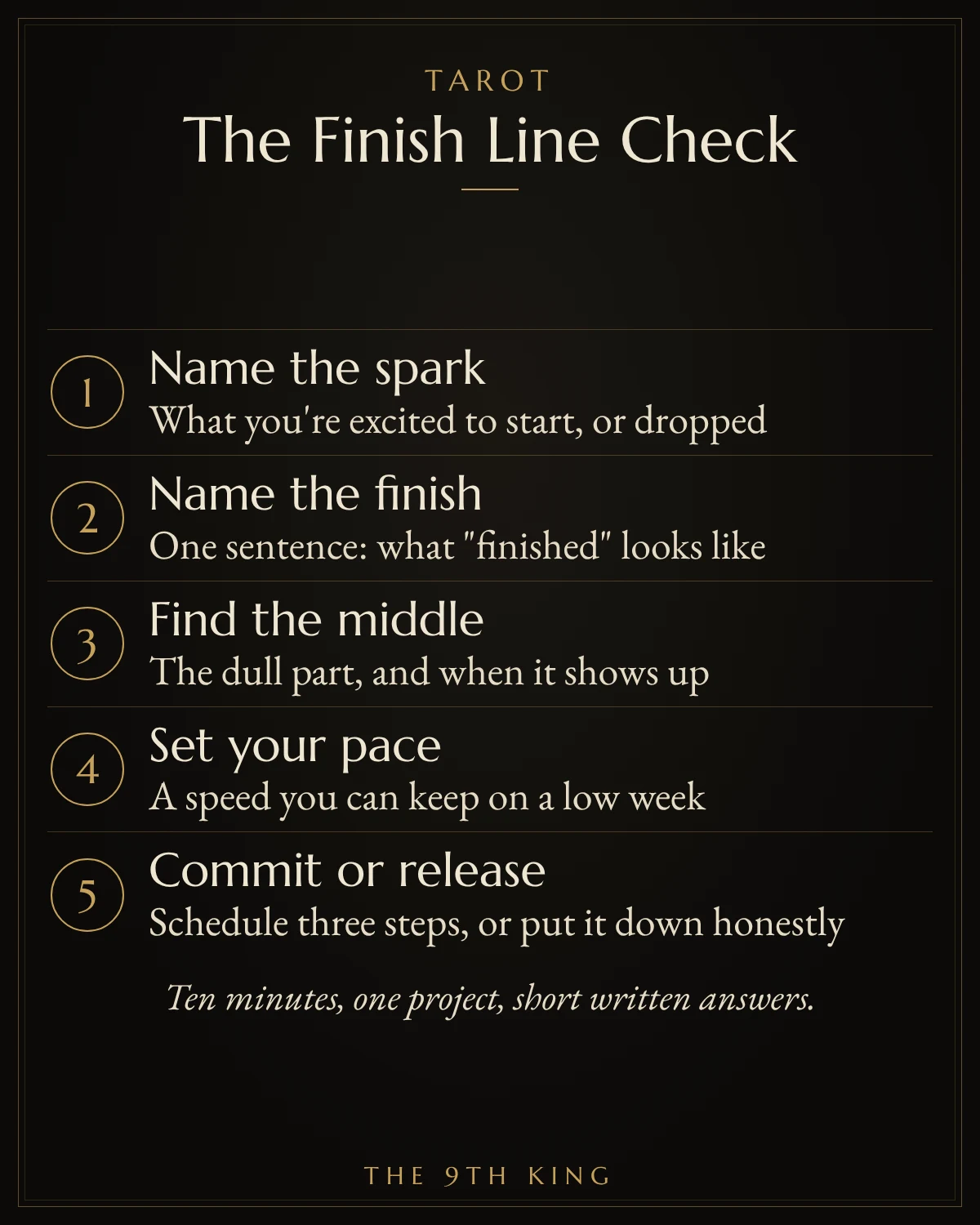
A ten-minute worksheet for any project, plan or idea you’re itching to start, or one you’ve already left half-done. Write short answers.
- Name the spark. What are you excited to start, or what did you start and drop?
- Name the finish. In one sentence, what does “finished” look like?
- Find the middle. What’s the dull, unglamorous part this will need, and when does it usually show up for you?
- Set your pace. What speed could you keep up on an ordinary, low-energy week?
- Commit or release. Either schedule the next three steps, or tell anyone affected, honestly, that you’re putting it down.
Releasing something on purpose counts as finishing. What the Knight of Wands warns against is riding off and leaving it smoldering.
Journal prompts for the Knight of Wands
For more, try our shadow work prompts.
- What am I most excited to start right now, and what am I hoping it will give me?
- What have I left half-finished, and what was happening in my life when I walked away?
- When I leave something, am I usually heading toward something new or away from something uncomfortable?
- Whose pace have I run over, and what did it cost them?
- Where do I mistake urgency for importance?
- What is one thing I could finish this month, small and real?
A gentle note: these prompts are for reflection, not therapy. If you’re dealing with trauma, abuse, thoughts of self-harm or distress that feels overwhelming, please work with a qualified therapist. And it’s always fine to stop a prompt that feels like too much and come back another day, or not at all.
New to tarot? Code of Ascension’s Tarot for Beginners (Code of Ascension) covers the basics.

Knight of Wands: FAQ
What does the Knight of Wands mean?
The Knight of Wands is a court card in the fire suit of Wands. Upright, readers commonly take it as passion, bold movement, adventure and confidence. Waite’s meanings centered on departure and change of residence. On The 9th King, it’s a mirror for self-knowledge: it honors the courage to move toward what excites you, then asks whether you’re heading somewhere or just heading out.
What does the Knight of Wands reversed mean?
Reversed, the Knight of Wands often points to fire without a container: impulsiveness, scattered energy, leaving things half-done or intensity that wears people out. Waite’s reversed meanings were rupture, division, interruption and discord. The card can point to someone else’s stop-and-start behavior, but it can just as easily point to your own. Ask which version honestly fits.
What does the Knight of Wands mean as feelings?
Upright, readers often take it as intense, eager feelings that want to turn into action: someone excited and ready to do something about it. Reversed, it can suggest feelings that are real but restless, flaring hot and then shifting. Tarot can’t read another person’s mind, though. Use the card to examine your own impression, then compare it with what the person actually does over time.
What does the Knight of Wands mean in love?
In love, the upright Knight of Wands points to passion shown through behavior: directness, excitement and the energy to plan things together. Reversed, it can point to stop-and-start energy, quick conflict or plans that keep changing. The card doesn’t tell you to start, stay or leave. It asks whether the passion in a connection, including your own, stays present once the novelty fades.
What element is the Knight of Wands?
Wands is the fire suit. In Liber LXXVIII, the Golden Dawn text whose court-card naming The 9th King follows, Knights are fire of their suit, so the Knight of Wands is “fire of fire,” the hottest pairing in the court (Liber LXXVIII). Its Golden Dawn title calls him a King, a reminder that the court names don’t match. Other systems differ.
Which zodiac sign is the Knight of Wands?
No single sign. In Liber LXXVIII, the Golden Dawn text The 9th King follows for court cards, this card rules from above the 20th degree of Scorpio through the first two decans of Sagittarius (Liber LXXVIII). That’s the last decan of Scorpio and the first two of Sagittarius. As a Wands card, it also shares the fire element with Aries, Leo and Sagittarius. Treat both as reflective links, not labels.
Is the Knight of Wands a good card?
There are no simply good or bad cards on The 9th King. Upright, the Knight of Wands can point to courage, energy and the willingness to go first. Reversed, it points to the same fire gone off course, into restlessness, half-finished plans or a pace that burns people out. Either way, the useful question is the same: is this energy building something, or just burning?

Your next step: pick one thing you’ve started and left, or one thing you’re itching to start, and run the Finish Line Check above this week. Then look at the fire in your own chart: start with How to Read a Birth Chart, and read Sagittarius Personality Traits if restlessness is a familiar story.
Explore Next
- The signs in the Knight’s span: Scorpio Personality Traits · Sagittarius Personality Traits
- Go deeper on the shadow: Shadow Work, Plainly · Shadow Work Prompts · Psychological Projection · Zodiac Shadow Work
- More Wands on The 9th King: King of Wands · Nine of Wands
- More tarot on The 9th King: Tarot Card Meanings · Minor Arcana · Tarot & the Zodiac · Knight of Cups · Knight of Pentacles · The Chariot
- More cards in this set: Ace of Wands · Page of Wands · Queen of Wands · Knight of Swords

Final Thought: Ride With a Destination
The Knight of Wands rides in with fire in his hands, and that’s a rare and good thing. The world needs people willing to go first, say yes and move before every doubt is settled. His one risk is mistaking the start for the journey. Light it fully, then stay long enough to see what it builds. That’s how boldness becomes something people can follow, including you. Know your nature. Rule your life.
About the Author
King is the founder of The 9th King, where zodiac psychology, relationships and shadow work are explored as tools for self-knowledge rather than fortune-telling. He’s a Libra Sun, and writes about the personal side of astrology on King The Kemist. Astrology on The 9th King is interpretation and self-reflection, not prediction or established fact.
Leave a Reply