
Quick Answer: What Does the Two of Pentacles Mean?
The Two of Pentacles (also written 2 of Pentacles) is a Minor Arcana card from Pentacles, the earth suit of work, money, body and home. In the traditional image, a young man dances with a pentacle in each hand, the two joined by an endless looping cord. On The 9th King, it’s the card of the loop: two things held at once, kept moving by rhythm rather than by force.
- Keywords: balance, juggling priorities, rhythm, adaptability, change, two things at once, pacing, capacity.
- Upright, in one line: a prompt to notice how you’re balancing two demands right now, if you want to keep both moving at a pace you can actually sustain.
- Reversed, in one line: juggling that has turned into strain or show; a prompt to look honestly at what you’re carrying, what you’ve dropped, and what your real capacity is today.
On The 9th King, tarot is a mirror for self-knowledge, not fortune-telling. The Two of Pentacles doesn’t say whether things will work out. It asks whether your balancing act fits the person doing it.
Table of Contents
The Two of Pentacles at a glance
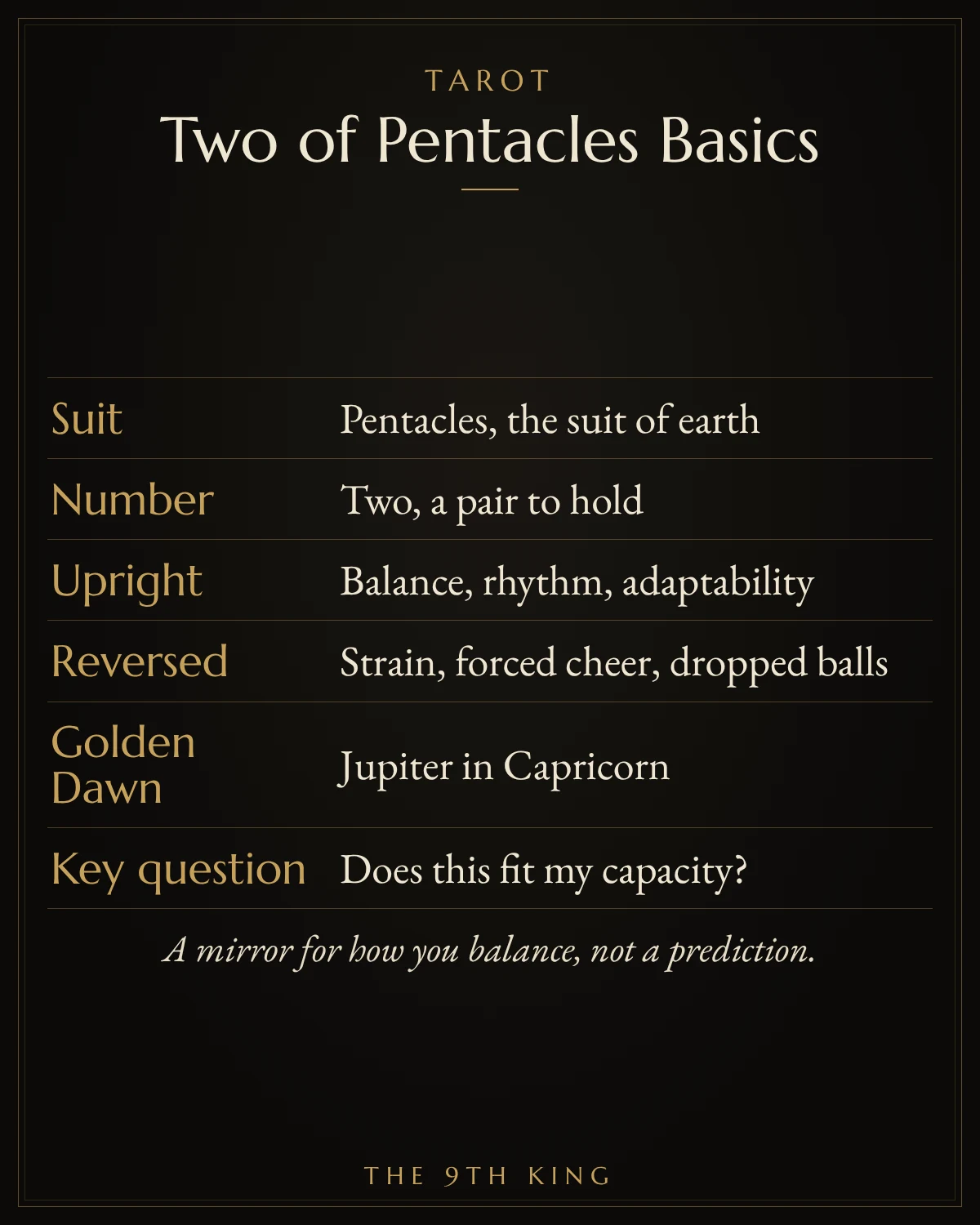
| Two of Pentacles | |
|---|---|
| Arcana | Minor Arcana, a pip (number) card |
| Suit and element | Pentacles, linked with earth |
| Number | Two |
| Golden Dawn title | Lord of Harmonious Change |
| Astrology (Golden Dawn) | Jupiter in Capricorn |
| Upright | Balance, rhythm, recreation |
| Reversed | Forced cheer, strain, overload |
| Key question | Does this fit my capacity? |
What the Two of Pentacles looks like
Most people meet this card through the Rider–Waite–Smith deck, first published in London by William Rider & Son in December 1909. A.E. Waite wrote the instructions and Pamela Colman Smith drew the art, and both were members of the Hermetic Order of the Golden Dawn (Wikipedia: Rider–Waite Tarot).
Waite’s description in The Pictorial Key to the Tarot is a single sentence (sacred-texts.com: Waite, Two of Pentacles), so this section stays close to it.
The dancer
Waite describes a young man caught in the middle of a dance. He isn’t standing still; the balance comes from the movement. On The 9th King, that’s the heart of the card: some kinds of balance are a rhythm, not a pose.
A pentacle in each hand
The young man has one pentacle in either hand. On The 9th King, we read this as an honest count: two things, two hands, nothing spare.
The endless cord
Waite says the two pentacles are joined by “that endless cord which is like the number 8 reversed” (sacred-texts.com: Waite, Two of Pentacles). He doesn’t explain the cord further. On The 9th King, we read that sideways eight as a loop with no break in it: when one side rises, the other falls, and the motion keeps both in play.
On the early Smith card
On the 1909 Smith card (Wikimedia Commons: 1909 Two of Pentacles scan), the young man wears a very tall hat, the cord is a broad green band looping around both pentacles, one of his feet is lifted mid-step, and behind him two ships ride high, rolling waves. Apart from the dancing young man, the two pentacles and the cord, none of this is in Waite’s text.

The Golden Dawn version of the card
The Golden Dawn’s teaching text on the tarot, Book T, as printed by Aleister Crowley in Liber LXXVIII, describes a different design: two pentacles like the Ace, united by a green-and-gold serpent bound around them like a figure 8, holding its tail in its mouth, with a white radiant angelic hand holding the center (Liber LXXVIII, sacred-texts.com). It notes that no roses enter into this card and calls it “a revolving symbol.” There’s no dancer, but the figure eight is shared.
Two of Pentacles meaning (upright)
Waite’s upright meanings come in two layers. He says the card is represented as one of gaiety, recreation and its connections, which he calls the subject of the design. Then he adds that it’s also read as news and messages in writing, and as obstacles, agitation, trouble and embroilment (sacred-texts.com: Waite, Two of Pentacles). Even Waite holds two readings at once.
Book T goes further. Under the title Lord of Harmonious Change, it lists the harmony of change, alternation of gain and loss, weakness and strength, and ever-changing occupation (Liber LXXVIII, sacred-texts.com). It describes someone industrious yet unreliable, fortunate through prudent management yet sometimes foolish, kind yet wavering.
On The 9th King, we read the upright card as balance that moves. It has three layers.
Rhythm over rigidity
The card can point to a season of keeping two things going: work and caregiving, a project and recovery, two people who both need you. The dancer doesn’t freeze to stay balanced; he shifts his weight. Ask yourself: What would change if I treated this as a rhythm to find, not a position to hold perfectly?
Lightness as a skill
Waite’s first word for this card is gaiety. On The 9th King, we read that as staying light while busy: humor, play, a little ease in a full week, without pretending it’s easy. Ask yourself: Where can I bring a little play into what I’m carrying, without hiding how much it is?
Knowing the count
Two pentacles, two hands. The upright card can point to knowing exactly what you’re holding and how much room is left. Ask yourself: Can I name everything I’m juggling right now, without checking a list?
Two of Pentacles reversed
Some readers read reversals as the opposite meaning, some as blocked energy, and some don’t use them. Waite’s reversed meanings start with enforced gaiety and simulated enjoyment, then turn to a list that sounds like an old office desk: literal sense, handwriting, composition, letters of exchange (sacred-texts.com: Waite, Two of Pentacles).
In his additional meanings, Waite gives the upright card a reassuring line: the troubles may be more in the imagination than in fact. For the reversed card he gives bad omen, ignorance and injustice (sacred-texts.com: Waite, Additional Meanings of the Lesser Arcana). He warns on that page that these extra meanings are “very often in disagreement with those previously given,” so treat them as an old layer, not a rule.
On The 9th King, the reversed card usually points to one of three patterns, offered as questions, not predictions.
The smile that’s working too hard
On The 9th King, we read Waite’s enforced gaiety as cheerfulness that has become a performance: saying “I’ve got it” when you don’t, keeping the dance going for an audience. Ask yourself: Who am I keeping up appearances for, and what would happen if I told one person the real count?
More balls than hands
The reversed card can point to a load that has grown past what two hands can hold. That isn’t a character flaw. Loads grow: a new role, an illness, a family need, a loss. Ask yourself: When did I last check what I’m carrying against what I can carry today?
The dropped ball
Sometimes something has already fallen: a bill forgotten, a promise missed. The reversed card can point to what you do next. Ask yourself: What have I dropped that I could pick up, renegotiate, or set down on purpose?
| Pattern | Upright tone | Reversed tone |
|---|---|---|
| Pace | A rhythm you can keep | Speeding up to keep up |
| Mood | Lightness alongside effort | Cheer as a cover |
| The count | Known and named | Fuzzy or growing |
| Missed things | Noticed and renegotiated | Hidden or ignored |
Two of Pentacles astrology: Jupiter in Capricorn
The 9th King uses Golden Dawn–derived correspondences, the tradition the Rider–Waite–Smith deck draws on. Other schools use different systems, and not every card maps to a single sign: the court cards and Pages work differently.
How the number cards get their planets
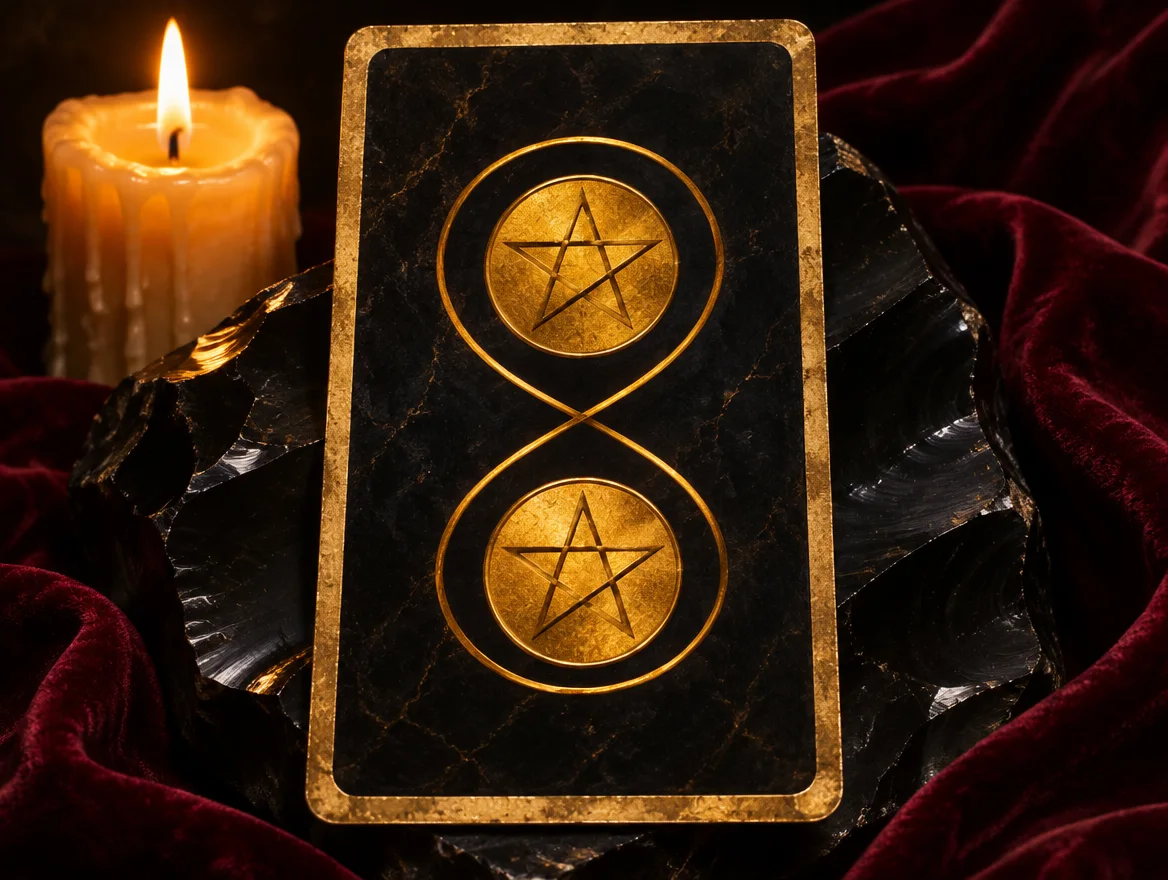
In the Golden Dawn system, the 36 small cards (Twos through Tens) are matched to the 36 decans of the zodiac: ten-degree thirds of a sign, each with a ruling planet. Book T‘s table lists the Two of Pentacles, Harmonious Change, under Jupiter in Capricorn (Liber LXXVIII, sacred-texts.com). It’s the first of three Capricorn entries in that table, followed directly by the Three of Pentacles (Mars in Capricorn) and then the Four of Pentacles (Sun in Capricorn). The card’s own entry places the symbols of Jupiter and Capricorn above and below the pentacles. Liber prints no degrees for it.
Book T places all four Twos in Chokmah on the Kabbalistic Tree of Life, and for this card adds a gentle line: pleasant change, a visit to friends.
What Jupiter brings
On The 9th King, Jupiter is the planet of growth, opportunity, generosity and faith that things can expand. It’s the traditional ruler of Sagittarius, so our Sagittarius Personality Traits page shows Jupiter’s style in a person, and our Jupiter Return guide follows one of its cycles in your chart. On this card, Jupiter is the part of you that says yes, there’s room for more.
What Capricorn brings
Capricorn is cardinal earth, ruled by Saturn: the sign of structure, responsibility and the long climb. Our Capricorn Personality Traits page covers the Goat’s discipline and its overworking shadow. On this card, Capricorn is the calendar, the budget and the honest count of hours.
The tension in the pairing
Jupiter wants to say yes. Capricorn wants to know if there’s time. The card sits where the two meet: room to grow, measured against real capacity. At its best, Jupiter keeps Capricorn from becoming all duty, and Capricorn keeps Jupiter from agreeing to everything.
The 9K reading: balance or overload?
The card’s tension
The Two of Pentacles holds two true things at once: you can handle a lot when you find the rhythm and rhythm doesn’t create extra hands. The card asks whether you’re balancing, or just refusing to put anything down.
The shadow side
The shadow of the Two of Pentacles is turning juggling into an identity. It can look like:
- Proving you can. Taking on one more thing to show you’re capable, then another.
- Busy as worth. Feeling uneasy when the schedule is light, as if being stretched is the only way to matter.
- The performance of fine. Waite’s enforced gaiety: keeping a bright face so no one sees the strain.
- Never setting anything down. Treating every commitment as permanent.
None of this is a moral failing. Patterns like these are often learned early. If that rings true, inner child work is a gentle, related place to look.
Capacity is real, inside and outside
Capacity isn’t only hours on a calendar. It includes money, health, sleep, grief and focus. An illness or a hard month can shrink what you can carry even if the list looks the same, and those limits are just as real.
Some loads can’t be put down: caring for someone, a job you need, a debt, your own health. The card doesn’t ask you to drop those. It asks what support, pacing or renegotiation might help you hold them.
| Rhythm | Overload |
|---|---|
| You can list your commitments | You keep finding ones you forgot |
| You check before saying yes | You say yes, then check |
| Rest is planned in | Rest happens only when you’re forced to stop |
| Missed things get renegotiated | Missed things get hidden |

These four checks are a starting point, not a verdict.
Rest isn’t dropping the ball
Rest, pacing and recovery aren’t failures of balance; they’re part of it. The dancer has to land between steps. Resting because your body or mind needs it is meeting a need, with or without an end date. Avoidance is different: putting off something you could handle because facing it is uncomfortable. That’s yours to sort out, and it can be a bit of both.
The self-mastery lesson
The lesson of the Two of Pentacles is to balance within your real capacity. Keep two things moving with rhythm and humor, say no or not yet to a third, set something down on purpose before it falls, and tell someone the true count.
Two of Pentacles as feelings, in love and at work
Two of Pentacles as feelings
As feelings, we often read the card on 9K as being pulled in two directions: interest that’s real but competing with other demands, or mixed feelings that shift back and forth. A card can’t tell you what someone feels or will do; their words and actions can. About your own feelings, ask: Am I unsure, or am I just stretched too thin to feel clearly?
Two of Pentacles love meaning
In a love reading, the upright card can point to a relationship finding its rhythm around busy lives, trading off who carries what. The reversed card can point to a relationship squeezed into the margins, or one person carrying more of the load than was ever agreed.
Tarot can’t tell you whether to stay or leave, and this page won’t either. Useful questions instead:
- What does each of us actually do in a normal week, in behavior I can see?
- When one of us is overloaded, what happens: do we talk, trade, or go quiet?
- Is there time for the two of us that isn’t logistics?
Two of Pentacles at work and with money
None of this is financial or career advice, only reflection.
At work, we often read the card on 9K as juggling projects or roles, or adjusting to change. Ask yourself: Am I managing this load, or is the load managing me?
With money, the card isn’t about how much you have, and your worth isn’t measured by it. It’s about how you track several obligations at once. Ask: Do I know what I’m balancing, or am I avoiding looking? For actual decisions, talk to a qualified professional.
The Ace of Pentacles is where the earth suit begins, and Temperance is the Major Arcana card of steady blending.
Practical exercise: the two-hands check
This isn’t a productivity system. It’s a quiet look at what you carry and what you can carry now. You need twenty minutes and a notebook.

Step 1: List what you hold
Write down everything you’re carrying: roles, projects, duties, recurring worries. Don’t rank them.
Step 2: Mark what’s fixed
Mark anything you can’t set down right now, like caring for someone, a job you need or your health. These aren’t problems to fix; they’re the shape of your load.
Step 3: Name your capacity
Write a few honest lines about what you have this month: time, energy, money, health, mood. Internal limits count, including grief or a body that needs more rest.
Step 4: Find the rhythm
Look at what’s left. What can alternate week by week, wait, or be held by someone else for a while?
Step 5: Choose one move
Pick one thing: set something down, ask for help, add a rest, slow a pace, or keep everything as it is because it fits. If it involves asking someone, that’s your choice, and only if it feels safe and useful.
A worked example (fictional)
Marcus (fictional) draws the Two of Pentacles reversed in a packed month.
He lists five things: his full-time job, driving his mother to two appointments a week, coaching his niece’s weekend soccer team, a freelance design project, and studying for a certification. He marks two as fixed: his job and his mother’s appointments.
Under capacity, he writes that he’s sleeping badly and has had a cold for two weeks.
Finding the rhythm, he notices the remaining three don’t all need him at once. The certification exam can move to the next testing window, and the coaching ends in three weeks.
His one move: he moves the exam to the next window. That leaves four things in his hands, two of them fixed, with coaching ending soon.
Journal prompts for the Two of Pentacles
- What two things am I balancing most right now?
- When did I last say “I’ve got it” when I didn’t? What was I protecting?
- What did I learn growing up about being busy, useful or “on top of things”?
- What would I set down if no one would be disappointed?
- Where can I add a little play or lightness this week?
For more, our shadow work prompts go deeper, and Shadow Work, Plainly explains how to start safely.
A warm note: this is reflective practice, not therapy. If you’re dealing with trauma, abuse, thoughts of self-harm or distress that feels overwhelming, please work with a qualified therapist who can walk with you. It’s always fine to stop a prompt that feels like too much.
Myths and misreadings of the Two of Pentacles
- “The Two of Pentacles means you’ll handle everything.” No. On The 9th King, tarot doesn’t predict outcomes. The card is a mirror for how you balance.
- “A good juggler never drops anything.” Real lives involve dropped things. What matters is what you do next: pick it up, renegotiate, or set it down on purpose.
- “It’s a hustle card.” On The 9th King, it isn’t. Waite’s first word for it is gaiety, and the dancer has two pentacles, not ten. The lesson is rhythm and capacity, not doing more.
- “Jupiter in Capricorn means this card is about Capricorn people.” No. The correspondence describes the card’s symbolism in the Golden Dawn tradition. Anyone can draw it, whatever their sign.
Two of Pentacles: FAQ
What does the Two of Pentacles mean?
The Two of Pentacles is a Minor Arcana card in the earth suit. Waite describes a young man dancing with a pentacle in each hand, the two joined by an endless cord shaped like a sideways 8. He reads it as gaiety and recreation, and also as messages, obstacles and agitation. On The 9th King, it’s a mirror for how you balance competing demands, not a prediction.
What does the Two of Pentacles reversed mean?
Reversed, Waite lists enforced gaiety and simulated enjoyment, then literal sense, handwriting, composition and letters of exchange. On The 9th King, we often read it as juggling that has turned into strain or a performance of being fine. Some readers don’t use reversals at all. Treat it as a prompt to check what you’re carrying against your real capacity today.
What does the Two of Pentacles mean as feelings?
As feelings, we often read the Two of Pentacles on 9K as being pulled in two directions: real interest competing with other demands, or mixed feelings that shift back and forth. A card can’t tell you what another person feels or will do; their words and actions can. About your own feelings, it can prompt you to ask whether you’re unsure or simply stretched too thin.
What does the Two of Pentacles mean in love?
In love, the upright card can point to a relationship finding its rhythm around busy lives, trading off who carries what and keeping some play in it. Reversed, it can point to a relationship squeezed into the margins, or an uneven load nobody agreed to. The card doesn’t tell you to stay or leave. It invites you to look at what each of you actually does in a week.
What zodiac sign is the Two of Pentacles?
In the Golden Dawn system, the tradition The 9th King uses, the Two of Pentacles corresponds to Jupiter in Capricorn, the first of the three Capricorn decans in Book T’s table. The Golden Dawn’s Book T calls the card the Lord of Harmonious Change. Other schools use different correspondences, so treat this as one traditional framework for symbolism.
Is the Two of Pentacles a yes or no card?
The 9th King doesn’t do yes or no readings, because tarot here is for self-reflection, not fortune-telling. Instead, ask what the card shows you: what you’re holding, what you can hold this month, and whether your pace is one you can keep. That question tends to be more useful than a yes or no.
Is the Two of Pentacles a good or bad card?
Neither, on The 9th King. Waite calls it a card of gaiety and recreation but also reads it as obstacles and agitation, and Book T’s Lord of Harmonious Change mixes gain with loss and strength with weakness. Read it as a mirror for how you handle change and competing demands, not as a good or bad omen.
Your next step: do the two-hands check above, and choose your one move before you close the notebook. Then find where Jupiter falls in your own chart with our guide on how to read a birth chart: the planet of growth that the Golden Dawn tied to this card.
Explore Next
- The Goat’s discipline and its overworking shadow: Capricorn Personality Traits
- Jupiter’s style in a person: Sagittarius Personality Traits
- Jupiter’s cycle in your own chart: Jupiter Return
- Where the earth suit begins: Ace of Pentacles
- The next Capricorn card, the skilled builder: Three of Pentacles
- Reading by feel: Intuitive Tarot (Code of Ascension)
- New to the cards: Tarot for Beginners: How Tarot Really Works (Code of Ascension)
- More tarot on The 9th King: Tarot Card Meanings · Minor Arcana · Tarot & the Zodiac · Wheel of Fortune · Shadow Work Tarot Spread
- More cards in this set: Eight of Pentacles, Nine of Pentacles, Ten of Pentacles

Final Thought: Keep the Loop Moving
The dancer in the Two of Pentacles isn’t holding everything still. He’s moving with what he holds, one pentacle rising as the other falls. You don’t have to carry more to prove you can. Know the count, find the rhythm, set things down on purpose, and let some lightness back into the dance. Know your nature. Rule your life.
About the Author
King is the founder of The 9th King, where zodiac psychology, relationships and shadow work are explored as tools for self-knowledge rather than fortune-telling. He’s a Libra Sun, and writes about the personal side of astrology on King The Kemist. Astrology on The 9th King is interpretation and self-reflection, not prediction or established fact.
Leave a Reply