

Quick Answer: What Are Shadow Work Prompts?
Shadow work prompts are journal questions that help you notice the parts of yourself you’ve learned to hide or judge: the anger you never show, the envy you call “just an opinion,” the talent you keep playing down. You answer one in writing, then look at what came up.
This page is a library, not a random list. The 60 prompts are sorted into eleven themes, from triggers, envy and anger to people-pleasing, family roles and relationships, then money and self-image (kept gentle), and finally the golden shadow, self-love and integration. Each theme has beginner and deeper prompts.
Use one prompt at a time, optionally with a 10 to 15 minute timer, and stop if it feels like too much. Shadow work is a reflective practice, not therapy. If you’re dealing with trauma, abuse, thoughts of self-harm or distress that feels overwhelming, the right next step is a qualified therapist, not a journal page.
New to the idea? Shadow Work, Plainly explains what the shadow is. This page assumes you’re ready to write.
Table of Contents
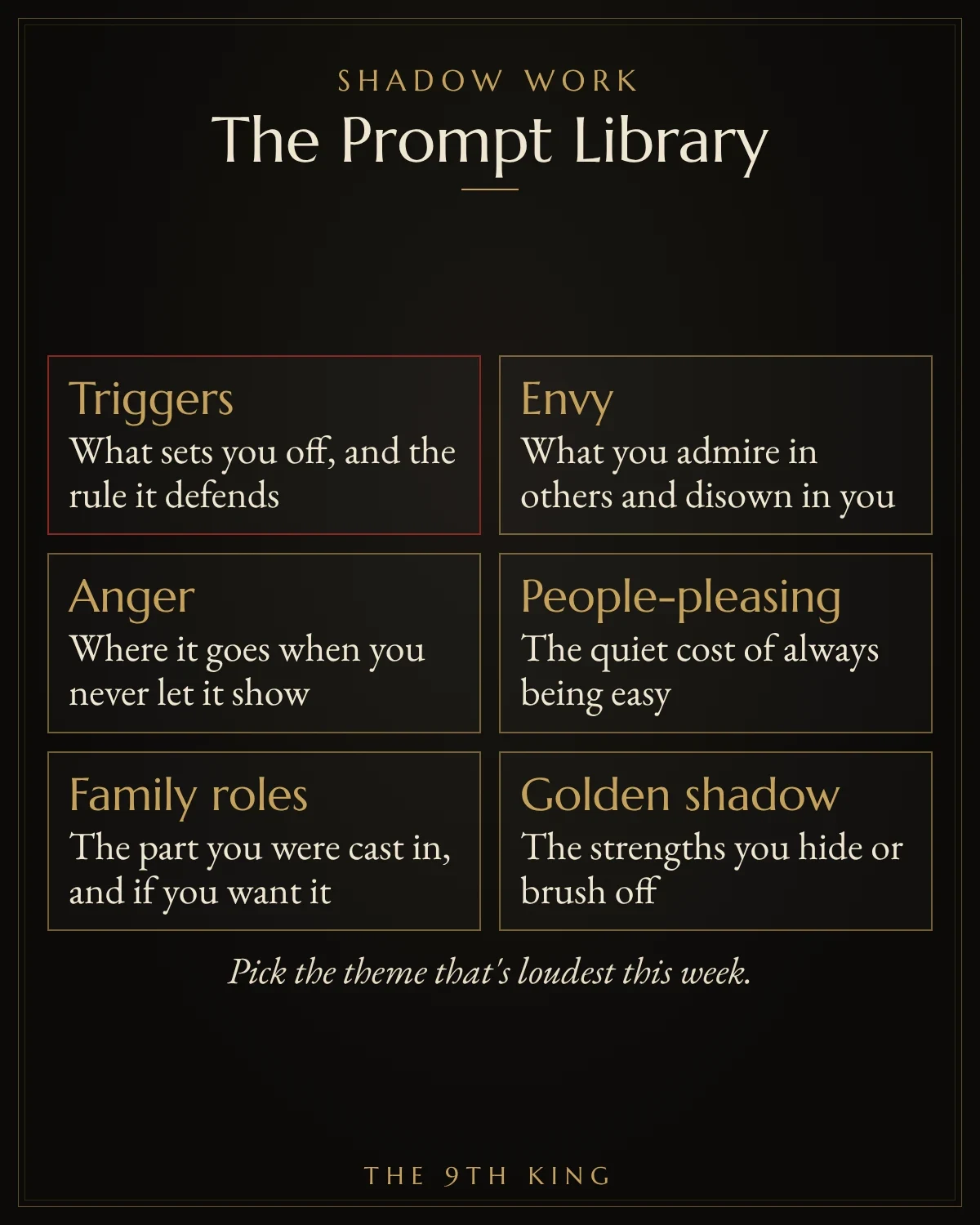
How to use this shadow work prompt library
A good prompt is a door, not a test. You don’t need to answer every question, and you don’t need to go in order. Let your week choose the theme.
Pick one prompt, not ten
Scan the themes and notice which one makes you flinch slightly or lean in. That’s usually the right one. Then pick a single prompt. One question answered honestly does more than ten answered on autopilot.
| If this happened this week | Start with this theme | Tier |
|---|---|---|
| Someone irritated you far too much | Triggers and reactions | Beginner |
| Someone’s good news stung | Envy and admiration | Beginner |
| You said “it’s fine” and it wasn’t | Anger or people-pleasing | Beginner |
| A family visit left you drained | Family roles | Beginner |
| You keep having the same fight | Relationships | Deeper |
| You played down a real strength | Golden shadow | Beginner |
Optional: timebox it
A short timer is a good optional starting point: 10 to 15 minutes gives the session a clear edge, so it’s easier to stop on purpose. It isn’t a medical rule, and longer doesn’t automatically mean deeper. For reference, the expressive-writing studies discussed in Advances in Psychiatric Treatment typically used sessions of around 15 to 20 minutes. Adjust to what leaves you steady.
Hand or keyboard
Either works. Handwriting is slower; typing is faster and easier to keep private. Choose whichever you’ll actually do, and keep the page where only you can reach it.
The stop rule
If a prompt brings up something that feels too big, too old or too raw, stop. Close the notebook, do the after-writing routine below, and choose a lighter prompt next time, or none. Stopping isn’t failing. Some material belongs with a professional, and noticing that is part of the work.
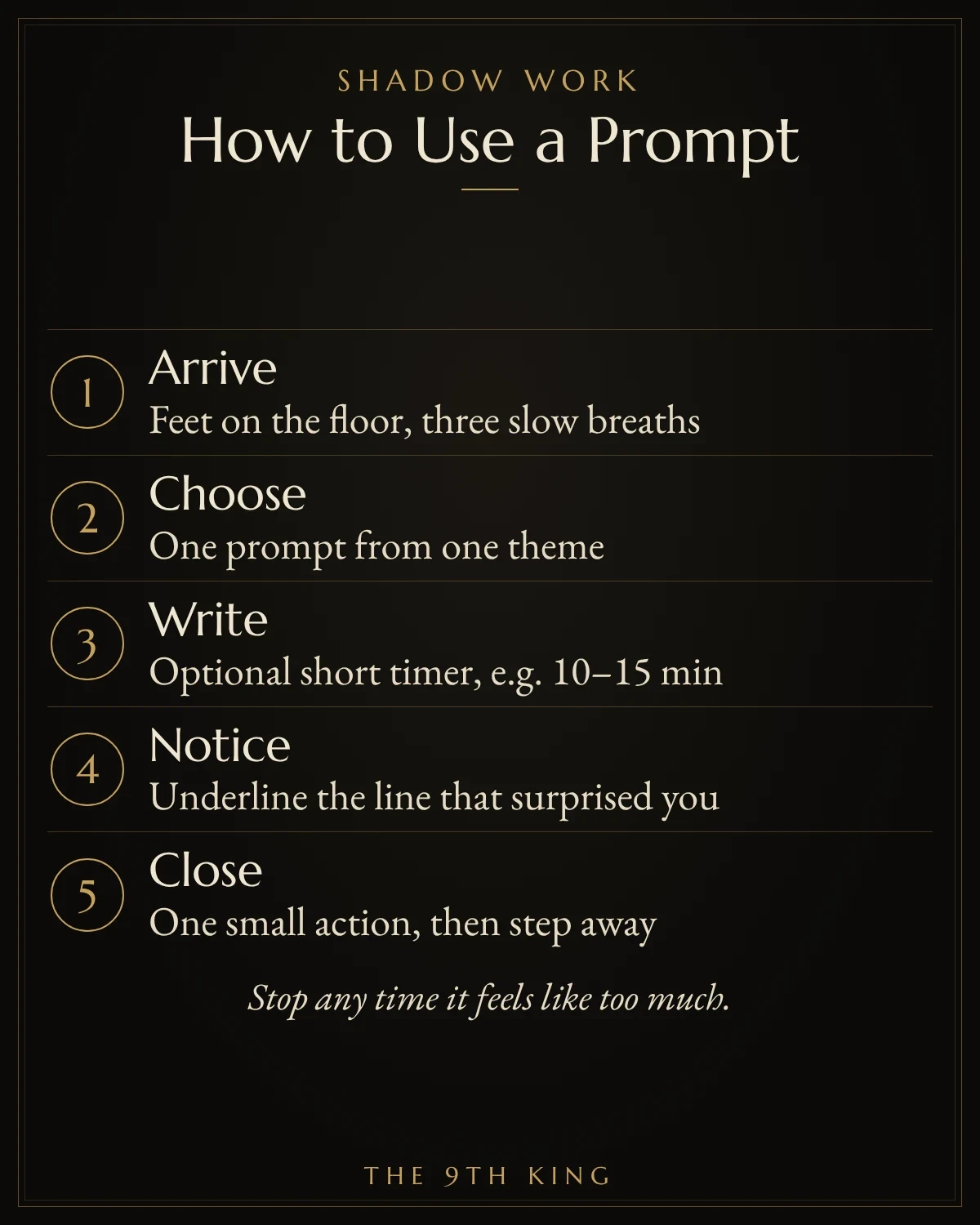
A 15-minute session, step by step (fictional example)
(Fictional) Dana is irritated, again, by a colleague who talks over people in meetings.
- Arrive (1 minute). Feet on the floor, three slow breaths.
- Choose (1 minute). Triggers and reactions, beginner: “Who irritated me more than they irritated anyone else this week, and what exactly did they do?”
- Write (10 minutes). Fast, no editing. Halfway through, a line appears she didn’t expect: “He takes up space like he’s allowed to.”
- Notice (2 minutes). She underlines it. The rule underneath seems to be taking up space is selfish. She remembers being called “too much” as a kid.
- Close (1 minute). One small action: in tomorrow’s meeting, she’ll finish one sentence without apologising for it.
No breakthrough required: one honest line and one small, safe step.
Before and after you write: a grounding routine
Prompts are meant to stir things. A three-minute routine on either side keeps the stirring useful instead of overwhelming.
Before you write
- Check your state. On a scale of 1 to 10, how stressed are you? Above a 7, pick a beginner prompt or skip today.
- Get physical. Feet on the floor, three slow breaths, shoulders down.
- Set an intention. One sentence: “I’m here to notice, not to fix.”
- Choose an exit. Decide what you’ll do when the timer ends: tea, a short walk, a text to a friend. Avoid writing right before sleep or a hard conversation.
After you write
- Underline one line. The sentence that surprised you most is your takeaway. You don’t need to analyse the rest.
- Name one small action. Safe, specific, doable in the next few days.
- Close the book, literally. Putting it away marks the session as finished.
- Do your exit. Move, change rooms, or talk to someone about something ordinary.
Beginner vs deeper shadow work prompts
Every theme below has two tiers. Beginner prompts look at the present: this week, this person, this reaction. Deeper prompts reach back into patterns, family history and long-held rules. Stay with beginner prompts for a few weeks, even if you feel ready for more. Depth comes from repetition, not intensity.
| Beginner prompts | Deeper prompts | |
|---|---|---|
| Focus | This week, one reaction | Patterns, origins, old rules |
| Feels like | Mild discomfort, curiosity | Tender, sometimes heavy |
| Best for | Starting out, busy weeks | Steady weeks, good support |
| Good sign | “Huh, I didn’t know that” | “That explains a lot” |
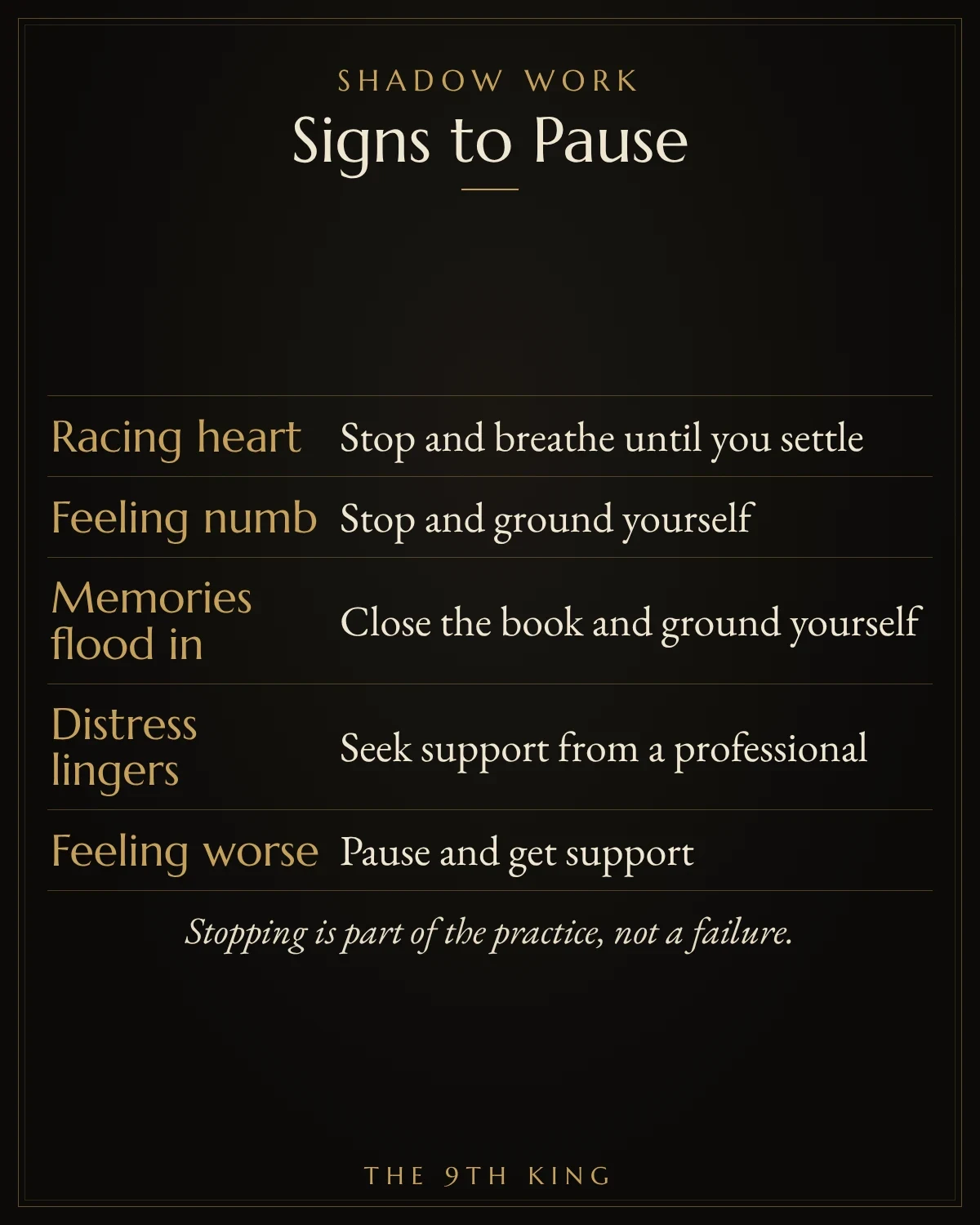
On either tier, pause if your heart won’t settle, painful memories keep replaying or you feel worse each day. If you go numb, stop and ground yourself (feet on the floor, slow breaths, look around the room) rather than pushing on or switching prompts. If distress persists or gets worse, seek support from a qualified professional.

Prompts for triggers, envy and anger
Most people start here. Outsized reactions, quiet envy and swallowed anger can sometimes invite reflection on something pushed out of your self-image. Jungian writers describe the unintegrated shadow as able to “project itself onto another person” (International Dictionary of Psychoanalysis, via Encyclopedia.com), which is why other people make such good mirrors.
Triggers and reactions
A trigger here means more heat than the moment deserves. The size of the reaction is the clue. But a strong reaction isn’t automatically projection: sometimes it’s a fair response to real harm, stress or a boundary being crossed. These prompts help you sort out which part is yours, without talking yourself out of what actually happened.
Beginner
- Who irritated me more than they seemed to irritate anyone else this week, and what exactly did they do?
- What’s one comment I keep replaying, and what did it seem to say about me?
- When did I react faster than I could think? What happened in my body first?
Deeper
- If this reaction had a voice, what rule would it be defending?
- Who first taught me that this behaviour was wrong, and how?
- What would I lose if I allowed myself a small, healthy version of the thing that triggers me?
Envy and admiration
Envy often points at something you want and haven’t let yourself pursue. Admiration that feels slightly painful works the same way.
Beginner
- Whose good news stung a little this month, and what exactly did they get?
- What do I criticise in someone that, honestly, I’d quite like to have?
- Finish the sentence: “Must be nice to…” What comes after it?
Deeper
- What did I decide, long ago, that people like me don’t get to have?
- If I stopped calling this envy and called it a desire, what would I want?
- What’s one small step toward the thing I envy, and what stops me taking it?
Anger
Many people learned early that anger was dangerous, so it went underground and came out as sarcasm, coldness or exhaustion.
Beginner
- When did I last say “it’s fine” when it wasn’t?
- How does my anger usually show up: loud, quiet, sideways, or not at all?
- What am I annoyed about right now that I haven’t told anyone?
Deeper
- What happened in my family when someone got angry? What did I learn from watching?
- What does my anger protect? Finish the sentence: “I get angry when someone crosses…”
- What would a calm, clean version of my anger sound like, in one sentence, to the person who needs to hear it?
Prompts for people-pleasing, family roles and relationships
This group is about what you trade away to keep connection. It often looks like virtue, which makes it hard to see. If people-pleasing is your loudest theme, our Libra traits guide looks at the same pattern through the sign most associated with it.
People-pleasing
Being easy to get along with is a gift. Being easy at your own expense is a habit, usually paid for later in resentment or burnout.
Beginner
- Where did I say yes this week when I meant no, or maybe?
- Whose disappointment am I most afraid of right now?
- If no one would be upset, what would I cancel this week?
Deeper
- What did I learn earned love when I was young: being helpful, quiet, funny, impressive?
- What part of me gets left out when I’m being “the easy one”?
- What am I afraid people would see if I stopped pleasing them for a week?
Family roles
Families hand out roles: the responsible one, the funny one, the peacemaker, the invisible one. Roles help families function, and they can stick long after you’ve outgrown them. Keep these prompts about roles and patterns, not about reliving painful events in detail.
Beginner
- If my family were a cast, what role would I play? Who cast me?
- What was I praised for as a child, and what was I criticised for?
- Which family phrase still lives in my head?
Deeper
- What part of me had no role in my family, and where did it go?
- What would I keep from my role, and what would I hand back?
- Which family rule am I still following that I never actually chose?
Relationships
Close relationships are where projection does its best work. The friend who’s “so selfish” is sometimes accurate, and sometimes a disowned piece of you.
Beginner
- What’s the argument I keep having, with different people?
- What do I accuse others of most often? Have I ever done it myself?
- What do I need in relationships that I find hard to ask for out loud?
Deeper
- What do I secretly hope a partner or friend will do for me so I don’t have to?
- Which trait do I choose in people over and over, even when it hurts?
- What would change if I treated my most frequent complaint about others as information about me?
If this theme is loud for you, Privacy Without Mixed Signals looks at the line between keeping something private and keeping someone at a distance.
Prompts for money, body and self-image
These themes go deep, so they’re kept gentle. If your history includes disordered eating, serious financial hardship or body-related distress, skip this section or bring it to a professional. That’s wise, not avoidant.
Money
Money carries family stories and quiet judgments about “people like that.” Its shadow often shows up as contempt or shame.
Beginner
- What’s my first feeling when I check my bank balance?
- Finish the sentence: “Rich people are…” and “Broke people are…”
- What’s one money conversation I keep avoiding?
Deeper
- What did money mean in the house I grew up in: safety, conflict, silence, love?
- Where am I generous with others and stingy with myself, or the other way round?
Body and self-image (gentle)
Self-image prompts can easily turn into self-criticism. These are about curiosity and respect, not appearance goals. If one starts a spiral, stop there. Put the pen down, take a few slow breaths, look around the room or step outside, and leave this section for another day. You don’t have to finish it.
Beginner
- What’s one thing my body did for me this week that I didn’t thank it for?
- Whose voice do I hear when I criticise how I look? Is it really mine?
Deeper
- When did I first learn there was a “right” way to look or be?
- What would I say to a close friend who described themselves the way I describe me?
Golden shadow, self-love and integration prompts
The shadow isn’t only the bad stuff. Jungian writers note it can have a positive side (International Dictionary of Psychoanalysis), and later writers call those hidden strengths the golden shadow. This group also closes the loop: digging without integrating tends to leave people raw.
The golden shadow
Strengths you’ve disowned because they once felt unsafe, arrogant or “not for you.”
Beginner
- What compliment do I brush off every time I hear it?
- What did I love doing as a child that I stopped doing?
Deeper
- Which quality in someone I admire might be partly mine already?
- Who would I be “too much” for if I let this strength show? Is that still true?
Self-love and self-compassion
Shadow work prompts for self-love aren’t affirmations. They’re about meeting the judged parts with some warmth, which is what makes change possible.
Beginner
- What would “good enough” look like for me this week?
- What have I found in this practice that I can now see with more kindness?
Deeper
- What part of me has been working hard to protect me, even in clumsy ways?
- If the part of me I’m most ashamed of could speak, what would it need from me?
Integration and after-care
Use these to end a session, or alone on tired days.
Beginner
- What’s the one line from today’s writing I want to remember?
- What do I need right now: rest, movement, company or quiet?
- Who could I tell, in one sentence, about something I noticed?
Deeper
- What’s one small, safe way to practise a rejected trait this week?
- What has changed, even slightly, since I started?
- What am I willing to try differently the next time this comes up?
- What can I let be unfinished for now?
How astrology can point you to the right prompts
On The 9th King, astrology is a symbolic language for self-reflection, not a science or a prediction tool. Used that way, your chart can suggest which theme to try first. It can’t tell you what’s in your shadow; writing does that. Our zodiac shadow work guide covers every sign in full. Here’s a quick map.
| Chart emphasis (interpretive) | Prompt theme to try | Why it fits |
|---|---|---|
| Libra or Venus | People-pleasing | Harmony at a personal cost |
| Aries or Mars | Anger | Heat, speed, fear of weakness |
| Virgo | Body and self-image | Self-criticism, high standards |
| Cancer or the Moon | Family roles | Care, home, old belonging |
| Leo | Golden shadow, envy | Being seen, fear of ordinary |
| Scorpio | Triggers, relationships | Control, trust, secrecy |
Three more specific pointers:
- Your Moon sign is often read as what you need to feel safe, which makes it a good guide to the family role prompts. It doesn’t always need an exact birth time; our Moon sign guide explains when it does.
- Saturn’s sign and house are often read as where you feel tested or not good enough, which can point to the money or self-image prompts.
- The 12th house is traditionally read as the hidden, behind-the-scenes part of life. Houses need an accurate birth time, so check your chart with our birth chart guide and the 12 houses explained first.
If a theme doesn’t fit, skip it: the chart offers suggestions to test, not facts. Start from the zodiac signs hub for the sign pages, or read Virgo personality traits if perfectionism is your loudest theme.
Common mistakes with shadow work prompts
Most problems come from doing too much, too fast.
- Answering ten prompts in one sitting. One prompt is a full session.
- Writing only to vent. Research on expressive writing suggests benefits depend on finding meaning, not only expressing emotion (APA Monitor on Psychology). Always end by underlining one line.
- Turning it into a verdict. “I’m a jealous person” isn’t insight. “I felt envy when she got promoted, and I think I want more recognition” is.
- Reliving painful events in detail. These prompts look at patterns and rules, not at replaying the worst moments of your life. If a prompt pulls you there, stop.
- Skipping integration. Insight without a small action tends to fade, or turn into rumination.
- Pushing through distress. A brief dip in mood is common. A worsening slide is a signal to pause.
Where the prompts come from: Jung and writing research
Two strands meet here, and they explain both why the practice can help and why it has limits.
Jung and the shadow
The idea comes from Carl Gustav Jung (1875 to 1961), the Swiss psychiatrist who founded analytic psychology and developed the concept of archetypes (Britannica). In Jungian terms, the shadow is what the conscious personality experiences as negative, and when it isn’t integrated it tends to be projected onto others (International Dictionary of Psychoanalysis). Hence all the prompts about other people.
Jung didn’t write journal prompts. Modern shadow work goes well beyond him, and it’s a practice, not settled science.
What writing research suggests
The best-known research on writing about difficult experiences comes from psychologist James Pennebaker of the University of Texas at Austin and colleagues. Expressive writing has been linked with some health benefits, and Pennebaker suggests it helps by giving anxious feelings structure (APA Monitor on Psychology).
The research comes with honest caveats:
- Writing about something hard usually brings a short-term rise in distress and lower mood straight afterwards (Advances in Psychiatric Treatment).
- It isn’t helpful for everyone. The same review reports that for some groups, including some trauma survivors, it was detrimental, and that it should supplement, not replace, proper care.
- Meaning matters. Researchers quoted by the APA found the gains depend on focused thought and a shift in how you see the experience.
Prompts aren’t research protocols, and no study can say what one will do for you. The research is simply a good reason to keep sessions short, end with meaning, and stop when it’s too much.
For a spiritual angle alongside the psychological one, Code of Ascension’s Shadow Work Meaning explores the practice from that side.

Shadow Work Prompts: FAQ
What are shadow work prompts?
Shadow work prompts are journal questions that help you notice traits, feelings and impulses you’ve learned to hide or judge, such as anger, envy or a strength you play down. You answer one prompt in writing for a short, set time, then look for the line that surprised you. The idea draws on Carl Jung’s concept of the shadow, but modern prompts are a self-reflection practice, not therapy.
What are good shadow work prompts for beginners?
Start with prompts about this week rather than your childhood. Good beginner prompts include “Who irritated me more than they irritated anyone else, and what exactly did they do?”, “Where did I say yes when I meant no?” and “What compliment do I always brush off?” They’re specific, low-risk and easy to link to a small action. Stay at this tier for a few weeks before going deeper.
How long should a shadow work session be?
There’s no fixed rule. Ten to fifteen minutes is a good optional starting point: set a timer, answer one prompt, underline one line and close with a small action. Expressive-writing research typically used sessions of around 15 to 20 minutes, so short sessions are a reasonable place to begin. Adjust to what leaves you feeling steady rather than drained, and stop early whenever you need to.
Should I write shadow work by hand or type it?
Either works. Handwriting slows you down, which some people find helps them notice what they actually think. Typing is faster and can be easier to keep private. The best choice is whichever you’ll do consistently and keep somewhere no one else will read, because honesty comes more easily when the page is private.
What should I do if a prompt brings up too much?
Stop. Close the journal, put your feet on the floor, take a few slow breaths and do something ordinary, like making tea or going for a short walk. Next time, choose a lighter beginner prompt or take a break. If the same painful material keeps returning, or you’re dealing with trauma, abuse or thoughts of self-harm, work with a qualified therapist. Stopping is part of the practice.
What are deep shadow work prompts?
Deep shadow work prompts look past this week’s reactions to the older rules underneath them: what earned love in your family, which beliefs you never chose, what part of you had no place growing up. Examples include “Which family rule am I still following that I never chose?” and “What part of me had no role in my family?” Use them on steady weeks, after some time with beginner prompts.
Can astrology help me choose shadow work prompts?
It can suggest a starting point. In interpretive astrology, a strong Libra emphasis is often linked with people-pleasing, a strong Aries or Mars emphasis with anger, and the Moon with family and belonging, so those themes are worth trying first. Treat it as a suggestion to test, not a fact about you. If a theme doesn’t fit your life, skip it. Astrology is a language for reflection, not science.

Your next step: pick the one theme that was loudest this week, choose a single beginner prompt, set a short timer if it helps, and write. When you’re ready to see which themes your chart highlights, read our Zodiac Shadow Work guide and find the sections for your Sun, Moon and Rising signs.
Explore Next
- What the shadow is and where the idea comes from: Shadow Work, Plainly
- The shadow side of every sign: Zodiac Shadow Work
- Your emotional needs and family patterns: Moon Sign Meaning
- Find your Saturn and 12th house: How to Read a Birth Chart
- The season of the hidden: Scorpio Season: What the Hidden Asks
- Seeing your own traits in other people: Psychological Projection
- Caring for your younger self: Inner Child Work

Final Thought: One Honest Line at a Time
You don’t meet your shadow by dragging it into the light all at once. You meet it the way you’d meet anyone shy: briefly, regularly and with some respect. One prompt, one honest line, one small step. Over time, the parts you’ve hidden stop running the show from behind the curtain and start working with you. Know your nature. Rule your life.
About the Author
King is the founder of The 9th King, where zodiac psychology, relationships and shadow work are explored as tools for self-knowledge rather than fortune-telling. He’s a Libra Sun, and writes about the personal side of astrology on King The Kemist. Astrology on The 9th King is interpretation and self-reflection, not prediction or established fact.
Leave a Reply