

Quick Answer: What Is Psychological Projection?
Psychological projection is seeing your own feelings, traits or impulses in someone else, as if they belonged to them rather than to you. The APA Dictionary of Psychology describes it as attributing your own positive or negative characteristics, affects, and impulses to another person or group.
The short version:
- Freud brought the idea into psychology and treated it as a defense mechanism: a mostly unconscious way of keeping uncomfortable feelings at a distance.
- Jung linked projection to the shadow, the parts of ourselves we’ve disowned. We often meet our shadow first in other people.
- Projection can be negative (the colleague who seems so arrogant) or positive (the friend who seems so effortlessly brave). The positive kind is often called the golden shadow.
- Not everything is projection. Sometimes your read on someone is simply accurate. The skill is checking, not assuming.
Projection is a normal human habit, not a diagnosis. Catching it is a reflective practice, not therapy.
Table of Contents
What psychological projection means, in plain words
Britannica sums projection up in one line: what is internal is seen as external. A feeling that starts inside you gets experienced as a fact about someone else.
A classic example from the APA entry: a person who is conflicted about their own anger turns “I hate them” into “They hate me.” The anger hasn’t gone anywhere. It has just changed address.
That’s the core move. It’s usually fast, it feels like seeing clearly rather than guessing, and it carries more heat than the situation explains.
One update worth knowing: in classical psychoanalysis the projected trait had to stay hidden from you. The APA entry notes that modern usage has largely dropped that requirement. You can know you’re impatient and still, in the moment, see impatience everywhere but in yourself.
Is projection the same as empathy?
Not quite, though they share roots. Britannica gives the example of a father reading sadness on his daughter’s face by drawing on how his own face looks when he’s sad: projection in a mild, useful form. It also describes a mature version, mentalisation or theory of mind, which recognises that other people have minds separate from yours. The trouble starts when the guess hardens into certainty and you stop checking.
Where the idea comes from: Freud’s defense mechanism
Freud and the word “projection”
According to Britannica, Sigmund Freud introduced projection to psychology, borrowing the word from neurology. He first used the wider term “defense” in an 1894 paper, and the Britannica entry on defense mechanisms lists projection alongside repression, denial, rationalisation and others.
What a defense mechanism is
The APA Dictionary defines a defense mechanism, in classical psychoanalytic theory, as an unconscious reaction pattern the ego uses to protect itself from anxiety caused by inner conflict. Two points from that entry matter for everyday life:
- Defenses range from immature to mature, depending on how much they distort reality.
- In more recent theories, defenses are seen as normal ways of coping. It’s rigid or excessive use that causes trouble.
That’s the healthiest way to hold projection. Everyone does it. The question isn’t “Am I a projector?” but “Where is this habit costing me clarity?”
Projection’s harder edges
The APA entry also notes that projection can be used to justify prejudice or dodge responsibility. If my failings are “out there” in a group of people, I don’t have to look at them.
Britannica adds a related idea from the psychoanalyst Melanie Klein, projective identification, where a person not only sees a state of mind in someone else but subtly draws it out of them. Britannica’s example: a man in a rage accuses his wife of being angry, and soon she is. If you’ve ever been accused of a mood until you actually had it, you’ve felt this from the other side.
What the research says (and doesn’t)
It’s tempting to treat projection as proven science. The honest picture is more mixed. A widely cited review by Baumeister, Dale and Sommer (1998) looked at social psychology evidence for seven Freudian defenses. They found projection is evident, but suggested it may be a by-product of defending yourself rather than the defense itself. Britannica’s defense mechanism entry also notes the concept began as a psychoanalytic hypothesis.
Use projection as a lens for reflection, not a proven explanation for every conflict.
Jung, the shadow and projection
The Swiss psychiatrist Carl Jung (1875–1961) took projection somewhere new. For Jung, projection is how we usually meet the shadow.
The Society of Analytical Psychology’s article on the shadow explains it this way: we see in other people qualities we dislike, and this often points to something we struggle with in ourselves. It also notes that projection tends to keep happening until the pattern is seen.
The two traditions ask different questions:
- Freud asks: what uncomfortable feeling am I protecting myself from?
- Jung asks: what part of me am I meeting out there, and what would it mean to own it?
If the shadow is new to you, Shadow Work, Plainly covers where the idea came from and how to start gently.
The shadow isn’t only dark
Here’s the part most people miss. The same SAP article says the shadow also holds good qualities, such as creative impulses and realistic insight, and calls it potentially a “treasure trove.” Unrecognised assertiveness or creativity, it suggests, can leave a person poorer. That’s the doorway to the golden shadow, which gets its own section below.
Examples of projection in everyday life
Projection is clearest in ordinary scenes. These are fictional.
At work (fictional)
Dana is furious that a new colleague “always has to be the centre of attention” in meetings. When a friend asks what bothers her most, Dana admits she has ideas she never says out loud. The colleague isn’t perfect, but the size of Dana’s anger has more to do with her own silenced ambition than with his airtime.
With friends (fictional)
Marcus is sure his friend is “judging him” for leaving a job. The friend has said nothing critical. Marcus is the one who thinks quitting was a failure. He’s hearing his own verdict in his friend’s silence.
In a relationship (fictional)
Priya keeps asking her partner whether he’s losing interest. He’s affectionate and consistent. Priya has been quietly bored and restless herself, and finds it easier to worry about his feelings than to look at her own.
The common thread is a mismatch: the reaction is larger, more certain or more moral than the evidence supports. That’s your best clue.
Projection or perception? How to tell the difference
Projection talk can be misused. If every criticism you make is “just your projection,” you stop noticing real problems. If every criticism of you is “their projection,” you stop learning. The goal isn’t to doubt every read you have on people. It’s to check the ones that come with a lot of heat.
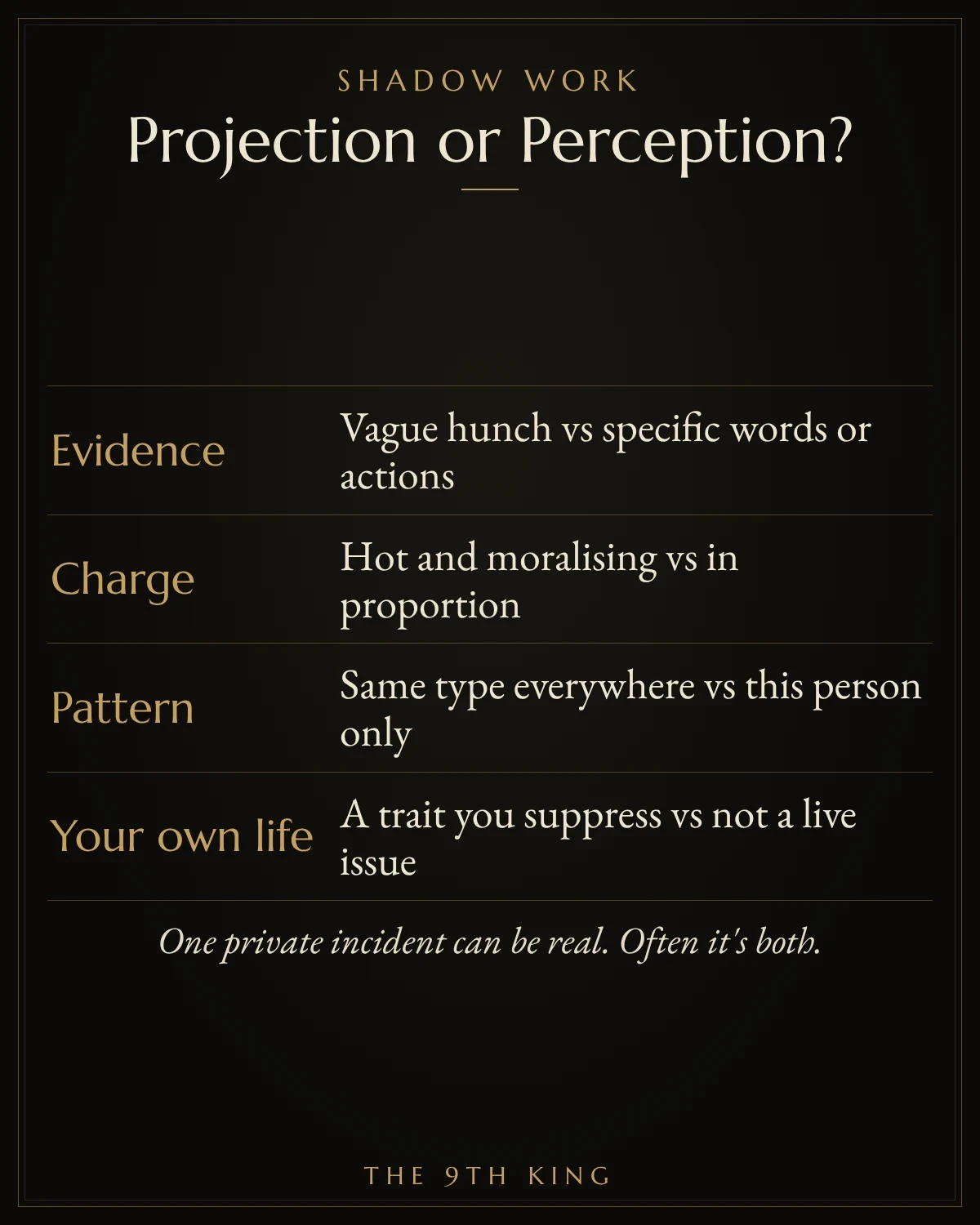
| Signal | More likely projection | More likely perception |
|---|---|---|
| Evidence | A vague sense, few specifics | Specific words or actions you can name |
| Emotional charge | Hot, moralising, urgent | Proportionate to what happened |
| Pattern | Same “type” bothers you everywhere | It’s about this person and situation |
| Your own life | The trait is something you suppress | The trait isn’t a live issue for you |
Use this table as a prompt for reflection, not as a test of whether your read is believable. Strong feelings often come with an accurate perception, especially when someone has actually harmed you or crossed a line. Heat is a reason to look a little closer, never a reason to dismiss what you saw.
Both can be true at once
Often the answer is both. Your colleague really may talk too much in meetings (perception), and your fury about it may be fed by your own unspoken ideas (projection). Owning the projection doesn’t mean excusing the behaviour. It means responding to the actual problem at its actual size.
Don’t gaslight yourself
If someone is mistreating you, “maybe I’m just projecting” can become a way of talking yourself out of what you see. Shadow work is never a reason to stay in a situation that is unsafe or disrespectful. You don’t need a pattern or witnesses to trust yourself: one private incident can matter, and many harmful things happen with no one else around. If you can name what was said or done, take it seriously. Taking projection seriously includes taking your accurate perceptions seriously too.
Don’t weaponise it on others
“You’re projecting” rarely helps an argument. Even when true, it tells the other person their feelings don’t count. Describe the specific behaviour instead, and keep the mirror for yourself.
How to stop projecting: catch it in the moment
You can’t stop projection entirely, and you don’t need to. What you can do is shorten the time between reacting and noticing. These steps work in the middle of a conversation, a scroll or a bad mood.
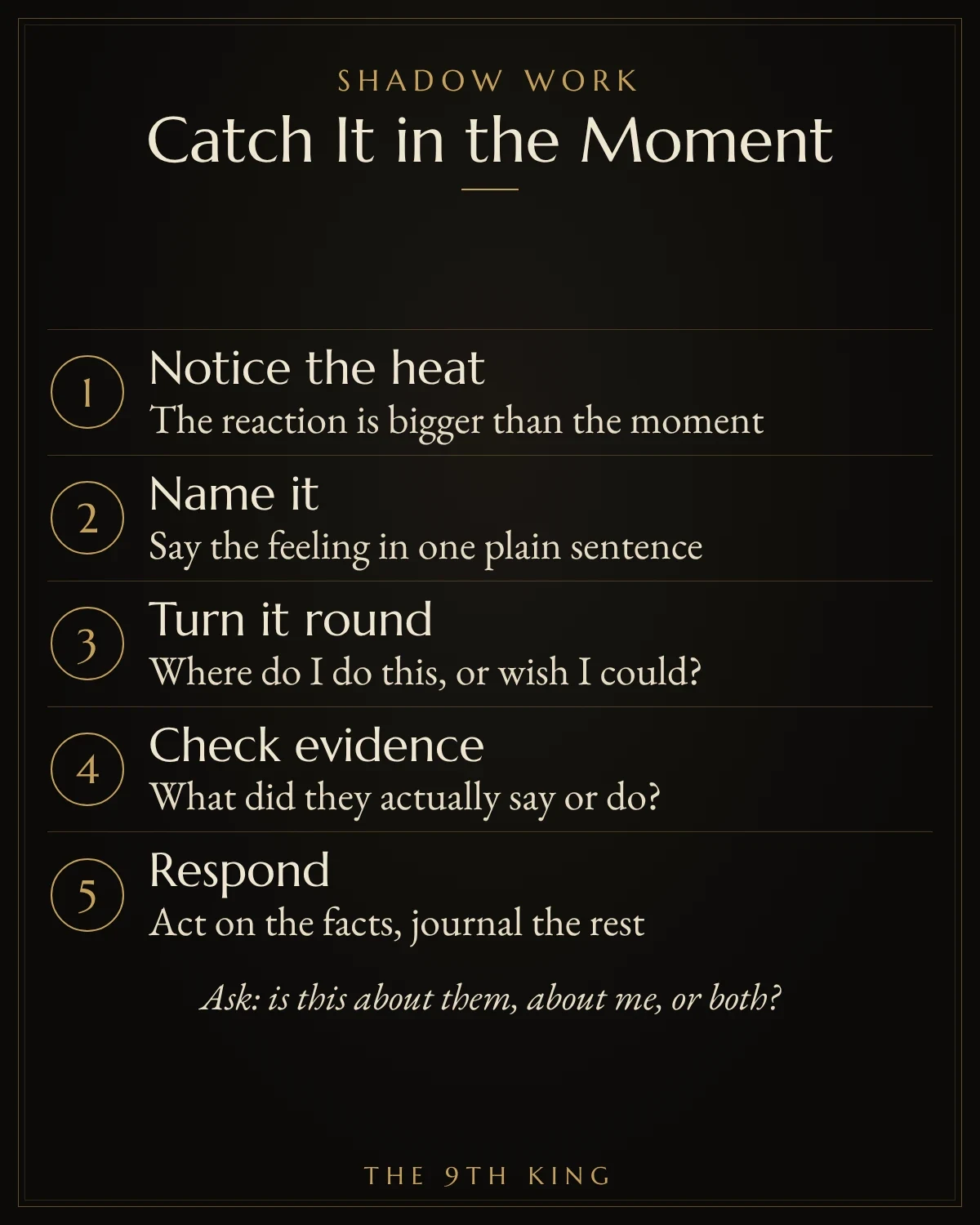
1. Notice the heat
The signal is a reaction out of proportion: a jolt of contempt, a wave of envy, a certainty that someone is “so fake.” Just register: that was big.
2. Pause and name it
Put the feeling into one plain sentence: “I’m feeling contempt for how loud she is.” Words make it easier to look at.
3. Turn it round
Ask three quick questions:
- Where do I do this?
- Where do I wish I could do this?
- What rule was I taught about this trait?
One of them often lands. Maybe you’re loud too, at home. Maybe you were told loud girls are “too much,” and you’d secretly love to take up space.
4. Check the evidence
Now go back outside. What did the person actually do? Would a neutral friend describe it the same way? This protects you from deciding everything is projection.
5. Choose a response
Act on the facts at their real size. Address any genuine issue calmly, and keep the projected part for your journal.
A useful one-liner to remember: “Is this about them, about me, or both?”
The golden shadow: the gold you see in other people
Most writing on projection stops at the negative kind. That’s only half the story.
The APA definition is explicit that projection covers positive characteristics too. You can attribute your own strength, warmth, talent or courage to someone else, and then admire them for having what you haven’t claimed.
In Jungian-influenced writing, the disowned positive side of the shadow is often called the golden shadow, and seeing it in others is called positive projection. The phrase circulates widely among later Jungian writers; Robert A. Johnson’s short, popular book Owning Your Own Shadow (HarperOne) is one well-known entry point to that tradition. We haven’t found a reliable source for exactly who coined the term, so we won’t name one.
What positive projection can look like
- Idealising a mentor so completely that you can’t imagine doing what they do.
- A crush that feels less like attraction and more like wanting to be the person.
- Celebrity or creator worship, where someone seems to have a confidence that’s “just not you.”
- Envy that won’t let go. Envy can sometimes contain a golden shadow wrapped in resentment: I want that, and I’ve decided I can’t have it.
Why we disown good qualities
Many people learned early that some good traits were risky: ambition looked arrogant, creativity looked impractical, visibility looked like showing off. The SAP article notes that positive feelings and impulses can end up in the shadow when they’re repressed, just like negative ones.
So the trait goes underground, and it reappears as admiration for someone who seems to have it naturally.

Reclaiming the gold
Reclaiming a golden shadow doesn’t mean becoming a copy of the person you admire. It means finding your version of the quality and trying it at a small, real scale.
- Name the quality, not the person. Not “I admire Leila” but “I admire how she says no without apologising.”
- Find one existing trace. When have you done even a little of this? There’s usually one memory.
- Try a ten percent version. Say one clean no this week. Share one piece of work you’d normally hide.
- Watch the admiration change. As you own more of the quality, the idealisation usually softens into ordinary respect.
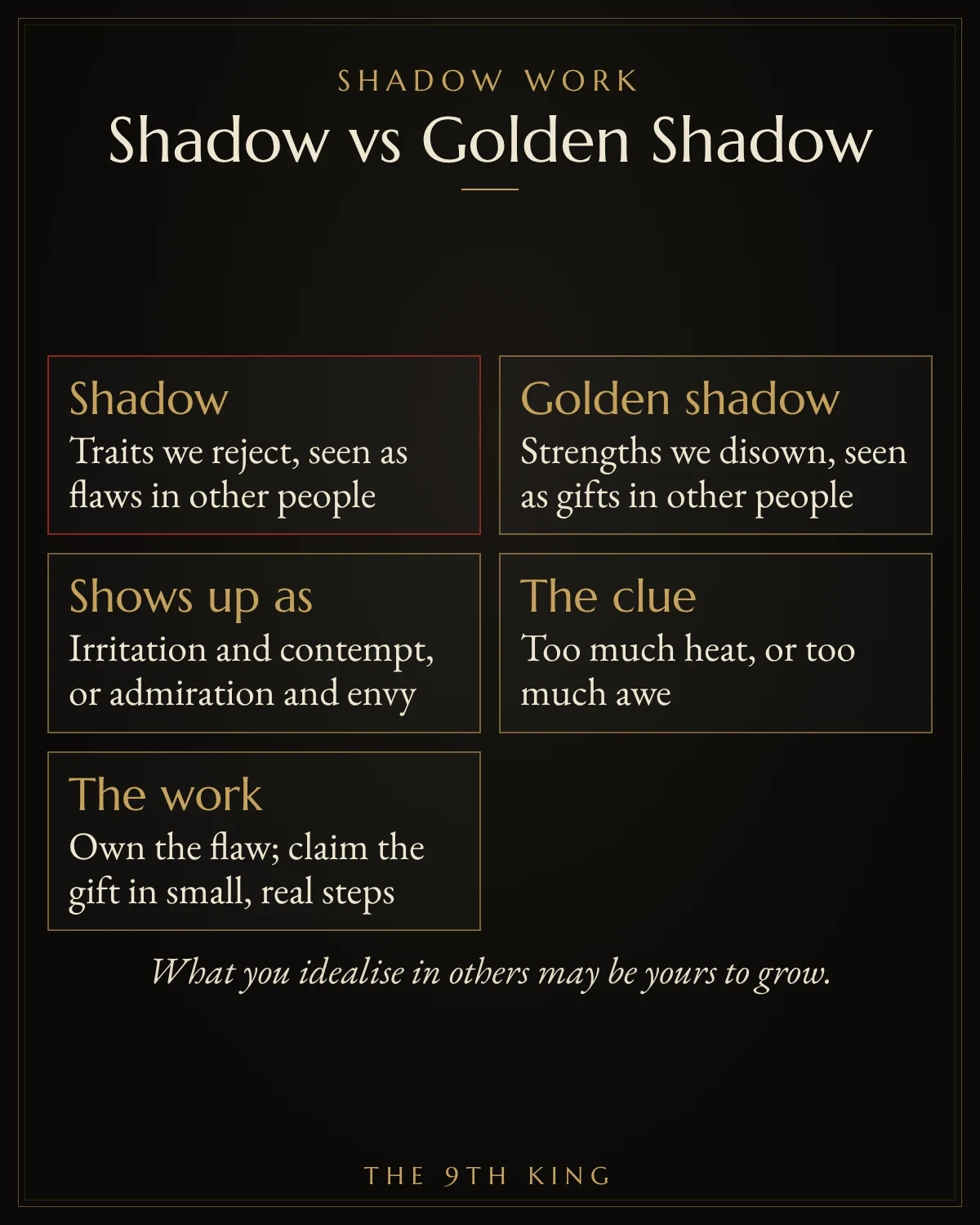
| Shadow | Golden shadow | |
|---|---|---|
| What’s disowned | Traits we judge as bad | Strengths we feel unworthy of |
| Shows up as | Irritation, contempt, disgust | Admiration, idealising, envy |
| The clue | Too much heat | Too much awe |
| The work | Own it, set limits, soften judgement | Claim it in small, real steps |
A golden shadow example (fictional)
Sam follows a ceramicist online and feels a mix of delight and quiet grief every time she posts. Sam says, “She’s just naturally creative. I’m not.” Journalling, Sam remembers loving clay in school and being told to focus on “real subjects.” Sam’s creativity was filed away and is now knocking. Sam books one beginner class, and the grief starts to turn into interest.
Projection in relationships
Close relationships are where projection does its most powerful work, because the people we love carry the strongest feelings. Common patterns:
- The early idealisation. A new partner can carry a lot of golden shadow: they seem brave, free, wise. Some of that is real. Some of it is you. When it fades, it can feel like they’ve changed, when partly you’re seeing them more clearly.
- The swap. One partner carries all the anxiety, the other all the calm, each relying on the other to hold a feeling they won’t hold themselves.
- The familiar fight. You have the same argument with different partners. That repetition is a strong sign something of yours is in the room.
A practical habit for couples: when a fight heats up, each person finishes the sentence “The part of this that might be about my history is…” No one has to agree. It just loosens the certainty.
If you enjoy astrology, comparing charts can be a playful way to talk about what each person seeks in the other. Synastry for beginners shows how it works, and Fire and Water relationships looks at a pairing where each side can see “too much” or “too little” feeling in the other. Use them as conversation starters, not evidence.
Projection and astrology: the 7th house and the Descendant
Astrology has its own symbolic vocabulary for what we look for in others.
The Descendant is the point of the zodiac setting on the western horizon at your birth. The Skyscript glossary explains that it marks the cusp of the 7th house. (In Whole Sign houses, the system used in the example below, the 7th house is simply the whole sign opposite your Rising sign, so the Descendant degree falls somewhere inside it rather than marking where it begins.) Traditionally, Deborah Houlding’s Skyscript page on the 7th house lists marriage, partnerships and open enemies among its main significations: the people who stand opposite you.
Many modern astrologers go a step further and read the Descendant as qualities we tend to look for, or meet, in other people, sometimes before we recognise them in ourselves. That’s an astrological interpretation, not a psychological finding, but it fits projection neatly as a reflective prompt.
To use it:
- Find your Descendant sign. You need an exact birth time, because the Descendant is always opposite your Rising sign. Both shift on average about one degree every four minutes and change sign roughly every two hours, faster or slower depending on the sign and the latitude of your birthplace.
- Ask: Which of this sign’s qualities do I admire or resent in partners and rivals?
- Ask: Where could I grow a little of that in myself?
Our 12 houses guide explains the 7th house in context, and How to Read a Birth Chart covers finding your Rising and Descendant. For sign-by-sign shadow themes, see Zodiac Shadow Work.
A worked example (fictional, Whole Sign houses)
The chart: Capricorn Rising, so the Descendant and 7th house are in Cancer.
Reading: a person who presents as composed and self-reliant (Capricorn Rising) may be drawn to partners who seem openly tender, nurturing and emotionally expressive (Cancer on the Descendant). They might admire that softness, or feel irritated by it as “neediness.” Either reaction can be a projection prompt.
The useful question: Where do I hide my own need for care behind competence?
The chart doesn’t prove the pattern. It offers a question to test against real life.
Myths and mistakes about projection
- “Everything I dislike in others is my projection.” No. Some things you dislike are genuinely unkind or unfair. Check the evidence.
- “If they’re projecting, I don’t have to listen.” Even a projection can carry useful feedback. Take what fits.
- “Telling someone they’re projecting helps them.” It usually shuts the conversation down. Use the idea on yourself.
- “Projection is always negative.” The APA definition includes positive traits. Idealisation and envy can involve projection too.
- “Projection is settled science.” It’s a useful psychoanalytic concept with mixed empirical support. Hold it lightly.
- “The chart explains my projections.” Astrology can offer prompts. It doesn’t diagnose or predict anything.
A projection worksheet you can reuse
Use this when a reaction keeps bothering you. It takes ten minutes.
- The person and the moment: Who triggered me, and what exactly happened?
- The feeling: What did I feel, in one word? How strong, from 1 to 10?
- The story: What did I decide about them? (“She’s arrogant.” “He’s so free.”)
- The evidence: What would a neutral observer have seen?
- The turn: Where do I do this, want this, or forbid this in myself?
- The gold check: Is there a quality here I secretly admire?
- The response: What will I do about the real situation, at its real size?
- The practice: One small step to own what’s mine this week.
A gentle note before you start: projection work is reflective self-inquiry, not treatment. If you’re dealing with trauma, abuse, thoughts of self-harm or distress that feels overwhelming, please work with a qualified therapist rather than on your own. And it’s always fine to stop a question, close the journal and come back another day, or not at all. Going slowly is part of doing this well.
Five journal prompts on psychological projection
- Who irritates me most right now, and what quality of theirs would I never allow in myself?
- Who do I admire to the point of feeling small, and what is the exact quality I’m drawn to?
- What argument have I had with more than one person, and what is my part in its repeating?
- When did I last decide what someone was thinking without asking them?
- What strength was I taught to hide, and where might it be ready to come back?
For a broader set of prompts that sit beside this one, Code of Ascension’s Shadow Work Meaning explores how hidden parts of the self show up across life.

Psychological Projection: FAQ
What is psychological projection in simple terms?
Psychological projection is seeing your own feelings, traits or impulses in another person, as if they belonged to them. The APA Dictionary of Psychology describes it as attributing your own positive or negative characteristics to someone else. A common example is feeling anger and experiencing the other person as the angry one. It’s a normal habit of the mind, not a diagnosis, and it can be noticed and checked.
Is projection a defense mechanism?
Yes. Freud brought projection into psychology, and it’s usually listed among the defense mechanisms, alongside repression, denial and rationalisation. The APA describes defense mechanisms as unconscious patterns that protect us from anxiety, and notes that modern theories see them as normal ways of coping. Research support varies by mechanism; one major review found projection evident but possibly a by-product of defending yourself.
What are some examples of projection?
Feeling sure a friend is judging you when you’re the one judging yourself. Being furious at a colleague’s confidence when you’ve silenced your own ideas. Accusing a partner of losing interest when you’re the restless one. Projection can also be positive, such as idealising a mentor so much you can’t imagine having their skills yourself.
What is the golden shadow?
The golden shadow is a term from Jungian-influenced writing for the positive qualities we’ve disowned, like creativity, confidence or tenderness. We may meet them first as admiration or envy of someone else, which can involve what’s called positive projection. Reclaiming the golden shadow means naming the quality you admire and practising a small version of it in your own life.
How do I know if I’m projecting or seeing someone accurately?
Use the clues above for reflection, not as a diagnostic or credibility test. Strong emotions can accompany an accurate perception of harm, so intensity alone doesn’t mean you’re projecting. Look at the specific words or actions you can name, even if it happened once and in private. Sometimes both are involved: the behaviour is real, and your reaction may also be amplified by something of your own.
How do I stop projecting?
You can’t stop it completely, but you can catch it sooner. Notice when a reaction feels bigger than the moment, name the feeling, ask where you do or want the same thing, check what the person actually did, then respond to the facts at their real size. Regular journalling helps these steps become quicker.
What does the 7th house have to do with projection?
In astrology, the 7th house traditionally covers partners and open opponents. In quadrant systems such as Placidus it begins at the Descendant; in Whole Sign houses it’s the whole sign opposite your Rising sign. Many modern astrologers read it as qualities we look for or meet in others before owning them. That’s an astrological interpretation, not science, but it makes a useful journal prompt. You need an exact birth time to find your Descendant.

Your next step: pick one person who stirred a strong reaction in you this week, admiration or irritation, and run them through the worksheet above. Then, if you like charts, look up your Descendant sign with our 12 houses guide and ask what it says about the qualities you tend to find in other people.
Explore Next
- Start with the basics: Shadow Work, Plainly
- The shadow side of every sign: Zodiac Shadow Work
- How two charts meet: Synastry for Beginners
- What you need vs what you’re drawn to: Moon vs Venus
- The 7th house and the rest of the wheel: The 12 Houses in Astrology
- Prompts to start writing with: Shadow Work Prompts
- Caring for your younger self: Inner Child Work

Final Thought: Take Back What’s Yours
Projection isn’t a flaw to be ashamed of. It’s the mind showing you, in other people, what you haven’t fully met in yourself, the difficult parts and the golden ones. Check what’s really there, own what’s yours, and let the rest go. Know your nature. Rule your life.
About the Author
King is the founder of The 9th King, where zodiac psychology, relationships and shadow work are explored as tools for self-knowledge rather than fortune-telling. He’s a Libra Sun, and writes about the personal side of astrology on King The Kemist. Astrology on The 9th King is interpretation and self-reflection, not prediction or established fact.
Leave a Reply