
Quick Answer: What Does the Seven of Pentacles Mean?
The Seven of Pentacles (also written 7 of Pentacles) is a Minor Arcana card from Pentacles, the earth suit of work, money, body and home. In the traditional image, a young man leans on his staff and looks hard at seven pentacles on a clump of greenery. On The 9th King, it’s the pause in the middle of the work: you’ve planted and tended, and now you look honestly at what’s growing.
- Keywords: patience, assessment, slow growth, long-term effort, investment of time, review, the middle of the season.
- Upright, in one line: a prompt to step back and take honest stock of something you’ve been growing, if you’ve been working on something slow.
- Reversed, in one line: impatience, effort that isn’t paying back, or waiting that has quietly turned into not tending; a prompt to tell real rest apart from avoidance.
On The 9th King, tarot is a mirror for self-knowledge, not fortune-telling. The Seven of Pentacles doesn’t say your work will pay off or that it won’t. It asks how you handle the slow stretch where nothing seems to happen yet.
Table of Contents
The Seven of Pentacles at a glance
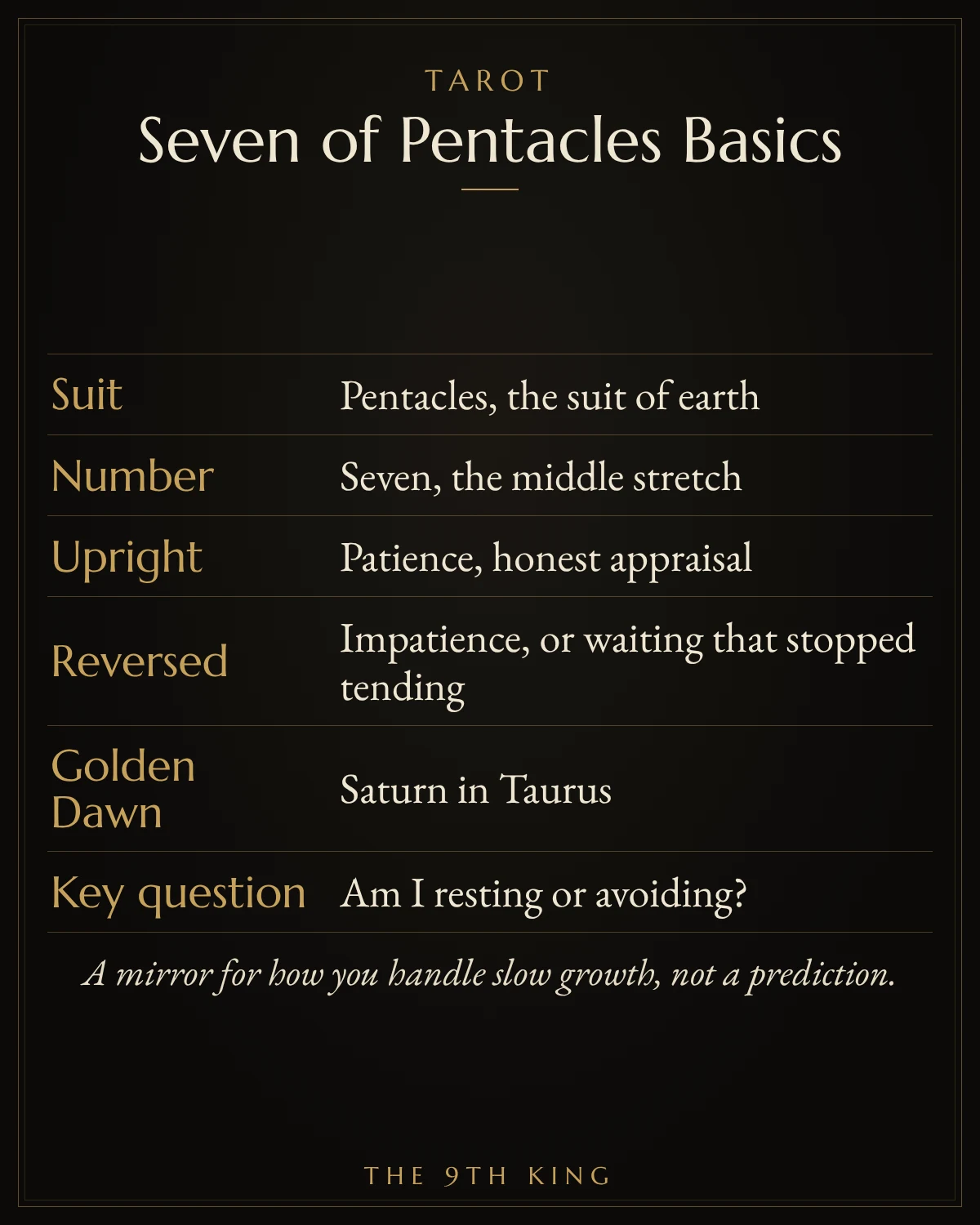
| Seven of Pentacles | |
|---|---|
| Arcana | Minor Arcana, a pip (number) card |
| Suit and element | Pentacles, linked with earth |
| Number | Seven |
| Golden Dawn title | Lord of Success Unfulfilled |
| Astrology (Golden Dawn) | Saturn in Taurus |
| Upright | Patience, assessment, slow growth |
| Reversed | Impatience, poor return, stalled tending |
| Key question | Am I resting, or avoiding? |
What the Seven of Pentacles looks like
Most people meet this card through the Rider–Waite–Smith deck, first published in London by William Rider & Son in 1909. A.E. Waite wrote the instructions and Pamela Colman Smith drew the art, and both were members of the Hermetic Order of the Golden Dawn (Wikipedia: Rider–Waite Tarot).
Waite’s description in The Pictorial Key to the Tarot (1911) is a single sentence, so this section stays close to it (sacred-texts.com: Waite, Seven of Pentacles).
The young man and his staff
A young man leans on his staff. He isn’t working in this moment; he’s resting his weight and, Waite says, looking intently. The staff that holds him up while he pauses is the same one he works with.
Seven pentacles on the greenery
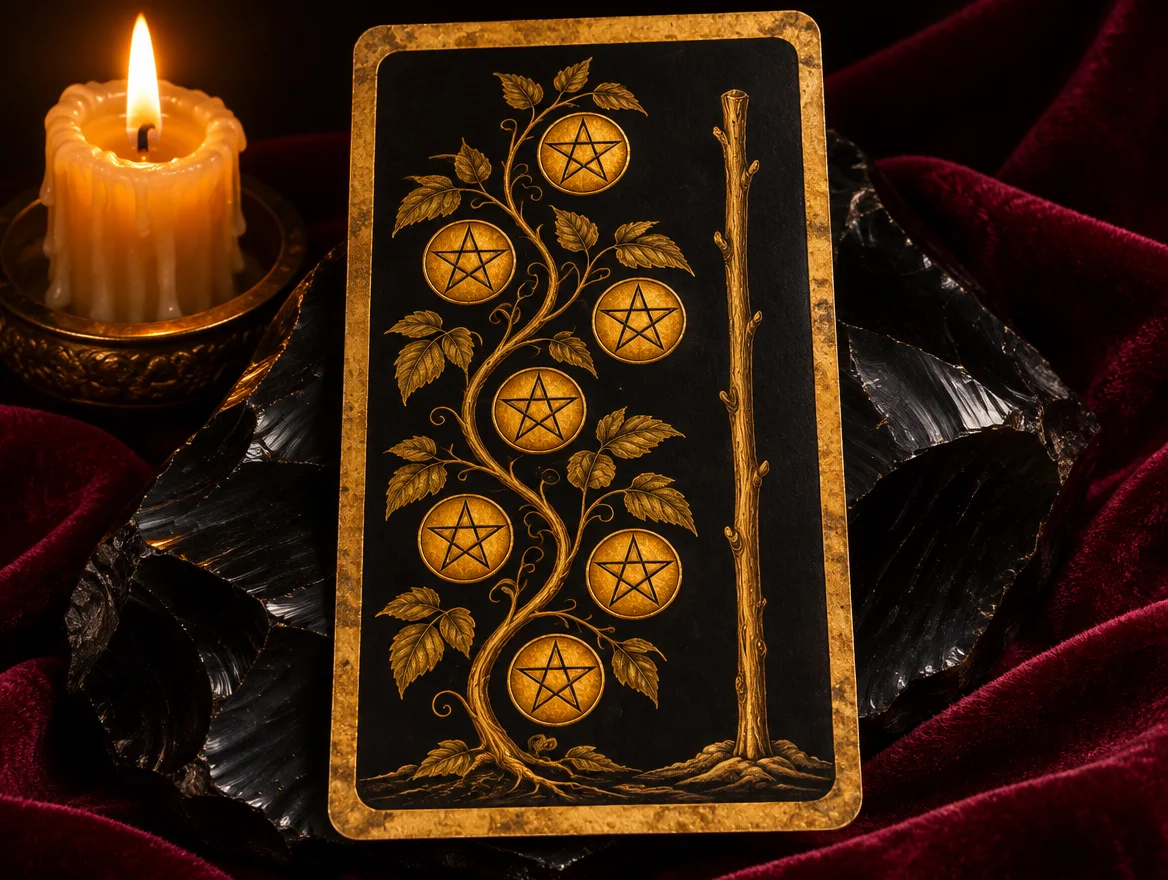
Beside him, on his right, seven pentacles are attached to a clump of greenery. On The 9th King, the pentacle stands for what’s solid and earned: money, but also skill, health and time. Growing on a plant, they read as a crop rather than a stack of coins, and you can’t hurry a crop.
Where his heart is
Waite adds that “one would say that these were his treasures and that his heart was there” (sacred-texts.com: Waite, Seven of Pentacles). That’s the emotional center of the card: he’s looking at something he cares about, and caring makes the wait harder.
The Golden Dawn version of the card
The Golden Dawn’s teaching text on the tarot, Book T, as printed by Aleister Crowley in Liber LXXVIII, describes a different design: a radiating angelic hand from a cloud holds a white rose branch, with seven pentacles and only five buds, which overhang the upper pentacles without touching them (Liber LXXVIII, sacred-texts.com). The text explains that the rosebuds come to nothing. The Rider–Waite–Smith card shows a young man instead, but the theme of unfinished growth is shared.
Seven of Pentacles meaning (upright)
Waite himself admits that the meanings contradict each other sharply. In the main, he says, it’s a card of money, business and barter, but one reading gives altercation and quarrels, and another gives innocence, ingenuity and purgation (sacred-texts.com: Waite, Seven of Pentacles).
Book T is less hopeful. Under the title Lord of Success Unfulfilled, it lists promises of success unfulfilled, hopes deceived and “little gain for much labour” (Liber LXXVIII, sacred-texts.com), plus small, isolated gains that seem promising but lead nowhere.
On The 9th King, we read the upright card more gently, as the moment of review in the middle of slow work. It has three layers.
The pause to look
The card can point to a natural checkpoint in something you’ve worked on for a while: a skill, a business, a relationship, your health. You stop, not to quit or push harder, just to see. Ask yourself: What is actually growing here, and what am I only hoping is growing?
Patient investment
Pentacles move at the pace of earth. The upright card can point to work that needs time more than extra effort right now. Watering a plant five times a day doesn’t get you a faster crop; a steady rhythm does more.
Honest appraisal
This is the layer Book T points toward. Sometimes the look shows a thinner crop than you hoped. That’s information, not failure: a prompt to check the soil, the method and the expectations while there’s still time to adjust.
Seven of Pentacles reversed
Some readers read reversals as the opposite meaning, some as blocked energy, and some skip them. Waite’s reversed meaning for this card is specific and a little odd: cause for anxiety about money that someone may propose to lend (sacred-texts.com: Waite, Seven of Pentacles). On The 9th King, the reversed card usually points to one of three patterns, offered as questions, not predictions.
Impatience: pulling up the seeds
You keep digging up the seed to see if it’s sprouted. The reversed card can point to giving up too early or judging slow work by fast standards. Ask yourself: Have I given this a fair season, or am I measuring it by how I feel today?
Effort that isn’t paying back
You’ve worked hard, and the return is small or absent. Ask whether the method, the place or the goal needs to change: If I started today, knowing what I know now, would I plant this again, here, this way?
Waiting that has stopped tending
Sometimes “I’m being patient” quietly turns into “I’ve stopped showing up.” This is different from rest, and we separate the two below. Ask yourself: Am I letting this grow, or have I walked away and kept calling it patience?
| Pattern | Upright tone | Reversed tone |
|---|---|---|
| Waiting | Steady, trusting | Restless or absent |
| Effort | Paced, sustainable | Frantic or stopped |
| Review | Honest, curious | Avoided or harsh |
| The crop | Still growing | Pulled early or neglected |
Seven of Pentacles astrology: Saturn in Taurus
The 9th King uses Golden Dawn–derived correspondences, the tradition the Rider–Waite–Smith deck draws on. Other schools use different systems, and not every card maps to a single sign: the court cards and Pages are handled differently. This is one traditional framework, offered as symbolism.
How the number cards get their planets
In the Golden Dawn system, the 36 small cards (Twos through Tens) are matched to the 36 decans of the zodiac: ten-degree thirds of a sign, each with a ruling planet. Book T‘s table lists the Seven of Pentacles, “Success unfulfilled,” under Saturn in Taurus (Liber LXXVIII, sacred-texts.com). It’s the last of the three Taurus decans in that table, after the Five of Pentacles (Mercury in Taurus) and the Six of Pentacles (Moon in Taurus). The card’s own entry names Saturn and Taurus as its Decan symbols.
Book T places all four Sevens in Netzach on the Kabbalistic Tree of Life, and for the Seven of Pentacles it lists unprofitable speculations and employments. It also says something about the Sevens as a group that fits this card closely: they show a possible result, one that depends on the action then taken. In the same text, Pentacles is the suit of earth; its Ace is the Root of the Powers of Earth.
What Saturn brings
On The 9th King, Saturn is the planet of time, structure, limits and long effort. It’s the traditional ruler of Capricorn, so our Capricorn Personality Traits page shows Saturn’s style in a person. On this card, Saturn is the clock you can’t speed up.
What Taurus brings
Taurus is fixed earth, ruled by Venus: the sign of the body, the senses, security and things that grow slowly and last. Our Taurus Personality Traits page covers the Bull’s steadiness and its stubborn shadow. On this card, Taurus is the field and the wish for something solid to show for your work.
The tension in the pairing
Taurus wants the harvest: something real in your hands. Saturn says not yet. The Seven of Pentacles sits in that gap. Saturn teaches Taurus that waiting isn’t wasted; Taurus teaches Saturn that you can enjoy the field while it grows.
The 9K reading: waiting or avoiding?
The card’s tension
The Seven of Pentacles holds two true things at once: I’ve put in real work and I can’t see the result yet. It’s tempting to end that discomfort fast, by pushing harder or calling it all a waste. The card asks you to stay in the middle, where the outcome is still open and, as Book T says of the Sevens, depends on what you do next.
The shadow side
The shadow of the Seven of Pentacles is turning the waiting into a verdict on yourself. It’s the voice that says if it were going to work, it would have worked by now, or everyone else’s garden is further along. It can look like:
- Constant checking. Refreshing the numbers so often that checking becomes the job.
- Comparison. Measuring your season against someone else’s harvest, without knowing when they planted.
- Sunk-cost loyalty. Staying with something only because you’ve already put so much in, not because it’s still growing.
- Avoidance dressed as patience. Not tending, not reviewing, not deciding, and calling it “giving it time.”
These patterns usually come from caring a lot, like the man whose heart is with his treasures. The question is whether your care is helping the crop or just wearing you out.
Rest is not avoidance
Rest is part of growing. A grower who never stops to lean on the staff can burn out before harvest. A real break, pacing, sleep, recovering from illness or a slow week aren’t this card’s shadow. They’re often what it’s asking for.
Avoidance is when you’ve stopped tending and stopped looking, and “patience” is covering a decision you don’t want to make. The difference isn’t how it feels: rest can feel guilty, and avoidance can feel calm. Use questions instead.
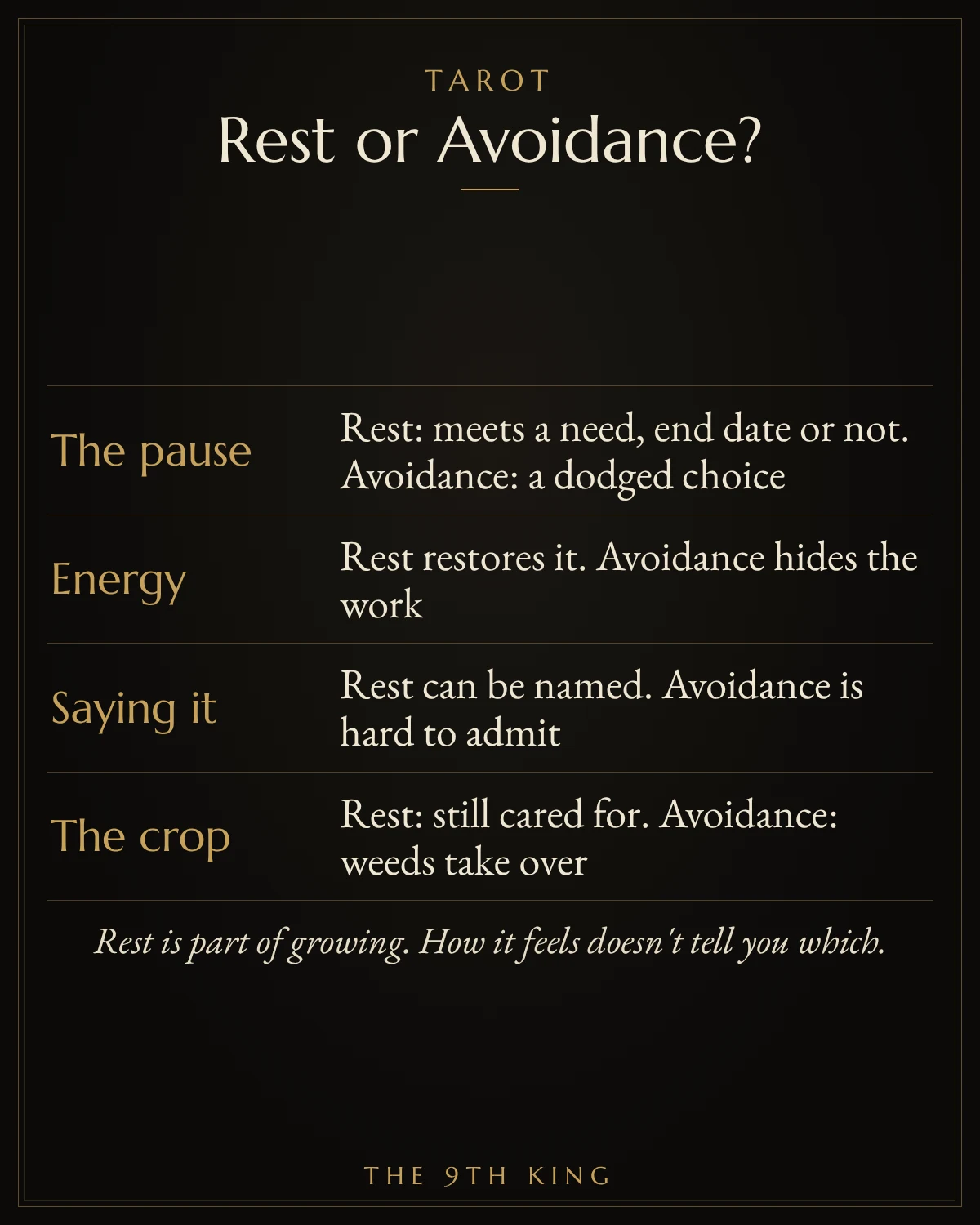
| Rest | Avoidance |
|---|---|
| It’s a pause that meets a need, end date or not | It’s dodging a decision |
| It restores energy for the work | It keeps the work out of sight |
| It can be named out loud | It’s hard to admit, even privately |
| The crop is still being cared for | The weeds are taking over |
Not sure which you’re in? Ask: Is anything still being tended while I’m away? Can I say out loud what I’m pausing and why? When will I look again? If you can answer, it may well be rest. If not, take a gentle look, without blame.
The self-mastery lesson
The lesson of the Seven of Pentacles is to appraise without abandoning. You can admit a crop is thin, adjust, rest and keep going without calling the whole thing a mistake. And if the honest look says plant something else, that’s what the review is for. Self-mastery here means setting your own checkpoints instead of reacting to every passing worry.
Seven of Pentacles as feelings, in love and at work
Seven of Pentacles as feelings
As feelings, readers often take the card as patient, careful interest: someone invested and still working out whether it’s growing. A card can’t tell you what someone feels or will do; their words and actions can. About your own feelings, ask: Am I waiting for something to grow, or waiting for permission to admit it hasn’t?
Seven of Pentacles love meaning
In a love reading, the upright card can point to a slow, steady season built on effort rather than sparks. The reversed card can point to impatience, keeping score of who has put in more, or two people both waiting without either one tending.
Tarot can’t tell you whether to stay or leave, and this page won’t either. If you don’t feel safe with someone, this isn’t a question of patience: your safety comes first. Otherwise, useful questions:
- What have we each been putting in lately, in behavior I can actually see?
- Am I waiting for a change I’ve asked for clearly, or one I’ve only hoped for?
- What would “tending” this relationship look like this week, in one small action?
If you two move at very different paces, fire and water relationships explores how intensity and caution can work together.
Seven of Pentacles at work and with money
None of this is financial or career advice, only reflection.
At work, readers often take the card as the mid-project review: deciding what to keep, change or drop. Its shadow is judging a long project by this week’s numbers. Ask yourself: What would a fair checkpoint look like here, and when?
With money, the lesson is about attitude, not amount. Waite’s reversed line about worry over lending is a reminder that money anxiety is part of this card’s story. Ask: Where am I expecting a return, and have I been clear with myself about the timeline? For actual decisions, talk to a qualified professional.
The Ace of Pentacles is the seed this card is watching grow.
Practical exercise: the harvest audit
This turns the self-mastery lesson into something you can do this week. You need twenty minutes, a notebook and one thing you’ve been working on slowly.

Step 1: Name the field
Write one sentence: What am I growing? “My career” is too big; “getting good enough at illustration to take paid work” is a field.
Step 2: Count what’s grown
List what’s real so far, not what you hope for: skills, small wins, contacts, habits, lessons learned the hard way. Thin crops still count.
Step 3: Check the tending
List what you’ve done for this field in the last few weeks. Long or short, just notice it, without judging yet.
Step 4: Rest or avoid?
If the tending has slowed, use the questions from the rest-or-avoidance section and write down which it is. If it’s rest, note what it’s restoring. If it’s avoidance, note the one decision you’ve been putting off. Either answer is information, not a grade.
Step 5: Set a checkpoint
Choose a date to look again and one thing you’ll look at, and put it in your calendar. Then let yourself stop checking until that day. You set the clock, so you don’t have to stare at it.
A worked example (fictional)
Marcus (fictional) has been building a small woodworking side business for eighteen months. Sales are slow, and he draws the Seven of Pentacles upright.
He names the field as “selling enough pieces to cover my materials.” What’s grown: real skill, eleven repeat customers and a waiting list for one design. The tending: nothing new listed in two months. Rest or avoid? Both: he was genuinely worn out after a busy season at his day job, and he’s been putting off a decision about raising his prices.
He takes two more weeks of rest, names the price decision to a friend and sets a checkpoint for the first of next month. The crop is thinner than he hoped, but it’s real.
Journal prompts for the Seven of Pentacles
- What am I growing right now that needs time more than effort?
- What have I already harvested from this work that I haven’t given myself credit for?
- Where am I comparing my season to someone else’s harvest?
- Is there something I’m calling “patience” that might be avoidance? What would I need to decide if I admitted it?
- Where do I need real rest, and what would make it easier to take without guilt?
- If I planted again today, knowing what I know now, what would I do differently?
For more, our shadow work prompts go deeper and Shadow Work, Plainly explains how to start safely. If the waiting stirs old fears of never being good enough, inner child work can be a gentle next step.
A warm note: this is reflective practice, not therapy. If you’re dealing with trauma, abuse, thoughts of self-harm or distress that feels overwhelming, please work with a qualified therapist who can walk with you. It’s always fine to stop a prompt that feels like too much.
Myths and misreadings of the Seven of Pentacles
- “The Seven of Pentacles means your efforts are wasted.” No. On The 9th King, tarot doesn’t predict outcomes, and Book T itself says the Sevens show a possible result that depends on the action taken. It’s a checkpoint, not a verdict.
- “It’s only a money card.” Waite calls it, in the main, a card of money, business and barter, but Pentacles covers the body, skill, home and time too. Any slow investment fits.
- “Waiting means doing nothing.” Real waiting often includes quiet tending, and rest is part of growth. Avoidance is a different thing.
- “Saturn in Taurus means this card is about Taurus people.” No. The correspondence describes the card’s symbolism in the Golden Dawn tradition. Anyone can draw it, whatever their sign.

Seven of Pentacles: FAQ
What does the Seven of Pentacles mean?
The Seven of Pentacles is a Minor Arcana card in the earth suit. It shows a young man leaning on his staff, looking intently at seven pentacles on a plant. Readers commonly take it as patience, assessment and slow growth: you’ve put in effort and now pause to see what’s coming of it. On The 9th King, it’s a mirror for how you handle the slow middle of any long project, not a prediction of results.
What does the Seven of Pentacles reversed mean?
Reversed, the Seven of Pentacles is often read as impatience, effort that isn’t paying back, or waiting that has quietly turned into not tending. It can point to giving up too early or staying only because of what you’ve already put in. Some readers don’t use reversals at all. Treat it as a prompt to tell real rest apart from avoidance, rather than a sign that something will go wrong.
What does the Seven of Pentacles mean as feelings?
As feelings, readers often take the Seven of Pentacles as patient, careful interest: someone who’s invested and is still working out whether the connection is growing. A card can’t tell you what someone feels or will do; their words and actions can. If the card is about your own feelings, it can prompt you to ask whether you’re waiting for growth or avoiding an honest look.
What does the Seven of Pentacles mean in love?
In love, the upright card can point to a slow, steady season in a relationship built more on effort than on sparks. Reversed, it can point to impatience, scorekeeping or two people both waiting without either one tending. The card doesn’t tell you to stay or leave. It invites you to look at what each of you is putting in, in behavior you can see.
What zodiac sign is the Seven of Pentacles?
In the Golden Dawn system, the tradition The 9th King uses, the Seven of Pentacles corresponds to Saturn in Taurus, one of the three decans of Taurus. The Golden Dawn’s Book T calls the card the Lord of Success Unfulfilled. Other schools use different correspondences, so treat this as one traditional framework for symbolism, not a fixed rule.
Is the Seven of Pentacles a yes or no card?
The 9th King doesn’t do yes or no readings, because tarot here is for self-reflection, not fortune-telling. Instead, ask what the card shows you: what you’ve grown so far, whether you’re resting or avoiding, and when a fair checkpoint would be.
Is the Seven of Pentacles a good or bad card?
Neither, on The 9th King. Waite admits its meanings contradict each other, while the Golden Dawn’s Book T gave it a gloomy title, the Lord of Success Unfulfilled, and linked it with little gain for a lot of work. On The 9th King, we see patience and honest review in it. Read it as a mirror for how you handle slow growth, not as a good or bad omen.

Your next step: do the harvest audit above for one thing you’ve been growing slowly, and set your checkpoint date before you close the notebook. Then find where Taurus falls in your own chart with our guide on how to read a birth chart: the steady earth sign the Golden Dawn tied to this card.
Explore Next
- The Bull’s steadiness and its shadow: Taurus Personality Traits
- Saturn’s long game in a person: Capricorn Personality Traits
- Where the earth suit begins: Ace of Pentacles
- The steady worker of the suit: Knight of Pentacles
- Go deeper with questions: Shadow Work Prompts
- The shadow side of every sign: Zodiac Shadow Work
- Reading by feel: Intuitive Tarot (Code of Ascension)
- New to the cards: Tarot for Beginners: How Tarot Really Works (Code of Ascension)
- More tarot on The 9th King: Tarot Card Meanings · Minor Arcana · Tarot & the Zodiac · Queen of Pentacles · Shadow Work Tarot Spread
- More cards in this set: Seven of Swords, Seven of Wands and Two of Cups

Final Thought: Lean on the Staff, Then Look Again
The young man in the Seven of Pentacles isn’t failing or lazy. He’s doing one of the hardest parts of real work: looking at something he cares about and telling himself the truth. Rest when you need to, tend what’s worth tending, and let the slow things be slow. Know your nature. Rule your life.
About the Author
King is the founder of The 9th King, where zodiac psychology, relationships and shadow work are explored as tools for self-knowledge rather than fortune-telling. He’s a Libra Sun, and writes about the personal side of astrology on King The Kemist. Astrology on The 9th King is interpretation and self-reflection, not prediction or established fact.
Leave a Reply