
Quick Answer: What Does the Page of Swords Mean?
The Page of Swords is the youngest court card in the suit of Swords, the tarot suit linked with air and the mind. In the classic Rider–Waite–Smith image, a young figure walks quickly over rough ground, holding a sword upright in both hands and glancing in every direction.
Keywords: curiosity, vigilance, sharp questions, a quick mind, learning, watchfulness.
- Upright, in one line: your mind wakes up and wants to know, and the card invites you to ask clear, honest questions and stay alert without getting paranoid.
- Reversed, in one line: the same sharpness turns into prying, gossip, arguing to win or being caught off guard, so the card asks what your questions are really for.
On The 9th King, tarot is a mirror for self-knowledge, not fortune-telling. The Page of Swords doesn’t warn you that something is coming. It points to the alert, curious part of you.
Table of Contents

The Page of Swords at a glance
| Page of Swords | |
|---|---|
| Arcana | Minor Arcana, court card |
| Suit | Swords (air) |
| Rank | Page, the youngest court card |
| Golden Dawn title | Princess of the Rushing Winds |
| Element pairing | Earth of Air |
| Zodiac span | None (Princesses don’t take one) |
| Upright themes | Curiosity, vigilance, clear questions |
| Reversed themes | Prying, gossip, arguing to win |
| Key question | Am I asking to understand, or to win? |
The sections below explain each row.
What the Page of Swords shows: the traditional imagery
Most modern readers know the Page of Swords from the Rider–Waite–Smith deck, published in 1909 by William Rider & Son of London. A.E. Waite gave the instructions for the deck and Pamela Colman Smith drew the art; both were members of the Hermetic Order of the Golden Dawn (Wikipedia: Rider–Waite Tarot). Britannica dates the first tarot decks to Italy in the 1430s and says tarot was first adapted for occult and fortune-telling use in France around 1780 (Britannica: Tarot). Each suit has four court cards: king, queen, knight and jack, or page.
The walker with the raised sword
Waite’s own description, in The Pictorial Key to the Tarot, is short and full of motion. A lithe, active figure holds a sword upright in both hands while walking fast over rugged land, with clouds gathered wildly around his path. He is alert, “looking this way and that, as if an expected enemy might appear” (Waite, Pictorial Key, Page of Swords, sacred-texts.com).
Notice what the page is not doing. He isn’t fighting, and nobody is there. He’s ready and scanning, sword held up rather than swung: a mind awake and on guard before it knows whether there’s anything to guard against.
Wind, clouds and rough ground
On the 1909 Smith card, wind seems to move through his hair, and he wears a light tunic rather than heavy armor, which many readers take as freedom to move quickly (Wikipedia: Page of Swords). Wikipedia also notes that his body and sword point one way while his head turns the other, read as curiosity about what lies around him, not only ahead.
Page of Swords meaning upright
Upright, readers commonly take the Page of Swords as fresh mental energy: curiosity, alertness and the urge to find things out. Waite’s divinatory notes list authority, overseeing, secret service, vigilance, spying and examination, along with the qualities that go with them (Waite, Pictorial Key). Modern readers usually soften spying into watchfulness and research.
- Curiosity. A question you can’t stop turning over.
- Vigilance. Noticing details others miss, checking before you trust.
- Sharp questions. The kind that cut through vagueness: What exactly do you mean? What’s the evidence? What did I agree to?
- Examination. Studying, testing a plan, reviewing the facts before you act.
The upright card’s best quality is honest attention. When something feels unclear, the card invites you to ask, look and learn, in good faith, instead of guessing.
Page of Swords reversed
Reversed, the same sharpness gets misused, overused or caught out. Waite’s reversed note points to the harsher side of these qualities, to what is unforeseen and to an unprepared state (Waite, Pictorial Key). Wikipedia lists alternative interpretations such as gossip, mischief and stirring up drama (Wikipedia: Page of Swords).
On 9K, we read it through three patterns.
1. Curiosity turns into prying
The question stops being what’s true? and becomes what can I find out about them? Reading messages not meant for you, or asking questions to corner rather than understand. The card can point to the moment watchfulness crosses into surveillance.
2. Information turns into gossip
Air is the element of words, and words travel. Reversed, the card can reflect passing on what you heard, with a little spin, or talking about people instead of to them. Ask yourself: Would I say this the same way if they were in the room?
3. Sharp words turn into arguing to win
The mind gets clever and combative. You score points long after the debate stopped helping anyone.
There’s a quieter reversed pattern too: being caught unprepared. Waite’s note about the unforeseen fits the version of you so busy watching other people that you miss what’s in front of you.
The check for all of these is simple: Am I asking to understand, or to win? Honest questions tend to make things clearer; prying, gossip and point-scoring tend to make them murkier.
Swords, air and the Golden Dawn: the card’s correspondences
The correspondences below are Golden Dawn–derived correspondences, the tradition The 9th King uses, which is the system the Rider–Waite–Smith deck draws on. Other schools differ, and not every card maps to a single sign; court cards, and Pages especially, work differently.
Swords are air
In the Golden Dawn’s tarot text known as Book T, printed by Aleister Crowley as Liber LXXVIII, the Ace of Swords is called the Root of the Powers of Air (Liber LXXVIII, sacred-texts.com). The suit is widely associated with the element of air and, in divination, with intellect (Wikipedia: Suit of swords).
The naming trap: Page, Knave, Princess
The Rider–Waite–Smith deck calls this card the Page. Older packs called the same rank the Knave or jack. The Golden Dawn called it the Princess, and Liber LXXVIII states that its four Princesses are the Knaves of the tarot pack (Liber LXXVIII).
Liber LXXVIII names the Knave of Swords the Princess of the Rushing Winds, also titled the Lotus of the Palace of Air. The 9th King follows the court-card naming in Liber LXXVIII (the Golden Dawn’s Book T): Knights are fire of their suit, Queens water, Kings air, Pages earth. Matching that Princess to the Rider–Waite–Smith Page of Swords is 9K’s convention; other systems differ, so check which naming a source uses.
Element pairing: Earth of Air
Liber LXXVIII lists the Princess of the Rushing Winds as Earth of Air, and describes her qualities as “Wisdom, strength, acuteness; subtlety in material things: grace and dexterity” (Liber LXXVIII). If ill dignified, it says, she is frivolous and cunning.
Earth is where things take form; air is thought. So Earth of Air is thought that lands: the idea tested against real life, the question asked of an actual person. The Page of Swords at its best doesn’t just think fast. It brings thinking down to the ground.
Why there’s no zodiac span
In the Golden Dawn system, the Kings, Queens and Princes rule spans of the zodiac. For example, Liber LXXVIII has the King of Swords, its Prince of the Chariot of the Winds, ruling from 20° Capricorn to 20° Aquarius. The Princesses don’t. Liber LXXVIII says the four Princesses rule the four parts of the heavens around the North Pole, and its Princess of Swords entry says she rules a quadrant of the heavens around Kether (Liber LXXVIII).
In plain terms: the Page of Swords isn’t tied to birthday dates.
The air signs, as element links
It can help to read the card alongside the three air signs. This is an element link, not a claim that the card “is” any of them:
- Gemini personality traits: air as curiosity, talk and a mind that wants to know everything.
- Libra traits: air as weighing both sides and asking what’s fair.
- Aquarius personality traits: air as independent thinking and the urge to question the rules.
If your chart has a lot of air, our guide on how to read a birth chart shows where to look.

The 9th King reading: tension, shadow and self-mastery
The 9K reading asks: What does this card show about how you use your own mind?
The tension: curiosity vs. vigilance turned hostile
The Page of Swords lives between wanting to know and expecting the worst. Curiosity is open: What’s going on here? Vigilance is protective: What could go wrong? Both are useful. The trouble starts when vigilance takes over and every unknown becomes an “expected enemy.”
Sometimes that instinct is wisdom. Sometimes it’s a habit learned where it once kept you safe, still running after you’ve left. If you’re in a situation where you genuinely aren’t safe, your safety comes first, and watchfulness there makes sense. The card’s question is for the rest of the time: Is my alertness helping me see, or keeping me braced?
The shadow side
The card’s shadow shows up in a few familiar shapes:
- The investigator. Checking, researching and digging into other people’s lives instead of asking them directly.
- The commentator. Always knowing, and sharing, the latest about everyone.
- The debater. Turning every conversation into a contest, and calling it honesty.
- The sentry. So braced for trouble that rest feels unsafe and trust feels naive.
If one of these stings, that’s information, not a verdict. Our zodiac shadow work guide covers the air signs’ shadows, which overlap with this card. And if you notice you often assume what other people are thinking, psychological projection is worth reading.

| Strength | Shadow version | The rebalance |
|---|---|---|
| Curiosity | Prying | Ask, don’t snoop |
| Vigilance | Constant bracing | Check once, then rest |
| Quick wit | Arguing to win | Aim to understand |
| Information | Gossip | Talk to people, not about them |
| Honesty | Bluntness as a weapon | True and useful, then say it |
The self-mastery lesson
The Page of Swords teaches one skill: ask the sharp question cleanly, of the right source, and then let the answer land.
Cleanly means without a trap built in. The right source means the person or facts involved, not a third party or a search history. Letting the answer land means you stop circling once you have what you need. Self-mastery here isn’t about dulling a sharp mind; it’s about pointing it at clarity instead of control.
Page of Swords as feelings and in love
“Page of Swords as feelings” usually comes from someone wondering how another person feels about them. Here’s the honest 9K answer.
What readers commonly say
Readers often take the Page of Swords in a feelings position as curious, watchful interest: someone who wants to know more, asks lots of questions and may be a little guarded.
What a card can and can’t tell you
A card can’t read another person’s mind or establish their motives. It can reflect the question you brought. A more useful question is: What is this card saying about how I’m approaching this? Are you the one with the sword up, scanning for signs?
Stick to what someone has said and done, not what you imagine they meant. If you want to know how someone feels, the direct path is usually available: ask them, kindly and without pressure, and accept what they choose to share.
Page of Swords in love
In a love reading, readers commonly associate the card with:
- Getting to know someone. Lots of talk, questions and mental chemistry.
- Honest conversation. Saying what you actually think, or asking what you’ve been avoiding.
- Wariness. Hesitating to trust, especially after being hurt.
Reversed, it can reflect checking up on a partner, reading into small things, or arguments that are more about winning than understanding. A relationship has room for privacy; our guide to privacy without mixed signals covers the difference between privacy and secrecy. Monitoring or controlling a partner is never okay, and if someone is doing that to you, the responsibility is theirs, not yours.
The card doesn’t tell you to stay, leave, confront or wait. It offers a question: Am I asking to understand this person, or to catch them out?
A worked example (fictional)
Sam (fictional) draws the Page of Swords after a partner comes home late and quiet. Sam’s instinct is to check the partner’s phone.
Upright reading: the card can point to healthy curiosity. Sam asks: What do I actually know, and what do I want to understand? Sam asks one plain question at a calm moment: “You seemed far away tonight. Is something going on?”
If it had come up reversed: the reflection shifts to prying. Is Sam about to search for evidence instead of talking? Am I trying to understand, or trying to win before anything has even been said?
Neither reading predicts what the partner will say.
Page of Swords at work and in study
At work, readers often take the Page of Swords as learning, research or fact-checking: the new role where you ask a hundred questions, the project that needs someone to read the fine print. Waite’s overseeing and examination fit here.
Its strongest ground is study. Ask the real question, then go find the answer from a good source. Don’t settle for rumor, and don’t argue about what you could simply look up.
Reversed, it often reflects office gossip, overchecking other people’s work, or getting caught unprepared. Ask where your attention is actually going.
None of this is career or financial advice; it’s a prompt to notice how you use your mind at work.
Myths and misreadings about the Page of Swords
- “The Page of Swords means someone is spying on you.” Waite lists spying among its meanings, but a card can’t establish facts about other people. On 9K, read it as a question about your own watchfulness.
- “It means bad news is coming.” Readers sometimes link Pages with messages. A card isn’t a delivery notice, and Swords aren’t a prediction of trouble.
- “Reversed means illness.” Waite’s reversed note mentions sickness (Waite, Pictorial Key). We don’t predict health or any life event from a card.
- “Reversed means you’re a bad person.” Reversed cards on 9K point to a blocked or overused version of the same energy, not to a verdict on you.
- “The Page of Swords is a Gemini card.” In the Golden Dawn system we use, Pages (Princesses) don’t take a zodiac span. Gemini is a helpful air-sign link, not an official correspondence.
Journal prompts and a practical exercise
The prompts and exercise below are reflective practice, not therapy. If you’re working through trauma, abuse, thoughts of self-harm or distress that feels overwhelming, please work with a qualified therapist. And it’s always fine to stop a prompt that feels like too much and come back another day, or not at all.
Seven journal prompts for the Page of Swords
- What question have I been turning over lately, and who or what could actually answer it?
- Where do I gather information about someone instead of talking to them?
- When did I last share something I’d heard, and how did I feel afterward?
- In my last disagreement, was I trying to understand or trying to win?
- Where does my alertness protect me, and where does it keep me from resting?
- What did I learn, as a child, about asking questions out loud?
- Am I asking to understand, or to win?
For more prompts in this style, see our shadow work prompts. New to shadow work? Shadow Work, Plainly explains how to start safely.
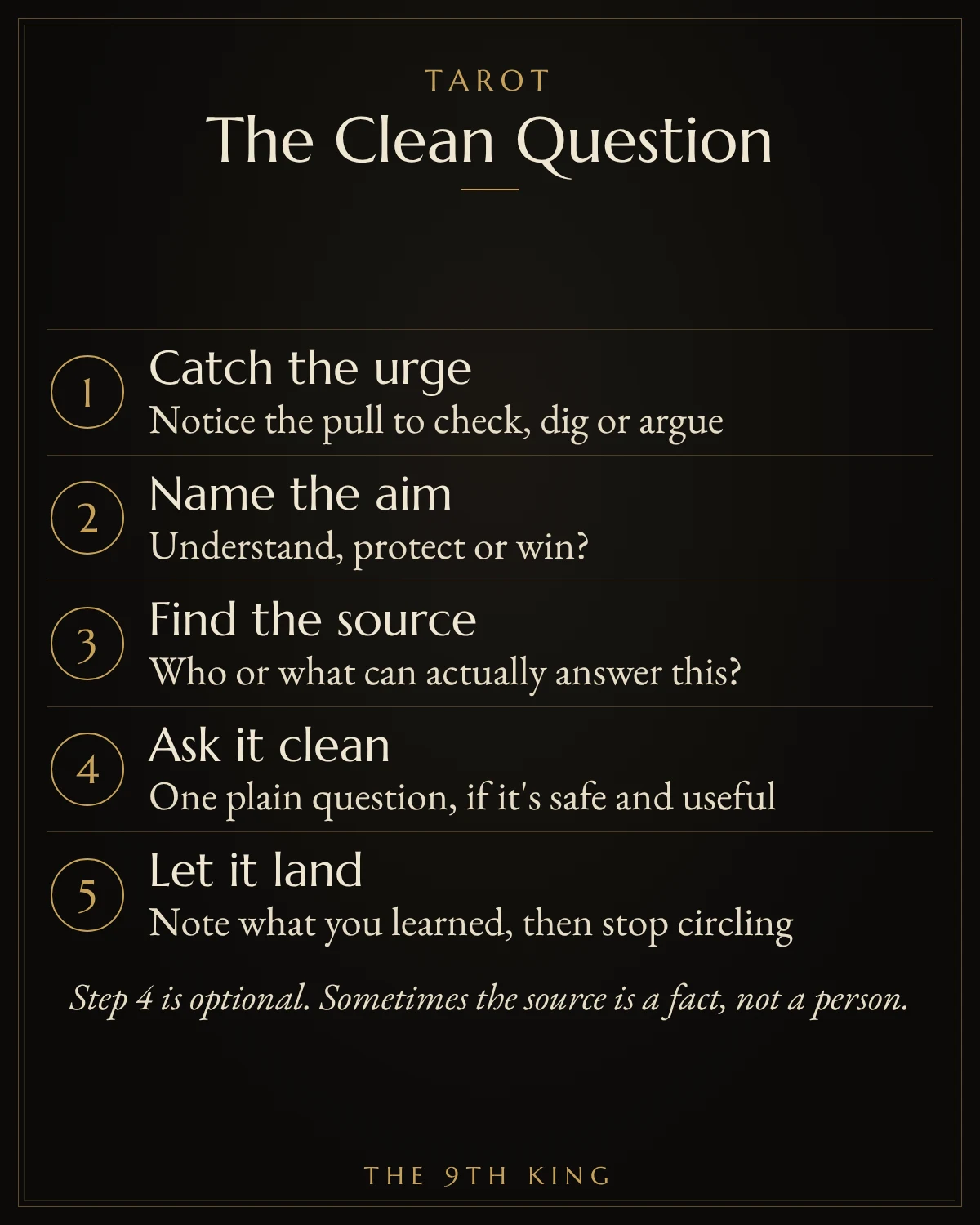
The exercise: the Clean Question
A short practice for the moment your mind starts scanning, checking or sharpening for a fight. Use it daily for a week, or whenever the card shows up.
| Step | What to do | Example (fictional) |
|---|---|---|
| 1. Catch the urge | Notice the pull to check, dig or argue | Wanting to scroll a coworker’s old posts |
| 2. Name the aim | Understand, protect or win? | Honestly, to win an argument |
| 3. Find the source | Who or what can actually answer this? | The coworker, or the project notes |
| 4. Ask it clean | One plain question, if safe and useful | “What did you mean by that comment?” |
| 5. Let it land | Note what you learned, then stop circling | “We wanted the same thing.” |
- Step 2 is the honesty check. If the answer is “win,” that’s information, not failure. Notice it and decide what you actually want.
- Step 4 is optional. You never have to contact anyone. Sometimes the right source is a document, a fact or your own notes, and sometimes the clean choice is to let the question go.
- Step 5 matters most. Once you know enough, lower the sword.
If you like reading intuitively, Code of Ascension’s guide to intuitive tarot (Code of Ascension) covers pairing card meanings with first impressions. You can also try the page in our three-card tarot spread as the card for “what I need to understand.”

Page of Swords: FAQ
What does the Page of Swords mean?
The Page of Swords is the youngest court card in the suit of Swords, the air suit. Upright, readers commonly take it as curiosity, vigilance and a quick, questioning mind: wanting to learn, noticing details and asking clear questions. On The 9th King it’s an invitation to use your sharp mind to understand rather than to win, not a prediction that something is about to happen.
What does the Page of Swords mean reversed?
Reversed, the Page of Swords often points to the same sharpness misused: prying, gossip, arguing to win, or being caught unprepared because your attention is elsewhere. A.E. Waite’s reversed note mentions the harsher side of the card’s qualities and an unprepared state. The useful question is whether your questions are aimed at clarity or control. Reversed doesn’t mean bad luck; it means the energy needs attention.
What does the Page of Swords mean as feelings?
In a feelings position, readers often take the Page of Swords as curious, watchful interest: someone who wants to know more but may be guarded or testing the waters. A card can’t read another person’s mind, though. Ask what it says about how you’re approaching the situation, and if you want to know how someone feels, ask them kindly and accept what they share.
What does the Page of Swords mean in love?
In love readings, the Page of Swords is commonly linked with getting to know someone, honest conversation and some wariness about trust. Reversed, it can reflect checking up on a partner or arguing to win. It doesn’t tell you to stay, leave, confront or wait; those choices are yours. It asks whether you’re trying to understand your partner or to catch them out.
What element is the Page of Swords?
Swords are the air suit. In the Golden Dawn system, the tradition The 9th King uses, the Page corresponds to the Princess of the Rushing Winds, whose element pairing in Liber LXXVIII is Earth of Air: the grounded part of air, or thought that lands in real life. That’s the court-card naming this site uses throughout, and other systems may name the courts differently.
Does the Page of Swords have a zodiac sign?
Not in the Golden Dawn system. The Kings, Queens and Princes of that system rule spans of the zodiac, but the Princesses, which 9K matches to the Rider–Waite–Smith Pages, rule quadrants of the heavens around the North Pole instead. Because Swords are air, Gemini, Libra and Aquarius are useful element links, but none is an official sign for this card.
Is the Page of Swords a person or a part of me?
It can be read either way. Court cards were traditionally read as people, and Waite pictured a lithe, alert young figure on the move. Many modern readers also treat court cards as parts of yourself. On The 9th King we start there: the Page of Swords is the curious, watchful part of your mind, and the question is whether you point it at understanding or at control.

Your next step: the next time you feel the urge to check, dig or argue this week, run the Clean Question above and write down which aim you named in step 2. Then read Psychological Projection to notice when the “expected enemy” you’re scanning for is really a story in your own head.
Explore Next
- When you’re guessing what others think: Psychological Projection
- Privacy vs secrecy in relationships: Privacy Without Mixed Signals
- Air as curiosity: Gemini Personality Traits
- Air as fairness: Libra Traits
- Air as independent thought: Aquarius Personality Traits
- New to tarot: Tarot for Beginners: How Tarot Really Works (Code of Ascension)
- More tarot on The 9th King: Tarot Card Meanings · Minor Arcana · Tarot & the Zodiac · Page of Cups · Page of Pentacles · Shadow Work Tarot Spread
- More cards in this set: Ace of Swords, Knight of Swords, Queen of Swords, King of Swords

Final Thought: Lower the Sword When You Can
A quick mind is worth having. The Page of Swords’ real lesson is what comes after the scanning. Ask the honest question of the right source, take in the answer, and let yourself rest once you know enough. Not every cloud is a storm, and not every unknown is an enemy. Know your nature. Rule your life.
About the Author
King is the founder of The 9th King, where zodiac psychology, relationships and shadow work are explored as tools for self-knowledge rather than fortune-telling. He’s a Libra Sun, and writes about the personal side of astrology on King The Kemist. Astrology on The 9th King is interpretation and self-reflection, not prediction or established fact.
Leave a Reply