
Quick Answer: What Is the Minor Arcana?
The Minor Arcana is the larger part of a tarot deck: 56 cards in four suits of 14 cards each. Every suit runs from Ace to Ten, plus four court cards (Page, Knight, Queen and King in the Rider–Waite–Smith deck). The other 22 cards are the Major Arcana.
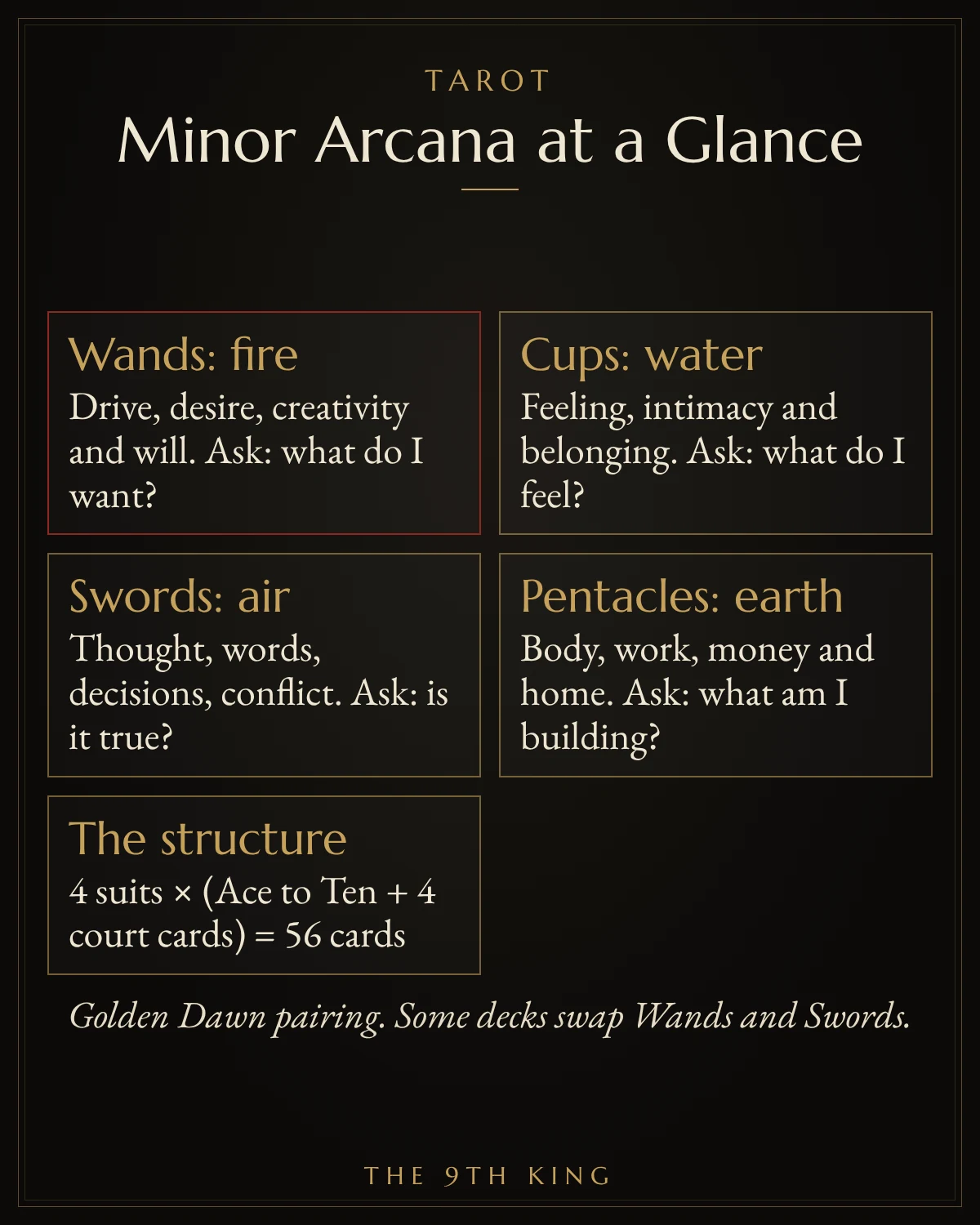
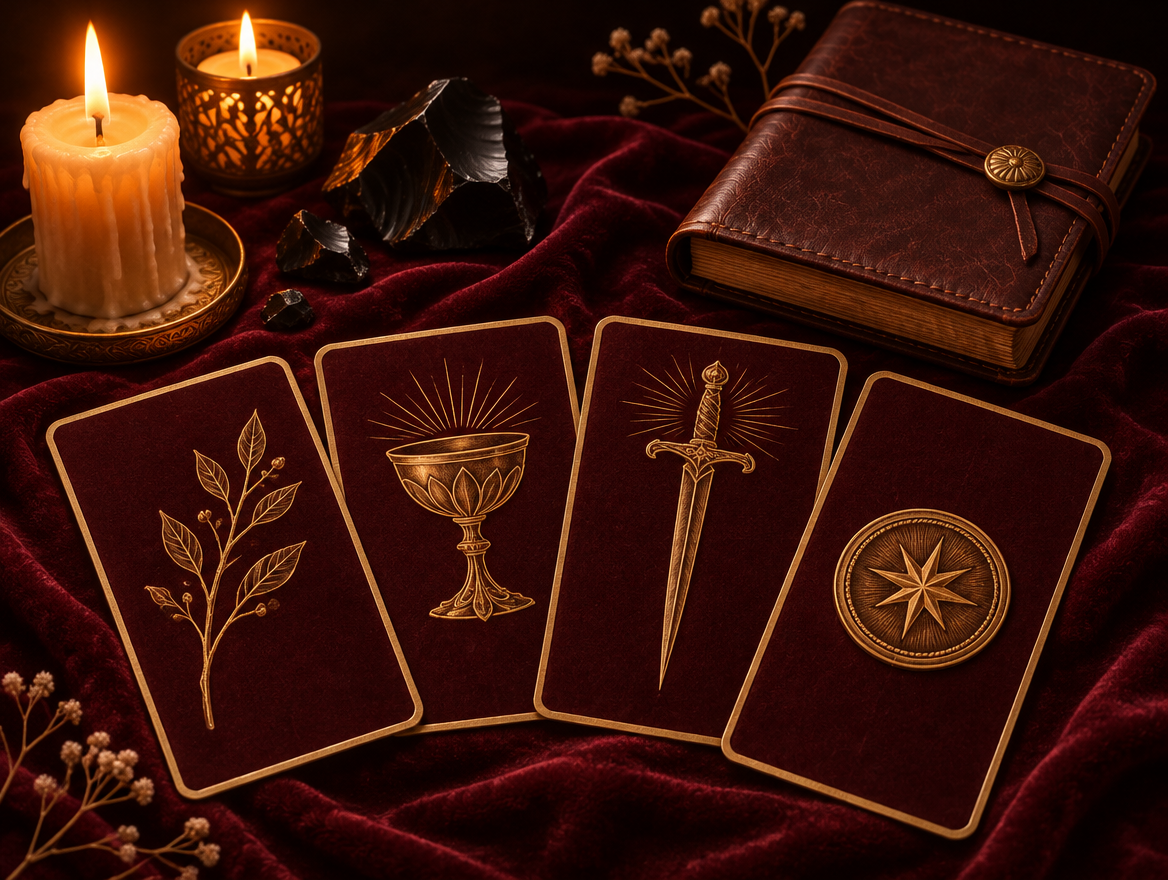
The four suits and their elements (the common Golden Dawn and Rider–Waite–Smith pairing):
- Wands: fire. Drive, desire, creative will.
- Cups: water. Feeling, relationships, the inner life.
- Swords: air. Thought, words, decisions, conflict.
- Pentacles: earth. Body, work, money, the material world.
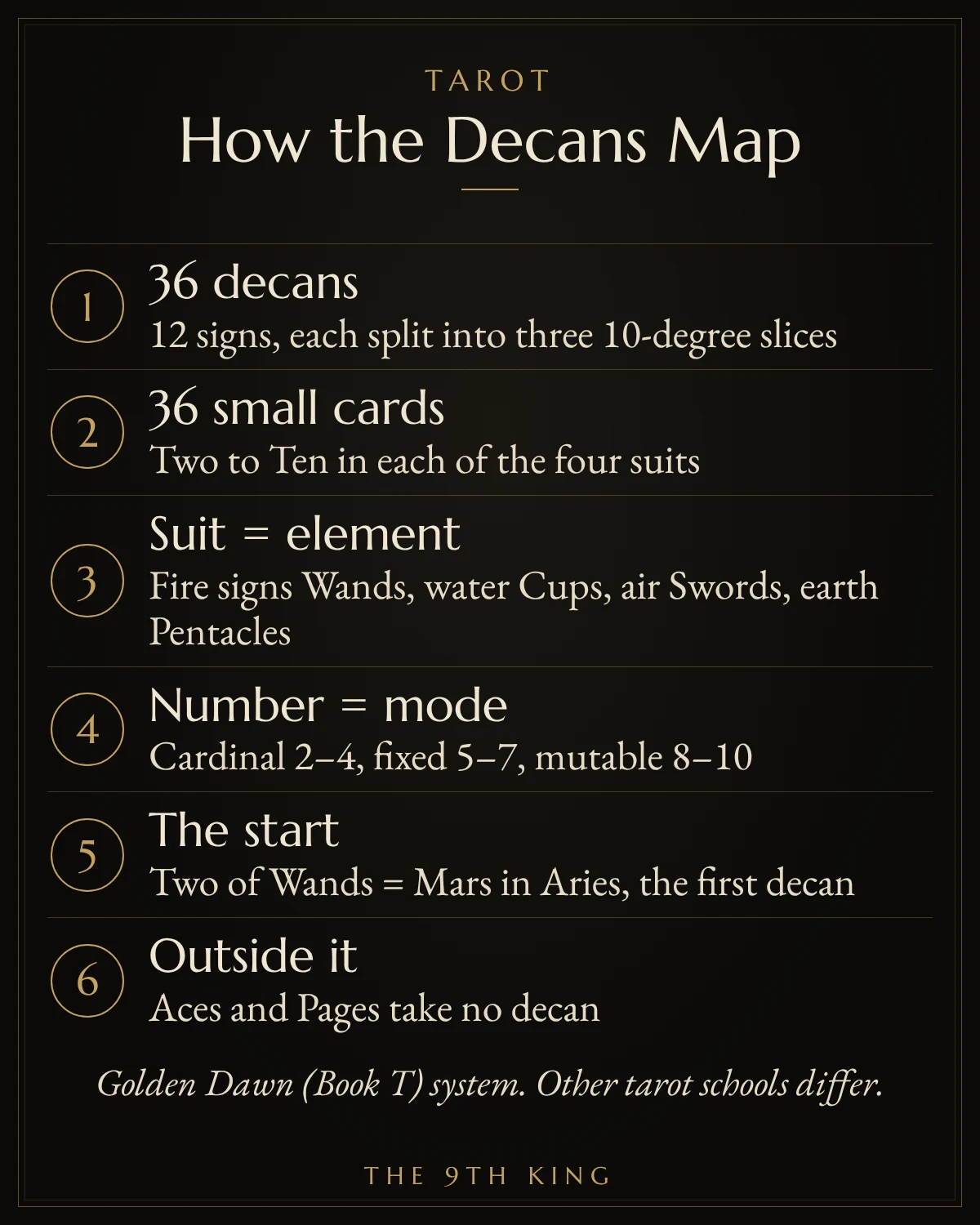
Numbers show where you are in a cycle (Ace = seed, Ten = full load). Court cards show a role or style you might be playing. In the Golden Dawn system, the cards Two to Ten also map to the 36 decans of the zodiac, starting with the Two of Wands as Mars in Aries.
On The 9th King, tarot is a mirror for self-knowledge, not fortune-telling. The Minor Arcana is the most practical part of that mirror: it describes ordinary days.
Table of Contents
What the Minor Arcana is (and where it came from)
A full tarot deck has 78 cards. Britannica describes it as 22 trumps (the Major Arcana) plus four suits of 14 cards, each with ten numbered cards and four court cards. That four-suit half is the Minor Arcana, also called the Lesser Arcana.
The structure is older than tarot’s mystical reputation. Britannica dates the first tarot decks to Italy in the 1430s, when illustrated trumps were added to an ordinary four-suit pack, and says tarot was first adapted for fortune-telling in France around 1780. The Minor Arcana began as a card game’s suits. The symbolism came later.
| Part | Cards per suit | Total |
|---|---|---|
| Ace to Ten (the “pips”) | 10 | 40 |
| Court cards | 4 | 16 |
| Minor Arcana | 14 | 56 |
Most beginner decks follow the Rider–Waite–Smith deck, designed by A. E. Waite and drawn by Pamela Colman Smith. In his public-domain companion book, The Pictorial Key to the Tarot (1910; scanned copy), Waite wrote that “the bridge between the Greater and Lesser Arcana is supplied by the court cards.”
Suit names vary: the Wikipedia entry on the Minor Arcana lists batons, staves or clubs for Wands and coins, disks or rings for Pentacles. The structure stays the same.
New to how a reading works? Code of Ascension’s Tarot for Beginners: How Tarot Really Works (Code of Ascension) is a gentle first stop.
The four tarot suits and their elements
The standard pairing in English-language tarot is Wands to fire, Cups to water, Swords to air and Pentacles to earth. TABI’s tutorial on the elements gives that pairing for the Rider–Waite–Smith deck, and the Golden Dawn’s manual, Book T, builds its small cards on it (more below).
Wands: fire
Wands are living branches, often sprouting leaves. Readers take them as the suit of drive, desire, ambition, creativity and will: the spark that makes you start something. Overdone, fire becomes burnout, impatience and ten projects you never finish. Wands share their element with the fire signs; Aries personality traits shows fire through the sign that holds the first Wands decans.
Cups: water
Cups hold, pour, spill and overflow. They’re read as the suit of emotion, intimacy, intuition, imagination and belonging. Water takes the shape of whatever holds it, which is both its gift and its risk. Overdone, Cups drift into daydreaming, people-pleasing or drowning in a mood. For water as personality, see Cancer personality traits, the first water sign.
Swords: air
Swords cut. They’re the suit of thought, language, truth, decisions and conflict. That’s why Swords cards can look harsh: the mind is where we argue, worry and tell ourselves stories. They’re symbolic of mental weather, not physical harm. Overdone, Swords become overthinking, sharp words and cold logic. Libra traits shows air as the element of weighing and choosing.
Pentacles: earth
Pentacles are coins marked with a five-pointed star. They’re read as the suit of the body, work, money, home, skill and time. Earth is slow and real: you can’t fake a garden. Overdone, Pentacles turn into workaholism, hoarding or a safe but small routine. A Pentacles card isn’t financial advice; it’s a prompt to look at how you treat your resources. Capricorn personality traits shows earth through the sign of the first Pentacles decans.
A note on the Wands and Swords swap
Not every tradition agrees on fire and air. TABI notes that “some systems associate Swords with Fire and Wands with Air,” and A. E. Thierens, in his 1930 General Book of the Tarot, assigned wands to air. The 9th King uses the Golden Dawn pairing because it’s the one the Rider–Waite–Smith deck draws on. If your deck’s guidebook swaps them, follow your deck and swap the labels below.
| Suit | Element | The question it asks |
|---|---|---|
| Wands | Fire | What do I want, and am I acting on it? |
| Cups | Water | What do I feel, and who am I connected to? |
| Swords | Air | What do I think, and is it true? |
| Pentacles | Earth | What am I building, and can I sustain it? |
Tarot numbers meaning: Ace to Ten as a progression
The other half of every numbered card is its number. Here’s what makes the Minor Arcana learnable: the numbers tell one story, and each suit retells it in its own element. Know what Fives tend to mean and you can make a first reading of any Five.
The Golden Dawn’s Book T gives a general meaning for each number (Liber LXXVIII, sacred-texts.com). Paraphrased: Aces are the roots of the powers of each element; Twos, initiation; Threes, realization of action; Fours, things settled and fixed; Fives, opposition and strife; Sixes, definite accomplishment; Sevens, a result that depends heavily on the surrounding cards; Eights, success for the time being; Nines, great fundamental force; Tens, force fully fixed and determined.
The table below turns those keynotes into the reflective cycle The 9th King uses.
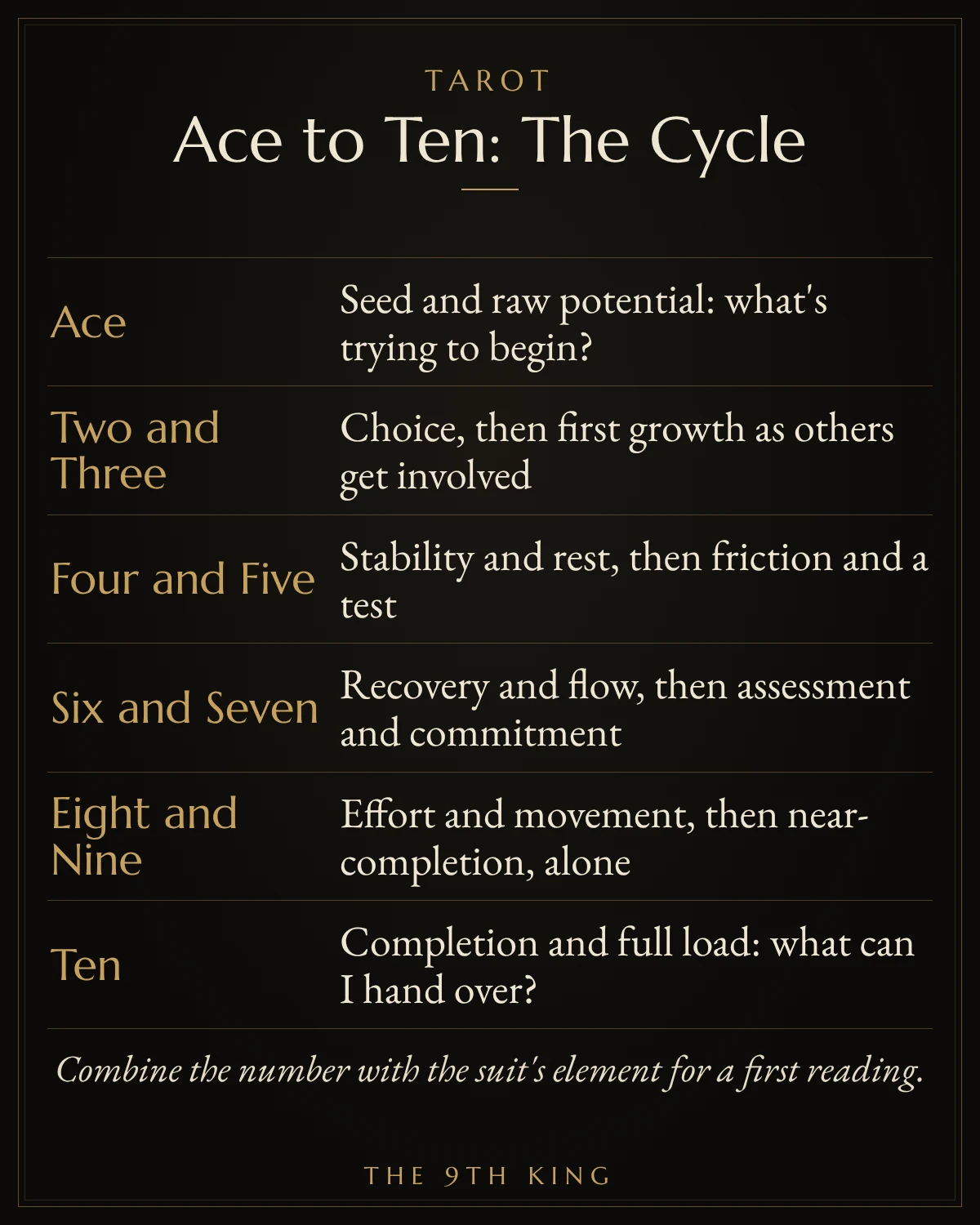
| Number | Theme readers often use | Ask yourself |
|---|---|---|
| Ace | Seed, gift, raw potential | What’s trying to begin? |
| Two | Choice, balance, first partnership | What am I weighing? |
| Three | First growth, others get involved | What has started to take shape? |
| Four | Stability, structure, rest | What needs a foundation, or a pause? |
| Five | Friction, loss, a test | Where is something pushing back? |
| Six | Recovery, harmony, exchange | What’s flowing again? |
| Seven | Assessment, challenge, inner work | What am I really committed to? |
| Eight | Effort, movement, skill or restriction | Where is my energy going? |
| Nine | Near-completion, intensity, self-reliance | What am I carrying alone? |
| Ten | Completion, full load, handover | What is finished, and what’s too heavy? |
How suit and number combine
Put the layers together. A Five is friction. The Five of Cups is friction in the feelings: regret, focusing on what spilled. The Five of Pentacles is friction in the material world: scarcity, feeling left out in the cold. Neither says what will happen to you; each names a stage you might recognize.
Aces stand slightly apart. Book T treats them as the root of each element, the element in its purest form, which is why readers often call an Ace a gift or an invitation: all potential, no story yet.
Court cards tarot: the four ranks and how to read them
Court cards show people, so the obvious reading is “this is someone in my life.” Sometimes it is. On The 9th King, the default is different.
Read a court card first as a role, style or stage you are playing. Ask where am I acting like this? before who is this? It avoids a trap our guide to psychological projection explains, seeing traits in others that you haven’t owned in yourself.
| Rank (RWS) | Style or stage | The shadow version |
|---|---|---|
| Page | Student, beginner, messenger | All curiosity, no follow-through |
| Knight | Mover, pursuer, on a mission | Speed without direction |
| Queen | Inner mastery, holding, nurturing | Control dressed as care |
| King | Outer mastery, leading, deciding | Rigidity, ruling instead of serving |
Combine rank with suit for a quick sketch: the Page of Swords is a watchful mind still learning to speak up; the Queen of Pentacles tends bodies, homes and budgets with steady skill. If the reading is plainly about a relationship and a card fits someone already on your mind, read it as a mirror of what that person brings out in you.
One court convention: Liber LXXVIII
The 9th King follows the court-card naming in Liber LXXVIII (the Golden Dawn’s Book T): Knights are fire of their suit, Queens water, Kings air, Pages earth. The text (sacred-texts.com) gives each court a Golden Dawn title; matching those to the Rider–Waite–Smith courts is our convention. For Wands:
| Card | Golden Dawn title | Element |
|---|---|---|
| Knight | Lord of the Flame and the Lightning | Fire of fire |
| Queen | Queen of the Thrones of Flame | Water of fire |
| King | Prince of the Chariot of Fire | Air of fire |
| Page (Knave) | Princess of the Shining Flame | Earth of fire |
The titles explain the confusion elsewhere: the mounted Knight is also called “King of the Spirits of Fire,” and the card Waite called King is a Prince. Other systems pair them differently. Knights, Queens and Kings also rule a stretch of the zodiac across two signs; Pages rule none. Card guides list a card’s span where it has one.
Minor Arcana astrology: the decan system made simple
In the Golden Dawn system, the cards Two to Ten are tied to the zodiac in an exact way. It’s simpler than it sounds.
What a decan is
Each zodiac sign covers 30 degrees. Split it into three 10-degree slices and you get decans: 12 signs × 3 = 36 decans. Now count the small cards: 4 suits × 9 cards (Two to Ten) = 36 cards. Book T says the small cards are “thirty-six in number, answering unto the thirty-six Decans of the Zodiac.” Each card gets one decan, described as a planet in a sign.
Where it starts: the Two of Wands
Book T assigns the Two of Wands to Mars in Aries, the first decan of the first sign. It gives Mars both the last decan of Pisces and the first of Aries, so the planet that closes the zodiac also opens it. Then the order runs on: the Three of Wands is the Sun in Aries, the Four of Wands is Venus in Aries.
Two rules from Book T‘s decan table do most of the work:
- The suit follows the sign’s element. Fire signs get Wands, water signs Cups, air signs Swords, earth signs Pentacles.
- The number follows the sign’s mode. Twos to Fours sit in the cardinal signs (Aries, Cancer, Libra, Capricorn), Fives to Sevens in the fixed signs (Taurus, Leo, Scorpio, Aquarius), Eights to Tens in the mutable signs (Gemini, Virgo, Sagittarius, Pisces).
Here’s the Wands suit as an example:
| Card | Decan (Golden Dawn) | Sign’s mode |
|---|---|---|
| Two of Wands | Mars in Aries | Cardinal |
| Three of Wands | Sun in Aries | Cardinal |
| Four of Wands | Venus in Aries | Cardinal |
| Five of Wands | Saturn in Leo | Fixed |
| Six of Wands | Jupiter in Leo | Fixed |
| Seven of Wands | Mars in Leo | Fixed |
| Eight of Wands | Mercury in Sagittarius | Mutable |
| Nine of Wands | Moon in Sagittarius | Mutable |
| Ten of Wands | Saturn in Sagittarius | Mutable |
The upcoming Tarot & the Zodiac guide covers all 36 decans in one place.
Aces and Pages don’t take decans
Aces are the roots of their elements, not slices of a sign. The Princesses (RWS Pages) don’t rule a decan either: Book T places them around the North Pole of the heavens, each one the throne of its suit’s Ace.
These are Golden Dawn–derived correspondences, the tradition The 9th King uses and the one the Rider–Waite–Smith deck draws on. Other schools differ, and you don’t need any of this to read the cards. It’s a bridge: if you know astrology, a card’s decan tells you which sign and planet in your own chart to look at. Our birth chart guide shows how to find them.
Minor vs Major Arcana in a reading
- Major Arcana cards point to big themes and lessons: what a season of life is about.
- Minor Arcana cards point to the everyday material where those lessons get worked out: a conversation, a habit, a decision, a budget, a mood.
A few patterns readers often notice in a spread:
- Mostly Minors: the situation is in your daily hands. Look at habits, not destiny.
- Mostly Majors: you may be in a bigger chapter. Reflect before you act.
- One suit dominating, or one missing: an element is loud, or neglected. More on that below.
These are prompts to look closer, not rules or predictions.
The 9th King lens: the Minor Arcana as everyday self-mastery
The Major Arcana describes the shape of a life. The Minor Arcana describes how you run your days, and self-mastery is built in days. Each suit is a domain you have to rule:
- Wands, your will: do you act on what you want, and stop before you burn out?
- Cups, your heart: can you feel fully without being swept away?
- Swords, your mind: can you think clearly, speak honestly and drop thoughts that aren’t true?
- Pentacles, your body and resources: are you building something that will still stand in a year?
The suit you over-use and the suit you avoid
The over-used suit is your comfort zone, the tool you use for everything, even jobs it doesn’t fit. A Swords-heavy person analyses a grief instead of feeling it. A Pentacles-heavy person works harder when what they need is rest or a hard conversation.
The avoided suit is often where the shadow lives: the part of you that you learned to distrust or never practised. If Swords cards make you uneasy, ask whether direct speech feels dangerous. If Cups cards do, ask where you learned that feelings are a liability. Our zodiac shadow work guide uses the same idea with the elements in your chart: an overloaded or empty element often says the same thing as a lopsided suit.
The goal isn’t a perfect 25% each. It’s rule over all four: reaching for any suit when the moment calls for it.
Practical exercise: sort your week by suit
This needs no deck. It works on your real life first, and then the cards start to make sense.
The worksheet
At the end of a week, make four columns: Wands, Cups, Swords, Pentacles.
- List what filled your week, a few words per item.
- Sort each item into a suit. Drive or creativity under Wands. Feelings and relationships under Cups. Thinking, planning, worrying or arguing under Swords. Work, money, body and home under Pentacles. If something fits two, pick the one it felt like.
- Count the columns. Which suit is fullest? Which is nearly empty?
- Give each column a number from the table above. Is your Pentacles life at a Four (stable) or a Nine (carrying it all alone)?
- Pick your court card in each suit. A Page in your feelings and a King at work?
- Choose one small move for the emptiest suit. One honest conversation (Swords). One evening of play (Wands). One check-in with someone you love (Cups). One early night (Pentacles).
Journal prompts
- Which suit do I reach for when I’m stressed, and what does it let me avoid?
- Which suit’s cards make me uneasy, and what did I learn about that element growing up?
- Which area is at a Ten right now, and what could I hand over?
- If I ruled all four suits well, what would one ordinary Tuesday look like?
More in this style: our shadow work prompts.
A warm note: these are reflective exercises, not therapy. If a prompt brings up trauma, abuse, thoughts of self-harm or distress that feels overwhelming, please work with a qualified therapist. It’s completely fine to stop a prompt that feels like too much.
A worked example (fictional)
Dana (fictional) sorts her week: 14 items under Pentacles (shifts, budgeting, meal prep), 9 under Swords (planning, a group-chat argument, late-night worrying), 3 under Wands and 1 under Cups.
Pentacles feels like a Nine, steady but done alone. Swords feels like a Seven, defending a position. Wands is an Ace she keeps ignoring: a song idea from Tuesday.
Her reading of herself: she runs life through earth and air and avoids water. Her shadow question: what feeling am I keeping busy to avoid? Her one move: call her sister on Sunday with no agenda. Next time she pulls a Cups card, it points at the column she left empty.
For an intuition-first way to read the cards themselves, try Code of Ascension’s Intuitive Tarot (Code of Ascension).
Myths and misreadings about the Minor Arcana
- “The Minor Arcana is less important.” It’s 56 of 78 cards and does most of the work in most readings. “Minor” means everyday, not trivial.
- “Swords cards are bad cards.” They describe the mind, worry and conflict included. They point to thought patterns, not danger or a fixed outcome.
- “Court cards are always other people.” Start with where am I playing this role?
- “Every system agrees on elements and astrology.” It doesn’t. Name your system and stay consistent.
- “A card tells you what will happen.” Not here. A card points to a theme worth looking at. What you do with it is yours.
Minor Arcana: FAQ
How many cards are in the Minor Arcana?
The Minor Arcana has 56 cards: four suits of 14 cards each. Every suit has ten numbered cards, Ace to Ten, plus four court cards, usually Page, Knight, Queen and King. Together with the 22 Major Arcana cards, that makes the standard 78-card tarot deck. Some decks rename the suits or the court ranks, but the 56-card structure stays the same.
What are the four tarot suits and what do they mean?
The suits are Wands, Cups, Swords and Pentacles. In the Golden Dawn and Rider–Waite–Smith tradition, Wands are fire (drive, desire, creativity), Cups are water (feelings and relationships), Swords are air (thought, words and conflict) and Pentacles are earth (body, work, money and home). Some decks swap the elements of Wands and Swords, so check your deck’s guidebook if it reads differently.
What do the numbers mean in the Minor Arcana?
Readers often treat Ace to Ten as one cycle. The Ace is a seed, Two a choice, Three first growth, Four stability, Five friction, Six recovery, Seven assessment, Eight effort, Nine near-completion and Ten a full load or ending. Combine the number with the suit’s element and you have a solid first reading of any numbered card, before you even study the picture.
How should I read court cards?
On The 9th King, read a court card first as a role or style you might be playing. Pages are learners, Knights are movers, Queens hold inner mastery and Kings hold outer mastery. Ask “where am I acting like this?” before asking who else it could be. If it clearly fits someone already on your mind, treat it as a mirror of what they bring out in you.
Why are the Golden Dawn court cards named differently?
The Golden Dawn titled its courts King, Queen, Prince and Princess. Liber LXXVIII, its Book T as printed by Crowley, gives each court a Golden Dawn title as well: the Knight carries the title of a King, the King is a Prince, and the Page is a Princess. Matching them this way is the convention The 9th King follows: Knights are fire of their suit, Queens water, Kings air, Pages earth. Other systems differ.
What are decans in tarot?
In the Golden Dawn system, each zodiac sign is split into three 10-degree decans, 36 in total. The 36 cards from Two to Ten across the four suits each take one decan, described as a planet in a sign. The sequence starts with the Two of Wands as Mars in Aries. Aces and Pages sit outside the decans, and other tarot schools use different correspondences.
Your next step: sort this week by suit with the worksheet above, then look up the empty column’s element in your own chart. Our zodiac signs overview shows which signs share each element; notice whether your chart is light there too.
Explore Next
- All twelve signs and their elements: The Zodiac Signs
- Your chart’s elements as a shadow clue: Zodiac Shadow Work
- Questions that go deeper: Shadow Work Prompts
- Why court cards can look like other people: Psychological Projection
- Find the planets behind the decans: How to Read a Birth Chart
- More tarot on The 9th King: Tarot Card Meanings · Major Arcana · Tarot & the Zodiac · King of Wands · Page of Pentacles · Knight of Pentacles · Nine of Wands · Page of Cups · Three-Card Tarot Spread · Shadow Work Tarot Spread
- Newly added Cups cards: Ace of Cups · Six of Cups · Knight of Cups · Queen of Cups · King of Cups
Final Thought: Rule the Small Cards
The Major Arcana is the story people tell about their lives. The Minor Arcana is the life: the fire you act on, the water you feel, the air you think in and the earth you build on. Notice the suit you hide behind and the one you avoid, and practise the one you need this week. Know your nature. Rule your life.
About the Author
King is the founder of The 9th King, where zodiac psychology, relationships and shadow work are explored as tools for self-knowledge rather than fortune-telling. He’s a Libra Sun, and writes about the personal side of astrology on King The Kemist. Astrology on The 9th King is interpretation and self-reflection, not prediction or established fact.