

Quick Answer: What Does the Two of Cups Mean?
The Two of Cups (also written 2 of Cups) is a Minor Arcana card from the suit of Cups. In the traditional Rider–Waite–Smith deck it shows a young man and a young woman pledging one another with their cups, under a winged staff. Readers usually take it as the card of mutual choice: love, friendship, attraction, partnership and two people meeting as equals.
- Keywords: connection, mutual choice, love, friendship, harmony, partnership, attraction, reconciliation.
- Upright, in one line: a prompt to notice where a connection is mutual and freely chosen, if one is present in your life, and what you each bring to it.
- Reversed, in one line: a prompt to look at where a bond feels uneven, merged or strained, and what you’d need to meet as equals again.
On The 9th King, tarot is a mirror for self-knowledge, not fortune-telling. The Two of Cups doesn’t say someone is your soulmate or that a relationship is about to start. It asks how you connect, and whether you show up as a whole person.
Table of Contents
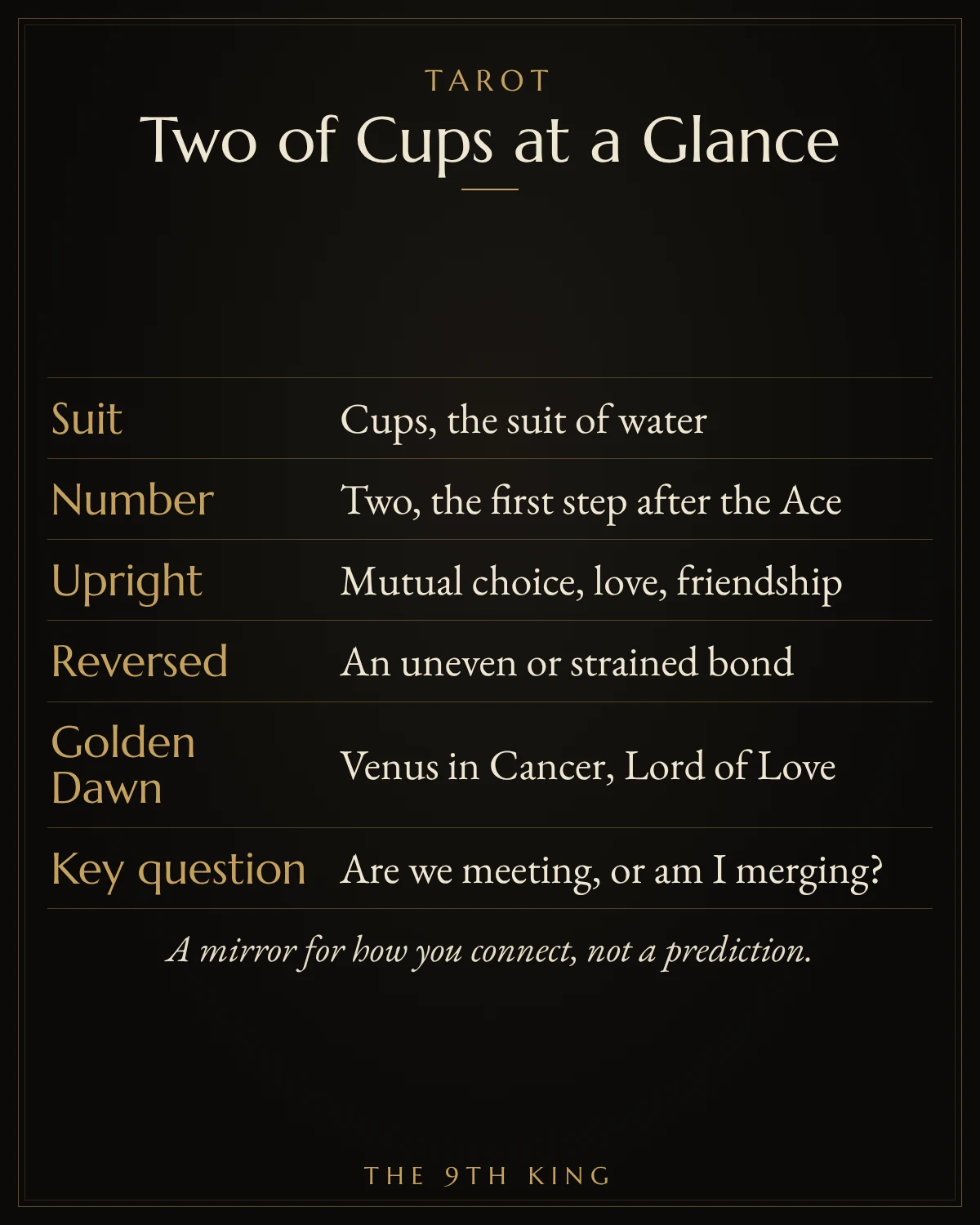
The Two of Cups at a glance
| Two of Cups | |
|---|---|
| Arcana | Minor Arcana, a pip (number) card |
| Suit and element | Cups, linked with water |
| Number | Two, the first step after the Ace |
| Golden Dawn title | Lord of Love |
| Astrology (Golden Dawn) | Venus in Cancer |
| Upright | Mutual choice, love, friendship, harmony |
| Reversed | An uneven, merged or strained bond |
| Key question | Are we meeting, or am I merging? |
What the Two of Cups looks like
Most people know this card from the Rider–Waite–Smith deck, first published in London by William Rider & Son in December 1909. A.E. Waite wrote the instructions and Pamela Colman Smith drew the art, and both belonged to the Hermetic Order of the Golden Dawn (Wikipedia: Rider–Waite Tarot).
The pledge
Waite’s description in The Pictorial Key to the Tarot (1911) begins with two people: a youth and a maiden pledging one another, each with a cup (sacred-texts.com: Waite, Two of Cups). A pledge is a promise made face to face: nobody chasing, nobody rescuing.
The winged staff and the lion’s head
Above their cups, Waite says, rises the Caduceus of Hermes, the winged staff of the messenger god, and between its great wings appears a lion’s head. He adds that this is a variant of a sign found in a few old examples of the card, and that the curious emblematical meanings attached to it don’t concern him there (sacred-texts.com: Waite, Two of Cups). So Waite himself leaves the symbol unexplained.
On The 9th King, a messenger’s staff over two cups suggests something passing between two people: words, care, attention. The lion’s head adds courage, because closeness takes nerve. That’s our reading, not Waite’s.
The Golden Dawn’s version
The Golden Dawn’s teaching text, Book T, as printed in Aleister Crowley’s Liber LXXVIII, describes a different picture with no people in it. Water falls onto two crossed dolphins, one silver and one gold, and pours from them in full streams, like gold and silver jets, into two cups, which overflow and flood the lower part of the card. The symbols of Venus and Cancer sit above and below (Liber LXXVIII, sacred-texts.com).
Two of Cups meaning (upright)
Waite’s divinatory meaning opens with a list: “Love, passion, friendship, affinity, union, concord, sympathy.” He adds the relationship between the sexes, and, as he puts it, a note set apart from fortune-telling about a desire that Nature doesn’t supply but that makes Nature holy (sacred-texts.com: Waite, Two of Cups). In his later list of additional meanings, he calls the card favorable in pleasure and business as well as love, along with wealth and honor (sacred-texts.com: Waite, Additional Meanings).
Book T names the card the Lord of Love. Its meaning reads: “Harmony of masculine and feminine united.” It goes on to list harmony, pleasure, mirth and subtlety, and, when the card is badly placed among the others, folly, dissipation, waste and silly actions. It places the card in Chokmah, the second station on the Kabbalistic Tree of Life, and sums up its sense as marriage, love and pleasure (Liber LXXVIII, sacred-texts.com).
The upright meaning readers commonly use has three layers.
Mutual choice
The heart of the card is that both people are choosing. The upright Two can point to a bond where interest, effort and respect go both ways. Ask yourself: Where in my life is care clearly mutual, shown in what both of us do?
Friendship and alliance
Waite’s list includes friendship, affinity and sympathy, not only romance. The card can point to a close friend, a creative partner, a business ally or a reconciliation after distance. Ask yourself: Who do I work well with, and have I told them?
The first exchange
In the Cups suit, the Ace is a single overflowing cup. The Two is the first time that feeling meets another person. On The 9th King, this is where feeling becomes relationship. Our Ace of Cups guide covers the single cup that comes before.
Two of Cups reversed
Readers handle reversals differently: some read the opposite meaning, some the same energy blocked, and some skip reversals entirely. Waite’s main entry for this card gives no reversed meaning. In his additional meanings, the reversed Two of Cups is a single word: passion (sacred-texts.com: Waite, Additional Meanings). Waite also warns in that section that these extra meanings often disagree with his main ones.
On The 9th King, the Two of Cups reversed usually points to one of three patterns, offered as questions, not predictions.
The pledge is uneven
One cup is doing all the pouring. You’re the one who plans, texts first, apologizes first or holds the friendship together. The reversed card can point to that imbalance. Ask yourself: If I stopped carrying this for two weeks, what would I notice? That’s a question to reflect on, not a test to run on someone.
The two cups have become one
Closeness has turned into merging. Your moods follow theirs, your plans wait on theirs, and you’ve lost track of what you want on your own. Ask yourself: What did I enjoy, believe or want before this bond, and is it still in my life?
Passion without the pledge
Waite’s one-word reversal, passion, can be read as strong feeling that has run ahead of agreement. Intensity is there, but clear mutual choice isn’t. Ask yourself: Is this feeling matched by what we’ve actually said and done?
| Pattern | Upright tone | Reversed tone |
|---|---|---|
| Choice | Mutual, shown in action | Assumed or one-sided |
| Selfhood | Two whole people | Merged into one |
| Feeling | Matched by agreement | Running ahead of it |
| Effort | Shared | Carried by one |
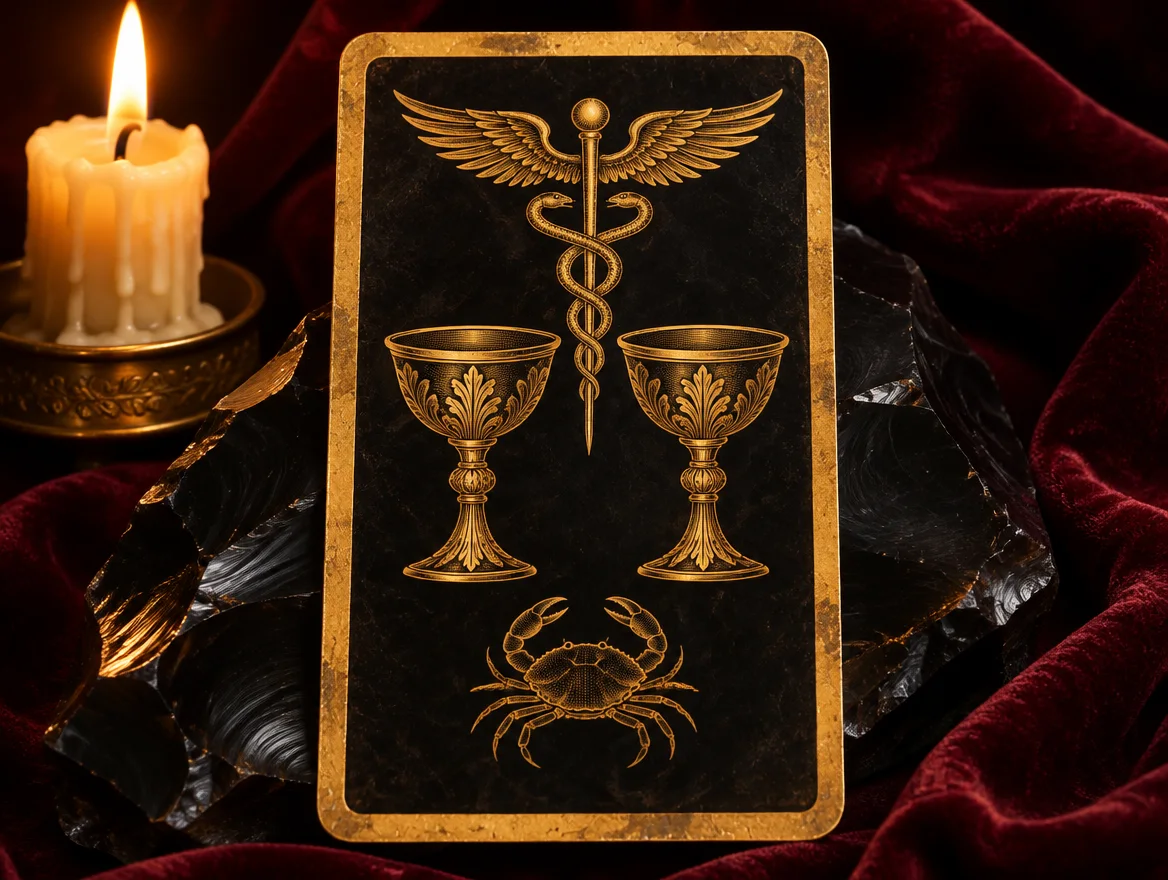
Two of Cups astrology: Venus in Cancer
The 9th King uses Golden Dawn–derived correspondences, the tradition the Rider–Waite–Smith deck draws on. Other schools of tarot and astrology use different systems, and not every card maps to a single sign: the court cards and Pages, for example, work differently. What follows is one traditional framework, offered as symbolism.
How the number cards get their planets
In the Golden Dawn system, the 36 small cards (the Twos through Tens) are matched to the 36 decans of the zodiac, each a ten-degree third of a sign with its own planet. Book T, as printed in Liber LXXVIII, lists the Two of Cups, the Lord of Love, as Venus in Cancer (Liber LXXVIII, sacred-texts.com). In the same table, Cancer’s three decans run Two of Cups (Venus), Three of Cups (Mercury) and Four of Cups (Moon), so the Two is the first of the three. Liber doesn’t print degrees for this entry.
For a wider look at how this system works across the deck, see our Minor Arcana guide and Tarot & the Zodiac.
What Venus brings
On The 9th King, Venus describes what you value, what you find beautiful, and how you give and receive affection. Venus rules Taurus and Libra, so our Taurus Personality Traits and Libra Traits pages show two sides of it: steady, sensual comfort and fair, balanced partnership.
What Cancer brings
Cancer is cardinal water: protective, loyal, sensitive and deeply tied to home and belonging. Our Cancer Personality Traits page explores the Crab’s care and its shell. On this card, Cancer is the part of love that wants safety: Will you be there? Can I bring my softer self to you?
The tension in the pairing
Venus wants connection that feels good and fair. Cancer wants connection that feels safe. Together they describe a warm, devoted bond, and its risk. When safety becomes the main goal, people can shrink themselves to keep the peace. The Two of Cups sits in that gap: love that feels like home, without either person disappearing into the home.
The 9K reading: meeting, not merging
The card’s tension
The Two of Cups holds two true things at once: I want to be close to you and I’m still my own person. The card shows two cups, not one. Closeness that erases one person isn’t the pledge on this card. Independence that never risks a pledge isn’t either.
The shadow side
The shadow of the Two of Cups is making the other person your whole cup. It can look like:
- Instant merging. Rearranging your life around someone within weeks, before you know how they treat you over time.
- Mirror-seeking. Choosing people who reflect back your best self-image, then feeling lost when they show who they really are. Our guide to psychological projection explains how we see our own hopes in other faces.
- Reading intent into small signs. Treating a look or a delayed reply as proof of deep feeling, or of rejection, instead of waiting for clearer behavior.
- Keeping the peace at any cost. Swallowing a need or a “no” because harmony feels more important than honesty.
These patterns usually start from something real, like an old lesson that love has to be earned. The question is whether they still help you.
Meeting or merging: how to tell
A card can’t tell you what another person feels or intends. What you can look at is behavior over time and consent: what each of you says yes to, freely, and what each of you actually does.
| Meeting as equals | Merging |
|---|---|
| Both people offer and ask | One gives, one receives |
| Yes and no are both safe | No feels risky |
| You keep your own friends and interests | Your world shrinks to the bond |
| Plans are agreed out loud | Plans are assumed |
| Care shows up in actions | Care is mostly guessed at |

A feeling on its own won’t settle this. Use questions instead: Do we both choose this, in words and actions? Can either of us say no without fear? Am I still myself here?
If anyone is hurting, threatening or controlling you, that isn’t an uneven pledge to fix with better communication. Responsibility for that behavior belongs to the person doing it, never to you, and your safety comes first, which can mean distance or leaving. Lean on people and services you trust.
The self-mastery lesson
The lesson of the Two of Cups is to fill your own cup before you raise it. The figures on the card each hold their own. Self-mastery here means knowing what you bring, what you need and what you won’t trade away, so that when you meet someone, you meet them as a whole person.
Two of Cups as feelings, in love and at work
Two of Cups as feelings
Asked “how does this person feel?”, readers often take the Two of Cups as warm, mutual interest: attraction, affection, a sense of being on the same wavelength. That’s an interpretation to reflect on, not evidence. A card can’t establish what someone else feels or will do. Ask yourself: What have they actually shown me? And if the card is about your own feelings: Am I interested in this person, or in the feeling of being chosen?
Two of Cups love meaning
In a love reading, the upright card can point to attraction, a new connection, a deepening commitment or a repair after a rough patch. Reversed, it can point to imbalance, merging or two people who want different things.
Tarot can’t tell you whether to stay, leave, start or end anything, and this page won’t either. A good relationship rests on things you can see: both people freely choosing it, both able to say yes or no, and both showing care in what they do. If someone isn’t respecting your no, that matters more than any card. Useful questions:
- Do we both choose this, out loud and in what we do?
- Can I say no to them, and can they say no to me, without punishment?
- Is the effort roughly shared over time, even if not every week?
To see how two charts meet, try our synastry for beginners guide.
Two of Cups at work
At work, readers often take the card as a good partnership: a collaborator you click with, a fair deal or a mended working relationship. This is reflection, not career or financial advice. Ask yourself: Is this partnership written down and fair to both of us, or only friendly?
Practical exercise: the two-cup check
You need about twenty minutes and a notebook. Pick one relationship: a partner, a friend, a family member or a work partner.
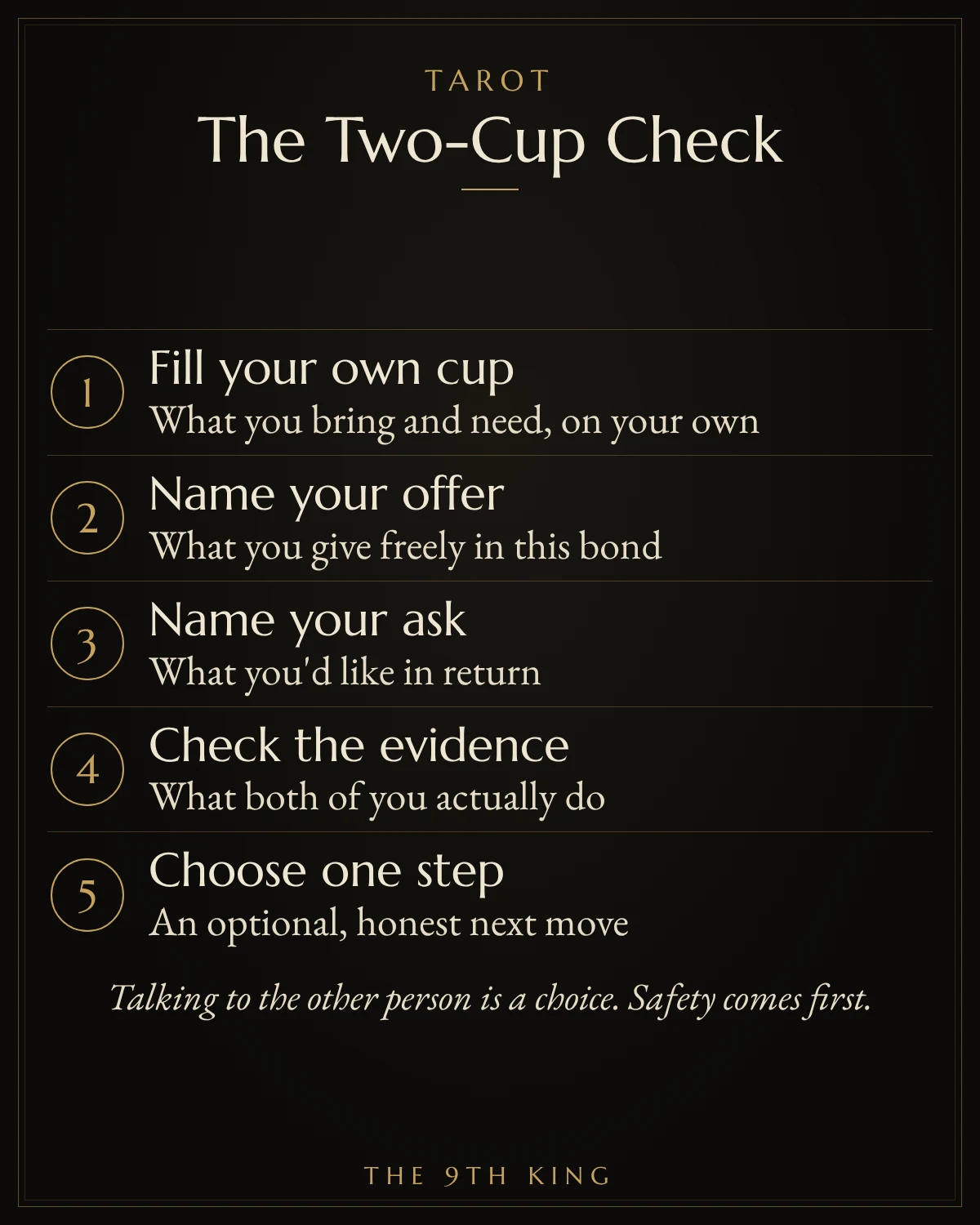
Step 1: Fill your own cup
Before you think about the other person, write a few lines about yourself: what you value, what restores you and what you need from close relationships in general.
Step 2: Name your offer
List what you give freely in this relationship: time, attention, practical help, humor, loyalty. Mark anything you give mostly out of fear of losing the person.
Step 3: Name your ask
Write what you’d like back, in plain words. More check-ins, help with plans, space on weekends, honesty when something’s wrong.
Step 4: Check the evidence
Look at behavior, not guesses. Over the last few months, what has the other person actually done? What have they agreed to or declined? If you notice you’re filling gaps with guesses, write “I don’t know” instead.
Step 5: Choose one step
Choose one small, honest step, if one feels right. It might be a conversation where you name one thing you’d like, if that feels safe and useful. Or a private change, like one evening a week for your own friends. Talking to the other person is a choice, not a requirement. If the relationship doesn’t feel safe, skip the conversation and lean on someone you trust.
A worked example (fictional)
Priya (fictional) has a close friendship with a coworker, and lately it feels lopsided. She draws the Two of Cups reversed.
What she offers: covering shifts, listening after hard days, planning their lunches. One item she marks: she covers shifts partly because she’s afraid of seeming difficult. What she asks: that her friend sometimes ask how she’s doing. Checking the evidence, she sees her friend does make time for her, but the lunches are always Priya’s idea.
Her step: at their next lunch she says, “I’d love it if you picked the place next time.” Her friend picks it on the spot. Priya also stops covering every shift. It feels more like two cups again.
Journal prompts for the Two of Cups
- What do I bring to close relationships that’s truly mine?
- Where do I give out of love, and where do I give out of fear of losing someone?
- In which bond do I feel most like myself, and what makes that possible?
- When did I last say no to someone close, and how did it go?
- Am I drawn to this person, or to the feeling of being chosen?
- What would meeting someone as an equal look like for me, in one ordinary day?
For more prompts like these, our shadow work prompts collection goes deeper, and Shadow Work, Plainly explains how to start safely.
A warm note: this is reflective practice, not therapy. If relationships bring up trauma or abuse, or if you’re dealing with thoughts of self-harm or distress that feels overwhelming, please work with a qualified therapist who can walk with you. It’s always fine to stop a prompt that feels like too much.
Myths and misreadings of the Two of Cups
- “The Two of Cups means you’ve met your soulmate.” No. On The 9th King, tarot doesn’t predict events or confirm destinies. The card reflects how you connect, not who someone is to you.
- “It’s only about romance.” Waite’s own list includes friendship, affinity, concord and sympathy, and his additional meanings mention business (sacred-texts.com: Waite, Additional Meanings). The card can be about any bond between two people.
- “Venus in Cancer means this card is about Cancer people.” No. The correspondence describes the card’s symbolism in the Golden Dawn tradition. Anyone can draw it, whatever their sign.
Two of Cups: FAQ
What does the Two of Cups mean?
The Two of Cups is a Minor Arcana card in the suit of Cups. In the Rider–Waite–Smith deck it shows a young man and woman pledging one another with their cups beneath a winged staff. Readers commonly take it as love, friendship, mutual choice and partnership. On The 9th King, it’s a mirror for how you connect: whether you meet people as an equal, and whether the bond is freely chosen by both.
What does the Two of Cups reversed mean?
Reversed, the Two of Cups is often read as an uneven, strained or merged bond: one person doing most of the giving, someone losing themselves in the relationship, or strong feeling that has run ahead of real agreement. Waite’s additional meanings give the reversal as a single word, passion. Some readers don’t use reversals at all. Treat it as a question to explore, not a sign that a relationship is ending.
What does the Two of Cups mean as feelings?
As feelings, readers often take the Two of Cups as warm, mutual interest: attraction, affection and a sense of being on the same wavelength. It’s an interpretation, not evidence, because a card can’t establish another person’s feelings or actions. A better guide is what someone says and does over time. The card can also prompt you to ask what you’re feeling and why.
What does the Two of Cups mean in love?
In love, the upright card can point to attraction, a new connection, deepening commitment or reconciliation. Reversed, it can point to imbalance or two people wanting different things. The card doesn’t tell you to stay, leave or start anything. It invites you to look at consent and behavior: whether both people freely choose the bond, can say no safely and show care in action.
What zodiac sign is the Two of Cups?
In the Golden Dawn system, the tradition The 9th King uses, the Two of Cups corresponds to Venus in Cancer, the first of Cancer’s three decans in the Book T table. The Golden Dawn’s Book T, as printed in Liber LXXVIII, calls the card the Lord of Love. Other schools use different correspondences, so treat this as one traditional framework for symbolism rather than a fixed rule.
Is the Two of Cups a yes or no card?
The 9th King doesn’t do yes or no readings, because tarot here is a tool for self-reflection, not fortune-telling. Instead of asking whether the card says yes, ask what it shows you: where a connection feels mutual, what you bring to it and whether you’re meeting the other person as an equal or pouring yourself into their cup.
How is the Two of Cups different from The Lovers?
Both cards deal with connection, but they work at different scales. The Lovers is a Major Arcana card, often read as a big life choice about values and alignment. The Two of Cups is a Minor Arcana card about the everyday reality of two people choosing each other. On The 9th King, we read The Lovers as the choice and the Two of Cups as the practice of keeping it mutual.
Your next step: try the two-cup check above with one relationship this week, starting with your own cup. Then read our Cancer Personality Traits page: Cancer’s need for safety and belonging is the pull this card asks you to balance with staying yourself.
Explore Next
- The sign behind the card: Cancer Personality Traits
- Venus’s two homes: Taurus Personality Traits · Libra Traits
- How two charts meet: Synastry for Beginners
- Affection and needs in your chart: Moon vs. Venus
- When we see ourselves in others: Psychological Projection
- Go deeper with questions: Shadow Work Prompts
- Reading by feel: Intuitive Tarot (Code of Ascension)
- New to the cards: Tarot for Beginners: How Tarot Really Works (Code of Ascension)
- More tarot on The 9th King: Tarot Card Meanings · Minor Arcana · Tarot & the Zodiac · Ace of Cups · Six of Cups · Queen of Cups · The Lovers
- More cards in this set: Two of Swords, Two of Wands, Seven of Pentacles

Final Thought: Two Cups, Two Whole People
The pair in the Two of Cups don’t pour everything into one vessel. Each holds a cup, and each raises it freely. Love and friendship at their best are two people who could stand alone, choosing not to. Fill your own cup, raise it honestly and watch what the other person does with theirs. Know your nature. Rule your life.
About the Author
King is the founder of The 9th King, where zodiac psychology, relationships and shadow work are explored as tools for self-knowledge rather than fortune-telling. He’s a Libra Sun, and writes about the personal side of astrology on King The Kemist. Astrology on The 9th King is interpretation and self-reflection, not prediction or established fact.
Leave a Reply