

Quick Answer: What Does the Six of Cups Mean?
The Six of Cups (also written 6 of Cups) is a Minor Arcana card from the suit of Cups. In the traditional Rider–Waite–Smith deck it shows children in an old garden with cups full of flowers. Readers usually take it as the card of memory: nostalgia, innocence, kindness, the people and places that shaped you, and the pull of “the way things were.”
- Keywords: memory, nostalgia, innocence, childhood, kindness, simple joy, reunion, roots.
- Upright, in one line: something sweet from the past is speaking to you; let it remind you who you are.
- Reversed, in one line: the past is either holding you too tightly or asking to be released, so you can turn toward what’s next.
On The 9th King, tarot is a mirror for self-knowledge, not fortune-telling. The Six of Cups doesn’t say an ex is coming back or that the good old days will return. It asks how you relate to your own history, and whether your memories are roots or a cage.
Table of Contents
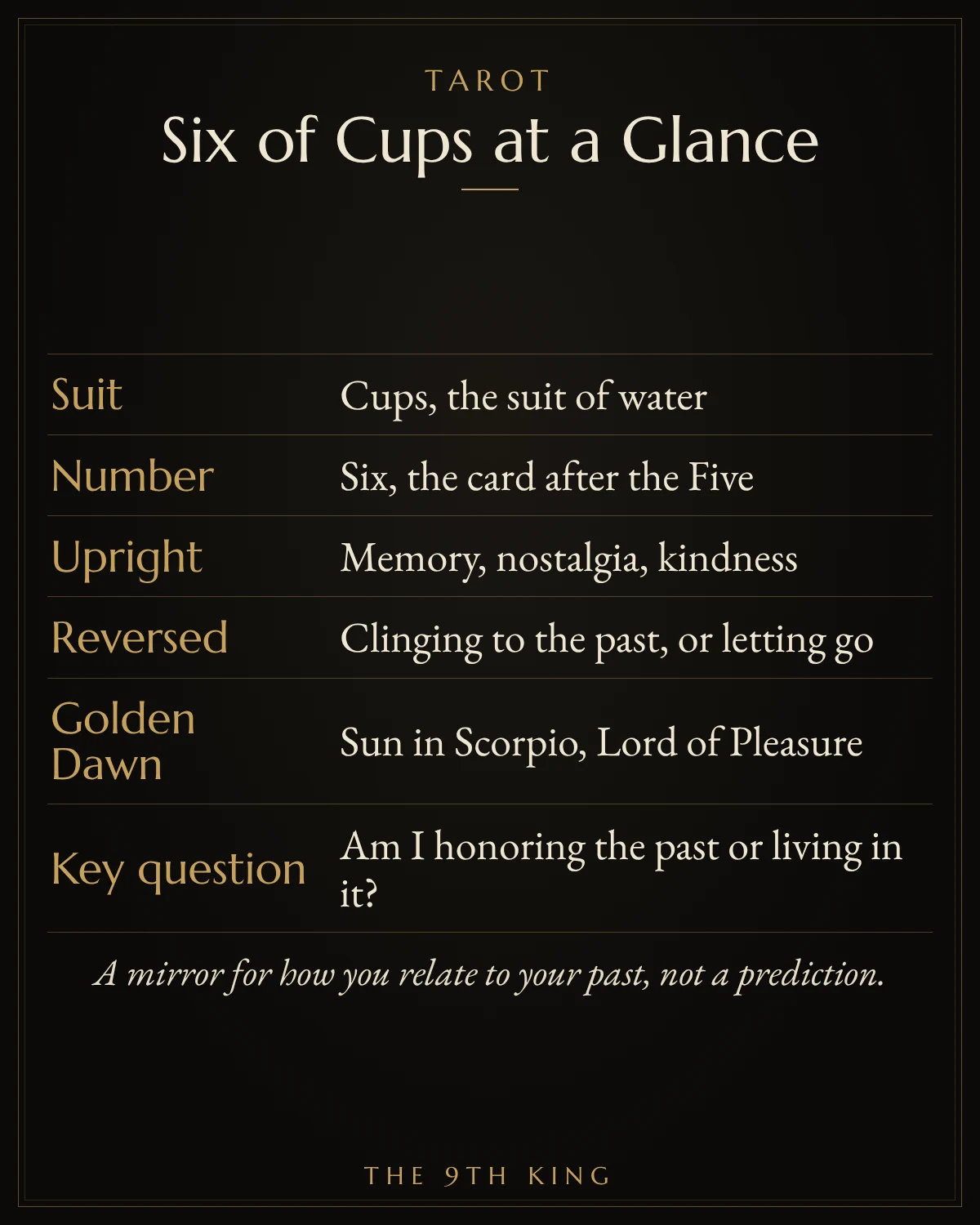
The Six of Cups at a glance
| Six of Cups | |
|---|---|
| Arcana | Minor Arcana, a pip (number) card |
| Suit and element | Cups, linked with water |
| Number | Six, the card after the Five |
| Golden Dawn title | Lord of Pleasure |
| Astrology (Golden Dawn) | The Sun in Scorpio |
| Upright | Memory, nostalgia, kindness, innocence |
| Reversed | Clinging to the past, or letting it go |
| Key question | Am I honoring the past or living in it? |
What the Six of Cups looks like
Most people know this card from the Rider–Waite–Smith deck, first published in London by William Rider & Son in December 1909. A.E. Waite wrote the instructions and Pamela Colman Smith drew the art, and both belonged to the Hermetic Order of the Golden Dawn (Wikipedia: Rider–Waite Tarot). Tarot is older: decks appeared in Italy in the 1430s, and fortune-telling use began in France around 1780 (Britannica: tarot).
The children in the garden
Waite’s own description in The Pictorial Key to the Tarot (1911) is one short line: children in an old garden, with their cups filled with flowers (sacred-texts.com: Waite, Six of Cups). Just play, flowers and an old place.
The gift being passed
Wikipedia’s summary of the card notes that one child hands a cup to the other, and that the cups hold lilies rather than water (Wikipedia: Six of Cups). Many readers see that gesture as the card’s heart: a gift given freely.
The walls and the figure in the background
The same summary describes castle walls enclosing the scene, which readers often take as comfort and safety, and an adult walking in the background, often read as the distance between past and present (Wikipedia: Six of Cups). The garden is safe, but it’s walled, and someone in the picture has already grown up.
The Golden Dawn’s version
The Golden Dawn’s own teaching text, Book T, describes a different picture: an angelic hand holding lotus stems, with six flowers bending over six cups. Water flows from the flowers into the cups, but the cups are not yet full (Liber LXXVIII, sacred-texts.com). The card is sweetness beginning to return, not a finished happiness.
Six of Cups meaning (upright)
Waite opens his meaning for the card with “A card of the past and of memories, looking back.” He gives childhood as an example, and describes happiness and enjoyment that come from the past rather than the present, along with things that have vanished. He also offers a second reading that flips the first: new relationships, new knowledge and new surroundings, with the children playing in an unfamiliar place (sacred-texts.com: Waite, Six of Cups).
Book T, as printed in Aleister Crowley’s Liber LXXVIII, calls the card the Lord of Pleasure and gives its meaning as “Commencement of steady increase, gain and pleasure; but commencement only.” It also lists more difficult notes, such as vanity and quarrels that come from pushing yourself forward, depending on its dignity, and sums up its place on the Kabbalistic Tree as the beginning of wish, happiness, success or enjoyment (Liber LXXVIII, sacred-texts.com).
The upright meaning readers commonly use has three layers.
Memory as a mirror
The card can point to a memory, place, song or person from your past showing up in your thoughts, and what it says about who you were before life got complicated. Ask yourself: What did I love before anyone told me what I should love?
Kindness without a ledger
The child handing over a cup is giving without keeping score. The upright card can point to simple generosity: a favor done for its own sake, an old friend who checks in for no reason.
Sweetness after loss
In the Golden Dawn order, the Six of Cups comes right after the Five, which Book T calls the Lord of Loss in Pleasure (Liber LXXVIII, sacred-texts.com). Read in sequence, the Six is where gentleness starts to come back after a disappointment. Not a full cup yet, but water is flowing again.
Six of Cups reversed
Some readers read reversals as the opposite meaning, some as blocked energy, and some skip them. Waite’s reversed meaning is short and forward-looking: the future, renewal and what will soon come to pass (sacred-texts.com: Waite, Six of Cups). Wikipedia’s summary of modern readings frames the warning side as a sign that it isn’t the time to dwell on the past (Wikipedia: Six of Cups).
On The 9th King, the reversed card usually points to one of three patterns, offered as questions.
The past has become a hiding place
You keep returning in your mind to an old self, relationship or city because the present feels harder: nostalgia turned into avoidance. Ask yourself: What am I not facing today while I’m busy missing yesterday?
The memory has been polished
Sometimes we remember a time as better than it was, and the present looks worse by comparison. Ask yourself: If I’m honest, what was hard about that time too?
Ready to leave the garden
Waite’s reversal points forward, and so can yours: you may simply be ready to stop looking back. Ask yourself: What would I start if I stopped waiting for things to go back to how they were?
| Pattern | Upright tone | Reversed tone |
|---|---|---|
| Memory | A gentle teacher | A hiding place |
| The past | Remembered honestly | Polished or replayed |
| Kindness | Given freely | Expected back |
| Direction | Roots that feed you | Ready to turn forward |

Six of Cups astrology: the Sun in Scorpio
The 9th King uses Golden Dawn–derived correspondences, the tradition the Rider–Waite–Smith deck draws on. Other schools of tarot and astrology use different systems, and not every card maps to a single sign: the court cards and Pages, for example, work differently. What follows is one traditional framework, offered as symbolism.
How the number cards get their planets
In the Golden Dawn system, the 36 small cards (Twos through Tens) are matched to the 36 decans of the zodiac, each a ten-degree third of a sign with its own planet. Book T, as printed in Liber LXXVIII, lists the Six of Cups, the Lord of Pleasure, as the Sun in Scorpio (Liber LXXVIII, sacred-texts.com). In the same table, Scorpio’s three decans run Five of Cups (Mars), Six of Cups (Sun) and Seven of Cups (Venus), so the Six sits in the middle of the sign.
Book T places all four Sixes in Tiphareth on the Kabbalistic Tree of Life, and in its list of what card groups mean in a spread, four Sixes together mean pleasure (Liber LXXVIII, sacred-texts.com). For a wider look at how this system works across the deck, see our Minor Arcana guide and Tarot & the Zodiac. The Nine of Wands page shows the same decan method on another pip card.
What the Sun brings
On The 9th King, the Sun describes identity, vitality and the self you’re growing into. On a card about memory, it’s the light you shine on your own story, from the present, choosing what to remember and why.
What Scorpio brings
Scorpio is fixed water: deep, private, loyal and intense. Our Scorpio Personality Traits page explores the sign’s depth and its shadow. On this card, Scorpio is the part of you that doesn’t forget, holding onto people and feelings long after others move on.
The tension in the pairing
It seems odd to put such a sweet card in the most intense water sign, but that’s the point. Scorpio holds on; the Sun wants to grow. The Six of Cups sits in that gap: deep loyalty to what was, and a quiet pull toward who you’re becoming. When the Sun wins, memory becomes warmth you carry forward. When Scorpio’s grip wins, memory becomes a place you can’t leave.
The 9K reading: honoring the past without living in it
The card’s tension
The Six of Cups holds two true things at once: the past shaped me and the past is over. Some people refuse to look back at all; others never quite leave. The card asks you to hold both. A past you can’t visit leaves you without roots. A past you can’t leave leaves you without a future.
The shadow side
The shadow of the Six of Cups is nostalgia used as a hiding place. It’s the sweetness of the garden turned into a reason not to grow. It can look like:
- Golden-age thinking. “Things were better back then,” said until it becomes a rule.
- Measuring people against the past. Comparing every new partner or friend to someone from years ago. Our guide to psychological projection explains how old faces get laid over new ones.
- Staying small to stay safe. Keeping an old role, the “good one” or the “easy one,” because changing feels like betrayal.
- Kindness with strings. Giving the cup, then waiting for it back.
These patterns usually start from something real: love for what you had, or a need for comfort. The question is whether nostalgia still feeds you.
A note on childhood
This card shows children, and for many people that’s tender ground. If your early years weren’t safe, the Six of Cups doesn’t ask you to go back there or call them happy. Any harm done to you as a child was the responsibility of the adults who caused it, never yours. You can read this card through a later memory, a chosen family, a place you found as an adult, or even a garden you imagine. Our inner child work guide offers a gentle way in, and it’s fine to go slowly or not at all.
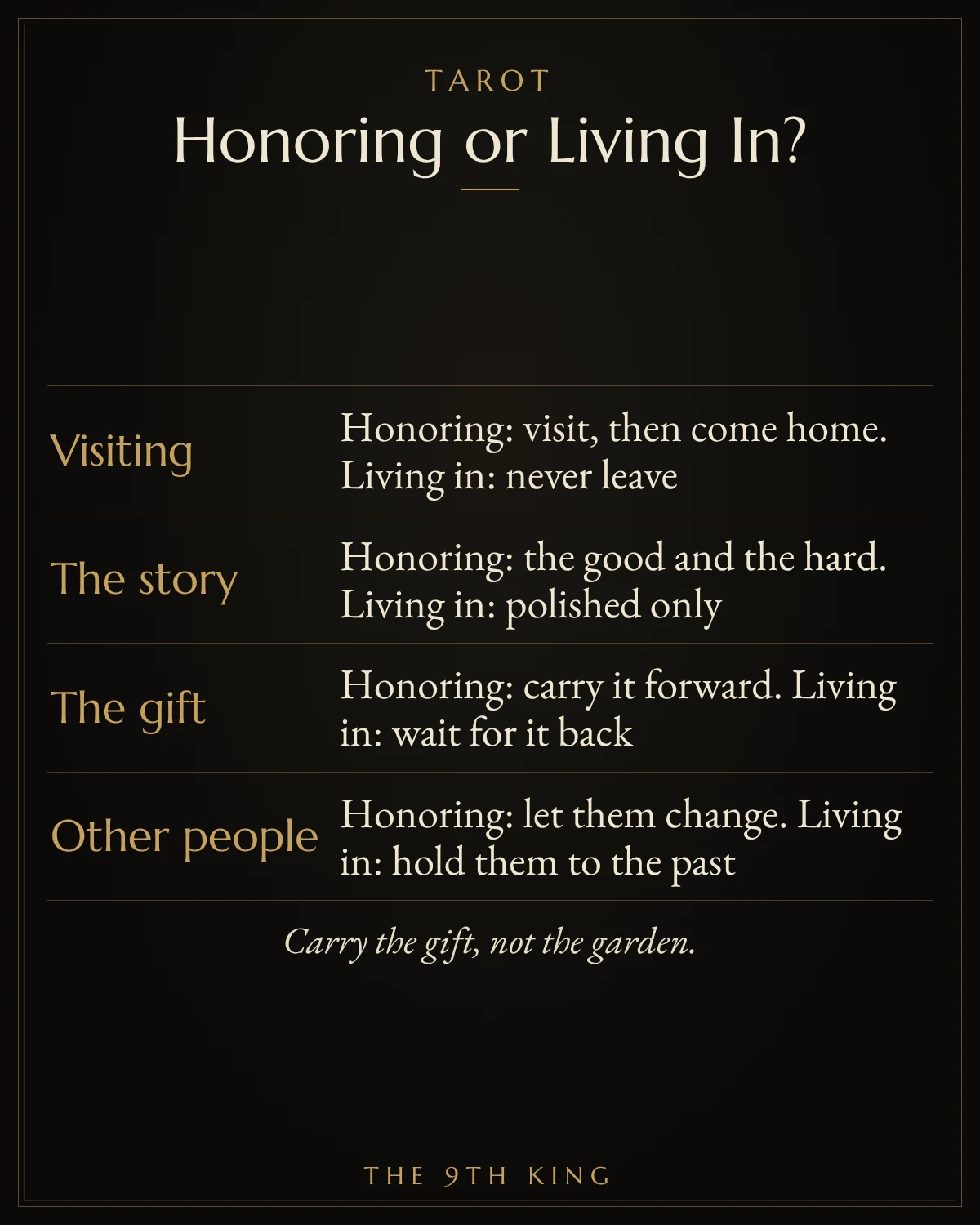
Honoring the past vs. living in it
| Honoring the past | Living in it |
|---|---|
| You visit, then come home | You never quite leave |
| Keeps the good and the hard | Keeps only the polished version |
| Carries a gift forward | Waits for it to return |
| Lets people change | Holds them to who they were |
A feeling alone won’t tell you which one you’re doing. Use questions instead: What does this memory give me? What does it keep me from? Can I take the gift without needing the time back?
The self-mastery lesson
The lesson of the Six of Cups is to carry the gift, not the garden. The good things from your past were qualities more than places: play, trust, curiosity, tenderness. Self-mastery means naming them and bringing them into the life you have now, instead of waiting for the old one to return.
Six of Cups as feelings, in love and at work
Six of Cups as feelings
Asked “how does this person feel?”, readers often take the Six of Cups as warm, familiar affection: tenderness, comfort, a sense of home. That’s an interpretation to reflect on, not evidence of what someone secretly feels: a card can’t establish another person’s feelings or actions. Ask yourself: Are we connecting with who we are now, or with a memory of each other? And if the card is about your own feelings: What am I missing, and is it the person or the time?
Six of Cups love meaning
In a love reading, the upright card can point to sweetness, play and familiarity. Many readers also link it with old flames and reunions. That doesn’t mean someone is coming back, or that you should reach out.
Tarot can’t tell you whether to stay, leave or reconnect, and this page won’t either. If someone from your past hurt you or doesn’t feel safe, your safety comes first, and you don’t owe anyone a reunion. Otherwise, the card can help you notice the pattern. Useful questions:
- Am I drawn to this person, or to who I was when I knew them?
- What part of that old connection would I want in any relationship now?
- Is nostalgia helping me see clearly, or softening something I need to see?
To see how two charts meet, try our synastry for beginners guide.
Six of Cups at work
At work, readers often take the card as returning to an old skill or early passion, or as goodwill on a team. The shadow version is refusing anything new because “the old way worked.” This is reflection, not career or financial advice. Ask yourself: What did I love about this work at the start, and where can I find that again here?
Practical exercise: the memory garden
You need about twenty minutes and a notebook. Choose a gentle memory, not a painful one: this is about what nourished you, not reliving what hurt.

Step 1: Choose a memory
Pick one warm memory from any age: a kitchen, a friendship, a summer, a song. If no early memory feels safe, choose a later one, or picture a garden you’d like to have had.
Step 2: Name the gift
Write one or two words for the quality that memory held: play, belonging, curiosity, ease, being looked after, being brave. That’s the cup being handed to you.
Step 3: Tell it honestly
Write a few lines about what was good, and one about what was hard or missing, if that feels comfortable. Honest memories teach more than polished ones. If this brings up too much, skip to Step 4.
Step 4: Carry one seed
Choose one small act this week that brings the gift into your life now. If it was play, an hour with no goal; if belonging, one message to someone you trust.
Step 5: Close the gate
Come back to today. Name three things you can see, put the notebook away and do something ordinary. A short grounding step like this may help you leave the memory where it belongs.
A worked example (fictional)
Marcus (fictional) moved to a new city for work and keeps scrolling through college photos. He draws the Six of Cups and recognizes the pull.
He chooses long evenings cooking with roommates. The gift he names is belonging. Telling it honestly, he admits he was also broke, anxious and unsure of himself. His seed: inviting two coworkers over for a simple dinner on Friday. Closing the gate, he puts the old photos in a folder instead of on his lock screen.
The dinner is a little awkward, and that’s fine. He’s carrying the gift, not recreating college.
Journal prompts for the Six of Cups
- What did I love before anyone told me what I should love?
- Which memory do I return to most, and what quality does it give me?
- Where am I comparing my present to a polished version of my past?
- What old role (the good one, the quiet one, the strong one) am I still playing, and does it still fit?
- Who has given me a cup with nothing asked back, and have I let them know?
- What would honoring my past look like, without needing to go back?
For more prompts like these, our shadow work prompts collection goes deeper, and Shadow Work, Plainly explains how to start safely. The Page of Cups is a good companion card if you want to explore the playful, curious side of the Cups suit.
A warm note: this is reflective practice, not therapy. If memories of childhood bring up trauma or abuse, or if you’re dealing with thoughts of self-harm or distress that feels overwhelming, please work with a qualified therapist who can walk with you. It’s always fine to stop a prompt that feels like too much.
Myths and misreadings of the Six of Cups
- “The Six of Cups means your ex is coming back.” No. On The 9th King, tarot doesn’t predict events. The card reflects how you relate to your past, not what someone else will do.
- “It’s always about childhood.” Waite gives childhood as one example, but he also offers a reading about new relationships and new surroundings (sacred-texts.com: Waite, Six of Cups). The card can be about any time or place that shaped you.
- “Nostalgia is unhealthy.” Warm remembering can be grounding. What matters is whether it feeds you or keeps you stuck.
- “It’s a purely happy card.” Book T calls it the Lord of Pleasure, but describes that pleasure as a beginning only, with harder notes depending on the cards around it (Liber LXXVIII, sacred-texts.com).
- “The Sun in Scorpio means this card is about Scorpio people.” No. The correspondence describes the card’s symbolism in the Golden Dawn tradition. Anyone can draw it, whatever their sign.

Six of Cups: FAQ
What does the Six of Cups mean?
The Six of Cups is a Minor Arcana card in the suit of Cups. In the Rider–Waite–Smith deck it shows children in an old garden with cups full of flowers. Readers commonly take it as memory, nostalgia, innocence and simple kindness. On The 9th King, it’s a mirror for how you relate to your past: whether your memories act as roots that feed you, or as a place you retreat to.
What does the Six of Cups reversed mean?
Reversed, the Six of Cups is often read as being stuck in the past, idealizing an old time or person, or using nostalgia to avoid the present. Waite’s own reversed meaning points the other way, toward the future and renewal. Some readers don’t use reversals at all. Treat it as a question, such as “what am I ready to stop waiting for?”, rather than a prediction.
What does the Six of Cups mean as feelings?
As feelings, readers often take the Six of Cups as warm, familiar affection: tenderness, comfort and a sense of home, sometimes mixed with nostalgia. It’s an interpretation, not evidence: a card can’t establish another person’s feelings or actions. It can prompt you to ask whether a connection is about who you both are now, or about a shared memory of who you used to be.
Does the Six of Cups mean someone from the past is coming back?
Many readers link the Six of Cups with old friends, old flames and reunions, but on The 9th King tarot doesn’t predict events. The card points to your own relationship with the past. If someone from your past does reach out, you get to decide what to do, and if they hurt you, you don’t owe them contact. The card is an invitation to reflect, not an instruction.
What zodiac sign is the Six of Cups?
In the Golden Dawn system, the tradition The 9th King uses, the Six of Cups corresponds to the Sun in Scorpio, the middle decan of Scorpio. The Golden Dawn’s Book T, as printed in Liber LXXVIII, calls the card the Lord of Pleasure. Other schools use different correspondences, so treat this as one traditional framework for symbolism rather than a fixed rule.
Is the Six of Cups a yes or no card?
The 9th King doesn’t do yes or no readings, because tarot here is a tool for self-reflection, not fortune-telling. Instead of asking whether the card says yes, ask what it shows you: what you’re remembering, what gift that memory holds and whether you’re honoring the past or quietly living in it.
How is the Six of Cups different from the Five of Cups?
In the Golden Dawn order, the Five of Cups is the Lord of Loss in Pleasure (Mars in Scorpio) and the Six is the Lord of Pleasure (Sun in Scorpio), the next decan of the same sign. Read in sequence, the Five sits with disappointment and the Six is where sweetness and gentleness begin to return. The Six is a beginning, not a finished happiness.

Your next step: try the memory garden exercise above with one gentle memory this week, and carry one seed into your present. Then read our Scorpio Personality Traits page: Scorpio’s loyalty to what it loves is the pull this card asks you to work with.
Explore Next
- The sign behind the card: Scorpio Personality Traits
- Tending the younger you, gently: Inner Child Work
- When old faces land on new people: Psychological Projection
- Go deeper with questions: Shadow Work Prompts
- Reading by feel: Intuitive Tarot (Code of Ascension)
- New to the cards: Tarot for Beginners: How Tarot Really Works (Code of Ascension)
- More tarot on The 9th King: Tarot Card Meanings · Minor Arcana · Tarot & the Zodiac · Page of Cups · Nine of Wands · Shadow Work Tarot Spread
- More new cards: Ace of Cups · Queen of Cups · Knight of Cups · King of Cups

Final Thought: Carry the Gift, Not the Garden
The children in the Six of Cups aren’t asking you to go back. They’re handing you something. The garden was real, and so were its walls, and the grown figure in the background can stand for you: older now, and free to walk on. Take the cup, keep what it gave you and walk on into your own life. Know your nature. Rule your life.
About the Author
King is the founder of The 9th King, where zodiac psychology, relationships and shadow work are explored as tools for self-knowledge rather than fortune-telling. He’s a Libra Sun, and writes about the personal side of astrology on King The Kemist. Astrology on The 9th King is interpretation and self-reflection, not prediction or established fact.
Leave a Reply