
Quick Answer: What Does the Two of Swords Mean?
The Two of Swords (also written 2 of Swords) is a Minor Arcana card from the suit of Swords. A.E. Waite describes it simply: a blindfolded woman balancing two swords on her shoulders. Readers often take it as the card of the held breath: two options, two loyalties or two truths, kept in careful balance while nothing moves.
- Keywords: balance, truce, stalemate, a pause, a hard choice, guarded calm, not looking.
- Upright, in one line: a prompt to notice where you’re holding two things in balance, and whether that stillness is giving you clarity or just buying time.
- Reversed, in one line: the balance is slipping; a prompt to check what you’ve been avoiding seeing, including any story you’ve been telling yourself.
On The 9th King, tarot is a mirror for self-knowledge, not fortune-telling. The Two of Swords doesn’t tell you which way to choose. It asks you to look honestly at your own stillness.
Table of Contents
The Two of Swords at a glance
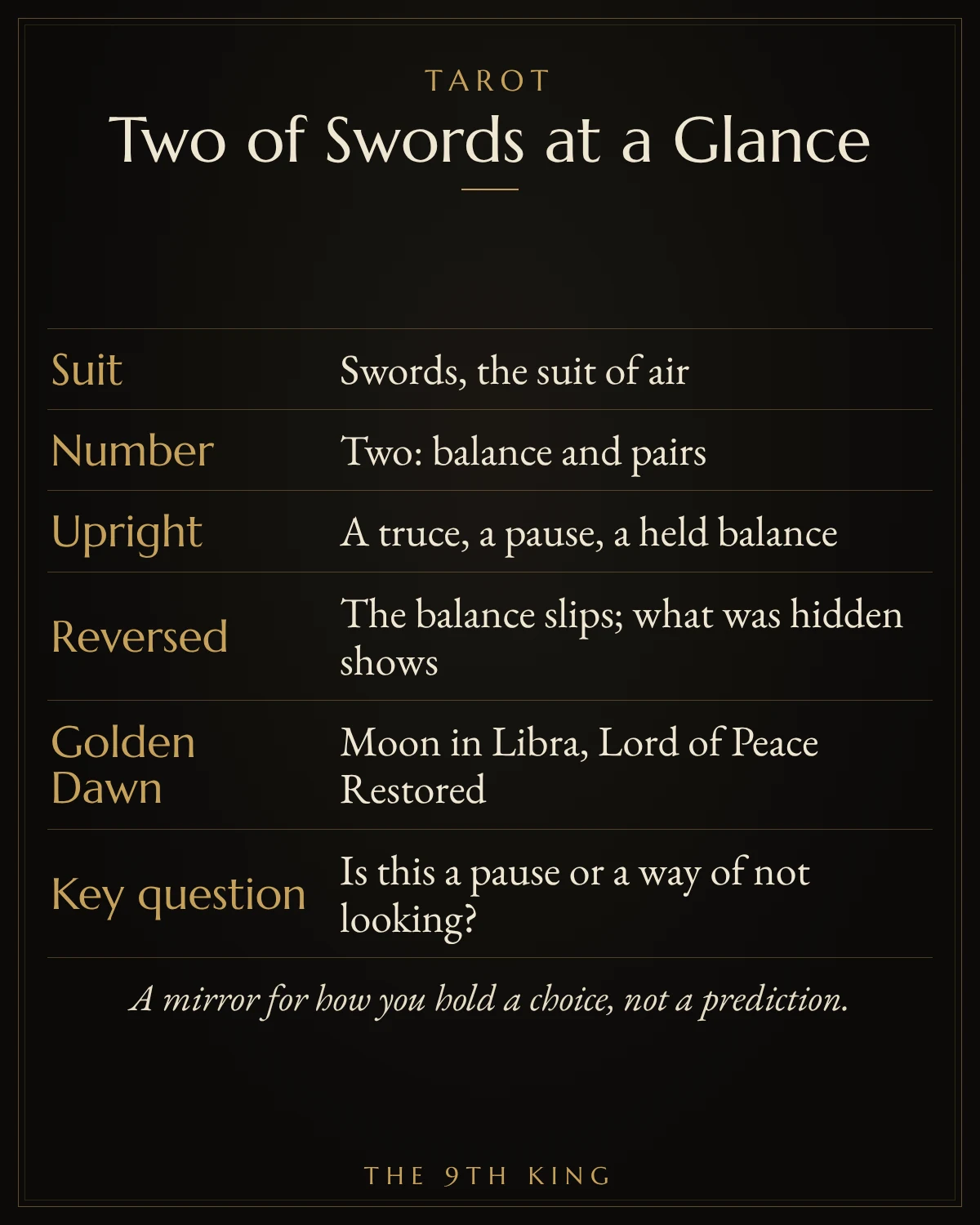
| Two of Swords | |
|---|---|
| Arcana | Minor Arcana, a pip (number) card |
| Suit and element | Swords, linked with air |
| Number | Two, the first pair |
| Golden Dawn title | Lord of Peace Restored |
| Astrology (Golden Dawn) | The Moon in Libra |
| Upright | Balance, truce, a careful pause |
| Reversed | Balance slipping, avoidance exposed |
| Key question | Is this a pause or a way of not looking? |
What the Two of Swords looks like
Most people meet this card through the Rider–Waite–Smith deck, first published in London by William Rider & Son in 1909. A.E. Waite wrote the instructions and Pamela Colman Smith drew the art, and both were members of the Hermetic Order of the Golden Dawn (Wikipedia: Rider–Waite Tarot).
What Waite says
Waite’s own description in The Pictorial Key to the Tarot (1911) is one short sentence. He calls the figure hoodwinked, an old word for blindfolded, and says she balances two swords upon her shoulders (sacred-texts.com: Waite, Two of Swords). That’s all he gives: a woman, a blindfold and two swords held in balance.
What the 1909 Smith card adds
On the 1909 Smith card, the woman is seated, there’s a wide body of water behind her and a crescent Moon above her. Wikipedia’s summary of the card describes her as calm, with the swords crossing and pointing in different directions (Wikipedia: Two of Swords). Apart from the blindfold and the two balanced swords, none of this is in Waite’s text, so treat it as the artist’s picture rather than Waite’s instruction.
The blindfold
Waite doesn’t say who tied the blindfold. Some readers take it as something done to her, others as a choice to shut out distraction. On The 9th King it’s a question: Is your blindfold protecting your focus, or protecting you from information you don’t want?
The two swords
Swords are the suit of thought, words and decisions. Two of them, balanced, can stand for two options, two loyalties or two truths that don’t fit together yet. Neither is lowered or used. The balance holds only while she keeps very still.
Two of Swords meaning (upright)
Waite’s divinatory meaning opens with “Conformity and the equipoise which it suggests.” He adds courage, friendship and concord in a state of arms, plus a second reading of tenderness, affection and intimacy. Then he adds a caution: these harmonious readings should be taken in a qualified way, because Swords, in his view, aren’t generally a suit of kindly forces (sacred-texts.com: Waite, Two of Swords).
Concord in a state of arms means peace with the weapons still raised: a truce, not a resolution.
The Golden Dawn’s teaching text on the tarot, Book T, as printed by Aleister Crowley in Liber LXXVIII, names the card the Lord of Peace Restored. It lists arrangement, peace restored and a truce, along with contradictory qualities in one nature, pleasure after pain and strength that comes through suffering. For the card’s place on the Tree of Life it adds: “Quarrel made up, yet still some tension in relations” (Liber LXXVIII, sacred-texts.com).
Wikipedia’s summary frames it as “a card of meditation, not of action” (Wikipedia: Two of Swords). Put together, the upright Two of Swords has three layers.
A truce
The card can point to a conflict that has gone quiet. Nobody has won, and the swords are still up. That can be a relief, and it can be fragile. Ask yourself: Is this peace, or a pause in the argument?
A held balance
The upright card can point to holding two things at once: two options, two people’s needs, or two parts of yourself. Holding them steadily, without collapsing into one side to end the discomfort, is a skill.
A chosen pause
Sometimes stillness is exactly right: you need more information, you’re tired, or the choice deserves time. Ask yourself: What would I need to know, or feel steady enough to face, before I choose?
Two of Swords reversed
Some readers use reversals and some don’t. Waite’s reversed meaning for this card is sharp: imposture, falsehood, duplicity, disloyalty (sacred-texts.com: Waite, Two of Swords).
A card can’t tell you that someone is lying to you, or why anyone acts as they do. On The 9th King, we turn Waite’s reversed meaning inward first. The reversed Two of Swords usually points to one of three patterns, offered as questions, not predictions.
The balance is slipping
You’ve held the position as long as you can, and the decision is starting to make itself. Ask yourself: If I stopped holding this so carefully, which way would it fall?
The blindfold is a story
Waite’s reversed words are about falseness. Before you look for it in other people, check the version you tell yourself. “I’m just waiting for the right time.” “It’s not really a problem.” “I don’t have a choice.” Some are true; some are a blindfold. Ask yourself: What am I saying to myself that I’d be uncomfortable saying out loud to a friend?
Information is coming in
Sometimes the reversed card points to the blindfold coming off: a fact, a feeling or a pattern in someone’s behavior becomes hard to ignore. That can be unsettling, but it’s information. If what you’re seeing is that something isn’t safe, take it seriously and lean on people you trust.
| Pattern | Upright tone | Reversed tone |
|---|---|---|
| Balance | Held steadily | Slipping or forced |
| Blindfold | Focus, a chosen pause | A story that hides a truth |
| Conflict | A truce | Tension coming back |
| Choice | Waiting on purpose | Being made by default |

Two of Swords astrology: the Moon in Libra
The 9th King uses Golden Dawn–derived correspondences, the tradition the Rider–Waite–Smith deck draws on. Other schools of tarot and astrology use different systems, and not every card maps to a single sign: the court cards and Pages, for example, are handled differently. What follows is one traditional framework, offered as symbolism.
How the number cards get their planets
In the Golden Dawn system, the 36 small cards (the Twos through Tens of the four suits) are matched to the 36 decans of the zodiac. A decan is a ten-degree third of a sign, and each one is given a ruling planet. Liber LXXVIII lists the Two of Swords, the Lord of Peace Restored, as the Moon in Libra. In its table, the Two, Three and Four of Swords take the Moon, Saturn and Jupiter in Libra, in that order, which places the Two in the first of Libra’s three decans (Liber LXXVIII, sacred-texts.com).
The same text describes the Golden Dawn’s own design for the card, not the Rider–Waite–Smith picture: two crossed swords with a five-petaled rose where they meet, read as beauty that grew out of hardship.
Book T also assigns all four Twos to Chokmah, the second sphere on the Kabbalistic Tree of Life. In the same text, the Ace of Swords is the root of the powers of air, which is why the suit of Swords is the suit of air.
What the Moon brings
On The 9th King, the Moon describes needs, instincts, habits and the reactions that come before thought. Our Moon Sign Meaning guide covers it in full. On a card about a held balance, the Moon is the need for safety underneath the stillness: the part of you that would rather not move than risk getting it wrong.
What Libra brings
Libra is cardinal air, ruled by Venus: the sign of the scales, fairness and partnership. Our Libra Traits page explores the Scales’ gift for diplomacy and its shadow side. On this card, Libra is her effort to keep everything even.
The tension in the pairing
The Moon wants to feel safe. Libra wants things fair and even. Together they describe someone who keeps the peace by not choosing, because choosing might hurt someone: calm on the surface, quiet effort underneath.
The 9K reading: a pause or a way of not looking?
The card’s tension
The Two of Swords holds two true things at once: I’m not ready to choose and Not choosing is also a choice. A pause that can’t admit it’s a choice turns into drift. A decision forced before you’re ready turns into regret.
The shadow side
The shadow of the Two of Swords is avoidance dressed up as balance. It’s the voice that says I’m just keeping the peace, while the thing that needs saying stays unsaid. It can look like:
- Fence-sitting. Agreeing with whoever spoke last so nobody is upset.
- Endless research. Gathering more so you never have to decide.
- Peace at any price. Swallowing your needs to keep a one-sided truce.
- Assuming reactions. Deciding other people’s reactions for them in advance. It can overlap with psychological projection, but it isn’t always the same thing.
These patterns usually start as smart responses to something real, like a home where conflict was frightening. The question is whether they still fit your life now.
Pause or avoidance: how to tell
A pause is a deliberate stop with a purpose. Real rest belongs here too: if you’re exhausted, grieving or ill, waiting to decide is often the wise thing, and it isn’t a shadow pattern. Avoidance is different: it’s not looking, so that you never have to choose.
| A pause | Avoidance |
|---|---|
| Has a reason you can name | Has an excuse that keeps changing |
| Has a rough plan to revisit | Has no end point |
| Gathers what you actually need | Gathers more so you never decide |
| Lets you rest | Keeps you braced and busy |

Feelings aren’t a reliable test: a wise pause can feel uneasy, and avoidance can feel calm. Use questions instead: Can I name why I’m waiting? Do I know what would help me decide? What happens to others while I wait?
Safety comes first. If the “peace” you’re keeping is with someone who hurts, threatens or controls you, holding the balance isn’t your job. A boundary can mean distance, no contact or leaving, and the responsibility for the harm belongs to the person causing it. Lean on people and services you trust.
The self-mastery lesson
The lesson of the Two of Swords is to lift the blindfold without dropping the swords. You don’t have to decide today, but you can look. Self-mastery here means seeing the whole situation, including what you’ve avoided, then choosing to act or to wait, on purpose.
Often the next step isn’t the big decision. It’s one honest look.
Two of Swords as feelings, in love and at work
Two of Swords as feelings
When someone asks “how does this person feel?” and draws the Two of Swords, readers often take it as guarded neutrality. The card can point to someone holding back, torn, or protecting a fragile calm. It can’t tell you what someone else feels or will do. It can be a prompt to ask yourself: What do I actually know from how they behave, and what am I guessing? And, if the card is about your own feelings: What feeling am I keeping very still so I don’t have to deal with it?
Two of Swords love meaning
In a love reading, the upright card can point to a truce after tension, something important not yet said, or a person torn between two loyalties. Remember Waite’s second reading of tenderness and intimacy: the card isn’t only stalemate. Reversed, it can point to unspoken things surfacing.
Tarot can’t tell you whether to stay or leave, and this page won’t either. If you don’t feel safe with someone, this isn’t about keeping the peace: your safety comes first. Otherwise, the card can help you notice the pattern. Useful questions:
- What have we both agreed, without saying it, not to talk about?
- Am I keeping the peace, or keeping quiet?
- What’s one honest sentence I could say, if and when it feels safe and useful?
If you like comparing charts, our Synastry for Beginners guide shows how astrologers read two people’s patterns side by side.
Two of Swords at work
At work, readers often take the card as a decision on hold: two paths, or two colleagues you’re trying not to take sides between. The shadow version is the decision that keeps getting pushed to next month. This is reflection, not career or financial advice. Ask yourself: What’s the smallest piece of information that would make this choice clearer?
Practical exercise: the blindfold check
You need about twenty minutes and a notebook. Doing this doesn’t commit you to deciding anything.
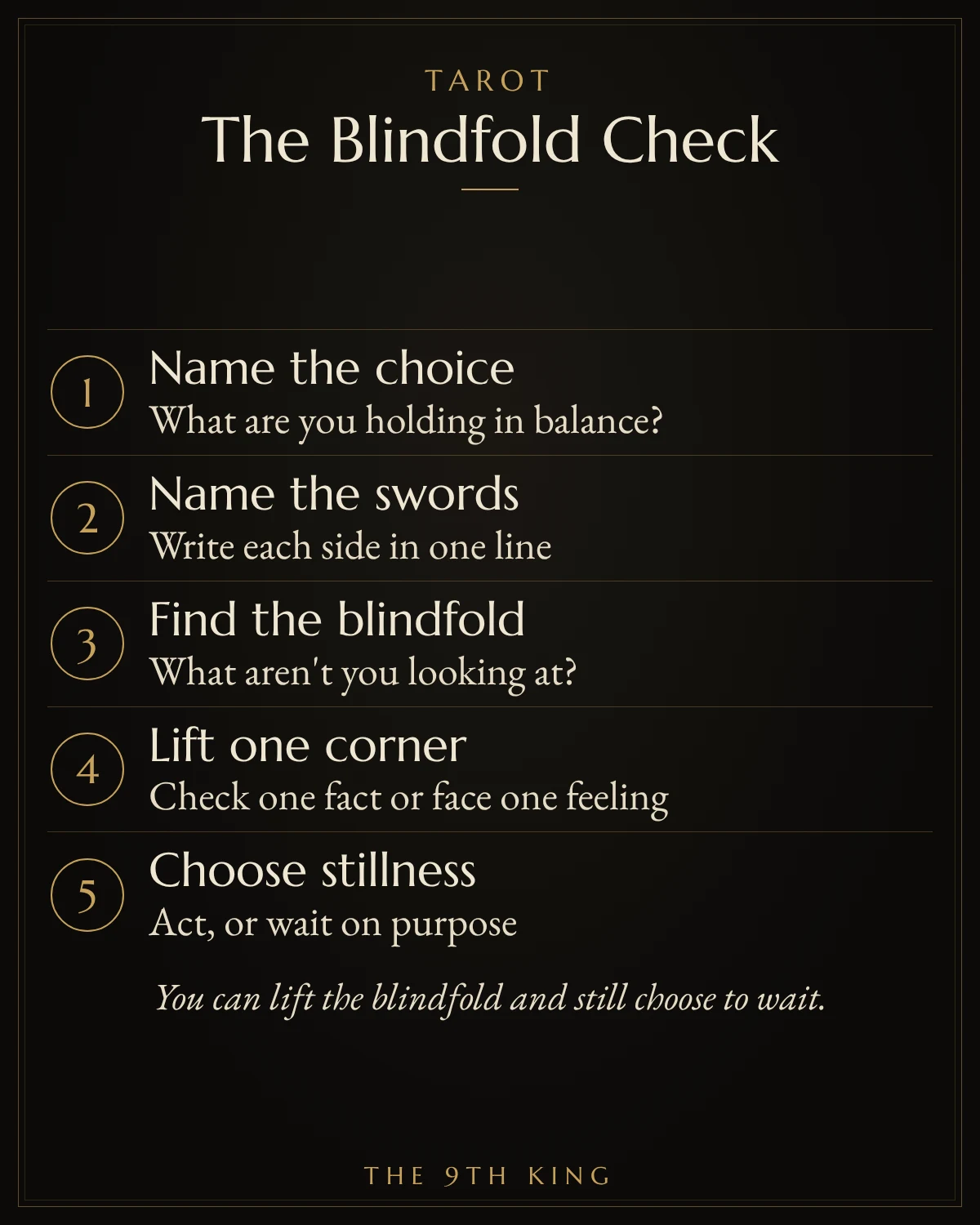
Step 1: Name the choice
Write one sentence: What am I holding in balance? If there are several, pick the one you think about most.
Step 2: Name the swords
Write each side in one line, such as “Say something to my sister” and “Let it go.” If there are more than two, write them all and circle the two heaviest.
Step 3: Find the blindfold
Ask: What am I not looking at? It might be a fact, a feeling or a pattern (this is the third time I’ve waited this out). Write whatever comes, without arguing with it.
Step 4: Lift one corner
Pick one thing from Step 3 to check or face this week: look up the fact, ask the question, or write about the feeling for ten minutes.
Step 5: Choose stillness
Now decide one of two things: I’m ready to act, and write the first small step, or I’m choosing to wait, and write why, plus a rough point when you’ll look again. Either can be the right answer. The difference is that now it’s a choice, not a default.
A worked example (fictional)
Theo (fictional) has been offered a role in another city and has been “thinking about it” for two months. He draws the Two of Swords upright and recognizes himself.
He names the choice as “move or stay.” His two swords: “a bigger role, far from friends” and “a job I’ve outgrown, close to people I love.” His blindfold: he hasn’t asked whether remote work is possible, because part of him doesn’t want the answer.
He lifts one corner and asks. The answer is “partly.” It doesn’t decide for him, but now the choice is about real options. He chooses to wait two more weeks, on purpose, while he visits the city once. The blindfold is off.
Journal prompts for the Two of Swords
- What am I holding in balance right now, and how long have I been holding it?
- Is my stillness a pause with a reason, or a way of not looking?
- What would I see if I took the blindfold off for one minute?
- Whose peace am I keeping, and does it cost me something I haven’t admitted?
- When did I first learn that choosing was dangerous, and is that still true?
- If a friend described my situation to me, what would I tell them I’m avoiding?
For more prompts like these, our shadow work prompts collection goes deeper, and Shadow Work, Plainly explains how to start safely. If your habit of keeping the peace began in childhood, inner child work can be a gentle next step.
A warm note: this is reflective practice, not therapy. If your stillness grew out of trauma or abuse, or if you’re dealing with thoughts of self-harm or distress that feels overwhelming, please work with a qualified therapist who can walk with you. It’s always fine to stop a prompt that feels like too much.
Myths and misreadings of the Two of Swords
- “The Two of Swords means you’ll be stuck forever.” No. On The 9th King, tarot doesn’t predict events. The card reflects how you’re holding a choice right now, not how long it will last.
- “It means someone is lying to you.” Waite’s reversed meanings include falsehood and duplicity, but a card can’t establish facts about other people. Look at what people actually do, and check your own stories first.
- “Indecision is always weakness.” A pause can be wise, especially when you’re tired, grieving or missing information. The question is whether it’s a pause or avoidance.
- “The Moon in Libra means this card is about Libra people.” No. The correspondence describes the card’s symbolism in the Golden Dawn tradition. Anyone can draw it, whatever their sign.
Two of Swords: FAQ
What does the Two of Swords mean?
The Two of Swords is a Minor Arcana card in the suit of Swords. Waite describes a blindfolded woman balancing two swords on her shoulders, with meanings like conformity and balance. Readers often take it as a truce, a held balance or a decision on pause. On The 9th King, it’s a mirror for how you’re holding a choice, not a prediction.
What does the Two of Swords reversed mean?
Reversed, the Two of Swords is often read as a balance that’s slipping, or a blindfold coming off. Waite listed falsehood and duplicity, but a card can’t prove anything about other people. On The 9th King, we turn it inward first: where are you telling yourself a story to avoid a choice? Some readers don’t use reversals at all.
What does the Two of Swords mean as feelings?
As feelings, readers often take the Two of Swords as guarded neutrality: someone holding back, torn between two things, or protecting a fragile calm. It can’t tell you what another person feels or will do. It can prompt you to separate what you’ve seen in their behavior from what you’re guessing, and to notice which feelings you’re keeping still yourself.
What does the Two of Swords mean in love?
In love, the upright card can point to a truce after tension, an unspoken topic, or someone torn between two loyalties. Waite also gave a reading of tenderness, affection and intimacy. Reversed, it can point to unspoken things surfacing. The card doesn’t tell you to stay or leave; it invites you to notice what’s being kept quiet and why.
What zodiac sign is the Two of Swords?
In the Golden Dawn system, the tradition The 9th King uses, the Two of Swords corresponds to the Moon in Libra, the first of Libra’s three decans in Liber LXXVIII’s table. The Golden Dawn’s Book T calls the card the Lord of Peace Restored. Other schools use different correspondences, so treat this as one traditional framework for symbolism rather than a fixed rule.
Is the Two of Swords a yes or no card?
The 9th King doesn’t do yes or no readings, because tarot here is a tool for self-reflection, not fortune-telling. That fits this card well: it’s about a choice not yet made. Instead, ask what the card shows you about what you’re weighing and what you haven’t looked at yet.
Why is the woman in the Two of Swords blindfolded?
Waite calls her hoodwinked, meaning blindfolded, but doesn’t explain why or who tied it. Readers interpret it in different ways: as shutting out distraction to keep her balance, as refusing to see something, or as relying on inner sense instead of sight. On The 9th King, the blindfold is a question: is it protecting your focus, or protecting you from information?

Your next step: do the blindfold check above for one choice you’ve been holding in balance. Then look up where the Moon sits in your own birth chart with our Moon Sign Meaning guide: your Moon describes what you need to feel safe enough to choose, and it’s the same planet the Golden Dawn tied to this card.
Explore Next
- The Moon behind the card: Moon Sign Meaning
- The Scales and their shadow: Libra Traits
- The root of the suit: Ace of Swords
- Balance and fair judgment in the Major Arcana: Justice · The High Priestess
- Go deeper with questions: Shadow Work Prompts
- The shadow side of every sign: Zodiac Shadow Work
- Reading by feel: Intuitive Tarot (Code of Ascension)
- New to the cards: Tarot for Beginners: How Tarot Really Works (Code of Ascension)
- More tarot on The 9th King: Tarot Card Meanings · Minor Arcana · Tarot & the Zodiac · Queen of Swords · Shadow Work Tarot Spread
- More cards in this set: Three of Swords, Six of Swords, Seven of Swords

Final Thought: Lift the Blindfold, Keep Your Balance
The woman in the Two of Swords isn’t weak: holding two heavy things perfectly still takes strength. But balance kept by not looking can’t last forever. You can lift the blindfold, see the whole picture and still choose to wait. Or you can lower one sword and move. Either way, make it yours. Know your nature. Rule your life.
About the Author
King is the founder of The 9th King, where zodiac psychology, relationships and shadow work are explored as tools for self-knowledge rather than fortune-telling. He’s a Libra Sun, and writes about the personal side of astrology on King The Kemist. Astrology on The 9th King is interpretation and self-reflection, not prediction or established fact.
Leave a Reply