
Quick Answer: What Does the Three of Cups Mean?
The Three of Cups (also written 3 of Cups) is a Minor Arcana card from the suit of Cups. In the traditional Rider–Waite–Smith deck, A.E. Waite describes it as maidens in a garden with their cups raised, as if pledging one another. Readers usually take it as the card of shared joy: friendship, celebration, community, good news and the people who show up for you.
- Keywords: friendship, celebration, community, gathering, shared success, gratitude, support, healing.
- Upright, in one line: a prompt to notice who you celebrate with and what is worth marking, if something good has come to a close or come together in your life.
- Reversed, in one line: a prompt to look at where celebration has tipped into excess, where a circle feels closed or crowded, or where you’re blending in rather than belonging.
On The 9th King, tarot is a mirror for self-knowledge, not fortune-telling. The Three of Cups doesn’t promise a party or new friends. It asks how you share joy, and whether your circle has room for the real you.
Table of Contents
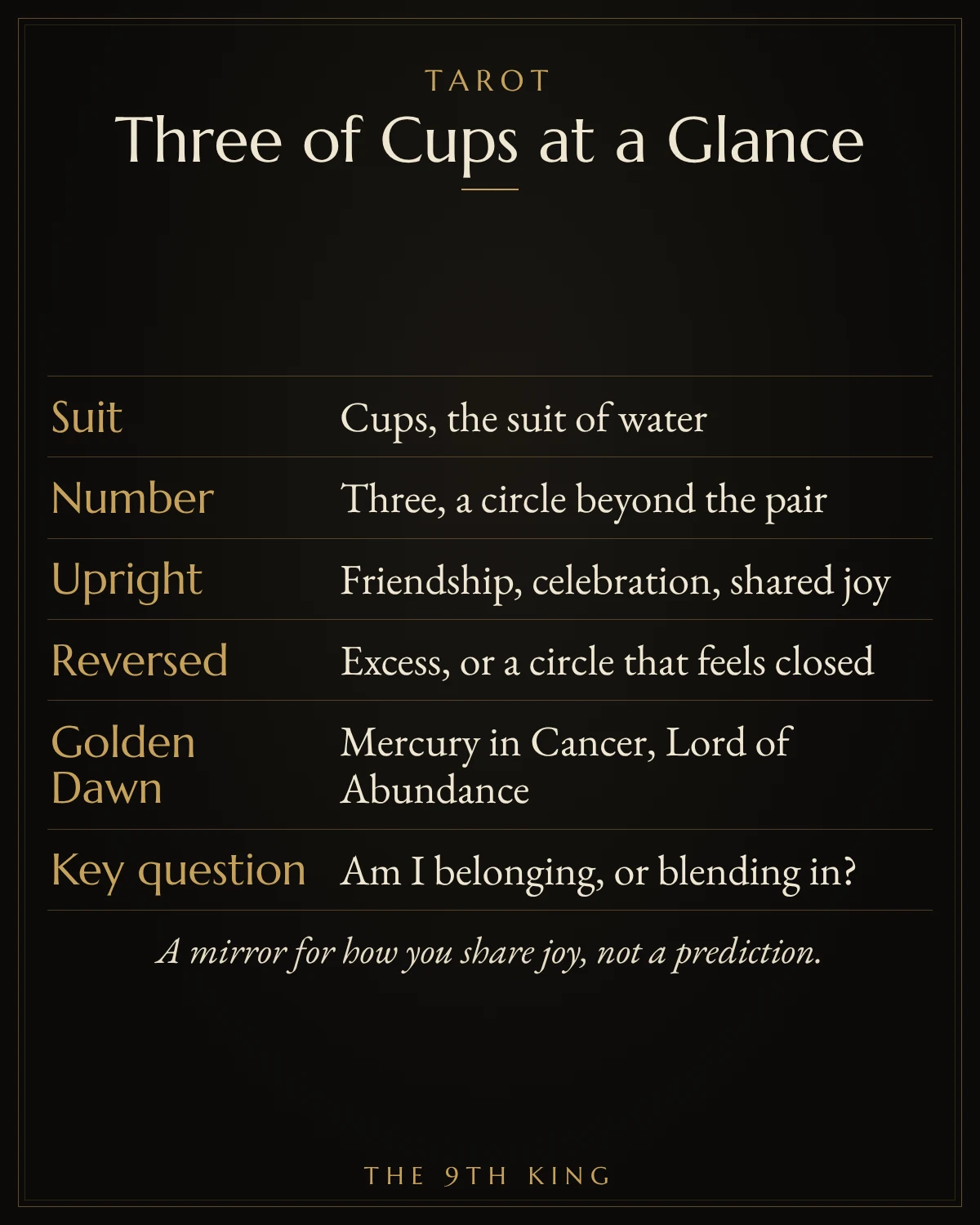
The Three of Cups at a glance
| Three of Cups | |
|---|---|
| Arcana | Minor Arcana, a pip (number) card |
| Suit and element | Cups, linked with water |
| Number | Three, a circle beyond the pair |
| Golden Dawn title | Lord of Abundance |
| Astrology (Golden Dawn) | Mercury in Cancer |
| Upright | Friendship, celebration, shared joy |
| Reversed | Excess, or a circle that feels closed |
| Key question | Am I belonging, or blending in? |
What the Three of Cups looks like
Most people know this card from the Rider–Waite–Smith deck, first published in London by William Rider & Son in December 1909. A.E. Waite wrote the instructions and Pamela Colman Smith drew the art, and both belonged to the Hermetic Order of the Golden Dawn (Wikipedia: Rider–Waite Tarot).
The toast in the garden
Waite’s description of the picture is one short line: “Maidens in a garden-ground with cups uplifted, as if pledging one another” (sacred-texts.com: Waite, Three of Cups). That’s all he says about the image. Apart from the maidens, the garden and the raised cups, the details people often mention for this card aren’t in Waite’s text, so this page leaves them out.
A pledge with raised cups is a toast: a group saying, together, this matters, and we’re glad to share it.
From pair to circle
In the Two of Cups, Waite describes a youth and a maiden pledging one another (sacred-texts.com: Waite, Two of Cups). In the Three, the pledge happens among a group. On The 9th King, we read that as the Two of Cups bond opening out into community. That’s our reading, not Waite’s.
The Golden Dawn’s version
The Golden Dawn’s teaching text, Book T, as printed in Aleister Crowley’s Liber LXXVIII, describes a picture with no people in it. A white radiating hand holds lotuses or water-lilies whose flowers pour white water into the cups. Every cup overflows: the top one into the other two, and those onto the lower part of the card. The three cups stand in an upright triangle, with the symbols of Mercury and Cancer above and below (Liber LXXVIII, sacred-texts.com).
Three of Cups meaning (upright)
Waite’s divinatory meaning begins with the conclusion of any matter in plenty, perfection and merriment, then lists a happy issue, victory, fulfilment, solace and healing (sacred-texts.com: Waite, Three of Cups). So for Waite, this isn’t only a party card. It’s about something reaching a good end, and the comfort that follows.
Book T names the card the Lord of Abundance. Its meanings include abundance, plenty, success, pleasure, love, gladness, kindness and liberality (generosity). It places the card in Binah, the third station on the Kabbalistic Tree of Life, and sums up its sense in a lively list: “Plenty, hospitality, eating and drinking, pleasure, dancing, new clothes, merriment” (Liber LXXVIII, sacred-texts.com).
The upright meaning readers commonly use has three layers.
Shared celebration
The heart of the card is joy marked together: a birthday, a recovery, a launch, a reunion. The upright Three can point to a moment worth pausing for, with people who are glad for you. Ask yourself: What have I finished or survived lately that I never stopped to mark?
Friendship and support
Cups raised at once suggest mutual support, not one person carrying the room. The card can point to friends, a chosen family or a team that has your back. Ask yourself: Who would I call first with good news, and who would call me?
Healing through company
Waite’s list ends with solace and healing. On The 9th King, we read this as the comfort of being among people who know you. Solitude has its place too. Ask yourself: Is there a person I’ve been meaning to let back in?
Three of Cups reversed
Readers handle reversals differently, and some skip them entirely. Waite does give a reversed meaning for this card: expedition, dispatch, achievement and end. He adds that it also signifies the side of excess in physical enjoyment and the pleasures of the senses (sacred-texts.com: Waite, Three of Cups).
So Waite’s reversal isn’t “no friends”. Part of it is finishing things quickly; part is too much of a good thing.
In his later list of additional meanings, Waite gives the reversed Three of Cups as consolation, cure and the end of the business. He also warns, in that same section, that these extra meanings often disagree with the main ones (sacred-texts.com: Waite, Additional Meanings).
On The 9th King, the Three of Cups reversed usually points to one of three patterns, offered as questions, not predictions.
Too much of a good thing
Following Waite, the reversed card can point to celebration that has turned into excess: one more night out, one more round. Ask yourself: What does “enough” look like for me, and when do I usually pass it? This isn’t a judgment on fun. A quiet night or a slow weekend is care, not a failure to celebrate.
A circle that feels closed
The reversed card can point to feeling left out, a trio where two people bond and one drifts, or a group that has stopped making room for newcomers. Ask yourself: Where do I feel on the edge of a circle, and what have I actually seen that tells me so?
Blending in instead of belonging
You’re welcome, but only a version of you is. You laugh at jokes you don’t find funny or keep your news small so it doesn’t stand out. Ask yourself: Which part of me do I leave at home when I see these people?
| Pattern | Upright tone | Reversed tone |
|---|---|---|
| Celebration | Marked and shared | Tipped into excess |
| The circle | Open and supportive | Closed or uneven |
| Your place | Belonging as yourself | Blending in to fit |
| Endings | A happy close | Rushed or unmarked |
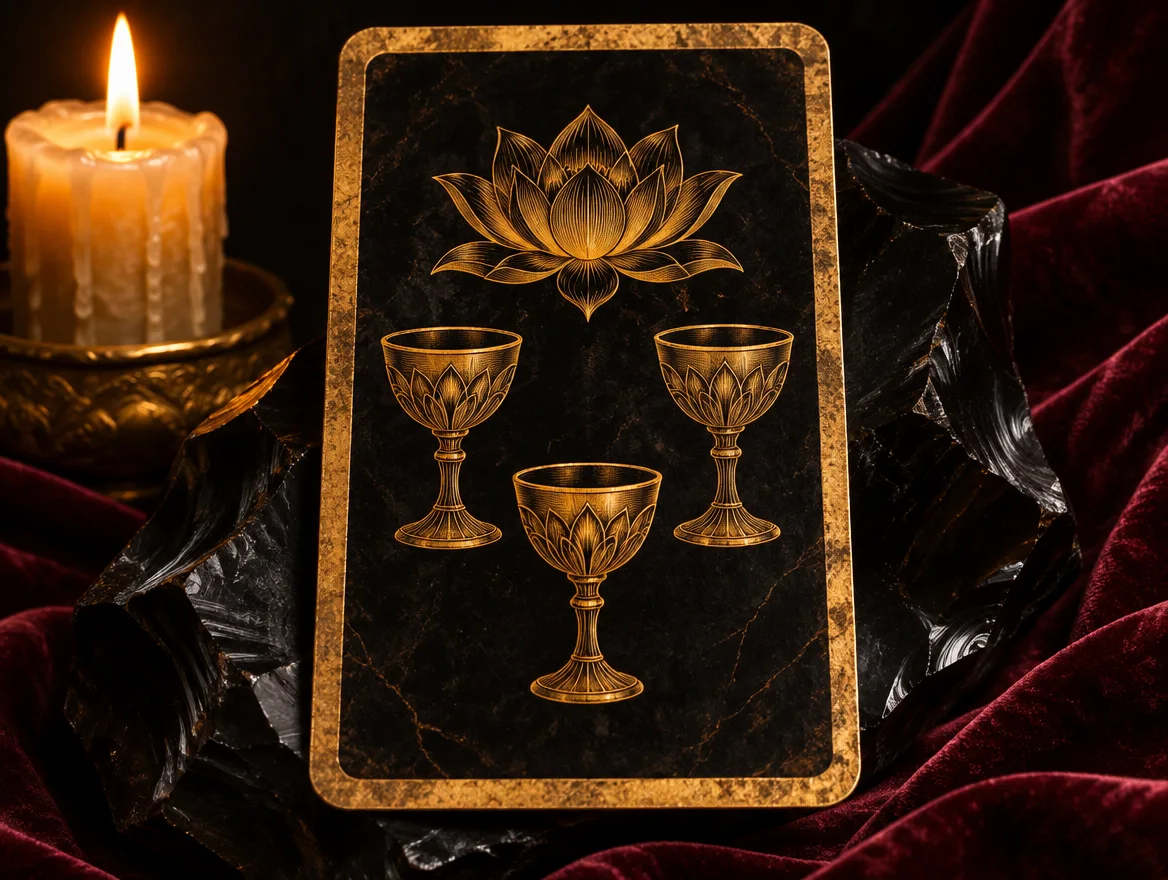
Three of Cups astrology: Mercury in Cancer
The 9th King uses Golden Dawn–derived correspondences, the tradition the Rider–Waite–Smith deck draws on. Other schools of tarot and astrology use different systems, and not every card maps to a single sign: the court cards and Pages, for example, work differently. What follows is one traditional framework, offered as symbolism.
How the number cards get their planets
In the Golden Dawn system, the 36 small cards (the Twos through Tens) are matched to the 36 decans of the zodiac, each a ten-degree third of a sign with its own planet. Book T, as printed in Liber LXXVIII, lists the Three of Cups, the Lord of Abundance, as Mercury in Cancer (Liber LXXVIII, sacred-texts.com). In the same table, Cancer’s three cards run Two of Cups (Venus), Three of Cups (Mercury) and Four of Cups (Moon), so by the order of that table the Three is the middle one. Liber also lists the Three of Cups in a separate table of central decans, alongside the other Threes, Sixes and Nines. Liber doesn’t print degrees for this entry.
For a wider look at how this system works across the deck, see our Minor Arcana guide and Tarot & the Zodiac.
What Mercury brings
On The 9th King, Mercury describes how you think, talk and share news. Mercury rules Gemini and Virgo, so our Gemini Personality Traits and Virgo Personality Traits pages show two sides of it: sociable curiosity and careful attention. On this card, Mercury is the chatter at the table and the stories passed around.
What Cancer brings
Cancer is cardinal water: protective, loyal and deeply tied to home and belonging. Our Cancer Personality Traits page explores the Crab’s care and its shell. On this card, Cancer is the part of friendship that feels like family: Do I belong here? Will these people look after me?
The tension in the pairing
Mercury wants to talk and spread the news. Cancer wants a safe, close circle. Together they describe warm, talkative belonging, and its risk: when the circle becomes the main source of safety, talk can turn inward to who’s in and who’s out. The card asks for a circle that feels like home without the talk becoming its wall.
The 9K reading: belonging without disappearing
The card’s tension
The Three of Cups holds two true things at once: I want to be part of this and I want to be myself in it. A toast works because each person raises their own cup. A group that asks you to put yours down so the others look better isn’t the toast on this card.
The shadow side
The shadow of the Three of Cups is trading yourself for a seat at the table. It can look like:
- Fitting the room. Changing your opinions or humor to match whoever you’re with.
- Celebrating to avoid feeling. Filling every free evening with plans so you never sit with something hard. (This is different from enjoying company, and different from rest. Both are fine.)
- Bonding through talk about others. Feeling closest to a group when you’re discussing someone who isn’t there.
- Shrinking your wins. Keeping good news to yourself because you’re afraid a friend will feel left behind.
These patterns often start from something real, like an old experience of being left out; our inner child work guide is related reading. The question is whether they still help you.
Belonging or blending in: how to tell
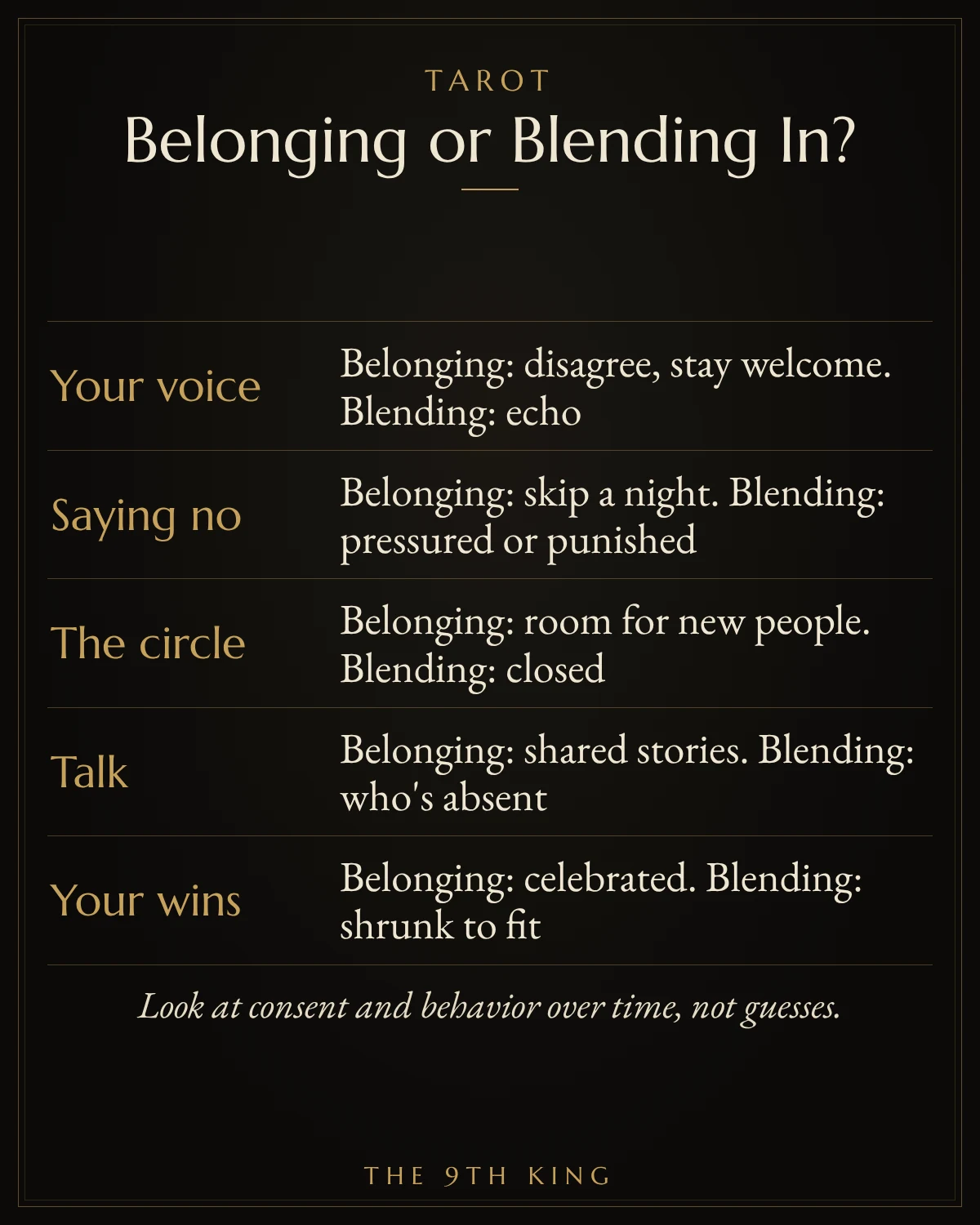
A card can’t tell you what a group thinks of you, or why someone didn’t invite you. What you can look at is behavior over time and consent: what people freely agree to, what they actually do, and whether you can say yes or no without paying for it.
| Belonging | Blending in |
|---|---|
| You can disagree and stay welcome | You echo the group to stay safe |
| You can skip a night without fallout | People pressure or punish you for skipping |
| The circle has room for new people | The circle stays closed |
| Talk is mostly shared stories | Talk is mostly about who’s absent |
| Your wins are celebrated | You shrink your wins to fit |
A mood won’t settle this: you can feel nervous in a good group and comfortable in a narrow one. Ask instead: Can I say what I think here? Can I say no?
If anyone in a group is pressuring, threatening or humiliating you, that isn’t yours to solve by fitting in better. Responsibility belongs to the people doing it, and your safety comes first, which can mean stepping back or leaving for good.
The self-mastery lesson
The lesson of the Three of Cups is to raise your own cup in company. Self-mastery here means bringing your real opinions, news and limits to the table, and including others the way you’d like to be included.
Three of Cups as feelings, in love and at work
Three of Cups as feelings
Asked “how does this person feel?”, readers often take the Three of Cups as warm, friendly enjoyment: someone who likes your company and counts you among their people. That’s an interpretation, not evidence; a card can’t establish what someone else feels or will do. Ask yourself: What have they actually shown me, in what they say and do? If the card is about your own feelings: Is this friendship, attraction, or simply relief at not being alone?
Three of Cups love meaning
In a love reading, the upright card can point to a relationship that fits your wider life, an anniversary worth marking or a playful, social season. Reversed, it can point to too much partying, friends who crowd the relationship or a partner who feels left out of your circle.
Some readers take the reversed card as a third person complicating a relationship. A tarot card can’t establish that anyone is unfaithful or reveal anyone’s motives. If trust is in question, look at what has actually happened and been agreed.
Tarot can’t tell you whether to stay, leave, start or end anything, and this page won’t either. Useful questions:
- Do I feel like myself around my partner’s people, and do they around mine?
- Is there room in this relationship for friendships outside it?
To see how two charts meet, try our synastry for beginners guide.
Three of Cups at work
At work, readers often take the card as team spirit: a project wrapped up well or a shared win. Reversed, it can point to a clique or office talk about absent people. This is reflection, not career or financial advice. Ask yourself: Does my team mark its wins, and does everyone get included in them?
Practical exercise: the three-cup toast
You need about twenty minutes and a notebook. Think of one circle in your life: friends, family, a team or a community.

Step 1: Name the win
Write down one thing from the past few months that deserves marking: a finished project, a hard conversation you got through, a habit you kept. Endings and recoveries count.
Step 2: Name your people
List who helped, who cheered and who simply stayed in touch while you were busy.
Step 3: Check the circle
Using the belonging table above, write one sentence per row about your chosen circle. If you aren’t sure, write “I don’t know” rather than guessing.
Step 4: Find your enough
Write how you actually like to celebrate: a dinner for four, a walk with one friend, a quiet night, a loud party. Then write where your “enough” usually is. Choosing rest is a perfectly good way to mark something.
Step 5: Raise one cup
Choose one small, optional way to mark the win: telling a friend your news, thanking someone from Step 2 or planning a small gathering. Contact is a choice, not a requirement. A private toast counts too.
A worked example (fictional)
Marcus (fictional) has just finished a two-year evening course and hasn’t told anyone outside his family. He draws the Three of Cups upright.
His win: the finished course. His people: two classmates who shared notes, his sister who checked in every exam week, and one old friend who kept inviting him out. That’s four people. He notices he keeps quiet about his own news in his main friend group. His “enough”: a small dinner, home by eleven.
His one cup: he books a table for five, himself and the four people on his list, and sends each one a short note saying thanks. His old friend replies first: “Finally. I’m in.”
Journal prompts for the Three of Cups
- When did I last celebrate something of my own, and who was there?
- In which group do I feel most like myself, and what makes that possible?
- What do I hold back when I’m with the people I most want to impress?
- Who in my life has been left on the edge of a circle I’m part of?
- What does “enough” celebration look like for me?
- Who has quietly helped me heal, and have I told them?
For more prompts like these, our shadow work prompts collection goes deeper, and Shadow Work, Plainly explains how to start safely.
A warm note: this is reflective practice, not therapy. If friendships or groups bring up trauma or abuse, or if you’re dealing with thoughts of self-harm or distress that feels overwhelming, please work with a qualified therapist who can walk with you. It’s always fine to stop a prompt that feels like too much.
Myths and misreadings of the Three of Cups
- “The Three of Cups means a party or wedding is coming.” No. On The 9th King, tarot doesn’t predict events. The card reflects how you share joy, not what’s on your calendar.
- “The reversed Three of Cups means someone is cheating.” A card can’t establish anything about another person’s actions. Waite’s own reversal is about excess and things ending quickly, not betrayal (sacred-texts.com: Waite, Three of Cups).
- “It’s only a fun card.” Waite’s upright list includes solace and healing, and Book T stresses abundance and kindness (Liber LXXVIII, sacred-texts.com). The card can be about comfort as much as celebration.
- “Mercury in Cancer means this card is about Cancer people.” No. The correspondence describes the card’s symbolism in the Golden Dawn tradition. Anyone can draw it, whatever their sign.

Three of Cups: FAQ
What does the Three of Cups mean?
The Three of Cups is a Minor Arcana card in the suit of Cups. Waite describes maidens in a garden raising their cups as if pledging one another, and gives meanings such as plenty, merriment, fulfilment, solace and healing. Readers commonly take it as friendship, celebration and community. On The 9th King, it’s a mirror for how you share joy and whether your circle lets you be fully yourself.
What does the Three of Cups reversed mean?
Reversed, Waite reads the Three of Cups as expedition, dispatch, achievement and end, and also as excess in physical enjoyment. On The 9th King, the reversal often points to celebration tipping into too much, a circle that feels closed, or blending in to fit a group. Some readers skip reversals entirely. Treat it as a question to explore, not as a sign that a friendship is ending.
What does the Three of Cups mean as feelings?
As feelings, readers often take the Three of Cups as warm, friendly enjoyment: someone who likes your company, feels at ease with you or counts you among their people. It’s an interpretation, not evidence, because a card can’t establish another person’s feelings or actions. A better guide is what someone says and does over time. The card can also prompt you to ask what you feel, and why.
What does the Three of Cups mean in love?
In love, the upright card can point to a relationship that fits well with your friendships, a celebration such as an anniversary, or a playful, social season. Reversed, it can point to too much partying or friends crowding the relationship. The card doesn’t tell you to stay or leave, and it can’t show whether anyone is unfaithful. It invites you to look at what has actually happened and been agreed.
What zodiac sign is the Three of Cups?
In the Golden Dawn system, the tradition The 9th King uses, the Three of Cups corresponds to Mercury in Cancer, the middle of Cancer’s three cards in the Book T table. The Golden Dawn’s Book T, as printed in Liber LXXVIII, calls the card the Lord of Abundance. Other schools use different correspondences, so treat this as one traditional framework for symbolism, not a fixed rule.
Is the Three of Cups a yes or no card?
The 9th King doesn’t do yes or no readings, because tarot here is a tool for self-reflection, not fortune-telling. Instead of asking whether the card says yes, ask what it shows you: what in your life deserves to be marked, who you’d want there, and whether you can raise your own cup in that company without shrinking to fit.
How is the Three of Cups different from the Two of Cups?
Both cards show a pledge with raised cups. In Waite’s descriptions, the Two of Cups is a youth and a maiden pledging one another, and the Three of Cups is a group of maidens doing the same. On The 9th King, we read the Two as a bond between two people and the Three as that warmth opening out into friendship and community, where the question shifts from meeting someone as an equal to belonging as yourself.
Your next step: try the three-cup toast above with one win from the past few months, even a small one. Then read our Cancer Personality Traits page: Cancer’s need for a safe circle is the pull this card asks you to balance with staying yourself in it.
Explore Next
- The sign behind the card: Cancer Personality Traits
- Mercury’s two homes: Gemini Personality Traits · Virgo Personality Traits
- Old hurts around being left out: Inner Child Work
- How two charts meet: Synastry for Beginners
- Go deeper with questions: Shadow Work Prompts
- Reading by feel: Intuitive Tarot (Code of Ascension)
- New to the cards: Tarot for Beginners: How Tarot Really Works (Code of Ascension)
- More tarot on The 9th King: Tarot Card Meanings · Minor Arcana · Tarot & the Zodiac · Ace of Cups · Two of Cups · Six of Cups · The Empress
- More cards in this set: Four of Cups, Five of Cups, Seven of Cups

Final Thought: Raise Your Own Cup
In Waite’s picture, the maidens raise their cups together, as if pledging one another. That’s belonging at its best: a circle where nobody has to shrink to fit. Mark what you’ve finished, thank the people who stayed and keep a seat open for someone new. Know your nature. Rule your life.
About the Author
King is the founder of The 9th King, where zodiac psychology, relationships and shadow work are explored as tools for self-knowledge rather than fortune-telling. He’s a Libra Sun, and writes about the personal side of astrology on King The Kemist. Astrology on The 9th King is interpretation and self-reflection, not prediction or established fact.
Leave a Reply