
Quick Answer: What Does The Lovers Tarot Card Mean?
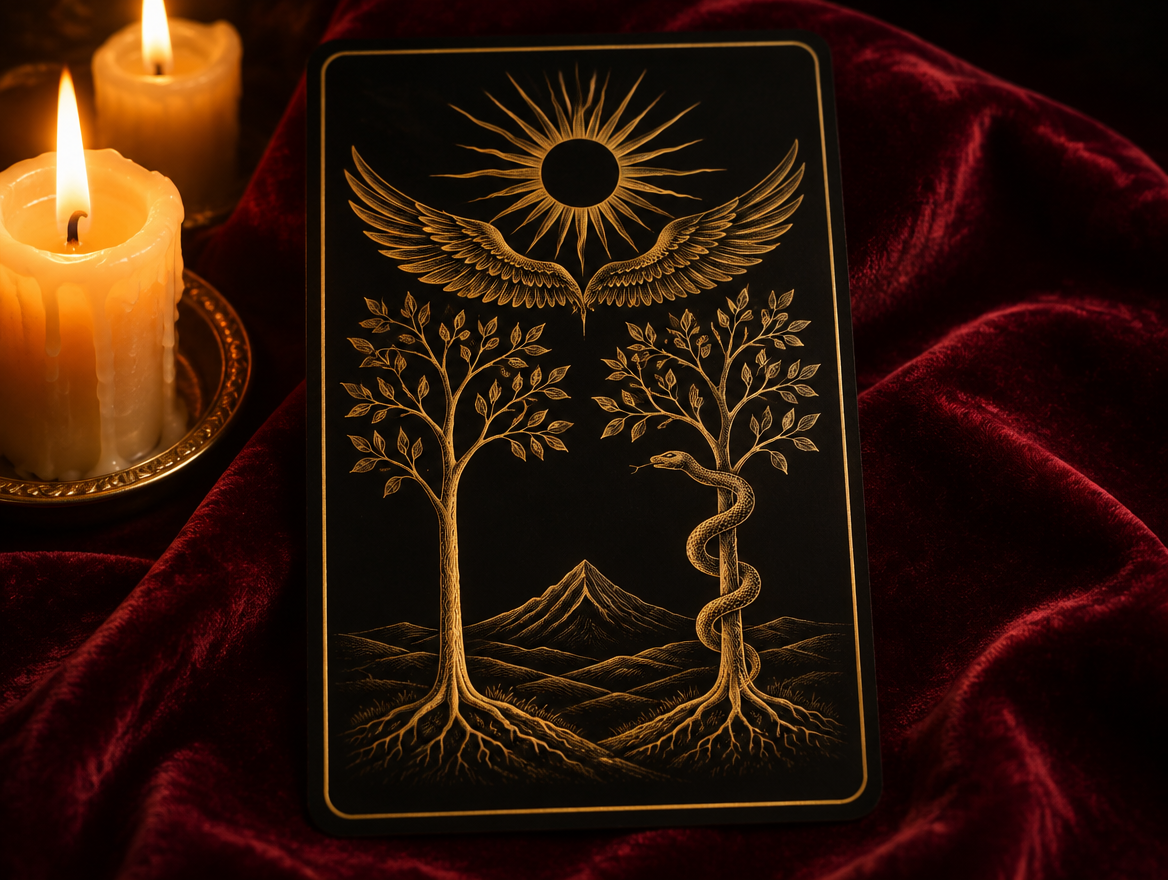
The Lovers is card VI (6) of the Major Arcana. On the traditional Rider–Waite–Smith card, a man and a woman stand unclothed in a garden, each before a tree, while a great winged figure spreads its arms above them under a bright sun. It’s the card of love, attraction and union, and just as much the card of choice.
Keywords: love, attraction, union, choice, values, alignment, honesty.
- Upright, in one line: the card can point to a real connection, or to a choice you make with your whole self, in line with what you value.
- Reversed, in one line: readers often take it as imbalance, mixed signals, or a choice you’re avoiding or making against yourself.
- Astrology link: in the Golden Dawn–derived correspondences The 9th King uses, The Lovers is paired with Gemini and the Hebrew letter Zain.
On The 9th King, tarot is a mirror for self-knowledge, not fortune-telling. The Lovers doesn’t tell you who you’ll end up with. It asks a harder, more useful question: am I choosing in line with my values, or waiting to be chosen?
Table of Contents

The Lovers tarot card at a glance
| The Lovers | |
|---|---|
| Number | VI (6), Major Arcana |
| Core theme | Love, union and choice |
| Upright | Connection, alignment, honest choice |
| Reversed | Imbalance, or a choice avoided |
| Correspondence (Golden Dawn–derived) | Gemini; Hebrew letter Zain |
| Golden Dawn title | The Children of the Voice; the Oracles of the Mighty Gods |
| 9K tension | Choosing vs being chosen |
| Key question | Am I choosing in line with my values? |
What’s on the card: The Lovers tarot symbolism, piece by piece
Most modern decks follow the Rider–Waite–Smith design, illustrated by Pamela Colman Smith to A. E. Waite’s instructions and first published by William Rider & Son in 1909 (Wikipedia: Rider–Waite Tarot). Waite described the card himself in The Pictorial Key to the Tarot, now in the public domain (sacred-texts.com: Waite, The Lovers). The card draws on biblical imagery, and Waite reads it in that light. We’ll describe it the way he did, plainly and without taking sides on faith.
The sun and the winged figure
At the top of the card the sun shines at its highest point. Beneath it, Waite describes “a great winged figure with arms extended,” pouring influences down on the pair below (sacred-texts.com: Waite, The Lovers). Waite doesn’t name the figure. Many readers call it an angel, and Wikipedia notes it is possibly the archangel Raphael (Wikipedia: The Lovers).
Read simply, it’s a bond blessed, or watched over, from above.
The two figures
In the foreground stand a man and a woman, unveiled before each other. Waite compares them to Adam and Eve in the first garden, and says they suggest youth, innocence and love before it is clouded by grasping desire (sacred-texts.com: Waite, The Lovers).
The key detail is that they’re unveiled. Nothing is hidden or performed. That’s the standard The Lovers sets: being seen as you are by someone you see as they are.
The two trees and the serpent
Behind the man, Waite places the Tree of Life with twelve fruits. Behind the woman is the Tree of the Knowledge of Good and Evil, with the serpent twining round it (sacred-texts.com: Waite, The Lovers).
Waite is careful here. He says the woman stands for the pull toward the life of the senses, but that she is not a willing temptress; he sees her as part of a larger design, and says the man can only complete himself through her. Modern readers usually take the two trees as two kinds of knowing, spirit and experience, both needed.
The mountain
On the 1909 Smith card, a single mountain peak rises in the distance between the two figures. Waite’s text doesn’t mention it. Readers often take it as a shared aim, or as the higher ground a relationship can reach toward.
What older decks showed instead
Waite notes that the card has changed a great deal over time. In the eighteenth-century form he knew, it was really a card of married life: a father and mother with their child between them, and Cupid above, about to loose his arrow (sacred-texts.com: Waite, Part I, The Trumps Major).
He also mentions later versions that showed a man standing between vice and virtue, which he dismissed and replaced with his garden scene (sacred-texts.com: Waite, The Lovers). So the “choice” reading of this card is old. Waite himself wanted to move it back toward love. On The 9th King we keep both: love, and the choices that make love honest.
The Lovers tarot meaning: upright and reversed
The Lovers upright
Upright, readers usually take The Lovers as one of the most hopeful cards in the deck. Common upright themes:
- Love and attraction: a strong pull toward someone or something.
- Union: two parts coming together, in a relationship, a partnership or inside yourself.
- Honesty: being open and unguarded with another person.
- Choice: a decision that matters, often between two paths.
- Alignment: acting in line with what you actually value.
The useful upright message isn’t “you’ve found the one.” It’s “choose with your whole self.”
The Lovers reversed
Reversed, readers tend to go one of a few ways, and your own situation usually decides which fits:
- Out of balance. One person gives more, wants more or risks more. The connection is real, but uneven.
- Mixed signals. What’s said and what’s done don’t match, in them or in you.
- A choice avoided. You’re standing at the fork and hoping it will decide itself.
- A choice against yourself. You pick what keeps the peace, or keeps a person, at the cost of something you value.
What Waite’s 1911 list said
Waite’s divinatory meanings for The Lovers were brief: “Attraction, love, beauty, trials overcome.” Reversed, he listed failure and foolish plans, and noted that another account spoke of marriage frustrated and contrary forces of all kinds (sacred-texts.com: Waite, Divinatory Meanings).
That’s the language of old fortune-telling. Britannica dates tarot to Italy in the 1430s, as a card game, and its use for fortune-telling to France around 1780 (Britannica: Tarot). On The 9th King we turn Waite’s list into questions. Trials overcome becomes what have we already come through? Foolish plans become what plan am I making that my values wouldn’t sign?

| Position | Common reading | Question to ask |
|---|---|---|
| Upright | Connection, alignment, honest choice | What do I truly want here? |
| Reversed (uneven) | One side gives or risks more | Where is this out of balance? |
| Reversed (avoided) | Hoping the choice makes itself | What am I putting off deciding? |
| Reversed (vs self) | Keeping peace at your values’ cost | What am I trading away? |
| Waite, 1911 | Attraction, love, beauty, trials overcome | What have we come through? |
| 9K question | Choice handed to someone else | What would I choose if no one chose for me? |
The Lovers and Gemini: the Golden Dawn correspondence
Why Gemini?
The astrology links on The 9th King are Golden Dawn–derived correspondences, the tradition The 9th King uses. Waite and Pamela Colman Smith were both members of the Hermetic Order of the Golden Dawn, and their deck reflects that background (Wikipedia: Rider–Waite Tarot).
In that system, the 22 Major Arcana are shared out among the elements, the planets and the zodiac signs. The Lovers is one of the zodiac cards. The Golden Dawn’s Book T, as printed in Liber LXXVIII, lists card 6, The Lovers, with the Hebrew letter Zain and the sign Gemini, and gives it the title The Children of the Voice; the Oracles of the Mighty Gods (Liber LXXVIII, sacred-texts.com).
What Gemini adds to the card
Gemini is the sign of the Twins. As our Gemini personality traits guide explains, it’s a mutable air sign ruled by Mercury: curious, talkative, quick to see two sides of everything. That fits The Lovers well. Two figures, two trees, two paths. Gemini’s gift is seeing both options clearly. Its challenge, like the card’s, is committing to one.
The Gemini lens asks: am I weighing my options, or using the weighing to avoid choosing?
Other schools differ
Other traditions use different attributions, and not every card maps to a single sign (court cards and Pages work on a different scheme altogether). The Gemini pairing is a symbolic lens, not a law. If another system suits you, use it consistently. For the full map of cards and signs as The 9th King uses it, see Tarot & the Zodiac.
The card vs your own chart
You don’t need to be a Gemini for this card to matter. Look at where Gemini falls in your chart; our guide on how to read a birth chart shows how. For how two charts meet in love, see synastry for beginners.
From The Hierophant to The Chariot: the order of the cards
After the teacher
The Lovers comes straight after The Hierophant (V), the card of teaching, tradition and the rules you inherit. First you learn what you’ve been told is right. Then you meet a choice that’s yours to make, where the rulebook only goes so far.
Before the drive forward
After The Lovers comes The Chariot (VII), the card of direction and willpower. Once you’ve chosen, you need the drive to follow through. In Liber LXXVIII, The Chariot is paired with Cancer, the sign after Gemini (Liber LXXVIII, sacred-texts.com), so the zodiac order and the card order move together here.
| Card | What it brings | What it asks |
|---|---|---|
| The Hierophant (V) | Tradition, teaching | What was I taught to want? |
| The Lovers (VI) | Love, choice | What do I choose? |
| The Chariot (VII) | Direction, will | Will I follow through? |
The 9K reading: choosing or being chosen?
The tension: alignment vs approval
The Lovers’ core tension is between choosing and being chosen. Both can feel like love from the inside.
- Choosing means you decide, with your values in view. You might choose a person, a path, a “no.” You’re an active part of your own life.
- Being chosen means you wait, shape yourself and hope someone picks you. Their decision becomes your decision.
The figures on the card stand unveiled, each before their own tree. Neither is shrinking to fit the other. That’s the standard: union between two whole people.
Honestly, most of us want to be chosen, and that’s human. The point is to notice when that wish starts making your choices for you.
The shadow side: splitting yourself to keep someone
The shadow of The Lovers is love, or the hope of love, that costs you yourself. It shows up in a few familiar ways:
- Choosing to be chosen. Picking people or paths mostly because they picked you first.
- Splitting yourself. Showing one version of you to keep the peace and keeping the rest out of sight, until you’re not sure which one is real.
- Avoiding the decision. Staying at the fork for months, hoping time or someone else will settle it.
- Seeing what you want to see. Falling for a picture of a person instead of the person. Our guide to psychological projection covers how this works and why it’s so common in new love.
If someone pressures, threatens or controls you to keep you close, that’s on them, not a failure of your choosing. The Lovers asks for honest choice, and honest choice needs safety first.
The self-mastery lesson: choose from your values, then let yourself be seen
The self-mastery lesson of The Lovers is simple to say and harder to live: a good choice is one you can stand behind as yourself.
Self-mastery here means three things:
- Know what you value before you’re in the moment of choosing.
- Choose actively, even when the choice is “not yet” or “no.”
- Stay whole inside your relationships, letting the other person see the real you.
You meet The Lovers by picking yourself first, then choosing others from there.
The Lovers tarot card in love, work and self-growth
These are reflections, not predictions. The Lovers points at connection, honesty and what you choose.
The Lovers in love
In love readings, The Lovers often points to strong attraction and real connection: two people meeting openly. It can also point to the choices inside a relationship: what you want it to be, what you’ll ask for, and what you won’t give up.
Questions worth asking:
- Do I feel like my full self in this connection, or a trimmed version?
- Am I choosing this person, or mostly glad to have been chosen?
- What do I value in love, and does this connection have room for it?
The Lovers doesn’t tell you to stay or leave. It asks you to be honest with yourself and the other person about what you’re choosing. If you want to look at the emotional needs and the attraction side of love separately, our guide to Moon vs Venus is a useful lens.
The Lovers at work
At work, The Lovers can point to partnerships and decisions that matter: a collaborator, an offer, a direction. It can also point to the pull between what looks good and what fits your values.
A grounded approach when The Lovers shows up around work:
- Write down the two or three values you won’t trade, before you weigh the options.
- Notice whether you’re leaning toward an option because it fits you, or because someone else will approve.
Nothing here is career or financial advice. For money or contract decisions, talk to a qualified professional.
A practical exercise: the Values Fork
This takes about twenty minutes, once, with or without a deck. You need a notebook and, if you like, The Lovers card in front of you (pull it on purpose; no random draw needed). Use it for one real choice you’re facing, in love or anywhere else.
The steps
- Name the fork. Write the choice in one plain sentence. “Do I tell Sam I want something more serious, or keep things casual?”
- List your values. Write three things you value most in this area of life, before looking at the options again.
- Walk each path. For each option, write how it fits, or doesn’t fit, each of those three values. Short notes are fine.
- Find the “chosen” pull. Ask: which option am I leaning toward because of what someone else will think, or to be wanted? Write it down honestly.
- Choose one step. Pick one small, real action that matches your values. It can be a conversation, a “not yet” or a “no.” Write when you’ll take it.
Worked example (fictional)
Dani (fictional) has been seeing someone for three months and wants more commitment, but hasn’t said so. Her fork: say what I want, or keep things light so I don’t scare them off.
Her three values: honesty, steadiness and room to grow. When she walks each path, “keep it light” fails honesty and steadiness. “Say what I want” fits all three but feels risky.
Her “chosen” pull is clear on paper: she’s been staying quiet so she’ll keep being chosen. Her one step: a calm conversation that weekend, saying what she wants without an ultimatum. She notes afterward that whatever the answer turned out to be, she felt more like herself for having asked.
Using the exercise in a reading
If The Lovers comes up in a spread, run the Values Fork for the area of life you asked about. A three-card tarot spread is a simple way to frame it: the situation, the choice, your values. If you’d rather read the card by feel first, Code of Ascension’s guide to intuitive tarot (Code of Ascension) covers that angle.

Journal prompts for The Lovers
Use one prompt per session. Write for ten minutes.
- What did I learn growing up about who gets to choose in love?
- When have I chosen something fully, and how did it feel in my body?
- Where am I waiting to be chosen instead of choosing?
- What part of me do I hide to keep someone close?
- What choice have I been putting off, and what am I afraid will happen if I make it?
- What three values would I want a partner, or a path, to respect?
- When do I feel most whole in a relationship, and what makes that possible?
For more prompts on hidden parts and relationship patterns, see our full list of shadow work prompts, and our zodiac shadow work guide if you want to explore how your signs shape the way you choose.
A gentle note: this is reflective practice, not therapy. If you’re dealing with trauma, abuse, thoughts of self-harm or distress that feels overwhelming, please work with a qualified therapist who can support you properly. And it’s always fine to stop a prompt that feels like too much.
Myths and misreadings about The Lovers
- “The Lovers means you’ve met your soulmate.” On The 9th King, no card predicts who you’ll end up with. The Lovers points to connection and choice you can notice and act on, not a guarantee.
- “The Lovers is only about romance.” It’s just as much about choices and values. It can come up around work, friendship or a decision inside yourself.
- “The Lovers reversed means a breakup.” Readers usually take it as imbalance, mixed signals or a choice avoided. It’s a prompt to look honestly, not a verdict.
- “The Lovers is the Venus card.” In the Golden Dawn–derived system, its correspondence is Gemini, a sign ruled by Mercury, not Venus.

The Lovers Tarot Card: FAQ
What does The Lovers tarot card mean?
The Lovers tarot card, Major Arcana VI, is commonly read as love, attraction, union and meaningful choice. The traditional card shows a man and a woman in a garden, each before a tree, beneath a winged figure and a bright sun. On The 9th King it’s read as a mirror, not a prediction: it invites you to notice what you truly value and to choose in line with it, rather than waiting for someone else to choose for you.
What does The Lovers reversed mean?
Readers usually take The Lovers reversed as imbalance, mixed signals, or a choice that’s being avoided or made against your own values. Waite listed failure and foolish plans for the reversed card, and mentioned frustrated unions and contrary forces. On The 9th King, treat it as a question: where is this out of balance, and what am I trading away? It’s a prompt for honesty, not a warning of a breakup.
What zodiac sign is The Lovers tarot card?
In the Golden Dawn–derived correspondences The 9th King uses, The Lovers is paired with Gemini and the Hebrew letter Zain. Its Golden Dawn title, as printed in Liber LXXVIII, is The Children of the Voice; the Oracles of the Mighty Gods. Gemini, the sign of the Twins, fits the card’s themes of two figures, two paths and choice. Other tarot schools use different attributions.
What does The Lovers tarot card mean in love?
In love, The Lovers often points to strong attraction and honest connection between two people who can see each other clearly. It can also prompt you to ask whether you feel like your full self in a relationship, and whether you’re choosing the person or mostly glad to be chosen. It doesn’t tell you to stay or leave. It invites honesty about what you want and value.
Is The Lovers a yes or no card?
The 9th King doesn’t use tarot for yes or no answers. The Lovers is often called a “yes” card elsewhere, but treating it that way skips the useful part, especially because the card is about choosing. A better approach is to ask what you truly value in the situation, what each option would cost you, and which choice you could stand behind as yourself.
Why is The Lovers card about choice?
Older versions of the card often carried a choice theme. Waite mentions later decks that showed a man standing between vice and virtue, and dismissed them in favor of his garden scene of human love. Many modern readers keep both ideas: The Lovers as love, and as the choices that make love honest. In the Golden Dawn system it’s also paired with Gemini, the sign of the Twins and of two sides.
Your next step: pick one real choice you’re facing and work through the Values Fork tonight. Then read our Gemini personality traits guide to see how the sign of the Twins weighs two sides, and where it gets stuck.
Explore Next
- The sign behind the card: Gemini Personality Traits
- Seeing the person, not the picture: Psychological Projection
- How two charts meet in love: Synastry for Beginners
- The card after this one: The Chariot Tarot Card
- Another card about attachment and freedom: The Devil Tarot Card
- More tarot on The 9th King: Tarot Card Meanings · Major Arcana · Tarot & the Zodiac · Shadow Work Tarot Spread
- More Major Arcana: The Hierophant · The Empress · The High Priestess

Final Thought: Choose as Yourself
The Lovers doesn’t ask you to be chosen. It shows two people standing unveiled, each before their own tree, meeting as equals. Know what you value, choose from there, and let the people you love see the real you while you do it. Know your nature. Rule your life.
About the Author
King is the founder of The 9th King, where zodiac psychology, relationships and shadow work are explored as tools for self-knowledge rather than fortune-telling. He’s a Libra Sun, and writes about the personal side of astrology on King The Kemist. Astrology on The 9th King is interpretation and self-reflection, not prediction or established fact.
Leave a Reply