Quick Answer: What Does the Seven of Wands Mean?
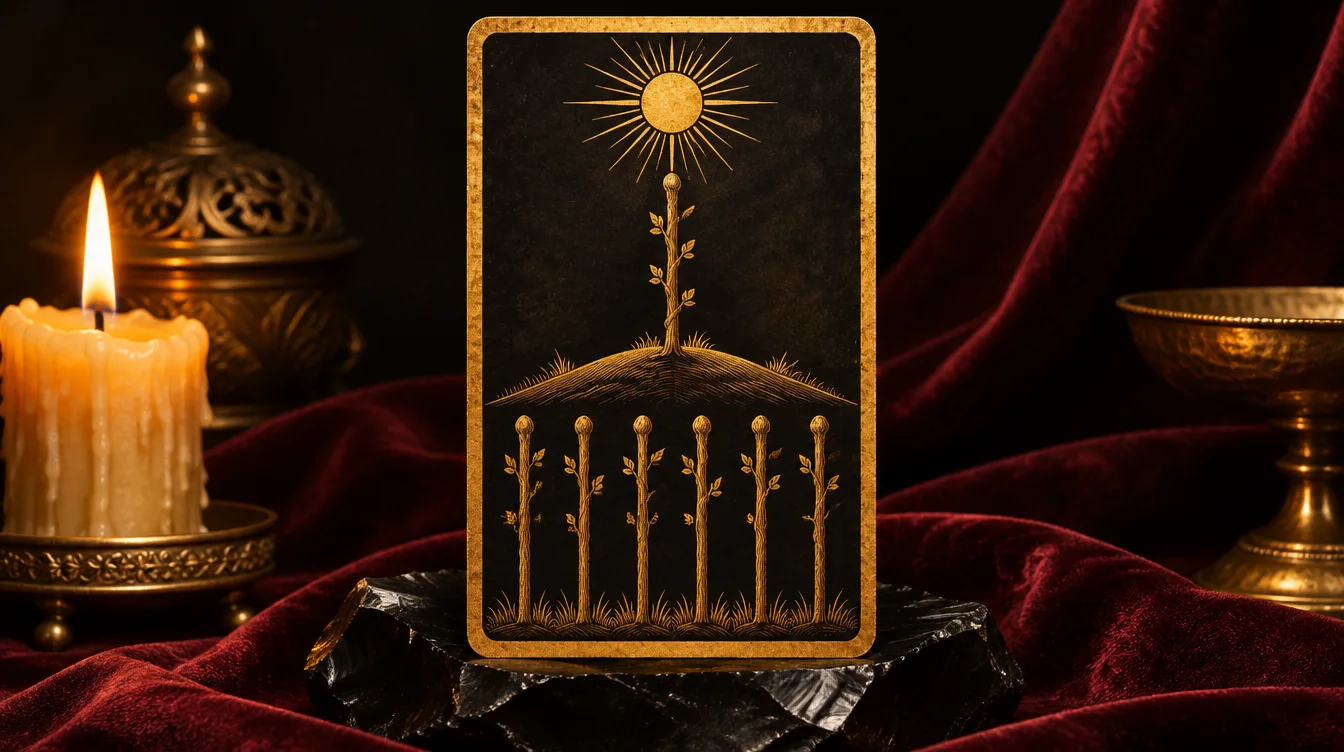
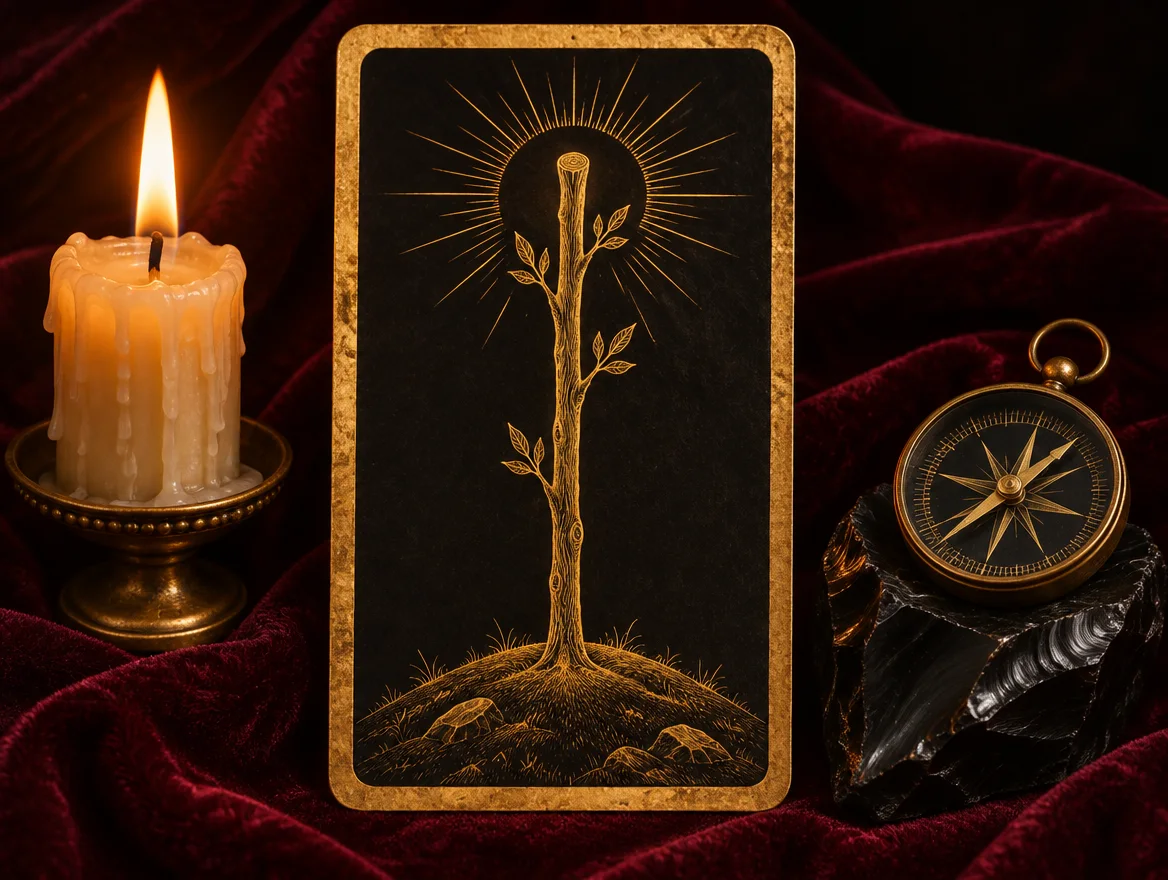
The Seven of Wands (also written 7 of Wands) is a Minor Arcana card from the suit of Wands. It shows one young man on high, rocky ground, holding a staff, while six more staves rise toward him from below. Readers usually take it as the card of standing your ground: you’re outnumbered or challenged, but you have the better position.
- Keywords: courage, conviction, standing firm, debate, competition, holding a position, pushback.
- Upright, in one line: a prompt to notice where you’re being challenged, and whether your position is worth holding with steady courage.
- Reversed, in one line: a prompt to look at doubt, anxiety or indecision, or at a stand that has turned into a fight you don’t need.
On The 9th King, tarot is a mirror for self-knowledge, not fortune-telling. The Seven of Wands doesn’t say opposition is coming, and it can’t tell you who is right. It asks how you hold your ground, and which ground is really yours.
Table of Contents
The Seven of Wands at a glance
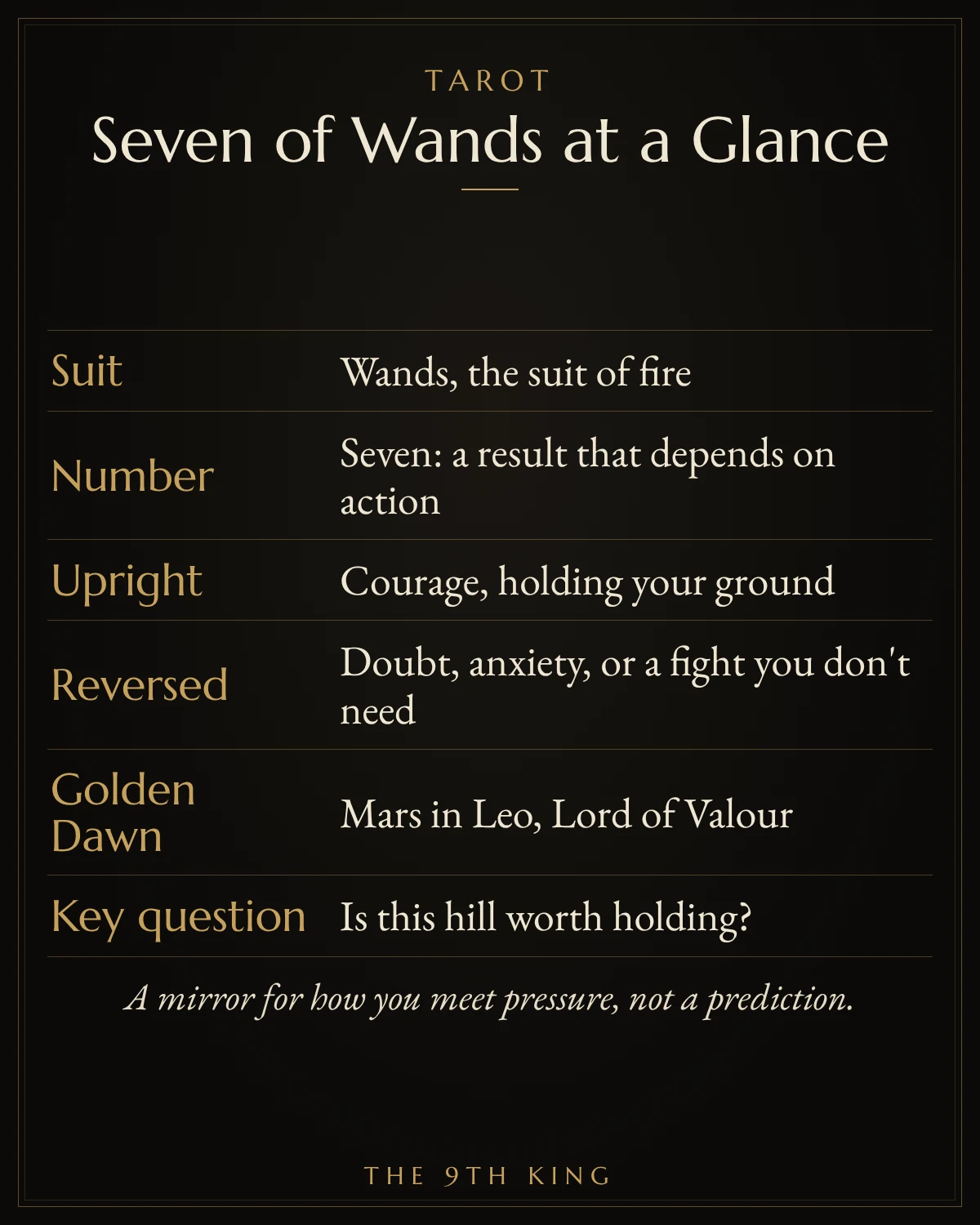
| Seven of Wands | |
|---|---|
| Arcana | Minor Arcana, a pip (number) card |
| Suit and element | Wands, the suit of fire |
| Number | Seven |
| Golden Dawn title | Lord of Valour |
| Astrology (Golden Dawn) | Mars in Leo |
| Upright | Courage, conviction, standing firm |
| Reversed | Doubt, anxiety, indecision, needless fights |
| Key question | Is this hill worth holding? |
What the Seven of Wands looks like
Most people know this card from the Rider–Waite–Smith deck, first published in London by William Rider & Son in 1909. A.E. Waite wrote the instructions, Pamela Colman Smith drew the 78 cards, and both were members of the Hermetic Order of the Golden Dawn. Waite’s guide, The Pictorial Key to the Tarot, followed in 1911 (Wikipedia: Rider–Waite Tarot).
The young man on the height
Waite’s description is brief: a young man on a craggy height, a rocky high point, brandishing a staff (sacred-texts.com: Waite, Seven of Wands). He’s not resting or retreating. He’s engaged.
The six staves below
Six other staves are raised toward him from below. Waite doesn’t say who holds them, so in a self-knowledge reading the six can stand for critics, competitors, family voices or your own doubts.
The high ground
He’s outnumbered, but above the others, and in Waite’s reading that height is why the card leans toward success. Apart from the young man, the height, his staff and the six staves, Waite gives no further visual detail, so anything else you notice on a printed deck is the artist’s addition.
Seven of Wands meaning (upright)
Waite calls this a card of valour and explains why in one line: on the surface “six are attacking one, who has, however, the vantage position” (sacred-texts.com: Waite, Seven of Wands). He then reads the card on two other levels. On the level of ideas, it points to discussion and heated argument. In business, it points to negotiation, trade rivalry, bargaining and competition. He ends by calling it a card of success, because the person on top may be out of the others’ reach.
The Golden Dawn’s teaching text on the tarot, Book T, as printed by Aleister Crowley in Liber LXXVIII, names the card the Lord of Valour. Its meaning begins: “Possible victory, depending on the energy and courage exercised.” It goes on to list opposition, obstacles and difficulties with the courage to meet them, alongside quarrelling, pretence and wrangling, and victory in small matters (Liber LXXVIII, sacred-texts.com).
Note the word possible: no promised win. On The 9th King, the upright Seven of Wands is read in three layers.
Courage under pressure
The card can point to a moment when you’re pushed and choose not to fold: speaking up in a meeting, or keeping a decision your family questions. The courage here isn’t loud. It’s staying where you stand.
Conviction you can explain
Waite’s “intellectual plane” reading is about argument. Upright, readers often take this as healthy debate: you know why you hold your view, and you can say it plainly. Ask yourself: Could I explain my position in two calm sentences, without attacking anyone?
Competition and earned ground
At work, the card can point to a crowded field where you’ve gained a foothold others want. Ask yourself: What did I do to reach this position, and what does holding it actually require?
Seven of Wands reversed
Readers handle reversals differently. Some read the opposite meaning, some read the same energy blocked, and some skip reversals entirely. Waite’s reversed meaning is short: perplexity, embarrassment and anxiety, plus a caution against indecision (sacred-texts.com: Waite, Seven of Wands).
On The 9th King, the Seven of Wands reversed usually points to one of three patterns, offered as questions, not predictions.
The footing slips
You’re still on the hill but no longer sure why, and your answer changes with whoever spoke last. This is Waite’s indecision. Ask yourself: Did I lose confidence in the position, or only in my right to hold it?
Every hill becomes a battle
The opposite slip is fighting everything: a question feels like an attack, and you defend positions nobody has threatened. Ask yourself: Which of these fights did someone else start, and which did I start because I expected one?
Worn down by the crowd
The reversed card can also point to tiredness from constant pushback, even over a fair position. That’s not weakness. It can be a sign to find allies or rest before deciding anything. Ask yourself: Who could stand on this hill with me?
| Pattern | Upright tone | Reversed tone |
|---|---|---|
| Courage | Steady, chosen | Shaky, or reckless |
| Argument | Clear and explainable | Anxious, or combative |
| Position | Earned high ground | Doubted, or overdefended |
| Energy | Focused | Scattered or drained |
Seven of Wands astrology: Mars in Leo
The 9th King uses Golden Dawn–derived correspondences, the tradition the Rider–Waite–Smith deck draws on. Other schools of tarot and astrology use different systems, and not every card maps to a single sign: the court cards and Aces, for example, are handled differently. What follows is one traditional framework, offered as symbolism.
How the number cards get their planets
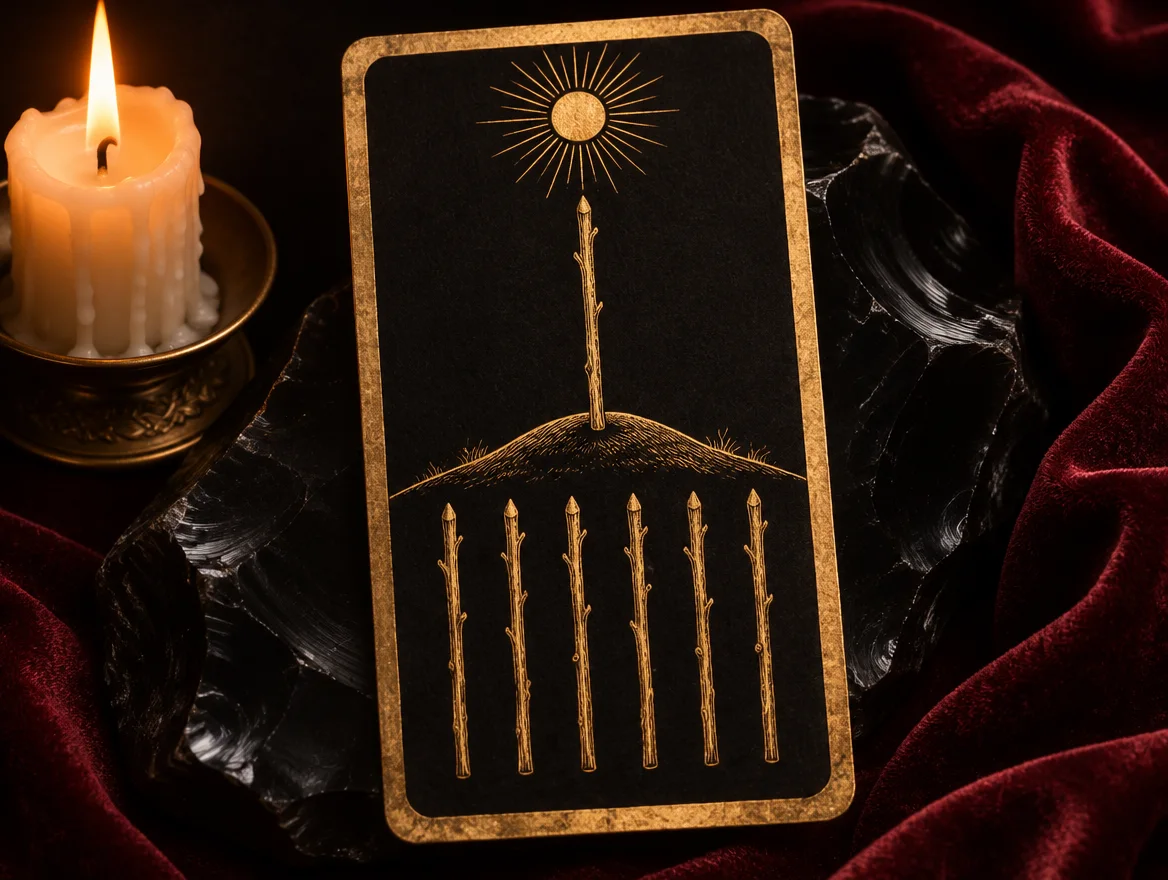
In Book T, the 36 small cards (the Twos through Tens) are matched to the 36 decans of the zodiac, ten-degree thirds of each sign, each ruled by a planet. Liber LXXVIII lists the Seven of Wands, Lord of Valour, as Mars in Leo, and its card description places the symbols of Mars and Leo above and below the central wand to represent the decan (Liber LXXVIII, sacred-texts.com).
The same text says the decan sequence begins in Leo, with Saturn’s decan first. Its table then runs Five of Wands (Saturn in Leo), Six of Wands (Jupiter in Leo) and Seven of Wands (Mars in Leo), so the Seven is the last of Leo’s three decan cards. Book T also groups all the Sevens under Netzach on the Kabbalistic Tree of Life, says the Sevens show a possible result that depends on the action then taken, and sums up this card as opposition met with courage. The suit of Wands, in the same text, is the suit of fire.
What Mars brings
Mars is the planet of drive and assertion, the traditional ruler of Aries. Our Aries Personality Traits page explores that raw, first-move energy. On this card, Mars is the staff in the young man’s hand: the part of you that’s ready to act, not just think.
What Leo brings
Leo is fixed fire, ruled by the Sun: the sign of pride, heart, visibility and self-expression. Our Leo Personality Traits guide covers its warmth and its shadow. On this card, Leo is the hill itself: a position you’ve claimed in public, tied to your sense of who you are.
The tension in the pairing
Mars wants to win. Leo wants to be seen and respected. Together they’re brave and a little touchy: pride can turn a simple disagreement into a test of worth. The Seven of Wands sits on that line: valour that serves something real, or valour that mostly protects your image.
The 9K reading: hold the hill, or pick the fight?
The card’s tension
The Seven of Wands holds two true things at once: I believe in this and I’m being challenged. Under pressure, some people fold to end the tension. Others dig in harder than the issue deserves. The card asks a third thing: hold what’s truly yours, and let the rest go without shame.
The shadow side
The shadow of the Seven of Wands is needing to win to feel safe. It’s the voice that hears a question as an insult. It can look like:
- Defending your identity instead of your point. Being wrong about one thing feels like being wrong as a person.
- Assuming the six are enemies. Some of the staves below may be questions, feedback or people who simply see it differently.
- Arguing to the last word. The goal becomes ending the conversation on top, not reaching understanding.
- Projection. Reading hostility into people because of past conflicts. Our guide to psychological projection explains how this works.
There’s a quieter shadow too: giving up ground you had every right to hold, just to be liked. That one rarely looks like conflict, but it costs as much.
Both patterns usually began as sensible responses to something real. The question is whether they fit your life now. Zodiac Shadow Work shows how they surface sign by sign.
Which hills are worth holding
Not every challenge needs the same response.
| Response | When it may fit |
|---|---|
| Hold | It touches your values, safety, work or role |
| Talk | The other view may hold something you’ve missed |
| Leave | It’s mostly about pride or winning |
| Get support | It’s too much to carry alone |
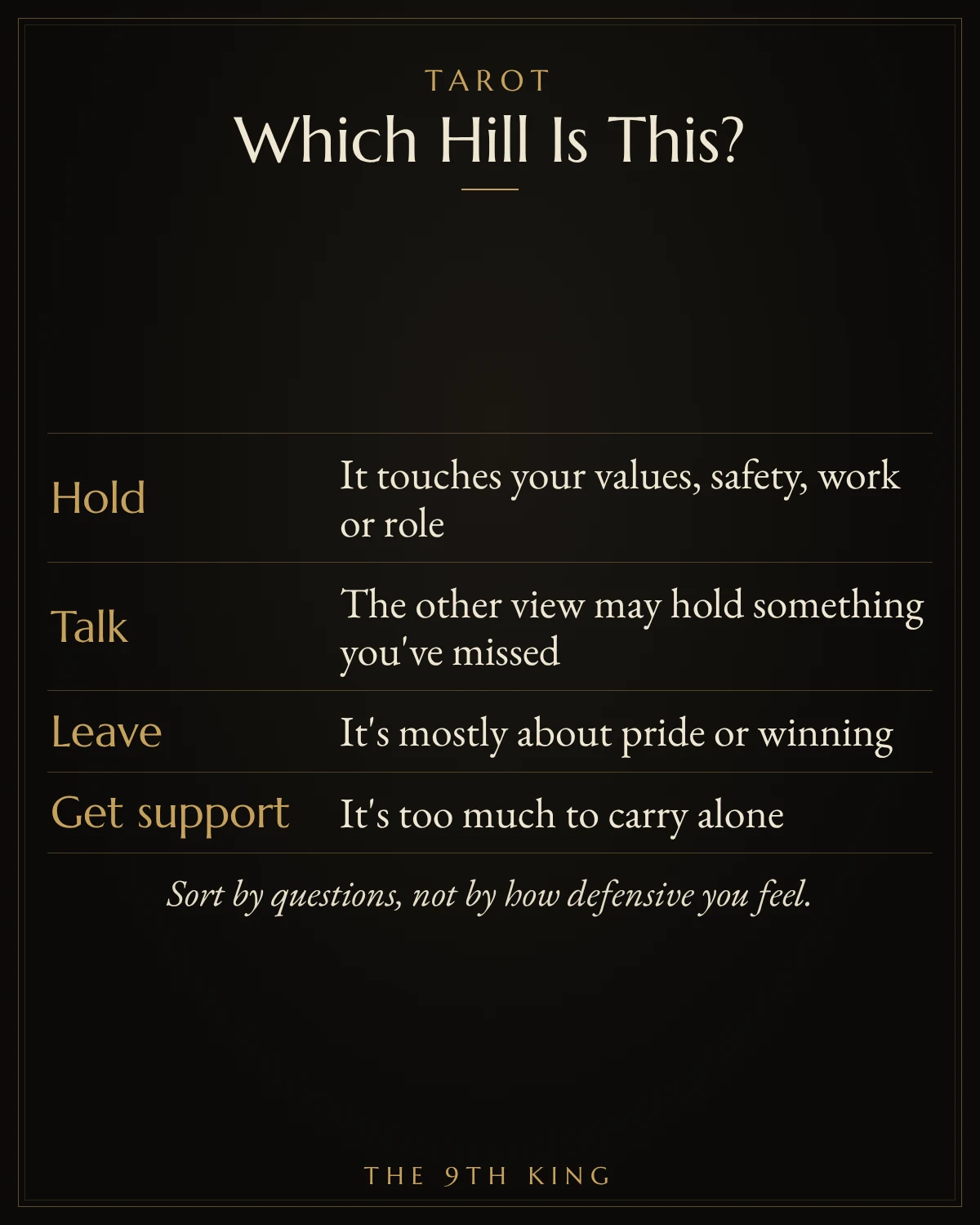
Use questions, not feelings, to decide. Feeling defensive doesn’t prove you’re wrong, and feeling sure doesn’t prove you’re right. Ask instead: What exactly is being challenged? What do I know, and how do I know it? What would I lose by stepping back, and what would I lose by holding on?
When the pushback is mistreatment. Some opposition isn’t a debate. If someone is threatening, controlling or hurting you, standing your ground can mean getting distance, saying no for good or leaving, and the responsibility for that harm belongs to the person causing it. Put your safety first and lean on people and services you trust.
The self-mastery lesson
The lesson of the Seven of Wands is to hold your ground without making everyone an enemy. You can feel shaken and still hold a considered position. Conviction can listen to a hard question, take what’s useful and still stand where it stands. You choose your hills on purpose, and you don’t need to win every exchange to know your worth.
Seven of Wands vs Nine of Wands
Both cards show a figure with staves, so they’re easy to mix up. Here’s how The 9th King reads the difference.
| Seven of Wands | Nine of Wands | |
|---|---|---|
| Moment | The challenge is happening now | After many battles, on watch |
| Figure | Young man on high ground | Tired figure before a fence of staves |
| Golden Dawn | Mars in Leo, Lord of Valour | Moon in Sagittarius, Lord of Great Strength |
| Core question | Is this hill worth holding? | Is this a boundary or a wall? |
Both Golden Dawn lines come from the same Liber LXXVIII table (sacred-texts.com). The Nine of Wands shows what long effort leaves behind.
Seven of Wands as feelings, in love and at work
Seven of Wands as feelings
When someone asks “how does this person feel?” and draws the Seven of Wands, readers often take it as feelings mixed with defensiveness: someone who cares but feels judged, pressured or on trial. A card can’t tell you what another person feels, so look at what you can observe, and ask yourself: Am I approaching this as a conversation, or as a challenge they have to survive?
Seven of Wands love meaning
In a love reading, the upright card can point to standing up for a relationship or a need when others question it, or to two people who disagree without crushing each other. The reversed card can point to a partnership where small disagreements become contests, or to one person quietly giving up ground to avoid conflict.
Tarot can’t tell you whether to stay or leave, and this page won’t either. Useful questions:
- What am I defending in this relationship, and is it a real need or a point of pride?
- When we disagree, do we both get to finish our sentences?
- Is there one issue I keep giving up on that I actually care about?
Healthy disagreement rests on consent and respect: each person is free to hold a view and free to say no. For fiery and sensitive styles, see fire and water relationships.
Seven of Wands at work
Waite tied this card to negotiation and competition. Upright, readers often take it as standing behind earned work under scrutiny. The shadow version is treating feedback as an attack, or defending a plan after the facts have changed. This is reflection, not career or financial advice. Ask yourself: Which part of my position rests on evidence, and which part rests on not wanting to look wrong?
Practical exercise: the hill audit
You need about twenty minutes and a notebook. Like every prompt here, it’s optional.
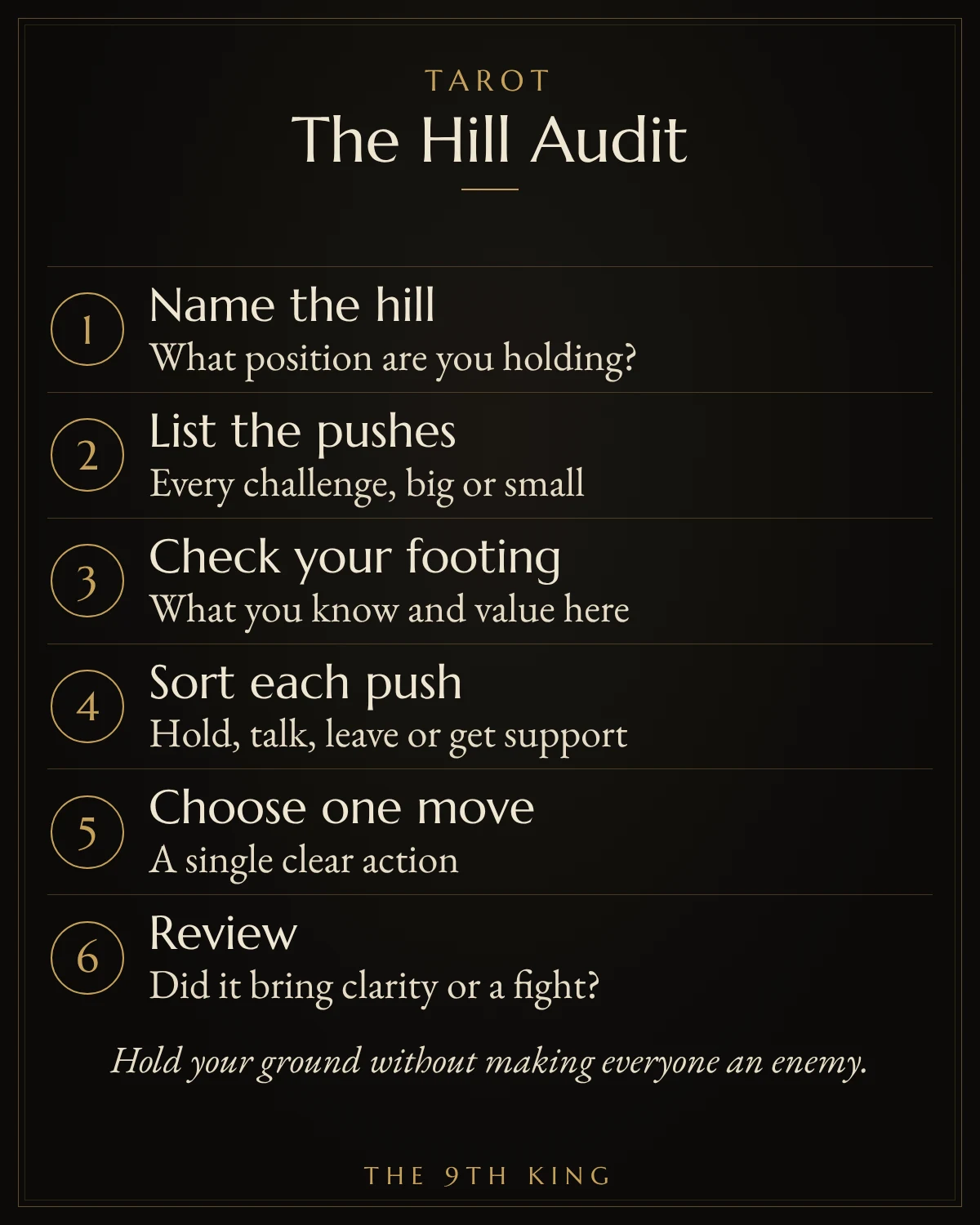
Step 1: Name the hill
Write one sentence: What position am I holding right now? A decision, a boundary, a project, a belief. If there are several, pick the one that takes the most energy.
Step 2: List the pushes
List every challenge to that position, however many. Include outside voices (a manager’s doubt) and inside ones (who do you think you are?). Don’t judge them yet.
Step 3: Check your footing
Write what you actually know and value here: facts you’ve checked, experience you have, the value the position protects. This is your high ground. If it’s thin, that’s useful too.
Step 4: Sort each push
Next to each push, write Hold, Talk, Leave or Get support, using the table above.
Step 5: Choose one move
Pick one clear action for this week: a calm sentence, a conversation you’ll open if it feels safe and useful, an argument you’ll drop, or a person you’ll ask for support.
Step 6: Review
At the end of the week, check: did your move bring clarity, or more fighting? Either answer shows which hills are worth your energy.
A worked example (fictional)
Marcus (fictional) recently left a stable job to freelance as a designer. His parents question it at every dinner, a former colleague hints he’ll be back, and his own fear keeps running the numbers. He draws the Seven of Wands upright and recognizes himself.
In the hill audit, he names the hill: “my decision to freelance for at least a year.” His pushes: his parents’ worry, the colleague’s comments, a slow month and his own fear. His footing: savings he planned for, two steady clients and a clear reason he left.
He sorts them. His parents’ worry goes under Talk: they may have useful questions about his plan. The colleague’s hints go under Leave. The slow month goes under Hold, since he planned for it. His fear goes under Get support, so he books time with a freelancer friend.
His one move: at dinner, he shares his one-year plan in two sentences instead of defending himself for an hour. The talk is calmer. He’s still on the hill, but not fighting everyone on it.
Journal prompts for the Seven of Wands
- What position am I holding right now, and why does it matter to me?
- Which of the challenges I face come from outside, and which come from my own doubt?
- When did I last change my mind because of a good argument, and how did that feel?
- Where do I fight to be right when I could listen instead?
- Where have I given up ground I wish I’d held?
- What would it look like to hold my position calmly, without needing the last word?
For more questions like these, our shadow work prompts collection goes deeper, and Shadow Work, Plainly explains how to begin. If your need to win, or your fear of conflict, goes back to childhood, inner child work can be a gentle next step.
A warm note: this is reflective practice, not therapy. If conflict in your life is tied to trauma or abuse, or if you’re dealing with thoughts of self-harm or distress that feels overwhelming, please work with a qualified therapist who can walk with you. It’s always fine to stop a prompt that feels like too much.
Myths and misreadings of the Seven of Wands
- “The Seven of Wands means people are against you.” No. A card can’t tell you about other people’s motives. On The 9th King it reflects how you’re meeting pressure, not who is plotting what.
- “It means you’ll win.” Waite does call it a card of success, but Book T frames it as possible victory that depends on courage and effort (Liber LXXVIII, sacred-texts.com). On The 9th King we don’t read outcomes at all.
- “Standing your ground means never backing down.” Courage includes changing your mind when the facts change. Holding every hill is exhaustion, not strength.
- “Mars in Leo means this card is about Leo people.” No. The correspondence describes the card’s symbolism in the Golden Dawn tradition. Anyone can draw it, whatever their sign.
Seven of Wands: FAQ
What does the Seven of Wands mean?
The Seven of Wands is a Minor Arcana card in the suit of Wands. It shows a young man on high ground holding a staff while six staves rise toward him from below. Readers commonly take it as courage, conviction and standing your ground under pressure. On The 9th King, it’s a mirror for how you meet challenges, not a prediction of conflict.
What does the Seven of Wands reversed mean?
Reversed, the Seven of Wands is often read as doubt, anxiety or indecision, which matches Waite’s own reversed meaning. On The 9th King it can also point to fighting battles you don’t need, or to feeling worn down by constant pushback. Some readers don’t use reversals. Treat it as a question, such as “which of these fights is mine?”
What does the Seven of Wands mean as feelings?
As feelings, readers often take the Seven of Wands as care mixed with defensiveness: someone who feels judged or on trial. A card can’t reveal what another person feels, so look at what you can observe, like how they respond to questions. It can also prompt you to check whether you’re treating the connection as a conversation or a contest.
What does the Seven of Wands mean in love?
In love, the upright card can point to standing up for a relationship or a need, or to two people who can disagree without crushing each other. Reversed, it can point to small disagreements turning into contests, or to one person giving up ground to keep the peace. The card doesn’t tell you to stay or leave.
What zodiac sign is the Seven of Wands?
In the Golden Dawn system, the tradition The 9th King uses, the Seven of Wands corresponds to Mars in Leo. Liber LXXVIII, which prints the Golden Dawn’s Book T, calls it the Lord of Valour, the last of Leo’s three decan cards. Other schools use different systems, so treat this as one symbolic framework.
Is the Seven of Wands a yes or no card?
The 9th King doesn’t do yes or no readings, because tarot here is a tool for self-reflection, not fortune-telling. Instead of asking whether the card says yes, ask what it shows you: where you’re being challenged, what your footing is, and whether this hill is worth your energy.
Is the Seven of Wands a good or bad card?
Neither, on The 9th King. Waite called it a card of valour and success, while Book T describes possible victory that depends on courage, alongside opposition and quarrelling. Both point to a hard moment with real strength in it. Read the card as a mirror for how you hold your ground, not as an omen.
Your next step: do the hill audit above for one position you’re holding this week. Then read our Leo Personality Traits guide and find where Leo falls in your own birth chart: that house can show where pride and courage meet in your life, the same mix the Golden Dawn tied to this card.
Explore Next
- The pride and heart behind the card: Leo Personality Traits
- Mars at full speed: Aries Personality Traits
- When others look like threats: Psychological Projection
- Go deeper with questions: Shadow Work Prompts
- The suit’s other fire: Ace of Wands · King of Wands · Nine of Wands
- Courage in the Major Arcana: Strength · The Chariot
- Reading by feel: Intuitive Tarot (Code of Ascension)
- New to the cards: Tarot for Beginners: How Tarot Really Works (Code of Ascension)
- More tarot on The 9th King: Tarot Card Meanings · Minor Arcana · Tarot & the Zodiac · Shadow Work Tarot Spread
- More cards in this set: Five of Wands, Two of Wands, Three of Wands, Four of Wands
Final Thought: Choose Your Hills
The young man on the Seven of Wands doesn’t win because he fights hardest. He’s steady because he knows where he stands. Pick the ground that’s truly yours, hold it calmly, and let the rest go without shame. Know your nature. Rule your life.
About the Author
King is the founder of The 9th King, where zodiac psychology, relationships and shadow work are explored as tools for self-knowledge rather than fortune-telling. He’s a Libra Sun, and writes about the personal side of astrology on King The Kemist. Astrology on The 9th King is interpretation and self-reflection, not prediction or established fact.
Leave a Reply