
Quick Answer: What Does the Queen of Cups Mean?
The Queen of Cups is the queen of the suit of Cups, the tarot suit linked with water and feeling. In the classic Rider–Waite–Smith image, she sits on a carved throne at the edge of the sea and gazes into an ornate cup that, unlike the other cups in the suit, is closed with a lid.
Keywords: empathy, emotional depth, intuition, compassion, emotional safety, care with limits.
- Upright, in one line: you feel deeply and read the room well, and the card invites you to use that sensitivity with steadiness, care and a clear sense of what is yours.
- Reversed, in one line: the same sensitivity spills over, so the card asks whether you’re absorbing other people’s feelings, losing your own, or using empathy to manage people instead of meeting them.
On The 9th King, tarot is a mirror for self-knowledge, not fortune-telling. The Queen of Cups doesn’t predict that a caring person will appear. She points to how you hold feeling: your own and everyone else’s.
Table of Contents

The Queen of Cups at a glance
| Queen of Cups | |
|---|---|
| Arcana | Minor Arcana, court card |
| Suit | Cups (water) |
| Rank | Queen |
| Golden Dawn title | Queen of the Thrones of the Waters |
| Element pairing | Water of Water |
| Zodiac span | 20° Gemini to 20° Cancer |
| Upright themes | Empathy, intuition, care with limits |
| Reversed themes | Absorbing, losing yourself, managing others |
| Key question | What here is mine to feel, and what is theirs? |
What the Queen of Cups shows: the traditional imagery
Most readers today know this card from the Rider–Waite–Smith deck, first published by William Rider & Son in London in 1909. A.E. Waite gave the instructions and Pamela Colman Smith drew the cards; both were members of the Hermetic Order of the Golden Dawn (Wikipedia: Rider–Waite Tarot). Britannica dates the first tarot decks to Italy in the 1430s and their occult use to France around 1780 (Britannica: Tarot).
The queen and the closed cup
In the traditional image, the Queen sits on an ornate stone throne carved with sea nymphs, fish and scallop shells. She holds an elaborate cup with handles shaped like angels and looks at it with deep concentration (Wikipedia: Queen of Cups).
The detail that matters most for this page is the lid. Every other cup in the suit is open. Hers is covered. Many readers take that as feeling held deeply but not poured out for everyone to see.
The water at her feet
Her throne stands right at the shoreline, with the sea at her feet and small pebbles along the edge (Wikipedia: Queen of Cups). She’s near the feeling, not under it.
What Waite said about her
In The Pictorial Key to the Tarot (1911), Waite describes her as beautiful, fair and dreamy, like someone who sees visions in a cup. Then he adds the line that keeps her from being a daydreamer: “she sees, but she also acts, and her activity feeds her dream” (Waite, Pictorial Key, Queen of Cups, sacred-texts.com).
The Queen of Cups isn’t passive. Her sensitivity leads to a choice.
Queen of Cups meaning upright
Upright, readers commonly take the Queen of Cups as emotional maturity: feeling a lot without being run by it. Waite’s divinatory list includes an honest, devoted woman who will be of service, loving intelligence that gives rise to vision, success, happiness and pleasure, wisdom and virtue (Waite, Pictorial Key). On 9K, the Queen can be anyone, and most often she’s a part of you.
- Empathy. You notice what people feel, often before they say it.
- Emotional depth. You can sit with a hard feeling without rushing to fix it.
- Emotional safety. People relax around you because you don’t punish feelings.
- Care with limits. The closed cup: you feel it all, and you still choose what to pour.
The upright card’s best quality is steady presence. She watches the water and stays on her throne.
Queen of Cups reversed
Reversed, the same gifts tip out of balance. Waite admits the old reversed accounts vary, from a good woman to one not to be trusted (Waite, Pictorial Key). Modern readers usually soften this into emotional insecurity, codependency, absorbing other people’s moods, or using emotional insight as a way to control (Wikipedia: Queen of Cups).
On 9K, we read it through three patterns. None means bad luck.
1. The lid comes off: absorbing everything
You walk into a room and leave with everyone’s mood. The card can point to taking in feelings that were never yours to carry.
2. The queen leaves her throne: losing yourself
You care for everyone else so fully that your own needs go quiet. This is the martyr pattern: giving until there’s nothing left, then feeling resentful or numb. The reversed card asks: When did I last let someone hold my cup?
3. The cup becomes a tool: managing people
Reading people well can turn into steering them: saying what they want to hear so they’ll do what you want, or using their feelings to get your way. That’s different from calming someone down to keep yourself or others safe, which is protection, not manipulation. If you’re soothing someone because you’re afraid of them, that’s a safety issue, and the responsibility for it belongs to the person causing the fear. The reversed card asks: Am I meeting this person, or managing them for my own advantage?
Sometimes the reversal also points the other way: the lid sealed shut, feelings switched off because they once became too much.
Cups, water and the Golden Dawn: the card’s correspondences
The correspondences below are Golden Dawn–derived correspondences, the tradition The 9th King uses, which is the system the Rider–Waite–Smith deck draws on. Other schools differ, and not every card maps to a single sign; court cards and Pages work differently from the numbered cards.
Cups are water
In the Golden Dawn’s tarot text known as Book T, printed by Aleister Crowley as Liber LXXVIII, the Ace of Cups is called the Root of the Powers of Water (Liber LXXVIII, sacred-texts.com).
The court-card naming
The 9th King follows the court-card naming in Liber LXXVIII (the Golden Dawn’s Book T): Knights are fire of their suit, Queens water, Kings air, Pages earth. Matching those Golden Dawn titles to the Rider–Waite–Smith cards is 9K’s convention; other systems pair them differently, so check which naming a source uses.
Liber LXXVIII calls the Queen of Cups “The Queen of the Thrones of the Waters,” and lists her element pairing as Water of Water: the watery part of water itself (Liber LXXVIII).
What the Golden Dawn says about Queens
Liber LXXVIII describes its four Queens as seated on thrones, a force that is steady and unshaken, slower than the others but enduring (Liber LXXVIII).
Its own picture of the Queen of Cups is different from Smith’s: a crowned queen on a throne above flowing water with lotuses in it, an ibis at her side, and a crayfish rising out of her cup. Its character notes are frank: imaginative, poetic, kind and good-natured, but slow to go to much trouble for others, with an imagination that outruns her feeling. And she is “very much affected by other influences” (Liber LXXVIII).
That last phrase is the key to this page. Her strength and her risk are the same thing.
A crayfish also crawls out of the pool on The Moon, the card of what rises from below.
Her zodiac span: 20° Gemini to 20° Cancer
In Liber LXXVIII, the Kings, Queens and Princes each rule a span of the zodiac, running from 20° of one sign to 20° of the next, so that, in effect, they link one sign to the next. The Queen of Cups rules from 20° Gemini to 20° Cancer (Liber LXXVIII). Aces and Princesses (the Pages) don’t take a span.
That span covers the last ten degrees of Gemini and the first twenty of Cancer. Liber LXXVIII’s decan table assigns those three ten-degree slices to three numbered cards:
| Degrees | Decan ruler | Numbered card |
|---|---|---|
| 20°–30° Gemini | Sun | Ten of Swords |
| 0°–10° Cancer | Venus | Two of Cups |
| 10°–20° Cancer | Mercury | Three of Cups |
Source: Liber LXXVIII. Dates for these degrees shift slightly each year, so check your own placements by degree.
Gemini and Cancer, as a pairing
Read the Queen alongside both signs as a reflection, not a personality claim:
- Gemini personality traits: the airy, curious mind that reads people quickly and picks up every signal in the room.
- Cancer personality traits: the protective, caring heart that feels those signals in the body and wants to look after them.
Together: she notices everything, and wants to hold all of it. If you have planets or your Moon in that span, these themes may feel familiar; our Moon sign guide explains how the Moon shapes emotional habits. For the full map of cards and signs, see Tarot and the Zodiac.

The 9th King reading: tension, shadow and self-mastery
The 9K question: How do you hold feeling, and who pours from your cup?
The tension: open heart vs. closed cup
The Queen of Cups lives between being open and being contained. Open, she can feel what others feel. Contained, she stays herself while she does it. Lose the openness and you go cold. Lose the containment and you go under. The card asks for both: a full cup with a lid you control.
The shadow side
The card’s shadow tends to show up in a few familiar shapes:
- The sponge. You soak up every mood around you and call it empathy, even when it leaves you wrung out.
- The martyr. You give and give, then feel unseen. Care becomes a quiet debt.
- The rescuer. Other people’s pain becomes your project.
- The handler. You use your read on people to keep the peace, keep them close or keep control.
- The sealed cup. You’ve shut feelings down to stay safe, and now nothing gets in or out.
If one stings, that’s information, not a verdict. Our zodiac shadow work guide covers the water signs’ shadows, which overlap with this card.
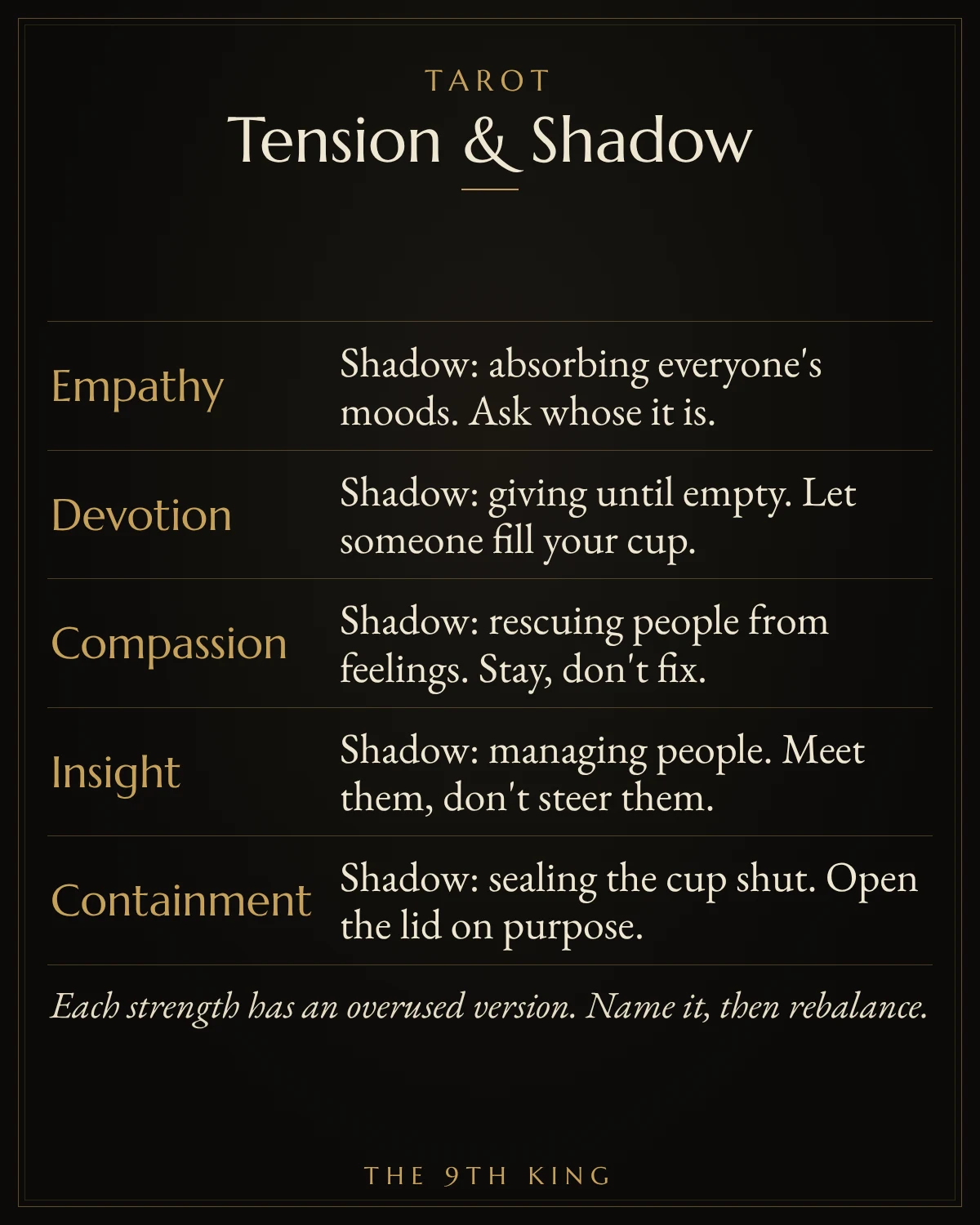
| Strength | Shadow version | The rebalance |
|---|---|---|
| Empathy | Absorbing everyone’s moods | Ask whose feeling it is |
| Devotion | Giving until empty | Let someone fill your cup |
| Compassion | Rescuing people from feelings | Stay with them, don’t fix them |
| Insight | Managing people | Meet people, don’t steer them |
| Containment | Sealing the cup shut | Open the lid a little, on purpose |
The self-mastery lesson
The Queen of Cups teaches one skill: feel it fully, then decide what to pour.
Empathy isn’t the problem. Empathy without a lid is. You can let a friend’s grief move you and still know the grief is theirs.
A boundary isn’t a wall around your heart. It’s the lid on the cup: you open it on purpose. It can sound like I care about this, and I can’t take it on tonight. With some people, it can mean a permanent limit or leaving the relationship altogether. If anyone is harming you, your safety comes first, and responsibility for that harm belongs to the person causing it, never to you for not being understanding enough.
If you tend to over-explain or go quiet when you set a limit, Privacy Without Mixed Signals covers how to keep things to yourself clearly and kindly, without confusing the people you love.
Queen of Cups as feelings and in love
What readers commonly say
Readers often take the Queen of Cups in a feelings position as deep, caring, protective feeling: tenderness that’s real, patient and attentive, though not always spoken out loud.
What a card can and can’t tell you
A card can’t read another person’s mind. A more useful question: What is this card showing me about my own feelings? Are you the one holding the closed cup, feeling more than you’ve said?
This is where psychological projection is worth knowing about. If you want to know how someone feels, ask them, kindly and without pressure.
Queen of Cups in love
In a love reading, readers commonly link the Queen of Cups with:
- Emotional attunement. Partners who notice each other’s moods and make room for them.
- Care that keeps its own shape. Devotion that doesn’t require disappearing into the other person.
- Emotional safety. A relationship where feelings can be said without being punished.
Reversed, it often turns to over-giving: tracking a partner’s moods until your own go missing. Ask: Am I caring for this person, or caretaking them?
The card doesn’t tell you to stay, leave, wait or confess. It asks whether you’re keeping hold of your own cup.
A worked example (fictional)
Dana (fictional) draws the Queen of Cups during a week when a close friend has been calling every night in distress. Dana listens for hours, then lies awake.
Upright reading: the card can point to Dana’s real gift: steady, warm presence. Dana asks: How do I keep offering this without losing sleep and myself? Dana tells the friend, “I want to be here for you. Can we talk at seven, for half an hour? And would you think about talking to a counselor too?”
If it had come up reversed: the reflection shifts to absorption. Dana asks: Am I carrying my friend’s feelings as if they were mine? Am I afraid that if I set a limit, I’m a bad friend?
Neither reading predicts what the friend will do.
Queen of Cups at work and in daily life
At work, readers often take the Queen of Cups as emotional intelligence: the colleague who senses tension in a meeting, the manager people trust with hard news, anyone in a caring role. Caring roles can quietly turn into absorbing roles. The card’s work lesson is the same as its self-mastery lesson: feel it, then decide what to carry home. A short walk after a shift may help mark the line between their day and yours.
Reversed, the card can point to emotional burnout or to being the unofficial office therapist.
None of this is career or financial advice.
Myths and misreadings about the Queen of Cups
- “The Queen of Cups always means a woman.” Waite read court cards as people and often by gender. On 9K, the Queen can stand for anyone, and most often for a part of you.
- “It’s a mother or pregnancy card.” Waite’s list includes a good mother (Waite, Pictorial Key), but we don’t predict pregnancy, health or any life event from a card.
- “Good empaths never say no.” The Queen’s cup has a lid. Limits are part of her nature, not a betrayal of it.
- “Reversed means someone will betray you.” Reversed on 9K points to a blocked or overused version of the same energy, not to a person’s hidden motives.
- “The Queen of Cups is a Cancer card.” In the Golden Dawn system we use, her span runs from 20° Gemini to 20° Cancer, so it reaches into both signs.
Journal prompts and a practical exercise
The prompts and exercise below are reflective practice, not therapy. If you’re working through trauma, abuse, thoughts of self-harm or distress that feels overwhelming, please work with a qualified therapist. And it’s always fine to stop a prompt that feels like too much and come back another day, or not at all.
Seven journal prompts for the Queen of Cups
- Whose feelings did I carry this week that weren’t mine to carry?
- When I sense someone is upset, what do I usually do first: listen, fix, soothe or withdraw?
- What did I learn growing up about saying no to someone who was hurting?
- Who in my life lets me pour out my own cup, and when did I last let them?
- Where am I keeping the peace instead of telling the truth?
- What does my body do when I’ve taken on too much of someone else’s mood?
- What here is mine to feel, and what is theirs?
For more prompts in this style, see our shadow work prompts. New to shadow work? Shadow Work, Plainly explains how to start safely.
The exercise: the Lid Check
A short practice for the moment you feel flooded by someone else’s emotions. Use it after a hard conversation, or whenever the Queen of Cups shows up in a reading.
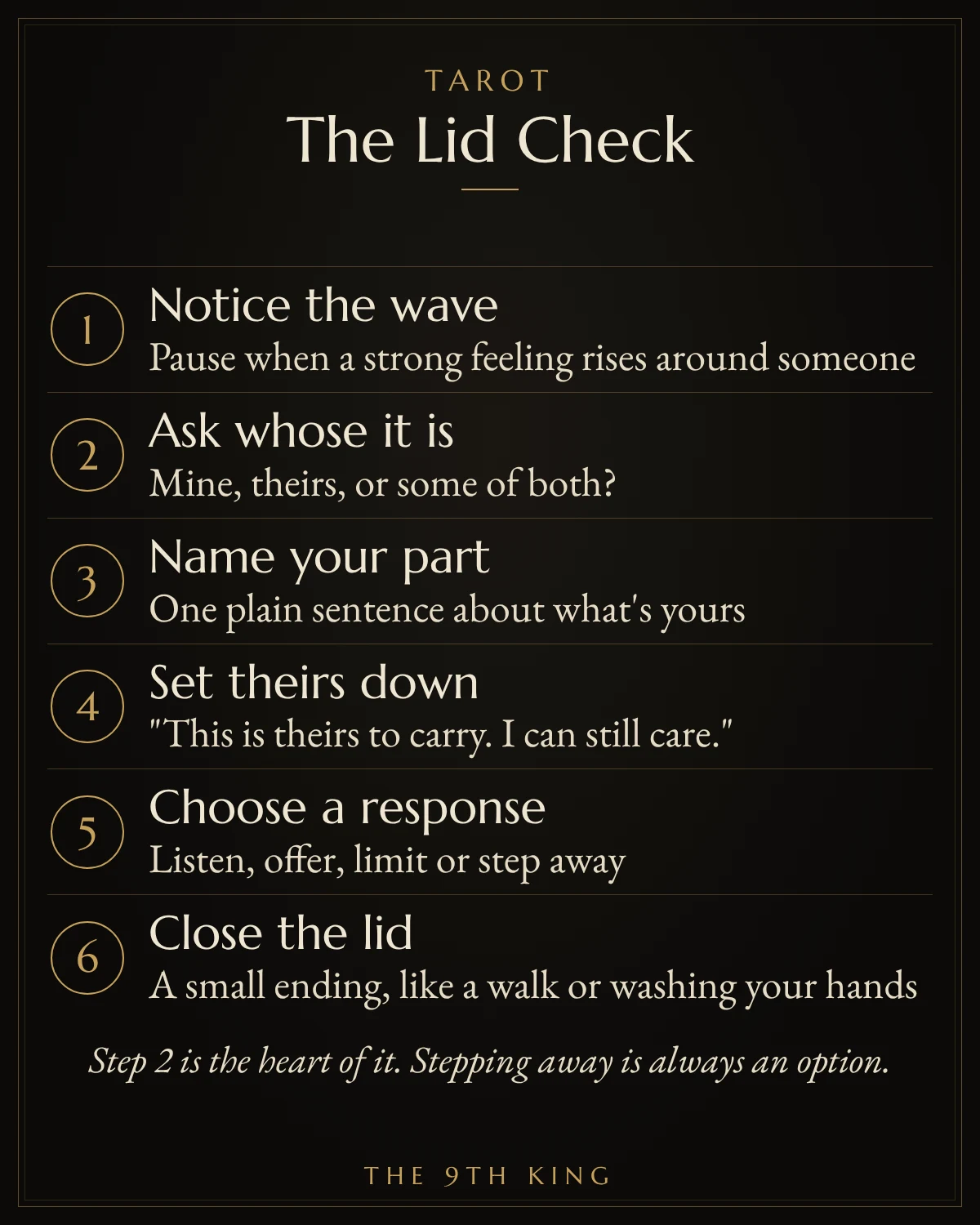
| Step | What to do | Example (fictional) |
|---|---|---|
| 1. Notice the wave | Pause when a strong feeling rises around someone | Chest tight after a friend’s call |
| 2. Ask whose it is | Mine, theirs, or some of both? | Mostly theirs, some mine |
| 3. Name your part | One plain sentence about what’s yours | “I’m worried I can’t help enough.” |
| 4. Set theirs down | “This is theirs to carry. I can still care.” | Said quietly, twice |
| 5. Choose a response | Listen, offer, limit or step away | Offer a set time to talk tomorrow |
| 6. Close the lid | A small ending, like a walk or washing your hands | A ten-minute walk |
- Step 2 is the heart of it. “Some of both” is a fine answer.
- Step 4 isn’t coldness. You still care; you just stop carrying it as your own.
- Step 5 includes stepping away. If someone is cruel or unsafe, a limit can be permanent, and you don’t owe anyone endless understanding.
- Step 6 may help, not cure. A small ritual can mark the end of a hard moment; it won’t erase it.
To go deeper, try our Shadow Work Tarot Spread. If you read intuitively, Code of Ascension’s guide to intuitive tarot (Code of Ascension) covers pairing card meanings with your first impressions.

Queen of Cups: FAQ
What does the Queen of Cups mean?
The Queen of Cups is the queen of the water suit, the suit of feeling. Upright, readers commonly take her as empathy, emotional depth, intuition and compassion that keeps its own shape. Her closed cup is the key image: she feels a great deal and still chooses what to pour. On The 9th King, she’s a mirror for how you hold feeling, not a prediction about anyone arriving in your life.
What does the Queen of Cups mean reversed?
Reversed, the Queen of Cups often points to sensitivity out of balance: absorbing other people’s moods, giving until you’re empty, or using emotional insight to manage people instead of meeting them. It can also point to the opposite, a cup sealed shut after feeling became too much. Reversed doesn’t mean bad luck or betrayal. It means your empathy needs a clearer lid.
What does the Queen of Cups mean as feelings?
In a feelings position, readers often take the Queen of Cups as deep, caring, protective feeling that may not be said out loud. A card can’t read another person’s mind, though. Start by asking what it shows about your own feelings, especially ones you’re holding back. If you want to know how someone else feels, ask them directly, kindly and without pressure.
What does the Queen of Cups mean in love?
In love readings, the Queen of Cups is commonly linked with emotional attunement, devotion and a relationship where feelings feel safe. Reversed, it often points to over-giving or keeping the peace at your own expense. It doesn’t tell you to stay, leave, wait or confess. It asks whether you can care deeply for someone and still keep hold of yourself.
What zodiac sign is the Queen of Cups?
In Liber LXXVIII, the Golden Dawn tarot text The 9th King follows, the Queen of Cups rules from 20° Gemini to 20° Cancer. So she isn’t tied to one sign; her span links late Gemini with early and middle Cancer. Other systems assign court cards differently, so check which tradition a source follows.
What element is the Queen of Cups?
Cups are the water suit, and Liber LXXVIII lists the Queen of Cups as Water of Water, the watery part of water itself. The 9th King follows that book’s court-card naming: Knights are fire of their suit, Queens water, Kings air and Pages earth. That makes the Queen of Cups the purest expression of the water element among the court cards.
Is the Queen of Cups a person or a part of me?
It can be read either way. Waite described court cards as people, and the Queen of Cups as an honest, devoted person who will be of service. Many modern readers also treat court cards as parts of yourself. On The 9th King we start there: the Queen of Cups is the empathic, caring part of you, and the question is whether she has a throne or is drowning.

Your next step: the next time you leave a conversation carrying someone else’s mood, run the Lid Check above and write down which part was yours. Then read Privacy Without Mixed Signals to practice keeping your own cup closed kindly and clearly.
Explore Next
- Keeping things to yourself, kindly: Privacy Without Mixed Signals
- The quick, signal-reading mind: Gemini Personality Traits
- The caring, protective heart: Cancer Personality Traits
- Seeing your feelings in others: Psychological Projection
- The suit’s youngest card: Page of Cups
- New to tarot: Tarot for Beginners: How Tarot Really Works (Code of Ascension)
- More tarot on The 9th King: Tarot Card Meanings · Minor Arcana · Tarot & the Zodiac · The Moon
- More new cards: King of Cups · Knight of Cups · Ace of Cups · Six of Cups

Final Thought: Keep Your Throne by the Water
You don’t have to feel less to be well. The Queen of Cups feels everything that comes in on the tide, and she still sits on dry stone with a lid on her cup. Stay close to the water, let it move you, and decide for yourself what you pour. Know your nature. Rule your life.
About the Author
King is the founder of The 9th King, where zodiac psychology, relationships and shadow work are explored as tools for self-knowledge rather than fortune-telling. He’s a Libra Sun, and writes about the personal side of astrology on King The Kemist. Astrology on The 9th King is interpretation and self-reflection, not prediction or established fact.
Leave a Reply