
Quick Answer: What Does the Six of Pentacles Mean?
The Six of Pentacles (also written 6 of Pentacles) is a Minor Arcana card from Pentacles, the earth suit of work, money, body and home. In the traditional image, a person dressed as a merchant weighs money in a pair of scales and gives it to people in need. On The 9th King, it’s the card of the scales: what you give, what you receive, and the terms that sit between the two.
- Keywords: giving, receiving, generosity, gifts, fair exchange, sharing what you have, support, the terms of help.
- Upright, in one line: a prompt to notice how help moves in your life right now, if you’re giving or receiving support and want both sides to stay fair and freely chosen.
- Reversed, in one line: wanting, envy or giving with hidden terms; a prompt to look honestly at the strings, the scorekeeping, or the discomfort of being on either side of help.
On The 9th King, tarot is a mirror for self-knowledge, not fortune-telling. The Six of Pentacles doesn’t say help is coming. It asks whether your balance of giving and taking is agreed or assumed.
Table of Contents

The Six of Pentacles at a glance
| Six of Pentacles | |
|---|---|
| Arcana | Minor Arcana, a pip (number) card |
| Suit and element | Pentacles, linked with earth |
| Number | Six |
| Golden Dawn title | Lord of Material Success |
| Astrology (Golden Dawn) | Moon in Taurus |
| Upright | Gifts, generosity, fair exchange |
| Reversed | Desire, envy, uneven terms |
| Key question | Are these terms agreed? |
What the Six of Pentacles looks like
Most people know this card from the Rider–Waite–Smith deck, published in London by William Rider & Son in December 1909. A.E. Waite wrote the instructions and Pamela Colman Smith drew the art, and both were members of the Hermetic Order of the Golden Dawn (Wikipedia: Rider–Waite Tarot).
Waite’s description in The Pictorial Key to the Tarot is two sentences (sacred-texts.com: Waite, Six of Pentacles), so this section stays close to them.
The merchant and the scales
Waite describes a person dressed as a merchant who weighs money in a pair of scales. This isn’t money thrown into a crowd. It’s measured and handed out on purpose. On The 9th King, the scales are the heart of the card: every act of giving has a weight, and someone decides what it is.
The people in need
The merchant gives the money to people Waite describes as needy and distressed. He doesn’t blame them for their need, and neither do we. On The 9th King, they’re people in a hard season, not lesser people.
Success and goodness of heart
Waite says the scene is a testimony to the merchant’s “own success in life, as well as to his goodness of heart” (sacred-texts.com: Waite, Six of Pentacles). The giving shows two things: that he has enough to share, and that he chooses to.
On the early Smith card
On the 1909 Smith card (Wikimedia Commons: 1909 Six of Pentacles scan), six pentacles fill the upper card, two people kneel on either side of the merchant, he holds the scales in one hand, and coins fall from his other hand toward one kneeling person’s open hands. Apart from the merchant, the scales and the giving to people in need, none of this is in Waite’s text.

The Golden Dawn version of the card
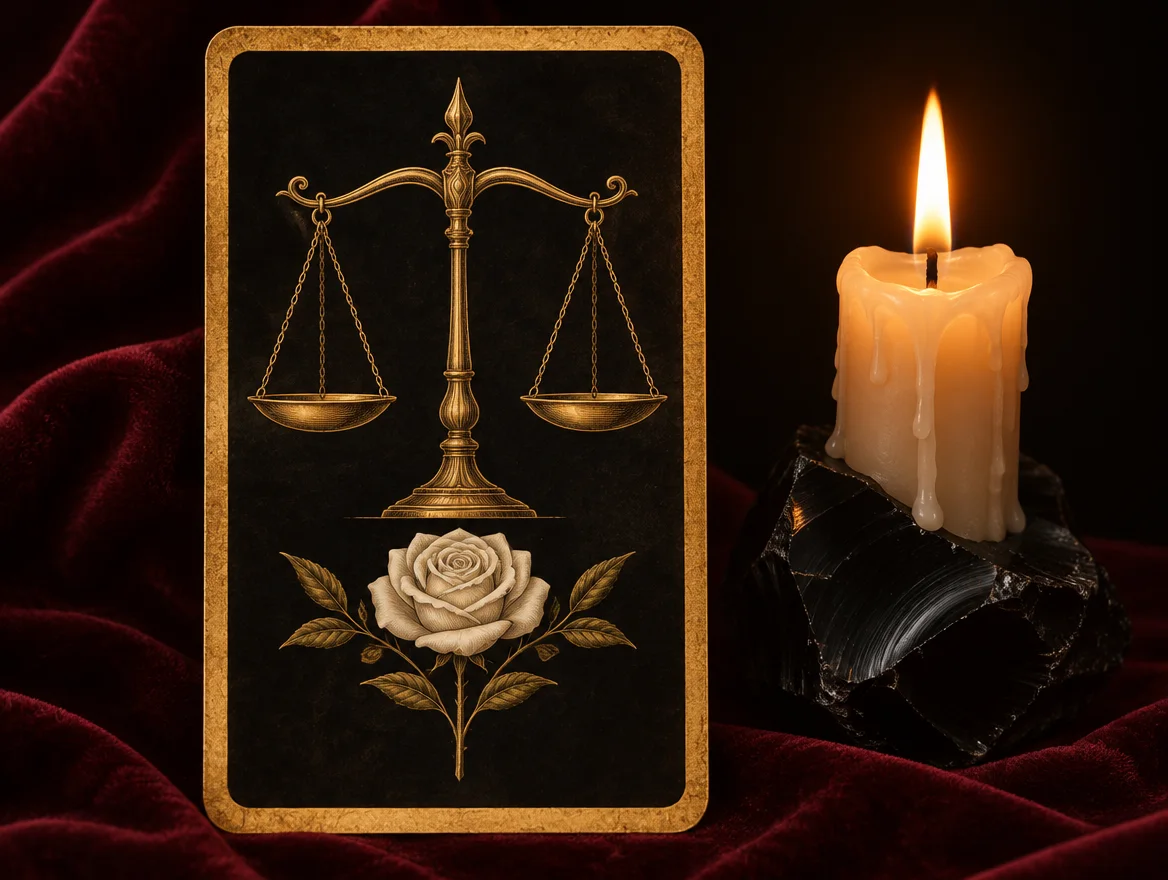
The Golden Dawn’s teaching text on the tarot, Book T, as printed by Aleister Crowley in Liber LXXVIII, describes a different design: a white radiant angelic hand holds a rose branch with white roses and buds, each touching a pentacle, and the six pentacles stand in two columns of three (Liber LXXVIII, sacred-texts.com). There’s no merchant and no scales, but the branch reaching every pentacle fits the theme of a fair share.
Six of Pentacles meaning (upright)
Waite’s upright meanings are brief: presents, gifts and gratification. He adds that another account gives attention, vigilance, a sense that now is the accepted time, and present prosperity (sacred-texts.com: Waite, Six of Pentacles).
Book T is broader. Under the title Lord of Material Success, it lists success and gain in material undertakings, power, influence and rank, and calls the card fortunate, successful, liberal and just (Liber LXXVIII, sacred-texts.com). “Liberal” here means openhanded.
On The 9th King, we read the upright card as help that moves well. It has three layers.
Giving from enough
The card can point to a season where you have something to share: money, time, skill, attention. The merchant gives from his success, not from his last coin. Ask yourself: Am I giving from what I have to spare, or from what I can’t afford to lose?
Receiving without shrinking
Receiving is just as real. The card can point to a time when you’re the one being helped. Receiving well isn’t weakness; it’s how people get through hard seasons. Ask yourself: Can I accept this help and still feel like myself?
Fair, open terms
The upright card can point to an exchange where both people know the terms: a gift is a gift, a loan is a loan, and nobody has to guess which. Ask yourself: Does everyone involved know what this help is, and what, if anything, is expected?
Six of Pentacles reversed
Some readers read reversals as the opposite meaning, some as blocked energy, and some don’t use them. Waite’s reversed meanings are a short, sharp list: desire, cupidity, envy, jealousy, illusion (sacred-texts.com: Waite, Six of Pentacles). Cupidity is an old word for strong wanting, especially for money.
In his additional meanings, Waite gives a sober upright line, “The present must not be relied on,” and for the reversed card, a check on ambition (sacred-texts.com: Waite, Additional Meanings of the Lesser Arcana). He notes on that page that these extra meanings often disagree with his main ones.
On The 9th King, the reversed card usually points to one of three patterns, offered as questions, not predictions.
Wanting and comparing
The reversed card can point to watching what someone else has and feeling the gap. That’s human, not a character flaw, and it tells you something about what you want. Ask yourself: What exactly do I want here, and is there a fair way to work toward it?
Help with strings
The reversed card can point to giving that later becomes a debt, or receiving that quietly turns into owing. A card can’t tell you what anyone intends. What you can look at is behavior and consent: were the terms named, did both people agree, and can either one say no without paying for it? Ask yourself: Was this agreed, or assumed?
The illusion of the scales
Waite ends his reversed list with illusion. On The 9th King, that can mean believing the scales are balanced when they aren’t, or uneven when they’re fine: a giver who doesn’t notice they’re running empty, or someone who refuses all help because needing it feels like less. Ask yourself: What am I telling myself about this exchange that I haven’t checked?
| Pattern | Upright tone | Reversed tone |
|---|---|---|
| Giving | From enough, freely | From pressure or for leverage |
| Receiving | Accepted with dignity | Refused, or resented |
| Terms | Named and agreed | Unspoken or shifting |
| Comparison | Not the point | Envy, keeping score |
Six of Pentacles astrology: Moon in Taurus
The 9th King uses Golden Dawn–derived correspondences, the tradition the Rider–Waite–Smith deck draws on. Other schools use different systems, and not every card maps to a single sign: the court cards and Pages are handled differently. This is one traditional framework, offered as symbolism.
How the number cards get their planets
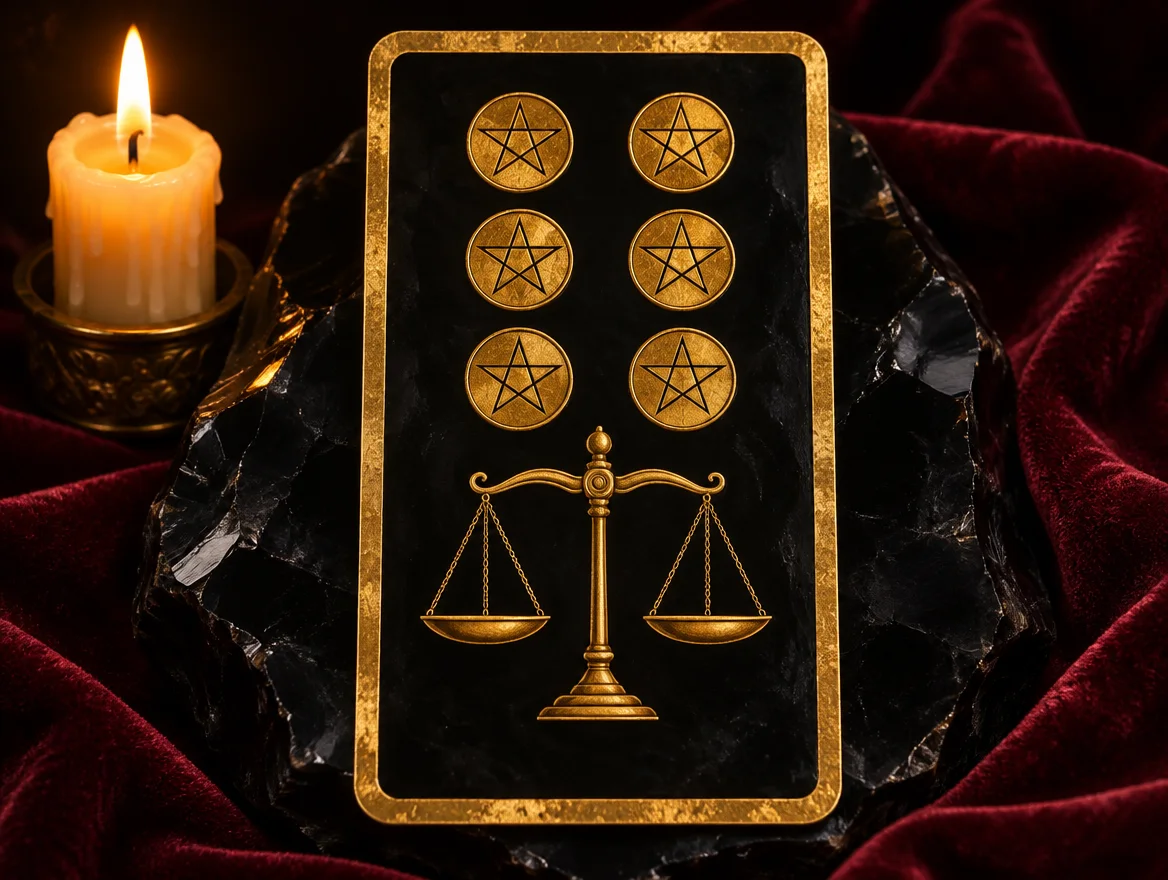
In the Golden Dawn system, the 36 small cards (Twos through Tens) are matched to the 36 decans of the zodiac: ten-degree thirds of a sign, each given a planet. Book T‘s table lists the Six of Pentacles, Material Success, under Moon in Taurus (Liber LXXVIII, sacred-texts.com), and the card’s own entry names Taurus and the Moon as its decan symbols. In that table it sits between the Five of Pentacles (Mercury in Taurus) and the Seven of Pentacles (Saturn in Taurus), and Liber’s separate table of central decans lists it for Taurus. Liber prints no degrees for it.
Book T places all four Sixes in Tiphareth on the Kabbalistic Tree of Life and sums them up as “Definite accomplishment. Thing carried out.” For this card it adds success in material things and prosperity in business.
What the Moon brings
On The 9th King, the Moon is the planet of needs, care and comfort. It’s the traditional ruler of Cancer, so our Cancer Personality Traits page shows the Moon’s caretaking style in a person, and our moon sign guide covers what your own Moon says about your needs. On this card, the Moon is the part of you that notices someone struggling, and remembers struggling yourself.
What Taurus brings
Taurus is fixed earth, ruled by Venus: the sign of resources and security. Our Taurus Personality Traits page covers the Bull’s steadiness and its possessive shadow. On this card, Taurus is the full purse and the wish to keep it safe.
The tension in the pairing
Taurus wants to hold on. The Moon wants to care for someone. The card sits where the two meet: security solid enough to share. At its best, the Moon softens Taurus’s grip, and Taurus keeps the Moon from giving away what it needs to stay well.
The 9K reading: gift or leverage?
The card’s tension
The Six of Pentacles holds two true things at once: giving can be pure kindness and giving can shift power. Whoever holds the scales decides the measure. The card asks whether the person receiving still has a say.
The shadow side
The shadow of the Six of Pentacles is turning help into a hierarchy. On the giving side or the receiving side, it can look like:
- Giving to stay needed. Helping in a way that keeps someone dependent, or feeling uneasy when they no longer need you.
- Keeping a ledger. Bringing up favors later, so a gift becomes a debt after the fact.
- Giving past empty. Saying yes until nothing is left for your own needs, then feeling resentful.
- Refusing all help. Treating receiving as shameful, so you struggle alone.
- Envy that hardens. Watching what others have until it sours how you treat them.
These patterns are often learned early. If that rings true, inner child work is a gentle, related place to look.
Strings, consent and behavior
Help with strings isn’t always bad. A loan with clear terms has strings, and that’s fine when both people agreed. The problem is terms that are hidden, changed later, or impossible to refuse.
A card can’t read anyone’s mind, so The 9th King looks at what you can observe: what was said, what was agreed, and what happens when someone says no. These questions work on either side of the scales.
| Freely given | Leverage |
|---|---|
| Terms are said out loud, or there are none | Terms show up later |
| Saying no is accepted | Saying no costs you something |
| No one brings it up as a debt | It’s mentioned when you disagree |
| You can still make your own choices | Your choices are expected to follow the help |

If help is being used to control you, that isn’t a balance problem to fix with more gratitude. Responsibility for control belongs to the person using it. Your safety comes first, and stepping back from that help, for a while or for good, can be a reasonable choice.
The self-mastery lesson
The lesson of the Six of Pentacles is to give and receive without losing your footing. You can share from enough, say clearly what your help is, and let people say no to it. You can accept help, say thank you, and still make your own choices.
Six of Pentacles as feelings, in love and at work
Six of Pentacles as feelings
As feelings, readers often take the card as care that wants to help: generosity or protectiveness toward someone. A card can’t tell you what someone feels or will do; their words and actions can. About your own feelings, ask: Do I want to help this person, or do I want them to need me? Both can be true at once.
Six of Pentacles love meaning
In a love reading, the upright card can point to care that moves both ways, even if it looks different: one person may bring money, the other time or steadiness, and both count. The reversed card can point to scorekeeping, one-sided giving, or support with an unspoken price.
Tarot can’t tell you whether to stay or leave, and this page won’t either. If you don’t feel safe with someone, this isn’t a question of balance: your safety comes first. Otherwise, useful questions:
- What does each of us give, in behavior I can actually see, not just in what we say?
- Is there anything I give that I’d quietly like back? Have I ever said so?
- Can either of us say no to the other’s help without a fight?
If you two show care in different ways, synastry for beginners shows how astrologers compare two charts, as reflection, not a verdict.
Six of Pentacles at work and with money
None of this is financial or career advice, only reflection.
At work, readers often take the card as mentoring, sharing credit, or how a team’s resources get handed out. Ask yourself: Is the way I share leaving people more capable, or more reliant on me?
With money, the lesson is about terms, not amounts. Whether you’re lending, giving, borrowing or receiving, ask: Does everyone know whether this is a gift or a loan, and what happens if it can’t be paid back? For actual decisions, talk to a qualified professional.
The Ace of Pentacles is where the earth suit begins, and the Seven of Pentacles follows this card in Book T’s Taurus decans.
Practical exercise: the give-and-take ledger
This isn’t a ledger for keeping score on other people. It’s a quiet look at your own patterns. You need twenty minutes and a notebook.
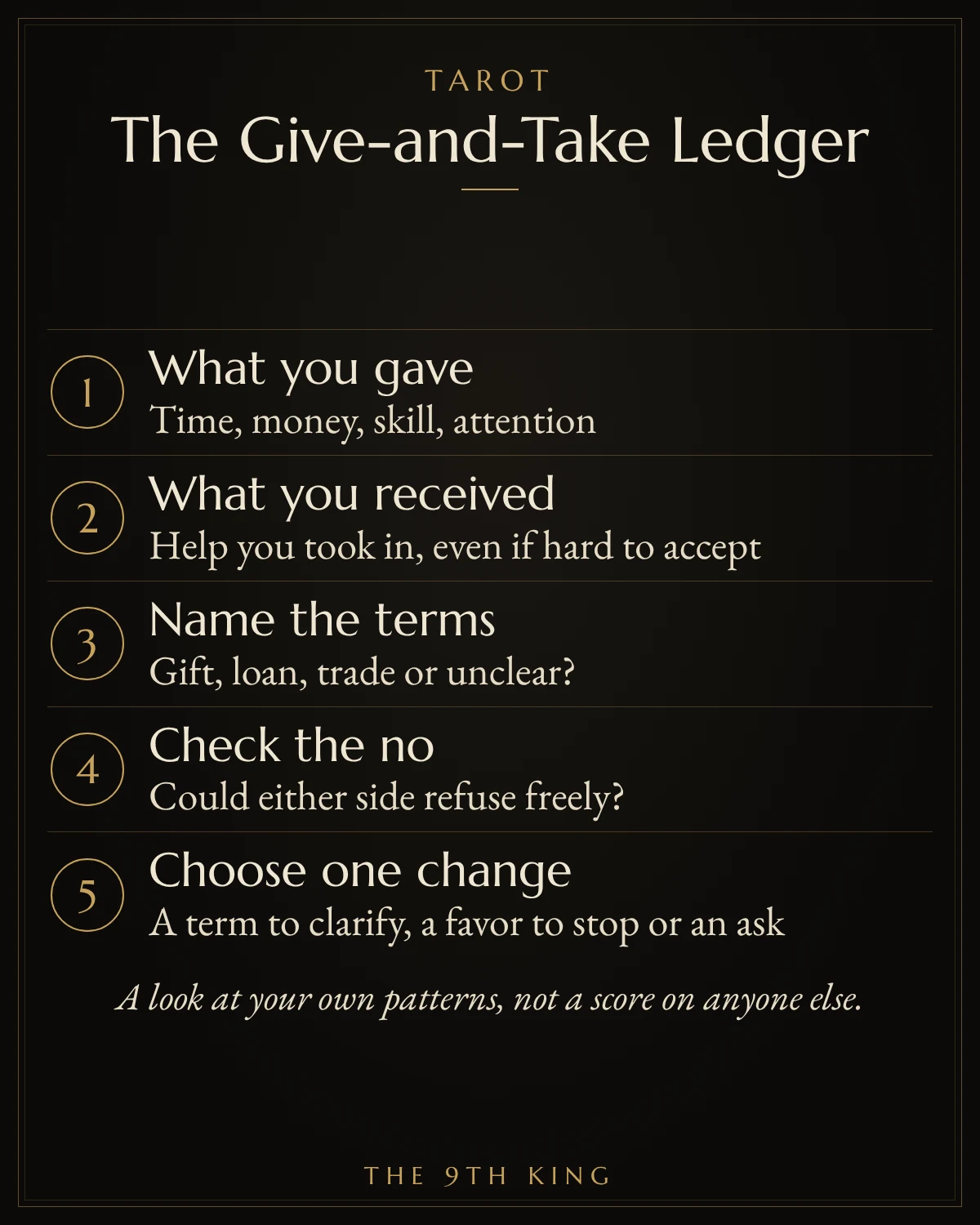
Step 1: What you gave
Think back over the last month. Write down help you’ve given: time, money, skill, attention, a favor. Don’t rank it.
Step 2: What you received
Now write down help you’ve taken in, including things that were hard to accept.
Step 3: Name the terms
Next to each item, write what it was: a gift, a loan, a trade, or unclear. “Unclear” is the most useful answer, because that’s where strings tend to hide.
Step 4: Check the no
For each unclear item, ask: Could either of us have said no freely? Could we now? If refusing would have cost something, note what.
Step 5: Choose one change
Pick one thing to adjust: a term to clarify, a favor to stop doing, or something to ask for. If it means talking to someone, that’s your choice, and only if it feels safe and useful.
A worked example (fictional)
Tasha (fictional) draws the Six of Pentacles reversed after a tiring month and does the ledger.
Under “gave,” she lists three things: covering two shifts for a coworker, giving her brother money for a car repair, and helping a friend move. Under “received,” she lists two: her neighbor watched her dog for a weekend, and her manager gave her a day off.
Naming the terms, she sees her brother’s money is unclear: she thought of it as a loan but never said so, and she can’t unilaterally make it repayable after the fact. The shifts were a trade she and her coworker agreed on. The neighbor’s help was a gift, yet Tasha still feels she owes something.
Her one change: she’ll ask her brother what he understood, explain what she’d expected, and agree on terms before helping again. And she lets the neighbor’s help stay a gift.
Journal prompts for the Six of Pentacles
- Where am I the giver right now, and where am I the receiver?
- Which is harder for me, giving or receiving? Where did I learn that?
- Is there help in my life whose terms have never been said out loud?
- Have I ever given something and later used it to win an argument? What was I protecting?
- What do I envy right now, and what does that envy tell me I want?
For more, our shadow work prompts go deeper, and Shadow Work, Plainly explains how to start safely.
A warm note: this is reflective practice, not therapy. If you’re dealing with trauma, abuse, thoughts of self-harm or distress that feels overwhelming, please work with a qualified therapist who can walk with you. It’s always fine to stop a prompt that feels like too much.
Myths and misreadings of the Six of Pentacles
- “The Six of Pentacles means money is coming.” No. On The 9th King, tarot doesn’t predict outcomes. The card is a mirror for how you give and receive.
- “The giver is the good one and the receiver is the weak one.” Neither. Waite describes the people’s situation, needy and distressed, not their worth. Nearly everyone stands on both sides of the scales at some point.
- “Real generosity has no limits.” The merchant gives from his success and weighs what he gives.
- “Moon in Taurus means this card is about Taurus people.” No. The correspondence describes the card’s symbolism in the Golden Dawn tradition. Anyone can draw it, whatever their sign.
Six of Pentacles: FAQ
What does the Six of Pentacles mean?
The Six of Pentacles is a Minor Arcana card in the earth suit. Waite describes a person dressed as a merchant who weighs money in scales and gives it to people in need. Readers commonly take it as gifts, generosity and fair exchange. On The 9th King, it’s a mirror for how you give and receive help, not a prediction that money is on its way.
What does the Six of Pentacles reversed mean?
Reversed, Waite lists desire, cupidity, envy, jealousy and illusion. Readers often take it as wanting what others have, help with hidden strings, or an uneven exchange. Some readers don’t use reversals at all. On The 9th King, treat it as a prompt to look at the terms of help in your life, using consent and behavior you can see rather than guesses about motives.
What does the Six of Pentacles mean as feelings?
As feelings, readers often take the Six of Pentacles as care that wants to help: generosity or protectiveness toward someone. A card can’t tell you what another person feels or will do; their words and actions can. About your own feelings, it can prompt you to ask whether you want to help someone, want to be needed by them, or both.
What does the Six of Pentacles mean in love?
In love, the upright card can point to care that moves both ways, even when each person gives in a different form. Reversed, it can point to scorekeeping, one-sided giving or support with an unspoken price. The card doesn’t tell you to stay or leave. It invites you to look at what each of you gives, and whether either of you can say no freely.
What zodiac sign is the Six of Pentacles?
In the Golden Dawn system, the tradition The 9th King uses, the Six of Pentacles corresponds to the Moon in Taurus, the central decan of Taurus in Book T’s table. The Golden Dawn’s Book T calls the card the Lord of Material Success. Other schools use different correspondences, so treat this as one traditional framework for symbolism.
Is the Six of Pentacles a yes or no card?
The 9th King doesn’t do yes or no readings, because tarot here is for self-reflection, not fortune-telling. Instead, ask what the card shows you: where you’re giving, where you’re receiving, and whether the terms of that help are clear and freely agreed.
Is the Six of Pentacles a good or bad card?
Neither, on The 9th King. Waite gives it upright meanings of gifts and present prosperity, and the Golden Dawn’s Book T calls it the Lord of Material Success, but Book T also warns that badly placed, it can show pride in money or wastefulness. Read it as a mirror for how you handle giving and receiving, not as a good or bad omen.

Your next step: do the give-and-take ledger above, and pick your one change before you close the notebook. Then find where your Moon falls in your own chart with our guide on how to read a birth chart: the planet of needs and care that the Golden Dawn tied to this card.
Explore Next
- The Bull’s steadiness and its shadow: Taurus Personality Traits
- The Moon’s caretaking style in a person: Cancer Personality Traits
- What your needs look like: Moon Sign Meaning
- Where the earth suit begins: Ace of Pentacles
- The next Taurus card, the patient grower: Seven of Pentacles
- Reading by feel: Intuitive Tarot (Code of Ascension)
- New to the cards: Tarot for Beginners: How Tarot Really Works (Code of Ascension)
- More tarot on The 9th King: Tarot Card Meanings · Minor Arcana · Tarot & the Zodiac · Queen of Pentacles · Shadow Work Tarot Spread
- More cards in this set: Three of Pentacles, Four of Pentacles, Five of Pentacles

Final Thought: Hold the Scales Honestly
The merchant in the Six of Pentacles isn’t a hero, and the people kneeling aren’t lesser. Most of us will stand in both places more than once. Give from enough, name your terms, let people say no, and let yourself be helped when it’s your turn. Know your nature. Rule your life.
About the Author
King is the founder of The 9th King, where zodiac psychology, relationships and shadow work are explored as tools for self-knowledge rather than fortune-telling. He’s a Libra Sun, and writes about the personal side of astrology on King The Kemist. Astrology on The 9th King is interpretation and self-reflection, not prediction or established fact.
Leave a Reply