
Quick Answer: What Does the Four of Cups Mean?
The Four of Cups (also written 4 of Cups) is a Minor Arcana card from the suit of Cups. In the traditional Rider–Waite–Smith deck it shows a young man seated under a tree, looking at three cups on the grass, while an arm from a cloud offers him a fourth. Readers usually take it as the card of withdrawal and weariness: feeling flat or fed up, stepping back, and not yet reaching for what’s offered.
- Keywords: weariness, withdrawal, rest, satiety, reflection, discontent, an overlooked offer, turning inward.
- Upright, in one line: a prompt to notice where you’ve stepped back, if you have, and whether that pause is meeting a need or keeping something good at arm’s length.
- Reversed, in one line: a prompt to look at what feels new or interesting again, and what you’d like to take up when you’re ready.
On The 9th King, tarot is a mirror for self-knowledge, not fortune-telling. The Four of Cups doesn’t say you’re missing your chance. It asks what your stillness is for.
Table of Contents

The Four of Cups at a glance
| Four of Cups | |
|---|---|
| Arcana | Minor Arcana, a pip (number) card |
| Suit and element | Cups, linked with water |
| Number | Four, a pause after the Three |
| Golden Dawn title | Lord of Blended Pleasure |
| Astrology (Golden Dawn) | Moon in Cancer |
| Upright | Weariness, withdrawal, rest, satiety |
| Reversed | New interest, new links, fresh ideas |
| Key question | What is my stillness for? |
What the Four of Cups looks like
Most people know this card from the Rider–Waite–Smith deck, first published in London by William Rider & Son in December 1909. A.E. Waite wrote the instructions and Pamela Colman Smith drew the art, and both belonged to the Hermetic Order of the Golden Dawn (Wikipedia: Rider–Waite Tarot).
The young man under the tree
Waite’s description in The Pictorial Key to the Tarot (1911) is short. A young man sits under a tree and contemplates three cups set on the grass before him (sacred-texts.com: Waite, Four of Cups). He isn’t drinking from them or pushing them away. He’s looking.
The fourth cup from the cloud
Waite goes on: an arm comes out of a cloud and offers him another cup. Yet his expression, Waite says, is one of discontent with his surroundings (sacred-texts.com: Waite, Four of Cups). Apart from the tree, the grass, the three cups, the offered cup and the discontented young man, no other detail is in Waite’s text.
On The 9th King, we read the arm from the cloud simply as something offered that you didn’t make yourself.
The Golden Dawn’s version
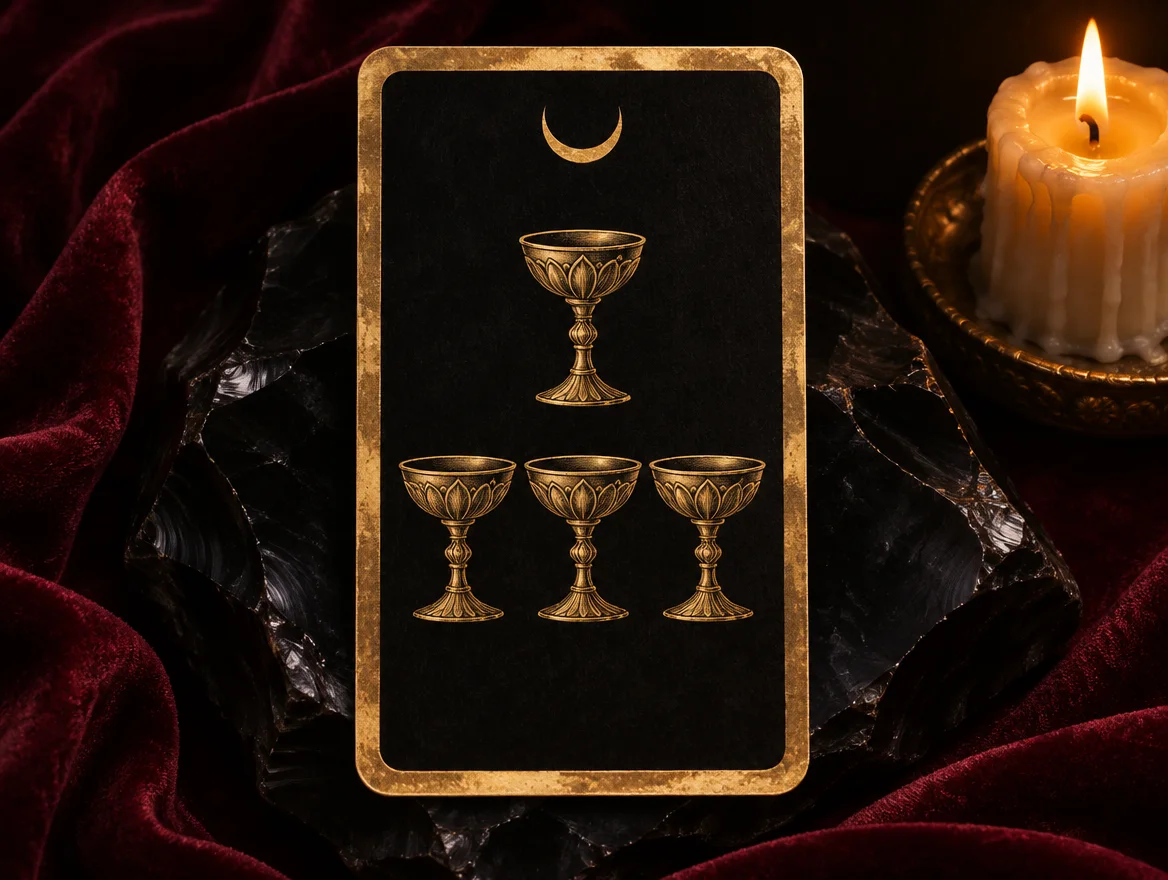
The Golden Dawn’s teaching text, Book T, as printed in Aleister Crowley’s Liber LXXVIII, describes a picture with no people in it. There are four cups. The two upper cups overflow into the two lower cups, which don’t overflow. A hand holds a lotus branch whose single top flower pours white water into the upper cups, and two leaves spread from the center to make a kind of cross between the four. The symbols of the Moon and Cancer sit above and below (Liber LXXVIII, sacred-texts.com).
Four of Cups meaning (upright)
Waite’s divinatory meaning begins with a hard list: weariness, disgust, aversion and imaginary vexations, “as if the wine of this world had caused satiety only.” Another wine, he says, like a fairy gift, is now offered to the figure, whom he calls a wastrel, but the figure sees no comfort in it. Then Waite adds a softer note: this is also a card of blended pleasure (sacred-texts.com: Waite, Four of Cups). In his later list of additional meanings, he gives the upright card a single word: contrarieties (sacred-texts.com: Waite, Additional Meanings).
Book T names the card the Lord of Blended Pleasure. Its meaning opens with success or pleasure approaching their end, and then says the card shows “A stationary period in happiness, which may, or may not, continue.” It adds that the card is too passive to stand for complete happiness, and that it implies some drawbacks to pleasure (Liber LXXVIII, sacred-texts.com).
Put those together and the upright meaning readers commonly use has three layers.
Satiety: too much of a good thing
The upright Four can point to a moment where you’ve had plenty, of input, people or options, and none of it lands anymore. Ask yourself: Am I lacking something, or am I simply full?
Withdrawal and reflection
Readers often take the card as turning inward: thinking things over, pulling back or needing quiet. That can be exactly right. Ask yourself: What am I stepping back from, and what am I stepping back toward?
The offer not yet seen
The fourth cup is held out, and the figure hasn’t taken it. On The 9th King, this doesn’t mean you’re making a mistake. It means something may be available that you haven’t looked at properly yet. Ask yourself: Is there an offer, an invitation or an idea I’ve waved off without really looking?
Four of Cups reversed
Readers handle reversals differently: some read the opposite meaning, some the same energy blocked, and some skip reversals entirely. Waite’s main entry gives the reversed Four of Cups as novelty, presage, new instruction, new relations (sacred-texts.com: Waite, Four of Cups). His additional meanings give a single word for the reversal: presentiment, a sense of something ahead. Waite warns in that section that these extra meanings often disagree with his main ones (sacred-texts.com: Waite, Additional Meanings).
On The 9th King, the Four of Cups reversed usually points to one of two patterns, offered as questions, not predictions.
Interest coming back
Waite’s reversed list is about newness. The reversed card can point to the moment you start noticing things again: a class, an idea, a person you’d like to know. Ask yourself: What caught my attention this week, even a little?
Reaching too fast
Sometimes the reversal shows the other side: grabbing every cup at once to escape a flat feeling. Ask yourself: Am I ready for this, or am I reaching to get away from the stillness?
| Pattern | Upright tone | Reversed tone |
|---|---|---|
| Attention | Turned inward | Turning outward again |
| Pleasure | Full, flat or muted | Fresh interest |
| Offers | Not yet looked at | Noticed, weighed |
| Pace | Paused | Moving, sometimes too fast |
Four of Cups astrology: Moon in Cancer
The 9th King uses Golden Dawn–derived correspondences, the tradition the Rider–Waite–Smith deck draws on. Other schools of tarot and astrology use different systems, and not every card maps to a single sign: the court cards and Pages, for example, work differently. What follows is one traditional framework, offered as symbolism.
How the number cards get their planets
In the Golden Dawn system, the 36 small cards (the Twos through Tens) are matched to the 36 decans of the zodiac, each a ten-degree third of a sign with its own planet. Book T, as printed in Liber LXXVIII, lists the Four of Cups, the Lord of Blended Pleasure, as Moon in Cancer (Liber LXXVIII, sacred-texts.com). In the same table, Cancer’s three decans run Two of Cups (Venus), Three of Cups (Mercury) and Four of Cups (Moon), so by the order of Liber’s own table the Four is the last of the three. Liber’s list of cards under each planet also places the Four of Cups under the Moon, in Cancer. Liber doesn’t print degrees for this entry.
For a wider look at how this system works across the deck, see our Minor Arcana guide and Tarot & the Zodiac.
What the Moon brings
On The 9th King, the Moon describes your emotional needs: how you feel safe and how you rest. Our Moon Sign Meaning guide explores it in a birth chart. The Moon also waxes and wanes; a quieter phase is part of its cycle.
What Cancer brings
Cancer is cardinal water: protective, sensitive and tied to home. The Moon rules Cancer, so here the Moon sits in its own sign. Our Cancer Personality Traits page explores the Crab’s care and its shell. On this card, Cancer is the part of you that pulls into the shell to feel safe.
The tension in the pairing
Together, the Moon and Cancer describe someone who knows when to retreat, and the risk that retreat becomes the default. The shell protects you, and it can also keep out good things. The Four of Cups sits in that gap.
The 9K reading: rest, full or turned away?
The card’s tension
The Four of Cups holds two true things at once: I need to step back and something here might still be good for me. The card doesn’t say which matters more right now.
Rest is not the shadow
Rest is not a problem to fix. Rest is a pause that meets a need, whether or not you know when it will end. If you’re ill, worn out, grieving or simply at capacity, stepping back is care, not avoidance. Nobody owes the world a yes to every cup.
Don’t judge a pause by how it feels, either. You can feel uneasy and still be choosing well.
The shadow side
The shadow of the Four of Cups is turning away by habit, not by choice. It can look like:
- Dismissing before looking. Saying “that won’t be for me” about an invitation or idea without finding out what it actually is.
- Waiting for the perfect cup. Treating every offer as not quite right.
- Counting what’s missing. Staring at the three cups and listing what’s wrong with each, while they still hold something.
- Keeping people at a distance to stay safe. Pulling into the shell when someone gets close, out of an old expectation that closeness leads to hurt. Our Inner Child Work guide is a related read on where expectations like that can start.
These patterns usually begin with something sensible. The question is whether they still help you.
Rest, full or turned away: how to tell
Waite lists imaginary vexations among the card’s meanings. On The 9th King, we don’t take that as a ruling that your feelings aren’t real. A flat or heavy feeling is real whatever caused it. What helps is looking at what the stillness is doing.
| Pattern | What it can look like | A question to ask |
|---|---|---|
| Rest | A pause that meets a need | What need is this meeting? |
| Fullness | Too much input to enjoy more | What could I put down? |
| Flatness | Things feel muted for now | What helps even a little? |
| Wariness | Holding back after a letdown | What am I protecting? |
| Habit | Saying no before looking | Have I really looked? |

Several patterns can be true at once. Use the questions as a mirror, not a test.
If a flat or heavy mood has been with you for a long while or is making ordinary days hard, a card isn’t the right tool for that, and it’s worth talking to a doctor or a qualified therapist.
The self-mastery lesson
The lesson of the Four of Cups is to know why you’re sitting down. Self-mastery here isn’t forcing yourself to want everything. It’s being honest about whether you’re resting, full, protecting yourself or turning away from habit, so that your no is a choice.
Four of Cups as feelings, in love and at work
Four of Cups as feelings
Asked “how does this person feel?”, readers often take the Four of Cups as distance or low energy: someone tired, preoccupied, unsure or not ready to engage. That’s an interpretation to reflect on, not evidence. A card can’t establish what someone else feels or why. Ask yourself: What have they actually said and done? And if the card is about your own feelings: Am I uninterested, or just tired right now?
Four of Cups love meaning
In a love reading, the upright card can point to a lull, a need for space or care you haven’t really noticed. Reversed, it can point to renewed interest, a fresh start in how you relate or a new connection.
Tarot can’t tell you whether to stay, leave, start or end anything, and this page won’t either. Needing space is a normal part of close relationships. What matters is what both people say and do: whether space is agreed and care still shows up. Useful questions:
- Is this a need for rest, or a sign that something in the bond needs attention?
- Have I said what I need, in plain words, or am I hoping they’ll guess?
To see how two charts meet, try our synastry for beginners guide.
Four of Cups at work
At work, readers often take the card as boredom, tiredness or rewards that no longer satisfy, sometimes with an overlooked project or idea nearby. This is reflection, not career or financial advice. Ask yourself: Does the work need changing, or do I need rest? Sometimes it’s both.
Practical exercise: the fourth-cup check
You need about twenty minutes and a notebook. Pick one area of life where you feel flat, tired or turned away.

Step 1: List three cups
Write down what’s already in front of you in this area, even if it doesn’t feel exciting right now. Three is a starting point, not a rule.
Step 2: Name the offer
What’s offered or possible that you haven’t really looked at? An invitation, an idea, someone’s care. “Nothing yet” is a real answer.
Step 3: Name your need
Ask what you actually need here: rest, less, more or something new. Write it plainly, without judging it.
Step 4: Check the reason
Look at the five patterns from the table above: resting, full, flat, wary or habit. Which ones sound like you right now? It’s fine to pick more than one, or to write “not sure”.
Step 5: Choose a response
For the fourth cup, choose one response: take it, decline it or not yet. “Not yet” is a full answer, not a failure. If the cup involves another person, contacting them is your choice, and only if it feels safe and useful.
A worked example (fictional)
Marcus (fictional) has felt flat about his weekends for a while. He draws the Four of Cups.
His three cups: a game night with friends, a gym routine and a show he watches. His fourth cup: a coworker invited him to join a Saturday pottery class. His need: he writes “less noise, something with my hands”. Checking the reason, he picks two: full, because game night has started to feel like one more thing on the calendar, and habit, because he said no to the class before asking what it involved.
His response to the fourth cup: “take it”, for one session of the pottery class to see. Separately, he decides to skip the next game night and rest. Three cups he already had, one cup he finally looked at, and two choices that are his own.
Journal prompts for the Four of Cups
- Where in my life do I feel full rather than empty?
- What am I stepping back from, and what do I hope to find in the quiet?
- When did I last say no to something before I really looked at it?
- What does real rest look like for me, and do I let myself have it?
- What small thing has caught my interest lately, even briefly?
- If I took one cup that’s been offered, which would it be, and what’s stopping me?
For more prompts like these, our shadow work prompts collection goes deeper, and Shadow Work, Plainly explains how to start safely.
A warm note: this is reflective practice, not therapy. If withdrawal is tied to trauma or abuse, or if you’re dealing with thoughts of self-harm or distress that feels overwhelming, please work with a qualified therapist who can walk with you. It’s always fine to stop a prompt that feels like too much.
Myths and misreadings of the Four of Cups
- “The Four of Cups means you’re missing your big chance.” No. On The 9th King, tarot doesn’t predict events or warn of lost opportunities. The card asks you to look at the offer, not to take it.
- “It means you’re ungrateful or lazy.” No. Waite’s list is about weariness and satiety, and Book T calls the card a stationary period. Needing rest or feeling flat isn’t a character flaw (sacred-texts.com: Waite, Four of Cups; Liber LXXVIII, sacred-texts.com).
- “Moon in Cancer means this card is about Cancer people.” No. The correspondence describes the card’s symbolism in the Golden Dawn tradition. Anyone can draw it, whatever their sign.

Four of Cups: FAQ
What does the Four of Cups mean?
The Four of Cups is a Minor Arcana card in the suit of Cups. In the Rider–Waite–Smith deck it shows a young man under a tree, looking at three cups, while an arm from a cloud offers him a fourth. Readers commonly take it as weariness, withdrawal and an overlooked offer. On The 9th King, it’s a mirror for your stillness: whether you’re resting, full, wary or turning away by habit.
What does the Four of Cups reversed mean?
Reversed, the Four of Cups is often read as interest coming back: new ideas, new learning and new connections. Waite’s main entry gives the reversal as novelty, presage, new instruction and new relations, and his additional meanings add a single word, presentiment. Some readers don’t use reversals at all. On The 9th King, it can also be a reminder not to rush out of a pause that’s meeting a need.
What does the Four of Cups mean as feelings?
As feelings, readers often take the Four of Cups as distance or low energy: someone tired, unsure or not ready to engage. It’s an interpretation, not evidence, because a card can’t establish another person’s feelings or reasons. A better guide is what someone says and does over time. It can also prompt you to ask whether you’re uninterested or simply tired.
What does the Four of Cups mean in love?
In love, the upright card can point to a lull, a need for space or care you haven’t noticed. Reversed, it can point to renewed interest or a fresh start. The card doesn’t tell you to stay, leave or start anything. It invites you to name what you need, say it plainly and look at what both people actually do, including whether space is agreed and care still shows up.
What zodiac sign is the Four of Cups?
In the Golden Dawn system, the tradition The 9th King uses, the Four of Cups corresponds to Moon in Cancer, the last of Cancer’s three decans in the Book T table. The Golden Dawn’s Book T, as printed in Liber LXXVIII, calls the card the Lord of Blended Pleasure. Other schools use different correspondences, so treat this as one traditional framework for symbolism rather than a fixed rule.
Is the Four of Cups a yes or no card?
The 9th King doesn’t do yes or no readings, because tarot here is a tool for self-reflection, not fortune-telling. Instead, ask what the card shows you: why you’ve stepped back, what you need right now and whether there’s an offer you haven’t looked at properly.
Is the Four of Cups a sign of depression?
No. A tarot card can’t diagnose anything, and The 9th King doesn’t use cards that way. Readers take the Four of Cups as weariness, withdrawal or a flat stretch, which everyone has at times. If a heavy or flat mood has lasted a long while or is making ordinary days hard, that’s worth talking about with a doctor or qualified therapist rather than a card.
How is the Four of Cups different from The Hermit?
Both cards show stepping back, at different scales. The Hermit is a Major Arcana card, often read as a deliberate search for inner wisdom. The Four of Cups is a Minor Arcana card about an everyday pause, often with mixed feelings and an offer nearby. On The 9th King, we read The Hermit as seeking and the Four of Cups as sorting out what your stillness is for.

Your next step: try the fourth-cup check above with one area of life this week, starting with what you already have. Then read our Moon Sign Meaning guide: your Moon describes how you rest and what you need, which is exactly what this card asks you to notice.
Explore Next
- The planet behind the card: Moon Sign Meaning
- The sign behind the card: Cancer Personality Traits
- Where old expectations start: Inner Child Work
- The shadow side of every sign: Zodiac Shadow Work
- Go deeper with questions: Shadow Work Prompts
- Reading by feel: Intuitive Tarot (Code of Ascension)
- New to the cards: Tarot for Beginners: How Tarot Really Works (Code of Ascension)
- More tarot on The 9th King: Tarot Card Meanings · Minor Arcana · Tarot & the Zodiac · Ace of Cups · Two of Cups · Six of Cups · Knight of Cups · The Hermit
- More cards in this set: Three of Cups, Five of Cups, Seven of Cups

Final Thought: Know Why You’re Sitting Down
The young man in the Four of Cups isn’t wrong to sit under the tree. He may need the shade. The card only asks whether he knows why he’s there, and whether he’s looked at the cup. Rest when you need to, and when you’re ready, notice what’s offered. Know your nature. Rule your life.
About the Author
King is the founder of The 9th King, where zodiac psychology, relationships and shadow work are explored as tools for self-knowledge rather than fortune-telling. He’s a Libra Sun, and writes about the personal side of astrology on King The Kemist. Astrology on The 9th King is interpretation and self-reflection, not prediction or established fact.
Leave a Reply