

Quick Answer: What Does the Two of Wands Mean?
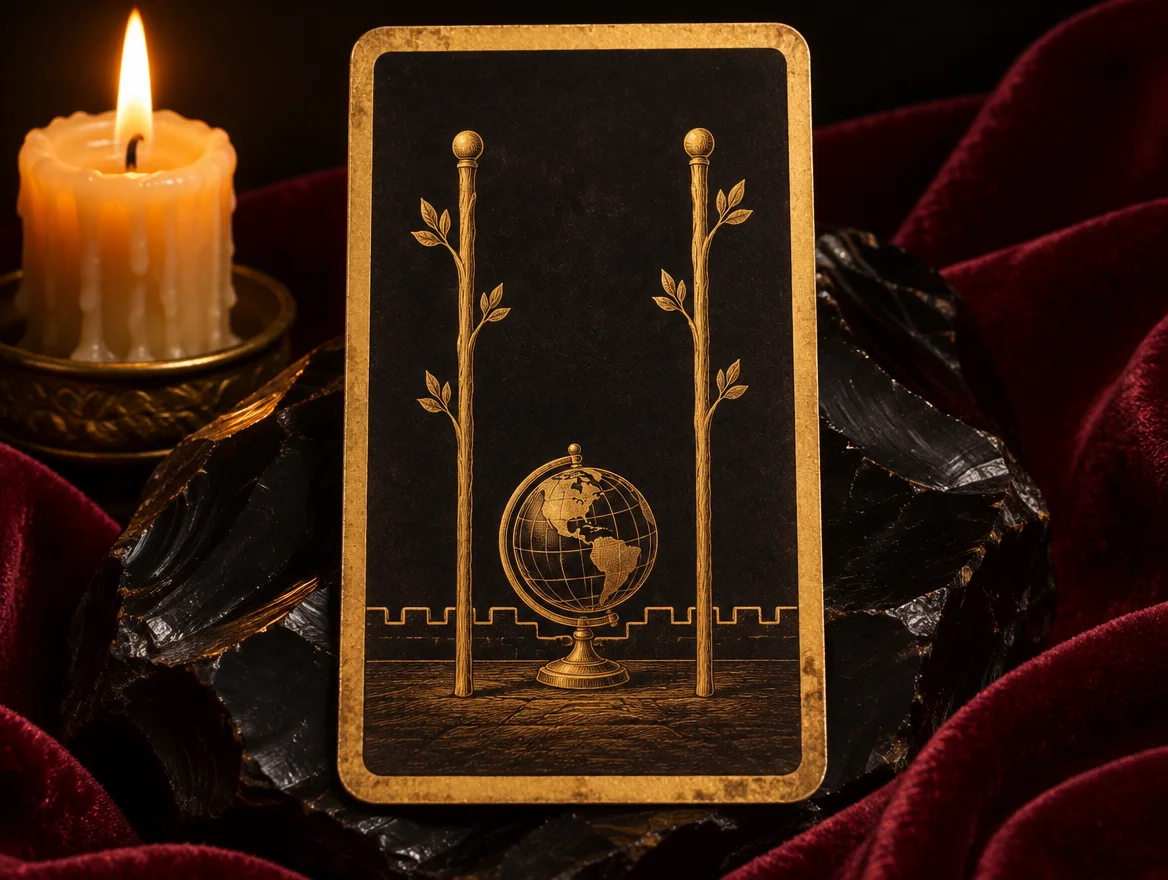
The Two of Wands (also written 2 of Wands) is a Minor Arcana card from the suit of Wands. It shows a tall man on a castle roof, looking out over sea and shore with a small globe in one hand and a staff in the other. On The 9th King, it’s read as the card of the view from the wall: you have a base, you can see further than before, and you’re deciding what to do with that view.
- Keywords: ambition, planning, vision, personal authority, the next horizon, restlessness, decision.
- Upright, in one line: a prompt to notice what you’ve already built and where you want to aim next, if you’re ready to choose a direction.
- Reversed, in one line: the plan stays on the roof; fear, second-guessing or restless dissatisfaction can keep you watching instead of moving.
On The 9th King, tarot is a mirror for self-knowledge, not fortune-telling. The Two of Wands doesn’t say a journey or a big win is coming. It asks how you relate to your own ambition, and whether your planning is a launch pad or a hiding place.
Table of Contents

The Two of Wands at a glance
| Two of Wands | |
|---|---|
| Arcana | Minor Arcana, a pip (number) card |
| Suit and element | Wands, linked with fire |
| Number | Two, the step after the Ace |
| Golden Dawn title | Lord of Dominion |
| Astrology (Golden Dawn) | Mars in Aries |
| Upright | Vision, planning, personal authority |
| Reversed | Hesitation, restlessness, fear of the next step |
| Key question | Am I planning, or hiding in the plan? |
What the Two of Wands looks like
Most people meet this card through the Rider–Waite–Smith deck, first published in London by William Rider & Son in December 1909. A.E. Waite wrote the instructions and Pamela Colman Smith drew the art, and both were members of the Hermetic Order of the Golden Dawn (Wikipedia: Rider–Waite Tarot).
The man on the roof
Waite’s own description in The Pictorial Key to the Tarot (1911) is brief. A tall man stands on a battlemented roof, the kind with notched walls along the top of a castle, and looks out over sea and shore (sacred-texts.com: Waite, Two of Wands). He isn’t marching anywhere. He’s high up, safe and looking out.
The globe and the two staves
In his right hand he holds a globe. In his left, a staff rests on the battlement. A second staff stands apart, fixed in a ring on the wall. So the two wands of the title aren’t the same: one is in his hand, one is anchored in place. On The 9th King we read that as the difference between what you’re carrying and what you’ve already secured.
The rose, the cross and the lily
Waite asks the reader to notice a Rose and Cross and a Lily on the left side of the card, without explaining them (sacred-texts.com: Waite, Two of Wands). On The 9th King, we read the pairing as a quiet reminder that ambition and values sit side by side on this card: what you want, and what you stand for.
Two of Wands meaning (upright)
Waite’s divinatory meaning is unusual because it pulls in two directions at once. On one side he lists riches, fortune and magnificence. On the other, physical suffering, sadness and what he calls mortification, a sense of inner disappointment. He then gives the image a famous gloss: a lord looking over his dominion and turning a globe in his hands, which he compares to “the sadness of Alexander amidst the grandeur of this world’s wealth” (sacred-texts.com: Waite, Two of Wands).
Waite is pointing at a feeling many ambitious people know: success on one side, a restless ache on the other.
The Golden Dawn’s teaching text on the tarot, Book T, as printed by Aleister Crowley in Liber LXXVIII, names the card the Lord of Dominion. It opens with “Strength, domination, harmony of rule and of justice,” then a run of traits that cut both ways, from courage, resolution and generosity to restlessness and obstinacy (Liber LXXVIII, sacred-texts.com).
Put together, the upright Two of Wands meaning we use on The 9th King has three layers.
Vision from a secure base
Our Ace of Wands guide reads the Ace as raw creative fire. The Two shows that spark with a home: a foothold from which you can see further, and ask, What’s next?
Planning and personal authority
The man holds the globe like a map he’s studying. Upright, readers often take the card as planning, weighing options and owning your own direction. The “dominion” in the Golden Dawn title doesn’t have to mean power over other people. On The 9th King, it’s read first as authority over your own choices.
The decision point
Two is the first number that offers a choice. Stay, or go. This path, or that one. Ask yourself: What am I actually choosing between, and have I said it out loud?
Two of Wands reversed
Readers handle reversals differently: some read the opposite meaning, some the same energy blocked, and some skip reversals entirely. Waite’s reversed meaning for this card is a short list: surprise, wonder, enchantment, emotion, trouble and fear (sacred-texts.com: Waite, Two of Wands). It’s a mixed list, with delight and dread side by side.
On The 9th King, the Two of Wands reversed usually points to one of three patterns, offered as questions, not predictions.
The plan that never leaves the roof
You’ve mapped the move for months, and planning has quietly become a way to avoid deciding. Ask yourself: What’s the smallest real step I’ve been putting off because planning feels safer?
The restless ache
This is Waite’s Alexander pattern: you have plenty, and it doesn’t feel like enough, because the ache isn’t really about the goal. Ask yourself: If I got the next thing, what would I hope to feel? Can I find any of that now?
Surprise and fear
Sometimes the view shows you something unexpected, and part of you wants to shut the window. Ask yourself: Is this fear telling me something useful, or just telling me this is new?
| Pattern | Upright tone | Reversed tone |
|---|---|---|
| Planning | Purposeful, leads to action | Endless, replaces action |
| Ambition | Grounded in values | Restless, never enough |
| The view | Exciting, wide | Overwhelming or ignored |
| Authority | Over your own path | Over others, or abandoned |
Two of Wands astrology: Mars in Aries
The 9th King uses Golden Dawn–derived correspondences, the tradition the Rider–Waite–Smith deck draws on. Other schools of tarot and astrology use different systems, and not every card maps to a single sign: the court cards and Pages, for example, are handled differently. What follows is one traditional framework, offered as symbolism.
How the number cards get their planets
In the Golden Dawn system, the 36 small cards (the Twos through Tens of the four suits) are matched to the 36 decans of the zodiac. A decan is a ten-degree third of a sign, and each one is given a ruling planet. Book T lists the Two of Wands, the Lord of Dominion, as Mars in Aries (Liber LXXVIII, sacred-texts.com).
The same text explains a detail worth knowing. There are 36 decans and only seven traditional planets, so one planet has to rule an extra decan. Book T gives that extra to Mars, assigning it both the last decan of Pisces and the first of Aries, because, it says, the long cold of winter needs great energy to overcome it and begin the spring (Liber LXXVIII, sacred-texts.com). So the Two of Wands sits at the very start of the Golden Dawn’s Aries decans, the first push of spring.
Book T also places all four Twos under Chokmah, one of the spheres of the Kabbalistic Tree of Life. For the Two of Wands, it adds influence over others, authority, power and dominion. In the same text, the suit of Wands is the suit of fire: its Ace is called the Root of the Powers of Fire.
What Mars brings
Mars is the planet of drive, courage, desire and conflict: the part of you that wants something and goes for it. On a card about vision, Mars is the push behind the plan, the urge to stop looking and start moving.
What Aries brings
Aries is cardinal fire, the first sign of the zodiac and traditionally ruled by Mars. It’s the sign of beginnings, nerve and the first step. Our Aries Personality Traits page explores the Ram’s courage and its shadow, including impatience and the itch to start more than you finish.
The tension in the pairing
Mars in Aries is Mars at home, so the card’s fire is strong, and yet the figure stands still. The card sits in the gap between the urge to act and the pause to aim. Used well, the pause makes the action land. Used badly, it becomes the whole story.
The 9K reading: planning or hiding?
The card’s tension
The Two of Wands holds two true things at once: I have enough and I want more. Some people push the wanting down; others chase the next horizon and never notice what they built. The card asks you to hold both. Gratitude that can’t admit wanting turns stale. Wanting that can’t admit what you already have turns into Waite’s restless Alexander.
The shadow side
The shadow of the Two of Wands is ambition that never touches the ground. It’s the voice that says I’ll move when the plan is perfect, or I’ll be happy once I get there. It can look like:
- Endless research. Another course, another spreadsheet, another month of thinking about it.
- Control dressed as planning. Needing every outcome mapped before you’ll risk one step.
- The next-horizon habit. Reaching one goal and feeling flat by lunchtime, already scanning for the next.
- Dominion over others. Turning “authority over my path” into deciding for everyone around you.
These patterns usually started as something useful. The question is whether they still serve you now. Our Zodiac Shadow Work guide is a good place to see how each sign’s strengths can tip into their shadow.
Planning or hiding: how to tell
Planning and hiding can look the same from outside. The difference is what the planning does.
| Planning | Hiding in the plan |
|---|---|
| Has a next step with a date | Has a next idea, no step |
| Gets smaller and sharper | Gets bigger and vaguer |
| Accepts some risk | Waits for zero risk |
| Ends in a choice | Ends in more planning |

Don’t judge it by how the planning feels. Real planning can feel anxious, and hiding can feel calm and productive. Use questions instead: Is there a dated next step? Has the plan narrowed in the last month? What risk am I waiting to disappear? What would I do this week if I trusted myself?
Be fair to yourself, too. Waiting for money, health, care duties or timing is real, and a pause you choose on purpose isn’t hiding.
The self-mastery lesson
The lesson of the Two of Wands is to aim, then step. The figure doesn’t need to leap off the wall. He needs to pick one direction and walk down the stairs. Self-mastery here means letting vision and action take turns: look far, then move near.
Dominion, on The 9th King, starts with your own time, attention and choices. You don’t need to rule the globe. You need to decide where your next staff goes.
Two of Wands as feelings, in love and at work
Two of Wands as feelings
When someone asks “how does this person feel?” and draws the Two of Wands, readers often take it as interest weighed against other plans. A card can’t tell you what another person feels or intends, so treat this as a prompt for yourself. If the card is about someone else, ask: What have they actually said and done, and what am I filling in? If it’s about your own feelings: Am I excited about this, or excited about the idea of it?
Two of Wands love meaning
In a love reading, the upright card can point to a relationship at a planning stage: talking about the future, where to live, what you want to build. It can also point to a partner whose attention is partly on outside goals. The reversed card can point to a couple who keep talking about “someday” without taking a step, or to restlessness that has more to do with you than with your partner.
Tarot can’t tell you whether to stay or leave, and this page won’t either. Useful questions:
- What future are we each picturing, and have we compared notes out loud?
- Is my restlessness about this relationship, or about my own unlived plans?
- What’s one small, shared step we could take toward something we both want?
If your relationship mixes big fire with deep feeling, our piece on fire and water relationships explores how drive and sensitivity can work together.
Two of Wands at work
At work, readers often take the card as strategy: you have a base and you’re weighing a new role or bigger project. The shadow version keeps drafting the plan and never sends the pitch. This is reflection, not career or financial advice. Ask yourself: What’s the first concrete move I could make in the next seven days?
Practical exercise: the view from the wall
This exercise turns the self-mastery lesson into something you can do this week. You need twenty minutes and a notebook.

Step 1: Name the ground
Write down what you’ve already built: skills, relationships, things you’ve learned. This is your castle.
Step 2: Name the horizon
Write one sentence about where you want to aim next. If there are several, list them, then circle the one that keeps coming back.
Step 3: Check the globe
Ask: If I reached that horizon, what would I hope to feel? Freedom, respect, rest, excitement, safety? Write it down. Then ask whether any of that is available now, in a smaller form. This is the antidote to the Alexander ache.
Step 4: Choose one staff
Pick one direction for now. Not forever, just for this season. The others can stay fixed in their rings on the wall.
Step 5: Take the stairs
Write one step you’ll take this week, with a day next to it. Keep it small: one email, one call, one hour of real work.
Step 6: Look back
At the end of the week, write: did you take the step, and what did it teach you? If not, what got in the way? No grades, only information.
A worked example (fictional)
Marcus (fictional) has run a small screen-printing side business for three years. He draws the Two of Wands upright and laughs, because he’s spent six months “researching” a move to selling online.
His ground: loyal local customers and real design skill. His horizon: a national online shop. Checking the globe, he realizes he mostly wants to feel taken seriously as an artist, and he already gets a little of that at local markets.
He chooses one staff: list five designs online. His stair step: photograph the shirts on Saturday. A week later, three listings are up. The plan didn’t need to be perfect. It needed to leave the roof.
Journal prompts for the Two of Wands
- What have I already built that I rarely give myself credit for?
- Where in my life is planning doing the job that action should be doing?
- What is the “Alexander ache” for me: what do I keep reaching for, and what do I hope it gives me?
- If I had full authority over my own time this month, what would I change first?
- Which of my ambitions reflect my values, and which are borrowed from someone else?
- What would I do this week if I trusted myself a little more?
For more prompts like these, our shadow work prompts collection goes deeper, and Shadow Work, Plainly explains how to start safely.
A warm note: this is reflective practice, not therapy. If you’re dealing with trauma, abuse, thoughts of self-harm or distress that feels overwhelming, please work with a qualified therapist who can walk with you. It’s always fine to stop a prompt that feels like too much.
Myths and misreadings of the Two of Wands
- “The Two of Wands means you’re about to travel.” No. On The 9th King, tarot doesn’t predict events. The sea and the globe can stand for a wider world, but the card reflects how you relate to your plans, not where you’ll be next month.
- “It’s a pure success card.” Waite himself split it down the middle, with riches and magnificence on one side and sadness on the other (sacred-texts.com: Waite, Two of Wands). The card holds both the view and the ache.
- “Dominion means control over other people.” The Golden Dawn title is Lord of Dominion, and Book T does mention influence over others. On The 9th King, we read it first as authority over your own choices. Power over others without their consent is the shadow, not the goal.
- “Mars in Aries means this card is about Aries people.” No. The correspondence describes the card’s symbolism in the Golden Dawn tradition. Anyone can draw it, whatever their sign.

Two of Wands: FAQ
What does the Two of Wands mean?
The Two of Wands is a Minor Arcana card in the suit of Wands. It shows a man on a castle roof holding a globe, with one staff in his hand and another fixed to the wall. Readers commonly take it as vision, planning and personal authority: you have a secure base and you’re deciding where to aim next. On The 9th King, it’s a mirror for how you handle ambition, not a prediction of travel or success.
What does the Two of Wands reversed mean?
Reversed, the Two of Wands is often read as planning that never turns into action, restless dissatisfaction, or fear when a bigger world opens up. Waite’s reversed list was surprise, wonder, enchantment, emotion, trouble and fear. Some readers don’t use reversals at all. Treat it as a question to explore, such as “what step am I avoiding?”, rather than a sign that plans are doomed.
What does the Two of Wands mean as feelings?
As feelings, readers often take the Two of Wands as interest weighed against other plans: real attraction, alongside a wider view of the future. A tarot card can’t tell you what another person feels or intends, so look at what they’ve actually said and done. If the card describes your own feelings, ask whether you’re drawn to the person or to the idea of the future they represent.
What does the Two of Wands mean in love?
In love, the upright card can point to a planning stage, such as talking about the future together, or to a partner whose attention is partly on outside goals. Reversed, it can point to endless “someday” talk or restlessness that has more to do with your own unlived plans. The card doesn’t tell you to stay or leave. It invites honest conversation about what you each want to build.
What zodiac sign is the Two of Wands?
In the Golden Dawn system, the tradition The 9th King uses, the Two of Wands corresponds to Mars in Aries, the first decan of Aries. The Golden Dawn’s Book T calls the card the Lord of Dominion and gives Mars this decan to mark the energy needed to begin the spring. Other schools use different correspondences, so treat this as one traditional framework for symbolism, not a fixed rule.
Is the Two of Wands a yes or no card?
The 9th King doesn’t do yes or no readings, because tarot here is a tool for self-reflection, not fortune-telling. Instead of asking whether the card says yes, ask what it shows you: what you’ve already built, where you want to aim, and whether your planning is leading to a real step or standing in for one.

Your next step: do the view from the wall exercise for one plan you’ve been circling. Then find where Mars sits in your own birth chart with our guide on how to read a birth chart: your Mars describes how you go after what you want, and it’s the same planet the Golden Dawn tied to this card.
Explore Next
- The Ram’s drive and its shadow: Aries Personality Traits
- The spark before the plan: Ace of Wands
- Further along the suit: Nine of Wands
- Go deeper with questions: Shadow Work Prompts
- The shadow side of every sign: Zodiac Shadow Work
- Reading by feel: Intuitive Tarot (Code of Ascension)
- New to the cards: Tarot for Beginners: How Tarot Really Works (Code of Ascension)
- More tarot on The 9th King: Tarot Card Meanings · Minor Arcana · Tarot & the Zodiac · King of Wands · Three-Card Tarot Spread
- More cards in this set: Three of Wands, Four of Wands, Five of Wands and Seven of Wands

Final Thought: Look Far, Then Step Near
The figure in the Two of Wands has earned his view. He doesn’t need to throw away his castle or grab the whole globe. He needs to choose one direction and take the stairs. Honor what you’ve built, name where you want to go, and let the plan touch the ground. Know your nature. Rule your life.
About the Author
King is the founder of The 9th King, where zodiac psychology, relationships and shadow work are explored as tools for self-knowledge rather than fortune-telling. He’s a Libra Sun, and writes about the personal side of astrology on King The Kemist. Astrology on The 9th King is interpretation and self-reflection, not prediction or established fact.
Leave a Reply