
Quick Answer: What Does the Ten of Swords Mean?
The Ten of Swords (also written 10 of Swords) is a Minor Arcana card from the suit of Swords, and the last number card in that suit. Readers often find it one of the hardest-looking cards in the deck. On The 9th King, we read it as the card of a complete ending: a plan, a role, a story or a way of thinking that has run all the way to its last page.
- Keywords: endings, completion, ruin of a plan, exhaustion, release, the worst-case story, a new count.
- Upright, in one line: a prompt to notice where something has fully run its course, if a plan, role or chapter in your life has reached its end.
- Reversed, in one line: getting back up slowly, or holding on to an ending that’s already over; a prompt to ask which one it is.
On The 9th King, tarot is a mirror for self-knowledge, not fortune-telling. The Ten of Swords doesn’t say ruin is coming, and it says nothing about harm to anyone’s body. It asks how you meet an ending, and what you tell yourself about it.
Table of Contents
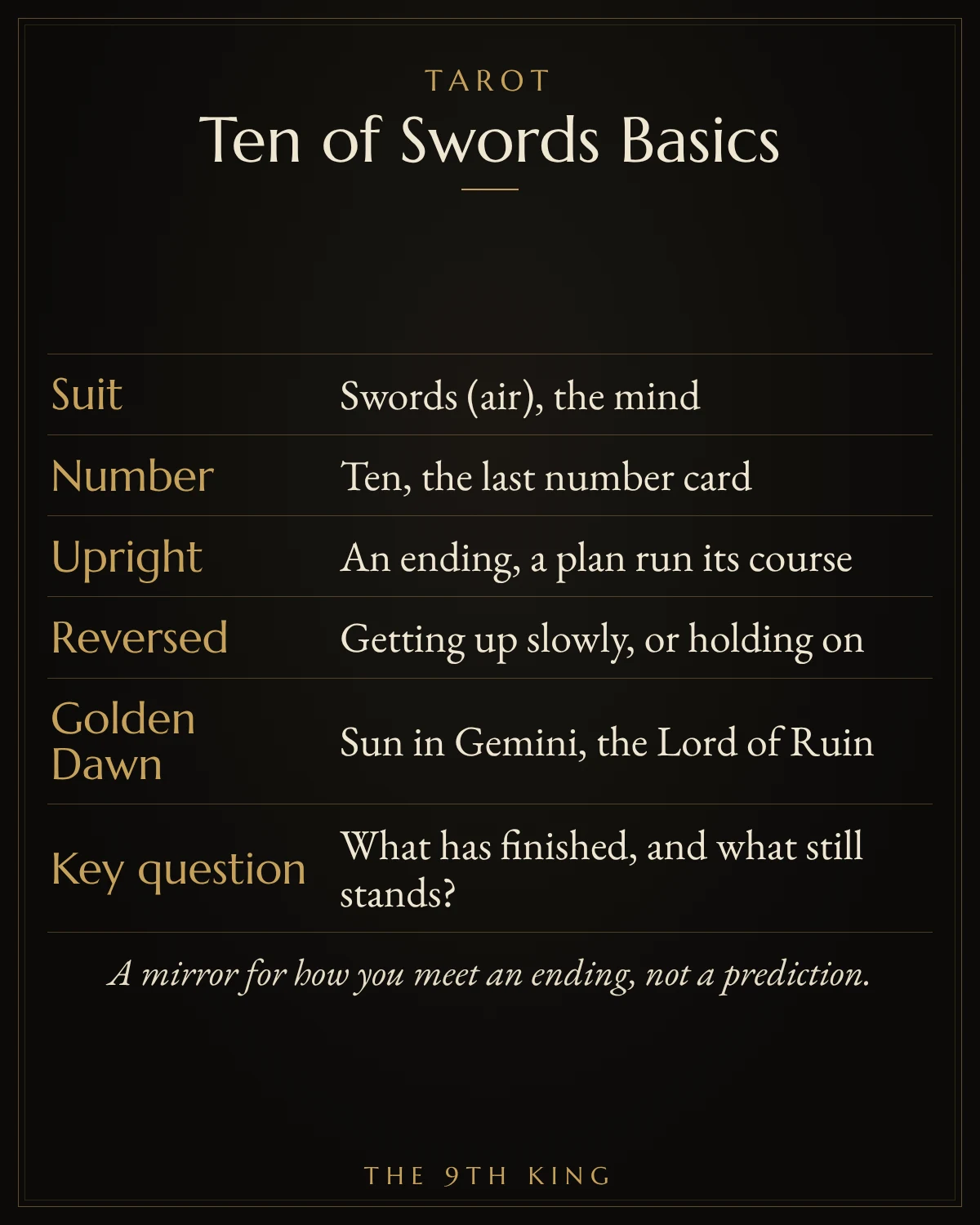
The Ten of Swords at a glance
| Ten of Swords | |
|---|---|
| Arcana | Minor Arcana, a pip (number) card |
| Suit and element | Swords, linked with air |
| Number | Ten, the last number card |
| Golden Dawn title | Lord of Ruin |
| Astrology (Golden Dawn) | Sun in Gemini |
| Upright | An ending, a plan run its course |
| Reversed | Getting up, or holding on |
| Key question | What has finished, and what still stands? |
What the Ten of Swords looks like
Most people know this card from the Rider–Waite–Smith deck, published by William Rider & Son of London in December 1909, with instructions by A.E. Waite and art by Pamela Colman Smith, both Golden Dawn members (Wikipedia: Rider–Waite Tarot).
Waite’s own description
Waite describes the picture in a single line: a figure lying prostrate, pierced by all ten of the card’s swords (sacred-texts.com: Waite, Ten of Swords). That is the whole description.
Reading the image as a symbol
On The 9th King, we read that picture as a symbol, never as a scene of harm. Swords are the suit of the mind: thoughts, words, judgments and hard facts. Ten of them is every sword the suit has. The image says, as loudly as a picture can, that a particular story has gone as far as it can go. The figure is the old version of a plan or a self, laid down because it’s finished.
The older Golden Dawn image
The Golden Dawn’s own description, in Book T as printed by Aleister Crowley in Liber LXXVIII, has no figure at all. Four hands hold eight swords with their points falling away from each other, and two more hands hold two swords crossed in the center, as if their meeting had pushed the others apart. No rose, flower or bud is shown, and the symbols of the Sun and Gemini sit above and below (Liber LXXVIII, sacred-texts.com).
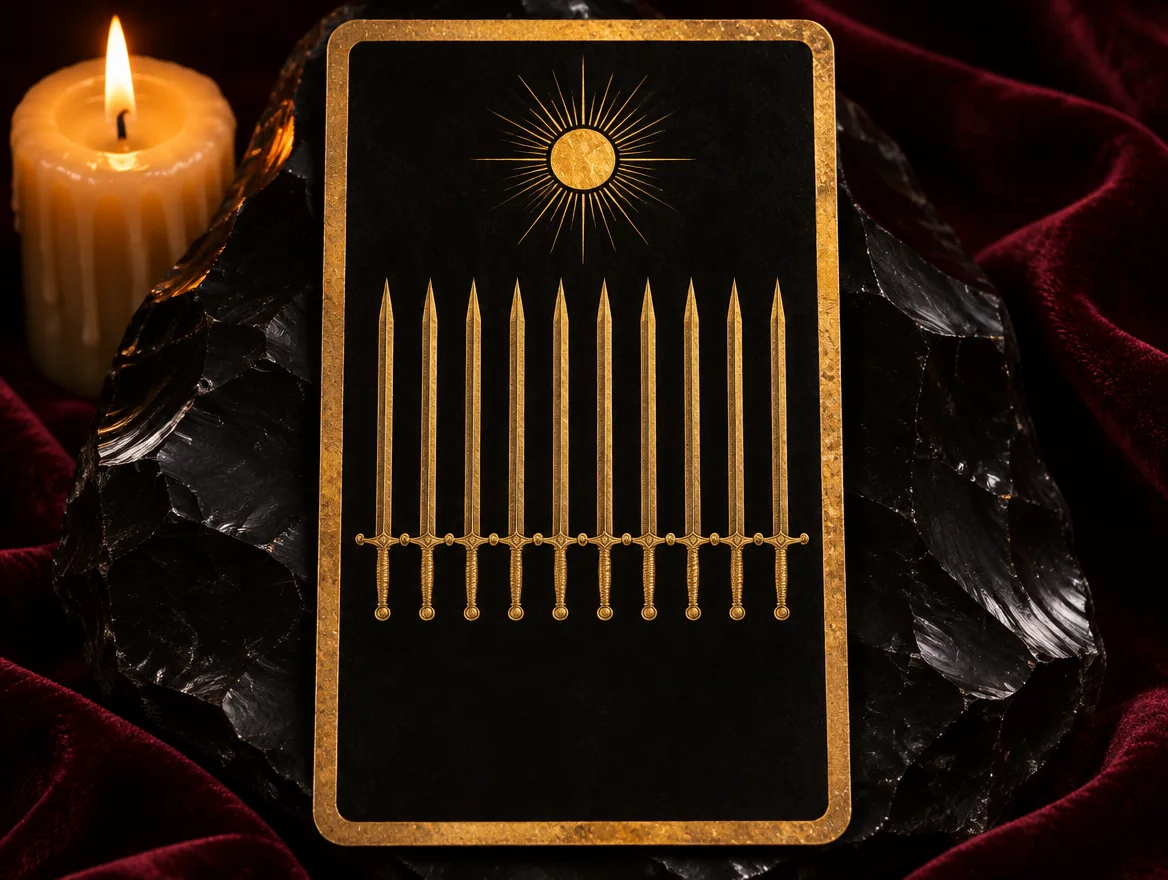
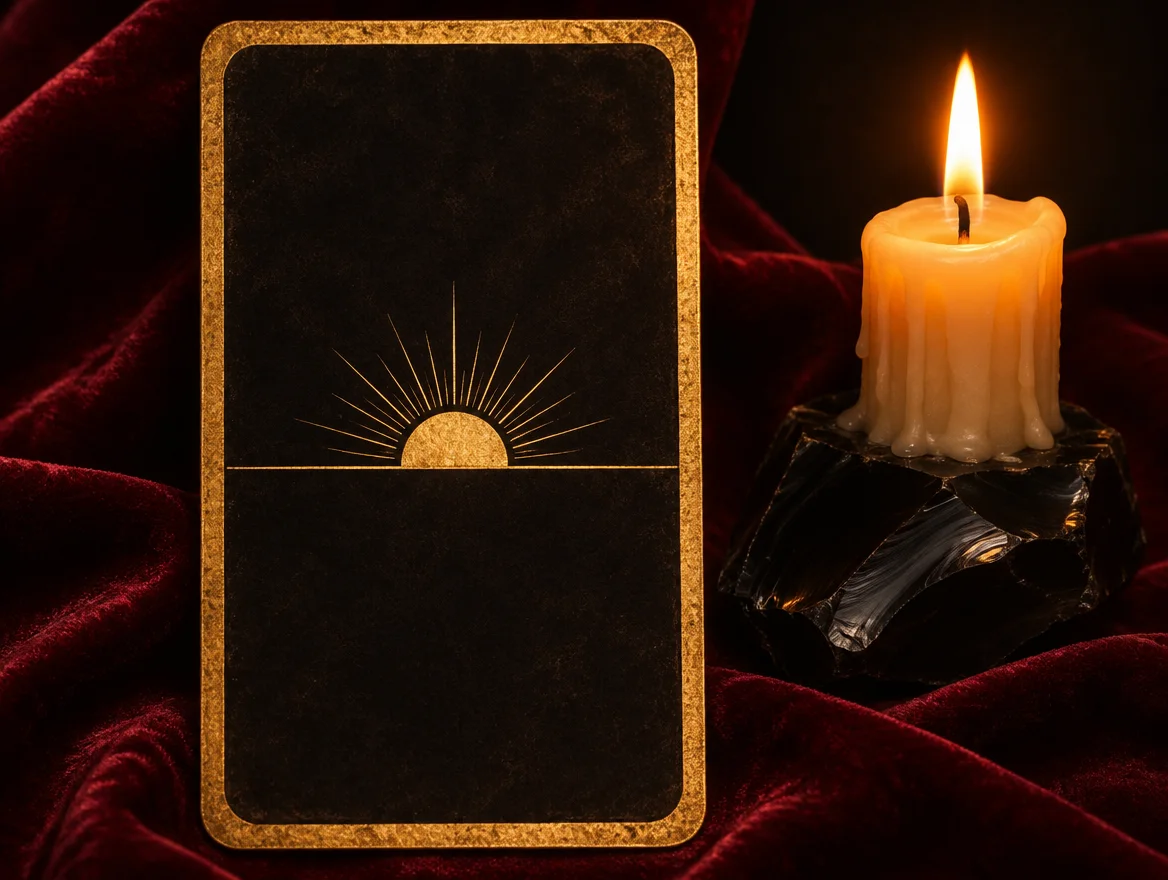
Our own 9K art keeps the calm part of the idea and drops everything sharp: ten upright swords standing in a quiet row before a dawn horizon. The dawn is our own symbol for what comes after an ending. It isn’t a detail from Waite’s text.
Ten of Swords meaning (upright)
Waite’s divinatory meaning begins with whatever the design itself suggests, then adds pain, affliction, tears, sadness and desolation (sacred-texts.com: Waite, Ten of Swords). He also adds a line that matters for anyone who has felt a chill on drawing this card: “It is not especially a card of violent death.”
Liber LXXVIII names the card the Lord of Ruin. Its list opens with complete disruption and failure and the ruin of plans and projects. Then it adds mirth, cleverness and eloquence, and closes “Yet clever, eloquent, etc., according to dignity”, meaning the cards around it shape how it reads (Liber LXXVIII, sacred-texts.com). Even the old sources didn’t treat this card as one flat note of doom.
On The 9th King, the upright Ten of Swords usually points to one of three things.
A plan that has run its course
The card can point to a plan, a project, a role or a hope that has reached its real end. Ask yourself: What have I been treating as “still possible” that has actually ended?
An exhausted story
Swords are thought, so the ending isn’t always an event. It can be a way of thinking that has worn out: a life plan you no longer believe, or a self-image that no longer fits. Ask yourself: Which story about my life have I outgrown?
The worst-case story
Sometimes the ten swords are thoughts, not facts. The mind piles every fear onto one moment until it feels like the end of everything. Ask yourself: How many of these swords are things that happened, and how many are things I’m afraid of?
Ten of Swords reversed
Readers handle reversals in different ways: some read the opposite meaning, some read the same energy blocked or softened, and some don’t use reversals at all. Waite’s reversed meaning is advantage, profit, success and favor that don’t last, plus power and authority (sacred-texts.com: Waite, Ten of Swords).
On The 9th King, the Ten of Swords reversed usually points to one of two patterns, offered as questions, not predictions.
Getting up slowly
The ending has happened, and you’re starting to stand. Not all at once, and not in a straight line. Ask yourself: What has helped me take even one step since this ended?
Holding on to what’s over
The reversal can point to an ending you haven’t let yourself call an ending: the project you keep reviving, the message you keep drafting, the role you keep performing after it’s gone. Ask yourself: Am I mourning this, or am I trying to undo it?
| Pattern | Upright tone | Reversed tone |
|---|---|---|
| The ending | Complete, clear | Recovering from it, or resisting it |
| The mind | Story run out | Rewriting the last page |
| The body | Tired, flat | Slowly getting up |
| The next step | A new count | A first small step |
Ten of Swords astrology: Sun in Gemini
The 9th King uses Golden Dawn–derived correspondences, the tradition the Rider–Waite–Smith deck draws on. Other schools of tarot and astrology use different systems, and not every card maps to a single sign: the court cards and Pages, for example, work differently. What follows is one traditional framework, offered as symbolism.
How the number cards get their planets
In the Golden Dawn system, the 36 numbered cards from Two to Ten are matched to the 36 decans of the zodiac. A decan is a ten-degree third of a sign, and each one has a ruling planet. Liber LXXVIII lists the Ten of Swords, the Lord of Ruin, with the decan Sun in Gemini (Liber LXXVIII, sacred-texts.com).
In Liber’s decan table, the three Gemini cards appear in this order: the Eight of Swords (Jupiter in Gemini), the Nine of Swords (Mars in Gemini) and the Ten (Sun in Gemini). So, going by the order of Liber’s own table, the Ten is the last of the three Gemini entries. Liber also lists the five decans the Sun rules: the Eight of Pentacles, the Six of Cups, the Four of Pentacles, the Three of Wands and this card.
What the Sun brings
On The 9th King, the Sun describes identity, vitality and the light by which you see things clearly. It’s the part of you that wants to live as yourself. Our guide to how to read a birth chart explains the Sun’s role in a chart.
What Gemini brings
Gemini is mutable air, the sign of the mind, talk, curiosity and many ideas at once. Our Gemini Personality Traits page explores the Twins’ quick mind and its shadow. On this card, Gemini is the busy mind that can talk itself into a corner, and also the mind that can tell a new story.
The tension in the pairing
At first the Sun seems an odd ruler for a card called Ruin. On The 9th King, we read it this way: the Sun shines on what’s left. When a story has fully ended, you can finally see it in plain light, without hoping or bargaining. What remains is clarity, and the part of you the Sun stands for, which didn’t end with the plan.
This pairing isn’t about people born under Gemini. Anyone can draw this card, whatever their sign.
The 9K reading: let the last page be the last page
The card’s tension
The Ten of Swords holds two truths at once: this is over and I’m still here. People often grip one and drop the other: deciding their whole life is over, or moving on so fast they never admit what ended. The card asks for both. The ending was real. So is whatever is left standing.
The shadow side
The shadow of the Ten of Swords isn’t sadness or tiredness after an ending. Those are natural. The shadow is turning an ending into a verdict. It can look like:
- The final verdict. Deciding one ending proves something about your worth: “I always fail”, “this is who I am now”.
- Adding swords. Piling every old disappointment onto this one until it feels like all of them at once.
- Reopening the last page. Rewriting the ending in your head, hunting for the move that would have saved it.
- The endless retelling. Telling the story again and again in a way that keeps it open rather than helping it close. Liber’s list for this card even mentions repeating things and many words.
- Refusing the ending. Keeping a finished thing on life support because letting it end feels like losing twice.
These patterns usually come from caring a great deal. The question is whether what you’re doing helps the ending close.
A word on rest: endings are tiring. Sleeping more, saying no to plans and moving slowly are often what’s needed, especially if illness or exhaustion is part of the picture. That’s rest, not avoidance. Avoidance means refusing to look at what ended at all.
An ending or a verdict
| Closing an ending | Making it a verdict | |
|---|---|---|
| The facts | “This plan ended.” | “Everything is ruined.” |
| The self | “I’m still here.” | “This is what I am.” |
| The story | Told to close it | Retold to reopen it |
| The question | “What still stands?” | “Why always me?” |
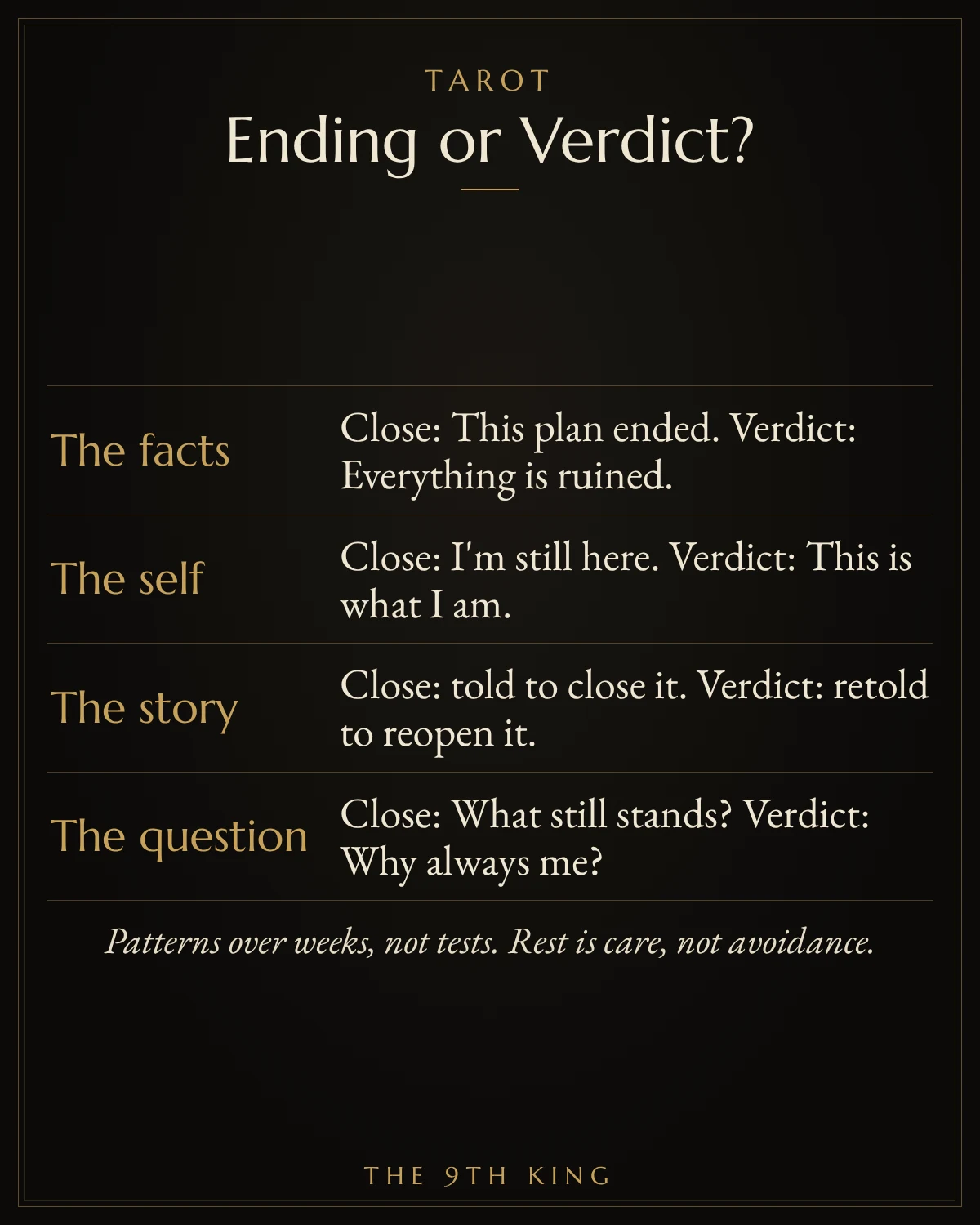
These are patterns, not tests. You can feel shaken, flat or angry while closing an ending well, and you can feel fine while quietly turning it into a verdict. How it feels in the moment doesn’t prove which is happening. Look at the pattern over days and weeks instead.
The self-mastery lesson
The lesson of the Ten of Swords is to let the last page be the last page. Ten is the final number card in the suit. After it, the count starts again with the Ace of Swords, the card of a clear new idea. Self-mastery here isn’t bouncing back fast. It’s letting a finished thing be finished, so your energy isn’t spent holding it up.
If you want to work with the stories you tell about yourself, Shadow Work, Plainly explains how to start gently. If an ending keeps waking up an older one, inner child work may help you meet that earlier hurt with more care.
Ten of Swords as feelings, in love and at work
Ten of Swords as feelings
When someone asks “how does this person feel?” and draws the Ten of Swords, readers often take it as exhaustion, defeat or feeling that something is over. But a card can’t tell you what’s in another person’s heart; their words and actions are the real evidence. If the card is about your own feelings, it can be a prompt to ask: Am I tired because something ended, or because I’m still holding it up?
Ten of Swords love meaning
In a love reading, readers often link the upright card with the end of a relationship, or of a pattern within one: an old argument, or a hope that one person would change. The card doesn’t predict a breakup, and it can’t establish what anyone did.
Tarot can’t tell you whether to stay or leave, and this page won’t either. If you don’t feel safe with someone, your safety comes first, and the person who causes harm is always the one responsible for it. Otherwise, useful questions include:
- What, specifically, has ended, even if the relationship itself hasn’t?
- Am I holding on to a version of this person, or of us, that’s already gone?
- What would a fresh start look like here, with this person or without them?
If an old dynamic keeps replaying between you and a partner, our guide to synastry for beginners can help you look at the pattern with curiosity instead of blame.
Ten of Swords at work
At work, readers often take the card as the end of a project, role or long effort. This is reflection, not career or financial advice. The shadow version is deciding one ending defines your whole working life. Ask yourself: What did this chapter teach me that the next one can use?
Practical exercise: closing the chapter
You need about twenty minutes, a notebook and a quiet place. Take it slowly. It’s fine to do one step, stop and come back another day.
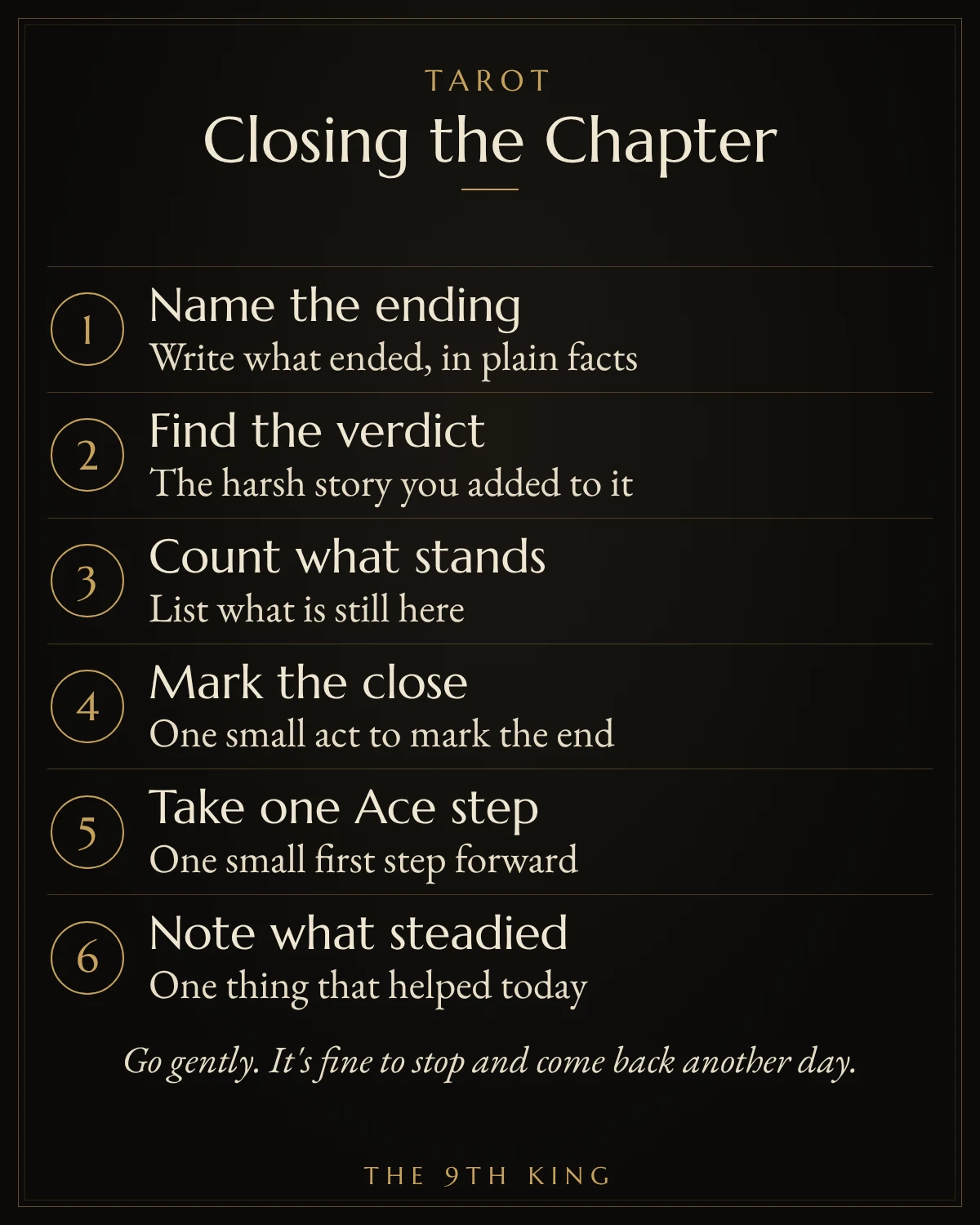
Step 1: Name the ending
Write what ended in one or two plain sentences. Facts only: “The project was cancelled in May.” “We stopped living together.” Leave out what it means for now.
Step 2: Find the verdict
Underneath, write the harsh story you’ve been adding to the facts: “I always fail.” “I wasted years.” On paper, it’s easier to see as a story laid on top of the facts.
Step 3: Count what stands
List what is still here after the ending: people, skills, places, parts of yourself. Write the number at the bottom.
Step 4: Mark the close
Choose one small act that marks the ending: writing a last line in a notebook, or putting an object in a drawer. If the ending involves another person, contacting them is a choice, not a step in this exercise. Do it only if it feels safe and useful.
Step 5: Take one Ace step
Pick one small first step toward whatever comes next, sized for a tired person: a single email, an hour on something new, one conversation.
Step 6: Note what steadied
Before bed, note one thing that steadied you today, even briefly. Over time, the list can show you moments of steadiness that are easy to miss on hard days.
A worked example (fictional)
Priya (fictional) spent two years building a community theater group that has now closed. She draws the Ten of Swords upright.
In Step 1 she writes: “The group closed in September.” In Step 2, the verdict: “I’m not good at leading anything.” In Step 3 she counts what stands: her friendship with the set designer, the scripts she wrote, her experience running rehearsals and the local hall that still rents space. She writes “4” at the bottom. For Step 4, she puts the group’s last poster in a folder and closes it. Her Ace step is one email to the hall about a single reading night. By the end of the week, her steady-things list has three lines.
Journal prompts for the Ten of Swords
- What in my life has truly ended, even if I haven’t said so out loud?
- What verdict have I attached to that ending, and is it a fact or a fear?
- Which of my swords are events, and which are thoughts about events?
- What am I still holding up that might be allowed to rest?
- What is still standing that I’ve been too tired to notice?
- If this is the last page, what would I like the first line of the next one to be?
For more prompts like these, our shadow work prompts collection goes deeper.
A warm note: this is reflective practice, not therapy. If an ending is tied to trauma or abuse, or if you’re dealing with thoughts of self-harm or distress that feels overwhelming, please work with a qualified therapist who can walk with you. It’s always fine to stop a prompt that feels like too much.
Myths and misreadings of the Ten of Swords
- “The Ten of Swords means death, or that something terrible is coming.” No. On The 9th King, tarot doesn’t predict events, and this is a card of symbolic endings only. Waite himself said it is not especially a card of violent death, and Liber LXXVIII calls it the Lord of Ruin, a word about plans and projects (sacred-texts.com: Waite, Ten of Swords).
- “It means you’ve been betrayed.” In his list of additional meanings, Waite includes treason on the part of friends, but only in one narrow case. He also warned that these extra meanings have little connection with the card designs and often disagree with his main meanings (sacred-texts.com: Waite, Additional Meanings). A card can’t establish what anyone else did.
- “Sun in Gemini means this card is about Gemini people.” No. The correspondence describes the card’s symbolism in the Golden Dawn tradition. Anyone can draw it, whatever their sign.
Ten of Swords: FAQ
What does the Ten of Swords mean?
The Ten of Swords is the last number card in the suit of Swords. Readers commonly take it as a complete ending: a plan, role or story that has run its course, often with exhaustion or sadness. On The 9th King, it’s read symbolically, never as literal harm. It’s a mirror for how you’re meeting an ending and what you’re telling yourself about it, not a prediction.
What does the Ten of Swords reversed mean?
Reversed, the Ten of Swords is often read as slowly getting back up after an ending, or as holding on to something that’s already over. Waite’s reversed meanings include success and favor that don’t last, plus power and authority. Some readers don’t use reversals at all. Treat it as a question to explore, such as “am I recovering, or trying to undo this?”
What does the Ten of Swords mean as feelings?
As feelings, readers often take the Ten of Swords as exhaustion, defeat or the sense that something is over. But a card can’t tell you what another person feels or what they’ll do; their words and actions are the real evidence. If the card is about you, it can be a prompt to admit what has ended and notice how tired you are from holding it up.
What does the Ten of Swords mean in love?
In love, the card is often linked with the end of a relationship or the end of an old pattern inside one. It doesn’t predict a breakup, and it can’t tell you what anyone has done. It doesn’t tell you to stay or leave either. It invites you to name what has truly ended, look after yourself, and put your safety first if you ever feel unsafe.
Does the Ten of Swords mean death?
No. On The 9th King, the Ten of Swords is a card of symbolic endings: a plan, a role or a story reaching its last page. Even Waite steered readers away from a literal reading, and the Golden Dawn named it the Lord of Ruin, a word about plans and projects. Read it as the end of a chapter, never as harm to anyone.
What zodiac sign is the Ten of Swords?
In the Golden Dawn system, the tradition The 9th King uses, the Ten of Swords corresponds to Sun in Gemini, the last of the three Gemini entries in Liber LXXVIII’s decan table. Liber calls the card the Lord of Ruin. It’s a planet-in-sign pairing rather than a card for one sign, and other schools use different correspondences, so treat it as symbolism.
Your next step: try the closing the chapter exercise above for one ending you’re carrying this week, gently and at your own pace. Then read our Gemini Personality Traits guide: Gemini is the sign the Golden Dawn tied to this card, and its quick, story-making mind can show you how a new chapter gets written.
Explore Next
- The Twins and their shadow: Gemini Personality Traits
- Start gently: Shadow Work, Plainly
- Go deeper with questions: Shadow Work Prompts
- Old hurts that echo: Inner Child Work
- The shadow side of every sign: Zodiac Shadow Work
- A new year, a new count: Solar Return Chart
- Reading by feel: Intuitive Tarot (Code of Ascension)
- New to the cards: Tarot for Beginners: How Tarot Really Works (Code of Ascension)
- More Swords on The 9th King: Ace of Swords · Three of Swords · Six of Swords · King of Swords
- Endings in the Major Arcana: Death · The Tower · The Star
- More tarot on The 9th King: Tarot Card Meanings · Minor Arcana · Tarot & the Zodiac · Shadow Work Tarot Spread
- More cards in this set: Eight of Swords, Nine of Swords
Final Thought: The Last Page, Not the Last Word
The Ten of Swords is honest about endings. But an ending is a page, not a verdict on you. Name what finished, set down the harsh story you added to it, count what is still standing and take one small step into the new count. The ending is real. So are you. Know your nature. Rule your life.
About the Author
King is the founder of The 9th King, where zodiac psychology, relationships and shadow work are explored as tools for self-knowledge rather than fortune-telling. He’s a Libra Sun, and writes about the personal side of astrology on King The Kemist. Astrology on The 9th King is interpretation and self-reflection, not prediction or established fact.
Leave a Reply