Quick Answer: What Does the Six of Swords Mean?
The Six of Swords (also written 6 of Swords) is a Minor Arcana card from the suit of Swords. A.E. Waite describes a ferryman taking passengers across the water in a small flat boat, on a smooth course, toward the further shore. Readers often take it as the card of the quiet crossing: moving away from a hard stretch, slowly and steadily, toward calmer ground.
- Keywords: transition, moving on, recovery, a steady passage, calmer thinking, leaving a hard place, help along the way.
- Upright, in one line: a prompt to notice where you’re already moving away from something hard, if you let the crossing be slow and steady.
- Reversed, in one line: a prompt to look at what’s holding the boat at the dock, or at what you’re trying to row back toward.
On The 9th King, tarot is a mirror for self-knowledge, not fortune-telling. The Six of Swords doesn’t say a move or a trip is coming. It asks how you’re handling the space between an old chapter and a new one.
Table of Contents

The Six of Swords at a glance
| Six of Swords | |
|---|---|
| Arcana | Minor Arcana, a pip (number) card |
| Suit and element | Swords, linked with air |
| Number | Six, past the conflict of the Five |
| Golden Dawn title | Lord of Earned Success |
| Astrology (Golden Dawn) | Mercury in Aquarius |
| Upright | Transition, recovery, steady passage |
| Reversed | Stuck, delayed, rowing back |
| Key question | What am I carrying across? |
What the Six of Swords looks like
Most people meet this card through the Rider–Waite–Smith deck, first published in London by William Rider & Son in December 1909. A.E. Waite wrote the instructions and Pamela Colman Smith drew the art, and both were members of the Hermetic Order of the Golden Dawn (Wikipedia: Rider–Waite Tarot).
The ferryman and his passengers
Waite’s description in The Pictorial Key to the Tarot is only a few lines long. A ferryman is carrying passengers in his punt, a small flat-bottomed boat, to the further shore. The course is smooth. Because the load is light, Waite notes, “the work is not beyond his strength” (sacred-texts.com: Waite, Six of Swords).
He doesn’t say who the passengers are or why they’re leaving.
Details on the 1909 Smith card
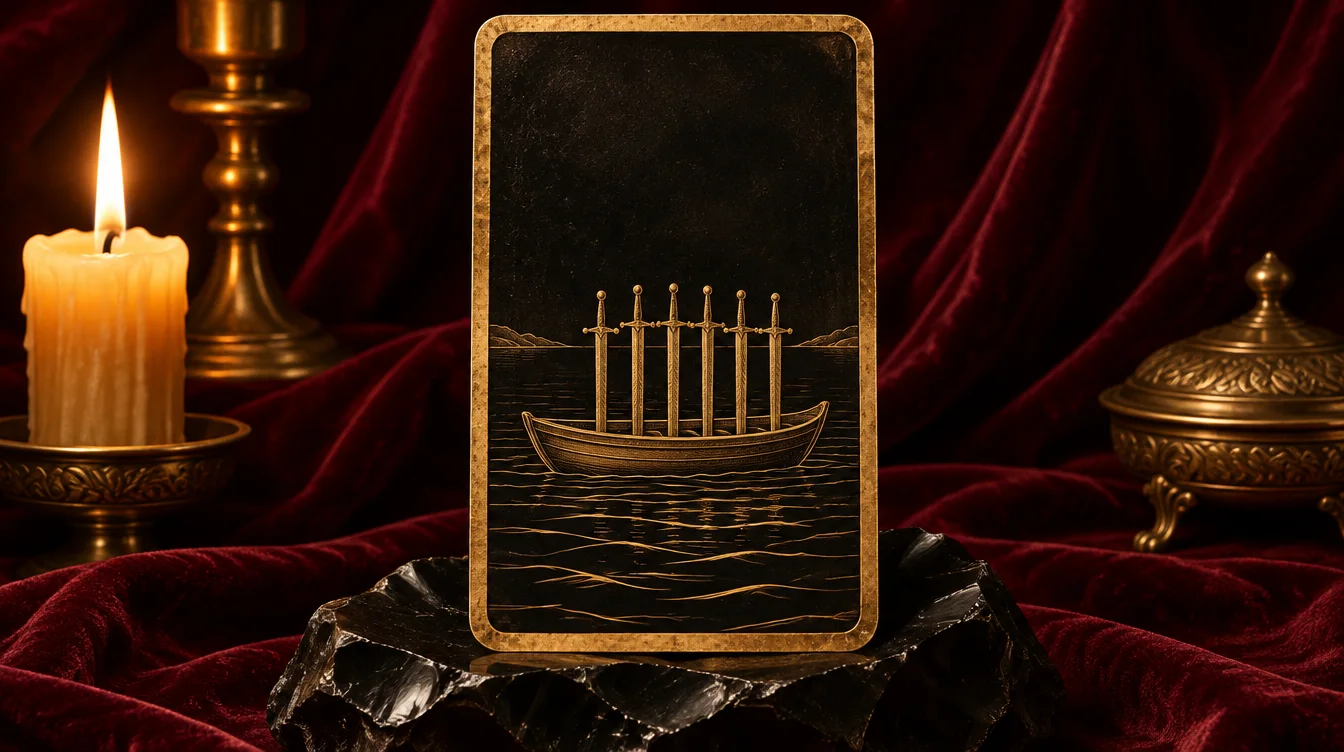
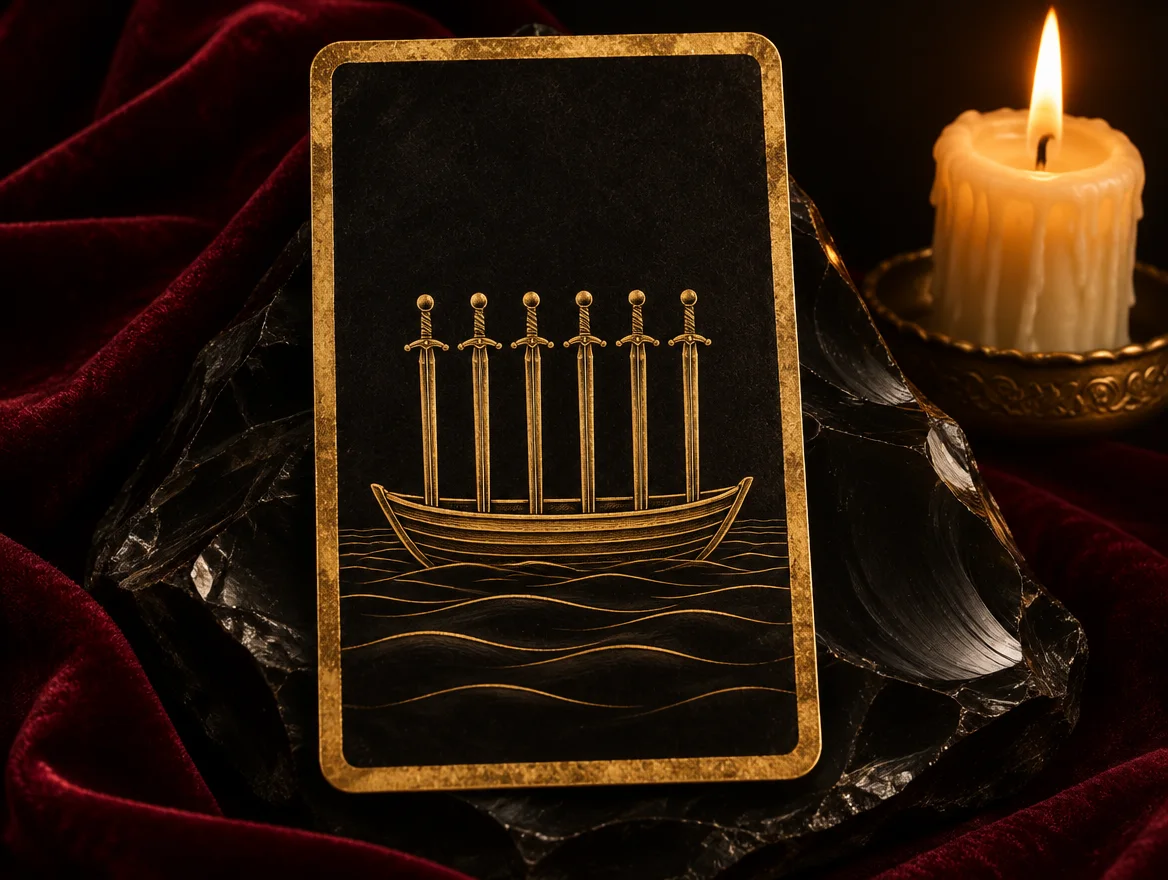
On the 1909 Smith card, the six swords stand upright in the boat, and the passengers sit low and wrapped, facing away from the viewer. Apart from the boat and its passengers, none of this is in Waite’s text. Our own art is an original 9K line-art design, not a copy of Smith’s card.
The Golden Dawn’s version
The Golden Dawn’s teaching text, Book T, as printed by Aleister Crowley in Liber LXXVIII, describes a different, more abstract card. Two hands each hold two swords, and the swords cross in the center. On that crossing, a rose is re-established, with the symbols of Mercury and Aquarius above and below (Liber LXXVIII, sacred-texts.com). In the same text, the Five of Swords shows that rose’s petals torn and falling. The Six puts the rose back together: not untouched, but whole again.
Six of Swords meaning (upright)
Waite’s divinatory meanings for the card are a short list: a journey by water, a route, a way, an envoy, and an expedient, meaning a practical way through (sacred-texts.com: Waite, Six of Swords). Book T gives the card the title Lord of Earned Success and opens its meaning with “success after anxiety and trouble,” adding patience and labour (Liber LXXVIII, sacred-texts.com). Wikipedia’s summary of common readings includes travel away from difficulty and passage from pain (Wikipedia: Six of Swords).
Put together, the upright Six of Swords meaning readers commonly use has three layers.
A crossing, not an arrival
The card shows the middle of the trip. You’ve left one shore and you haven’t reached the other. Readers often take this as the in-between season after a breakup, a job ending or a hard year, when the worst has passed but nothing feels settled yet.
Calmer water
Waite’s course is smooth. On The 9th King, we read that as the moment your mind starts to quiet: the replaying slows down and you can think about the situation instead of only reacting to it. Ask yourself: What feels a little less loud than it did a month ago?
Help on the way across
The passengers aren’t rowing. Someone else is steering. Readers often take the card as a reminder that moving on doesn’t have to be a solo job: a friend, a routine or simply time can carry part of the load. Ask yourself: What is helping me move, even if I haven’t thanked it yet?
Six of Swords reversed
Readers handle reversals differently: some read the opposite meaning, some the same energy blocked, and some skip reversals entirely. Waite’s reversed meanings are surprising: declaration, confession and publicity, with one source he mentions reading it as a proposal of love (sacred-texts.com: Waite, Six of Swords). On The 9th King, we keep his idea of something said out loud, and add the modern sense of a stalled crossing.
The Six of Swords reversed usually points to one of three patterns, offered as questions, not predictions.
The boat hasn’t left the dock
You know a chapter is over, but you’re still standing on the old shore. Ask yourself: What would one small push away from the dock look like?
Rowing back toward the old shore
You’ve started to move on, then you turn the boat around: rereading old messages, or going back to a habit you already decided to leave. Ask yourself: What am I hoping to find back there that I haven’t found yet on the way forward?
What needs to be said
Waite’s reversed meanings were about declaration and confession. On The 9th King, we read that as the crossing that can’t continue until something is named: to yourself, in a journal or, if it’s safe and useful, to someone else. Ask yourself: Is there something I haven’t admitted that’s keeping me in place?
| Pattern | Upright tone | Reversed tone |
|---|---|---|
| Movement | Slow and steady | Stalled or turned back |
| Mind | Quieter, clearer | Looping, replaying |
| Help | Accepted | Refused or not asked for |
| The old shore | Behind you | Still pulling |
Six of Swords astrology: Mercury in Aquarius
The 9th King uses Golden Dawn–derived correspondences, the tradition the Rider–Waite–Smith deck draws on. Other schools of tarot and astrology use different systems, and not every card maps to a single sign: the court cards and Pages, for example, are handled differently. What follows is one traditional framework, offered as symbolism.
How the number cards get their planets
In the Golden Dawn system, the 36 small cards (the Twos through Tens of the four suits) answer to the 36 decans of the zodiac. A decan is a ten-degree third of a sign, and each one is given a ruling planet. Book T lists the Six of Swords, the Lord of Earned Success, as Mercury in Aquarius (Liber LXXVIII, sacred-texts.com). Liber’s table places it between the Five (Venus in Aquarius) and the Seven (Moon in Aquarius), the second of Aquarius’s three decans in that list.
Book T also files all four Sixes under Tiphareth on the Kabbalistic Tree of Life, and for this card it adds a short gloss that echoes Waite: labour, work and a journey by water. In the same text, the suit of Swords is the suit of air.
What Mercury brings
Mercury is the planet of the mind, messages, learning and getting from one place to another. It rules Gemini and Virgo, which our Gemini Personality Traits and Virgo Personality Traits pages explore. On this card, Mercury is the ferryman’s skill: the know-how that finds a route through.
What Aquarius brings
Aquarius is fixed air: the sign of perspective, ideas, community and the long view. Our Aquarius Personality Traits page covers the Water Bearer’s gifts and its shadow. On this card, Aquarius is the step back that makes leaving possible.
The tension in the pairing
Mercury wants to talk it through, analyze and explain. Aquarius wants distance and a wider frame. Together they make a mind that can finally see clearly. The risk is detachment: you understand everything about what happened and still haven’t felt it. The Six of Swords sits right there, between thinking your way across and letting yourself be carried.
The 9K reading: what you carry across
The card’s tension
The Six of Swords holds two true things at once: I’m leaving and I’m taking some of it with me. The swords stay in the boat. On The 9th King, we read them as the thoughts, lessons and memories you bring from the old shore. Some are useful, some are heavy, and you don’t need to leave all of them behind. The work is knowing which ones you carry, and why.
The shadow side
The shadow of the Six of Swords is leaving without arriving. It’s moving on in body but not in mind, or moving so often that nothing ever has to be faced. It can look like:
- Geographic fixes. Changing cities or jobs, and finding the same problem waiting on the new shore.
- Numb distance. Calling it “moving on” when it’s really not feeling anything.
- Over-explaining. Analyzing what went wrong, Mercury style, so you never sit with the sadness.
- Carrying old expectations. Seeing the people on the new shore as copies of the people on the old one. Our guide to psychological projection covers a related pattern.
Distance can protect you while you heal. The question is whether it’s still helping, or has become a way of never landing.
Moving on or running away?
Leaving a situation that is unsafe, abusive or harmful is never “running away.” If someone hurt or controlled you, the responsibility for that harm belongs to them, and getting distance is a boundary, not a failure. Safety comes first, always, and it’s fine to lean on people and services you trust to make the crossing.
Outside of safety, the difference often shows up in what you do once you’re across.
| Moving on | Running away |
|---|---|
| Knows what it’s leaving | Avoids looking back at all |
| Brings the lesson | Brings the pattern |
| Lets the feelings come | Keeps moving to stay numb |
| Lands, then rests | Never lands |
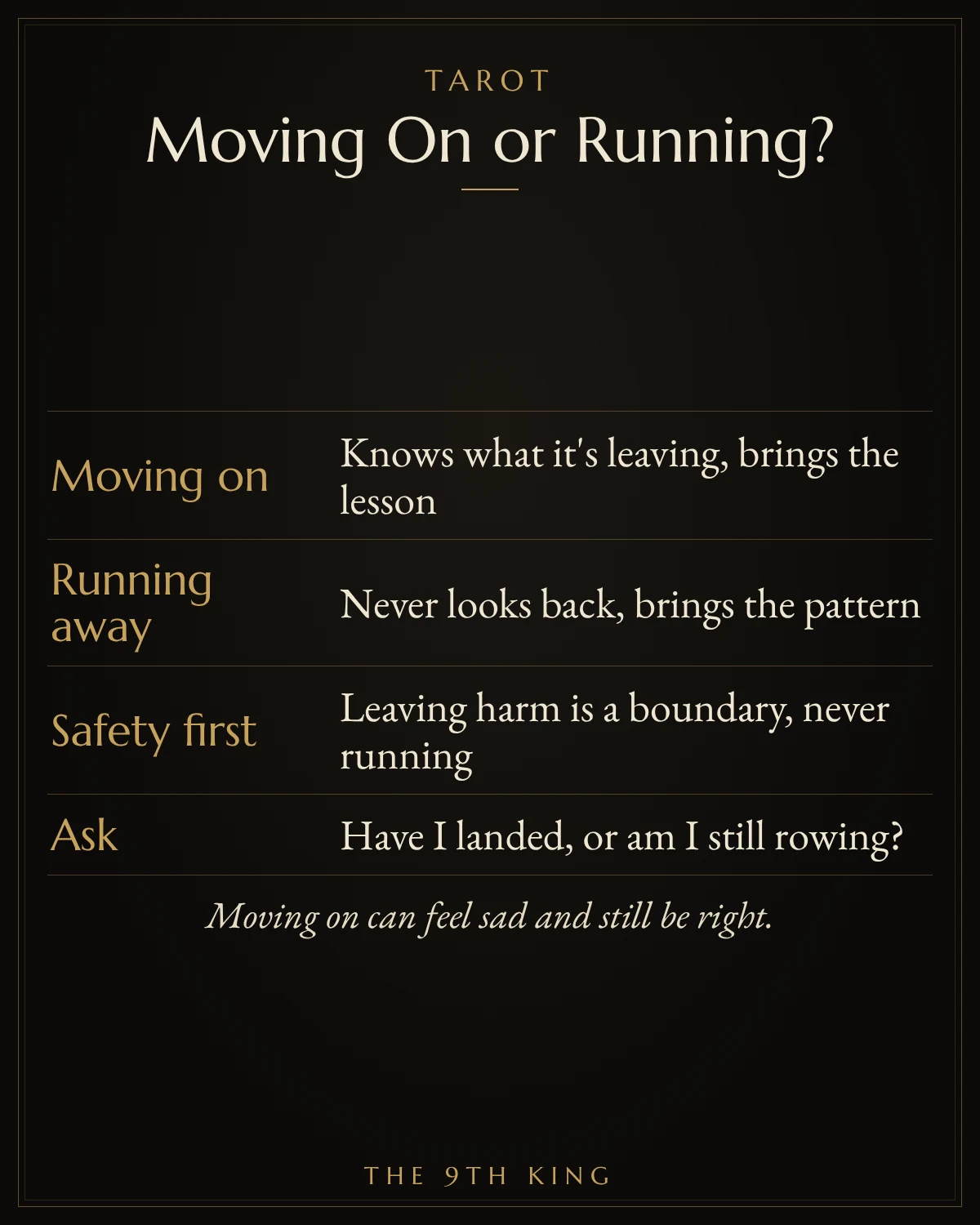
Feelings aren’t a reliable test here: moving on can feel sad and still be right. Use questions instead: What am I leaving, specifically? What did it teach me? Am I letting myself feel this, or staying busy so I don’t have to? When I get across, will I stop?
Rest matters here, too. Needing time, sleep and quiet after a hard stretch isn’t avoidance.
The self-mastery lesson
The lesson of the Six of Swords is to let the crossing be a crossing. You don’t have to be healed by the time you leave, and you don’t have to have a plan for the far shore before you push off. Self-mastery here means choosing a direction, accepting help, and not churning the water with constant checking and replaying. It also means unpacking when you land: at some point you step onto the new shore, set the swords down, and look at what you’ve brought.
Six of Swords as feelings, in love and at work
Six of Swords as feelings
When someone asks “how does this person feel?” and draws the Six of Swords, readers often take it as quiet, reflective distance. The card can’t tell you what someone else feels or why; only their words and actions over time can. If the card is about your own feelings, it can be a prompt to ask: Am I calmer, or am I just further away?
Six of Swords love meaning
In a love reading, the upright card can point to recovering after a breakup, two people moving through a hard season together, or a relationship changing shape. The reversed card can point to being stuck on an old relationship, going back to something you already decided to leave, or a conversation that hasn’t happened yet.
Tarot can’t tell you whether to stay or leave, and this page won’t either. If you don’t feel safe with someone, your safety comes first, and getting distance isn’t something you need a card’s permission for. Otherwise, the card can help you notice the pattern. Useful questions:
- What am I still carrying from a past relationship into this one?
- Is there something that needs to be said, and is it safe and useful to say it?
Six of Swords at work
At work, readers often take the card as a transition: a new role, a team change, leaving a job or slowly recovering after a rough project. This is reflection, not career or financial advice. Ask yourself: If I left, what would I want to be different on the other side, and what part of that is in my hands?
Practical exercise: the crossing manifest
A manifest is a ship’s list of what it’s carrying. This exercise helps you make one for your own crossing. You need about twenty minutes and a notebook.
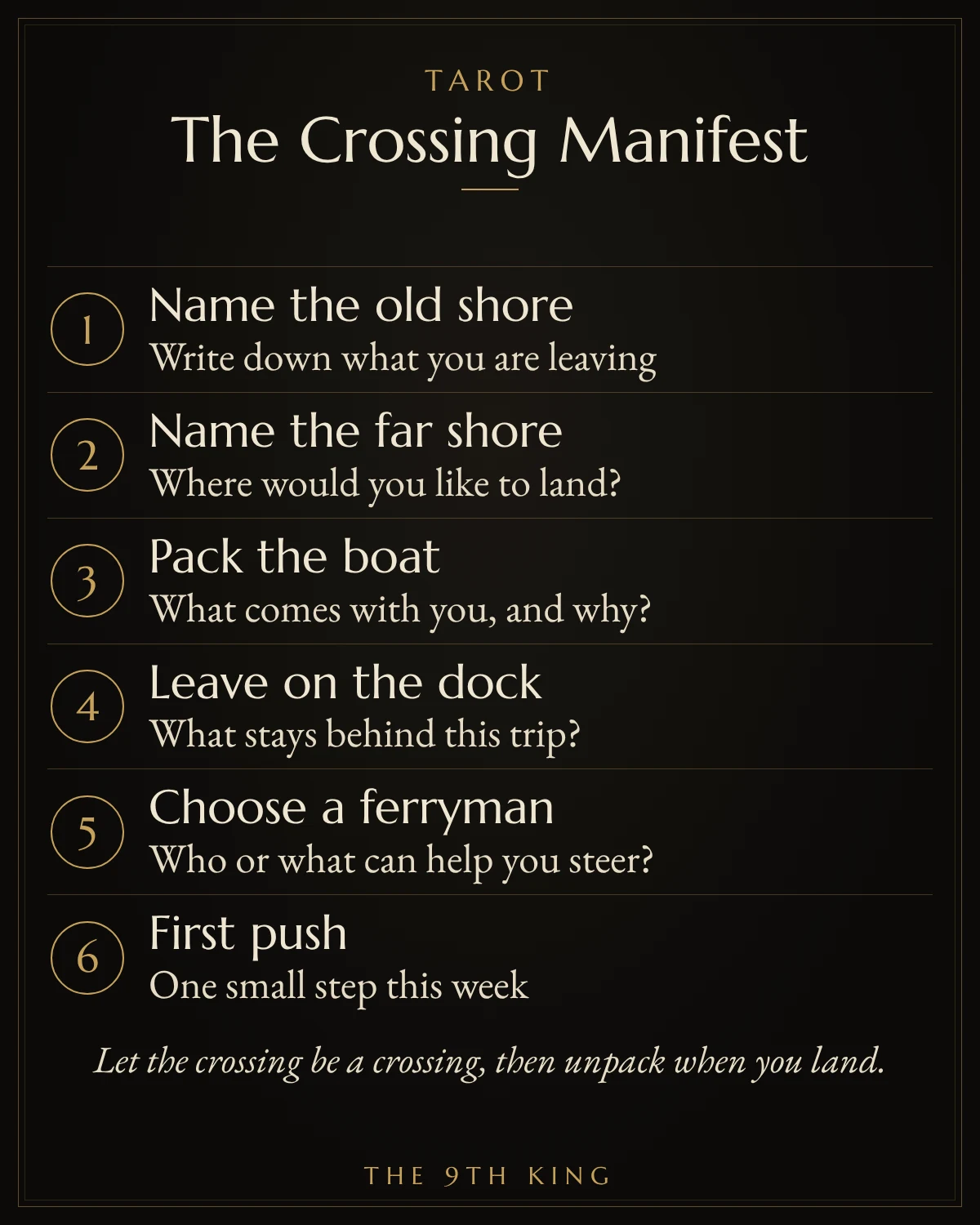
Step 1: Name the old shore
Write one or two sentences: What am I leaving? Be specific: “the job where I stopped speaking up” is easier to work with than “a bad year.”
Step 2: Name the far shore
Write what you’d like the other side to feel like. It doesn’t have to be a plan. “Quieter mornings” is enough.
Step 3: Pack the boat
List what you’re bringing with you: lessons, skills, memories, relationships, beliefs. Next to each one, write a few words about why it’s coming. Some things come because they’re useful. Some come because you’re not ready to let them go yet, and that’s allowed.
Step 4: Leave on the dock
Now list what you’re choosing to leave behind: a habit, a story about yourself, a way of reacting. It doesn’t have to be forever; it just doesn’t get a seat on this trip.
Step 5: Choose a ferryman
Ask: Who or what can help steer? It might be a friend, a counselor, a routine or a calendar reminder. Reaching out to a person is optional; choose it only if it feels safe and useful.
Step 6: First push
Pick one small action you’ll take this week to move away from the old shore. Keep it small enough that you’ll actually do it.
A worked example (fictional)
Priya (fictional) left a long relationship six months ago and keeps drawing the Six of Swords.
In her crossing manifest, she names the old shore as “the life where I planned everything around someone else’s moods.” Her far shore is “a home that feels like mine.” In the boat, she packs her cooking, two close friends and the lesson that she notices tension early. On the dock, she leaves her habit of checking her ex’s social media at night.
Her ferryman is a Sunday call with her sister, which she chooses because it feels safe. Her first push is moving the social apps off her phone’s home screen. A week later she’s still sad some evenings, and lets that be part of the trip.
Journal prompts for the Six of Swords
- What chapter am I moving away from, and have I said goodbye to it in my own words?
- Which “swords” am I carrying from the old shore, and which of them do I actually need?
- Where am I letting someone or something help me, and where am I insisting on rowing alone?
- Is my distance from the past helping me heal, or helping me avoid feeling it?
- What would landing look like, so I’ll know when the crossing is done?
- Is there something I haven’t said or admitted that’s keeping the boat at the dock?
For more prompts like these, our shadow work prompts collection goes deeper, and Shadow Work, Plainly explains how to start safely. If the old shore goes all the way back to childhood, inner child work can be a gentle next step.
A warm note: this is reflective practice, not therapy. If the hard stretch you’re leaving involved trauma or abuse, or if you’re dealing with thoughts of self-harm or distress that feels overwhelming, please work with a qualified therapist who can make the crossing with you. It’s always fine to stop a prompt that feels like too much.
Myths and misreadings of the Six of Swords
- “The Six of Swords means you’re going to travel.” No. Waite listed a journey by water among its meanings, but on The 9th King tarot doesn’t predict events. Readers often take the journey as an inner one: a passage from one season of life to another.
- “It’s a sad card.” The 1909 Smith card can look somber, but Waite describes a smooth course and a light load, and Book T calls it the Lord of Earned Success.
- “Reversed means you’re stuck forever.” A reversal can simply mean you’re not ready yet, or that something needs to be said first. That’s information, not a verdict.
- “Mercury in Aquarius means this card is about Aquarius people.” No. The correspondence describes the card’s symbolism in the Golden Dawn tradition. Anyone can draw it, whatever their sign.
Six of Swords: FAQ
What does the Six of Swords mean?
The Six of Swords is a Minor Arcana card in the suit of Swords. Waite describes a ferryman carrying passengers across smooth water to the further shore. Readers commonly take it as transition, recovery and moving away from a hard stretch toward calmer ground. On The 9th King, it’s a mirror for how you’re handling change, especially what you’re bringing with you, not a prediction that a trip or move is coming.
What does the Six of Swords reversed mean?
Reversed, the Six of Swords is often read as a crossing that’s stalled: staying on the old shore, rowing back toward something you already left, or a conversation that needs to happen first. Some readers don’t use reversals at all. Treat it as a question to explore, such as “what’s keeping me at the dock?”, rather than a fixed outcome.
What does the Six of Swords mean as feelings?
As feelings, readers often take the Six of Swords as quiet, reflective distance: someone working through something or slowly moving away from a painful time. A card can’t tell you what another person feels or why; only their words and actions over time can. If the card is about you, it can prompt you to ask whether you’re truly calmer or just further away.
What does the Six of Swords mean in love?
In love, the upright card can point to recovering after a breakup, or two people moving through a hard season together. Reversed, it can point to being stuck on an old relationship or an unsaid conversation. The card doesn’t tell you to stay or leave. It invites you to notice what you’re carrying from past relationships and whether you’re rowing together or alone.
What zodiac sign is the Six of Swords?
In the Golden Dawn system, the tradition The 9th King uses, the Six of Swords corresponds to Mercury in Aquarius, the second Aquarius decan in Book T’s list. Book T, as printed in Liber LXXVIII, calls the card the Lord of Earned Success. Other schools use different correspondences, so treat this as one traditional framework for symbolism rather than a fixed rule about any sign.
Is the Six of Swords a yes or no card?
The 9th King doesn’t do yes or no readings, because tarot here is a tool for self-reflection, not fortune-telling. Instead of asking whether the card says yes, ask what it shows you about the situation: what you’re leaving, what you’re carrying, who is helping you steer and whether you’re ready to push away from the old shore.
Is the Six of Swords a good or bad card?
Neither, on The 9th King. The card can look somber, but Waite describes a smooth course and a light load, and the Golden Dawn’s Book T titles it the Lord of Earned Success, opening its meaning with success after anxiety and trouble. Read it as a mirror for a transition: some sadness about what’s behind you, and some relief about where you’re going.

Your next step: fill in the crossing manifest above for one transition you’re in right now. Then read our Aquarius Personality Traits guide: Aquarius is the sign the Golden Dawn tied to this card, and its gift for stepping back and seeing the bigger picture is the same perspective that helps a crossing make sense.
Explore Next
- The sign behind the card: Aquarius Personality Traits
- The first card of the suit: Ace of Swords
- A clear mind after hard experience: Queen of Swords
- Go deeper with questions: Shadow Work Prompts
- The shadow side of every sign: Zodiac Shadow Work
- Reading by feel: Intuitive Tarot (Code of Ascension)
- New to the cards: Tarot for Beginners: How Tarot Really Works (Code of Ascension)
- More tarot on The 9th King: Tarot Card Meanings · Minor Arcana · Tarot & the Zodiac · Shadow Work Tarot Spread
- More cards in this set: Two of Swords, Three of Swords, Five of Swords, Seven of Swords
Final Thought: Let the Water Be Calm
The passengers in the Six of Swords don’t have to row, and they don’t have to be healed before they leave. They only have to stay in the boat while it crosses. Know what you’re leaving, choose what comes with you, let someone help steer, and when you reach the far shore, set the swords down and look around. Know your nature. Rule your life.
About the Author
King is the founder of The 9th King, where zodiac psychology, relationships and shadow work are explored as tools for self-knowledge rather than fortune-telling. He’s a Libra Sun, and writes about the personal side of astrology on King The Kemist. Astrology on The 9th King is interpretation and self-reflection, not prediction or established fact.
Leave a Reply