Quick Answer: What Does the Seven of Cups Mean?
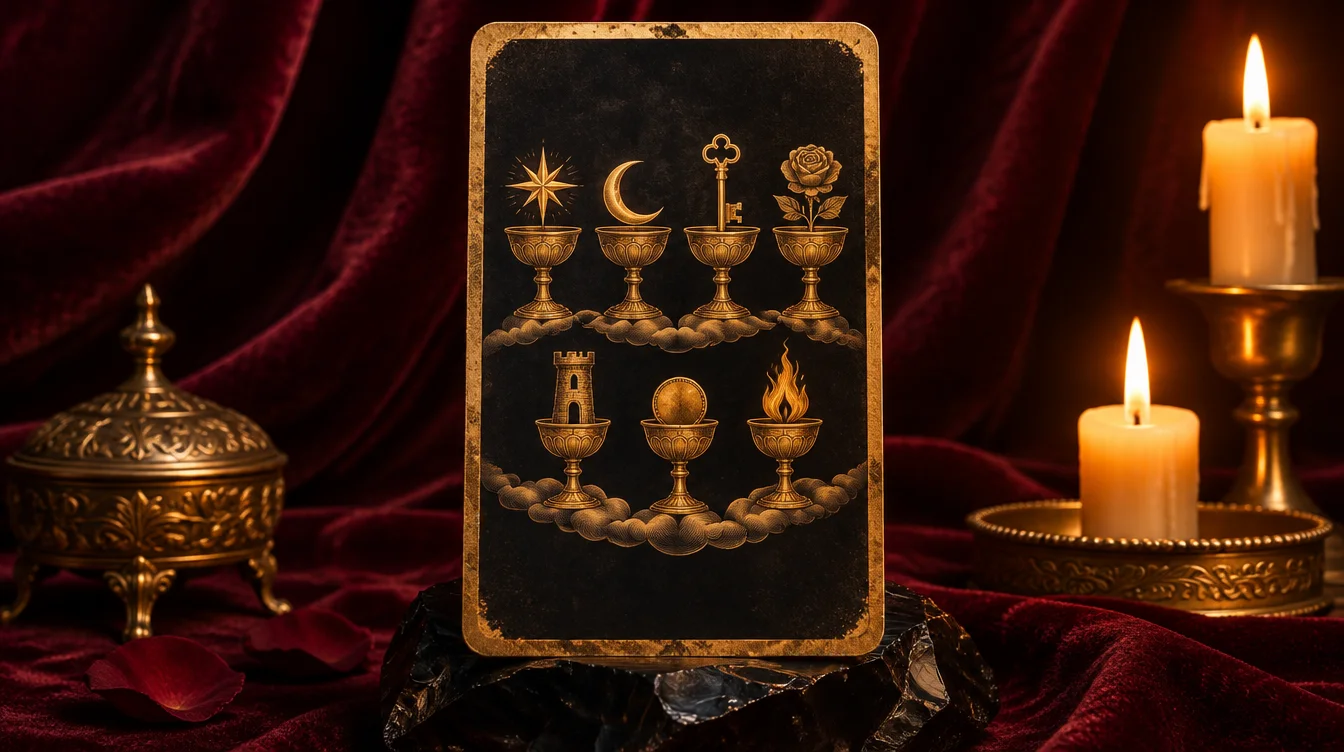
The Seven of Cups (also written 7 of Cups) is a Minor Arcana card from the suit of Cups. A.E. Waite describes its seven cups as chalices of vision, and on the 1909 Rider–Waite–Smith card they float on a cloud, each holding a different image. Readers usually take it as the card of many options and bright imagining: daydreams, possibilities, wishful thinking and the challenge of choosing one path.
- Keywords: imagination, options, daydreams, vision, wishful thinking, temptation, confusion, choice.
- Upright, in one line: a prompt to notice where you’re holding several bright possibilities, if you are, and which of them has real substance.
- Reversed, in one line: a prompt to look at where a wish is ready to become a clear aim, with will and a first step behind it.
On The 9th King, tarot is a mirror for self-knowledge, not fortune-telling. The Seven of Cups doesn’t say which option will work out or that one of your dreams is about to come true. It asks how you sort what you imagine from what you can actually build.
Table of Contents
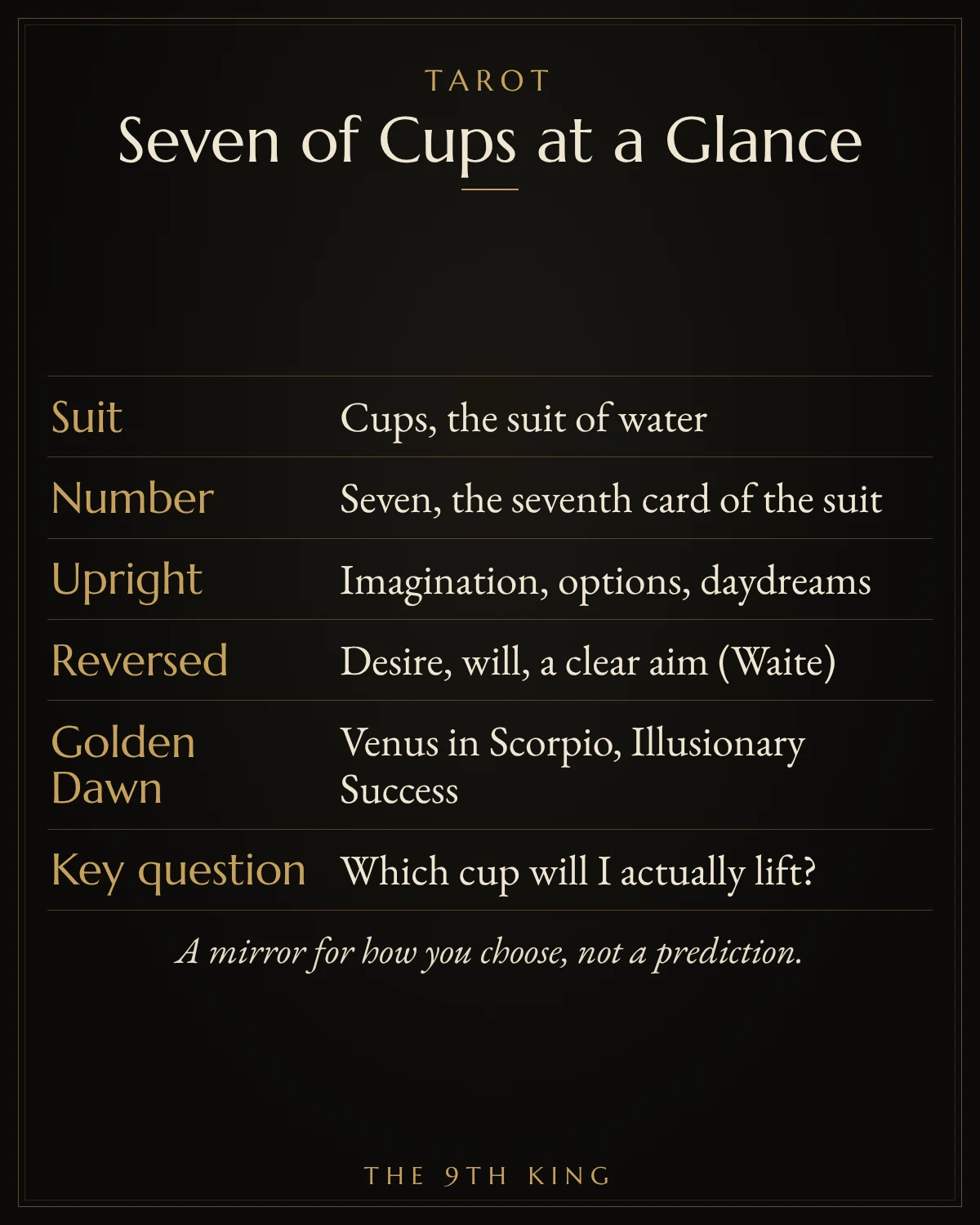
The Seven of Cups at a glance
| Seven of Cups | |
|---|---|
| Arcana | Minor Arcana, a pip (number) card |
| Suit and element | Cups, linked with water |
| Number | Seven, the seventh card of the suit |
| Golden Dawn title | Lord of Illusionary Success |
| Astrology (Golden Dawn) | Venus in Scorpio |
| Upright | Imagination, options, daydreams |
| Reversed | Desire, will, a clear aim |
| Key question | Which cup will I actually lift? |
What the Seven of Cups looks like
Most people know this card from the Rider–Waite–Smith deck, first published in London by William Rider & Son in December 1909. A.E. Waite wrote the instructions and Pamela Colman Smith drew the art, and both belonged to the Hermetic Order of the Golden Dawn (Wikipedia: Rider–Waite Tarot).
Waite’s own words
Waite’s description in The Pictorial Key to the Tarot (1911) gives no list of objects and no scene. He writes only: “Strange chalices of vision, but the images are more especially those of the fantastic spirit” (sacred-texts.com: Waite, Seven of Cups). So for Waite, the cups are visions, and the pictures in them belong to fantasy.
The 1909 Smith card
The details most people picture come from Smith’s drawing, not Waite’s text. On the 1909 Smith card, seven cups sit on a cloud, and each seems to hold something different: a head, a shrouded glowing figure, a snake, a castle or tower, a heap of treasure, a laurel wreath and a dragon. A figure in front of them seems to be conjuring the vision (Wikipedia: Seven of Cups). Apart from the cups themselves and the idea of vision, none of these details are in Waite’s text, and readers interpret the seven images in many different ways.
On The 9th King, the cloud matters most. Everything in the cups is offered, and nothing in them is yet on solid ground. That’s our reading, not Waite’s.
The Golden Dawn’s version
The Golden Dawn’s teaching text, Book T, as printed in Aleister Crowley’s Liber LXXVIII, describes a different picture. Seven cups are arranged as two descending triangles above a point, and a hand holds lotus stems rising from the lowest central cup. Every cup but that one has a lotus flower hanging over it, yet no water falls from the flowers, and all seven cups are empty. The symbols of Venus and Scorpio sit above and below (Liber LXXVIII, sacred-texts.com).
Seven of Cups meaning (upright)
Waite’s divinatory meaning lists fairy favors, images of reflection, sentiment, imagination and things seen in the glass of contemplation. He allows some attainment on those levels, but adds that nothing permanent or substantial is suggested (sacred-texts.com: Waite, Seven of Cups).
Book T names the card the Lord of Illusionary Success (spelled that way on the page). Its meaning opens: “Possible victory, but neutralized by the supineness of the person.” It goes on to speak of success that looks real but isn’t, error, promises unfulfilled, and success gained but not followed up (Liber LXXVIII, sacred-texts.com). Liber’s list also includes harsher words about vices and deception. On The 9th King we don’t use those as labels for anyone; we read the card’s core as a gap between promise and follow-through.
The upright meaning readers commonly use has three layers.
Imagination at full volume
The card is full of pictures. Upright, it can point to a season of rich imagining: new ideas, creative visions, big what-ifs. Every real project begins as a picture in someone’s mind. Ask yourself: What am I imagining lately, and what does it tell me about what I want?
Too many options
The upright card can point to a moment with several paths open, where each looks good from a distance and none has been tested. Ask yourself: How many options am I holding right now, and have I looked closely at any of them?
Promise without follow-through
Both Waite and Book T point to the same edge: the vision hasn’t become anything solid. The upright Seven can point to plans that stay plans, or a win that’s never followed up. Ask yourself: Which of my ideas have I actually started, and which am I still only enjoying in my head?
Seven of Cups reversed
Readers handle reversals differently: some read the opposite meaning, some the same energy blocked, and some skip reversals entirely. Waite’s reversed meaning for this card is unusually hopeful. He gives four words: desire, will, determination, project (sacred-texts.com: Waite, Seven of Cups). In his additional meanings, the reversed Seven is success, if the Three of Cups appears with it (sacred-texts.com: Waite, Additional Meanings). Waite also warns in that section that these extra meanings often disagree with his main ones.
On The 9th King, the Seven of Cups reversed usually points to one of three patterns, offered as questions, not predictions.
The fog clears
The reversed card can point to the moment you stop circling options and name the one you want. Ask yourself: If I had to pick one cup today, which would it be, and why?
A wish gets a plan
Project is a working word. The reversed Seven can point to a dream picking up structure: a deadline, a budget, a first step, a person to ask. Ask yourself: What would the first small, real action on this look like?
Still lost in the clouds
Some readers take the reversal the other way: confusion deepening, or a hasty choice made to escape the discomfort of choosing. Ask yourself: Am I choosing because this is right, or because I want the uncertainty to stop?
| Pattern | Upright tone | Reversed tone |
|---|---|---|
| Vision | Many bright pictures | One clear aim |
| Options | All open, none tested | Narrowed to one |
| Energy | Dreaming | Will and determination |
| Next move | Not yet taken | A first real step |
Seven of Cups astrology: Venus in Scorpio
The 9th King uses Golden Dawn–derived correspondences, the tradition the Rider–Waite–Smith deck draws on. Other schools of tarot and astrology use different systems, and not every card maps to a single sign: the court cards and Pages, for example, work differently. What follows is one traditional framework, offered as symbolism.
How the number cards get their planets
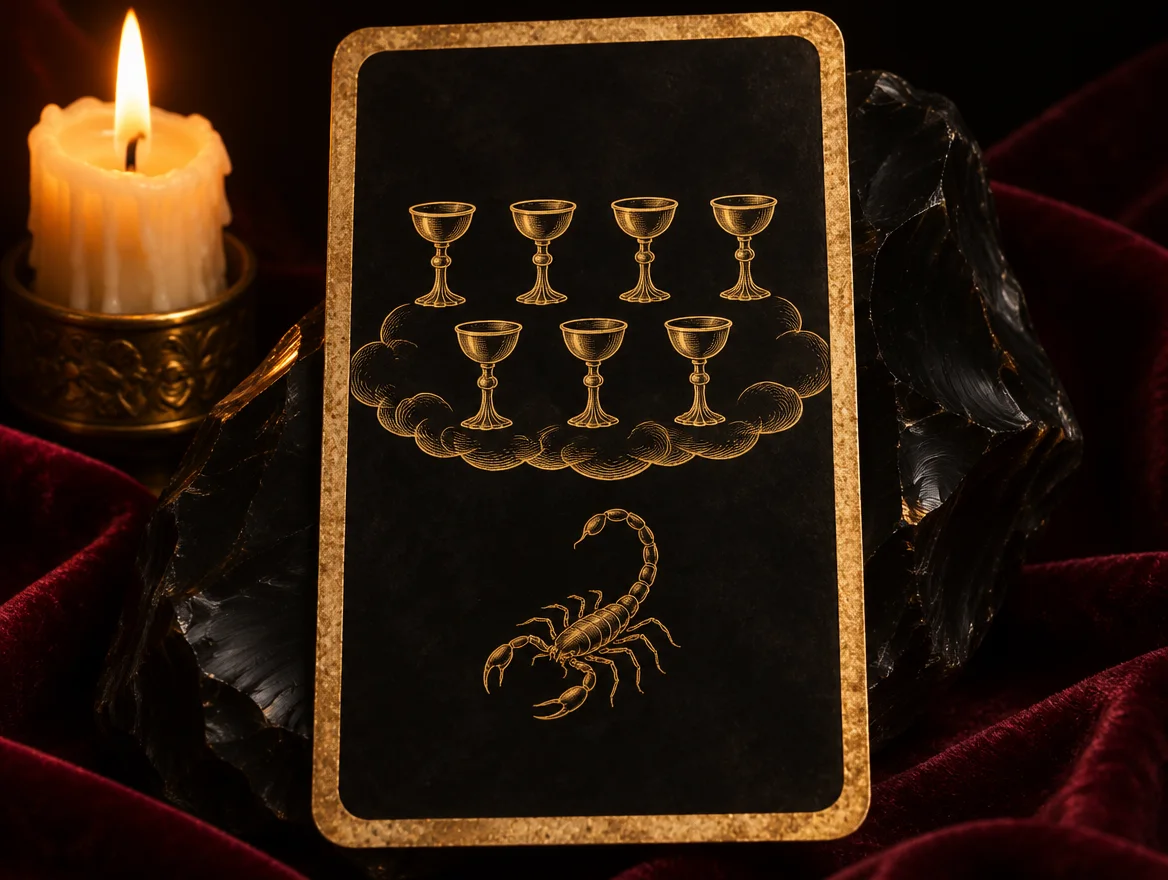
In the Golden Dawn system, the 36 small cards (the Twos through Tens) are matched to the 36 decans of the zodiac, each a ten-degree third of a sign with its own planet. Book T, as printed in Liber LXXVIII, lists the Seven of Cups, the Lord of Illusionary Success, as Venus in Scorpio (Liber LXXVIII, sacred-texts.com). In the same table, Scorpio’s three decans run Five of Cups (Mars), Six of Cups (Sun) and Seven of Cups (Venus), so the Seven comes last of the three in Liber’s order. Liber doesn’t print degrees for this entry.
For a wider look at how this system works across the deck, see our Minor Arcana guide and Tarot & the Zodiac. The Six of Cups, the Sun in Scorpio, is this card’s live neighbor in the same sign.
What Venus brings
On The 9th King, Venus describes what you value and what draws you in. Venus rules Taurus and Libra, so our Taurus Personality Traits and Libra Traits pages show two sides of it: steady, sensual comfort and the love of harmony and good design.
What Scorpio brings
Scorpio is fixed water: intense, private and drawn to what lies under the surface. Our Scorpio Personality Traits page explores its depth. On this card, Scorpio is the part of desire that wants something completely, and can fixate on it.
The tension in the pairing
Venus is attraction to what looks beautiful. Scorpio is the depth and fixity of desire. Together they describe a strong pull toward a picture: a person, a future or a version of yourself. That pull can fuel devotion and creative work, or keep you staring at an image instead of testing it.
The 9K reading: many cups, one hand
The card’s tension
The Seven of Cups holds two true things at once: imagination is how anything new begins and a picture isn’t a plan. The card isn’t against dreaming. It asks what you do after.
The shadow side
The shadow of the Seven of Cups is living in the preview. It can look like:
- Option hoarding. Keeping every door open so you never have to risk choosing the wrong one.
- Falling for the picture. Getting attached to an idealized image of a job, a place or a person, and losing interest when the real version shows up with flaws.
- The new-idea high. Starting fresh plans because beginnings feel exciting, then drifting when the work turns ordinary.
- Waiting for certainty. Treating “I’m not sure yet” as a reason to never test anything, when a small test could teach you more.
These patterns often start from something real, like an old fear of getting it wrong. Our guide to inner child work is a related read if those fears feel old. The question is whether the pattern still helps you.
Dreaming itself is not the shadow. Daydreaming can be rest, play or recovery from a hard stretch, and a pause that meets a need is not avoidance. The shadow is the habit of using the cloud to skip the ground every time.
Wish or plan: how to tell
A card can’t tell you which option is right or whether a person or offer is what it seems. What you can look at is evidence and action: what you actually know, and what you’ve actually done.
| A wish | A plan |
|---|---|
| Lives in “someday” | Has a next step and a rough date |
| Built on how it might feel | Built on what you know |
| Every option stays open | One option gets tested |
| Costs are unclear | Costs are named |
| Nothing has been tried | Something small has been tried |

A feeling of excitement on its own won’t settle this, and neither will a feeling of doubt. You can feel unsure and still make a sound choice. Use questions instead: What do I actually know? What would it cost? What’s one small test I can run?
The self-mastery lesson
The lesson of the Seven of Cups is to choose a cup and lift it. Self-mastery here means honoring your visions, then committing to one long enough to learn whether it holds water. Waite’s reversed words, desire, will, determination and project, read like the steps of that lesson.
Seven of Cups as feelings, in love and at work
Seven of Cups as feelings
Asked “how does this person feel?”, readers often take the Seven of Cups as mixed, dreamy or undecided feelings: fascination, curiosity, a pull that isn’t settled, or someone weighing several options. That’s an interpretation to reflect on, not evidence. A card can’t establish what someone else feels, intends or will do. Ask yourself: What have they actually said and done? And if the card is about your own feelings: Am I drawn to this person, or to the picture I’ve built of them?
Seven of Cups love meaning
In a love reading, the upright card can point to several possibilities at once, a crush that lives mostly in imagination, or an idealized picture of a partner. Reversed, it can point to getting clear about what you want, or to seeing someone as they are.
Tarot can’t tell you whether to stay, leave, start or end anything, and this page won’t either. Book T mentions deception in love among this card’s meanings, but a card can’t show whether anyone is being honest with you. That’s something only words and actions over time can show. Useful questions:
- Am I responding to who this person is, or to who I hope they’ll be?
- What do we both say we want, out loud?
- What has each of us actually done, over months rather than moments?
If idealizing people is a pattern for you, our guide to psychological projection is a related read, and synastry for beginners shows how two charts meet.
Seven of Cups at work
At work, readers often take the card as too many projects, several job ideas at once, or an exciting offer that hasn’t been checked. This is reflection, not career or financial advice. Ask yourself: Which of these options have I actually looked into, with real numbers and real conversations?
Practical exercise: the seven-cup sort
You need about thirty minutes, a notebook and something you’re torn about.
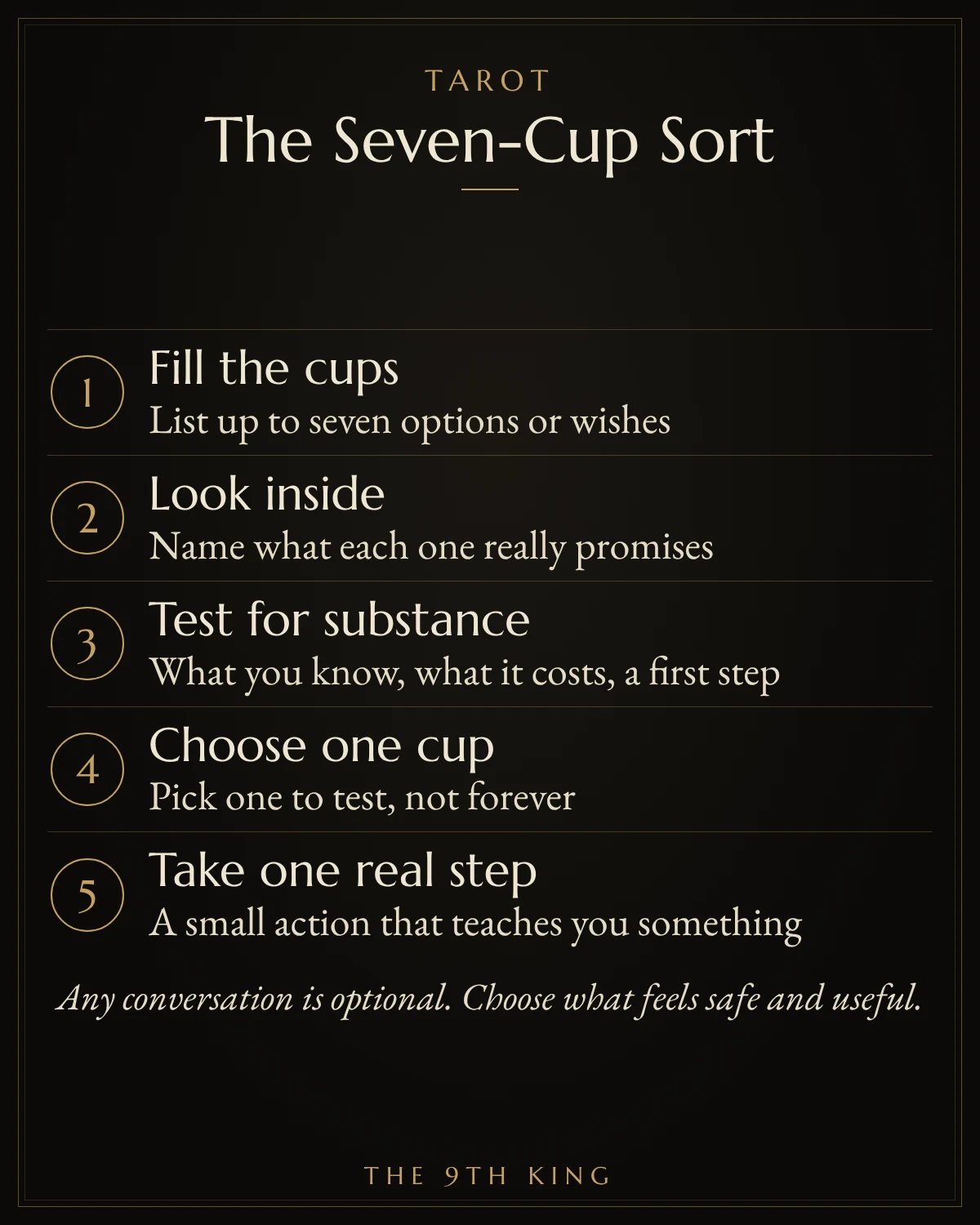
Step 1: Fill the cups
Write down up to seven options, wishes or ideas you keep returning to. Fewer is fine. Don’t judge them yet.
Step 2: Look inside
Next to each one, write the feeling or need under it: freedom, respect, safety, adventure, rest, being seen. Several cups may promise the same thing.
Step 3: Test for substance
For each cup, answer three short questions. What do I actually know about this? What would it cost in time, money or energy? What’s one first step I could take? A cup with no answers yet isn’t wrong. It’s still in the cloud.
Step 4: Choose one cup
Pick one option to test. Not forever, just next. If two are close, pick the one with the clearest first step.
Step 5: Take one real step
Do one small action that teaches you something real: a phone call, a visit, a rough draft, or an honest conversation if that feels safe and useful. Then decide whether to keep going, adjust or try the next cup.
A worked example (fictional)
Dev (fictional) is restless at work and keeps imagining a different life. He draws the Seven of Cups upright.
He fills seven cups: open a coffee cart, move abroad, go back to school, start a podcast, switch teams, take up woodworking, become a photographer. Looking inside, he sees that four of them (the coffee cart, moving abroad, the podcast and photography) mostly promise the same thing: being noticed. The other three (school, switching teams, woodworking) each have a clear first step.
He chooses switching teams. His real step is a short chat with someone on that team, and he learns the work is closer to what he wants than he expected. He keeps woodworking just for fun, and gives the wish to be noticed its own journal page.
Journal prompts for the Seven of Cups
- What do I daydream about most, and what need sits underneath it?
- Which option am I keeping open mainly so I don’t have to choose?
- When have I fallen for a picture of something and been surprised by the real thing?
- What would I attempt if I knew a first try didn’t have to be perfect?
- Which idea of mine has the most substance, and what’s stopping me from testing it?
- What does choosing one cup cost me, and what does never choosing cost me?
For more prompts like these, our shadow work prompts collection goes deeper, and Shadow Work, Plainly explains how to start safely.
A warm note: this is reflective practice, not therapy. If this work brings up trauma or abuse, or if you’re dealing with thoughts of self-harm or distress that feels overwhelming, please work with a qualified therapist who can walk with you. It’s always fine to stop a prompt that feels like too much.
Myths and misreadings of the Seven of Cups
- “The Seven of Cups means you’re being lied to.” No. Book T lists deception among the card’s meanings, but on The 9th King a card can’t prove anything about another person’s honesty. Look at what people say and do over time.
- “It’s a bad card for dreamers.” Not on 9K. Waite allows some attainment on the level of imagination, and his reversed meaning is desire, will, determination and project (sacred-texts.com: Waite, Seven of Cups). The card asks dreamers to test their dreams.
- “Venus in Scorpio means this card is about Scorpio people.” No. The correspondence describes the card’s symbolism in the Golden Dawn tradition. Anyone can draw it, whatever their sign.

Seven of Cups: FAQ
What does the Seven of Cups mean?
The Seven of Cups is a Minor Arcana card in the suit of Cups. Waite calls its cups strange chalices of vision, and on the 1909 Smith card seven cups float on a cloud, each holding a different image. Readers commonly take it as imagination, many options, daydreams and wishful thinking. On The 9th King, it’s a mirror for how you sort a wish from a plan, and whether you’re ready to choose one path and test it.
What does the Seven of Cups reversed mean?
Reversed, Waite gives the Seven of Cups four hopeful words: desire, will, determination and project. On The 9th King, the reversal often points to a vision becoming a clear aim with a first step behind it. Some readers take it the other way, as confusion deepening or a hasty choice made just to end uncertainty. Some readers don’t use reversals at all. Treat it as a question to explore, not a forecast.
What does the Seven of Cups mean as feelings?
As feelings, readers often take the Seven of Cups as mixed, dreamy or undecided feelings: fascination, curiosity or weighing several options. It’s an interpretation, not evidence, because a card can’t establish another person’s feelings or intentions. A better guide is what someone says and does over time. The card can also prompt you to ask whether you’re drawn to a person or to a picture of them.
What does the Seven of Cups mean in love?
In love, the upright card can point to several possibilities at once, a crush that lives mostly in imagination or an idealized picture of a partner. Reversed, it can point to getting clear about what you want. The card doesn’t tell you to stay, leave or start anything, and it can’t show whether someone is being honest. Look at words and actions over time, and at what you both say you want.
What zodiac sign is the Seven of Cups?
In the Golden Dawn system, the tradition The 9th King uses, the Seven of Cups corresponds to Venus in Scorpio, the last of Scorpio’s three decans in Liber LXXVIII’s table. The Golden Dawn’s Book T, as printed in Liber LXXVIII, calls the card the Lord of Illusionary Success. Other schools use different correspondences, so treat this as one traditional framework for symbolism rather than a fixed rule.
Is the Seven of Cups a yes or no card?
The 9th King doesn’t do yes or no readings, because tarot here is a tool for self-reflection, not fortune-telling. Instead of asking whether the card says yes, ask what it shows you: how many options you’re holding, which of them has real substance, and what one small step would help you learn whether a dream holds water.
What are the images in the Seven of Cups?
On the 1909 Smith card, each of the seven cups seems to hold something different: a head, a shrouded glowing figure, a snake, a castle or tower, treasure, a laurel wreath and a dragon. Waite’s text doesn’t list or explain them. He only calls them visions of the fantastic spirit. Readers interpret the images in many ways, so on The 9th King we focus on the fact that all seven float on a cloud.
Your next step: try the seven-cup sort above with one decision you’ve been circling, and take one real step this week. Then read our Scorpio Personality Traits page: Scorpio’s depth of desire is the pull this card asks you to test against the ground.
Explore Next
- The sign behind the card: Scorpio Personality Traits
- Venus’s two homes: Taurus Personality Traits · Libra Traits
- When we see our hopes in others: Psychological Projection
- Old fears behind new patterns: Inner Child Work
- Go deeper with questions: Shadow Work Prompts
- Reading by feel: Intuitive Tarot (Code of Ascension)
- New to the cards: Tarot for Beginners: How Tarot Really Works (Code of Ascension)
- More tarot on The 9th King: Tarot Card Meanings · Minor Arcana · Tarot & the Zodiac · Ace of Cups · Two of Cups · Six of Cups · Knight of Cups · The Moon
- More cards in this set: Three of Cups, Four of Cups, Five of Cups

Final Thought: Bring One Cup Down from the Cloud
The Seven of Cups doesn’t scold you for dreaming. It shows how much you can imagine, then asks what you’ll do with it. Most of the cups can wait. Pick one, look inside it honestly, and take one small step that puts it on solid ground. Know your nature. Rule your life.
About the Author
King is the founder of The 9th King, where zodiac psychology, relationships and shadow work are explored as tools for self-knowledge rather than fortune-telling. He’s a Libra Sun, and writes about the personal side of astrology on King The Kemist. Astrology on The 9th King is interpretation and self-reflection, not prediction or established fact.
Leave a Reply