
Quick Answer: What Does The Tower Tarot Card Mean?
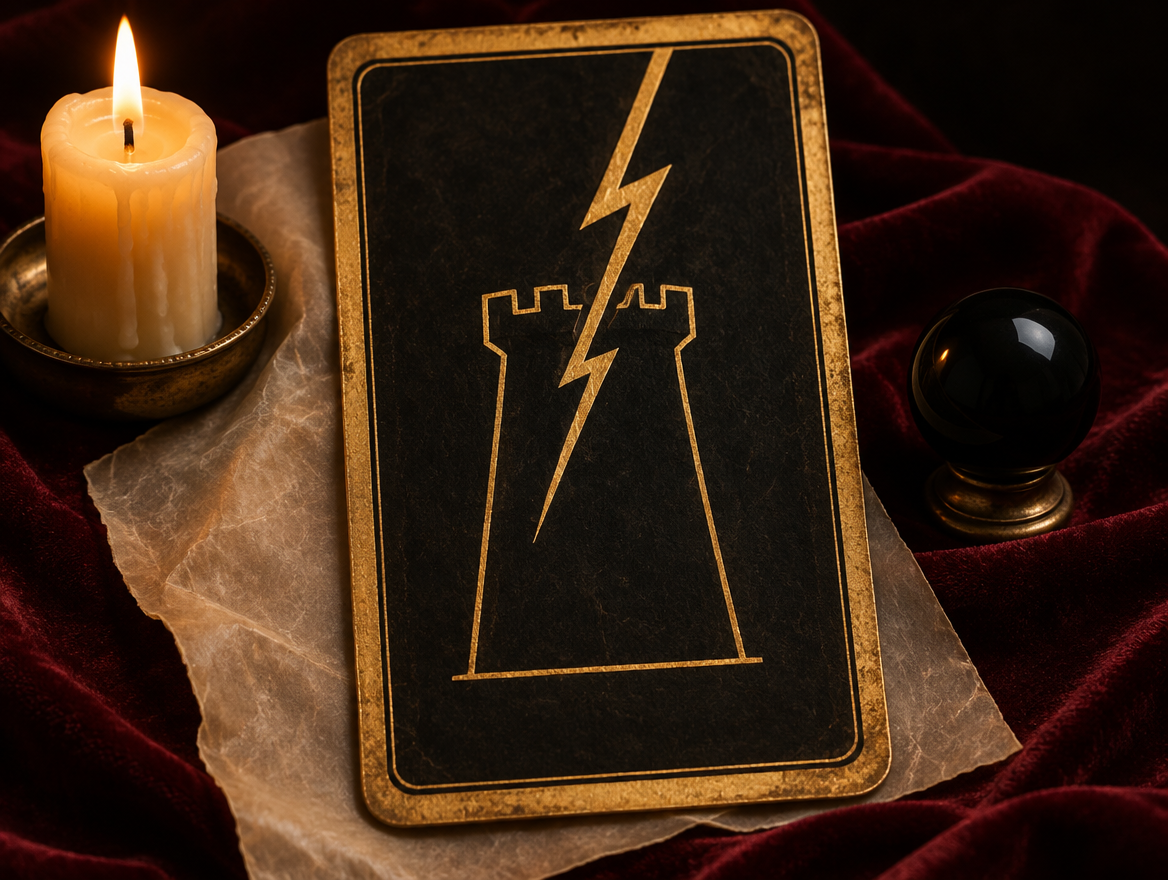
The Tower is card XVI (16) of the Major Arcana. Waite described it as a tower struck by lightning: a tall tower hit from above, with two figures falling from it. The scene is symbolic, and that’s how The 9th King reads it.
Keywords: sudden change, revelation, false structures, upheaval, release, truth arriving fast.
- Upright, in one line: the card can point to a belief, role or story about yourself that no longer holds, and to a truth that arrives all at once.
- Reversed, in one line: readers often take it as change you’re resisting or delaying, or as a quieter, more inward shake-up.
- Astrology link: in the Golden Dawn–derived correspondences The 9th King uses, The Tower is paired with the planet Mars and the Hebrew letter Peh.
On The 9th King, tarot is a mirror for self-knowledge, not fortune-telling. The Tower doesn’t say your life is about to fall apart. It asks a sharper, kinder question: what have I built that isn’t true, and what’s underneath it?
Table of Contents

The Tower tarot card at a glance
| The Tower | |
|---|---|
| Number | XVI (16), Major Arcana |
| Golden Dawn title | The Blasted Tower |
| Core theme | A false structure gives way |
| Upright | Revelation, sudden change |
| Reversed | Resisted change, inner shake-up |
| Correspondence (Golden Dawn–derived) | Mars (planet) |
| Hebrew letter (Golden Dawn) | Peh |
| 9K tension | Comfort vs truth |
| Key question | What have I built that isn’t true? |
Below: the imagery, the meanings, why Mars, then the 9K reading and an exercise.
What’s on the card: The Tower tarot symbolism
Most modern decks follow the Rider–Waite–Smith design, published by William Rider & Son in 1909 to A. E. Waite’s instructions and illustrated by Pamela Colman Smith, both Golden Dawn members (Wikipedia: Rider–Waite Tarot). Waite wrote about each trump in The Pictorial Key to the Tarot, now in the public domain (sacred-texts.com: Waite, XVI. The Tower).
The tower and the lightning
In his list of the trumps, Waite names the card the Tower struck by Lightning and gives three older alternative titles: the Castle of Plutus, God’s House and the Tower of Babel (sacred-texts.com: Waite, The Trumps Major). He calls it a card of confusion, and says its design fits almost every one of those names except the French Maison Dieu, the House of God, unless you picture that house as abandoned.
The lightning comes from above, without warning. Whatever the tower was built on couldn’t stand up to a single strike of something real.
The crown and the flames
On the 1909 Smith card, the top of the tower, shaped like a crown, is knocked loose. Wikipedia reports a reading of that crown as “materialistic thought being bought cheap, downcast” (Wikipedia: The Tower (tarot card)). The same page notes that the older Tarot of Marseille filled the sky with colored balls, and that Smith replaced them with small flame-shaped marks resembling the Hebrew letter yod.
Readers often take the crown as what we’re proudest of: a title, a reputation, a self-image. The Tower knocks off what you put on top, not who you are.
The two figures
Two figures fall from the tower. In the Tower of Babel reading, Waite notes, they’re held to be Nimrod and his minister. His own reading is more useful. He rejects the idea that the card is punishment for pride, because that doesn’t explain the two figures. Instead he says one stands for the literal word made void and the other for its false interpretation (sacred-texts.com: Waite, XVI. The Tower).
In plain terms, the figures are ideas losing their footing: a rule gone hollow, and the story we told about it.
Waite’s key: a House of Falsehood
Waite agrees with an earlier writer that the card shows a house of doctrine being torn apart, and then goes one step further: he understands it as a reference to a “House of Falsehood” (same source). He adds that, in a deeper sense, it may point to an old order of things coming to an end.
That’s the line The 9th King builds on. The Tower isn’t the collapse of everything you have. It’s the collapse of what was false.
Where the card comes from
The Tower has been in tarot decks since the 15th century, always following The Devil, though no Tower card survives from the famous Visconti-Sforza painted deck. Some older decks called it La Foudre, “The Lightning,” and showed a lightning-struck tree (Wikipedia: The Tower (tarot card)). Britannica dates tarot’s invention to Italy in the 1430s and its adaptation to fortune-telling to France around 1780 (Britannica: Tarot).

The Tower tarot meaning: upright and reversed
Below are the meanings readers commonly use, then Waite’s older list. The 9K reading follows later.
The Tower upright
Upright, readers usually take The Tower as sudden change that reveals something. Common themes:
- Revelation: a truth you can’t un-see, arriving all at once.
- A belief breaking: something you were sure of, about yourself, a person or the world, stops holding.
- A role ending: a title, identity or position you leaned on stops fitting.
- Release: the relief, sometimes surprising, of no longer holding up something false.
The upright message isn’t “brace for disaster.” It’s “notice what just became visible.”
The Tower reversed
Reversed, readers tend to go one of two ways:
- Resisting the change. You can see the crack, but you’re propping the wall up anyway. The structure is still standing because you’re holding it.
- An inner shake-up. The change is happening quietly, inside: a private realization rather than a visible event.
A reversed Tower is a question, not a reprieve: what am I still holding up that I already know is cracked?
What Waite’s 1911 list said
Waite’s divinatory list was stark. Upright, he gave misery, distress, adversity, disgrace, deception and ruin, calling it “a card in particular of unforeseen catastrophe.” Reversed, he gave, according to one account, the same in a lesser degree, along with oppression, imprisonment and tyranny (sacred-texts.com: Waite, Divinatory Meanings).
That’s old fortune-telling language. We don’t read “catastrophe” as an event coming for you. We read “deception” as the useful word: The Tower is the moment a deception, including the ones we tell ourselves, stops working. And “imprisonment” in the reversed card describes living inside a structure you’ve outgrown.

| Position | Common reading | Question to ask |
|---|---|---|
| Upright | Revelation, sudden change | What just became visible? |
| Reversed (resisting) | Propping up the cracked wall | What am I still holding up? |
| Reversed (inward) | A quiet, private shake-up | What do I know now that I didn’t? |
The Tower and Mars: the Golden Dawn correspondence
Why Mars?
The astrology links on The 9th King are Golden Dawn–derived correspondences, the tradition The 9th King uses and the one the Rider–Waite–Smith deck draws on. The Golden Dawn’s Book T, as printed in Aleister Crowley’s Liber LXXVIII, lists card 16 as The Blasted Tower, with the Hebrew letter Peh and the planet Mars, and gives it the title “The Lord of the Hosts of the Mighty” (Liber LXXVIII, sacred-texts.com).
Notice that this is a planet, not a sign. The Tower isn’t “the Aries card.” Mars is the traditional ruler of Aries, so our Aries personality traits guide is useful context for how astrologers describe Mars energy, but the card’s correspondence is Mars itself.
Other schools differ
Other traditions differ: the Golden Dawn gives The Tower the letter Peh, while the French system gives it Ayin (Wikipedia: The Tower (tarot card)). Not every card maps to a single sign; some map to planets or elements, and court cards work differently. Treat Mars as a symbolic lens, not a law. Our Tarot & the Zodiac guide shows the full set.
What Mars adds to the card
Astrologers associate Mars with drive, courage, action, conflict, heat and the urge to cut through. That fits the card’s lightning: fast, direct, impossible to ignore.
Read through Mars, The Tower looks less like bad luck and more like force meeting a weak point. Mars at its best is honest and brave: it ends the pretending. Its shadow is force for its own sake, breaking things because waiting feels unbearable. Sometimes the lightning comes from outside. Sometimes we’re the ones throwing it.
The Tower after The Devil
Waite says the catastrophe is in some sense a reflection of the previous card. The Devil is about the fall into the material and animal side; The Tower, he says, is destruction on the intellectual side (sacred-texts.com: Waite, XVI. The Tower). Put simply: The Devil is the chain you live with; The Tower is the idea that kept the chain in place, finally cracking.
The 9K reading: false structures and sudden truth
The tension: comfort vs truth
The Tower’s core tension is between comfort and truth. Every one of us builds structures: beliefs about who we are, roles we play, stories that explain why things went the way they did. Most of them are useful. Some were built quickly, to protect us, on ground that was never solid.
The Tower is the moment a truth arrives that the structure can’t absorb. It feels sudden, but often the crack was there for a long time. What’s sudden is that you finally see it.
What kind of structures?
When The 9th King reads The Tower, we look for structures like these:
- A belief about yourself: “I’m the strong one.” “I’m bad with people.” “I don’t need anyone.”
- A role: the fixer, the peacekeeper, the high achiever, the one who never asks for help.
- A story about the past: an explanation for an old hurt that protected you, but also kept you stuck.
- An image you maintain: for work, for family, online.
None of these are bad to have built. The question is whether they’re true now.
The shadow side: building on denial, or breaking to feel in control
The shadow of The Tower runs in two directions, and both are very human.
Building on denial. This is the tower that keeps getting taller while the foundation gets weaker. It sounds like:
- “If I just work harder, it’ll hold.” Adding floors instead of checking the ground.
- “Everyone else is the problem.” Looking at the lightning instead of the crack. Our guide to psychological projection explains why the truths we refuse sometimes show up as blame.
Breaking things to feel in control. This is the Mars shadow. When uncertainty feels unbearable, some of us knock the tower down ourselves, before anything else can. It sounds like:
- Quitting, ending or blowing something up the moment it feels shaky, so at least you chose it.
- Calling it “radical honesty” when it’s a way to make others carry your discomfort.
Both protect us from the exposed middle, where you know something isn’t true but haven’t decided what to build instead. And if someone else is the one deliberately creating chaos in your life to keep you off balance, that responsibility is theirs, not yours.
The self-mastery lesson: check the foundation before the lightning does
The self-mastery lesson of The Tower is this: you can’t always choose when the truth arrives, but you can choose to look at your foundations before it does.
It doesn’t mean tearing everything down. It means:
- Name the structure plainly: the belief, role or story.
- Look for the crack: the truth that keeps knocking.
- Rebuild on what’s true, one small piece at a time, instead of rushing to put the old tower back up.
After a shake-up, the urge is to rebuild the same shape, fast. Mastery is pausing long enough to ask what you actually want to stand on.

The Tower tarot card in love, work and self-growth
These are reflections, not predictions.
The Tower in love
In love readings, The Tower often points to a story about the relationship that no longer holds: who your partner is, who you are together, or what you’ll put up with. It can also point to an honest conversation that clears the air.
Ask yourself:
- What story about this relationship have I been protecting?
- What truth have I been avoiding saying, or hearing?
- Am I rebuilding the same pattern I just watched fall?
The Tower doesn’t tell you to stay or leave. It invites you to examine the assumptions you’ve been building on and check them against real-world evidence. What you do with that is your choice. If the pattern you’re noticing started early, our guide to inner child work can help you trace where those first walls went up.
The Tower at work and with money
At work, The Tower can point to an identity built on a job, or to a plan resting on an assumption you never tested.
A grounded approach when The Tower shows up around work:
- Separate the structure (title, plan) from what you bring (skills, relationships, judgment).
- List which assumptions you’ve checked and which you’ve only hoped.
- Make no sudden, irreversible decision from a single reading.
Nothing here is career or financial advice. For money, debt or contract decisions, talk to a qualified professional.
The Tower in self-growth
For personal growth, The Tower is about letting a self-image go without letting yourself go. When an old belief cracks, it can feel like losing yourself. Often you’re losing a costume. If you’re new to this kind of inner work, Shadow Work, Plainly is a gentle place to start.
A practical exercise: the Foundation Check
This takes about 20 minutes, with or without a deck. You need paper and a pen. Pick one low-stakes structure the first time, not the biggest thing in your life.
The steps
- Structure. Write the belief, role or story in one plain sentence. “I’m the one who holds everything together.”
- Crack. Write the truth that keeps knocking: the comment you keep hearing, the tiredness you keep feeling, the fact you keep stepping around. “I’m exhausted, and nobody asked me to do all of this.”
- Protection. Write what this structure has kept you safe from. Be fair to it; it was built for a reason. “Feeling useless. Being a burden. Conflict.”
- Bedrock. Write what’s actually true underneath, as simply as you can. “I care about my people. I’m allowed to need help too.”
- One brick. Choose one small, honest step that builds on the bedrock rather than the old tower. Write it down, and when you’ll do it.
Worked example (fictional)
Maya (fictional) pulls The Tower after a friend says, half-joking, “You never tell us how you are.” It stings because it’s true.
Her structure: “I’m the low-maintenance friend.” The crack: she’s lonely in a group she’s known for ten years. The protection: she never had to risk being too much. The bedrock: “I want to be known, not just liked.”
Her one brick is small: next time someone asks how she is, she’ll give one true sentence instead of “fine.” She does it that weekend. A friend calls two days later just to check in.
One floor came down, the one that was never true, and she was still standing. The Mars courage wasn’t in breaking anything; it was in saying one honest thing.
Using the exercise in a reading
If The Tower comes up in a spread, run the Foundation Check on your question. For a layout built around the hidden self, try our Shadow Work Tarot Spread, or keep it simple with a three-card tarot spread. If you’re newer to tarot and want the basics of how a reading works, see Tarot for Beginners: How Tarot Really Works (Code of Ascension).
Journal prompts for The Tower
Use one prompt per session. Write for ten minutes, then put it away until tomorrow.
- What belief about myself have I defended the hardest, and when did I last check if it’s still true?
- Where am I adding floors to something whose foundation I haven’t looked at?
- What truth have I been saving for “later,” and what am I afraid will happen once it’s said?
- When things feel uncertain, do I tend to hold on tighter or knock things down first?
- What’s a structure in my life that cracked before, and what did I learn about myself afterward?
- If one false thing in my life gave way this month, which would I quietly be relieved to lose?
For more prompts on self-image, denial and the hidden self, see our full list of shadow work prompts, and our zodiac shadow work guide to explore your own sign’s shadow.
A gentle note: this is reflective practice, not therapy. If you’re dealing with trauma, abuse, thoughts of self-harm or distress that feels overwhelming, please work with a qualified therapist or counselor who can support you properly. Reaching out is a strength, not a failure. And it’s always fine to stop a prompt that feels like too much.
Myths and misreadings about The Tower
- “The Tower predicts disaster.” Tarot on The 9th King doesn’t predict events. The card is a symbol of a false structure giving way, and the moment truth becomes visible.
- “The Tower means a breakup.” It can point to a story about a relationship changing, which is not the same as a relationship ending. It doesn’t tell you to stay or leave.
- “The Tower reversed means you dodged it.” Readers often take it as change being resisted, or happening inwardly. Holding a cracked wall up isn’t the same as escaping the crack.
- “The Tower is the worst card in the deck.” No card is bad on The 9th King. Waite himself read it as a house of falsehood coming down, and losing something false is often a relief.
- “The Tower is about Aries people.” The Golden Dawn correspondence is the planet Mars, not a sign, and it says nothing about anyone’s character. Mars rules Aries, which is context, not a verdict.

The Tower Tarot Card: FAQ
What does The Tower tarot card mean?
The Tower tarot card, Major Arcana XVI, is commonly read as sudden change, revelation and the collapse of a false structure. The traditional image shows a tower struck by lightning. On The 9th King it’s a mirror, not a prediction: it asks which belief, role or story about yourself no longer holds, and what’s true underneath it. A. E. Waite read the card as a house of falsehood coming down.
What does The Tower reversed mean?
Readers usually take The Tower reversed in one of two ways. Either you’re resisting a change you can already see coming, propping up something that’s cracked, or the shake-up is happening inwardly, as a private realization rather than an outward event. Treat it as a question about what you’re still holding up, not as a verdict.
What planet is The Tower tarot card?
In the Golden Dawn–derived correspondences The 9th King uses, The Tower is paired with the planet Mars and the Hebrew letter Peh. The Golden Dawn’s Book T, printed as Liber LXXVIII, calls the card The Blasted Tower and gives it the title “The Lord of the Hosts of the Mighty.” Other schools use different attributions, so treat the pairing as a symbolic lens.
Is The Tower a bad card?
No card is bad on The 9th King. The Tower can feel unsettling because it points at beliefs and roles we’d rather not question. But the card’s own symbolism is about something false giving way, which is often how room is made for something truer. What falls is rarely what was holding you up.
What does The Tower tarot card mean in love?
In love, The Tower often points to a story about a relationship that no longer fits: an idea of your partner, of yourself, or of what you’ll accept. It can also point to an honest conversation that clears the air. It doesn’t tell you to stay or leave. It invites you to question your assumptions, look at the real evidence and decide for yourself.
Is The Tower a yes or no card?
The 9th King doesn’t use tarot for yes or no answers. The Tower is about revelation and false structures, which makes a simple verdict unhelpful. A better approach is to ask what belief or plan your question rests on, whether you’ve checked it, and what one honest step would build on solid ground instead.
Is The Tower an Aries card?
Not in the Golden Dawn system. Liber LXXVIII pairs The Tower with the planet Mars, not with a zodiac sign. Mars is the traditional ruler of Aries, so the two share themes like drive, courage and directness, but the card’s correspondence is the planet. In that same list, the card paired with Aries is The Emperor (Liber LXXVIII, sacred-texts.com).
Your next step: pick one small belief about yourself this week and run the Foundation Check above, all five steps. Then read our Aries personality traits guide to see how astrologers describe Mars-ruled energy: the courage to say the true thing, and the urge to break things when waiting feels too hard.
Explore Next
- The sign Mars rules: Aries Personality Traits
- The card before The Tower: The Devil Tarot Card
- When we see our truths in other people: Psychological Projection
- Questions for the hidden self: Shadow Work Prompts
- More tarot on The 9th King: Tarot Card Meanings · Major Arcana · Tarot & the Zodiac · Shadow Work Tarot Spread
- More Major Arcana: The Star
- More Major Arcana: Death
Final Thought: Let the False Floors Go
The Tower is one of the most feared cards and one of the most honest. It doesn’t take away what’s true about you. It takes away what never was: the role you outgrew, the story that stopped fitting, the image you were tired of holding up. You can’t always choose when the lightning comes. You can check your foundations and build on what’s actually solid. Know your nature. Rule your life.
About the Author
King is the founder of The 9th King, where zodiac psychology, relationships and shadow work are explored as tools for self-knowledge rather than fortune-telling. He’s a Libra Sun, and writes about the personal side of astrology on King The Kemist. Astrology on The 9th King is interpretation and self-reflection, not prediction or established fact.
Leave a Reply