

Quick Answer: What Does the Three of Swords Mean?
The Three of Swords (also written 3 of Swords) is a Minor Arcana card from the suit of Swords. In the traditional Rider–Waite–Smith design, three swords pierce a heart under cloud and rain. Readers usually take it as the card of heartbreak and grief: a loss, a painful truth or a separation that hurts.
- Keywords: heartbreak, grief, sorrow, painful truth, separation, disappointment, release.
- Upright, in one line: a prompt to notice a hurt that’s asking to be felt, if something in your life has been lost, ended or changed.
- Reversed, in one line: a hurt that’s softening, or one that’s stuck in a loop of replaying, numbing or confusion; a prompt to tend it gently.
On The 9th King, tarot is a mirror for self-knowledge, not fortune-telling. The Three of Swords doesn’t say heartbreak is coming, and it can’t tell you anything about another person’s motives. It asks how you’re carrying what already hurts.
Table of Contents

The Three of Swords at a glance
| Three of Swords | |
|---|---|
| Arcana | Minor Arcana, a pip (number) card |
| Suit and element | Swords, linked with air |
| Number | Three |
| Golden Dawn title | Lord of Sorrow |
| Astrology (Golden Dawn) | Saturn in Libra |
| Upright | Grief, heartbreak, painful truth |
| Reversed | Softening, or a hurt on replay |
| Key question | What does this hurt need from me? |
What the Three of Swords looks like
Most people know this card from the Rider–Waite–Smith deck, first published by William Rider & Son of London in December 1909. A.E. Waite wrote the instructions and Pamela Colman Smith drew the art. Both belonged to the Hermetic Order of the Golden Dawn (Wikipedia: Rider–Waite Tarot).
Waite’s own description
Waite’s description in The Pictorial Key to the Tarot is one of the shortest in the book: three swords piercing a heart, with cloud and rain behind (sacred-texts.com: Waite, Three of Swords). That is all he says about the picture: no figure, no landscape, no story.
The heart and the weather
That bareness is the point. This card shows a feeling, drawn as plainly as a road sign. The heart is the part of you that loves and grieves. The swords are the hard facts, words or changes that reached it. The rain is the mood: heavy and, like all weather, passing.
The older Golden Dawn image
The Golden Dawn’s own description of the card, in Book T as printed by Aleister Crowley in Liber LXXVIII, looks different. There are no hearts in it. Three hands come out of clouds holding three upright swords, and the central sword has parted a five-petaled rose, whose petals are falling (Liber LXXVIII, sacred-texts.com). Our own 9K art keeps the calm part of this idea: three upright swords and a rose, with nothing cut or pierced.
Three of Swords meaning (upright)
Waite’s divinatory meaning is a list: “Removal, absence, delay, division, rupture, dispersion.” He adds that the rest is too simple and obvious to spell out, because the picture says it (sacred-texts.com: Waite, Three of Swords).
Liber LXXVIII names the card the Lord of Sorrow. Its list starts with disruption, separation and quarrelling, then sorrow and tears. Strikingly, it also lists gentler traits, such as singing, faithfulness in promises and honesty in money, and ends by saying the whole depends on dignity, meaning the cards around it (Liber LXXVIII, sacred-texts.com). Even the old sources didn’t read this card as pure doom.
On The 9th King, the upright Three of Swords usually points to one of three things.
Grief and loss
The card can point to something that has ended or gone: a relationship, a friendship, a plan, a version of your life you expected to have. Grief is what love does when what it loved is gone or changed. Ask yourself: What have I lost that I haven’t let myself mourn?
A painful truth
Swords are the suit of the mind: thought, words and truth. Readers often take the Three as the moment a truth lands in the heart. You learn something you can’t unlearn, or admit something you already knew. It hurts, but it’s also clarity. Ask yourself: What do I know now that I didn’t let myself know before?
Separation
Waite’s words division and rupture point to things coming apart. That can be two people, two plans or two parts of yourself that want different things. Separation isn’t automatically a mistake.
Three of Swords reversed
Readers handle reversals in different ways: some read the opposite meaning, some read the same energy blocked or softened, and some don’t use reversals at all. Waite’s reversed meaning for this card is “mental alienation, error, loss, distraction, disorder, confusion” (sacred-texts.com: Waite, Three of Swords). Wikipedia’s summary of common readings describes the reversal as a sorrow that is somehow eased by its circumstances, or less severe than it could have been (Wikipedia: Three of Swords).
On The 9th King, the Three of Swords reversed usually points to one of three patterns, offered as questions, not predictions.
The hurt is softening
The rain is easing. You can talk about what happened without it flooding you. The reversed card can point to the early, uneven stage of mending. Ask yourself: What has helped, even a little, and can I do more of it?
The hurt is on replay
This is close to the distraction and confusion in Waite’s reversed list. The mind keeps running the same scene, the same conversation, the same “what if”. The heart doesn’t get a chance to grieve because the head won’t stop arguing the case. Ask yourself: Am I feeling this, or am I rehearsing it?
The hurt is packed away
Sometimes the reversal points to grief that has been pushed down: staying busy, or saying “I’m over it” before you are. Numbness can be the mind’s way of protecting you through hard days, and it isn’t something you simply choose. If it stays for a long stretch, that’s worth gentle attention, and support can help. Ask yourself: Is there a safe time and place where I could let a little of this out?
| Pattern | Upright tone | Reversed tone |
|---|---|---|
| The hurt | Fresh, felt | Softening or stuck |
| The mind | Sees the truth | Replays or blurs it |
| The heart | Open, aching | Mending or numbed |
| The weather | Rain falling | Easing or held in |

Three of Swords astrology: Saturn in Libra
The 9th King uses Golden Dawn–derived correspondences, the tradition the Rider–Waite–Smith deck draws on. Other schools of tarot and astrology use different systems, and not every card maps to a single sign: the court cards and Pages, for example, work differently. What follows is one traditional framework, offered as symbolism.
How the number cards get their planets
In the Golden Dawn system, the 36 numbered cards from Two to Ten are matched to the 36 decans of the zodiac. A decan is a ten-degree third of a sign, and each one has a ruling planet. Liber LXXVIII lists the Three of Swords, the Lord of Sorrow, with the decan Saturn in Libra (Liber LXXVIII, sacred-texts.com).
The same text lists the three Libra cards in order: the Two of Swords (Moon in Libra), the Three (Saturn in Libra) and the Four (Jupiter in Libra). The Three sits in the middle. Liber also lists the five decans Saturn rules, and this card is one of them, alongside the Five and Ten of Wands, the Eight of Cups and the Seven of Pentacles. It places all four Threes in Binah on the Kabbalistic Tree of Life, and for this card it adds the phrase “Unhappiness, sorrow, and tears.”
What Saturn brings
On The 9th King, Saturn describes time, limits, structure and the things that last because they’ve been tested. On a card about grief, Saturn is the slow part: the truth that grief has its own timeline and can’t be rushed or argued away.
What Libra brings
Libra is cardinal air, the sign of relationships, balance and fairness. Our Libra Traits page explores the Scales’ love of harmony and its shadow. On this card, Libra is the reason the hurt lands where it does: in connection, in the space between two people, in the feeling that something isn’t fair.
The tension in the pairing
Libra wants balance and peace. Saturn brings weight, limits and hard facts. The Three of Swords sits in that gap: the moment harmony breaks and you have to live with what’s true instead of what you hoped. Saturn doesn’t punish Libra here. It asks Libra to grow a kind of fairness that can hold sorrow too.
The 9K reading: let the rain pass
The card’s tension
The Three of Swords puts the heart and the mind in the same frame. The swords are thought and truth; the heart is feeling. People often try to handle grief with only one: thinking it through endlessly without crying, or feeling it so completely they can’t step back. The card asks for both: I understand what happened and it still hurts. Understanding doesn’t cancel the hurt. Hurt doesn’t cancel the understanding.
The shadow side
The shadow of the Three of Swords isn’t grief itself. Grief is a natural response to loss. The shadow is reopening the wound to make sure it’s still there. It can look like:
- The replay. Going over the same moment again and again, hunting for the line that would have changed everything.
- Checking the wound. Rereading old messages or looking up someone’s profile to feel the sting again.
- Self-blame as control. Deciding it was all your fault, because that feels more manageable than admitting some things were outside your hands.
- Grief as identity. Holding on to the hurt because letting it soften feels like forgetting.
- Rushing to fine. Telling everyone you’re okay so nobody asks, before you are.
These patterns usually come from love and a wish to make sense of things. The question isn’t whether you’re grieving “right”, but whether what you’re doing helps the hurt move.
A word on rest: grief is tiring. Sleeping more, cancelling plans, moving slowly and asking for quiet are often what a grieving body needs. That’s care, not avoidance. Avoidance is something different: pushing the hurt away so completely that it never gets any room at all.
Tending a hurt or reopening it
| Tending a hurt | Reopening a hurt | |
|---|---|---|
| The feeling | Lets it come and go | Calls it back on purpose |
| The story | Told to someone safe | Replayed alone, on a loop |
| Rest | Rests when tired | Stays busy so it can’t land |
| The question | “What do I need?” | “What’s wrong with me?” |
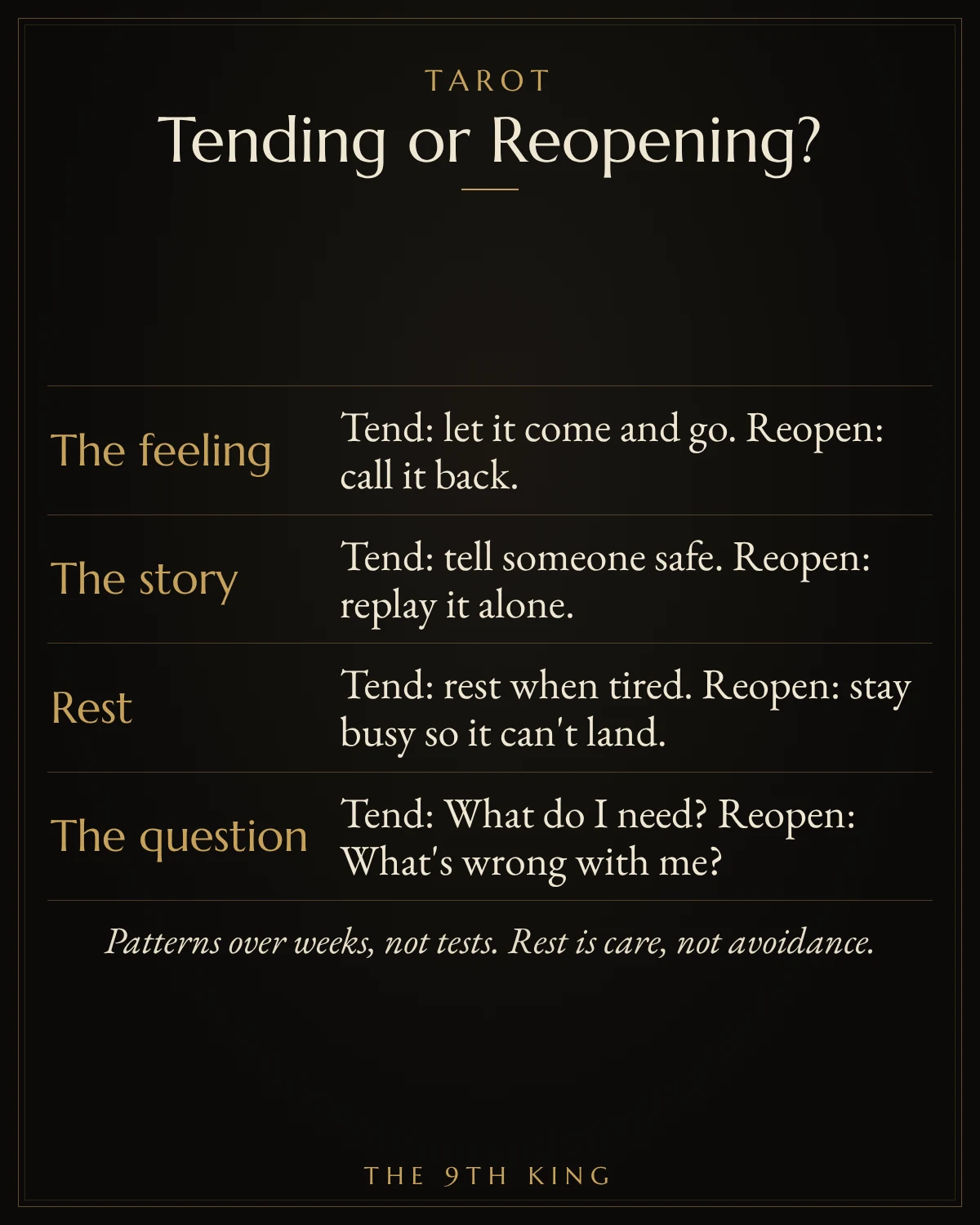
These are patterns, not tests. A feeling can be painful while you’re tending it, and calm while you’re avoiding it. How it feels in the moment doesn’t prove which is happening. Look at the pattern over days and weeks instead.
The self-mastery lesson
The lesson of the Three of Swords is to treat grief like weather, not like a verdict. Rain falls, and it doesn’t mean the sky is broken. A loss hurts, and it doesn’t mean you’re broken. Self-mastery here means giving the hurt time and care, and not adding a second wound by blaming yourself for feeling it.
If you’re learning how to sit with painful feelings, Shadow Work, Plainly explains how to start gently, and inner child work can help if an old hurt keeps answering whenever a new one arrives.
Three of Swords as feelings, in love and at work
Three of Swords as feelings
When someone asks “how does this person feel?” and draws the Three of Swords, readers often take it as hurt or sorrow. But a card can’t tell you what’s in another person’s heart; their words and actions are the real evidence. If the card is about your own feelings, it can be a prompt to ask: Have I let myself say, even privately, how much this hurt?
Three of Swords love meaning
In a love reading, readers often link the upright card with heartbreak: a breakup, a painful conversation or distance. That doesn’t mean it predicts one. It can’t establish whether anyone has been unfaithful or what another person meant. Those questions belong to honest conversation and observable behavior.
Tarot can’t tell you whether to stay or leave, and this page won’t either. If you’re hurting in a relationship, the card can help you notice what’s happening inside you. If you don’t feel safe with someone, put your safety first. The person who causes harm is responsible for it, never the person who was hurt. Otherwise, useful questions include:
- What exactly hurt, in plain words, without adding a story about what it means?
- Have I said what I need, clearly, or am I hoping it’ll be guessed?
- What would caring for myself look like this week, whatever happens next?
If you and a partner keep hurting each other in the same places, our guide to synastry for beginners can help you look at the pattern with curiosity instead of blame.
Three of Swords at work
At work, readers often take the card as disappointment: a plan that fell through or a hard piece of feedback. This is reflection, not career or financial advice. The shadow version is deciding one setback says everything about your worth. Ask yourself: What’s the one fair lesson here, and what part am I making heavier than it is?
Practical exercise: naming the three swords
You need about twenty minutes, a notebook and a quiet place. It’s fine to do one step, stop and come back another day.

Step 1: Name the event
Write what happened in one or two sentences, as plainly as you can. Facts only: “The relationship ended in March.” “I didn’t get the role.” This is the first sword.
Step 2: Name the meaning
Underneath, write what it means to you. “I’m scared I’ll be alone.” “I’d built my plans around it.” This is the second sword, and it’s often the one that hurts most.
Step 3: Name the replay
Write down the thought that keeps looping: the line you keep rehearsing. This is the third sword. Seeing it on paper can make it easier to notice.
Step 4: Choose one care
Pick one small, kind thing that answers what you found: a walk, an early night, a talk with a friend. If the hurt involves another person, contacting them is a choice, not a step in this exercise. Do it only if it feels safe and useful.
Step 5: Set a rain window
Choose a set time, say fifteen minutes in the evening, to feel it fully: cry, write, remember. Then close the notebook and do something gentle. For some people this may help the replay settle; if it doesn’t suit you, let it go.
Step 6: Note what steadied
Before bed, note one thing that steadied you today, even briefly. Over time, the list can show you moments of steadiness that are easy to miss on hard days.
A worked example (fictional)
Marcus (fictional) lost a close friendship after a falling-out. He draws the Three of Swords upright and recognizes the feeling at once.
In Step 1 he writes: “We stopped talking after an argument in June.” In Step 2: “I thought we’d always be in each other’s lives.” In Step 3, the replay: “If I’d answered differently, it would have been fine.” For his care, he tells his brother the whole story over dinner instead of rehearsing it alone. He decides not to reach out to the friend for now, and leaves that door open for later. His rain window is ten minutes after work. By Friday, his steady-things list has four lines, and the replay starts less often.
Journal prompts for the Three of Swords
- What loss am I carrying that I haven’t fully named?
- What truth arrived with this hurt, and what has it shown me?
- Where am I reopening the wound, and what am I hoping to find there?
- What would it mean to let this soften without forgetting it?
- Who can I tell the story to safely, without needing to be okay?
- What would I say to a friend carrying exactly this hurt?
For more prompts like these, our shadow work prompts collection goes deeper.
A warm note: this is reflective practice, not therapy. If your grief is tied to trauma or abuse, or if you’re dealing with thoughts of self-harm or distress that feels overwhelming, please work with a qualified therapist or grief counselor who can walk with you. It’s always fine to stop a prompt that feels like too much.
Myths and misreadings of the Three of Swords
- “The Three of Swords means a breakup is coming.” No. On The 9th King, tarot doesn’t predict events. The card reflects how you’re carrying hurt, not what will happen next.
- “It means someone is cheating or betraying you.” A card can’t establish facts about another person’s actions or motives. If you have real concerns, they belong to honest conversation and what you can observe.
- “It’s the worst card in the deck.” Wikipedia’s summary calls it among the most negative cards (Wikipedia: Three of Swords). But Liber LXXVIII lists faithfulness, singing and honesty among its traits too. Grief is hard, not bad.
- “Waite said it means a lover will leave.” In his list of additional meanings, Waite says that, for a woman, it can mean a lover leaving. He also warned that these extra meanings have little connection with the card designs and often disagree with his main meanings (sacred-texts.com: Waite, Additional Meanings).
- “Saturn in Libra means this card is about Libra people.” No. The correspondence describes the card’s symbolism in the Golden Dawn tradition. Anyone can draw it, whatever their sign.

Three of Swords: FAQ
What does the Three of Swords mean?
The Three of Swords is a Minor Arcana card in the suit of Swords. In the Rider–Waite–Smith deck it shows three swords piercing a heart, with cloud and rain behind. Readers commonly take it as heartbreak, grief, sorrow or a painful truth. On The 9th King, it’s a mirror for how you’re carrying a loss, not a prediction that something bad will happen.
What does the Three of Swords reversed mean?
Reversed, the Three of Swords is often read as a hurt that’s softening, or one that’s stuck: replayed in the mind, numbed or packed away. Waite’s reversed meanings include distraction and confusion. Some readers don’t use reversals at all. Treat it as a question to explore, such as “what would help this hurt move?”, rather than as a verdict.
What does the Three of Swords mean as feelings?
As feelings, readers often take the Three of Swords as hurt or sorrow. But a card can’t tell you what another person feels or what they’ll do; their words and actions are the real evidence. If the card is about you, it can be a prompt to admit, at least privately, how much something hurt, and what you need now.
What does the Three of Swords mean in love?
In love, the card is often linked with heartbreak, distance or a painful conversation. It doesn’t predict a breakup, and it can’t tell you whether anyone has been unfaithful. It doesn’t tell you to stay or leave either. It invites you to name what hurt, say what you need and look after yourself, with your safety always first.
What zodiac sign is the Three of Swords?
In the Golden Dawn system, the tradition The 9th King uses, the Three of Swords corresponds to Saturn in Libra, the middle of the three Libra decans. Liber LXXVIII calls the card the Lord of Sorrow. It’s a planet-in-sign pairing rather than a card for one sign, and other schools use different correspondences, so treat it as symbolism.
Is the Three of Swords a yes or no card?
The 9th King doesn’t do yes or no readings, because tarot here is a tool for self-reflection, not fortune-telling. Instead of asking whether the card says yes, ask what it shows you: what you’ve lost, what truth has landed and what this hurt needs from you so it can begin to soften.
Your next step: try the naming the three swords exercise above for one hurt you’re carrying this week, gently and at your own pace. Then read our Libra Traits guide: Libra is the sign the Golden Dawn tied to this card, and its search for balance can show you what you most want restored.
Explore Next
- The Scales and their shadow: Libra Traits
- Start gently: Shadow Work, Plainly
- Go deeper with questions: Shadow Work Prompts
- Old hurts that echo: Inner Child Work
- The shadow side of every sign: Zodiac Shadow Work
- Reading by feel: Intuitive Tarot (Code of Ascension)
- New to the cards: Tarot for Beginners: How Tarot Really Works (Code of Ascension)
- More Swords on The 9th King: Ace of Swords · Queen of Swords · King of Swords
- Hope after the storm: The Star
- More tarot on The 9th King: Tarot Card Meanings · Minor Arcana · Tarot & the Zodiac · Shadow Work Tarot Spread
- More cards in this set: Two of Swords, Five of Swords, Six of Swords, Seven of Swords
Final Thought: Rain, Not a Verdict
The Three of Swords is honest about pain. It doesn’t pretend the heart wasn’t hurt. But the rain behind it is weather, and weather moves. Name what happened, feel it in doses, rest when you need to and let someone safe hear the story. The hurt is real. So is your capacity to carry it and, slowly, to set it down. Know your nature. Rule your life.
About the Author
King is the founder of The 9th King, where zodiac psychology, relationships and shadow work are explored as tools for self-knowledge rather than fortune-telling. He’s a Libra Sun, and writes about the personal side of astrology on King The Kemist. Astrology on The 9th King is interpretation and self-reflection, not prediction or established fact.
Leave a Reply