Quick Answer: What Does the Five of Cups Mean?
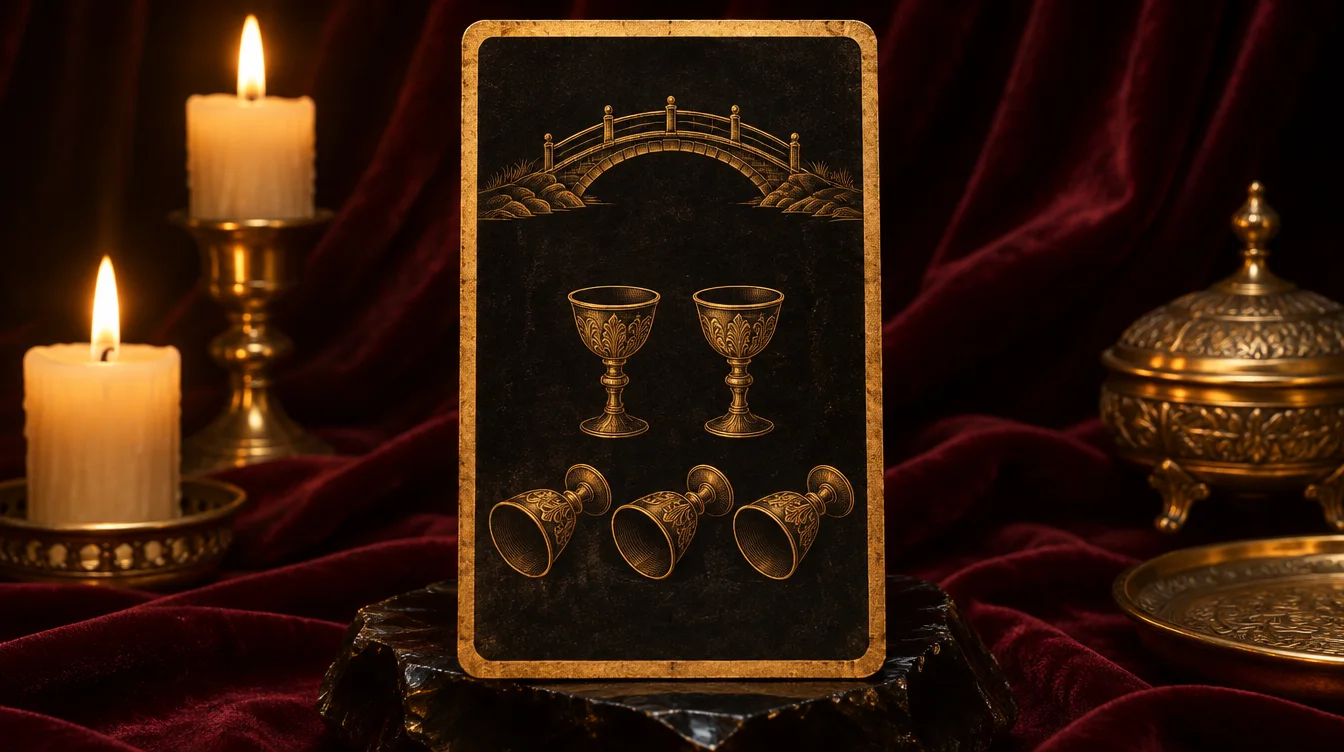
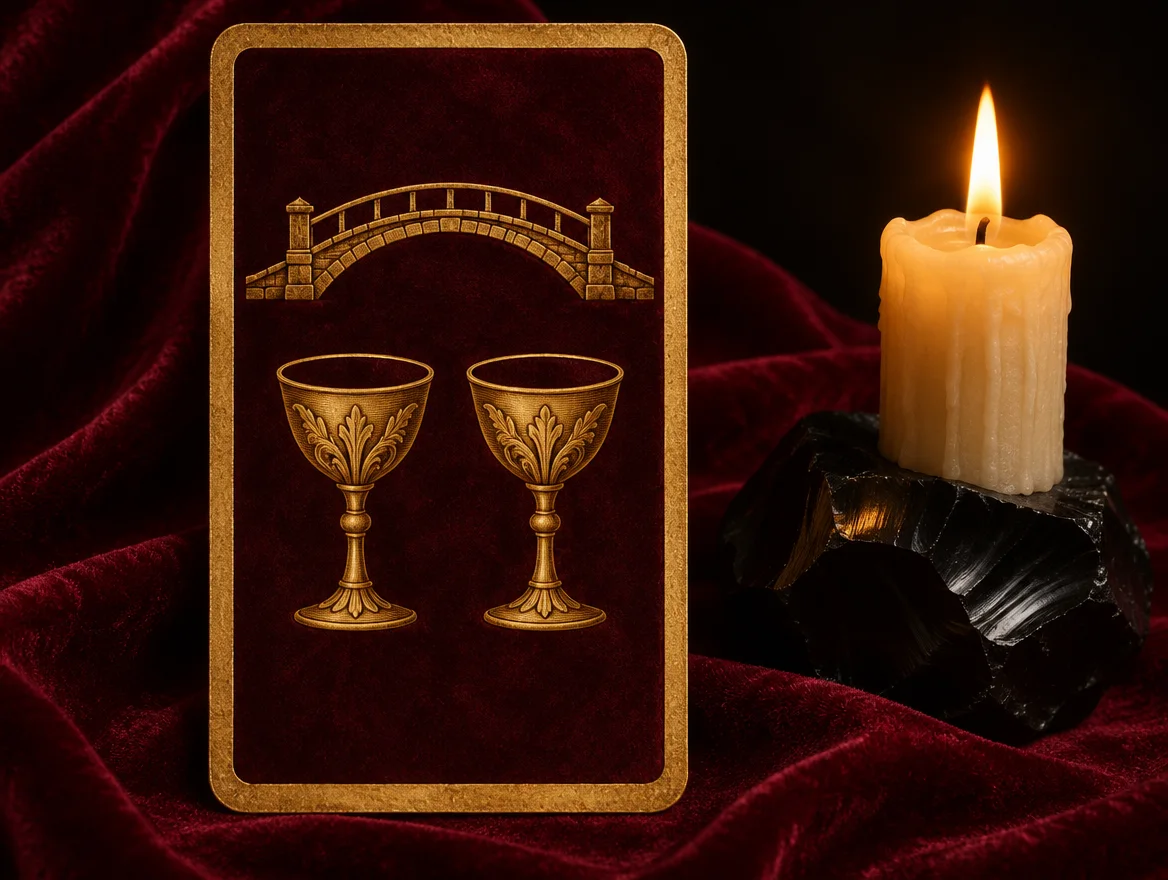
The Five of Cups (also written 5 of Cups) is a Minor Arcana card from the suit of Cups. In the traditional Rider–Waite–Smith design, a dark, cloaked figure looks at three cups lying on their sides, while two cups still stand behind him and a bridge leads away in the distance. Readers usually take it as the card of loss and regret, with a quiet note that something remains.
- Keywords: loss, grief, regret, disappointment, mourning, what remains, the way back.
- Upright, in one line: a prompt to notice a loss or disappointment that’s asking to be grieved, if something you cared about has fallen or ended.
- Reversed, in one line: a prompt to notice whether you’re starting to turn toward what remains, or whether regret is holding your gaze on what fell.
On The 9th King, tarot is a mirror for self-knowledge, not fortune-telling. The Five of Cups doesn’t say a loss is coming, and it can’t tell you what anyone else feels or intends. It asks how you’re carrying what you’ve already lost.
Table of Contents
The Five of Cups at a glance
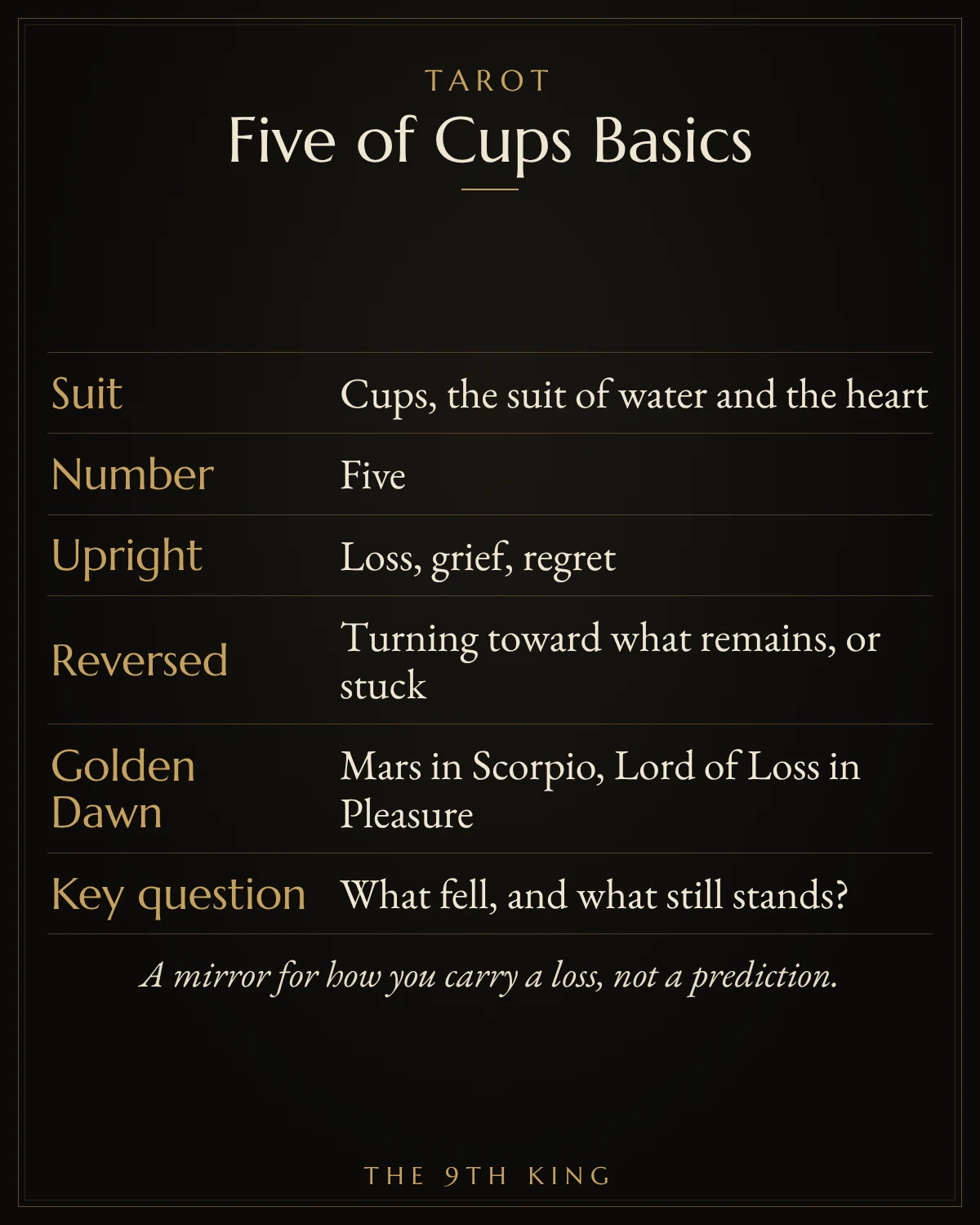
| Five of Cups | |
|---|---|
| Arcana | Minor Arcana, a pip (number) card |
| Suit and element | Cups, linked with water |
| Number | Five |
| Golden Dawn title | Lord of Loss in Pleasure |
| Astrology (Golden Dawn) | Mars in Scorpio |
| Upright | Loss, grief, regret |
| Reversed | Turning back, or stuck |
| Key question | What fell, and what still stands? |
What the Five of Cups looks like
Most people know this card from the Rider–Waite–Smith deck, published by William Rider & Son of London in December 1909, with instructions by A.E. Waite and art by Pamela Colman Smith. Both belonged to the Hermetic Order of the Golden Dawn (Wikipedia: Rider–Waite Tarot).
Waite’s own description
In The Pictorial Key to the Tarot, Waite describes a dark, cloaked figure looking sideways at three cups that lie prone, with two others standing upright behind him. In the background, a bridge leads to a small keep or holding (sacred-texts.com: Waite, Five of Cups). Apart from the figure, the five cups, the bridge and the keep, Waite gives no other detail about the scene.
Three fallen, two standing
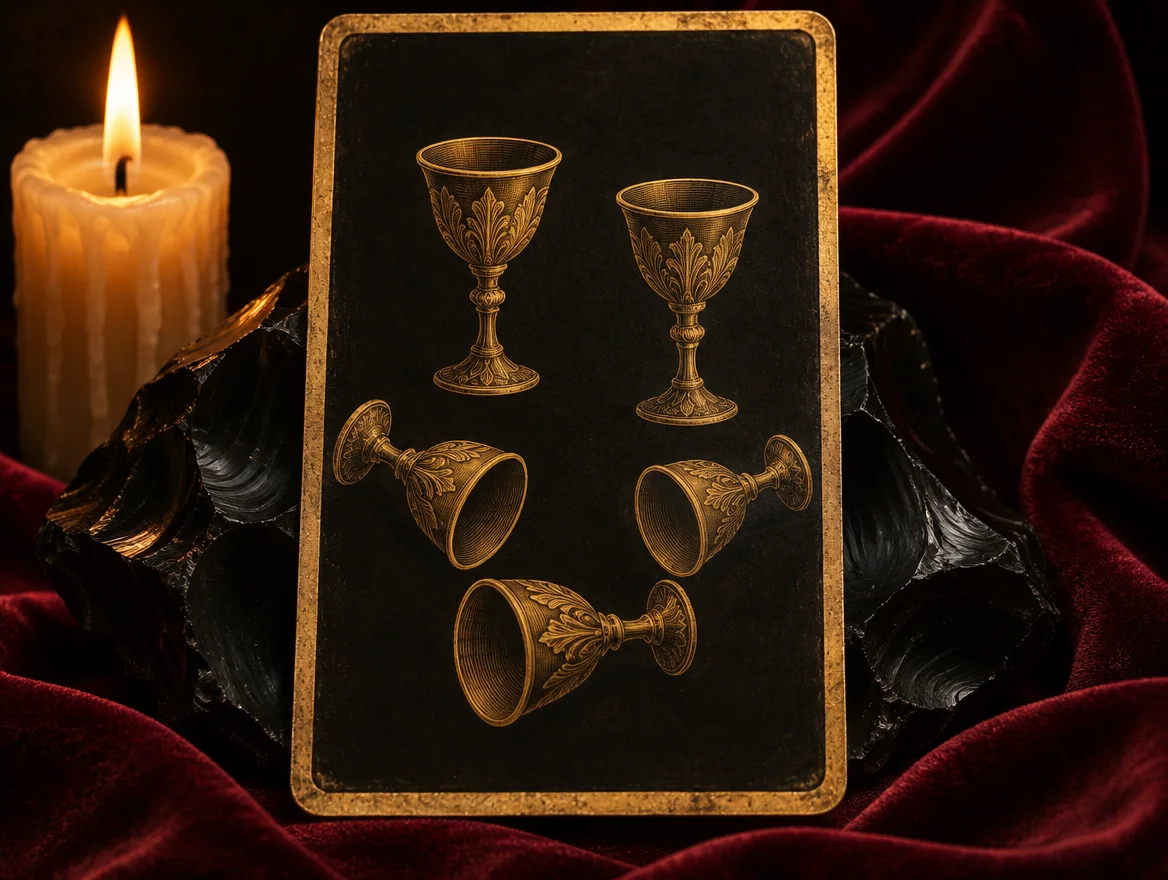
The arithmetic of this card is its message: three down, two up. The figure’s attention is on the three, and that makes sense: when something falls, it’s natural to look at it. The two upright cups aren’t a scolding, and they don’t cancel the loss. They’re simply there for when the person is ready to turn. On The 9th King, we read the bridge not as a deadline but as a reminder that a road back exists, to be taken at your own pace.
The older Golden Dawn image
The Golden Dawn’s own description of the card, in Book T as printed by Aleister Crowley in Liber LXXVIII, has no figure at all. A white radiating angelic hand holds lotus stems whose flowers are falling, with leaves but no buds. No water flows from them, and every cup is empty (Liber LXXVIII, sacred-texts.com). Our own 9K art keeps the calm part of these ideas: five cups, three resting on their sides and two upright, with nothing spilling.
Five of Cups meaning (upright)
Waite’s divinatory meaning opens with a sentence that holds the whole card: “It is a card of loss, but something remains over.” He adds that three have been taken and two are left. He also calls it a card of inheritance and patrimony that doesn’t match what was expected, and says some interpreters read it as a marriage that comes with bitterness or frustration (sacred-texts.com: Waite, Five of Cups).
Liber LXXVIII names the card the Lord of Loss in Pleasure. Its meanings describe the end of pleasure, disappointment and sorrow, and “loss in those things from which pleasure is expected.” It also lists kindness that goes unreturned, and a short note in parentheses mentions disappointment in love and the loss of a friendship (Liber LXXVIII, sacred-texts.com). The loss lands where you hoped for joy, which is why it stings.
On The 9th King, the upright Five of Cups usually points to one of three things.
Grief for something that mattered
The card can point to the loss of something you loved or counted on: a person, a relationship, a home, a hope, a version of the future. Grief doesn’t need to be justified or measured against anyone else’s. Ask yourself: What have I lost that still deserves to be mourned?
Regret and the replay
Sometimes the fallen cups are choices you wish you could take back. Readers often take the Five as the card of “if only”. Regret can show you what you value. It can also become a loop that keeps you staring at the same three cups. Ask yourself: What is this regret trying to teach me, and have I heard it yet?
Expectations that didn’t come true
Waite’s note about an inheritance that doesn’t match expectations widens the card beyond bereavement. It can be any gap between what you were promised, or promised yourself, and what arrived. Ask yourself: What did I expect here, and what am I grieving about the gap?
Five of Cups reversed
Some readers read reversals as the opposite meaning, some as the same energy blocked or softened, and some skip them. Waite’s reversed meaning for this card is a list: “News, alliances, affinity, consanguinity, ancestry, return, false projects.” Consanguinity means blood relationship, so much of the list is about kinship and coming back (sacred-texts.com: Waite, Five of Cups).
On The 9th King, the reversal usually points to one of three patterns, offered as questions.
Turning toward what remains
The two standing cups come into view: the people, strengths and parts of life that are still here. This isn’t “getting over it”. It’s the loss and the life both in the frame at once. Ask yourself: What is still standing that I haven’t had the energy to notice?
Reaching back toward people
Waite’s words return, alliances and affinity point here. The reversed card can point to reconnecting with family, old friends or a community you drifted from while hurting. Contact is a choice, not an obligation. Ask yourself: Is there someone safe I’d like to let back in, even a little?
Regret on a loop
Sometimes the gaze stays locked on the fallen cups, and the replay gets louder. Waite’s “false projects” can be read here as plans built to undo the past, which no plan can do. Ask yourself: Am I trying to fix something that can only be grieved?
| Pattern | Upright tone | Reversed tone |
|---|---|---|
| The gaze | On what fell | Turning, or fixed |
| The heart | Grieving | Opening, or stuck |
| People | Feeling alone | Reaching back |
| The bridge | In the distance | Coming into view |
Five of Cups astrology: Mars in Scorpio
The 9th King uses Golden Dawn–derived correspondences, the tradition the Rider–Waite–Smith deck draws on. Other schools of tarot and astrology use different systems, and not every card maps to a single sign: the court cards and Pages, for example, work differently. What follows is one traditional framework, offered as symbolism.
How the number cards get their planets
In the Golden Dawn system, the 36 numbered cards from Two to Ten are matched to the 36 decans of the zodiac. A decan is a ten-degree third of a sign, and each one has a ruling planet. Liber LXXVIII lists the Five of Cups, the Lord of Loss in Pleasure, with the decan Mars in Scorpio (Liber LXXVIII, sacred-texts.com).
In the order of Liber‘s own decan table, the three Scorpio cards run Five, Six and Seven of Cups: Mars, then Sun, then Venus in Scorpio. So the Five comes first in that list, and our Six of Cups guide covers the next one. Liber also lists the six decans Mars rules, one more than the other planets, and this card is among them.
What Mars brings
On The 9th King, Mars describes drive, courage and the urge to act. In traditional astrology, Mars is also Scorpio’s ruler (many modern astrologers add Pluto). On a card about loss, Mars is the urge to do something when nothing can be done, which can come out as regret, anger at yourself or a restless need to fix the past.
What Scorpio brings
Scorpio is fixed water, the sign of depth and intense bonds. Our Scorpio Personality Traits page explores the Scorpion’s loyalty and shadow. On this card, Scorpio is why the loss goes deep: it doesn’t love halfway, so it doesn’t grieve halfway.
The tension in the pairing
Mars wants to act; Scorpio wants to feel everything fully. The Five of Cups sits where those meet: deep feeling plus a drive that can’t change what happened. The pairing asks for a different kind of courage: staying with a feeling you can’t fix.
The 9K reading: grieve the three, keep the two in view
The card’s tension
The Five of Cups holds two true things at once: something real was lost, and something real remains. People often get pulled toward one side: told to “look at the bright side” before they’ve grieved, or grieving while everything else drops out of view. The card asks for both, in their own time: this mattered and it’s gone and I’m still here, with things that matter. Neither truth cancels the other.
The shadow side
The shadow of the Five of Cups isn’t grief. Grief is a natural, healthy response to loss, and it can take as long as it takes. The shadow is adding a second weight on top of the first. It can look like:
- The courtroom. Putting yourself on trial for the loss, again and again, as if a guilty verdict would bring the cups back up.
- The “if only” loop. Replaying one decision, hunting for the version where nothing fell.
- Forced brightness. Counting your blessings out loud before you’ve let yourself feel the loss, or letting others hurry you there.
- Going it alone. Refusing company because you don’t want to be a burden, even when someone safe is offering.
These patterns usually come from love, or from a wish for control in a moment that took control away. The question is whether the extra weight helps you or just makes the load heavier.
A word on rest: grief is tiring. Sleeping more, cancelling plans and moving slowly are often what a grieving body needs. That’s care, not avoidance. Numbness can also come with grief, and it isn’t something you choose. If it stays for a long stretch, it’s worth gentle attention and support.
Honoring a loss or adding weight
| Honoring a loss | Adding weight | |
|---|---|---|
| The feeling | Given room | Judged or rushed |
| Regret | Heard for its lesson | Replayed as a verdict |
| People | Let in when safe | Kept out “for them” |
| The question | “What do I miss?” | “Why did I fail?” |
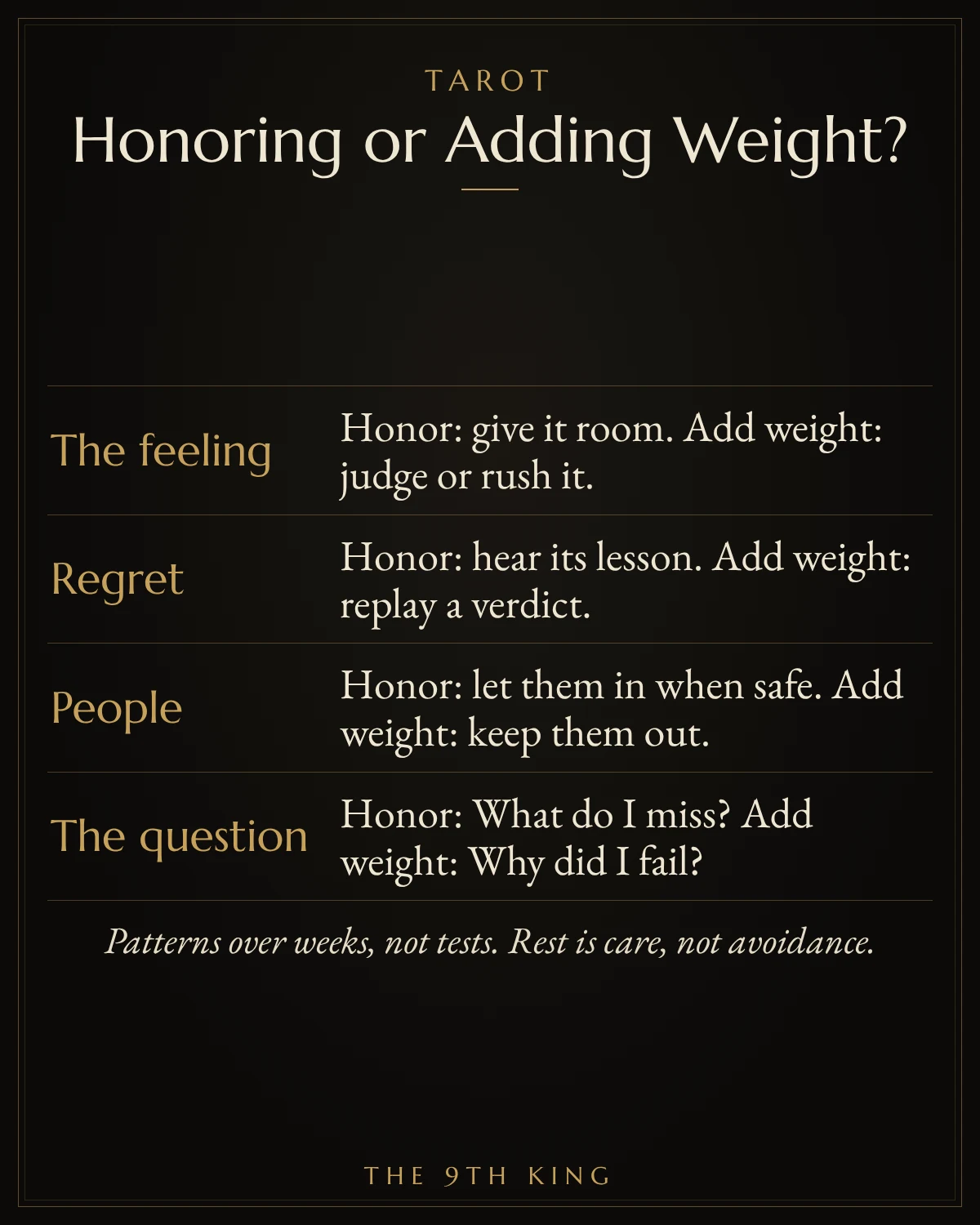
These are patterns, not tests. Honoring a loss can hurt a great deal, and adding weight can feel oddly familiar. How it feels doesn’t prove which is happening; look at the pattern over weeks instead.
The self-mastery lesson
The lesson of the Five of Cups is to grieve what fell without forgetting what stands. You don’t have to turn around before you’re ready, or pretend the three cups didn’t matter. Self-mastery here means letting the loss be as big as it is and refusing the second weight of blame.
Five of Cups as feelings, in love and at work
Five of Cups as feelings
When someone asks “how does this person feel?” and draws the Five of Cups, readers often take it as sadness, regret or disappointment. But a card can’t tell you what’s in another person’s heart; their words and actions are the real evidence. If the card is about your own feelings, it can be a prompt to ask: Have I let myself admit how much I miss what’s gone?
Five of Cups love meaning
In a love reading, readers often link the upright card with grief over a relationship: a breakup or a hope that didn’t come true. That doesn’t mean the card predicts a breakup, and it can’t tell you what a partner or an ex intends.
Tarot can’t tell you whether to stay or leave, and this page won’t either. If you don’t feel safe with someone, put your safety first. Anyone who causes harm is responsible for it, never the person who was hurt. Otherwise, useful questions include:
- What exactly am I grieving: the person, or the future I pictured?
- What still stands in my love life and friendships, even if it’s small?
- What would caring for my heart look like this week?
Our guide to synastry for beginners can help you look at relationship patterns with curiosity instead of blame.
Five of Cups at work
At work, readers often take the card as disappointment: a role you didn’t get or a project that ended. This is reflection, not career, legal or financial advice. The shadow version is letting one loss decide your whole story. Ask yourself: What still stands in my working life that this setback can’t take?
Practical exercise: three fallen, two standing
You need about twenty minutes, a notebook and a quiet place. It’s fine to do one step and come back another day, or to skip a step.
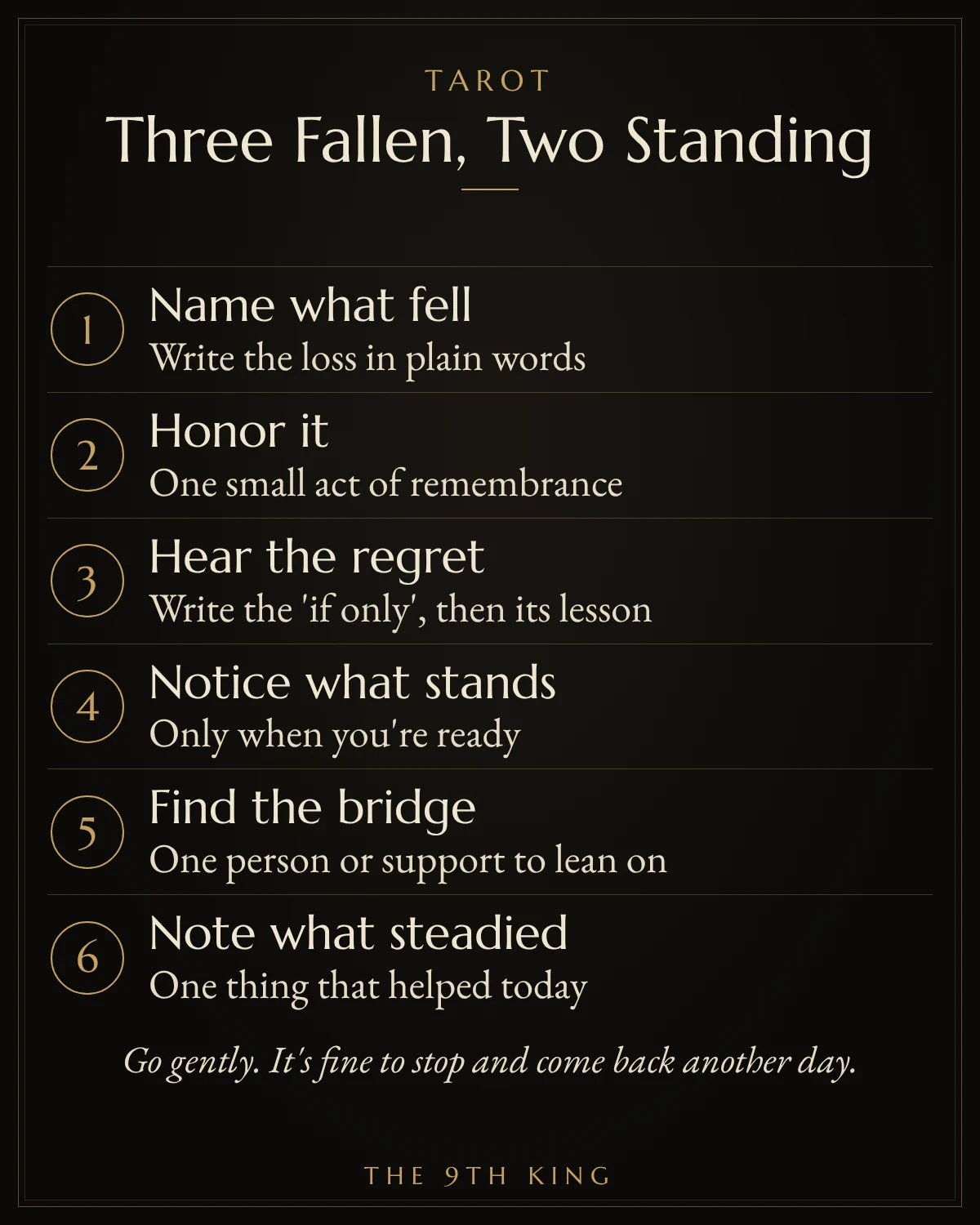
Step 1: Name what fell
Write the loss in one or two plain sentences: “The business closed.” “We stopped being friends.” Naming it gives it a place.
Step 2: Honor it
Choose one small act of remembrance: light a candle, look at a photo, write a few lines about what it meant. Honoring a loss isn’t wallowing. It’s treating something that mattered as if it mattered.
Step 3: Hear the regret
If there’s an “if only”, write it down. Underneath, write what it shows you about what you value. Hearing the lesson doesn’t mean the loss was your fault.
Step 4: Notice what stands
Only when you’re ready, write down one or two things that are still here: a person, a skill, a part of yourself. If nothing comes, leave the line blank and come back another day. This step is a door, not a demand.
Step 5: Find the bridge
Name one person or support you could lean on: a friend, a group, a counselor. Reaching out is a choice. If contact with someone feels unsafe or too much, pick a support that doesn’t involve them.
Step 6: Note what steadied
Before bed, note one thing that steadied you today, even for a moment. Over time, the list may show you moments of steadiness that are easy to miss on hard days.
A worked example (fictional)
Dana (fictional) closed her small bakery after six years and draws the Five of Cups upright.
In Step 1 she writes: “The bakery closed in August.” In Step 2, she frames a photo of the shop on opening day. In Step 3, her regret: “If only I’d moved sooner.” Underneath: “I care about building things that last.” In Step 4, she lists two things still standing: her recipes and her friendship with her old head baker. In Step 5, she calls that friend for coffee. By Sunday, her steady-things list has three lines.
Journal prompts for the Five of Cups
- What loss am I carrying that I haven’t fully named?
- What did this loss take from me that other people might not see?
- Which regret keeps returning, and what does it say about what I value?
- Who or what is still standing beside me, even quietly?
- What would it mean to honor this loss without carrying blame for it?
- What would I say to a friend standing where I’m standing now?
For more prompts like these, our shadow work prompts collection goes deeper.
A warm note: this is reflective practice, not therapy. If your grief is tied to trauma or abuse, or if you’re dealing with thoughts of self-harm or distress that feels overwhelming, please work with a qualified therapist or grief counselor who can walk with you. It’s always fine to stop a prompt that feels like too much.
Myths and misreadings of the Five of Cups
- “The Five of Cups means you’re going to lose something.” No. On The 9th King, tarot doesn’t predict events. The card reflects how you’re carrying a loss or disappointment, not what will happen next.
- “It means you’re dwelling and need to get over it.” Looking at what fell is natural. Grief isn’t a mistake to correct, and the two standing cups are an invitation, not a demand to cheer up.
- “It’s only about bereavement.” Waite names loss in general, plus inheritance and marriage that fall short of expectations; Liber LXXVIII adds disappointment in love and lost friendship. The card covers many kinds of loss.
- “Waite said it means a happy marriage.” In his list of additional meanings, Waite does call the card generally favourable, with a happy marriage among other things. He also warned that these extra meanings have little connection with the card designs and often disagree with his main meanings (sacred-texts.com: Waite, Additional Meanings).
- “Mars in Scorpio means this card is about Scorpio people.” No. The correspondence describes the card’s symbolism in the Golden Dawn tradition. Anyone can draw it, whatever their sign.
Five of Cups: FAQ
What does the Five of Cups mean?
The Five of Cups is a Minor Arcana card in the suit of Cups. In the Rider–Waite–Smith deck it shows a cloaked figure looking at three fallen cups, with two cups still standing behind and a bridge in the distance. Readers commonly take it as loss, grief, regret or disappointment. On The 9th King, it’s a mirror for how you’re carrying a loss, not a prediction that something will be lost.
What does the Five of Cups reversed mean?
Reversed, the Five of Cups is often read as turning toward what remains and reconnecting with people, or as regret stuck on a loop. Waite’s reversed meanings include news, alliances, kinship and return. Some readers don’t use reversals at all. Treat it as a question to explore, such as “what is still standing for me?”, rather than as a verdict about your grief.
What does the Five of Cups mean as feelings?
As feelings, readers often take the Five of Cups as sadness, regret or disappointment. But a card can’t tell you what another person feels or what they’ll do; their words and actions are the real evidence. If the card is about you, it can be a prompt to admit, at least privately, how much you miss what’s gone, and what you need now.
What does the Five of Cups mean in love?
In love, the card is often linked with grief over a relationship, a breakup or a hope that didn’t come true. It doesn’t predict a breakup, and it can’t tell you what a partner or an ex intends. It doesn’t tell you to stay or leave either. It invites you to name what you’re grieving and notice what still stands, with your safety always first.
What zodiac sign is the Five of Cups?
In the Golden Dawn system, the tradition The 9th King uses, the Five of Cups corresponds to Mars in Scorpio, the first of the three Scorpio cards in Liber LXXVIII‘s decan table. Liber calls the card the Lord of Loss in Pleasure. It’s a planet-in-sign pairing rather than a card for one sign, and other schools use different correspondences, so treat it as symbolism.
Is the Five of Cups a yes or no card?
The 9th King doesn’t do yes or no readings, because tarot here is a tool for self-reflection, not fortune-telling. Instead of asking whether the card says yes, ask what it shows you: what you’ve lost, which regret keeps returning, and what is still standing beside you when you’re ready to look.
Your next step: try the three fallen, two standing exercise above for one loss you’re carrying, gently and at your own pace. Then read our Scorpio Personality Traits guide: Scorpio is the sign the Golden Dawn tied to this card, and its depth can help you understand why some losses go all the way down.
Explore Next
- The Scorpion and its shadow: Scorpio Personality Traits
- Start gently: Shadow Work, Plainly
- Go deeper with questions: Shadow Work Prompts
- Old disappointments that echo: Inner Child Work
- The shadow side of every sign: Zodiac Shadow Work
- Reading by feel: Intuitive Tarot (Code of Ascension)
- New to the cards: Tarot for Beginners: How Tarot Really Works (Code of Ascension)
- More Cups on The 9th King: Ace of Cups · Two of Cups · Six of Cups · Queen of Cups
- Another card of grief: Three of Swords
- Hope after loss: The Star
- More tarot on The 9th King: Tarot Card Meanings · Minor Arcana · Tarot & the Zodiac · Shadow Work Tarot Spread
- More cards in this set: Three of Cups, Four of Cups, Seven of Cups
Final Thought: What Still Stands
The Five of Cups doesn’t ask you to stop looking at what fell. Three cups went down, and they mattered. Two are still standing, and they matter too. Grieve at your own pace, put down blame that was never yours, and let someone safe walk part of the way with you. When you’re ready, the bridge is there. Know your nature. Rule your life.
About the Author
King is the founder of The 9th King, where zodiac psychology, relationships and shadow work are explored as tools for self-knowledge rather than fortune-telling. He’s a Libra Sun, and writes about the personal side of astrology on King The Kemist. Astrology on The 9th King is interpretation and self-reflection, not prediction or established fact.
Leave a Reply