
Quick Answer: What Does the Death Tarot Card Mean?
Death is card XIII (13) of the Major Arcana. First, the thing most people want to know: a tarot card cannot establish that someone will die. On The 9th King, Death is read symbolically, as endings and change: a chapter closing so a new one can begin.
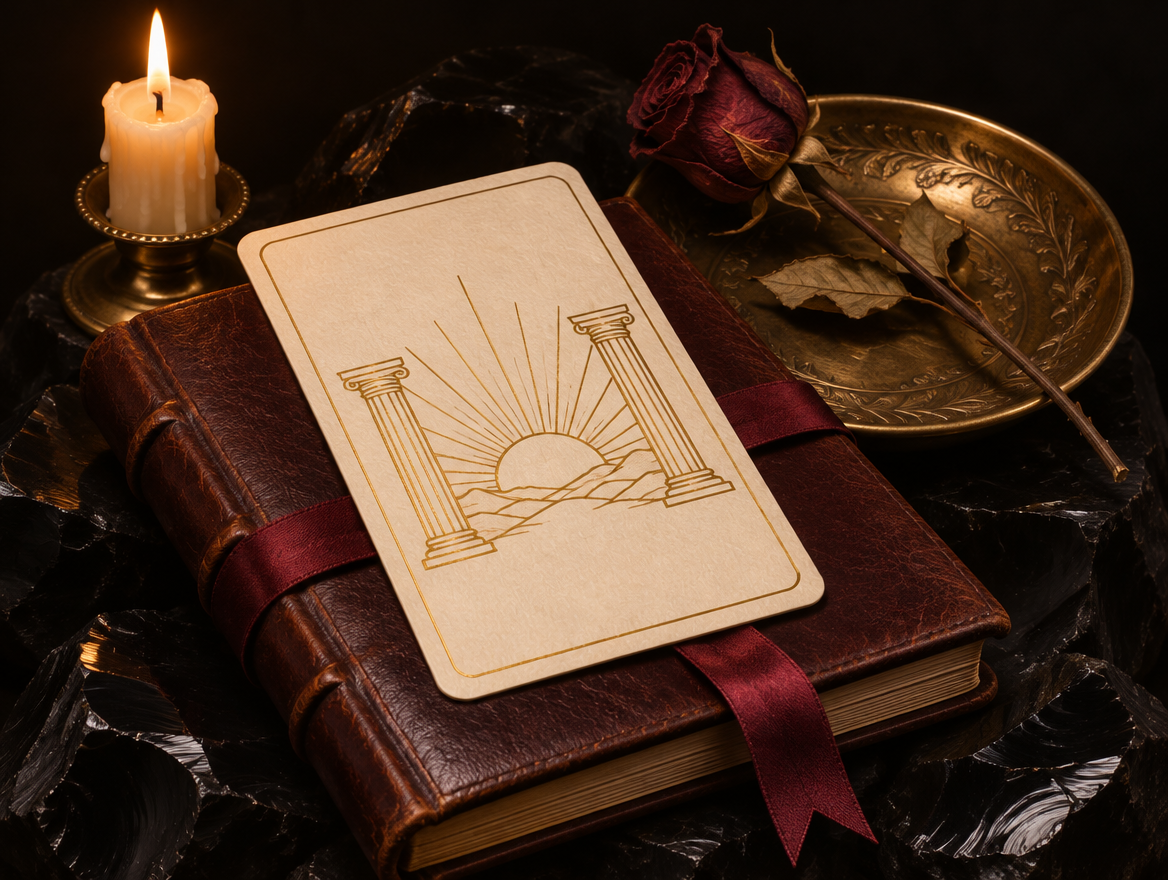
In the traditional Rider–Waite–Smith design, a rider moves slowly forward carrying a black banner marked with a rose, while figures from every walk of life go down before him and a sun shines between two pillars on the horizon.
Keywords: endings, change, transformation, letting go, transition, renewal, clearing space.
- Upright, in one line: the card can point to something that’s finishing, a role, a habit, a relationship pattern or an old idea of yourself, and asks what that ending makes room for.
- Reversed, in one line: readers often take it as resisting a change that’s already underway, or as an ending that’s stalled, half-done or slow to arrive.
- Astrology link: in the Golden Dawn–derived correspondences The 9th King uses, Death is paired with Scorpio.
On The 9th King, tarot is a mirror for self-knowledge, not fortune-telling. Death doesn’t announce a loss. It asks a steadier question: what in my life is ready to finish, and what would it make room for?
Table of Contents

The Death tarot card at a glance
| Death | |
|---|---|
| Number | XIII (13), Major Arcana |
| Core theme | Endings and change |
| Upright | Something finishing, clearing space |
| Reversed | Resisting, or an ending stalled |
| Correspondence (Golden Dawn–derived) | Scorpio |
| Hebrew letter (Golden Dawn) | Nun |
| 9K tension | Completing vs clinging |
| Key question | What is ready to finish? |
What’s on the card: Death tarot symbolism
Most modern decks follow the Rider–Waite–Smith design, first published in December 1909 by William Rider & Son of London to A. E. Waite’s instructions and illustrated by Pamela Colman Smith, both members of the Hermetic Order of the Golden Dawn (Wikipedia: Rider–Waite Tarot). Waite described each trump in The Pictorial Key to the Tarot, now in the public domain (sacred-texts.com: Waite, XIII. Death).
Waite’s choice: a rider, not a reaper
Waite deliberately moved away from the older reaper picture. He wrote that change, transformation and the passage from a lower state to a higher one were better shown by an apocalyptic vision than by the reaping figure of earlier decks. He wanted the card to read as a passage, not a threat.
On the 1909 Smith card, the rider wears black armor and sits on a white horse. Waite’s text simply calls him a mysterious horseman who moves slowly.
The slow pace and the absence of a weapon
Two details in Waite’s description set the card’s tone. The horseman moves slowly, and he carries no visible weapon. Readers often take that as the heart of the card: most endings arrive the way seasons turn, steadily, not as attacks.
The black banner and the rose
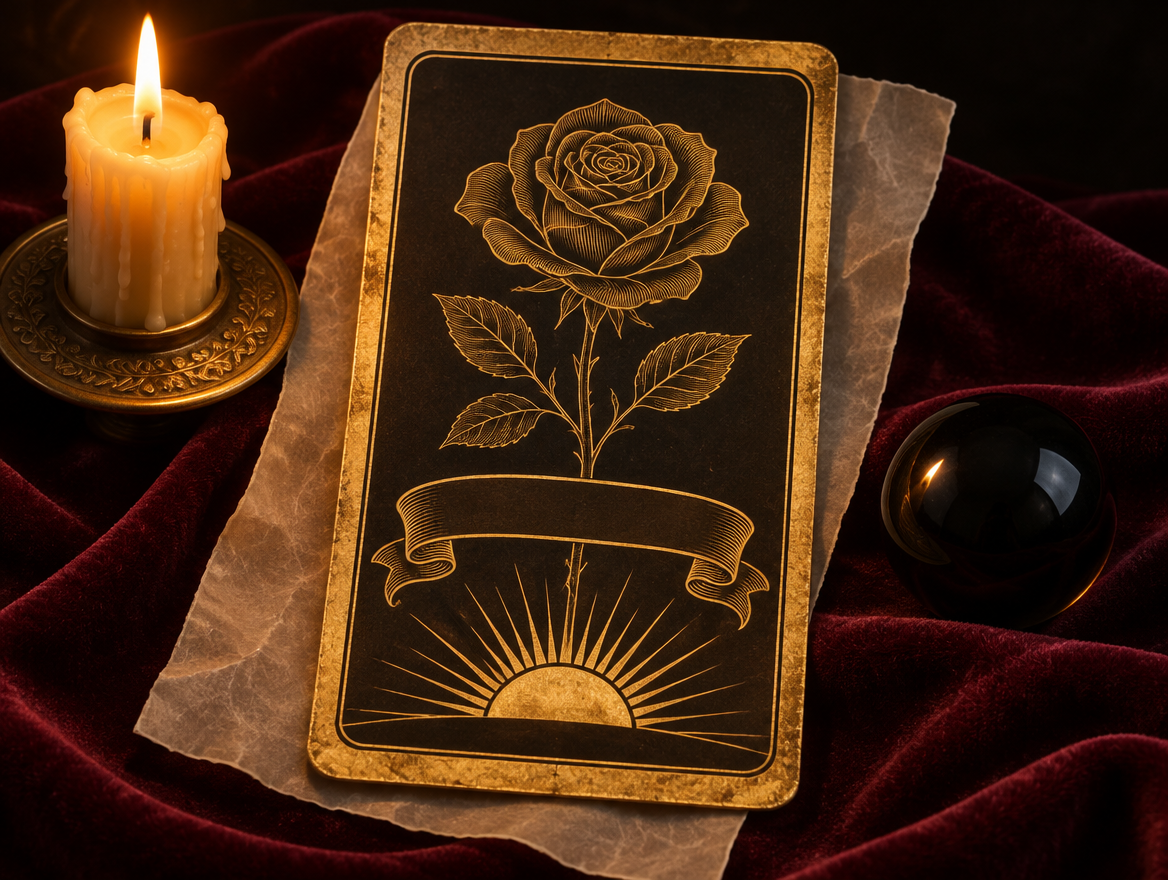
The rider holds a black banner marked with what Waite calls the Mystic Rose, which he says signifies life: an ending and a living thing, held on the same flag.
The figures before him
Waite writes that a king, a child and a maiden fall before the horseman, while a prelate, a church figure, stands with clasped hands waiting. Readers commonly take the group as a reminder that change reaches everyone. Some readers also notice the prelate’s stillness: you can meet a change calmly rather than fighting it.
The sun between the pillars
On the horizon, between two pillars, Waite places a shining sun, which he calls the sun of immortality. The horizon beyond the ending is lit.
The card that once had no name
Older decks handled this card differently. In the Tarot of Marseille and the Visconti-Sforza cards, card XIII often carries no title at all and is sometimes called “the card with no name”; some later decks retitle it “Rebirth” (Wikipedia: Death (tarot card)).

Death tarot meaning: upright and reversed
Death upright
Upright, readers usually take Death as an ending that’s part of a larger change. Common themes:
- A chapter closing: a job, a role, a home, a stage of life or a season of a relationship.
- Letting go: releasing a habit, belief or identity that no longer fits.
- Transformation: becoming different after a big life step.
- Clearing space: something has to go so something else has room.
The useful upright message isn’t “you’re about to lose something.” It’s “notice what’s already finishing, and let it finish well.”
Death reversed
Reversed, readers tend to go one of two ways:
- Resisting the change. You can feel that something is over, but you’re holding the door shut: staying in a role, a routine or a story about yourself because the unknown feels worse.
- An ending stalled. The change is happening slowly, or only halfway. You’ve left in spirit but not in practice.
Some readers also take Death reversed as a change that’s happening on the inside before anything shows on the outside. A reversed Death is a question about pace, not a warning.
What the older lists said
Waite’s 1911 list of divinatory meanings was blunt. Upright, he gave words like end, mortality, destruction and corruption. Reversed, he gave inertia, sleep, lethargy and petrifaction (sacred-texts.com: Waite, Divinatory Meanings).
But in his own description of the card, Waite said the existing occult explanations were, for once, better than usual, and he named them: “rebirth, creation, destination, renewal” (sacred-texts.com: Waite, XIII. Death). The Golden Dawn’s short list of meanings for card 13 begins with time, age and transformation, and describes the change as involuntary (Liber LXXVIII, sacred-texts.com).
Britannica dates tarot’s adaptation to fortune-telling to France around 1780; the cards began as an Italian card game in the 1430s (Britannica: Tarot). On The 9th King we keep the symbolic side: end as the end of a situation, and inertia as the reversed card’s honest question, where am I refusing to move?

| Position | Common reading | Question to ask |
|---|---|---|
| Upright | A chapter closing, letting go | What is ready to finish? |
| Reversed (resisting) | Holding on past the ending | What am I keeping alive out of fear? |
| Reversed (stalled) | An ending half-done | What would finishing well look like? |
Death and Scorpio: the Golden Dawn correspondence
Why Scorpio?
The astrology links on The 9th King are Golden Dawn–derived correspondences, the tradition The 9th King uses and the one the Rider–Waite–Smith deck draws on. The Golden Dawn’s Book T, as printed in Aleister Crowley’s Liber LXXVIII, lists card 13, Death, with the Hebrew letter Nun and the sign Scorpio, and gives it the title The Child of the Great Transformers: the Lord of the Gates of Death (Liber LXXVIII, sacred-texts.com).
Before that title says anything about death, it calls the card a child of transformers. In this tradition the card’s job is change.
Other schools differ
Other traditions use different attributions, and not every card maps to a single sign; court cards, for instance, work on a different scheme. The Scorpio pairing is a symbolic lens, not a law, and it says nothing about Scorpio people being dark or ominous. If another system suits you better, use it consistently. Our Tarot & the Zodiac guide shows the full set of pairings.
What Scorpio adds to the card
Scorpio is the fixed water sign (Wikipedia: Death (tarot card)). Astrologers associate it with depth, intensity, privacy and loyalty. Our Scorpio personality traits guide covers the sign in depth.
Read through Scorpio, the card gets more personal. Fixed signs are known for staying power, and water is feeling. Together they give the card its central puzzle: the depth that lets you love something fully can make it hard to let go. Scorpio’s gift is transformation by going through, not around. Its shadow is holding on so tightly that the change has to break the grip instead of loosening it.
Death and The Devil
Death sits between The Hanged Man (XII) and Temperance (XIV). And if The Devil is about the chains we hold, Death is about what happens when we finally set something down.
The 9K reading: endings that make room
The tension: completing vs clinging
Death’s core tension is between completing and clinging. Completing means letting something reach its natural end: you say the goodbye, take what you learned and walk on. Clinging means keeping something going after its time, because ending it feels like failure, or because you don’t know who you’ll be without it.
Both come from love; we cling to what mattered. The question isn’t whether it mattered. It’s whether it’s still alive, or whether you’re the one keeping it on its feet.
Letting a version of yourself finish
The most personal reading of Death on The 9th King is about identity. Sometimes what’s ending is a version of you: the people-pleaser, the one who always holds it together, the one who had to be tough to get through a hard stretch. That version may have kept you safe once. Thank it. You’re allowed to let it retire.
This kind of ending is more like the slow rider: one choice, then another, until you notice you’re living differently. Our guide to inner child work can help if the version that’s finishing started young.
The shadow side: clinging, or burning it all down
The shadow of Death shows up in two opposite ways.
- Clinging. Staying in something long after it ended on the inside. Rebuilding the same situation in a new place, or telling yourself it’ll go back to how it was.
- Burning everything down. Ending ten things at once because one needed to end. Quitting the job, leaving the city and cutting off friends in the same week, so the real ending gets lost in the noise.
The second shadow is easy to mistake for courage. But a scorched-earth ending often skips the actual grief and the actual lesson. Ending one thing cleanly is harder, and usually wiser, than ending everything loudly. It’s also easy to see what someone else should let go of and miss what you’re holding; our guide to psychological projection explains why.
The self-mastery lesson: end one thing cleanly
The self-mastery lesson of Death is this: a clean ending makes room; a forced or frozen one just moves the weight around.
It means three things:
- Name what’s finishing in plain words, without drama.
- Honor what it gave you, so you don’t have to pretend it was all bad to let it go.
- Make one clear closing move, and leave the rest of your life standing.
That’s the room the card promises: not an empty space to fear, but a cleared one you get to fill.
If a reading touches real grief
Some people find this card while they’re grieving a real loss. If that’s you, it’s okay if a reading brings that grief to the surface; the card isn’t saying anything about the person you lost, and you don’t have to make the feeling into a lesson.

The Death tarot card in love, work and self-growth
These are reflections, not predictions.
Death in love
In love readings, Death often points to a relationship changing form. That can mean a relationship ending, but just as often it means a stage ending: the early rush giving way to something steadier, an old pattern finally stopping, or a new chapter after a big life change.
Ask yourself:
- What’s actually finishing here: the relationship, a role I play in it, or an old way we treat each other?
- Am I holding on to the person, or to who I was when we met?
- If one pattern between us ended, what might have room to grow?
Death doesn’t tell you to stay or leave. If you’re single, the card can point to letting a past relationship finally finish inside you. To look at a relationship’s patterns through astrology, see synastry for beginners.
Death at work and with money
At work, Death can point to a role you’ve outgrown: a job, title or way of working that fit an earlier version of you, or a project that deserves a proper finish.
A grounded approach when Death shows up around work:
- Separate “this is over for me” from “I must act today.”
- Write down what this role gave you and what you’d take with you.
- Make no sudden, irreversible decision from a single reading.
Nothing here is career or financial advice. For money, contract or business decisions, talk to a qualified professional.
Death in self-growth
For personal growth, Death is about getting good at endings. Most of us learn how to start things, not how to finish them. Practicing small, clean endings builds trust that you can handle the big ones. For the long view of life chapters, see our progressed chart guide. If you’re new to this kind of inner work, Shadow Work, Plainly is a gentle place to start.
A practical exercise: the Clean Ending
This takes about 20 minutes, with or without a deck. You need paper, a pen and, if you like, the Death card in front of you. Pick something small and low-stakes the first time: a habit, a routine, a commitment you’ve outgrown.
The steps
- Name. Write what’s finishing in one plain sentence. “I’m done being the person who answers every group chat within a minute.”
- Honor. Write what it gave you. Be fair; it gave you something. It made me feel needed. It kept me in the loop when I was new in town.
- Keep. Write what you’ll carry forward. Endings don’t erase everything. I’ll keep being the one who remembers birthdays.
- Close. Choose one clear, kind closing act. One, not ten. Mute the chats for evenings, tell a friend what you’re changing, or put the old thing physically away. Write down what you chose.
- Make room. Write one small thing you’ll put in the space. Reading for twenty minutes after dinner.
Worked example (fictional)
Priya (fictional) pulls Death while journaling about feeling stuck. What’s finishing, she realizes, isn’t her job. It’s her role as the office fixer, the person everyone brings their problems to. It made her feel valued and got her noticed early on. That goes in the honor column.
Her first instinct is the shadow version: quit and start over somewhere new. Instead she picks one closing act. The next time a coworker brings her a problem that isn’t hers, she points them to the right person instead of taking it on. For the space, she blocks one afternoon a week for the project she actually wants to lead.
Over a month, the requests slow and she has time for her own work. The fixer version of Priya didn’t die; it retired. There’s a Scorpio flavor here: she had to feel how much the old role meant before she could set it down.
Using the exercise in a reading
If Death comes up in a spread, run the Clean Ending on your question. A simple past, present and future layout from our three-card tarot spread guide works well: past for what’s finishing, present for the closing act, future for the room it makes. If you’re new to reading, tarot for beginners (Code of Ascension) walks through the basics.
Journal prompts for the Death card
Use one prompt per session. Write for ten minutes, then put it away until tomorrow.
- What in my life has already ended on the inside, even if it’s still going on the outside?
- Which version of myself am I ready to thank and let retire?
- What am I keeping alive mainly because I’m afraid of who I’d be without it?
- When I’ve ended things before, did I tend to cling, or burn it all down?
- What did an ending in my past make room for that I couldn’t see at the time?
- What is one small thing I could finish cleanly this month?
- If I trusted that something good could grow in the space, what would I let go of?
For more prompts on change and the hidden self, see our full list of shadow work prompts, and our zodiac shadow work guide if you want to explore the Scorpio shadow specifically.
A gentle note: this is reflective practice, not therapy. If you’re dealing with grief that feels unmanageable, trauma, abuse, thoughts of self-harm or distress that feels overwhelming, please work with a qualified therapist or counselor who can support you properly. Reaching out is a strength, not a failure. And it’s always fine to stop a prompt that feels like too much.
Myths and misreadings about the Death card
- “The Death card means someone will die.” A tarot card can’t establish that. On The 9th King, Death is read as symbolic change: endings of situations, roles and patterns. Tarot here doesn’t predict events.
- “Death is the worst card in the deck.” No card is bad on The 9th King. Many readers find Death hopeful: an old thing finishing, room opening.
- “Death means the change will be sudden.” Waite’s horseman moves slowly, and many endings are gradual. The card describes a change, not its speed.
- “Death reversed means the bad thing is cancelled.” Readers usually take the reversal as resistance or a stalled ending, not a reprieve.
- “Scorpios are the death sign.” The Scorpio link is a symbolic correspondence in one tradition. Scorpio’s depth is what a real transformation takes.
Death Tarot Card: FAQ
What does the Death tarot card mean?
The Death tarot card, Major Arcana XIII, is commonly read as endings, change, transformation and letting go. On The 9th King, it isn’t read as literal death. The traditional image shows a slow rider carrying a banner with a rose, with a sun rising on the horizon. On The 9th King it’s a mirror, not a prediction: it asks what is ready to finish in your life and what that ending would make room for.
Does the Death card mean someone will die?
No. A tarot card cannot establish that someone will die. On The 9th King, Death is read symbolically, as endings and change, and we don’t use tarot to predict events at all. The card is read symbolically, as the end of a chapter, a role, a habit or an old version of yourself. Even A. E. Waite, who designed the modern card, described it in terms of change, transformation and renewal.
What does Death reversed mean?
Readers usually take Death reversed in one of two ways. Either you’re resisting a change that’s already underway, holding on to something that has ended on the inside, or an ending is stalled, slow or only half finished. Some readers also see it as a change happening inside you before it shows. Treat it as a question about what you’re holding on to, not as a warning.
What zodiac sign is the Death tarot card?
In the Golden Dawn–derived correspondences The 9th King uses, Death is paired with Scorpio, the fixed water sign, and the Hebrew letter Nun. The Golden Dawn’s Book T, printed as Liber LXXVIII, calls it the Child of the Great Transformers. Other schools of tarot use different attributions, so treat the pairing as a symbolic lens, not a statement about Scorpio people.
What does the Death tarot card mean in love?
In love, Death often points to a relationship changing form: a stage ending, an old pattern stopping, or a new chapter after a big life change. It can sometimes point to a relationship ending, but it doesn’t tell you to stay or leave. A useful question is what’s actually finishing: the relationship itself, a role you play in it, or a way you treat each other.
Is Death a good or bad card?
No card is good or bad on The 9th King. Death can look frightening, but many readers find it hopeful, because it shows an old thing finishing and room opening for something new. Its traditional image even includes a rose that Waite says signifies life and a sun on the horizon. Its challenge is learning to end things cleanly instead of clinging.
Is Death a yes or no card?
The 9th King doesn’t use tarot for yes or no answers. Death is about endings and change, which makes a simple verdict unhelpful. A better approach is to ask what is ready to finish, what it gave you, what you want to carry forward, and what one clear, kind step would let it end well and make room for what comes next.
Your next step: pick one small thing that’s already finished on the inside and run the Clean Ending above, one closing act and all. Then read our Scorpio personality traits guide to see how the card’s sign handles depth, loyalty and the art of letting go.
Explore Next
- The sign behind the card: Scorpio Personality Traits
- Questions for the hidden self: Shadow Work Prompts
- Every sign’s shadow side: Zodiac Shadow Work
- The chains we hold: The Devil Tarot Card
- More tarot on The 9th King: Tarot Card Meanings · Major Arcana · Tarot & the Zodiac · Three-Card Tarot Spread
- More cards: Wheel of Fortune · Judgement
- More Major Arcana: The Hanged Man · Temperance · The Tower
Final Thought: Let It Finish, Then Look at the Room
The Death card shows a rider who moves slowly, carries no weapon and holds a rose that stands for life, with a sun on the horizon behind him. On The 9th King, it isn’t read as being about dying. It’s about the endings that are part of any full life, and the space they leave. You don’t have to cling to what’s finished, and you don’t have to burn everything down to prove you’ve moved on. Name what’s ending, honor what it gave you, make one clean closing move, and see what grows in the room it leaves. Know your nature. Rule your life.
About the Author
King is the founder of The 9th King, where zodiac psychology, relationships and shadow work are explored as tools for self-knowledge rather than fortune-telling. He’s a Libra Sun, and writes about the personal side of astrology on King The Kemist. Astrology on The 9th King is interpretation and self-reflection, not prediction or established fact.
Leave a Reply