
Quick Answer: What Does the Seven of Swords Mean?
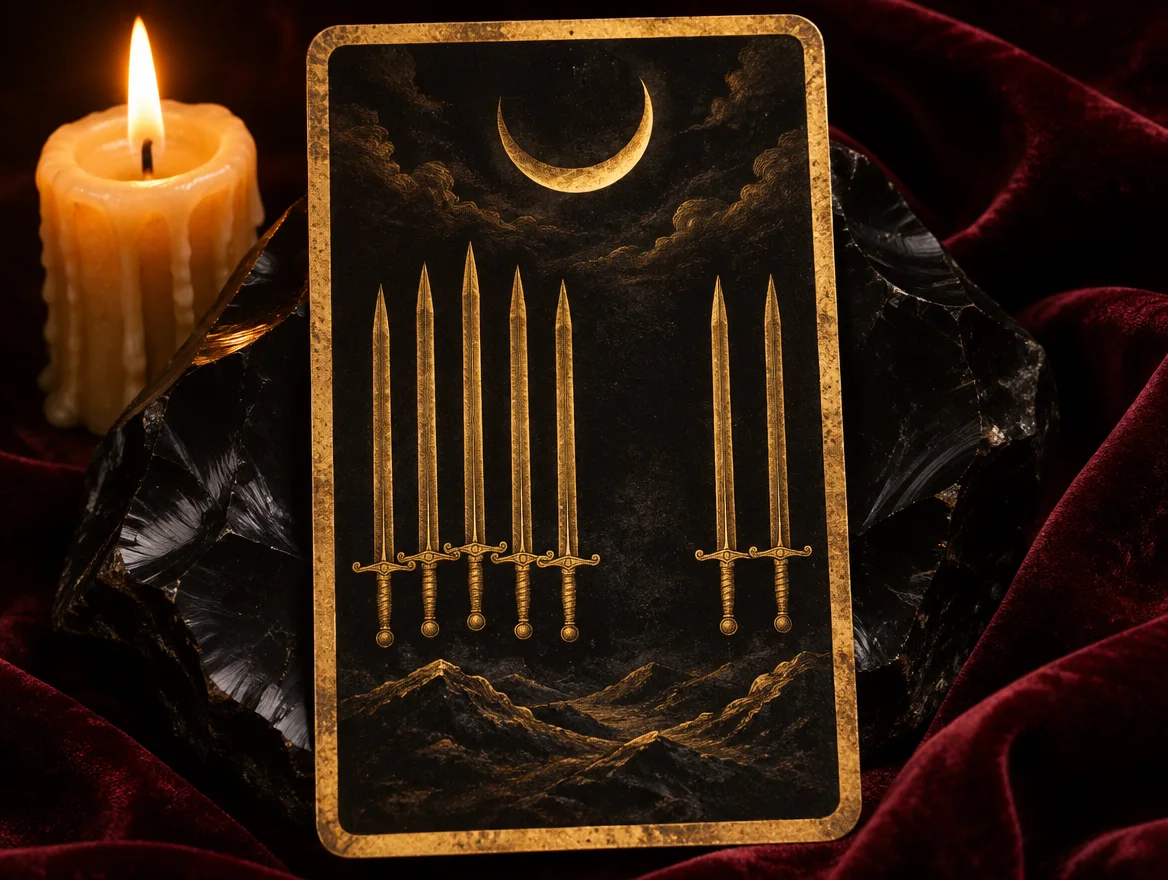
The Seven of Swords (also written 7 of Swords) is a Minor Arcana card from the suit of Swords. In the traditional Rider–Waite–Smith card, a man hurries away from a camp carrying five swords while two stay stuck in the ground. Readers often take it as the card of the quiet plan: strategy, going it alone, and the question of what you’re keeping hidden and why.
- Keywords: strategy, planning, secrecy, working alone, partial success, self-deception, second thoughts.
- Upright, in one line: a prompt to notice where you’re working an angle on your own, if a plan feels like it has to stay hidden to work.
- Reversed, in one line: a prompt to take advice, come clean with yourself, or set down a strategy that’s costing more than it gives.
On The 9th King, tarot is a mirror for self-knowledge, not fortune-telling. The Seven of Swords can’t tell you that anyone is lying to you or taking from you, and it doesn’t label you either. It asks you to look at how you get what you need, and whether your methods still match who you want to be.
Table of Contents

The Seven of Swords at a glance
| Seven of Swords | |
|---|---|
| Arcana | Minor Arcana, a pip (number) card |
| Suit and element | Swords, linked with air |
| Number | Seven, linked to Netzach in Book T |
| Golden Dawn title | Lord of Unstable Effort |
| Astrology (Golden Dawn) | The Moon in Aquarius |
| Upright | Strategy, planning, working alone |
| Reversed | Advice, honesty, a plan set down |
| Key question | Is this privacy or hiding? |
What the Seven of Swords looks like
Most people meet this card through the Rider–Waite–Smith deck, first published in London by William Rider & Son in 1909. A.E. Waite wrote the instructions and Pamela Colman Smith drew the art, and both were members of the Hermetic Order of the Golden Dawn (Wikipedia: Rider–Waite Tarot).
The figure and the five swords
Waite’s description in The Pictorial Key to the Tarot is only three short sentences. A man is caught in the act of carrying five swords away quickly, the other two swords stay stuck in the ground, and a camp is close by (sacred-texts.com: Waite, Seven of Swords). That’s all Waite says about the picture. He doesn’t call the man a thief, and he doesn’t say whose swords they are.
The two swords left behind
The two swords still in the ground are easy to overlook, but they matter for the 9K reading: whatever the figure is doing, he can’t carry everything.
The camp
The camp means this happens near other people. On the 1909 Smith card, the camp is drawn as a row of tents, and the figure glances back over his shoulder toward it. Apart from the man, the five swords he carries, the two swords in the ground and the nearby camp, none of these details are in Waite’s text.
Seven of Swords meaning (upright)
Here’s the surprise: Waite’s own divinatory meanings don’t mention theft at all. He lists design, attempt, wish, hope and confidence, and also quarreling, a plan that may fail, and annoyance. Then he admits the card is hard to pin down: “The design is uncertain in its import, because the significations are widely at variance” with each other (sacred-texts.com: Waite, Seven of Swords).
The Golden Dawn’s teaching text on the tarot, Book T, as printed by Aleister Crowley in Liber LXXVIII, names the card the Lord of Unstable Effort. Its meaning is partial success: giving way when victory is close, as if the last reserves of strength were used up, and losing ground by not continuing the effort. The same entry lists a mixed set of traits, including a habit of betraying confidences, “not always intentionally,” and a tendency to waver (Liber LXXVIII, sacred-texts.com).
Put together, the upright Seven of Swords meaning readers commonly use has three layers.
Strategy and the plan
At its most neutral, the card is about a plan: thinking ahead and choosing your moment. Swords are the suit of the mind, and the Seven is the mind in tactical mode. Ask yourself: What am I trying to get, and what is my plan for getting it?
Going it alone
The figure works by himself. Sometimes that’s wise: not every plan needs a committee. Sometimes it’s a way of avoiding a conversation. Ask yourself: Am I doing this alone because it’s best, or because asking would be uncomfortable?
Partial success
The figure gets five swords, not seven. The card can point to a plan that half works, or effort that fades before the finish. Ask yourself: Where am I settling for most of what I wanted, and is that a fair trade or a quiet retreat?
Seven of Swords reversed
Readers handle reversals differently: some read the opposite meaning, some the same energy blocked, and some skip reversals entirely. Waite’s reversed meanings for this card are mixed again: good advice, counsel and instruction, alongside slander and babbling (sacred-texts.com: Waite, Seven of Swords). In his list of additional meanings, he adds a reversed sense of “good advice, probably neglected” (sacred-texts.com: Waite, Additional Meanings).
On The 9th King, the Seven of Swords reversed usually points to one of three patterns, offered as questions, not predictions.
Taking the advice
The reversed card can point to the moment you stop going it alone and ask someone who knows more. Ask yourself: What advice have I already been given and quietly ignored?
Coming clean with yourself
The reversal can be about the story you tell yourself: the shortcut you called efficiency. Ask yourself: What do I already know about this situation that I’ve been avoiding saying out loud?
Setting the plan down
Sometimes the reversed card points to a strategy that has stopped working: the secret that takes more energy to keep than to share. Ask yourself: What is keeping this plan going costing me each week?
Seven of Swords astrology: the Moon in Aquarius
The 9th King uses Golden Dawn–derived correspondences, the tradition the Rider–Waite–Smith deck draws on. Other schools of tarot and astrology use different systems, and not every card maps to a single sign: the court cards and Pages, for example, are handled differently. What follows is one traditional framework, offered as symbolism.
How the number cards get their planets
In the Golden Dawn system, the 36 small cards (the Twos through Tens of the four suits) are matched to the 36 decans of the zodiac. A decan is a ten-degree third of a sign, and each one is given a ruling planet. Book T lists the Seven of Swords, the Lord of Unstable Effort, as the Moon in Aquarius (Liber LXXVIII, sacred-texts.com). In Liber’s decan table, the three Aquarius cards run in order as the Five of Swords (Venus), the Six of Swords (Mercury) and the Seven of Swords (the Moon), so the Seven is the last of the three Aquarius decans.
Book T also assigns all four Sevens to Netzach, “victory,” on the Kabbalistic Tree of Life, and it says something about the Sevens that fits this card well: “The Sevens then shew a possible result: which is dependent on the action then taken” (Liber LXXVIII, sacred-texts.com). In the same text, the suit of Swords is the suit of air.
What the Moon brings
On The 9th King, the Moon describes needs, instincts and habits; our Moon Sign Meaning guide covers it in full. On this card, the Moon is the need underneath the strategy: the safety or belonging you’re actually trying to secure.
What Aquarius brings
Aquarius is fixed air: independence, ideas and the outsider’s clear view. Our Aquarius Personality Traits page explores its originality and its detached shadow. On this card, Aquarius is the part that steps back and does things its own way.
The tension in the pairing
The Moon wants closeness and emotional safety. Aquarius wants distance and freedom to think. The Seven of Swords sits in that gap: a very human need met through a very solitary plan. The Moon supplies the reason; Aquarius supplies the method, and sometimes the method keeps everyone, including you, at arm’s length from the reason.
The 9K reading: privacy or hiding?
The card’s tension
The Seven of Swords holds two true things at once: I have a right to my own plans and I owe honesty to the people my plans affect. It’s easy to lean hard on one: keeping nothing to yourself, or keeping everything and calling it independence. The card asks you to tell the difference between what’s yours to keep and what’s being kept from someone with a stake in it.
The shadow side
The shadow of the Seven of Swords is self-deception dressed up as cleverness. It’s the voice that says nobody needs to know, and then, a little later, I don’t need to know either. It can look like:
- Rationalizing. A long, smart explanation for something that a short honest sentence would cover.
- The quiet shortcut. Skipping the step you don’t like and hoping it won’t matter.
- Lone-wolf pride. Refusing help so no one sees you struggle.
- Suspicion as a habit. Expecting others to be working angles because you sometimes do. Our guide to psychological projection explains how this works.
These patterns usually started as sensible protection. The question is whether they now cost you trust, including trust in yourself.
Privacy or hiding: how to tell
Privacy is your right to keep parts of your life to yourself. Secrecy is keeping back something that directly affects someone else, who would reasonably expect to know. Self-deception is keeping it from yourself.
| Privacy | Secrecy |
|---|---|
| Keeps what’s yours | Keeps back what affects others |
| Can involve keeping things hidden, for good reason | Leaves someone with a real stake in the dark |
| Owes no one an explanation | Often leans on a cover story |

Feelings aren’t a reliable test here: privacy can feel uncomfortable, and a secret can feel calm. Use questions instead: Who has a real stake in this? Am I keeping this to protect myself, or to avoid a fair consequence? Privacy that keeps you safe is still privacy. If being open with someone would put you at risk, protecting your safety comes first, and that’s not deception.
Our article on privacy without mixed signals shows how to keep your own space so it reads as a boundary, not a mystery.
When the card seems to be about someone else
People often draw this card and think of someone else. A tarot card can’t establish what another person did or why. If you have concerns about someone’s honesty, look at what you can actually observe: what was agreed, what happened, and what they say when you ask directly. Base any decision on that, not on a card. And if you’ve been on the receiving end of real deception, responsibility for it belongs to the person who chose it, not to you for having trusted them.
The self-mastery lesson
The lesson of the Seven of Swords is methods you can stand behind. You’re allowed to plan and keep your own counsel, and private doesn’t mean wrong. Self-mastery here means your methods would hold up if they came to light: if you’d need to edit the story for someone you respect, that’s the part to look at.
It also means finishing what you start: the plan you abandon at the last step leaves two swords in the ground.
Seven of Swords as feelings, in love and at work
Seven of Swords as feelings
Asked “how does this person feel?”, readers often take the Seven of Swords as feelings held close: interest kept private, or someone still working out what they want. It doesn’t tell you what anyone is doing. It can be a prompt to ask yourself: What do I actually know, and what am I guessing? And, if the card is about your own feelings: What am I not saying, and what would it take to say it?
Seven of Swords love meaning
In a love reading, the upright card can point to something unspoken: a need you haven’t named or a plan you’re making alone. The reversed card can point to a conversation you’re ready to have.
Tarot can’t tell you whether to stay or leave, or prove whether a partner has been honest. Relationships rest on agreements both people chose and behavior you can see over time. Useful questions:
- What have we actually agreed, out loud, about privacy and honesty?
- Is there something I keep to myself that my partner would reasonably expect to know?
To see how two charts handle trust, try synastry for beginners.
Seven of Swords at work
At work, readers often take the card as strategy: positioning, timing, choosing your battles. The shadow version is the shortcut you hope no one checks. This is reflection, not career or financial advice. Ask yourself: Is there a part of this I’d be uneasy explaining in a meeting? What would make it easy to explain?
Practical exercise: the two swords left behind
You need twenty minutes and a notebook. It’s yours alone: no one else needs to see it.

Step 1: Name the plan
Write one sentence: What am I trying to get? Then add the need underneath it, the Moon in this card: safety, freedom, respect or rest.
Step 2: Count the five
List what you’re carrying to make this plan work: steps, things you’re saying, things you’re doing alone. These are your five swords.
Step 3: Find the two
Now list what you left behind. What did you skip? A conversation, a cost, a person you didn’t ask, a fact you decided not to look at? These are the two swords still in the ground.
Step 4: Sort each one
Next to each item from Steps 2 and 3, write P (private and fine), S (secret, affects someone else) or D (self-deceiving, kept from yourself). Use the questions from earlier: Who has a stake in this, and do they know?
Step 5: Choose one move
Pick one item marked S or D and choose one small step into the open: writing it down plainly, asking for advice, or, only if it’s safe and useful, one honest conversation. You decide whether to involve anyone else.
Step 6: Review
At the end of the week, check: did the plan feel lighter or heavier? Either answer is useful information.
A worked example (fictional)
Marcus (fictional) has been interviewing for new jobs without telling his manager. He draws the Seven of Swords upright and feels caught out.
He names the plan as “a new job” and the need underneath as “respect for my work.” His five include lunch-break interviews, a recruiter and doing it all alone. His two left behind: he never told his partner how unhappy he is, and he never asked his manager about a promotion.
The job search itself is a P: it’s his career. Not telling his partner is an S: it affects their shared plans. Never asking about the promotion is a D: he’s been calling it hopeless without checking. His one move: he tells his partner that evening. By the end of the week he feels lighter, and he still keeps the search private at work, a choice he can stand behind.
Journal prompts for the Seven of Swords
- What am I trying to get right now, and what need sits underneath it?
- Where am I working alone because it’s best, and where because asking feels exposing?
- What story have I been telling myself that a short, honest sentence would replace?
- What did I leave behind to make this plan work, and do I want it back?
- If I imagine explaining how I handled this to someone I respect, what part would I want to edit?
For more prompts like these, our shadow work prompts collection goes deeper, and Shadow Work, Plainly explains how to start safely. For the shadow side of your own sign, see zodiac shadow work.
A warm note: this is reflective practice, not therapy. If secrecy in your life is tied to trauma, abuse or feeling unsafe, or if you’re dealing with thoughts of self-harm or distress that feels overwhelming, please work with a qualified therapist who can walk with you. It’s always fine to stop a prompt that feels like too much.
Myths and misreadings of the Seven of Swords
- “The Seven of Swords means someone is lying to you.” No. On The 9th King, a card can’t tell you what another person did. It reflects your own situation and questions, not someone else’s guilt. Look at what you can observe.
- “It’s the thief card.” Waite’s picture shows a man carrying swords away, but his divinatory meanings are design, attempt, hope and confidence, plus quarreling and a plan that may fail (sacred-texts.com: Waite, Seven of Swords). Theft isn’t on his list.
- “Drawing it means you’re a bad person.” The card can point to strategy, independence and privacy, all healthy. A shortcut or secret is information, not a verdict.
- “The Moon in Aquarius means this card is about Aquarius people.” No. The correspondence describes the card’s symbolism in the Golden Dawn tradition. Anyone can draw it, whatever their sign.
Seven of Swords: FAQ
What does the Seven of Swords mean?
The Seven of Swords is a Minor Arcana card in the suit of Swords. In the traditional card, a man carries five swords away from a camp while two stay in the ground. Readers commonly take it as strategy, planning, working alone and keeping something private or hidden. On The 9th King, it’s a mirror for how you go after what you need and whether your methods match your values, not a prediction about anyone.
What does the Seven of Swords reversed mean?
Reversed, the Seven of Swords is often read as taking advice, being honest with yourself or setting down a plan that isn’t working. A.E. Waite listed good advice, counsel and instruction among its reversed meanings, alongside slander and babbling. Some readers don’t use reversals at all. Treat it as a question, such as “what advice have I been ignoring?”, rather than a sign that something will happen.
What does the Seven of Swords mean as feelings?
As feelings, readers often take the Seven of Swords as feelings held close: interest kept private, mixed motives or someone still working out what they want. It can’t tell you what another person feels or plans. It can prompt you to separate what you actually know from what you’re guessing, and to ask what you yourself might be holding back.
Does the Seven of Swords mean cheating?
Not on The 9th King. A tarot card can’t establish whether anyone has been unfaithful or dishonest. Some readers associate the card with secrecy, but that’s a theme to reflect on, not evidence. If you’re worried about honesty in a relationship, look at what was agreed, what you can observe over time and what your partner says when you ask directly, and make your own choices from there.
What zodiac sign is the Seven of Swords?
In the Golden Dawn system, the tradition The 9th King uses, the Seven of Swords corresponds to the Moon in Aquarius, the last of Aquarius’s three decans in the Book T table. The Golden Dawn’s Book T calls the card the Lord of Unstable Effort. Other schools use different correspondences, so treat this as one traditional framework for symbolism rather than a fixed rule.
Is the Seven of Swords a yes or no card?
The 9th King doesn’t do yes or no readings, because tarot here is a tool for self-reflection, not fortune-telling. Instead of asking whether the card says yes, ask what it shows you: where you’re planning alone, what you’re keeping private, what you’re keeping hidden and whether your strategy is one you could explain out loud.
Is the Seven of Swords a good or bad card?
Neither, on The 9th King. Waite himself said its meanings are widely at variance, listing hope and confidence alongside quarreling and a plan that may fail. The Golden Dawn’s Book T reads it as partial success and effort that fades near the finish. Read it as a mirror for how you’re going after what you want, not as a good or bad omen.
Your next step: do the two swords left behind exercise for one plan you’re working on this week. Then look up where the Moon sits in your own birth chart with our Moon Sign Meaning guide: your Moon describes the needs underneath your plans, and it’s the same planet the Golden Dawn tied to this card.
Explore Next
- The Moon behind the card: Moon Sign Meaning
- The independent thinker and its shadow: Aquarius Personality Traits
- Keeping your space clearly: Privacy Without Mixed Signals
- Go deeper with questions: Shadow Work Prompts
- Reading by feel: Intuitive Tarot (Code of Ascension)
- New to the cards: Tarot for Beginners: How Tarot Really Works (Code of Ascension)
- The suit of Swords on The 9th King: Ace of Swords · Queen of Swords · King of Swords
- More tarot on The 9th King: Tarot Card Meanings · Minor Arcana · Tarot & the Zodiac · The Moon · Shadow Work Tarot Spread
- More cards in this set: Two of Swords, Three of Swords, Five of Swords and Six of Swords
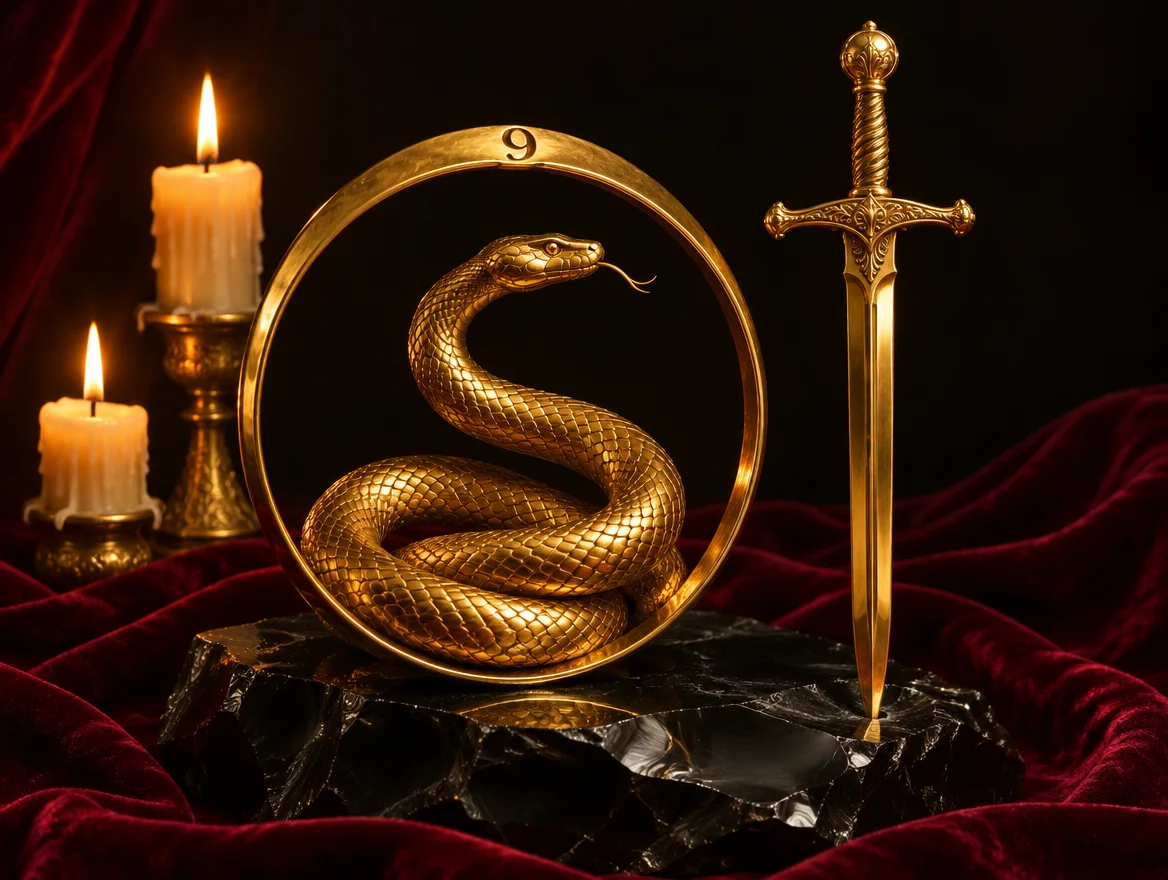
Final Thought: A Plan You Could Say Out Loud
The figure in the Seven of Swords is clever, quick and alone, and he still can’t carry everything. You’re allowed your own plans and your own privacy. Just check that they don’t leave someone with a real stake in the dark, and go back for the two swords you left behind when they matter. Know your nature. Rule your life.
About the Author
King is the founder of The 9th King, where zodiac psychology, relationships and shadow work are explored as tools for self-knowledge rather than fortune-telling. He’s a Libra Sun, and writes about the personal side of astrology on King The Kemist. Astrology on The 9th King is interpretation and self-reflection, not prediction or established fact.
Leave a Reply