Quick Answer: What Does Your Moon Sign Mean?
In astrology, your Moon sign is the zodiac sign the Moon was in when you were born. Astrologers read it as your emotional needs: what makes you feel safe, how you react under stress, and what comfort looks like to you.
A simple way to hold it:
- Your Sun is who you’re growing into.
- Your Rising is how you meet the world.
- Your Moon is what you need when nobody’s watching.
The Moon moves fast. It changes sign roughly every two and a half days, so two people born the same week can have completely different Moons. To find yours you need your birth date, place and, ideally, your birth time.
Table of Contents
What the Moon represents in a birth chart
Every planet in a birth chart stands for a part of life. The Moon stands for the part that feels before it thinks.
In the astrological reading, the Moon describes:
- Emotional needs: what you need from life and from other people to feel okay.
- Safety and comfort: where you go, and what you reach for, when things get hard.
- Instinctive reactions: the response that arrives before you’ve decided anything.
- Early patterns: how you learned to be cared for, and how you care for others.
- Moods and rhythms: the private ebb and flow underneath your public self.
The Moon is the fastest-moving body in the chart. It circles the whole zodiac in about 27 days, which is part of why astrologers associate it with things that change quickly: moods, appetites, feelings that come and go. The Sun takes a year to make the same journey and is read as something steadier: your overall direction.
It’s worth being clear about what this is. Astrology is a symbolic language, not a science. There’s no evidence that the Moon’s position on your birthday shapes your emotional life. What the Moon sign gives you is a vocabulary: a set of questions about your needs that are worth asking whatever you believe about the sky.
Moon sign vs Sun sign vs Rising sign
Most people know their Sun sign, the one listed in horoscope columns. The Sun, Moon and Rising together are often called the Big Three, and Code of Ascension’s Big Three guide (Code of Ascension) is a good primer if they’re new to you.
Here’s how the three tend to work together:
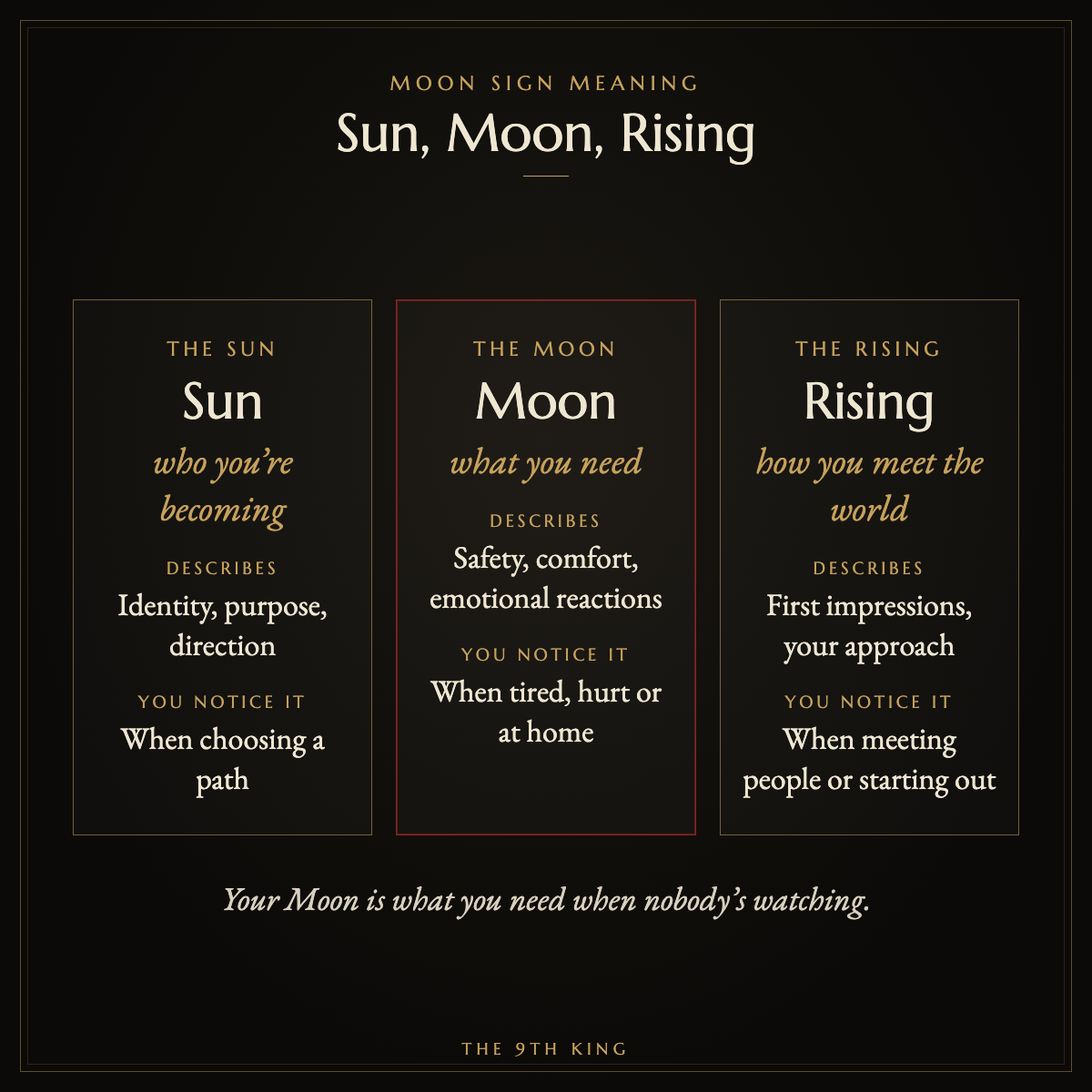
| What it describes | When you notice it | |
|---|---|---|
| Sun | Identity, purpose, what you’re growing toward | When you’re choosing a direction |
| Moon | Needs, comfort, emotional reactions | When you’re tired, hurt or at home |
| Rising | First impressions, your approach to new situations | When you meet people or start something |
This is why so many people say their Sun sign “doesn’t sound like me.” The Sun describes a direction you grow into over a lifetime. The Moon describes how you feel right now. If you’ve ever read your Sun sign description and thought, “That’s who I am at work, but not who I am at 11pm,” your Moon is probably the missing piece.
How to find your Moon sign
You need three things:
- Your birth date.
- Your birthplace, so the calculator can use the right time zone.
- Your birth time, as exact as you can get it.
Enter those into any reputable birth chart calculator and look for the Moon symbol, a small crescent, in the list of placements. Our guide to how to read a birth chart shows where to find it on the wheel.
Why the birth time matters for the Moon
The Moon spends only about two and a half days in each sign. If you were born on a day when the Moon was in the middle of a sign, your birth time doesn’t matter much for your Moon sign. If you were born on a day when the Moon changed sign, a few hours either way can put it in one sign or the next.
If you don’t know your birth time, run the calculator with noon as the time, then try 00:01 and 23:59. If all three give the same Moon sign, you can be fairly confident. If they disagree, read both descriptions below and see which one fits your experience more closely. That’s not proof, but it’s a reasonable way to start.
The Moon by element: four ways of feeling
Before you read your exact sign, it helps to look at its element. Each of the four elements describes a broad style of emotional life.
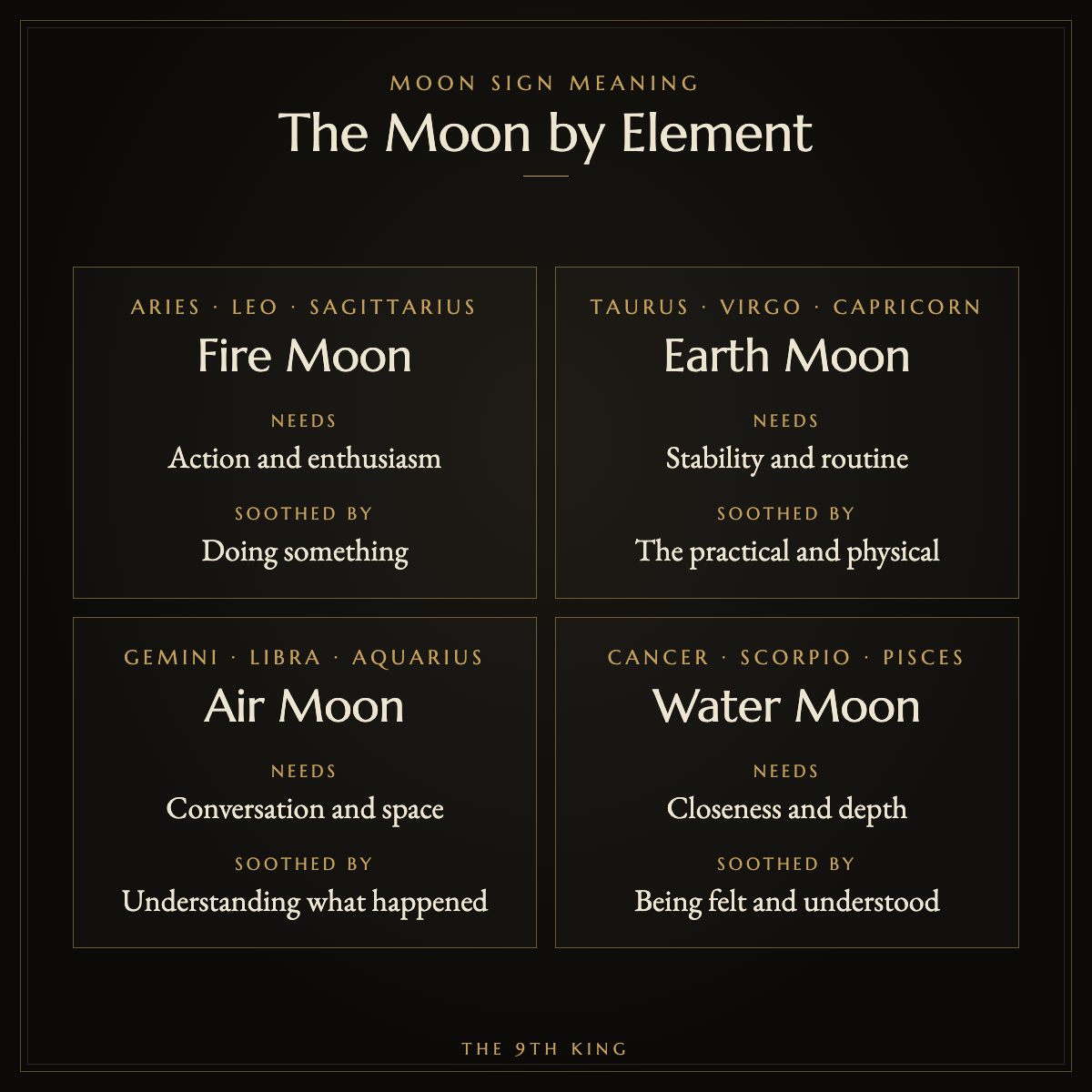
- Fire Moons (Aries, Leo, Sagittarius) process feelings through action. They’re soothed by doing something: moving, creating, getting out of the house. They can feel trapped by long, slow emotional conversations.
- Earth Moons (Taurus, Virgo, Capricorn) process feelings through the practical and physical. They’re soothed by routine, food, a tidy space, a plan. They can struggle to name a feeling until they’ve done something useful with it.
- Air Moons (Gemini, Libra, Aquarius) process feelings through thought and conversation. They’re soothed by talking it through and understanding what happened. They can mistake analysing a feeling for feeling it.
- Water Moons (Cancer, Scorpio, Pisces) process feelings by feeling them, fully. They’re soothed by closeness, being understood and time to absorb. They can be overwhelmed when there’s too much feeling and not enough privacy.
If you’re reading this with a partner, compare your Moon elements first. Two people with different elements often aren’t arguing about the issue at all. They’re arguing about how to have the argument.
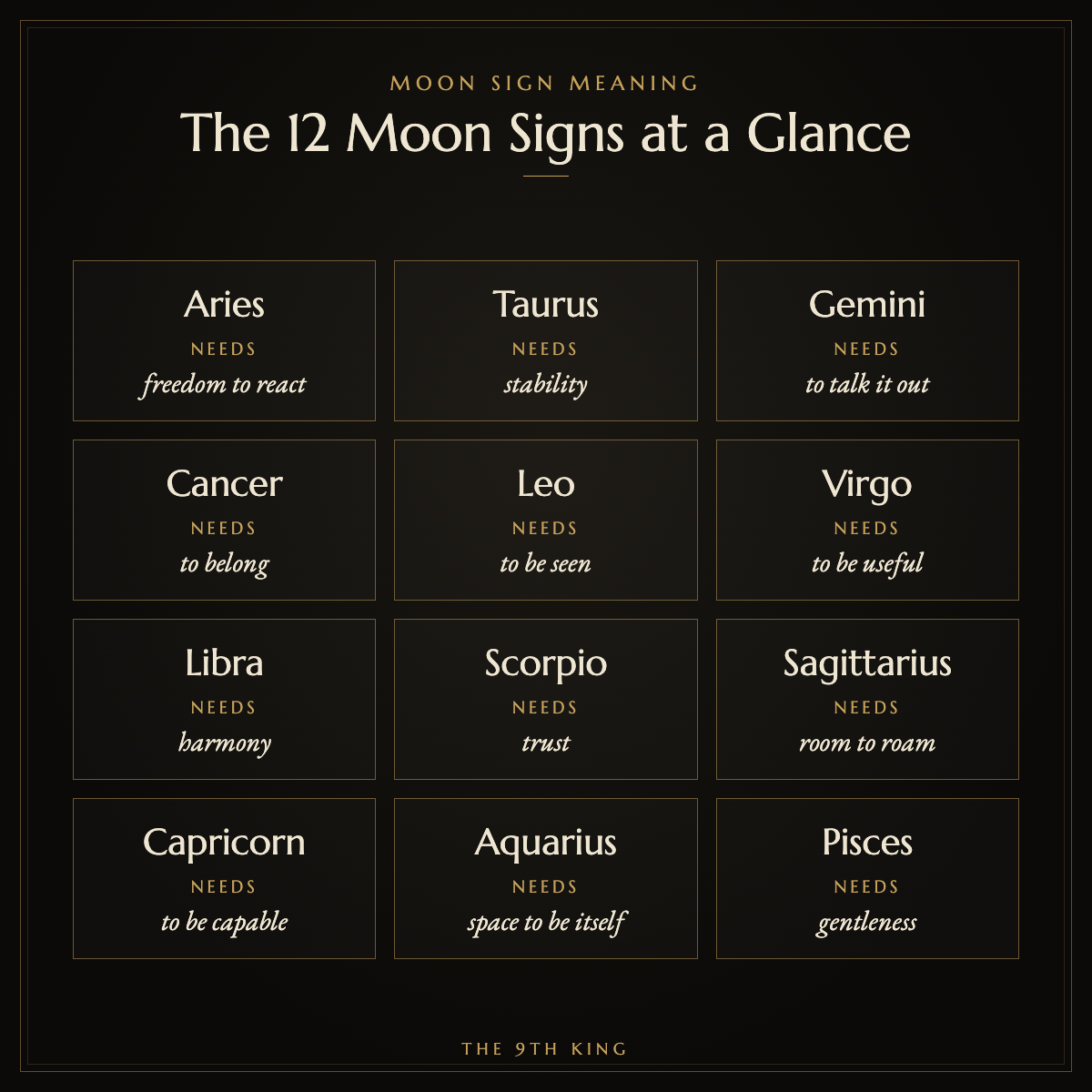
All 12 Moon signs: needs, comfort and stress
For each sign below you’ll find what that Moon needs, what comforts it, and how it tends to react under stress. Read these as hypotheses. Keep what fits and drop what doesn’t.
Moon in Aries
Needs: independence, action, and the freedom to respond honestly in the moment.
Comforted by: movement, a challenge, getting the feeling out rather than sitting with it.
Under stress: flares quickly, says the sharp thing, then is often over it before the other person is.
An Aries Moon tends to feel things fast and hot. The gift is courage and emotional honesty. The work is learning that other people’s feelings don’t run on the same clock.
Moon in Taurus
Needs: stability, physical comfort, and predictability.
Comforted by: good food, nature, touch, a familiar routine, a calm space.
Under stress: digs in, goes quiet, becomes stubborn about small things.
Traditional astrology calls the Moon “exalted” in Taurus, meaning it was seen as especially at ease here. A Taurus Moon is often steady and soothing to be around. The work is noticing when comfort becomes avoidance.
Moon in Gemini
Needs: mental stimulation, conversation, and variety.
Comforted by: talking it through, reading about it, a change of scene.
Under stress: overthinks, gets restless, jokes to avoid the heavier feeling.
A Gemini Moon understands its feelings by putting them into words. The gift is curiosity and lightness. The work is staying with a feeling long enough to feel it, not only explain it.
Moon in Cancer
Needs: emotional security, belonging, and a sense of home.
Comforted by: family (chosen or otherwise), nostalgia, caring for others, a safe nest.
Under stress: withdraws into its shell, gets moody, can become quietly defensive.
The Moon traditionally “rules” Cancer, so this is where it’s considered most at home. A Cancer Moon is deeply caring and remembers everything. The work is asking for care as easily as it gives it.
Moon in Leo
Needs: warmth, appreciation, and to feel seen.
Comforted by: affection, play, creativity, being celebrated by the people who matter.
Under stress: feels wounded by being overlooked, can turn dramatic or proudly cold.
A Leo Moon has a big, generous heart. The gift is loyalty and warmth that lights a room. The work is admitting the need for attention plainly instead of performing around it.
Moon in Virgo
Needs: order, usefulness, and to feel competent.
Comforted by: tidying, fixing, helping, making a list, small routines done well.
Under stress: worries, criticises (itself first), tries to control the details.
A Virgo Moon shows love through practical care. The gift is quiet devotion. The work is believing that it deserves care even when it isn’t being useful.
Moon in Libra
Needs: harmony, partnership, and fairness.
Comforted by: beauty, good company, a calm conversation, things being “right” between people.
Under stress: people-pleases, avoids conflict, struggles to know what it actually wants.
A Libra Moon is tuned to other people’s feelings. The gift is grace and diplomacy. The work is saying “I’m not okay with this” before resentment builds.
Moon in Scorpio
Needs: depth, trust, and emotional honesty.
Comforted by: privacy, one or two truly trusted people, understanding the real story.
Under stress: goes silent, tests loyalty, holds onto hurt.
Traditional astrology calls the Moon in Scorpio its “fall,” a placement where it was thought to be less at ease. In practice, a Scorpio Moon feels intensely and loyally. The gift is depth. The work is letting people in before they’ve passed every test. (Our Scorpio Season guide explores this sign’s themes further.)
Moon in Sagittarius
Needs: freedom, meaning, and room to explore.
Comforted by: travel, big ideas, laughter, open sky, a sense that life is going somewhere.
Under stress: gets restless, avoids heavy conversations, looks for the exit or the bright side too fast.
A Sagittarius Moon is optimistic and honest. The gift is hope. The work is staying present for the sad parts instead of turning them into a lesson right away.
Moon in Capricorn
Needs: structure, achievement, and self-reliance.
Comforted by: progress, a plan, responsibility handled well, quiet time alone.
Under stress: shuts feelings away, works harder, acts as if it doesn’t need anyone.
Traditional astrology calls Capricorn the Moon’s “detriment,” the sign opposite its home. A Capricorn Moon often learned early to be the capable one. The gift is resilience. The work is letting someone else carry something for a while.
Moon in Aquarius
Needs: independence, authenticity, and friendship.
Comforted by: space, ideas, community, being accepted as it is.
Under stress: detaches, intellectualises, becomes coolly distant.
An Aquarius Moon cares deeply about people in general and can find one-to-one intimacy harder. The gift is acceptance of others’ differences. The work is noticing the feeling under the detachment.
Moon in Pisces
Needs: compassion, imagination, and gentleness.
Comforted by: music, art, water, sleep, solitude, spiritual practice, quiet.
Under stress: absorbs other people’s moods, escapes, loses its own boundaries.
A Pisces Moon is deeply empathic. The gift is compassion without conditions. The work is telling the difference between its own feelings and everyone else’s.
The Moon in the houses: where your needs live
If you know your birth time, your Moon also falls in one of the twelve houses. The sign tells you how you feel. The house tells you where in life those needs show up most strongly.
- 1st house: feelings show on your face; you meet the world emotionally.
- 2nd house: security comes from money, possessions and stable values.
- 3rd house: you need to talk, write and stay connected to your local world.
- 4th house: home and family are central to feeling safe.
- 5th house: you need play, romance and creative expression.
- 6th house: routine, work and health habits steady your mood.
- 7th house: partnership is where your needs are most alive.
- 8th house: you need deep intimacy and can feel shared resources intensely.
- 9th house: you need meaning, travel, study or belief.
- 10th house: your feelings are tied to career and public standing.
- 11th house: friends and community are your emotional home.
- 12th house: you need solitude and may keep feelings hidden, even from yourself.
The full meaning of each house will be its own guide on The 9th King. For now, read your Moon’s house as the area of life where your emotional weather is most noticeable.
Your birth Moon phase
Your Moon sign is not the same as the Moon phase you were born under. The phase depends on the angle between the Sun and Moon at your birth, and it’s a separate layer some astrologers like to read.
The astrologer Dane Rudhyar popularised this idea in The Lunation Cycle (1967), linking each phase to a broad life attitude. In simple terms:
- New Moon: instinctive, beginning-oriented, acts before it fully knows why.
- Waxing (crescent to gibbous): building, striving, working things out.
- Full Moon: aware, relationship-focused, sees both sides.
- Waning (gibbous to balsamic): sharing, teaching, releasing, preparing for what’s next.
Most chart calculators will show your birth phase. Treat it as a light extra note, not a headline.
Moon signs in love and relationships
If you want to understand how you and a partner handle closeness, the Moon is often more useful than the Sun. Two people can share values and goals (Sun) and still clash over how to comfort each other (Moon).
Three practical questions to ask together:
- What do you need on a bad day? A fire Moon may want to go for a walk; a water Moon may want to be held; an earth Moon may want dinner sorted; an air Moon may want to talk.
- What does care look like to you? A Virgo Moon might show love by fixing your bike. A Leo Moon might want to hear it out loud. Neither is wrong.
- What do you do when you’re hurt? Knowing that your partner withdraws (Scorpio, Capricorn) or flares up (Aries) takes a lot of the sting out of it.
For broad sign pairings, Code of Ascension’s zodiac compatibility chart (Code of Ascension) is a useful reference. How the Moon and Venus work together in love will be its own guide on The 9th King. And if you and a partner keep repeating the same fight, our guide to fire and water signs shows how two different emotional styles can lock into a loop.
Two worked examples (fictional charts)
Example 1: Leo Sun, Capricorn Moon
On paper: warm, expressive and confident (Leo Sun), with an emotional core that’s private, self-reliant and achievement-focused (Capricorn Moon).
How it might show up: “People think I’m the life of the party, and I am. But when something’s really wrong, I don’t tell anyone. I handle it, quietly, and only mention it once it’s fixed.”
The useful question: Who do I let see me struggle, and what would happen if I let one more person in?
Example 2: Capricorn Sun, Pisces Moon in the 12th house
On paper: disciplined and ambitious in public (Capricorn Sun), with a soft, imaginative, highly sensitive inner life that needs a lot of solitude (Pisces Moon in the 12th).
How it might show up: “At work I’m organised and calm. At home I need hours of quiet, music and sleep, or I start to feel like I’m dissolving. I didn’t realise how much I needed that until I burned out.”
The useful question: Am I scheduling rest as seriously as I schedule work?
Both are hypotheses, not verdicts. The point is the question each reading raises.
Common mistakes with Moon signs
- Using your Sun sign for everything. If your horoscope never sounds like you, check your Moon.
- Guessing your Moon without a birth time when the Moon changed sign that day. Check the boundary first.
- Treating “difficult” Moons as bad. A Capricorn or Scorpio Moon isn’t cursed; it’s a different way of feeling.
- Using the Moon as an excuse. “I’m a Scorpio Moon, I don’t forgive” describes a tendency, not a rule you have to follow.
- Confusing your Moon sign with the current Moon. The Moon in today’s sky (a transit) affects everyone’s mood forecast; your Moon sign is fixed at birth.
- Forgetting the rest of the chart. Aspects to your Moon, especially from Saturn, Mars or Venus, can change how it expresses itself a lot.
Five journal prompts for your Moon sign
- Write your Moon sign’s “needs” line. Was that need met in your home growing up? How?
- What did you reach for the last time you felt overwhelmed? Does it match your Moon’s element?
- Who in your life comforts you in the way your Moon prefers? Who doesn’t, and do they know what you need?
- What does your Moon do under stress? When did that last happen, and what would the healthier version have looked like?
- If you know your Moon’s house, how much of your energy goes into that area of life? Is it giving back?
Moon Sign Meaning: FAQ
What is my Moon sign?
It’s the zodiac sign the Moon was in at the moment you were born. You can find it with a birth chart calculator using your birth date, time and place.
Is the Moon sign more important than the Sun sign?
Neither is more important. They describe different things. Many people find the Moon describes their private, emotional life more accurately than their Sun sign does.
Can I find my Moon sign without a birth time?
Often, yes. The Moon stays in a sign for about two and a half days. If it didn’t change sign on your birth date, you’ll get the same Moon whatever time you enter. If it did, you’ll need your birth time to be sure.
What does it mean if my Sun and Moon are in the same sign?
You were born near a New Moon. Astrologers often read this as a strong alignment between what you want and what you need, with less inner tension and sometimes less perspective.
What does it mean if my Sun and Moon are in opposite signs?
You were born near a Full Moon. This is often read as a pull between two sides of yourself that you spend life learning to balance.
Which Moon signs are considered “strongest”?
In traditional astrology, the Moon is considered most at home in Cancer (its rulership) and Taurus (its exaltation), and less at ease in Capricorn and Scorpio. Modern astrologers mostly read these as different styles, not better or worse.
Do Moon signs affect compatibility?
Many astrologers think so. Comparing two people’s Moons is often a good way to understand how each needs to be comforted and how each reacts to conflict.
Is my Moon sign the same as the Moon phase I was born in?
No. Your Moon sign is where the Moon was in the zodiac. Your Moon phase is the angle between the Sun and Moon. They’re separate layers.
Can my Moon sign change?
Your birth Moon doesn’t change. The Moon in the sky moves through every sign each month, and astrologers read those transits against your birth chart, but your natal Moon stays the same.
Is any of this scientifically proven?
No. There’s no evidence that Moon signs determine emotional temperament. On The 9th King, astrology is a symbolic language for self-reflection, not established science.
Explore Next
- Start with the wheel: How to Read a Birth Chart
- The basics of your Big Three: Sun, Moon and Rising (Code of Ascension)
- How your Rising sign shapes first impressions: Rising Sign Meaning (Code of Ascension)
- Emotional styles in conflict: Fire and Water Signs
- Where it all happens: The 12 Houses Explained
- Comparing two charts: Synastry for Beginners
- What you need vs what you want: Moon vs Venus
- Coming soon on The 9th King: Don’t Know Your Birth Time?
- Going deeper: Dane Rudhyar, The Lunation Cycle (1967)
Final Thought: Know What You Need
Most of us were taught to think about what we want. Far fewer were taught to ask what we need. Your Moon sign is a prompt to ask that question honestly, and to stop being surprised by the same reactions on the same kind of bad day. Know what soothes you. Then give it to yourself on purpose.
About the Author
King is the founder of The 9th King, where zodiac psychology, relationships and shadow work are explored as tools for self-knowledge rather than fortune-telling. Astrology on The 9th King is interpretation and self-reflection, not prediction or established fact.