

Quick Answer: What Does the Five of Swords Mean?
The Five of Swords (also written 5 of Swords) is a Minor Arcana card from the suit of Swords. It shows one figure gathering swords while two others walk away, with two more swords left on the ground. Readers often take it as the card of the hollow win: a conflict has ended, but nobody walks off the field whole.
- Keywords: conflict, aftermath, winning at a cost, pride, defeat, tension, the urge to be right.
- Upright, in one line: a prompt to notice the cost of a recent clash, if winning it, or losing it, is still taking up space in you.
- Reversed, in one line: a prompt to ask whether you’re ready to set the fight down, or whether an old grudge is still running the show.
On The 9th King, tarot is a mirror for self-knowledge, not fortune-telling. The Five of Swords doesn’t say a fight is coming, and it can’t tell you who is to blame in one that already happened. It asks you to look honestly at how you handle conflict, and what you’re willing to pay to come out on top.
Table of Contents

The Five of Swords at a glance
| Five of Swords | |
|---|---|
| Arcana | Minor Arcana, a pip (number) card |
| Suit and element | Swords, linked with air |
| Number | Five, the middle of the suit |
| Golden Dawn title | The Lord of Defeat |
| Astrology (Golden Dawn) | Venus in Aquarius |
| Upright | Conflict, aftermath, a costly win |
| Reversed | Letting go, or holding a grudge |
| Key question | What did being right cost? |
What the Five of Swords looks like
Most people meet this card through the Rider–Waite–Smith deck, first published in London by William Rider & Son in 1909. A.E. Waite wrote the instructions and Pamela Colman Smith drew the art, and both were members of the Hermetic Order of the Golden Dawn (Wikipedia: Rider–Waite Tarot).
The figure holding three swords
In the foreground stands a man Waite calls disdainful. He carries two swords on his left shoulder and holds a third in his right hand, its point turned down to the earth. Waite sums him up in one line: “He is the master in possession of the field” (sacred-texts.com: Waite, Five of Swords). He has won something; the card leaves open what it was worth.
The two figures walking away
Behind him, two figures are leaving. Waite describes them as retreating and dejected, and he notes that the man is watching them go. They aren’t fighting back. Whatever the contest was, for them it’s over.
The two swords on the ground
Waite says the swords of the departing pair lie on the ground. Count them all and you get the card’s five: three with the man, two left behind. Those two dropped swords are easy to miss, and on The 9th King they carry a lot of the card’s meaning: something set down, given up or abandoned in the fight.
The sky
On the 1909 Smith card, the sky is full of broken, jagged clouds, which Wikipedia’s summary reads as lingering tension after the conflict (Wikipedia: Five of Swords). The clouds aren’t in Waite’s text. Apart from the man, his three swords, the two departing figures and their two swords on the ground, Waite describes no other details of the scene.
Five of Swords meaning (upright)
Waite’s divinatory meanings for this card are some of the harshest in the deck: degradation, destruction, revocation, infamy, dishonour and loss (sacred-texts.com: Waite, Five of Swords). The Golden Dawn’s teaching text, Book T, as printed in Liber LXXVIII, opens its own meaning for the card with “Contest finished and decided against the person,” then lists failure, defeat, anxiety and trouble (Liber LXXVIII, sacred-texts.com).
Those older lists read like a verdict. On The 9th King, the upright meaning has three layers instead.
A contest that has ended
The card can point to an argument, a rivalry or a power struggle that has reached its end. What remains is the aftermath: who’s leaving, who’s holding what, and what got left on the ground. Ask yourself: Which fight in my life is technically over but still replaying in my head?
Winning at a cost
The man in the foreground has the swords, but look at the scene around him. He’s alone. Readers often take the upright Five as a hollow victory: you got the outcome, the last word or the point, and lost something you didn’t plan to give up, like trust, goodwill, sleep or your own sense of fairness.
Losing and walking away
The card isn’t only about the winner. If you see yourself in the departing figures, the upright Five can point to a defeat you’re still carrying. Ask yourself: Did I leave because I lost, or because staying would have cost more?
Five of Swords reversed
Readers handle reversals differently: some read the opposite meaning, some the same energy blocked, and some skip reversals entirely. Waite’s reversed meaning for this card is short and grim: much the same as upright, plus burial and obsequies (sacred-texts.com: Waite, Five of Swords). On The 9th King we read that symbolically, as the end of a conflict being laid to rest, not as anything literal. Wikipedia’s summary of common modern readings includes both reconciliation and lingering resentment (Wikipedia: Five of Swords).
On The 9th King, the Five of Swords reversed usually points to one of three patterns, offered as questions, not predictions.
Ready to put the swords down
The reversed card can point to a turning point: you’re tired of the fight and open to repair, or simply to peace inside yourself. That doesn’t require the other person to agree. Ask yourself: What would it look like to stop carrying this, whether or not anything changes between us?
The grudge that keeps the field open
The reversal can also point to a conflict that never really ended for you. You rehearse old arguments, keep score or bring up the same point in new fights. Ask yourself: What am I still trying to win, and who would I be if I stopped trying?
Regret after a win
Sometimes the reversed Five shows up after you got what you wanted and it felt worse than expected. That discomfort doesn’t mean you were wrong about the facts. It may mean you’d handle the how differently next time.
| Pattern | Upright tone | Reversed tone |
|---|---|---|
| The fight | Just ended | Laid to rest, or still open |
| The win | Gained, but hollow | Regretted or released |
| The loss | Fresh, carried | Healing, or held as a grudge |
| The swords | Gathered up | Set down, or picked up again |
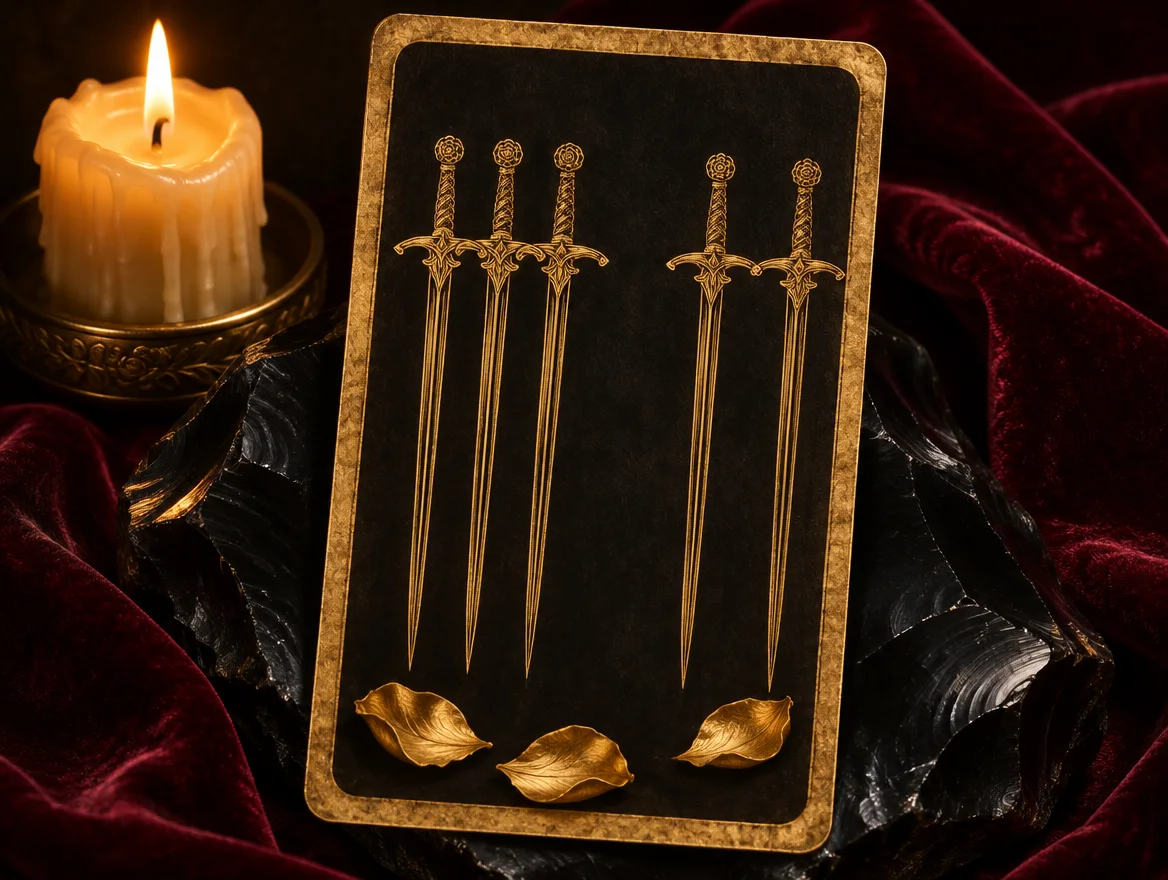
Five of Swords astrology: Venus in Aquarius
The 9th King uses Golden Dawn–derived correspondences, the tradition the Rider–Waite–Smith deck draws on. Other schools of tarot and astrology use different systems, and not every card maps to a single sign: the Aces, court cards and Pages, for example, are handled differently. What follows is one traditional framework, offered as symbolism.
How the number cards get their planets
In the Golden Dawn system, the 36 small cards (the Twos through Tens of the four suits) are matched to the 36 decans of the zodiac. A decan is a ten-degree third of a sign, and each one is given a ruling planet. Liber LXXVIII prints the Five of Swords as “The Lord of Defeat” and lists its decan as Venus in Aquarius (Liber LXXVIII, sacred-texts.com). In the same table, the Five, Six and Seven of Swords are listed in order as the three Aquarius decans, ruled by Venus, Mercury and the Moon, which places the Five first. The Five of Swords doesn’t make this “the Aquarius card”: the other two Aquarius decans belong to the Six and Seven of Swords.
Book T also assigns the Five of Swords to Geburah on the Kabbalistic Tree of Life, the sphere it gives to all four Fives, and glosses the card there as defeat, loss, malice and spite. In the same text, Swords are the suit of air.
What Venus brings
Venus is the planet of love, beauty, pleasure and what we value. It rules Taurus and Libra; our Libra Traits and Taurus Personality Traits pages show its two moods. Our Moon vs Venus guide explains how Venus describes what you’re drawn to and how you relate. On a card about conflict, Venus is the part of you that wants harmony and connection, and that feels it when they break.
What Aquarius brings
Aquarius is fixed air: the sign of ideas, principles, independence and the group. Our Aquarius Personality Traits page covers its clear thinking and its shadow, including the pull to stay detached and be right. On this card, Aquarius is the mind that holds a position on principle, and can hold it a little too long.
The tension in the pairing
Venus wants closeness. Aquarius wants to be free and to stand by its ideas. The Five of Swords sits in that gap: the moment when being right on principle starts to cost you warmth. Book T’s portrait of the card even describes a quick, clever mind whose feelings of pity rise easily but don’t last. On The 9th King, we read that as a pattern to notice in yourself, a sharp mind outrunning a soft heart, not a label for anyone else.
The 9K reading: the cost of being right
The card’s tension
The Five of Swords holds two true things at once: I needed to stand up for something and the way it went left damage. Most people try to pick one. They either defend every move they made, or they decide they should never have spoken up. The card asks you to hold both. A position can be right and the fight can still cost too much.
The shadow side
The shadow of the Five of Swords is winning as a way to feel safe. It’s the voice that says if I lose this point, I lose myself, and turns every disagreement into a contest. In yourself it can look like:
- Scorekeeping. Remembering every point you won and every time you were wronged.
- Arguing past the point. Continuing after the issue is settled, because you want the other person to admit it.
- Collecting swords. Holding onto old arguments as proof, ready to use them again.
- Expecting the old fight. Expecting attack from people who remind you of past opponents. Sometimes this overlaps with psychological projection, though often it’s simply an old expectation carried forward.
These patterns usually began as a real need to be heard or safe. Do they still serve you?
Three places on the field
You can stand in more than one of these positions over time. None is a verdict on who you are, and the card can’t tell you what anyone else intended.
| Position | What it can point to | A question to ask |
|---|---|---|
| Holding the swords | You came out ahead | What did winning cost? |
| Walking away | You lost or chose to leave | What am I still carrying? |
| The dropped swords | What got set down | Do I want it back? |

Walking away is sometimes the strongest move available. If someone is threatening, controlling or hurting you, leaving the field is a boundary, not a defeat, and the responsibility for that harm belongs to the person who caused it. Lean on people and services you trust.
The self-mastery lesson
The lesson of the Five of Swords is to choose your battles and your methods. Self-mastery here isn’t avoiding all conflict. Some conflicts are worth having. It’s knowing what you’re fighting for, how far you’ll go and what you won’t trade to win. A useful test: Is this about the issue, or about winning?
Our Ace of Swords page shows the suit’s starting point: one clear sword of truth. The Five shows what happens when that clarity turns into a contest.
Five of Swords as feelings, in love and at work
Five of Swords as feelings
When someone asks “how does this person feel?” and draws the Five of Swords, readers often take it as tension or unresolved conflict: hurt pride, defensiveness or the sense of having lost or won something that mattered. A card can’t tell you what another person actually feels or intends. Their words and behavior are better evidence than any draw. If the card is about your own feelings, ask: Am I still angry about the issue, or about how it was handled?
Five of Swords love meaning
In a love reading, the upright card can point to an argument that left both people bruised, or to a pattern where one person usually ends up with the last word. The reversed card can point to a wish to make peace, or to resentment that keeps reopening old fights.
Tarot can’t tell you whether to stay or leave, and this page won’t either. If you don’t feel safe, your safety comes first. Otherwise, the card can help you look at how you fight. Useful questions:
- Do we argue to understand each other, or to win?
- What do I do after an argument: repair, withdraw or rehearse it?
Five of Swords at work
At work, readers often take the card as office politics, a competition that got personal or a decision that went against you. The shadow version is winning the meeting and losing the team. This is reflection, not career or financial advice. Ask yourself: Is there a way to stand by my point that doesn’t burn the bridge?
Practical exercise: closing the field
You need about twenty minutes and a notebook. Pick a conflict that has ended, or mostly ended, and that you still think about.

Step 1: Name the contest
Write one sentence: What was this conflict really about? The surface issue often sits on top of a deeper one, like respect or feeling heard.
Step 2: Count the cost
List what the conflict took from you: time, sleep, trust, focus, a friendship, your peace. No scores or percentages, just an honest list.
Step 3: Find your place
Using the three positions above, write where you stood: holding the swords, walking away or among the dropped swords. You may have been in more than one.
Step 4: Own your part
Write down only your own words and choices. What would you keep? What would you do differently? Leave other people’s behavior on their side of the page. If someone harmed or threatened you, that is theirs to own, not yours.
Step 5: Choose a move
Pick one, and only if it’s safe and useful: reach out to repair, set or keep a boundary, or simply release the fight inside yourself. Contact is a choice, not a requirement. Many conflicts close without another conversation.
Step 6: Close the field
Finish with one sentence: What I’m done carrying from this is… If it helps, fold the page and put it away.
A worked example (fictional)
Marcus (fictional) won a long argument with his sister about how to plan their mother’s birthday. His plan went ahead, but she barely spoke at the party. He draws the Five of Swords upright and recognizes the scene.
In the exercise, he names the contest as “who gets to decide for the family.” The cost: two tense weeks and a cold party. His place: holding the swords. His part: he’d keep his idea but drop the sarcastic texts. His move: he sends a short message saying he’s sorry about how he argued, without taking back the plan. He doesn’t know how she’ll respond, and that’s fine. His closing line: “I’m done needing to win this one.”
Journal prompts for the Five of Swords
- Which fight is over on paper but still running in my mind?
- When I win an argument, what do I usually feel ten minutes later?
- What have I set down in a conflict, like a value, a friendship or my calm, that I want back?
- Where do I keep score, and what would happen if I stopped?
- How do I want to fight, so that I can respect myself afterward?
For more prompts like these, our shadow work prompts collection goes deeper, and Shadow Work, Plainly explains how to start safely.
A warm note: this is reflective practice, not therapy. If a conflict involves abuse or trauma, or if you’re dealing with thoughts of self-harm or distress that feels overwhelming, please work with a qualified therapist who can walk with you. It’s always fine to stop a prompt that feels like too much.
Myths and misreadings of the Five of Swords
- “The Five of Swords means someone is going to betray you.” No. On The 9th King, tarot doesn’t predict events or reveal other people’s motives. The card reflects how you’re handling conflict.
- “It proves someone in your life is the villain.” A card can’t establish that about anyone. Look at actual behavior and how you’re treated, not at a draw.
- “Walking away means you lost.” Sometimes it means you chose not to pay a price that was too high, or that you protected yourself.
- “Venus in Aquarius means this card is about Aquarius people.” No. The correspondence describes the card’s symbolism in the Golden Dawn tradition. Anyone can draw it, whatever their sign.

Five of Swords: FAQ
What does the Five of Swords mean?
The Five of Swords is a Minor Arcana card in the suit of Swords. It shows one figure gathering swords while two others walk away, leaving two swords on the ground. Readers often take it as conflict, its aftermath and the hollow win: getting the outcome but losing something along the way. On The 9th King, it’s a mirror for how you handle conflict, not a prediction that a fight is coming.
What does the Five of Swords reversed mean?
Reversed, the Five of Swords is often read in two directions. It can point to readiness to put a conflict down and make peace, at least inside yourself. Or it can point to a grudge that keeps an old fight open. Some readers don’t use reversals at all. Treat it as a question, such as “what am I still trying to win?”, rather than as a sign of what’s ahead.
What does the Five of Swords mean as feelings?
As feelings, readers often take the Five of Swords as tension, hurt pride or unresolved conflict. It can’t tell you what another person really feels or intends; their words and actions are better evidence. If the card is about your own feelings, it can prompt you to ask whether you’re upset about the issue itself or about the way the conflict was handled.
What does the Five of Swords mean in love?
In love, the upright card can point to an argument that left both people hurt, or a pattern where one person usually wins. Reversed, it can point to a wish to make peace or to old resentment resurfacing. The card doesn’t tell you to stay or leave. It invites you to look at how you fight, and whether your arguments aim at understanding or at winning.
What zodiac sign is the Five of Swords?
In the Golden Dawn system, the tradition The 9th King uses, the Five of Swords corresponds to Venus in Aquarius, the first of the three Aquarius decans. Liber LXXVIII, which prints the Golden Dawn’s Book T, calls the card the Lord of Defeat. Other schools use different correspondences, so treat this as one traditional framework for symbolism, not a fixed rule.
Is the Five of Swords a yes or no card?
The 9th King doesn’t do yes or no readings, because tarot here is a tool for self-reflection, not fortune-telling. Instead of asking whether the card says yes, ask what it shows you about the situation: where a conflict stands, what it has cost and whether winning is still the thing that matters most to you.
Is the Five of Swords a good or bad card?
Neither, on The 9th King. Waite gave it some of the harshest meanings in the deck, and Book T names it the Lord of Defeat. But the card describes a common human moment: the time just after a conflict. Read it as a mirror for how you fight and what you’re willing to pay to win, not as a good or bad omen.

Your next step: try the closing-the-field exercise for one conflict you’re still carrying this week. Then read our Aquarius Personality Traits guide: Aquarius is the sign the Golden Dawn tied to this card’s decan, and its pull toward principle and being right can help you notice your own.
Explore Next
- The sign behind the decan: Aquarius Personality Traits
- How Venus shows up in you: Moon vs Venus
- Noticing what you might be putting onto others: Psychological Projection
- Go deeper with questions: Shadow Work Prompts
- Reading by feel: Intuitive Tarot (Code of Ascension)
- New to the cards: Tarot for Beginners: How Tarot Really Works (Code of Ascension)
- More Swords on The 9th King: Ace of Swords · Queen of Swords · King of Swords · Minor Arcana · Tarot & the Zodiac
- More cards in this set: Six of Swords, Seven of Swords and Five of Wands
Final Thought: Put Down What You Don’t Need to Carry
The man in the Five of Swords has the swords and the field, and he’s standing there alone. The card doesn’t ask you to stop standing up for yourself. It asks you to notice what each fight costs, to own your part and to set down the swords you no longer need. Choose your battles, choose your methods, and let the finished ones end. Know your nature. Rule your life.
About the Author
King is the founder of The 9th King, where zodiac psychology, relationships and shadow work are explored as tools for self-knowledge rather than fortune-telling. He’s a Libra Sun, and writes about the personal side of astrology on King The Kemist. Astrology on The 9th King is interpretation and self-reflection, not prediction or established fact.
Leave a Reply