Quick Answer: What Does The Moon Tarot Card Mean?
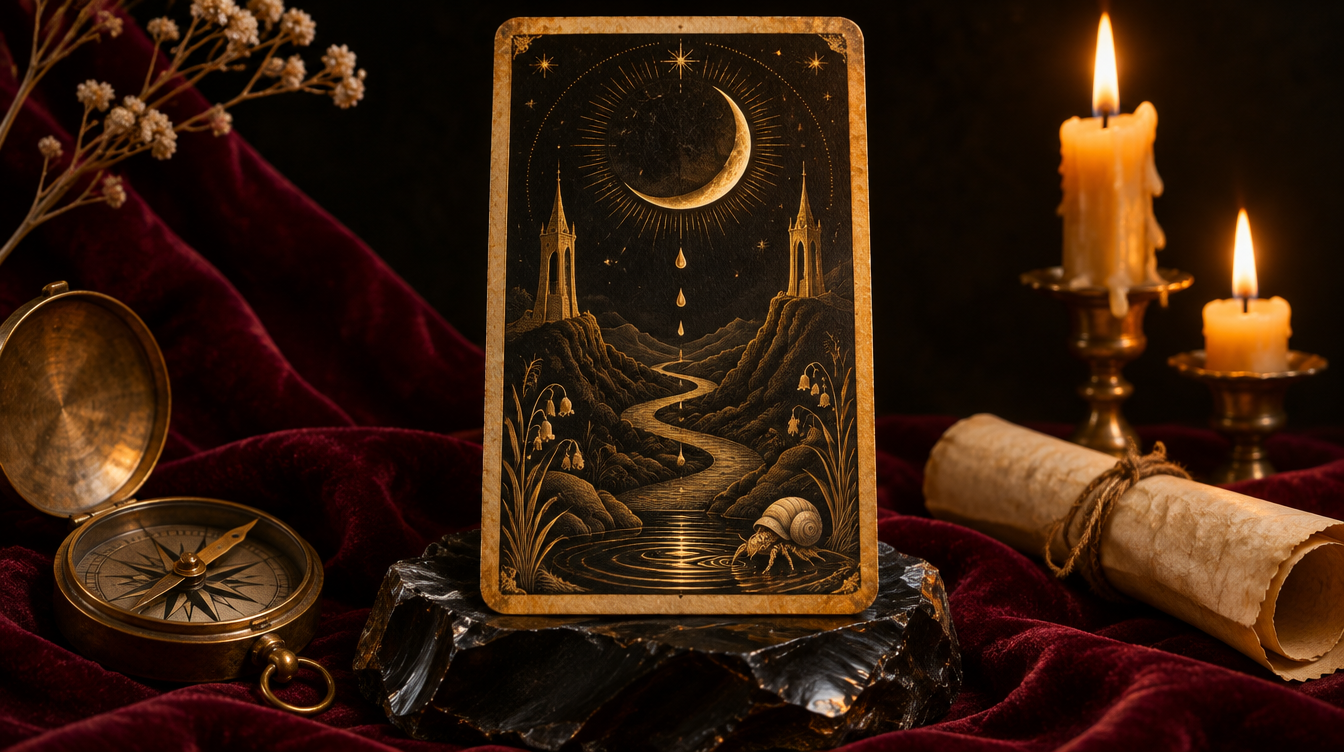
The Moon is card XVIII (18) of the Major Arcana. It shows a night road between two towers, a dog and a wolf howling at the Moon, and a small creature crawling out of a pool. It’s the card of half-light: enough to walk by, not enough to be certain.
Keywords: uncertainty, intuition, imagination, dreams, fear, illusion, the unconscious.
- Upright, in one line: you’re in unclear territory, and the card can point to trusting your inner sense while staying honest about what you actually know.
- Reversed, in one line: readers often take it as confusion starting to lift, or as fear and projection getting louder than the facts.
- Astrology link: in the Golden Dawn–derived correspondences The 9th King uses, The Moon is paired with Pisces.
On The 9th King, tarot is a mirror for self-knowledge, not fortune-telling. The Moon doesn’t predict deception or danger. It asks a better question: in this fog, what do I actually know, and what am I adding?
Table of Contents

The Moon tarot card at a glance
| The Moon | |
|---|---|
| Number | XVIII (18), Major Arcana |
| Core theme | Uncertainty and the unconscious |
| Upright | Intuition, dreams, not knowing yet |
| Reversed | Clarity returning, or fear taking over |
| Correspondence (Golden Dawn–derived) | Pisces |
| Element of Pisces | Water (mutable) |
| 9K tension | Intuition vs projection |
| Key question | What do I know, and what am I assuming? |
Below: the imagery, the common meanings, why Pisces, then the 9K reading and one exercise.
What’s on the card: The Moon tarot symbolism, piece by piece
Most modern decks follow the Rider–Waite–Smith design, drawn by Pamela Colman Smith to A. E. Waite’s instructions and first published by William Rider & Son in 1909 (Wikipedia: Rider–Waite Tarot). Waite explained the symbols himself in The Pictorial Key to the Tarot, now in the public domain (sacred-texts.com: Waite, The Moon).
The Moon itself
A large Moon hangs at the top of the card, with a face and many rays; Waite counts sixteen chief rays and sixteen secondary ones. He notes it is waxing, growing, on what he calls the side of mercy. He also records that older decks drew it differently: waning on some eighteenth-century cards, full in Etteilla’s edition (sacred-texts.com: Waite, Part I, The Trumps Major). A growing Moon is a useful detail. The light is partial, but it’s increasing.
Waite’s own summary of the card is that it represents “life of the imagination apart from life of the spirit.” In plainer terms: this is the realm of images, dreams, moods and impressions, before they’ve been tested against anything solid.
The falling drops
Drops fall from the Moon toward the land. Waite describes the Moon shedding fertilizing dew in great drops, and in his longer reading he calls it the dew of thought. Readers often take them as quiet night-time nourishment: ideas and hunches you didn’t plan.
The dog and the wolf
Two animals howl at the sky, one tame, one wild. Waite notes that some decks show two dogs, others a wolf and a dog, and he reads them as the fears of the natural mind facing the unknown by reflected light. Put simply: the dog is your trained, social self, the wolf your instinct. In the dark, both get loud.
The pool and the crayfish
In the foreground is water, and a crayfish crawls out of it toward the land. Waite describes this creature as something from the deep that tries to emerge and usually sinks back. It’s the clearest picture of the unconscious on any card: something old and half-formed coming to the surface, slowly.
The two towers and the path
Two towers stand on either side of a path that winds away toward the horizon. Waite calls the path the way out into the unknown. You can’t see where it ends. You can only see the next stretch, and that’s the whole point of the card.

The Moon tarot meaning: upright and reversed
Below are the meanings tarot readers commonly use, followed by the older divinatory list Waite printed. The 9K interpretation comes after.
The Moon upright
Upright, readers usually take The Moon as a sign that you’re in uncertain territory. Information is missing, feelings are strong, and the situation looks different depending on your mood. Common upright themes:
- Intuition: a gut sense that’s worth listening to, even before you can explain it.
- Dreams and imagination: vivid inner images, creative ideas, symbolic thinking.
- Not knowing yet: a stretch of road where certainty simply isn’t available.
- Fear and anxiety: worries that grow in the dark because nothing contradicts them.
- Illusion: seeing what you expect rather than what’s there.
The useful upright message isn’t “something is wrong.” It’s “walk carefully and check your assumptions.”
The Moon reversed
Reversed, readers tend to go one of two ways, and the surrounding cards and your own situation usually decide which fits:
- The fog is lifting. Something hidden becomes clearer, a fear loses its grip, or you finally name what was bothering you.
- The fog is thickening. Anxiety or confusion is getting louder than the evidence, and you may be projecting your own fears onto people or situations.
What Waite’s 1911 list said
Waite’s divinatory list for The Moon was blunt. Upright, he gave words like hidden enemies, danger, deception, darkness and error. Reversed, he gave instability, inconstancy, silence and lesser deception (sacred-texts.com: Waite, Divinatory Meanings).
That’s the language of old fortune-telling. Britannica dates the adaptation of tarot to fortune-telling to France around 1780; the cards began as an Italian card game in the 1430s (Britannica: Tarot). On The 9th King we read the old list differently. “Hidden enemies” becomes what am I not seeing yet? “Deception” becomes where might I be fooling myself? Same card, turned from a warning into a question.

| Position | Common reading | Question to ask |
|---|---|---|
| Upright | Uncertainty, intuition, dreams | What do I actually know? |
| Reversed (clearing) | Confusion lifting, fear named | What just became clear? |
| Reversed (thickening) | Fear outrunning the facts | What story am I adding? |
The Moon and Pisces: the Golden Dawn correspondence
Why Pisces?
The astrology links used on The 9th King are Golden Dawn–derived correspondences, the tradition The 9th King uses. The Hermetic Order of the Golden Dawn was an occult society, and both Waite and Pamela Colman Smith were members. Their deck reflects that background (Wikipedia: Rider–Waite Tarot).
In that system, The Moon is attributed to Pisces. The World of Playing Cards notes this plainly in its survey of tarot attributions, and also observes that the Pisces link misses the card’s obvious lunar symbolism (WOPC: Attributes of the Egyptian Tarot). The Golden Dawn’s Book T, as printed by Aleister Crowley in Liber LXXVIII, lists The Moon with Pisces and gives it the title The Ruler of Flux and Reflux, a fitting name for the tides (Liber LXXVIII, sacred-texts.com). Bill Heidrick’s table of Golden Dawn correspondences pairs the card with Pisces too, through the Hebrew letter Qof (billheidrick.com: Magical Correspondences). WOPC’s objection is a fair point, and worth knowing: the card is named after the Moon, but its sign in this tradition is Pisces, not the Moon as a planet.
Other schools differ
Other traditions use different attributions, and not every card maps to a single sign (court cards work on a different scheme). The Pisces pairing is a symbolic lens, not a law. If another system suits you, use it consistently.
What Pisces adds to the card
Pisces is the mutable water sign, the last of the zodiac. In astrology it’s associated with imagination, empathy, dreams, blurred boundaries and a sense of the unseen. Read The Moon through that lens and the card’s themes line up: the dissolving edges of night, feelings that soak into everything, and the risk of losing the line between what you sense and what you fear. Our Pisces traits guide covers the sign in depth, including its shadow side.
The Moon card vs your Moon sign
These are two different tools that share a name. Your Moon sign describes your emotional needs; the Moon card is a symbol for uncertainty and the unconscious. If the card keeps appearing, it’s a good prompt to revisit your Moon sign and ask what you need to feel safe when things are unclear.
The 9K reading: intuition or projection?
The tension: sensing vs supposing
The Moon’s core tension is between intuition and projection. Both can feel the same from the inside. Both arrive fast, carry strong emotion and seem obviously true.
- Intuition is pattern recognition you can’t fully explain yet. Sometimes it’s right, sometimes it isn’t.
- Projection is your own fear, wish or old hurt placed onto someone or something else.
Here’s the honest part: how a feeling feels doesn’t tell you which one it is. A calm hunch can be wrong, and an urgent one can be right. Our guide to psychological projection explains the idea in full. The short version: when the light is low, the mind fills the gaps with what it already carries. So instead of judging the feeling by its tone, check it against what you can see.

| Question | What it does |
|---|---|
| What do I actually know? | Separates facts from mood |
| What am I assuming? | Names the gaps you’ve filled |
| What would change my mind? | Shows what evidence matters |
| What does someone I trust see? | Adds an outside view |
| Can I check before acting? | Turns a hunch into a test |
The shadow side: when fear writes the story
The shadow of The Moon is letting fear do the narrating. It shows up in a few familiar ways:
- The midnight spiral. A small unknown at 11 pm becomes a disaster by 2 am, with no new facts added.
- Mind-reading. Deciding what someone else thinks or intends, then reacting to your version of them.
- Treating any feeling as proof. Calling every worry a psychic warning, or every calm hunch a sure thing, which makes neither open to checking.
- Hiding in the fog. Staying vague on purpose, because clarity would mean having to choose.
The self-mastery lesson: walk the next stretch
The self-mastery lesson of The Moon is simple to say and hard to do: you don’t need to see the whole road to take the next honest step.
The path between the towers winds out of sight, but it is a path. Self-mastery here means three things:
- Name what you know separately from what you feel.
- Let the feeling speak without letting it decide.
- Take one small step that would make sense whether your fear is right or wrong.
What the crayfish teaches
The crayfish crawling from the pool is the card’s most hopeful detail. Deep material surfaces partway, retreats and returns. You don’t have to drag it out; you only have to stop pushing it back down. If that’s the work you’re in, Shadow Work, Plainly is a gentle place to start.
The Moon tarot card in love, work and self-growth
These are reflections, not predictions. The Moon points at what’s unclear and what you might be adding to it.
The Moon in love
In love readings, The Moon often points to uncertainty in a connection: mixed signals, unspoken feelings, or a stage where you don’t yet know where you stand. It can also point to your own fears coloring the picture, especially old hurts from past relationships.
Questions worth asking:
- What do I actually know about how this person feels, from what they’ve said and done?
- What am I filling in, and does that story come from them or from my past?
- What would I ask if I weren’t afraid of the answer?
The Moon doesn’t tell you to stay or leave. It asks you to get clearer first, often with a direct, kind question in daylight. If the pattern you’re seeing is about someone who keeps things vague, our guide to privacy without mixed signals may help you tell healthy privacy from avoidance.
The Moon at work
At work, The Moon can point to unclear information: shifting plans, vague instructions, rumors filling a silence. It can also point to imaginative strengths, anything that needs you to see what isn’t there yet.
A grounded approach when The Moon shows up around work:
- Write down what’s confirmed, in one column, and what’s assumed, in another.
- Ask one clarifying question of the person who actually knows.
- Don’t make a big, irreversible decision from a 2 am feeling.
Nothing here is career or financial advice. For money or contract decisions, talk to a qualified professional.
The Moon in self-growth
For personal growth, The Moon is about befriending the dark. Not every unknown is a threat, and some of your best ideas come from the part of you that only speaks when it’s quiet. The growth is listening to it without handing it the wheel.
A practical exercise: the Two-Column Night Walk
This takes about 15 minutes and works with or without a deck, any time you feel stuck in uncertainty. You need paper, a pen and, if you like, The Moon card in front of you (pull it on purpose; no random draw needed).
The steps
- Name the fog. At the top of the page, write the situation in one sentence. “I don’t know if my friend is upset with me.”
- Draw two columns. Label the left one “What I know” and the right one “What I’m adding.”
- Fill the left column with facts only. Things you saw, heard or read. No interpretations. “She hasn’t replied in three days.” “Her last message was short.”
- Fill the right column with everything else. Every guess, fear and story. “She’s angry about what I said.” “She’s pulling away like everyone does.”
- Circle anything in the right column that sounds like an old story you’ve told before about other people. It may or may not fit this time; check it.
- For each guess, ask what would change your mind and whether you can check it, or ask someone you trust, before you act.
- Choose one next step that would be wise whether your fears are right or wrong. Write it at the bottom.
Worked example (fictional)
Dana (fictional) has been waiting two weeks to hear back after a job interview. Her left column is short: the recruiter said “a few weeks,” and it’s been two. Her right column is long: the interview went well (her impression), they hated her, someone else got it, she always blows interviews.
When she circles the old stories, “I always blow interviews” stands out. It’s a line she’s carried since a rough first job, not a fact about this company. She also has a hunch: the hiring manager seemed rushed and distracted. What would change her mind? An update from the recruiter. Can she check? Yes, by asking.
Her next step, wise in either version: one short, polite follow-up email, then energy into another application. She moves forward without letting the fog decide.
Using the exercise in a reading
If The Moon comes up in a spread, do the Two-Column Night Walk for the question you asked. For a simple structure, Code of Ascension’s guide to how tarot really works for beginners (Code of Ascension) covers the basics of laying out and reading a spread.
Journal prompts for The Moon
Use one prompt per session. Write for ten minutes, then read it back the next morning, in daylight.
- Where in my life am I walking without being able to see the end of the road?
- What fear keeps returning when I’m tired or alone, and how old is it?
- When has a hunch of mine turned out right, and what evidence confirmed it?
- When has a strong feeling turned out wrong? What did I assume that I could have checked?
- Whose intentions am I guessing at right now, and what would it take to simply ask?
- What’s trying to surface from my deep water, and what do I do to push it back down?
- What’s one step I could take this week that makes sense whether my fear is right or wrong?
For more prompts on fear, projection and the hidden self, see our full list of shadow work prompts, and our zodiac shadow work guide if you want to explore the Pisces shadow specifically.
A gentle note: this is reflective practice, not therapy. If you’re dealing with trauma, abuse, thoughts of self-harm or distress that feels overwhelming, please work with a qualified therapist who can support you properly. And it’s always fine to stop a prompt that feels like too much.
Myths and misreadings about The Moon
- “The Moon means someone is lying to you.” It can point to unclear information, but it doesn’t accuse anyone. Often the illusion it points to is your own assumption.
- “The Moon is a bad card.” No card is bad on The 9th King. The Moon describes a stage of not knowing that every real change passes through.
- “You can tell intuition from fear by how it feels.” Calm feelings can be wrong and urgent ones right. The Moon asks you to check a feeling against evidence, not judge it by its tone.
- “The Moon reversed always means the truth comes out.” That’s one reading. Another is that fear is getting louder. Context and honesty decide which fits.
- “The Moon card is about the planet Moon.” In the Golden Dawn–derived system, its correspondence is the sign Pisces. The name and the lunar imagery are a separate layer.

The Moon Tarot Card: FAQ
What does The Moon tarot card mean?
The Moon tarot card, Major Arcana XVIII, is commonly read as uncertainty, intuition, dreams, illusion and the unconscious. It shows a night road between two towers with a dog and a wolf howling at the sky. On The 9th King it’s read as a mirror, not a prediction: it asks you to separate what you actually know from what fear or imagination is adding, and to take the next honest step anyway.
What does The Moon reversed mean?
Readers usually take The Moon reversed in one of two ways. Either confusion is lifting, a fear has been named or something hidden is becoming clearer, or anxiety and projection are getting louder than the facts. Some also read it as ignoring your intuition. Your own situation decides which fits best, so treat it as a question about your state of mind rather than a verdict.
What zodiac sign is The Moon tarot card?
In the Golden Dawn–derived correspondences The 9th King uses, The Moon is paired with Pisces, the mutable water sign. That tradition shaped the Rider–Waite–Smith deck most people learn with. Other schools of tarot use different attributions, so the Pisces pairing is a symbolic lens rather than a fixed rule. It doesn’t mean the card is only for Pisces.
What does The Moon tarot card mean in love?
In love, The Moon often points to uncertainty: mixed signals, unspoken feelings, or not knowing where you stand. It can also point to your own fears or old hurts coloring how you see someone. It doesn’t tell you to stay or leave. It invites you to get clearer first, often with a calm, direct conversation, and to check which parts of your story come from them and which from your past.
Is The Moon a yes or no card?
The 9th King doesn’t use tarot for yes or no answers. The Moon in particular is about not knowing yet, which makes it a poor fit for a simple verdict. A more useful approach is to ask what’s unclear in the situation, what you’re assuming, and what single step you could take that would make sense whatever the outcome turns out to be.
What do the dog and wolf mean on The Moon card?
In Waite’s own reading, the dog and the wolf stand for the fears of the natural mind when it faces the unknown. Many readers also see them as two sides of you: the tame, social self and the wild, instinctive self. Both howl at the Moon, which is only reflected light. That makes them a good picture of fear reacting to an image rather than a real threat.
What does the crayfish on The Moon card symbolize?
The crayfish crawling out of the pool is usually read as something rising from the unconscious: an old fear, a memory or an idea not fully formed. Waite notes it often sinks back before it fully emerges. That’s a reassuring detail. Deep material tends to surface gradually, in stages, and you don’t have to force it out all at once.

Your next step: the next time you feel lost in the fog, try the Two-Column Night Walk above before you act. Then read our guide to psychological projection to learn how old stories can shape what you see in the present.
Explore Next
- When feelings land on other people: Psychological Projection
- The sign behind the card: Pisces Traits
- Your emotional needs in astrology: Moon Sign Meaning
- Questions for the hidden self: Shadow Work Prompts
- Reading by feel, not only the book: Intuitive Tarot (Code of Ascension)
- More tarot on The 9th King: Tarot Card Meanings · Major Arcana · Tarot & the Zodiac · Shadow Work Tarot Spread · Three-Card Tarot Spread
- The card after this one: The Sun

Final Thought: The Path Is There Even When You Can’t See the End
The Moon never shows you where the road goes. It shows you that there is a road, that the light is growing, and that the howling is mostly aimed at reflections. Name what you know, let your feelings speak without letting them steer, and take the next honest step. Know your nature. Rule your life.
About the Author
King is the founder of The 9th King, where zodiac psychology, relationships and shadow work are explored as tools for self-knowledge rather than fortune-telling. He’s a Libra Sun, and writes about the personal side of astrology on King The Kemist. Astrology on The 9th King is interpretation and self-reflection, not prediction or established fact.
Leave a Reply