
Quick Answer: What Does the King of Pentacles Mean?
The King of Pentacles is a court card in the suit of Pentacles, the Minor Arcana suit tarot readers link with the element of earth: the body, work, money, home and the material world. He is the suit’s most mature figure, the one who has stopped chasing results and started tending them.
Keywords: stewardship, steadiness, practical skill, reliability, patience, provision.
- Upright, in one line: readers often take it as a call to build something that lasts and to look after it with patience, so it can hold more than just you.
- Reversed, in one line: the same earth gone heavy: status-chasing, stubbornness, hoarding, or using resources to control instead of to care.
On The 9th King, tarot is a mirror for self-knowledge, not fortune-telling. The King of Pentacles doesn’t predict money, a promotion or a wealthy person arriving in your life. It asks a quieter, harder question: Am I building something that lasts, or just something that looks impressive?
Table of Contents

The King of Pentacles at a glance
| King of Pentacles | |
|---|---|
| Arcana | Minor Arcana, court card |
| Suit | Pentacles (also coins or disks) |
| Element | Earth |
| Upright keywords | Stewardship, steadiness, skill |
| Reversed keywords | Status, hoarding, control |
| Shadow side | Mistaking ownership for worth |
| Self-mastery lesson | Tend it so it outlasts you |
| Key question | Am I building to last, or to impress? |
First the traditional imagery and common meanings; then The 9th King’s own reading, prompts and exercise.
What’s on the card: the traditional imagery
The King of Pentacles most people picture comes from the Rider–Waite–Smith deck, illustrated by Pamela Colman Smith from A.E. Waite’s instructions and first published in December 1909 by William Rider & Son of London (Wikipedia: Rider–Waite Tarot).
Tarot itself is older: decks were invented in Italy in the 1430s and first adapted for fortune-telling in France around 1780 (Britannica).
What Waite says about the King
Waite’s entry in The Pictorial Key to the Tarot is brief; he says the figure needs no special description (sacred-texts.com). Paraphrased, he points to three things:
- A dark face. Waite reads it as suggesting courage, with a tendency toward the lethargic. Steadiness and sluggishness are close cousins.
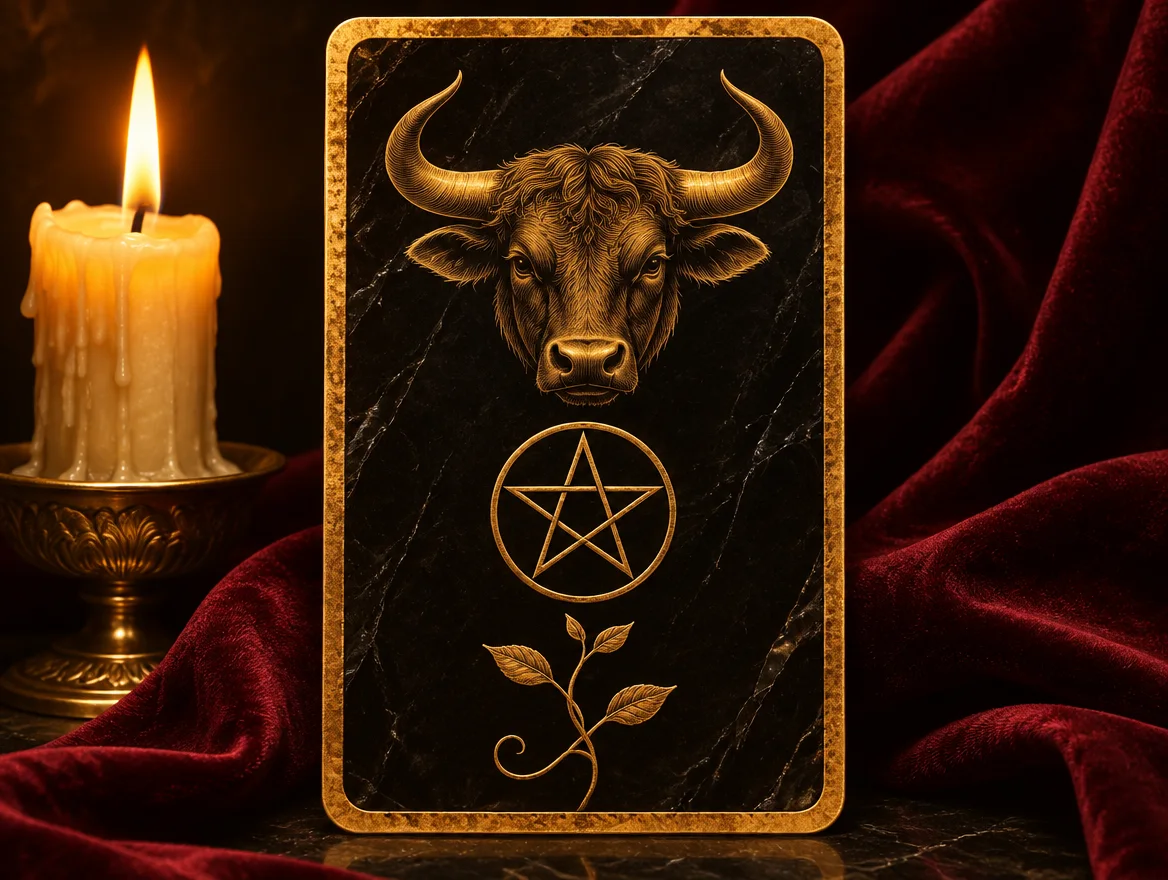
- The bull’s head. He asks the reader to notice a bull’s head repeated on the throne. On The 9th King we read it as strength that is slow, rooted and hard to move.
- The pentagram. Across the suit, he says, the sign is engraved or blazoned with a pentagram, standing for the four elements in human nature and the power that can govern them.
What the 1909 card adds
On the 1909 Smith card, the King sits on a dark throne decorated with bulls, his robe is covered in grapes, and a castle stands behind him (Wikipedia: King of Coins). Waite’s text doesn’t mention the grapes or the castle, so treat them as Smith’s details, not his. Together they suggest a harvest gathered and a home built.
Coins, pentacles and the money question
Waite adds a note that’s easy to skip and worth keeping. He says that in many old packs this suit stood for coin and money, and that he didn’t invent the change to pentacles. Then he gives his reason for some change: “the cards do not happen to deal especially with questions of money” (sacred-texts.com).
So the King touches money, but he isn’t only about money. He’s about what you build in the physical world and how you look after it.
If you’re new to reading cards as scenes, Code of Ascension’s Tarot for Beginners: How Tarot Really Works (Code of Ascension) covers the basics.
King of Pentacles meaning: upright and reversed
Upright
Waite’s upright meanings for this card are valour, realizing intelligence, business and ordinary intellectual aptitude, sometimes a gift for mathematics, and success along those paths (sacred-texts.com). “Realizing” is the key word: intelligence that turns ideas into real, usable things.
Modern readers often take the upright King as mature earth: someone who knows how things get built and kept. Common upright themes:
- Stewardship: looking after what you have so it grows, rather than spending it to be seen.
- Steadiness: being the same person on a slow Tuesday as on launch day.
- Practical skill: knowing how the work is really done, not only how it looks.
- Reliability: your word, your bills and your promises hold.
- Provision: making a place where other people are fed, housed or supported.
A court card is usually most useful as a mirror of your own behavior. The upright King can point to a season of keeping rather than starting: maintain the thing, protect the routine, finish what you planted. Ask yourself: What have I already built that deserves my care more than my next idea?
Readers sometimes take it as a grounded, dependable person in your life. Hold that lightly, and ask what quality in them am I being asked to learn?
Reversed
Reversed isn’t a “bad person” card. Waite’s reversed list is blunt (it includes weakness, corruption and peril) (sacred-texts.com). On The 9th King we read it as stewardship that has lost its purpose.
Modern readers commonly take the reversed King in one of two directions:
- Earth turned too heavy: stubbornness, possessiveness, hoarding, status-chasing, or using money and resources as leverage over people.
- Earth turned too loose: neglect of what you’ve built, careless spending, broken reliability, or the King who stopped tending his fields.
Rather than “money will go wrong,” try: Where has what I own started owning me?

King of Pentacles in love, at work and as feelings
King of Pentacles as feelings
“As feelings” usually means how does someone feel about me? Tarot on The 9th King can’t read another person’s mind, but it can describe a kind of feeling worth reflecting on.
Upright, readers often take it as feelings that are steady, protective and committed: care shown through reliability. Reversed, it can point to feelings that are possessive or guarded. The part you can actually read is your own: Do I feel safe in this connection, or managed? Look at what the person does, not what a card says they feel.
King of Pentacles in love
In love, the upright King can point to loyal, patient, practical energy: love shown by building a shared life. The catch is that earth can confuse providing with connecting. Ask yourself:
- Do I show love only through what I provide, and skip saying it?
- Do we both have a real say in shared decisions, including money?
- Am I steady, or just unwilling to change anything?
Reversed, readers often see possessiveness, coldness or money used as control. None of that tells you whether to stay or leave; only you can weigh that. One thing is clear, though: if someone uses money to restrict or control you, the responsibility for that sits with them, not you. Your safety comes first, and talking it through with someone you trust or a qualified professional may help.
If you keep falling for partners who seem to have it all together, psychological projection is worth a read.
King of Pentacles at work and with money
At work, the King of Pentacles is the one who knows how the business really runs and keeps the lights on. Readers often take it as encouragement to value maintenance and long-term care as much as new launches.
The shadow version: the boss who measures people only by output, or the founder who expands to look big and neglects the core.
This is reflection, not financial or career advice. The card doesn’t predict income, investments or jobs. A quick check: If someone looked at how I use my time and money this month, would they see stewardship or status?
Pentacles, earth and the court-card naming trap
Pentacles as earth
In occult and divinatory use, the suit of coins or pentacles is connected with the classical element of earth (Wikipedia: Suit of coins). The Golden Dawn’s tarot teaching, printed by Crowley as Liber LXXVIII, calls the Ace of Pentacles the root of the powers of earth (Liber LXXVIII, sacred-texts.com).
Golden Dawn–derived correspondences: the tradition The 9th King uses
Astrology links on The 9th King follow Golden Dawn–derived correspondences, the tradition the Rider–Waite–Smith deck draws on. Other schools differ, and not every card maps to a single zodiac sign. Court cards work differently from the numbered cards and the Major Arcana: in the Golden Dawn system, each court card is read as an element within an element. That’s where the naming trap begins.
The naming trap
The Golden Dawn and the Rider–Waite–Smith deck don’t use the same court titles, so here is the rule this site uses. The 9th King follows the court-card naming in Liber LXXVIII (the Golden Dawn’s Book T): Knights are fire of their suit, Queens water, Kings air, Pages earth. Liber LXXVIII prints each Golden Dawn title beside a familiar card name, and it calls the Page the “Knave” (Liber LXXVIII). Matching those figures to the Rider–Waite–Smith courts is The 9th King’s convention, not something the source says about Waite’s deck. Other systems differ: Crowley’s Thoth deck, for example, uses Knight, Queen, Prince and Princess (Wikipedia: Thoth tarot deck).
| Card (Liber’s name) | Golden Dawn title | Pairing |
|---|---|---|
| Knight of Pentacles | King of the Spirits of Earth | Fire of earth |
| Queen of Pentacles | Queen of the Thrones of Earth | Water of earth |
| King of Pentacles | Prince of the Chariot of Earth | Air of earth |
| Knave of Pentacles | Princess of the Echoing Hills | Earth of earth |
So on this site the King of Pentacles is air of earth: matter that is planned, organized and put to use. Liber LXXVIII pictures this Prince as a winged, kingly figure in a chariot drawn by a bull, over flowering land, holding an orb of gold downward and a sceptre topped with an orb and cross. The bull echoes Waite’s throne, though we can’t say Waite intended the link.
Paraphrased, Liber says this Prince increases matter, makes things solid, applies them practically, and is steady and reliable; ill dignified, he turns selfish and purely material. In either case, the text says, he is “slow to anger, but furious if roused” (Liber LXXVIII). The same text says the Golden Dawn’s Princes, seated in their chariots, have an effect both rapid and enduring. For this King, the second word is the whole card.
His span of the zodiac
Liber LXXVIII says this Prince rules from 20 degrees of Aries to 20 degrees of Taurus (Liber LXXVIII). That’s a stretch across two signs, so the King of Pentacles isn’t “the Taurus card.” Read it as context: the drive of Aries handing over to the patience of Taurus.
The earth signs, as element links
The King of Pentacles shares its element with the three earth signs. That’s an element link, not “this card equals this sign”:
- Taurus personality traits: earth that savors and keeps.
- Virgo personality traits: earth that refines and serves.
- Capricorn personality traits: earth that climbs and builds structures.
Not sure where earth sits in your chart? See how to read a birth chart.
The 9K reading: tension, shadow and self-mastery
Here The 9th King’s reading goes beyond keywords. The King of Pentacles carries a grown-up lesson: the difference between building something that lasts and collecting things that look like success.
The tension: stewardship versus status
A steward asks, What does this need to stay healthy? A status-chaser asks, What does this say about me? From outside they can look identical: the same house, the same business. The difference is the direction of care. Stewardship points outward and forward, toward the thing itself and the people it supports. Status points back at the self.
Under pressure, some people cling to what they have and stop growing; others keep upgrading the surface and neglect the foundation. The King’s task is real care for material things without turning them into a scoreboard.
The shadow side
Shadow work means looking at the parts of yourself you’d rather not see; our zodiac shadow work guide looks at each sign’s version. The King’s crowned version:
- Ownership as identity: “I am what I have,” so any loss feels like losing yourself.
- The scoreboard: comparing your life to other people’s by price, size and title.
- Provision as leverage: giving in a way that keeps others dependent, or using who pays as who decides.
- The lethargic King: Waite’s own hint. Comfort slows into coasting, and the fields stop being tended.
If shadow work is new to you, Shadow Work, Plainly explains how to begin safely. If your relationship with money or security started in a hard childhood, inner child work may help you see where the grip comes from.
| Strength | When it’s overused | One way to rebalance |
|---|---|---|
| Stewardship | Hoarding, can’t share | Share one resource on purpose |
| Steadiness | Refusing all change | Change one small habit |
| Practical skill | Only numbers count | Name one unmeasured value |
| Reliability | Rigid, joyless duty | Schedule one real rest |
| Provision | Giving as control | Ask what they actually need |
The self-mastery lesson: tend it so it outlasts you
A field can be harvested for one great year or tended for fifty. The lesson is to build for the fifty:
- Measure what you build by whether it’s healthy, not whether it’s admired.
- Keep maintaining what works before buying what’s new.
- Let the people around you have real say in shared resources.
- Remember Waite’s note: the suit isn’t only about money. Your body, your skills, your home and your time are all things you steward.
Journal prompts for the King of Pentacles
- What have I built that I’m proud of, and what does it need from me now?
- Where am I spending to be seen rather than to build?
- Who depends on what I provide, and do they have a voice in it?
- What would “enough” look like for me, in plain words?
- Am I building something that lasts, or just something that looks impressive?
Our shadow work prompts collection goes deeper.
A short, important note: these prompts are for reflection, not therapy. If you’re dealing with trauma, abuse, thoughts of self-harm or distress that feels overwhelming, please work with a qualified therapist who can support you safely. It’s always fine to stop a prompt that feels like too much.
Practical exercise: the steward’s walk
This is the one exercise to take from the King of Pentacles. It takes about fifteen minutes on paper: a king walking his land, looking at what’s actually there.
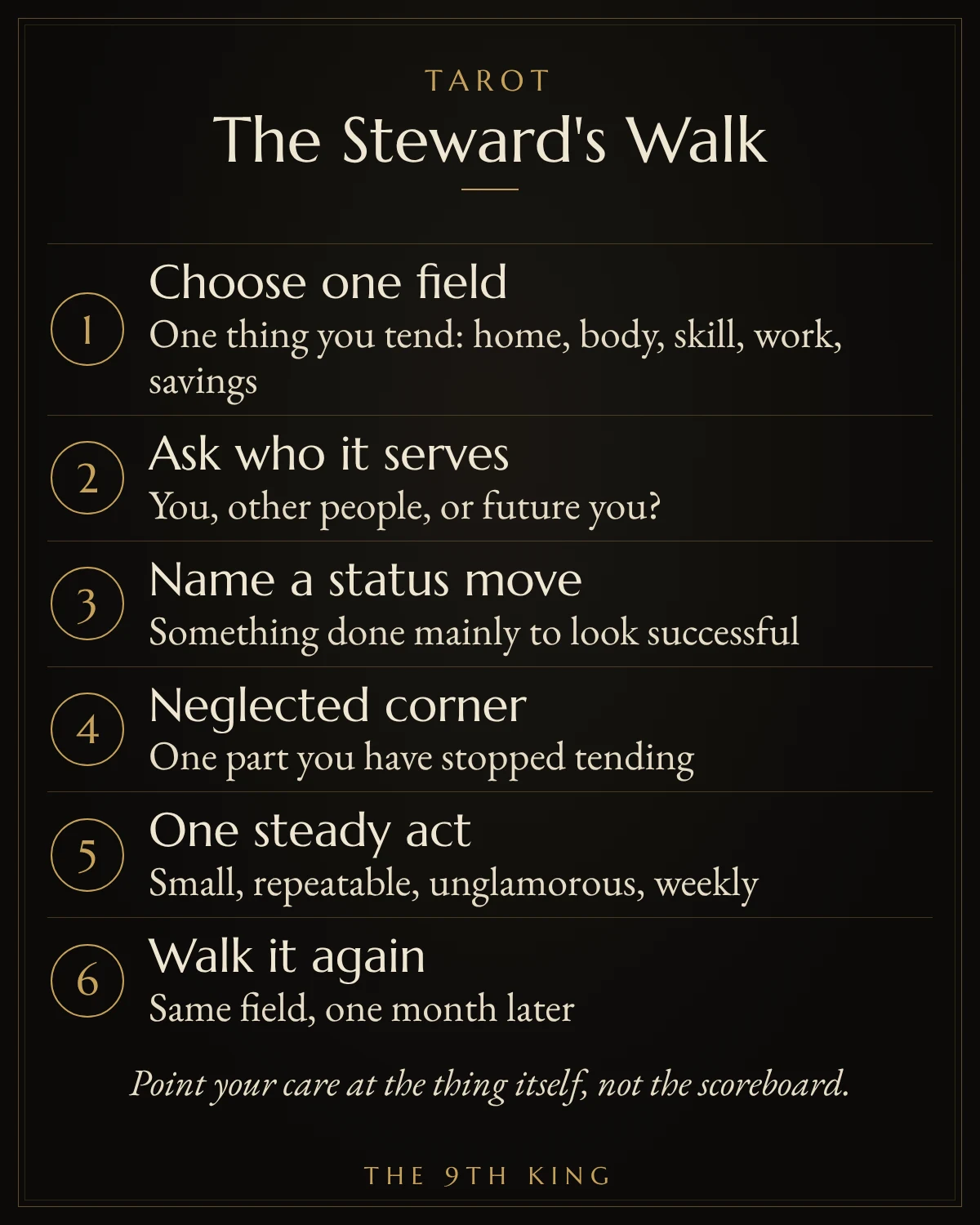
- Choose one field. Pick one thing you tend: your home, your body, a skill, a business, a team, a savings habit. One is enough.
- Ask who it serves. You, other people, future you? There’s no right answer. You’re just looking.
- Name a status move. Write down one thing you did for this field mainly to look successful. Be honest and kind with yourself.
- Neglected corner. Write down one part of it you’ve stopped tending: the repair you keep delaying, the routine that slipped, the conversation about shared decisions you haven’t had.
- One steady act. Choose one small, repeatable, unglamorous action for that corner, doable weekly.
- Walk it again. In a month, walk the same field through steps 1 to 5 again. Look for the pattern, not a grade.
The aim isn’t to care less about material things. It’s to point your care at the thing itself and the people it supports. To pair this with a card pull, Code of Ascension’s Intuitive Tarot (Code of Ascension) shows how to combine traditional meanings with first impressions.
Two worked examples (fictional)
Example 1 (fictional): the café owner and the second location. Rosa pulls the King of Pentacles upright while thinking about a second café. She picks the first café as her field. Her status move: she’s pricing a new location mostly because a rival opened one. Her neglected corner: a failing espresso machine and two staff who’ve asked about training for months. Her steady act: one hour a week on both. The card predicted nothing. It gave her a clearer question before she decides.
Example 2 (fictional): the reliable provider. Theo pulls the King of Pentacles reversed. He’s the main earner at home and picks the household budget as his field. Asking who it serves, he realizes his partner hasn’t seen the accounts in a year and asks him before small purchases. He’d called it handling things. His steady act: offering a monthly half hour where they look at the numbers together, if his partner wants it, with both having a say. His shadow question: Do I provide so we’re secure, or so I stay in charge?
Myths and misreadings about the King of Pentacles
- “The King of Pentacles means money is coming.” On The 9th King, the card isn’t a forecast. Waite himself said the suit doesn’t deal especially with money questions. It’s a mirror for how you build and tend things.
- “It means a rich partner is on the way.” A court card describes a quality, not a delivery.
- “Reversed means you’re greedy.” Reversed is earth out of balance: too heavy or too loose. It points to something worth tending, not a verdict on your character.
- “It’s the Taurus card.” In Liber LXXVIII this Prince spans 20° Aries to 20° Taurus, and the suit shares earth with Taurus, Virgo and Capricorn. We don’t assign it one sign.

King of Pentacles: FAQ
What does the King of Pentacles mean?
The King of Pentacles is the mature figure of the suit of Pentacles, the earth suit. Upright, readers often take it as stewardship, steadiness, practical skill, reliability and provision: someone who builds things that last and looks after them. On The 9th King it’s a mirror, not a prediction. It asks whether what you’re building is meant to last and to support others, or mainly to impress.
What does the King of Pentacles reversed mean?
Reversed, the King of Pentacles usually points to earth out of balance. Too heavy, it shows stubbornness, hoarding, status-chasing or resources used as control. Too loose, it shows neglect, careless spending or broken reliability. A.E. Waite’s reversed list is harsh, but on The 9th King we read it as stewardship that has lost its purpose. A useful question: where has what I own started owning me?
What does the King of Pentacles mean as feelings?
Tarot can’t read another person’s mind, so on The 9th King “as feelings” is a prompt about the kind of feeling involved. Upright, the King of Pentacles suggests steady, protective, committed care that shows up as reliability. Reversed, it suggests feelings that are possessive or guarded. The most reliable things to examine are your own feelings and the other person’s actual behavior, not what a card says they feel.
What does the King of Pentacles mean in love?
In love, the upright King of Pentacles is often read as loyal, patient, practical energy that builds a shared life. The challenge is confusing providing with connecting. Reversed, readers often see possessiveness, coldness or money used as control. The card doesn’t tell you whether to stay or leave. It asks how you show love, and whether both people have a real say in what you share.
Is the King of Pentacles a yes or no card?
The 9th King doesn’t do yes-or-no readings, because tarot here is a tool for self-knowledge rather than prediction. Instead of asking whether something will happen, try a reflective question the King of Pentacles is good at: “If I were building this to last ten years, what would I do differently this week?” Your answer usually tells you more than a yes or no could.
What zodiac sign is the King of Pentacles?
In the Golden Dawn naming The 9th King follows (Liber LXXVIII), the King of Pentacles is the Prince of the Chariot of Earth: air of earth, ruling from 20 degrees of Aries to 20 degrees of Taurus. As an earth-suit card it also shares an element with Taurus, Virgo and Capricorn. Read that as one tradition’s map and a set of themes to reflect on, not a single sign.
Is the King of Pentacles about money?
Partly, but not only. Waite noted that the suit once stood for coins in many old packs, yet he argued the cards don’t deal especially with questions of money. On The 9th King, the King of Pentacles covers everything you build and tend in the physical world: your home, body, skills, work and time. Money talk here stays reflective, never financial advice or a forecast.

Your next step: bring the King of Pentacles into your own chart. Find where the earth signs sit in your birth chart, read your sign’s shadow in our Zodiac Shadow Work guide, then take one steward’s walk this week.
Explore Next
- The shadow side of every sign: Zodiac Shadow Work
- Start shadow work safely: Shadow Work, Plainly
- Earth that savors and keeps: Taurus Personality Traits
- Earth that builds structures: Capricorn Personality Traits
- The rest of the suit so far: Page of Pentacles · Knight of Pentacles
- More tarot on The 9th King: Tarot Card Meanings · Minor Arcana · Tarot & the Zodiac · King of Wands · The Emperor · Shadow Work Tarot Spread
- More cards in this set: Ace of Pentacles · Queen of Pentacles

Final Thought: Build for the Fifty Years
The King of Pentacles isn’t asking you to want less. He’s asking you to care well for what you have: tend what you’ve built, share the say in what you hold together, and measure success by what lasts rather than what impresses. Know your nature. Rule your life.
About the Author
King is the founder of The 9th King, where zodiac psychology, relationships and shadow work are explored as tools for self-knowledge rather than fortune-telling. He’s a Libra Sun, and writes about the personal side of astrology on King The Kemist. Astrology on The 9th King is interpretation and self-reflection, not prediction or established fact.
Leave a Reply