
Quick Answer: What Does the Four of Swords Mean?
The Four of Swords (also written 4 of Swords) is a Minor Arcana card from the suit of Swords, the suit of air, thought and conflict. In the traditional image, a carved figure of a knight lies at full length on a tomb in the attitude of prayer. On The 9th King, it’s the card of the swords put down: rest, recovery, quiet and a break from strife.
- Keywords: rest, recovery, retreat, solitude, quiet, a pause after struggle, keeping watch, restoring your strength.
- Upright, in one line: a prompt to notice what rest you need right now, if you’ve been through a hard stretch, and what would let your mind stop standing guard.
- Reversed, in one line: a prompt to look at how you’re coming back out of a pause, how you’re spending limited energy, or what keeps you from resting when you need to.
On The 9th King, tarot is a mirror for self-knowledge, not fortune-telling. The Four of Swords doesn’t say how long a quiet season lasts. It treats rest as a real need.
Table of Contents
The Four of Swords at a glance
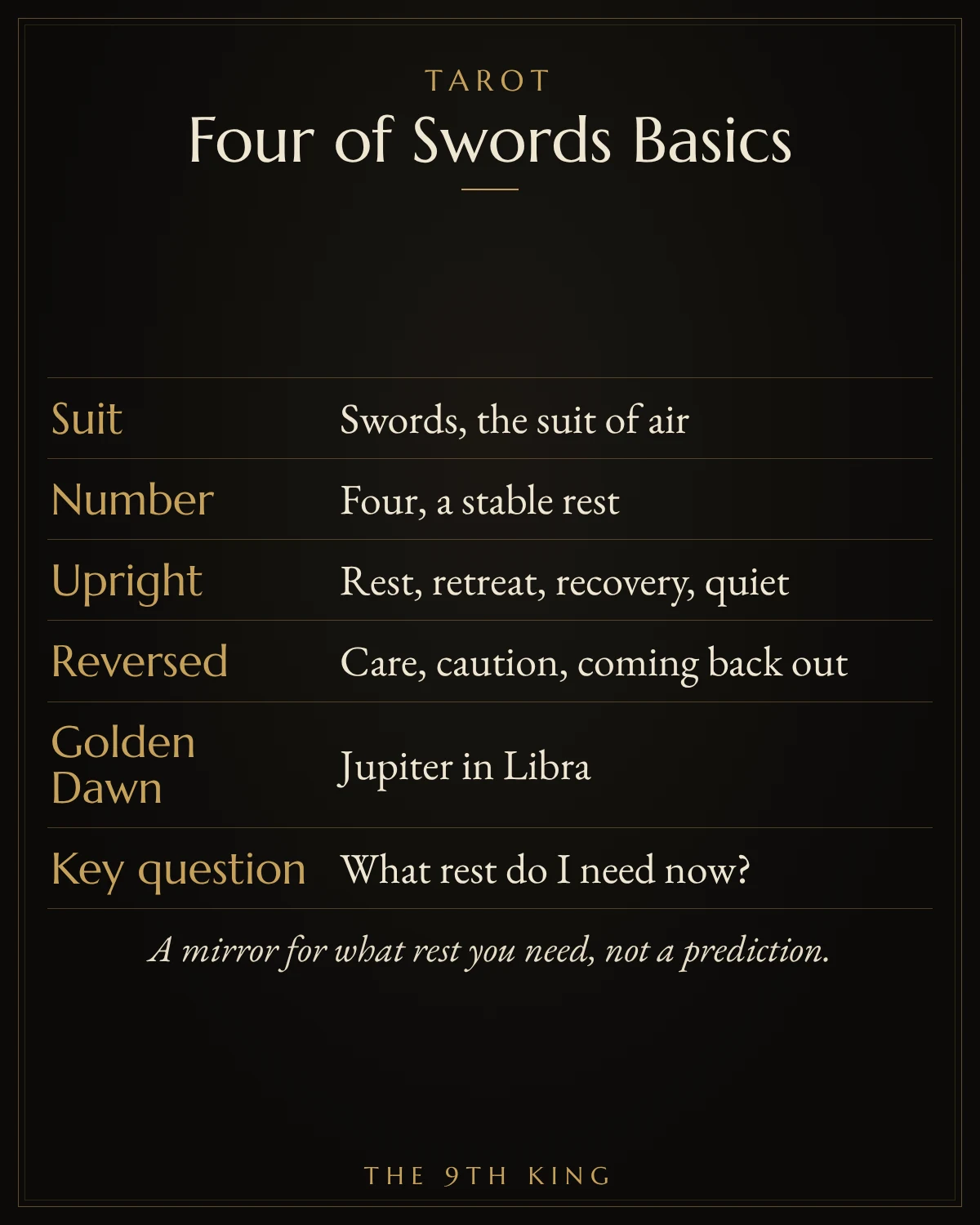
| Four of Swords | |
|---|---|
| Arcana | Minor Arcana, a pip (number) card |
| Suit and element | Swords, linked with air |
| Number | Four |
| Golden Dawn title | Lord of Rest from Strife |
| Astrology (Golden Dawn) | Jupiter in Libra |
| Upright | Rest, retreat, solitude, repose |
| Reversed | Care, caution, economy, precaution |
| Key question | What rest do I need now? |
What the Four of Swords looks like
Most people know this card from the Rider–Waite–Smith deck, first published in London by William Rider & Son in December 1909. A.E. Waite wrote the instructions, Pamela Colman Smith drew the art, and both were members of the Hermetic Order of the Golden Dawn (Wikipedia: Rider–Waite Tarot).
Waite’s description in The Pictorial Key to the Tarot is a single sentence: the effigy of a knight “in the attitude of prayer, at full length upon his tomb” (sacred-texts.com: Waite, Four of Swords).
The effigy
An effigy is a carved likeness, the kind set on top of an old tomb. It isn’t a person asleep, and on The 9th King it isn’t a picture of death. It’s a figure of complete stillness.
The attitude of prayer
Waite gives the figure the attitude of prayer, and on the 1909 card that means palms pressed together. The hands that would hold a sword are joined, at rest, turned toward something quieter than the fight.
The tomb
Waite lists tomb and coffin among the card’s meanings and says these two suggested the design (sacred-texts.com: Waite, Four of Swords). On The 9th King, we read the tomb as an image of things laid to rest: a struggle that’s over for now. It’s a symbol, not a forecast.
On the early Smith card
On the 1909 Smith card (Wikimedia Commons: 1909 Four of Swords scan), three swords hang on the wall above the figure, blades down, and a fourth sword lies flat along the side of the tomb. A stained-glass window with figures in it fills the upper left corner, and the knight appears to wear armor, eyes closed, palms pressed together. Apart from the knight’s effigy, the prayer and the tomb, none of this is in Waite’s text.

The Golden Dawn version of the card
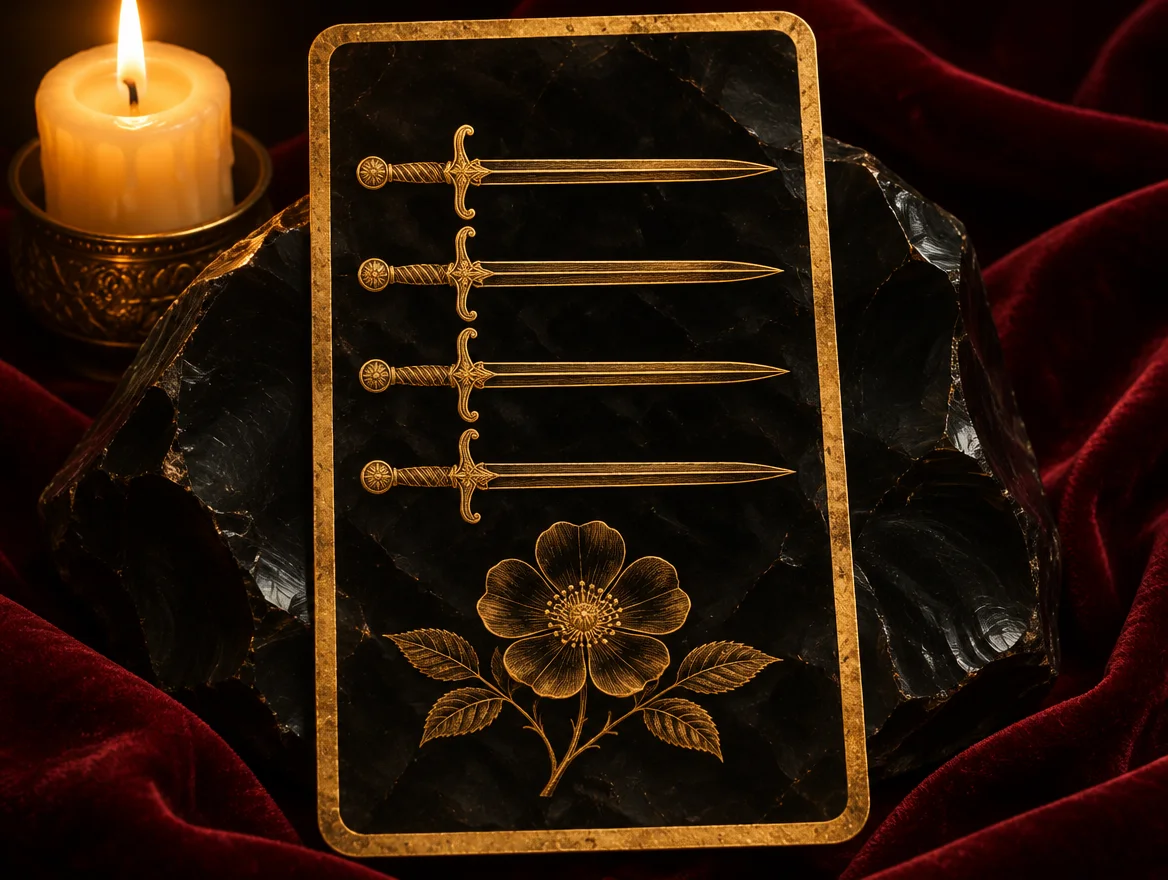
The Golden Dawn’s teaching text on the tarot, Book T, as printed by Aleister Crowley in Liber LXXVIII, describes a different design (Liber LXXVIII, sacred-texts.com). Two white radiating hands each hold two swords, the four swords cross in the center, and a five-petaled rose with white rays is reinstated at the point where they meet. The symbols of Jupiter and Libra sit above and below.
In the same text, the Five of Swords shows that rose’s petals torn and falling. In the Four, the rose is whole.
Four of Swords meaning (upright)
Waite’s upright meanings are a short list: vigilance, retreat, solitude, hermit’s repose, exile, tomb and coffin (sacred-texts.com: Waite, Four of Swords).
Book T is gentler and fuller. Under the title Lord of Rest from Strife, it opens with “Rest from sorrow; yet after and through it,” then adds peace after war, relaxation of anxiety, and quietness, rest, ease and plenty after struggle (Liber LXXVIII, sacred-texts.com).
On The 9th King, we read the upright card as rest that meets a need. It has three layers.
Rest after strain
The card can point to a season after something hard: an argument, a loss, a long stretch of worry, an illness. The swords can come down. Ask yourself: What have I been carrying, and what would it mean to set it down for a while?
Retreat and solitude
Waite’s list includes retreat, solitude and hermit’s repose. On The 9th King, we read that as the kind of rest that needs some distance: quiet, fewer voices, time alone. Our Hermit page explores the Major Arcana’s own retreat. Ask yourself: Do I need quiet, company, or a bit of both?
Keeping watch
Waite’s list starts with vigilance, right beside repose. On 9K, we read Waite’s word vigilance as the part of you that’s still on guard. Ask yourself: What is my mind still watching for, and does it need to be watched right now?
Four of Swords reversed
Some readers read reversals as the opposite meaning, some as blocked energy, and some don’t use them. Waite’s reversed meanings are practical and careful: wise administration, circumspection, economy, avarice, precaution, testament (sacred-texts.com: Waite, Four of Swords). Circumspection means caution; a testament is a will.
In his additional meanings, Waite calls the Four of Swords a bad card, then says that reversed, a qualified success may come by wise administration of affairs (sacred-texts.com: Waite, Additional Meanings of the Lesser Arcana). He warns on that page that these extra meanings are “very often in disagreement with those previously given,” so we treat them as a side note.
On The 9th King, the reversed card usually points to one of three patterns, offered as questions.
Coming back out
The reversed card can point to the end of a pause: picking the swords back up, returning to work, conversation or the world. Ask yourself: What do I want to bring back from this quiet time?
Careful with limited energy
On 9K, we read Waite’s words economy and wise administration as care with limited energy. Precaution here isn’t fear; it’s pacing. Ask yourself: Where is my energy best spent this week, and where can I spend less?
Rest that isn’t landing
Waite’s list also includes avarice, holding too tight. On 9K, we read the reversed card as the grip that won’t let go, even when you’re lying down: still checking, still rehearsing, still bracing. Ask yourself: What am I holding onto so tightly that I can’t rest?
| Pattern | Upright tone | Reversed tone |
|---|---|---|
| The swords | Put down for now | Picked back up, with care |
| Your energy | Restoring | Budgeted, paced |
| Solitude | Chosen quiet | Ending, or hard to leave |
| Your mind | Allowed to go still | Still on watch |
Four of Swords astrology: Jupiter in Libra
The 9th King uses Golden Dawn–derived correspondences, the tradition the Rider–Waite–Smith deck draws on. Other schools use different systems, and not every card maps to a single sign: the court cards and Pages are handled differently. This is one traditional framework, offered as symbolism.
How the number cards get their planets
In the Golden Dawn system, the 36 small cards (Twos through Tens) answer to the 36 decans of the zodiac: ten-degree thirds of a sign, each given a planet (Liber LXXVIII, sacred-texts.com). Book T‘s table lists the Four of Swords, Rest from Strife, under Jupiter in Libra, and the card’s entry names Jupiter and Libra as its decan symbols. Liber prints no degrees for it.
In that table, the three Libra cards run in order: the Two of Swords (Moon in Libra), the Three of Swords (Saturn in Libra), then the Four (Jupiter in Libra). So the Four is the last Libra decan, right after the Three of Swords, the card of sorrow. Rest follows grief, which fits Book T‘s phrase about rest after and through sorrow. See the Two of Swords and Three of Swords.
Book T places the card in Chesed, the fourth station on the Kabbalistic Tree of Life, with a note about convalescence, recovery from sickness and change for the better. That’s symbolism from an old text, not health guidance.
What Jupiter brings
On The 9th King, Jupiter is the planet of growth and generosity. It’s the traditional ruler of Sagittarius and Pisces, so our Sagittarius Personality Traits and Pisces Traits pages show its open-handed style in a person. On this card, Jupiter is the generous part of you that gives yourself room.
What Libra brings
Libra is cardinal air, ruled by Venus: the sign of balance, fairness and the scales. Our Libra Traits page covers its grace and its habit of keeping the peace at its own cost. On this card, Libra is the wish to set things level again after a fight.
The tension in the pairing
Libra wants balance. Jupiter wants more room. The card sits where the two meet: rest as a way of restoring balance, given generously. At its best, Jupiter lets Libra stop weighing every side for a while.
The 9K reading: still on watch?
The card’s tension
The Four of Swords holds two true things at once: the fight is over for now and part of you is still standing guard. The card asks whether you can let the watch end, even briefly.
Rest is not avoidance
First, plainly: rest isn’t a shadow pattern. Rest is a pause that meets a need, with an end date or without one. Rest that illness, grief or exhaustion requires is never laziness or avoidance. Stepping back from someone who harms you is safety, not retreat from responsibility; responsibility for harm belongs to the person who caused it.
Avoidance is a different thing that can sit next to rest: a pause that also covers a conversation or task you dread. That’s worth noticing gently, without turning the rest into the problem. You can need the rest and be putting something off at the same time.
The shadow side
The shadow of the Four of Swords isn’t resting. It’s never quite being allowed to. It can look like:
- Earning rest. Believing you can only stop once everything is done, so you never stop until you crash.
- Resting on guard. Lying down but rehearsing arguments, checking messages, bracing for the next thing.
- Guilt about the pause. Treating time off as a debt you have to explain or make up.
- Rest as a reward, not a need. Treating sleep, quiet or recovery as a prize for good behavior.
These patterns are often learned early. If that rings true, inner child work is a gentle, related place to look, and zodiac shadow work frames them through your chart.
What still keeps watch
Some vigilance is useful. If you’re caring for someone or living somewhere that isn’t safe, staying alert can be a real need. Real limits on rest can be outside you or inside you: a caregiving role, a job you need, pain, grief. So the question is what’s one watch that can safely end, even for an hour?
Six kinds of rest
Not all rest looks like sleep. On The 9th King, we name six kinds, so you can notice which one you’re short on:
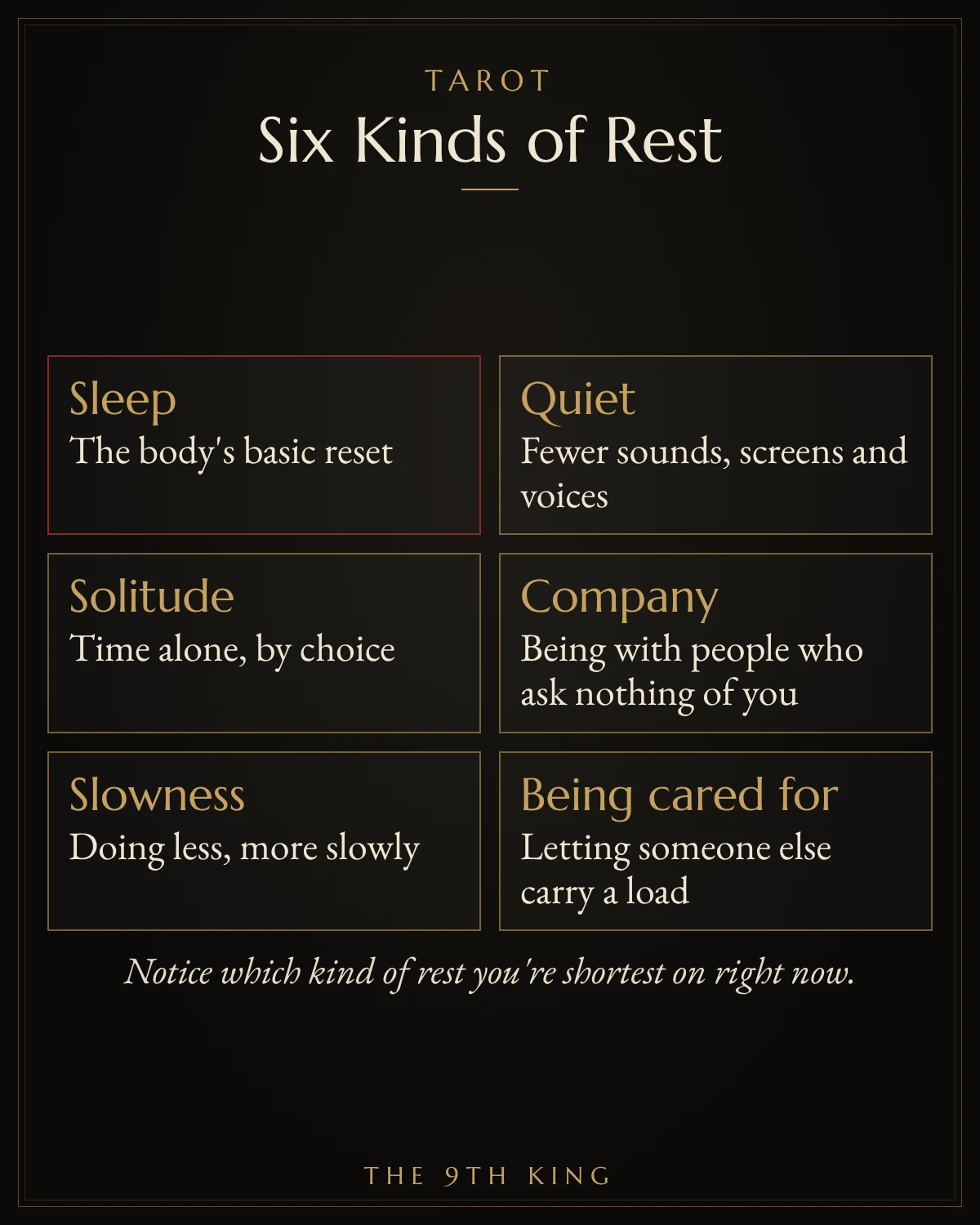
- Sleep: the body’s basic reset. If sleep is hard to come by, that’s worth raising with a doctor.
- Quiet: fewer sounds, screens and voices.
- Solitude: time alone, by choice. Waite’s hermit’s repose lives here.
- Company: being with people who ask nothing of you.
- Slowness: doing less, more slowly.
- Being cared for: letting someone else carry a load. It can be the hardest kind to accept, and it counts.
The self-mastery lesson
The lesson of the Four of Swords is to let the swords come down when they can. You can rest without earning it, retreat without explaining it, and come back when you’re ready. Rest isn’t time lost from your life. It’s part of it.
Four of Swords as feelings, in love and at work
Four of Swords as feelings
As feelings, The 9th King often reads the card as needing space: tiredness, quiet, a wish to withdraw for a while. A card can’t tell you what someone else feels or why they’re quiet; their words and actions can. About your own feelings, ask: Am I pulling back because I need rest, because I need distance from something specific, or both? Either answer is allowed.
Four of Swords love meaning
In a love reading, the upright card can point to a pause: quiet after conflict, or time apart to recover. The reversed card can point to coming back together after a break, or to one person still keeping watch after an argument has ended.
Tarot can’t tell you whether to stay or leave, and this page won’t either. If you don’t feel safe with someone, this isn’t a question of rest: your safety comes first. Otherwise, useful questions:
- Do we both know a pause is happening, or is one of us guessing?
- What does each of us actually do when we need space: go quiet, go out, go to sleep?
- After a fight, what helps each of us stop bracing?
If you two handle space differently, synastry for beginners shows how astrologers compare two charts, as reflection, not a verdict.
Four of Swords at work and in the body
None of this is career or medical advice, only reflection.
At work, we often read the card as a break between projects or recovery after a hard push. Ask yourself: What would a real break look like in the job I actually have, not the one I wish I had?
In the body, the card is a reminder that rest is a need, not a reward. For anything about your health, ask a doctor or other qualified professional.
The Ace of Swords is where the air suit begins.
Practical exercise: lay one sword down
Four steps, one for each sword. It isn’t a test of how well you rest, only a starting point for noticing what still keeps watch. You need fifteen minutes and a notebook.
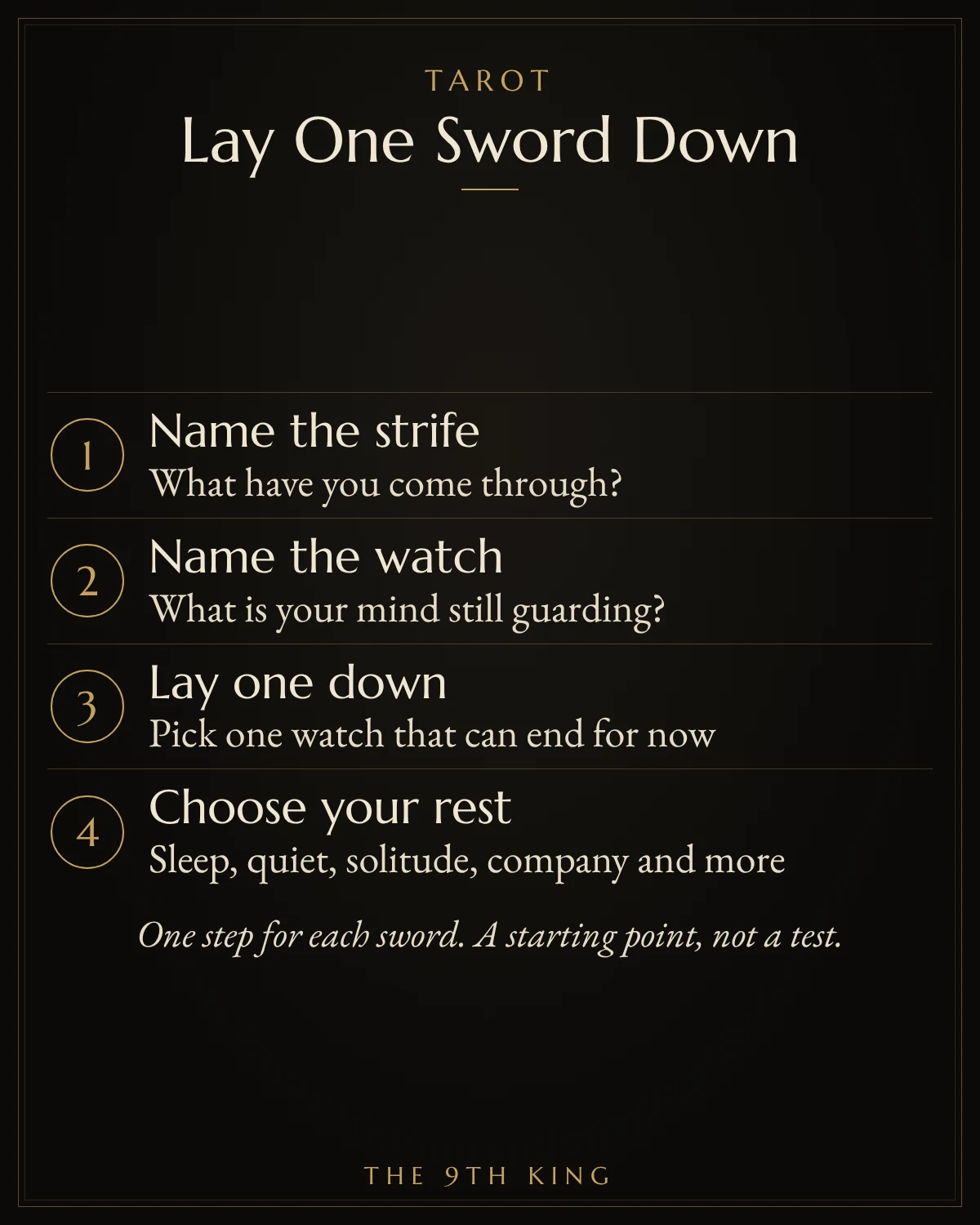
Step 1: Name the strife
Write what you’ve come through lately: the argument, the deadline, the loss, the long worry. You don’t need to rank it or explain it.
Step 2: Name the watch
Write down everything your mind is still guarding: messages you’re waiting on, conversations you keep rehearsing, things you’re bracing for. Some may be real needs; write them anyway.
Step 3: Lay one down
Pick one item that can safely end for now, even for an evening. Write what laying it down looks like: a note on paper, phone in another room, or asking someone else to watch it.
Step 4: Choose your rest
Look at the six kinds of rest in the 9K reading above and pick the one you’re shortest on. Plan one small piece of it. Afterward, note any moment of steadiness, however brief. Over time, those notes can show you what helps.
A worked example (fictional)
Dev (fictional) draws the Four of Swords after a hard month. Under “the strife,” he writes two things: extra shifts covering for a sick coworker, and his sister’s breakup. Under “the watch,” he lists four: work email, his sister’s texts, a bill due next week, and a conversation with his manager he keeps rehearsing.
He keeps his sister’s texts on, because she may need him. He looks at the other three and lays one down: the bill. He writes the due date on paper and sets a reminder. Three watches are left, and he lets that be enough for now.
For his rest, he picks quiet and plans one evening with no screens. The next day he notes one steady moment: twenty minutes on the porch when nothing needed answering.
Journal prompts for the Four of Swords
- What have I come through lately that I haven’t let myself rest from?
- Which kind of rest am I shortest on right now?
- What did I learn growing up about resting, and who taught me?
- What is my mind still guarding, and which of those watches is truly needed?
- What would I want to bring back with me when this quiet season ends?
For more, our shadow work prompts go deeper, and Shadow Work, Plainly explains how to start safely.
A warm note: this is reflective practice, not therapy. If you’re dealing with trauma, abuse, thoughts of self-harm or distress that feels overwhelming, please work with a qualified therapist who can walk with you. It’s always fine to stop a prompt that feels like too much.
Myths and misreadings of the Four of Swords
- “The Four of Swords is about death or illness.” No. The figure is a carved effigy on a tomb, a symbol of stillness. Book T‘s note even speaks of change for the better. On The 9th King, the card is about rest, not harm.
- “It means you’re being lazy.” No. Rest is a need, and the card treats it that way.
- “It means wait and do nothing until things change.” No. Tarot here doesn’t set timelines. The card asks what rest you need, not how long anything lasts.
- “Jupiter in Libra means this card is about Libra people.” No. The correspondence describes the card’s symbolism in the Golden Dawn tradition. Anyone can draw it, whatever their sign.
Four of Swords: FAQ
What does the Four of Swords mean?
The Four of Swords is a Minor Arcana card in the air suit. Waite describes the effigy of a knight on his tomb in the attitude of prayer, and lists vigilance, retreat, solitude and repose among its meanings. On The 9th King, we read it as rest after strain: a mirror for what rest you need, not a prediction about what happens next.
What does the Four of Swords reversed mean?
Reversed, Waite lists wise administration, circumspection, economy, avarice, precaution and testament. On The 9th King, we read it as coming back out of a pause, pacing limited energy, or holding on so tightly that rest doesn’t land. Treat it as a prompt to look at how you’re spending your strength, not as a warning.
What does the Four of Swords mean as feelings?
As feelings, The 9th King often reads the Four of Swords as needing space: tiredness, quiet, or a wish to withdraw for a while. A card can’t tell you what another person feels or why they’ve gone quiet; their words and actions can. About your own feelings, it can prompt you to ask whether you need rest, distance from something specific, or both.
What does the Four of Swords mean in love?
In love, the upright card can point to a pause: quiet after conflict, time apart to recover, or a need for rest more than more talking. Reversed, it can point to coming back together, or to one person still bracing after a fight has ended. The card doesn’t tell you to stay or leave. It invites you to check that you both know a pause is happening.
What zodiac sign is the Four of Swords?
In the Golden Dawn system, the tradition The 9th King uses, the Four of Swords corresponds to Jupiter in Libra, the last of Libra’s three decans in Book T’s table. Book T calls it the Lord of Rest from Strife. Other schools use different correspondences, so treat this as one traditional framework for symbolism, not a statement about Libra people.
Is the Four of Swords about death?
No. Waite says the meanings tomb and coffin suggested the design, and the figure is a carved effigy on a tomb. On The 9th King, the card is read as rest, recovery and things laid to rest, never as literal death or harm. The Golden Dawn’s Book T even links it to convalescence and change for the better.
Is the Four of Swords a good or bad card?
Neither, on The 9th King. In his additional meanings, Waite calls it a bad card, but he warns that those extra meanings often disagree with his main ones. Book T speaks of quietness and ease after struggle. Read it as a mirror for rest and recovery, not as an omen.
Your next step: do the lay-one-sword-down exercise above, and plan one small piece of the rest you’re shortest on before you close the notebook. Then find where Jupiter falls in your own chart with our guide on how to read a birth chart.
Explore Next
- Libra’s grace and its peacekeeping shadow: Libra Traits
- Jupiter’s long cycle in your chart: Jupiter Return
- Where the air suit begins: Ace of Swords
- The Libra decan just before this one, the card of sorrow: Three of Swords
- Reading by feel: Intuitive Tarot (Code of Ascension)
- New to the cards: Tarot for Beginners: How Tarot Really Works (Code of Ascension)
- More tarot on The 9th King: Tarot Card Meanings · Minor Arcana · Tarot & the Zodiac · Five of Swords · Shadow Work Tarot Spread
- More cards in this set: Eight of Cups, Ten of Wands, Two of Pentacles
Final Thought: Let the Watch End
The knight on the tomb isn’t defeated, and he isn’t lazy. He’s still. Most of us get very few moments when nothing needs defending. When one comes, you’re allowed to take it: put the swords down, rest in the way you need, and come back when you’re ready. Know your nature. Rule your life.
About the Author
King is the founder of The 9th King, where zodiac psychology, relationships and shadow work are explored as tools for self-knowledge rather than fortune-telling. He’s a Libra Sun, and writes about the personal side of astrology on King The Kemist. Astrology on The 9th King is interpretation and self-reflection, not prediction or established fact.
Leave a Reply