

Quick Answer: What Does The High Priestess Tarot Card Mean?
The High Priestess is card II (2) of the Major Arcana. She sits between a white pillar and a black pillar, in front of a veil, holding a scroll that is partly hidden by her mantle. She’s the card of knowing something before you can explain it, or before you say it.
Keywords: inner knowing, intuition, silence, mystery, patience, the hidden, reflection.
- Upright, in one line: the card can point to listening inward, holding what isn’t ready to be said, and trusting that quiet is a form of knowing.
- Reversed, in one line: readers often take it as ignoring your inner voice, surface knowledge, or silence that has turned into secrecy or stalling.
- Astrology link: in the Golden Dawn–derived correspondences The 9th King uses, The High Priestess is attributed to the Moon (the planet, not a sign), with the Hebrew letter Gimel.
On The 9th King, tarot is a mirror for self-knowledge, not fortune-telling. The High Priestess doesn’t reveal your future. She asks: what do I already know, and what am I doing with it?
Table of Contents
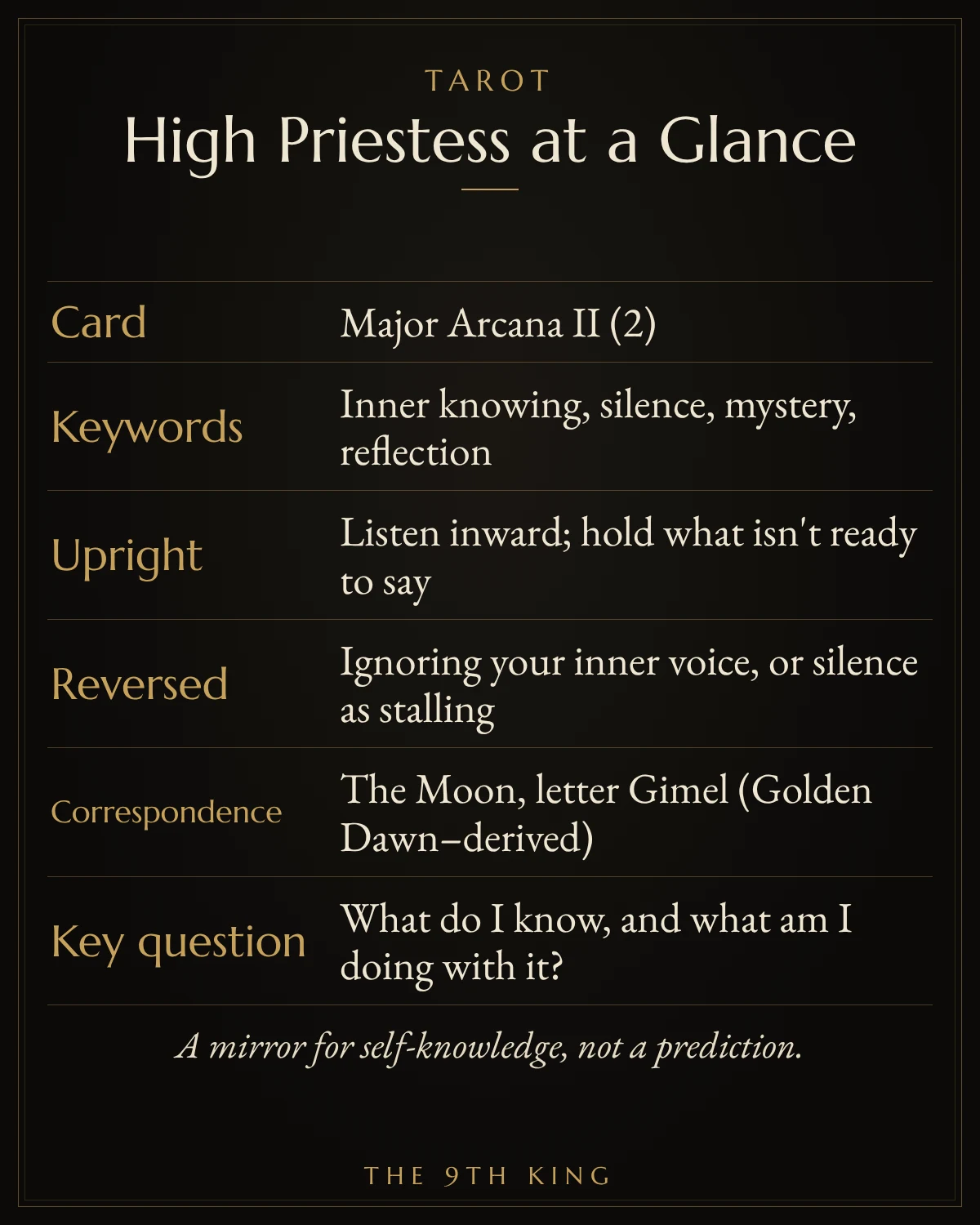
The High Priestess tarot card at a glance
| The High Priestess | |
|---|---|
| Number | II (2), Major Arcana |
| Core theme | Inner knowing and silence |
| Upright | Intuition, patience, the unspoken |
| Reversed | Ignored intuition, or secrecy |
| Correspondence (Golden Dawn–derived) | The Moon (planet) |
| Hebrew letter (Golden Dawn) | Gimel |
| 9K tension | Knowing vs telling |
| Key question | What do I know, and what am I doing with it? |
Below: the imagery, the common meanings, why the Moon, then the 9K reading and one exercise.
What’s on the card: The High Priestess tarot symbolism
Most modern decks follow the Rider–Waite–Smith design, drawn by Pamela Colman Smith to A. E. Waite’s instructions and first published by William Rider & Son in December 1909 (Wikipedia: Rider–Waite Tarot). Waite described the card in The Pictorial Key to the Tarot, now public domain (sacred-texts.com: Waite, The High Priestess); this section follows his description unless noted.
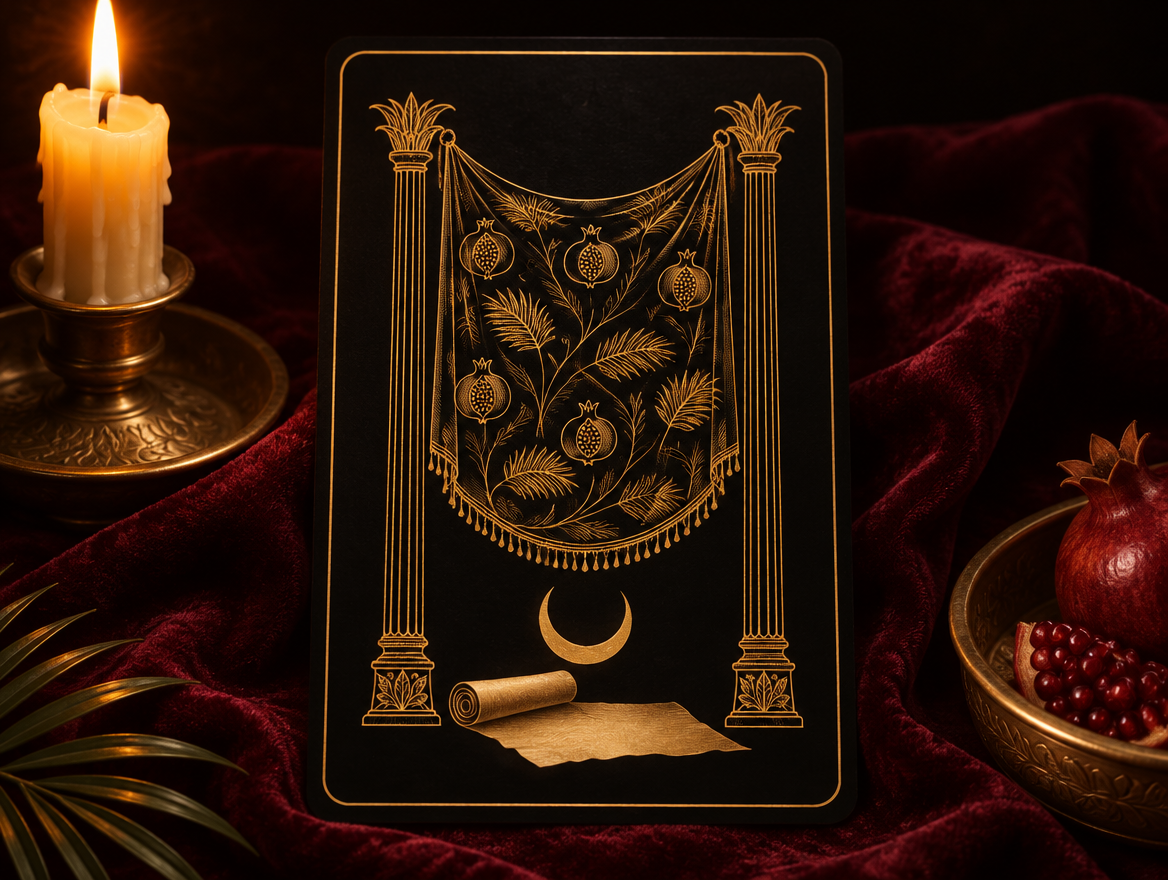
The pillars: white and black
She sits between two pillars, one white and one black, which Waite labels J. and B., the pillars of the mystic Temple. Readers often take the pillars as opposites held at once: light and dark, spoken and unspoken, known and not yet known. The High Priestess doesn’t pick a side. She sits in the space between.
The veil behind her
Behind her hangs the veil of the Temple, embroidered with palms and pomegranates. A veil hides something, but it also shows you something is there. Not a locked door, a curtain: what’s behind it isn’t forbidden, just not on display.
The scroll and the half-covered word
In her hands is a scroll inscribed Tora, which Waite links to the Greater Law and the Secret Law. What matters most here is how she holds it. The scroll is partly covered by her mantle, Waite says, to show that “some things are implied and some spoken.”
That line is the card in miniature. Not everything you know has to be said, and not everything unsaid is a lie.
The crescent, the crown and the cross
Waite lists three more symbols on the figure herself:
- A lunar crescent at her feet. The Moon is her ground, the thing she stands on.
- A horned diadem on her head, with a globe in the middle. A crown with horns, like a crescent, around a globe.
- A large solar cross on her breast. Sun symbolism held close, at the heart.
So she carries both lights: the Moon below and above, the Sun at the center. Waite calls her “the Queen of the borrowed light,” the Moon’s light being sunlight reflected. He adds that this borrowed light is the light of all, a gentle way of saying reflected light still counts as light.
Her robes
Waite describes flowing, gauzy vestments and a mantle of shimmering radiance. Nothing about her is armored; her power is stillness.
Older names for the card
In his survey of the trumps, Waite notes that the card was also called the Pope Joan, or Female Pontiff, and that some early writers called her the Mother or the Pope’s Wife, which he says goes against the symbolism (sacred-texts.com: Waite, The Trumps Major). He calls her instead the Secret Tradition. On the 1909 Smith card she wears no papal tiara, unlike older “Papess” cards, as Wikipedia notes (Wikipedia: Rider–Waite Tarot). Waite pairs her with the Hierophant, card V, as its counterpart.
He also draws on Kabbalah, naming her the Shekinah, the indwelling glory, and calling this card in some respects the highest and holiest of the Greater Arcana. You don’t need his framework to use it; he simply saw her as sacred and inward.
The High Priestess tarot meaning: upright and reversed
Below are the meanings readers commonly use, then Waite’s older list. The 9K interpretation follows.
The High Priestess upright
Upright, readers usually take The High Priestess as an invitation to slow down and listen inward. Common upright themes:
- Inner knowing: a sense of something you can’t fully explain yet, worth paying attention to.
- Silence and discretion: not everything needs to be said right now.
- Patience: letting a situation unfold before forcing an answer.
- Mystery: something isn’t visible yet, and that’s okay.
The useful upright message: you may already know more than you’ve admitted, so give it room.
The High Priestess reversed
Reversed, readers tend to go a few ways; your situation usually tells you which fits:
- Ignoring your inner voice. You sense something but keep overriding it, often to stay agreeable or busy.
- Surface knowledge. Collecting information without letting any of it sink in.
- Silence gone sour. Quiet that has become secrecy, withholding, or a way to avoid a needed conversation.
- Waiting too long. Calling it patience when it’s really avoidance.
What Waite’s 1911 list said
Waite’s divinatory list for the card reads: secrets, mystery, the future as yet unrevealed, silence, tenacity, wisdom and science. It also includes an old fortune-teller’s line about a woman who interests the Querent. Reversed, he gave passion, moral or physical ardour, conceit and surface knowledge (sacred-texts.com: Waite, Divinatory Meanings).
That’s fortune-telling language, which came to tarot long after the cards. Britannica dates tarot’s invention to Italy in the 1430s and its first use for fortune-telling to France about 1780 (Britannica: Tarot). On The 9th King we turn the old words into questions. “Secrets” becomes what am I keeping, and why? “Surface knowledge” becomes what do I know only in my head, and not yet in my life?
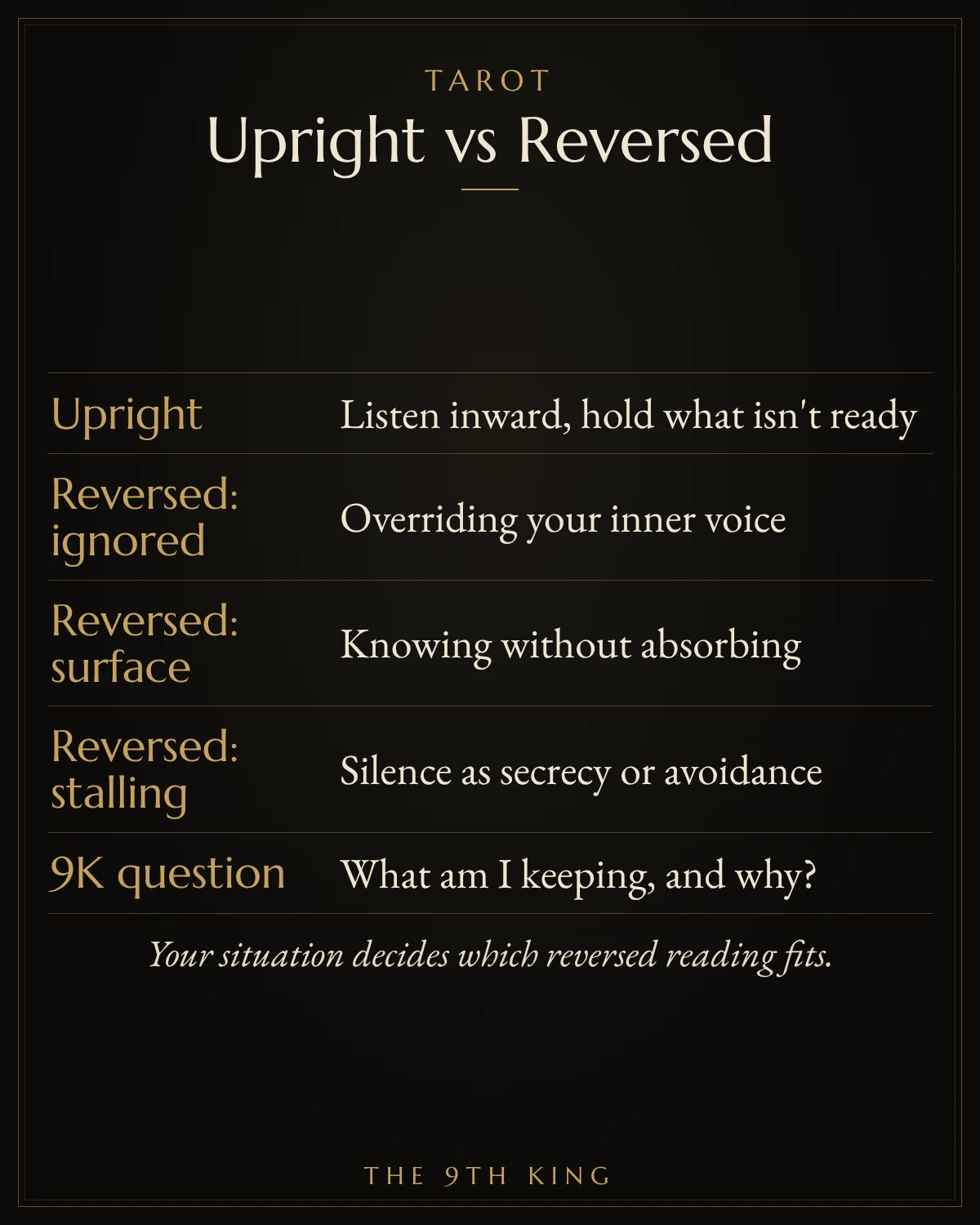
| Position | Common reading | Question to ask |
|---|---|---|
| Upright | Inner knowing, silence, patience | What do I already know? |
| Reversed (ignored) | Overriding your inner voice | What am I talking myself out of? |
| Reversed (surface) | Knowing without absorbing | What haven’t I let sink in? |
| Reversed (stalling) | Silence as secrecy or avoidance | What am I keeping, and why? |
The High Priestess and the Moon: the Golden Dawn correspondence
Why the Moon?
The astrology links on The 9th King are Golden Dawn–derived correspondences, the tradition The 9th King uses. The Hermetic Order of the Golden Dawn was an occult society, and both Waite and Pamela Colman Smith were members, which is why their deck reflects its ideas (Wikipedia: Rider–Waite Tarot).
The Golden Dawn’s Book T, as printed in Aleister Crowley’s Liber LXXVIII, lists card 2 as The Priestess of the Silver Star, with the Hebrew letter Gimel and the attribution Moon (Liber LXXVIII, sacred-texts.com). That’s a planet attribution, not a zodiac sign.
Waite’s own imagery fits the pairing: the crescent at her feet, the horned crown and the borrowed light are all lunar.
Not the same as The Moon card
Here’s the naming trap. The card called The Moon (XVIII) isn’t attributed to the Moon in this system. Its Golden Dawn correspondence is the sign Pisces, as our Moon tarot card guide explains. The planet Moon belongs to The High Priestess. The two share a mood, not an attribution.
Other schools differ
Other traditions use different attributions, and not every card maps to a single sign or planet (court cards and Pages follow a separate scheme). The Moon pairing is a symbolic lens, not a law. Our overview of tarot and the zodiac lays out how the 9K system fits together.
What the Moon adds to the card
In astrology the Moon is associated with feelings, instincts, memory and what you need to feel safe: the private side of a chart. Read The High Priestess through that lens and her silence makes sense. She’s not hiding to deceive; she’s protecting something tender until it’s ready.
Your own Moon sign describes how you process quietly; our Moon sign guide explains it, and how to read a birth chart shows where it fits. The Moon also rules Cancer, so Cancer personality traits adds context on protection and emotional memory. That’s context only: this isn’t “the Cancer card.” Its attribution is the planet.
The 9K reading: knowing versus telling
The tension: inner knowing vs outward action
The High Priestess’s tension isn’t intuition versus logic. It’s knowing versus telling, and behind that, knowing versus doing.
- Knowing is what she has: the scroll, the quiet, the sense of what’s true.
- Telling is what she doesn’t rush.
- Doing is where her lesson ends up. Knowledge that never touches your life stays a scroll in your lap.
The healthy version of this card holds what it knows without announcing it, and chooses on purpose when to speak and when to act.
What inner knowing is, and isn’t
Inner knowing is worth listening to; it’s often your mind joining dots faster than you can name them. But it isn’t infallible, and here’s the honest part: how a feeling feels doesn’t tell you whether it’s intuition. A quiet, settled sense can be wrong. A loud, anxious one can be right. Calm isn’t proof, and neither is urgency.
So give inner knowing a hearing, then a test. What’s it based on? What would change your mind? Our guide to psychological projection is useful here, because sometimes what feels like knowing is an old fear placed onto a new situation.
The shadow side: when silence becomes control
The High Priestess’s shadow is subtle because it looks like a virtue. From the outside, these look just like silence and patience:
- Secrecy as control. Keeping information back because it gives you an edge, or keeps someone else off balance.
- Withholding. Going quiet to punish, or making someone guess what’s wrong instead of telling them.
- “Waiting for a sign.” Calling it patience when you already know what you need to do and are avoiding it. Sometimes the sign you’re waiting for is permission you could give yourself.
- Hoarding insight. Knowing yourself in theory and changing nothing.
The difference between privacy and controlling secrecy usually comes down to why and who it affects. Privacy protects you; secrecy as control manages someone else. Our guide to privacy without mixed signals goes into that line in detail. And if you’re on the other side of it, with someone using silence or secrets to control you, that behavior is theirs to own, not yours to fix.
The self-mastery lesson: hold it, then choose
The self-mastery lesson of The High Priestess is: you’re allowed to know things quietly, and you’re responsible for what you do with them.
In practice:
- Listen before you speak. Give your inner sense a hearing before you explain it away or broadcast it.
- Check your reason for silence. Ask whether you’re protecting something or avoiding something.
- Choose your moment, then use it. Silence is a pause, not a permanent address. When the time comes, speak or act.
If your silence turns out to be an old habit from a time when speaking up wasn’t safe, Shadow Work, Plainly is a gentle place to start looking at it.
The High Priestess tarot card in love, work and self-growth
These are reflections, not predictions.
The High Priestess in love
In love readings, The High Priestess often points to what’s unsaid in a connection: feelings not yet named, an unchecked sense about someone, or two people still guarded. It can also point to healthy privacy: not every feeling needs sharing on day one.
Questions worth asking:
- What do I sense about this connection that I haven’t said, even to myself?
- Am I quiet because it’s not time yet, or because I’m scared of the answer?
- Is my mystery protecting me, or keeping someone at a distance I don’t actually want?
The High Priestess doesn’t tell you to stay or leave. It asks you to know your own mind first, then decide what to share and when.
The High Priestess at work
At work, the card can point to discretion: confidential information, a project still in development, or a moment where listening teaches more than talking.
A grounded approach:
- Notice what you’ve observed but haven’t voiced, and ask whether voicing it would help.
- Respect real confidentiality, but be honest about the difference between discretion and hiding a problem.
Nothing here is career or financial advice. For money or contract decisions, talk to a qualified professional.
The High Priestess in self-growth
For personal growth, The High Priestess is about building a relationship with your own quiet. The growth isn’t learning something new; it’s taking what you already know seriously enough to let it change something.
A practical exercise: the Three Drawers
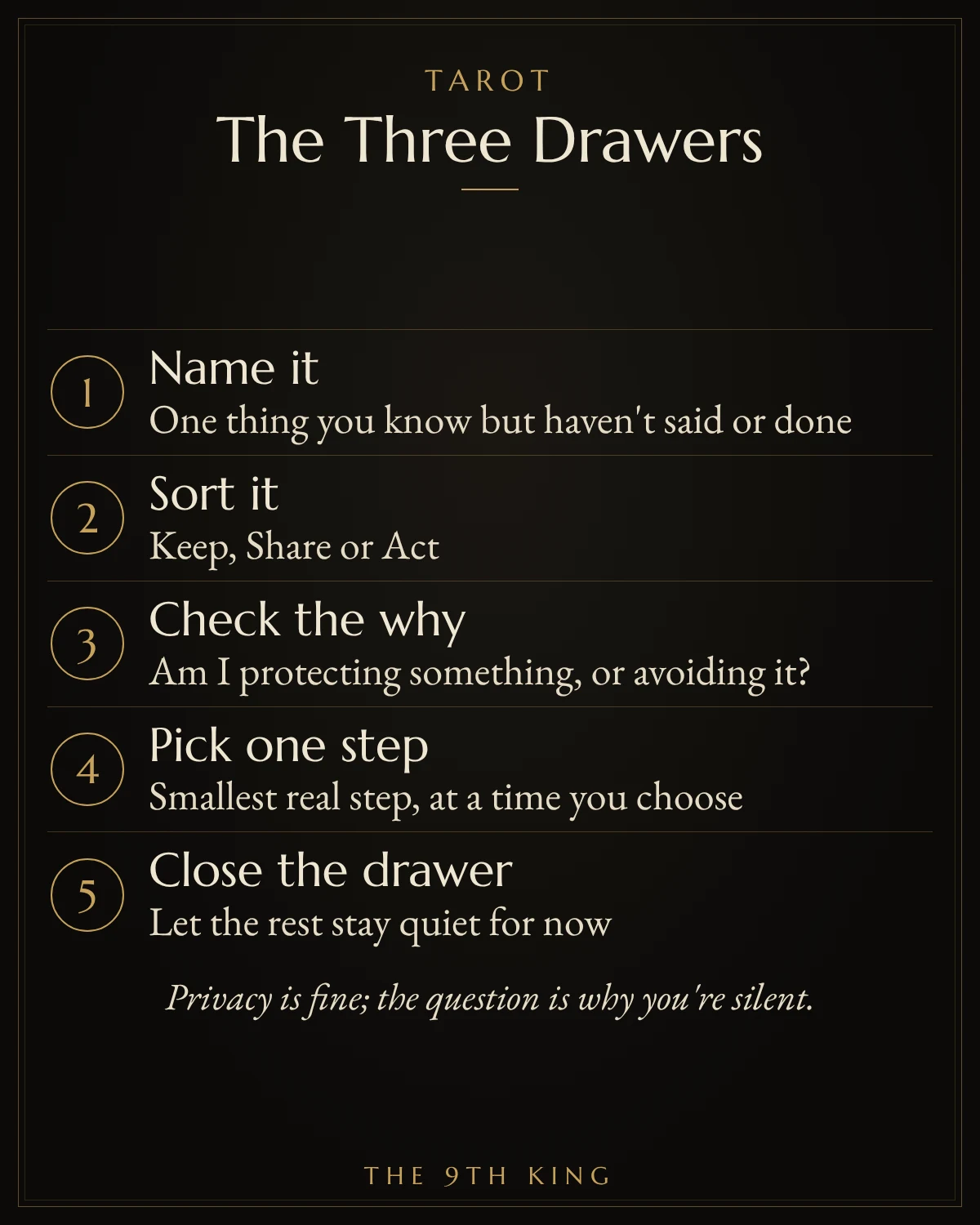
This takes about fifteen minutes, with or without a deck. You need paper, a pen and, if you like, The High Priestess in front of you (pull it on purpose). You sort what you know into three drawers, keep, share and act, and check your reasons honestly.
The steps
- Name it. Write down one thing you know, or strongly sense, that you haven’t said out loud or acted on. One sentence. “I know I’m not happy in this role.”
- Sort it. Decide which drawer it belongs in for now: Keep (private, and fine to stay that way), Share (someone needs to hear it) or Act (it calls for a step, not a conversation).
- Check the why. Write one honest line about why you’ve been quiet. Then ask: am I protecting something, or avoiding something? It can be both, and both are human.
- Pick one step. For Share or Act, write the smallest real step you could take, and when you’ll take it. You choose the timing; there’s no right number.
- Close the drawer. Read what you wrote once, put the card away, and let the rest stay quiet. Not everything needs to move today.
Worked example (fictional)
Marcus (fictional) has known for months that he wants to go back to school part-time. He hasn’t told his partner or looked at a single program.
He writes it down, then sorts it. At first he puts it in Keep. When he checks the why, the honest line is: “If I say it, I’ll have to do it, and if I fail, everyone will know.” That’s avoidance wearing patience as a costume. He’s been “waiting for a sign.”
He moves it to Share. His one step is small: tell his partner on Sunday, just the wish, no plan yet. The point isn’t to decide everything in one sitting. It’s to stop keeping it from the person it affects most.
Using the exercise in a reading
If The High Priestess comes up in a spread, run the Three Drawers on your question; our three-card tarot spread pairs well with it. To lean on intuition more than the book, Code of Ascension’s guide to intuitive tarot (Code of Ascension) covers reading by feel.
Journal prompts for The High Priestess
Use one prompt per session. Write for ten minutes, then leave it until the next day.
- What do I know about my life right now that I haven’t said out loud?
- When did I last override an inner sense to keep the peace? What happened?
- Where in my life am I calling it patience when it might be avoidance?
- Who do I keep at a distance with silence, and what am I protecting by doing it?
- When has a quiet hunch of mine been right, and what evidence confirmed it? When has one been wrong?
- What did I learn about speaking up when I was young, and does that rule still serve me?
- What would change if I took one thing I already know seriously this week?
For more, see our shadow work prompts and zodiac shadow work guide.
A gentle note: this is reflective practice, not therapy. If you’re dealing with trauma, abuse, thoughts of self-harm or distress that feels overwhelming, please work with a qualified therapist who can support you properly. And it’s always fine to stop a prompt that feels like too much.
Myths and misreadings about The High Priestess
- “The High Priestess means someone is keeping a secret from you.” It can point to hidden information, but it doesn’t accuse anyone. Often the thing unspoken is yours.
- “She’s a passive card.” Listening is active, and her lesson ends in a choice about when to speak or act.
- “A calm feeling is your intuition talking.” A feeling’s tone doesn’t prove it’s intuition. Calm hunches can be wrong and anxious ones right. Check the feeling against what you can see.
- “Secrecy is always the shadow.” Privacy is healthy. The shadow is secrecy used to control, punish or avoid. The question is why, and who it affects.
- “Reversed means you’ve lost your intuition.” You don’t lose it. Reversed, readers usually see it as being ignored, crowded out or stuck behind avoidance.

The High Priestess Tarot Card: FAQ
What does The High Priestess tarot card mean?
The High Priestess, Major Arcana II, is commonly read as inner knowing, intuition, silence, patience and mystery. She sits between a white and a black pillar, holding a half-covered scroll before a veil. On The 9th King she’s a mirror, not a prediction: she asks what you already know, why you’re keeping it quiet, and when it’s time to speak or act.
What does The High Priestess reversed mean?
Readers usually take The High Priestess reversed as ignoring your inner voice, knowing things without letting them sink in, or silence that has turned into secrecy or stalling. Waite’s list included conceit and surface knowledge. Treat it as a question, not a verdict: where am I overriding what I sense, or calling avoidance patience?
What planet is The High Priestess tarot card?
In the Golden Dawn–derived correspondences The 9th King uses, The High Priestess is attributed to the Moon, with the Hebrew letter Gimel, as printed in Liber LXXVIII. That’s a planet, not a zodiac sign. Other traditions use different attributions, so treat the pairing as a symbolic lens rather than a fixed rule.
Is The High Priestess the same as The Moon card?
No. The High Priestess is card II and carries the planet Moon in the Golden Dawn system. The card named The Moon is card XVIII and carries the sign Pisces. They share a lunar mood, but The Moon is about fog and uncertainty, while The High Priestess is about quiet knowing and choosing when to share it.
What does The High Priestess mean in love?
In love, The High Priestess often points to what’s unspoken: feelings not yet named, a sense about someone you haven’t checked, or two people still guarded. It doesn’t tell you to stay or leave. It asks you to know your own mind first, and to notice whether your silence is protecting you or keeping someone at a distance.
Is The High Priestess a yes or no card?
The 9th King doesn’t use tarot for yes or no answers. The High Priestess is about what isn’t visible yet, which makes her a poor fit for a verdict. A more useful approach: ask what you already sense, what you haven’t said, and what one small step would honor what you know, whatever the outcome.
What do the pillars on The High Priestess card mean?
Waite describes a white pillar and a black pillar, marked J. and B., the pillars of the mystic Temple, with the High Priestess seated between them. Many readers take them as opposites held in balance: light and dark, spoken and unspoken. She doesn’t choose a side, which is part of her lesson: you can hold two truths while you wait to understand them.

Your next step: pick one thing you’ve known for a while and haven’t said or done, and run it through the Three Drawers above. Then read our guide to privacy without mixed signals to sharpen the line between healthy privacy and silence that costs you.
Explore Next
- When silence is healthy, and when it isn’t: Privacy Without Mixed Signals
- The planet behind the card: Moon Sign Meaning
- The card that shares a name, not an attribution: The Moon Tarot Card
- Questions for the hidden self: Shadow Work Prompts
- Reading tarot from the ground up: Tarot for Beginners: How Tarot Really Works (Code of Ascension)
- More tarot on The 9th King: Tarot Card Meanings · Major Arcana · Tarot & the Zodiac · Shadow Work Tarot Spread
- More Major Arcana: The Magician · The Empress · The Hierophant

Final Thought: Knowing Is the Beginning, Not the End
The High Priestess keeps her scroll half-covered, and that’s allowed. Some things are yours to carry quietly. But the scroll is still in her hands, ready to be read when the time comes. Listen inward, check your reasons for silence, and when you know it’s time, speak or step. Know your nature. Rule your life.
About the Author
King is the founder of The 9th King, where zodiac psychology, relationships and shadow work are explored as tools for self-knowledge rather than fortune-telling. He’s a Libra Sun, and writes about the personal side of astrology on King The Kemist. Astrology on The 9th King is interpretation and self-reflection, not prediction or established fact.
Leave a Reply