Quick Answer: What Is a Jupiter Return?
A Jupiter return is the moment (or moments) when the planet Jupiter, moving through the sky today, comes back to the same degree it occupied when you were born, and the season around it while Jupiter is back in your natal sign. Because Jupiter takes about 12 Earth years to go once around the Sun, this happens roughly every 12 years: around ages 12, 24, 36, 48, 60, 72 and 84.
What astrologers read into it:
- Growth: a new round of expanding, learning or reaching further.
- Faith and meaning: a check-in on what you believe and what feels worth doing.
- Teachers and mentors: the people, books and traditions that widen your world.
- Generosity, and its overflow: saying yes, sometimes to too much.
It is not a guarantee of luck, money or a big break. Read it as a reflective season: a natural point to ask what you’ve outgrown and what you want to grow into next. To find yours, you only need the sign and degree of your natal Jupiter. A birth time helps with the house; for the sign it usually isn’t needed, unless Jupiter changed signs on the day you were born.
Table of Contents
The astronomy first: why every 12 years?
Everything about the Jupiter return starts with one number. NASA’s Jupiter facts page puts a Jupiter year at about 12 Earth years, or 4,333 Earth days. Divide 4,333 by 365.25 and you get roughly 11.86 years. That’s the length of one full trip around the Sun. Seen from Earth, Jupiter also takes about 11.86 years on average to move through all twelve zodiac signs. But Earth is moving too, which adds retrograde loops to Jupiter’s path, so any single return can arrive a few months earlier or later than a straight 12-year count, and the exact degree can be reached once or three times.
That makes Jupiter’s pace easy to remember: about one sign per year, twelve years per circle. The time in each sign varies a little, but it’s a good working rule.
Why the ages aren’t exact
Because the real cycle is a bit under 12 years, the returns drift slightly earlier than the round numbers as life goes on:
| Return | Round number | Closer to |
|---|---|---|
| 1st | 12 | about 11.9 |
| 2nd | 24 | about 23.7 |
| 3rd | 36 | about 35.6 |
| 4th | 48 | about 47.4 |
| 5th | 60 | about 59.3 |
| 6th | 72 | about 71.2 |
| 7th | 84 | about 83.0 |
So by the seventh return, the timing is closer to 83 than 84. Treat the ages as a neighbourhood, not a birthday. Your actual dates come from the sky, which is why the “how to find yours” section below matters more than any age list.
Why it can be exact up to three times
Jupiter sometimes appears to move backward against the stars. This is called retrograde motion, and it’s an effect of viewpoint. NASA’s Astronomy Picture of the Day explains that it happens when Earth overtakes the slower outer planets as they orbit the Sun (NASA APOD, May 6, 2026: The Retrograde Dance of Saturn and Neptune). Like a slower car you pass on the motorway, it seems to slide backward against the hills without ever reversing.
If your natal Jupiter sits in the stretch of sky that Jupiter backs over during a retrograde, the transiting planet can cross your exact degree three times: once going forward, once during the retrograde, and once more after it turns direct. If your natal degree sits outside that stretch, you’ll get one exact pass.
That’s why astrologers often describe a Jupiter return as a season lasting several months, rather than a single day. The whole year Jupiter spends in your natal sign tends to be read as the broader return period, with the exact hits as its sharpest points. Our natal chart vs transits guide covers how transits in general are timed.
What a Jupiter return means in astrology
Astrology gives each planet a set of themes. Jupiter’s are some of the warmest in the chart, and also some of the easiest to misread.
Jupiter as the “greater benefic”
In traditional astrology, planets are grouped by whether they tend to help or hinder. Deborah Houlding’s Skyscript glossary describes benefics as planets “that assist in a positive outcome,” and notes that Jupiter is traditionally called the Greater Benefic and Venus the Lesser Benefic (Skyscript: Benefics).
That label is the root of the popular idea that a Jupiter return is “lucky.” But a benefic is a planet whose symbolism leans toward ease, support and increase. It describes a tone, not a payout.
Jupiter’s core themes
When astrologers read Jupiter in a chart, they tend to look at:
- Growth and expansion: where life wants to get bigger, broader or more ambitious.
- Belief and faith: religious, philosophical or simply the working assumptions you live by.
- Meaning: the sense that what you’re doing connects to something worthwhile.
- Teachers and learning: higher education, mentors, travel, other cultures, big ideas.
- Generosity and trust: giving, receiving and believing things can work out.
- Excess: overdoing it, overpromising, overspending, overcommitting.
Rulership and dignity
Jupiter traditionally rules Sagittarius and Pisces, which is why those signs carry so much of its flavour. Sagittarius gets the restless, truth-seeking, travelling side of Jupiter (see Sagittarius personality traits). Pisces gets the devotional, compassionate, boundary-dissolving side (see Pisces traits). Skyscript’s dignities entry also lists Jupiter as exalted in Cancer and in fall in Capricorn (Skyscript: Fall), which ties Jupiter to protection, care and abundance shared at home, as our Cancer personality traits guide explains.
So what does the return itself mean?
Put those themes together and the Jupiter return reads as a renewal of your personal growth cycle. Whatever Jupiter describes in your birth chart, by sign, house and aspects, comes back around for review. Astrologers often describe it as a time when beliefs feel up for revision, a teacher appears (or you become one), and the question “what is this all for?” gets louder. None of that is guaranteed. The return is a lens for noticing what’s already moving in your life, not a forecast of what will arrive.
A quick contrast with the Saturn return
The Saturn return, around ages 29 to 30, is usually read as structure, limits and responsibility. Jupiter’s is read as growth, meaning and faith. Saturn asks what will you build and maintain? Jupiter asks what will you open up to?
How to find your Jupiter return
You need your birth data and about ten minutes.
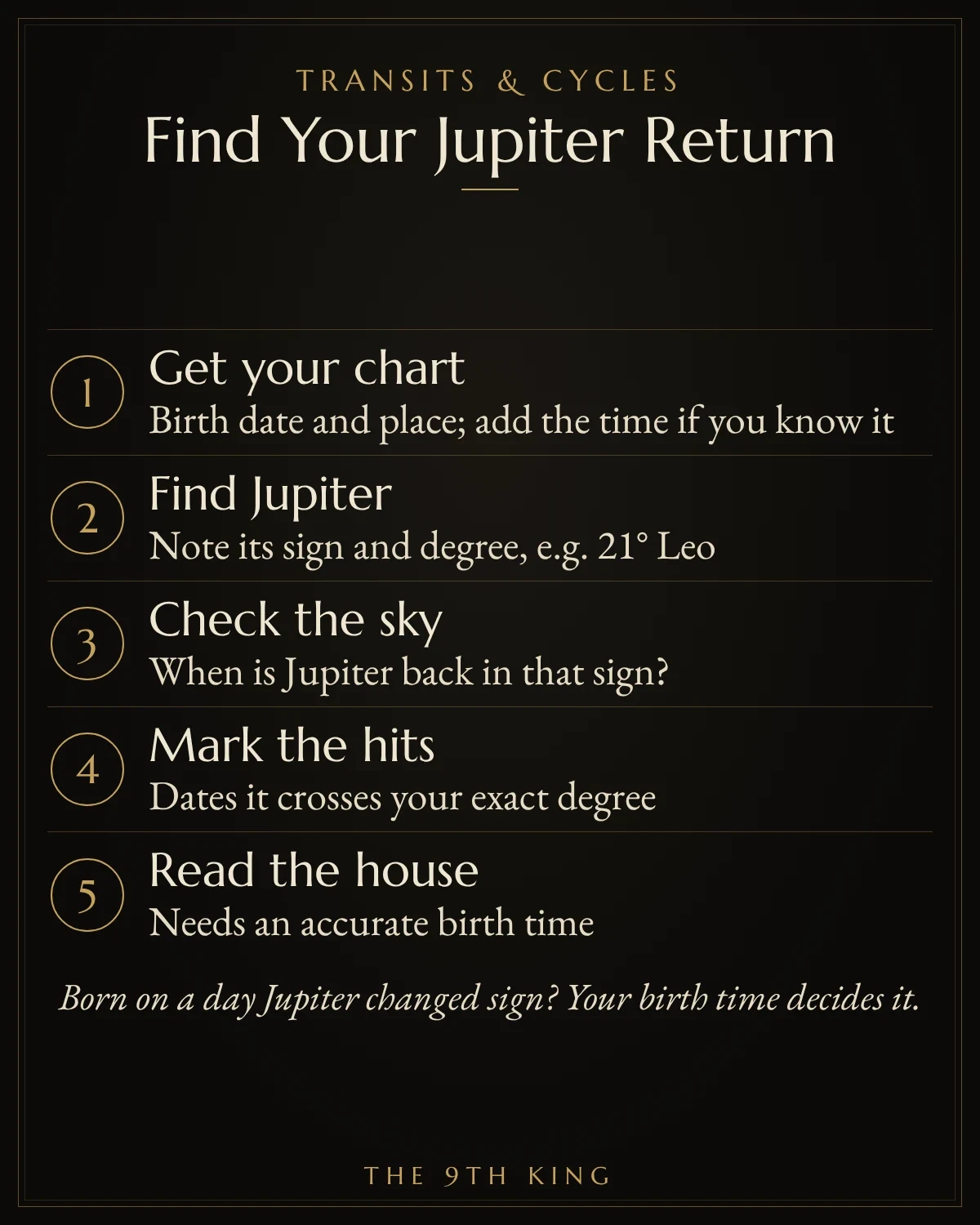
Step 1: Pull up your birth chart
Use a free chart service. Astrodienst’s free horoscopes page offers a chart drawing with your Ascendant and calculations. You’ll need your birth date and place, and your birth time if you have it. If you’re new to reading the wheel, our how to read a birth chart guide walks through the symbols.
Step 2: Find natal Jupiter’s sign and degree
Look for the Jupiter glyph (♃) and note two things: its sign and its degree. For example, “Jupiter at 14° Leo.” Write it down. That’s your target.
Do you need a birth time for this? For the sign, almost never. Jupiter spends about a year in each sign, so your birth date is enough unless you were born on a day Jupiter changed signs. Then the birth time decides it. The exact degree shifts only a little over a single day, so a missing birth time barely affects the timing of your return.
Step 3: Check when Jupiter comes back to that sign
Your Jupiter return year is the year transiting Jupiter is back in your natal Jupiter’s sign. Astrodienst’s page also offers an ephemeris tool for any time range, which lists where each planet is on each date. You can also search a reputable astrology calendar for “Jupiter enters [your sign]” plus the year.
Shortcut: Jupiter was in today’s sign roughly 12, 24 and 36 years ago too, give or take at the edges.
Step 4: Mark the exact hits
Scan the ephemeris for the dates Jupiter reaches your natal degree. Strictly, an exact return is a moment: the instant transiting Jupiter reaches the same degree and minute as your natal Jupiter. If a retrograde happens nearby, you may get three such moments. Astrologers often talk about a broader return period around them (the months Jupiter spends near your degree, or even the whole year it’s in your natal sign), so be clear which one you mean. The exact dates are the peaks of the season, and good days to sit down with your journal.
Step 5: Find the house (birth time needed)
Houses depend on the rotation of the Earth, which changes every few minutes, so the house your Jupiter sits in needs an accurate birth time. Different house systems can also put Jupiter in different houses, especially near a cusp. Pick one system and stay with it. Our 12 houses guide explains what each house covers.
Jupiter return 2026: who’s having one?
Here’s where the sky stands around the time of writing (November 2026).
Jupiter in Cancer: Cafe Astrology lists Jupiter in Cancer from June 9, 2025, to June 30, 2026, and its previous stay there from June 25, 2013, to July 16, 2014 (Cafe Astrology). So people born in that 2013–2014 window had their first Jupiter return, around age 12, during 2025–2026.
Jupiter in Leo: Astrostyle lists Jupiter entering Leo on June 30, 2026, and gives its previous Leo stay as July 16, 2014, to August 11, 2015 (Astrostyle). That means children born in that window are in their first Jupiter return now.
Moving back in roughly 12-year steps, people born with Jupiter in Leo in the previous cycles are in a Leo Jupiter return too: Jupiter was in Leo from about August 1, 2002 to late August 2003, and from about mid-August 1990 to mid-September 1991 (our own calculation of Jupiter’s geocentric ecliptic longitude using the Astropy library’s built-in planetary ephemeris; allow a day or two either side, and confirm in Astrodienst’s free ephemeris). Earlier cycles were messier because of retrogrades: Jupiter moved in and out of Leo across 1978–1979, 1966–1968 and 1955–1956. If you were born in those years, check your own chart for Jupiter’s sign rather than trusting a year range.
The retrograde in Leo: Jupiter stations retrograde at about 27° Leo on December 13, 2026 in Coordinated Universal Time (UTC), which is the evening of December 12 in US Eastern time. It turns direct at about 17° Leo on April 13, 2027 (UTC), the evening of April 12 in US Eastern time, then moves into Virgo late on July 25, 2027 in US Pacific time, which is July 26 in UTC and US Eastern time (Synthesis Astrology). We checked these dates with our own calculation (Jupiter’s geocentric ecliptic longitude from the Astropy library’s built-in planetary ephemeris, sampled every half hour), and you can confirm them in Astrodienst’s free ephemeris. If a calendar shows a date one day earlier, it’s almost always using a US time zone.
What that means in practice: if your natal Jupiter sits between roughly 17° and 27° Leo, transiting Jupiter is likely to cross your exact degree three times between late 2026 and mid-2027. Outside that stretch you get a single exact pass: in 2026 for the early degrees of Leo, in 2027 for the last few. Check an ephemeris for your own degree.
If you’re curious what Leo symbolism adds to Jupiter’s themes, our Leo personality traits guide covers the sign of creative confidence and visibility.
Jupiter return ages and themes
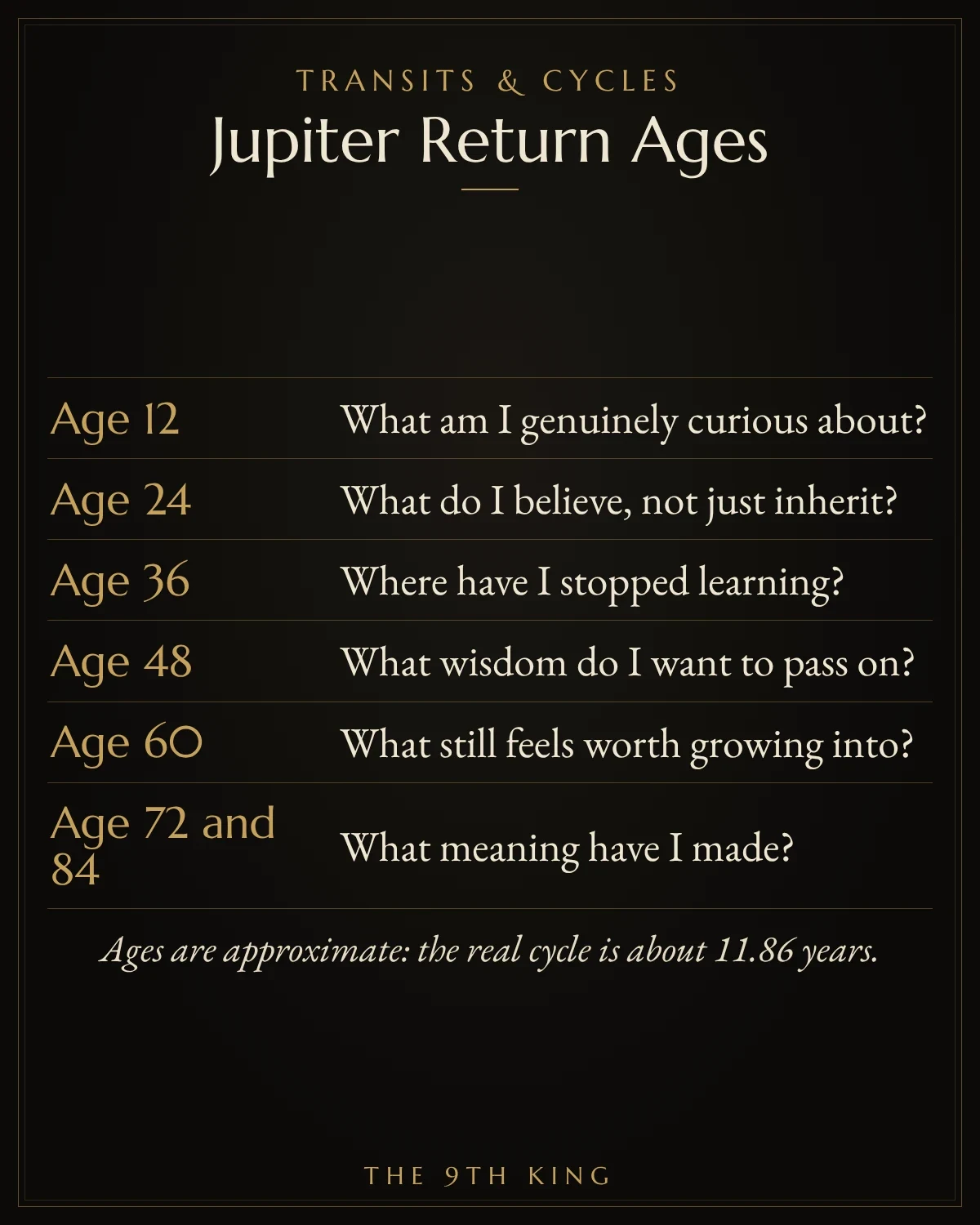
Each return lands at a different life stage, so the same planet asks different questions. These are reflective prompts, not developmental rules, and plenty of people feel nothing obvious at a given return.
| Age (approx.) | Common theme | A reflective question |
|---|---|---|
| 12 | Curiosity, first independent beliefs | What am I genuinely curious about? |
| 24 | Choosing a worldview, early adult direction | What do I actually believe, not just inherit? |
| 36 | Expanding or rethinking a path | Where have I stopped learning? |
| 48 | Mentoring, mid-life meaning | What do I know that’s worth passing on? |
| 60 | Renewed purpose, new freedoms | What still feels worth growing into? |
| 72 | Wisdom, legacy, faith | What do I trust now that I didn’t before? |
| 84 | Meaning and gratitude | What meaning have I made, and who shares it? |
Reading the stages
- Around 12: children start testing the beliefs they were handed. For parents, it’s a moment to notice what lights a child up, not to look for omens.
- Around 24: often read as the “explore” chapter, choosing a worldview or direction to try, a few years before the Saturn return’s “commit” chapter.
- Around 36 and 48: themes often shift from getting more to getting wiser: a second education, a pivot, or teaching what you know.
- 60 and beyond: returns of meaning. With fewer outside demands, the question becomes what you still want to explore, and what has carried you.
Jupiter return by house
The house of your natal Jupiter is where the return plays out most directly, because transiting Jupiter returns to that same house. Remember: this needs an accurate birth time, and the house can change depending on the house system. The examples below use whichever system you’ve chosen; the themes are short on purpose.
| House | Where growth is focused | Reflective question |
|---|---|---|
| 1st | Self, body, presence | How do I want to show up now? |
| 2nd | Money, values, skills | What do I truly value, not just own? |
| 3rd | Learning, writing, siblings | What do I want to learn or say? |
| 4th | Home, family, roots | What does home need to grow into? |
| 5th | Creativity, joy, children | Where do I want more play? |
| 6th | Work habits, health routines | Which daily habit deserves an upgrade? |
| 7th | Partnerships, contracts | What kind of partner am I becoming? |
| 8th | Shared resources, intimacy | What am I ready to share or release? |
| 9th | Study, travel, belief | What am I ready to understand? |
| 10th | Career, reputation | What do I want to be known for? |
| 11th | Friends, groups, hopes | Who am I growing alongside? |
| 12th | Retreat, spirit, the unseen | What do I need to rest and restore? |
A few notes on reading the table:
- The 9th and 12th are the houses modern astrologers pair with Sagittarius and Pisces, Jupiter’s two signs. Returns here are often read as especially reflective or philosophical.
- The 2nd and 8th involve resources. These are the houses where the “overspending” side of Jupiter deserves the most attention.
- The sign matters too. Jupiter in Taurus in the 2nd reads differently from Jupiter in Gemini in the 2nd. Combine house with sign, and with any aspects Jupiter makes, which our astrology aspects guide covers.
A worked example (fictional)
The chart (fictional, Whole Sign houses): natal Jupiter at 21° Leo in the 10th house.
The 2026–27 picture: transiting Jupiter enters Leo on June 30, 2026. Because 21° sits inside the stretch Jupiter backtracks over during its 2026–27 retrograde, this person could get three exact passes: one on the way forward in late 2026, one while Jupiter is retrograde in early 2027, and one after it turns direct, in spring or early summer 2027.
The reading: a growth season focused on career and public role (10th house) in a sign of creativity and visibility (Leo). The useful questions: Am I growing into work that I’d be proud to be seen doing? Am I saying yes to visibility I actually want, or just to more?

A Jupiter return worksheet
Use this before or during your return season, and revisit it at each exact hit.
- Write your Jupiter placement. Sign, degree and house (if you know your birth time). Example: Jupiter 21° Leo, 10th house.
- Look back 12 years. What were you learning, believing or reaching for at your last return? List three things.
- Name what grew. Of those three, which one actually grew, and which one fizzled? Be honest; both teach something.
- Name what you’ve outgrown. Which belief, habit or goal from that time no longer fits?
- Name one teacher. A person, book, practice or tradition that widened your world in the last cycle.
- Choose one area to expand. Use the house table above as a prompt. Pick one area, not five.
- Set a limit. Write down what “too much” would look like: money, time or commitments. This is your Jupiter guardrail.
- Pick a date to review. Put a reminder on the calendar for each exact hit, or the end of Jupiter’s year in your sign.
Step 7 isn’t there to dampen hope. It keeps the growth you choose sustainable.
Jupiter return journal prompts
Use one prompt at a time. You don’t need to answer them all, and it’s fine to skip one that doesn’t fit or that stirs up more than you want right now. If reflection on the past brings up something heavy, such as trauma or overwhelming distress, a qualified therapist is a better companion for that than a journal.
- What do I believe now that I didn’t believe twelve years ago?
- Where in my life am I ready to grow, and where am I just restless?
- Who taught me something important in the last cycle, and have I told them?
- What does “enough” look like for me this year?
- What would I study, explore or visit if I trusted it would be worth it?
- Where have I been generous, and where have I been overextended?
- What gives my life meaning right now, in one sentence?
Common Jupiter return mistakes
Jupiter’s themes are generous, which makes its mistakes easy to make and easy to forgive. A gentle look at the usual ones:
- Expecting a jackpot. The “greater benefic” label describes a supportive tone, not a windfall. Waiting for luck can mean missing the quieter growth that’s actually on offer.
- Saying yes to everything. Jupiter can be read as the planet of more. More plans, more projects, more promises. Pick the yeses that matter.
- Overspending in the name of abundance. A return isn’t a financial signal. If you’re thinking about a big purchase or investment, decide it on its merits, not the transit.
- Overpromising. Optimism is lovely; a calendar with no room in it is not. Promise what you can keep.
- Comparing returns. Your friend’s return was a dream job; yours was a quiet year of reading. Both count.
- Ignoring the house. If you know your birth time, the house is often where the return feels most personal. If you don’t, the sign alone is still worth reflecting on.
- Treating it as a deadline. Nothing has to happen by your Jupiter return. It’s a check-in, not a test.
Jupiter Return: FAQ
What is a Jupiter return?
A Jupiter return is the moment (or moments) when transiting Jupiter comes back to the degree it held at your birth, and the season around it while Jupiter is back in your natal sign. Because Jupiter’s orbit takes about 11.86 years, it happens roughly every 12 years. Astrologers read it as a renewal of your growth cycle: a time to review beliefs, learning, teachers and what gives your life meaning. It’s a reflective season, not a guarantee of luck.
At what age is your Jupiter return?
Roughly at ages 12, 24, 36, 48, 60, 72 and 84. Because the real cycle is a little under 12 years, later returns come slightly early; the seventh lands closer to 83 than 84. The exact timing depends on where Jupiter was when you were born, so check an ephemeris or chart service for your own dates rather than relying on age alone.
How do I find when my Jupiter return is?
Pull up a free birth chart, find Jupiter’s sign and degree, then look up when transiting Jupiter returns to that sign. An ephemeris shows the exact dates it crosses your natal degree. Your birth date is usually enough for the sign. You need an accurate birth time to know which house your Jupiter return falls in, and for the sign if Jupiter changed signs on your birth date.
How long does a Jupiter return last?
The exact return is a single moment: the instant Jupiter reaches your natal degree and minute. Because Jupiter moves slowly, it can stay within about a degree of that point for days or even weeks, especially near a station, and most astrologers read the whole year Jupiter spends in your natal sign as the return season. If a retrograde happens near your natal degree, Jupiter can cross it three times over several months. That’s why it’s better to think of a Jupiter return as a season rather than a single date.
Is a Jupiter return lucky?
Not necessarily. Jupiter is traditionally called the “greater benefic,” meaning its symbolism leans toward support and increase. But that describes a tone, not a promised outcome. Many people experience the return as a time of learning, rethinking beliefs or meeting a mentor rather than a windfall. It can also bring the temptation to overdo things, so treat it as a reflective season.
Who is having a Jupiter return in 2026?
Jupiter was in Cancer until June 30, 2026, then moved into Leo, according to Cafe Astrology and Astrostyle. People with natal Jupiter in Cancer had their return in 2025–2026; people with natal Jupiter in Leo are in theirs from mid-2026 into 2027. That includes children born mid-2014 to mid-2015 and adults born about 12, 24 or 36 years earlier.
What’s the difference between a Jupiter return and a Saturn return?
A Saturn return comes around age 29 to 30 and is usually read as a time of structure, responsibility and limits. A Jupiter return comes about every 12 years and is read as growth, faith and meaning. One asks what you’ll build and maintain; the other asks what you’ll open up to. Both are interpretive frameworks for reflection, not predictions.
Does the Jupiter return house matter?
Yes, if you know your birth time. The house shows which area of life the return focuses on: career in the 10th, relationships in the 7th, study and travel in the 9th, and so on. Different house systems can place Jupiter differently near a cusp, so choose one system and stay consistent. Without a birth time, reflect on the sign instead.

Your next step: find your natal Jupiter. Pull up your birth chart, write down Jupiter’s sign, degree and house, then read our natal chart vs transits guide to see how a returning planet fits into the rest of your timing.
Explore Next
- How transits work: Natal Chart vs Transits
- Find Jupiter’s house: The 12 Houses in Astrology
- Read your whole chart: How to Read a Birth Chart
- Jupiter’s signs: Sagittarius Personality Traits · Pisces Traits
- Your yearly birthday chart: Solar Return Chart
- How your chart slowly unfolds: Progressed Chart

Final Thought: Grow Toward What Means Something
A Jupiter return doesn’t hand you anything. It brings a familiar question back around: what are you growing toward, and does it still mean something to you? Answer it honestly every twelve years and you’ll have a record of who you’ve become. Know your nature. Rule your life.
About the Author
King is the founder of The 9th King, where zodiac psychology, relationships and shadow work are explored as tools for self-knowledge rather than fortune-telling. He’s a Libra Sun, and writes about the personal side of astrology on King The Kemist. Astrology on The 9th King is interpretation and self-reflection, not prediction or established fact.
Leave a Reply