

Quick Answer: What Does the Ten of Wands Mean?
The Ten of Wands (also written 10 of Wands) is a Minor Arcana card from Wands, the suit linked with fire, drive and will. In the traditional image, a man walks under the weight of ten staves he is carrying. On The 9th King, it’s the card of the heavy bundle: everything you’re holding at once, and the honest question of how it’s being carried.
- Keywords: burden, responsibility, overload, the weight of success, carrying too much alone, duty.
- Upright, in one line: a prompt to notice what you’re carrying, if your load has grown heavier than one person can comfortably hold, and to ask what support or pacing would help.
- Reversed, in one line: strain, friction and loads pulling in different directions; a prompt to look at what’s tangled, what could be shared, and where rest has been pushed aside.
On The 9th King, tarot is a mirror for self-knowledge, not fortune-telling. The Ten of Wands doesn’t say you’re failing. It asks what’s in your arms right now, and how to carry it with more care.
Table of Contents
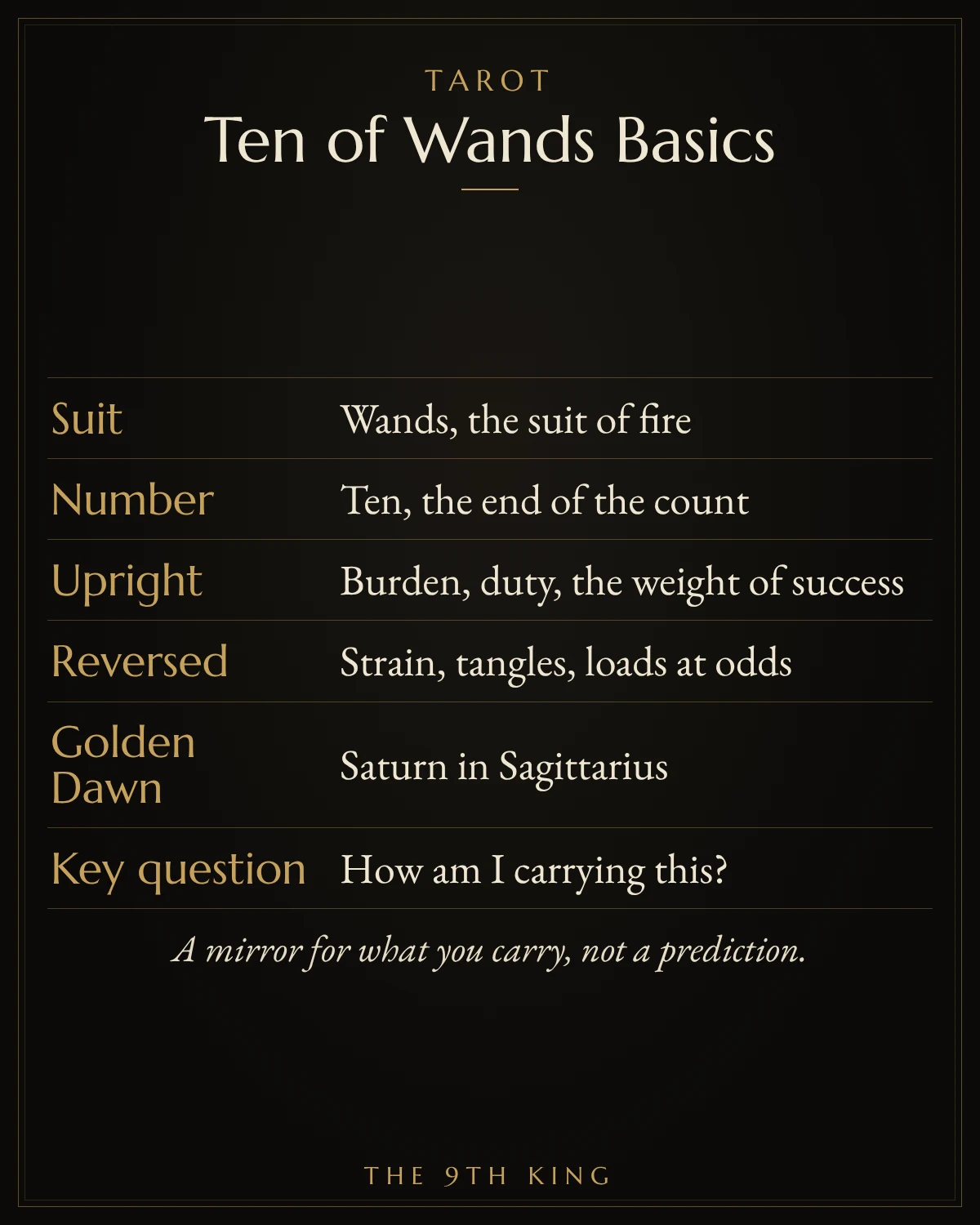
The Ten of Wands at a glance
| Ten of Wands | |
|---|---|
| Arcana | Minor Arcana, a pip (number) card |
| Suit and element | Wands, linked with fire |
| Number | Ten |
| Golden Dawn title | Lord of Oppression |
| Astrology (Golden Dawn) | Saturn in Sagittarius |
| Upright | Burden, duty, heavy success |
| Reversed | Strain, friction, tangles |
| Key question | How am I carrying this? |
What the Ten of Wands looks like
Most people know this card from the Rider–Waite–Smith deck, first published by William Rider & Son of London in December 1909. A.E. Waite wrote the instructions and Pamela Colman Smith drew the art, and both were members of the Hermetic Order of the Golden Dawn (Wikipedia: Rider–Waite Tarot).
Waite’s own description in The Pictorial Key to the Tarot is one sentence: “A man oppressed by the weight of the ten staves which he is carrying” (sacred-texts.com: Waite, Ten of Wands).
The man and the ten staves
Waite doesn’t say how the man came to carry the staves, or that he chose badly. On The 9th King, we start there too: not with blame, but with weight.
The place ahead
Waite mentions a place the figure is approaching, so the man is heading somewhere (sacred-texts.com: Waite, Ten of Wands). Wikipedia’s Ten of Wands page notes a city in the background and suggests he may be headed there to rid himself of the load (Wikipedia: Ten of Wands). Apart from the man, the staves and the place he approaches, none of this is in Waite’s text. You can see the early Smith card in the 1909 scan on Wikimedia Commons (Wikimedia Commons: 1909 Ten of Wands scan).

The Golden Dawn version of the card
The Golden Dawn’s teaching text on the tarot, Book T, as printed by Aleister Crowley in Liber LXXVIII, describes a different design: four hands hold eight wands crossed, and a fifth hand holds two wands upright through the point where the others meet, with flames issuing and the symbols of Saturn and Sagittarius above and below (Liber LXXVIII, sacred-texts.com). On 9K, two extra wands pushed through a crowded bundle reads as “one more thing” on a full load.
Ten of Wands meaning (upright)
Waite admits this is a card of many meanings, some of which can’t be reconciled. He sets aside one older reading tied to honor and good faith. His chief meaning is oppression, but he also lists fortune, gain and any kind of success, and then the oppression of those very things (sacred-texts.com: Waite, Ten of Wands). He adds false-seeming, disguise and perfidy (an old word for betrayal).
On The 9th King, we read Waite’s word oppression as weight that has become more than the carrier can comfortably hold, and we read the upright card in three layers.
The weight of things that went well
On 9K, this is the part of Waite’s reading we lean on most. The load can be the business that grew, the role you earned, the family you love. Success can be heavy. Ask yourself: Which of the things I’m carrying are here because something went right?
Carrying it all at once
The card can point to a season when everything arrives together. That isn’t a character flaw. Ask yourself: Am I carrying these one at a time, or all at once, with no break in between?
Looking past the load
On The 9th King, we read the bundle as something that can block the view of the road and the people beside you. Ask yourself: If I could see over this load for a minute, what would I notice?
Ten of Wands reversed
Some readers read reversals as the opposite meaning, some as blocked energy, and some skip them. Waite’s reversed meanings are brief: contrarieties, difficulties, intrigues and their analogies (sacred-texts.com: Waite, Ten of Wands). Contrarieties are things working against each other.
In his additional meanings, Waite gives this card a short line, “Difficulties and contradictions, if near a good card,” and he notes on that page that these extra meanings are very often in disagreement with his main ones (sacred-texts.com: Waite, Additional Meanings of the Lesser Arcana).
On The 9th King, the reversed card usually points to one of three patterns, offered as questions.
Loads pulling against each other
The reversed card can point to duties that clash, like a job and a caregiving role that want the same hours. That’s a support problem, not a moral one. Ask yourself: Which of my loads are fighting each other, and who else knows that?
The bundle slipping
The reversed card can point to a heavy load starting to slip: missed details, short temper, a body asking for a stop. That’s information, not failure. Ask yourself: What is my body or my calendar telling me that I haven’t wanted to hear?
Setting something down, or trying to
On The 9th King, the reversed card can also point to the start of lightening the load: handing something back or asking for help. That can feel awkward and still be the right call. Ask yourself: What have I already started to put down, and can I let that stand?
| Pattern | Upright tone | Reversed tone |
|---|---|---|
| The load | Heavy, held together | Slipping or tangled |
| Success | Weight of what went well | Duties at odds |
| Help | Often carried alone | Asked for, or overdue |
| Rest | Pushed to later | Needed now |
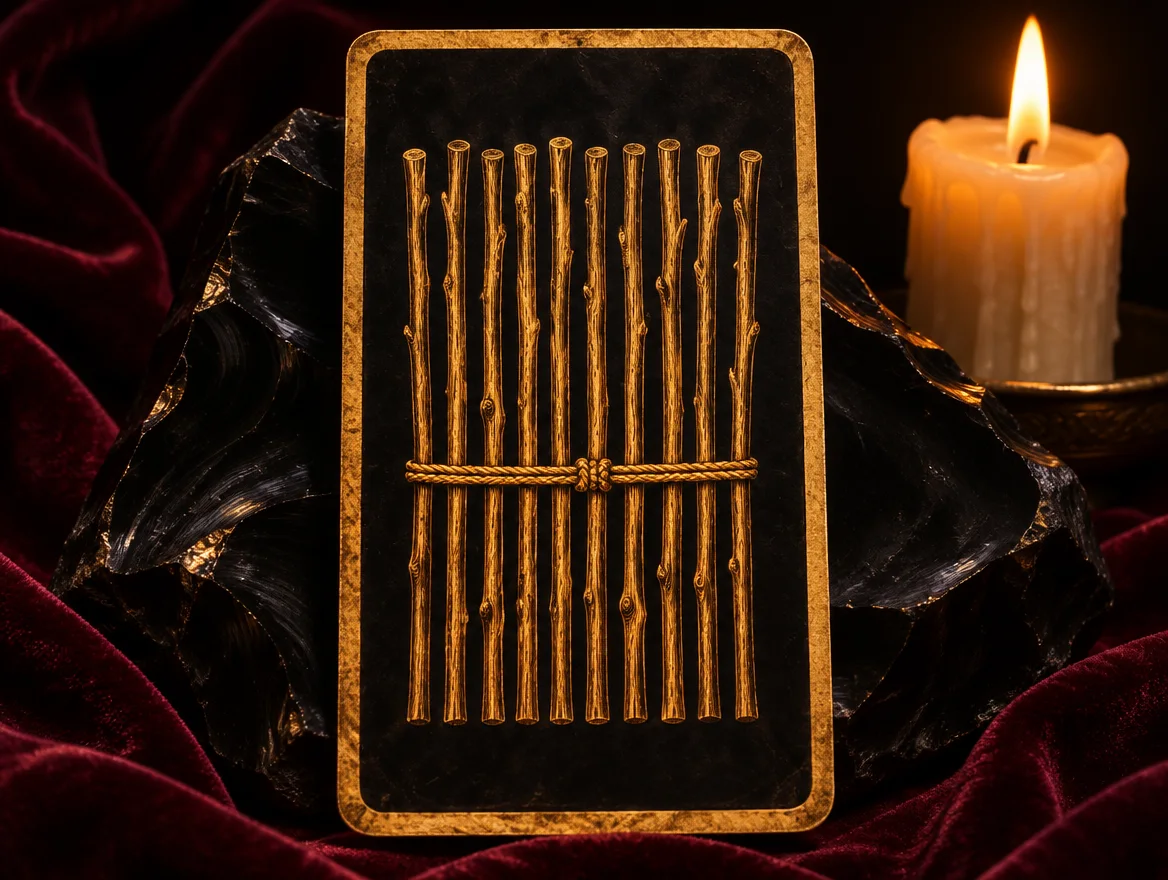
Ten of Wands astrology: Saturn in Sagittarius
The 9th King uses Golden Dawn–derived correspondences, the tradition the Rider–Waite–Smith deck draws on. Other schools use different systems, and not every card maps to a single sign: the court cards and Pages are handled differently. This is one traditional framework, offered as symbolism.
How the number cards get their planets
In the Golden Dawn system, the 36 small cards (Twos through Tens) are matched to the 36 decans of the zodiac: ten-degree thirds of a sign, each given a planet. Book T‘s card entry calls the Ten of Wands The Lord of Oppression and names Saturn and Sagittarius as its symbols. Its table lists the card under Saturn in Sagittarius, directly after the Nine of Wands (Moon in Sagittarius), making it the last of the three Sagittarius decans in table order (Liber LXXVIII, sacred-texts.com). Liber prints no degrees for it.
Book T places all four Tens in Malkuth, the last station on the Kabbalistic Tree of Life, and sums up Malkuth as “Fixed, culminated, complete Force, whether good or evil.” In plain terms, the Tens are where things have fully landed. Book T‘s notes on reading several cards together also say four Tens suggest anxiety and responsibility.
Book T‘s meaning is sharp: overbearing force used for selfish ends, and failure where the opposition is too strong, which it blames on the person’s selfishness at the start. Well placed, though, it shows generosity, disinterestedness and self-sacrifice. On The 9th King, we don’t read the card as blame. Many loads come from love, need or circumstance.
What Saturn brings
On The 9th King, Saturn is the planet of limits, structure, time and weight: the part of life that says this is real, and it has a cost. Saturn rules Capricorn (Wikipedia: Capricorn (astrology)), so our Capricorn Personality Traits page shows Saturn’s dutiful, load-bearing style in a person. On this card, Saturn is the full weight of what you’ve taken on.
What Sagittarius brings
Sagittarius is mutable fire, ruled by Jupiter (Wikipedia: Sagittarius (astrology)): the sign of vision, reach and saying yes to the big thing. Our Sagittarius Personality Traits page covers the Archer’s optimism and its restless shadow. On this card, Sagittarius is the bold yes that started the bundle.
The tension in the pairing
Sagittarius wants more road and more yes. Saturn adds up the cost. The card sits where they meet: a big vision that has turned into a heavy load. At its best, Saturn helps Sagittarius choose what’s worth carrying, and Sagittarius reminds Saturn why it mattered.
The 9K reading: carried, shared or set down?
The card’s tension
The Ten of Wands holds two true things at once: some loads are worth carrying and no one can carry everything. It doesn’t ask you to drop what you love. It asks whether the way you carry it can last.
Loads you can’t put down
Some staves don’t come off. Caring for a parent or child who needs you, living with an illness, paying down a debt, holding a job you need: these are real limits, inside you or around you, and no card should make you feel guilty for carrying them. On The 9th King, the question for these loads isn’t “Why did you pick this up?” It’s “What would make this a little easier to carry?” That might be support, pacing, or a shorter list somewhere else.
Rest is a need, not a reward. You don’t have to earn it by finishing the pile. Rest that illness or exhaustion requires is never laziness or avoidance.
The shadow side
The shadow of the Ten of Wands is carrying more than you need to, in a way you don’t have to. It isn’t the weight itself. It can look like:
- Never asking. Holding everything alone even when help is on offer.
- Saying yes by reflex. Taking the extra stave before you’ve checked whether your arms have room.
- Proving worth through load. Feeling that you only matter when you’re the one holding it all together.
- Holding what could be handed back. Keeping tasks that belong to someone else, or no longer need doing.
- Rest last, by habit. Pushing breaks to “after this” even when a pause is possible.
These patterns are often learned early. If that rings true, inner child work is a gentle, related place to look, and zodiac shadow work shows how your chart can frame the same questions.
What other people do with your load
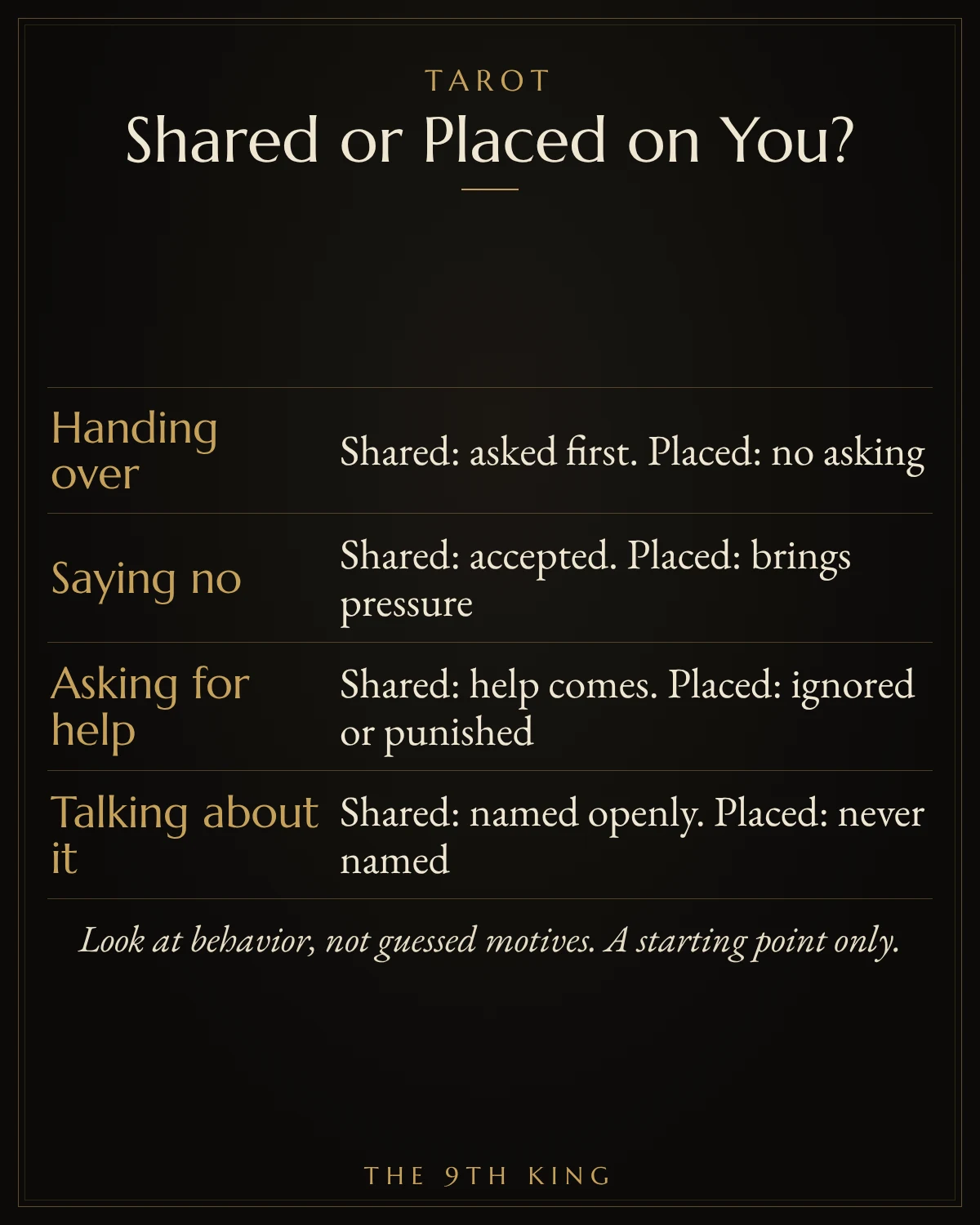
A card can’t tell you what anyone intends, so look at behavior. This table is a starting point, not a verdict.
| Shared load | Load placed on you |
|---|---|
| Asked before it’s handed over | Handed over without asking |
| Your no is accepted | Your no brings pressure |
| Help comes when you ask | Asks are ignored or punished |
| The load is talked about | The load is never named |
If someone uses pressure, threats or punishment to keep you carrying, that isn’t a load-management problem to solve by trying harder. Responsibility for that belongs to the person applying the pressure. Your safety comes first, and stepping back, for a while or for good, can be a reasonable choice.
The self-mastery lesson
The lesson of the Ten of Wands is to carry what’s yours with care, and to stop carrying what isn’t. You can hold a load you’ve chosen or can’t put down, and still ask for help, pace yourself and rest. Strength here isn’t how much you hold. It’s how honestly you look at the bundle.
Ten of Wands as feelings, in love and at work
Ten of Wands as feelings
As feelings, we often read the card on The 9th King as being stretched thin: tired, responsible, maybe proud and worn out at once. A card can’t tell you what another person feels or will do; their words and actions can. About your own feelings, ask: Is this tiredness asking me for rest, for help, or for a change in what I’m carrying? More than one can be true.
Ten of Wands love meaning
In a love reading, the upright card can point to one person carrying most of the household or emotional load, or a season so full the relationship gets what’s left. The reversed card can point to that weight starting to show, or to a first conversation about sharing it.
Tarot can’t tell you whether to stay or leave, and this page won’t either. If you don’t feel safe with someone, this isn’t a question of load: your safety comes first. Otherwise, useful questions:
- What does each of us carry, in tasks I can actually see, not just in what we say?
- Is there a load I’ve never mentioned because I assumed it was mine?
- When one of us asks for help, what happens next?
If you handle pressure very differently, fire and water relationships looks at how temperaments meet.
Ten of Wands at work and with money
None of this is financial or career advice, only reflection.
At work, we often read the card as the person who became the go-to for everything. Ask yourself: Which of my tasks could someone else learn to do, and have I let them?
With money, the lesson is about weight, not amounts. Debt, bills and providing for others can be loads you can’t set down. Ask: What would make this easier to carry, and who could I talk to about it? For actual decisions, talk to a qualified professional.
The Ace of Wands is where the fire suit begins as a single spark, and the Nine of Wands comes just before this card in Book T’s Sagittarius decans: the tired defender who is still standing.
Practical exercise: the ten staves inventory
This is a quiet look at your own load, not a test. You need twenty minutes and a notebook.
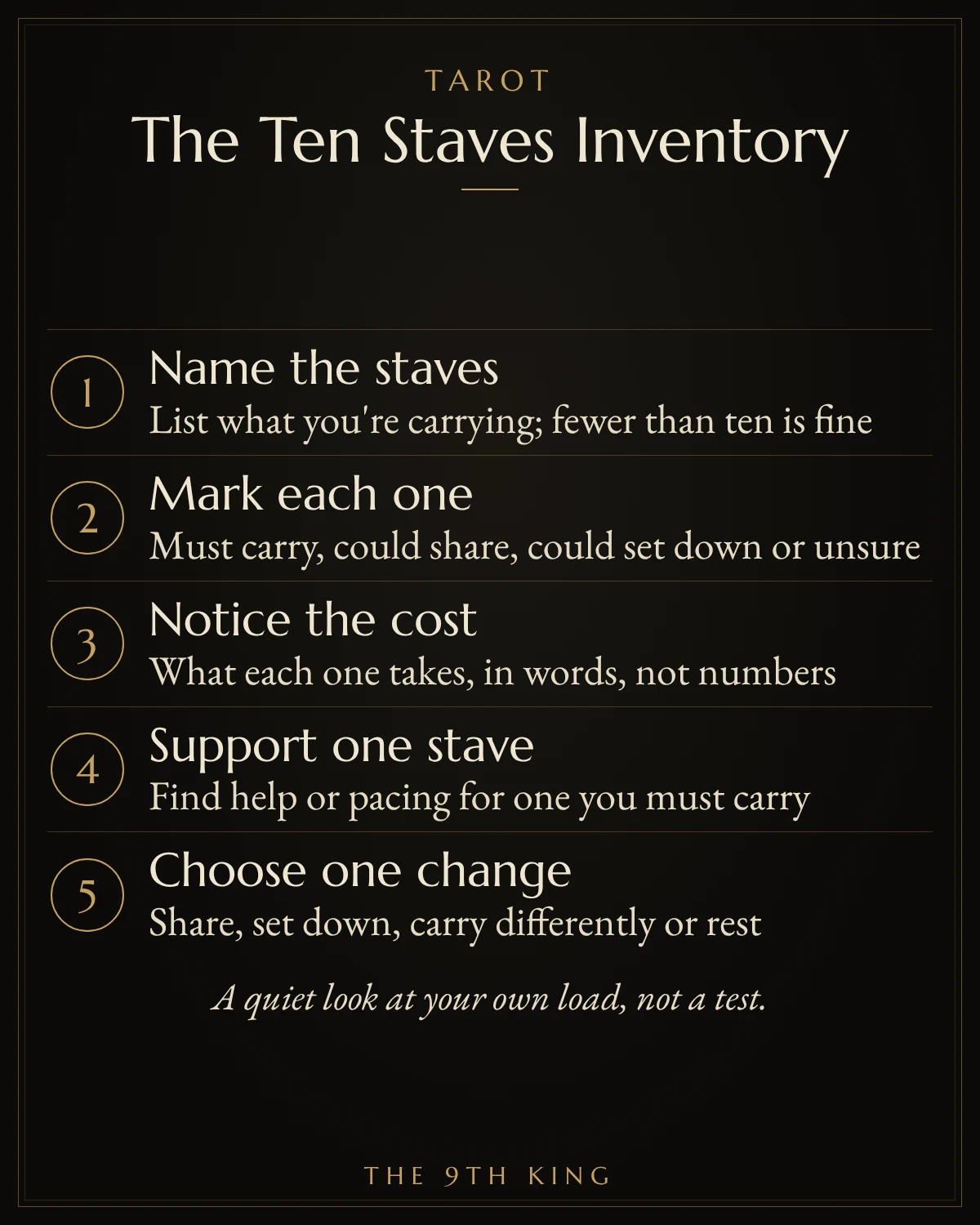
Step 1: Name the staves
Write down what you’re carrying right now: duties, roles, worries, people who depend on you. Fewer than ten is fine.
Step 2: Mark each one
Next to each, write one label: must carry for now, could share, could set down, or unsure. “Must carry” is an honest answer. Caregiving, illness, needed work and debt often belong there.
Step 3: Notice the cost
For each stave, write a few words about what it takes from you: sleep, evenings, attention, mood. Words, not numbers.
Step 4: Support one stave
Pick one “must carry” load and write one kind of support or pacing that might help: a person, a service, a shorter list elsewhere, a protected rest. Asking anyone is your choice, and only if it feels safe and useful.
Step 5: Choose one change
Pick one thing to do this week: share one stave, set one down, carry one differently, or protect one stretch of rest.
A worked example (fictional)
Dana (fictional) draws the Ten of Wands after a month of long days.
She names six staves: helping her dad after his surgery, her full-time job, organizing the family’s schedules, keeping the books for her son’s soccer team, fixing a neighbor’s computer whenever he asks, and answering work emails at night.
She marks two as must carry for now (her dad and her job), one as could share (the family schedules), two as could set down (the soccer books after the season, and the neighbor’s computer), and one as unsure (the night emails). That’s six.
For support, she asks a friend to sit with her dad one afternoon a month, and the friend agrees. Her one change: she asks her brother to take over the family schedules. The night emails stay “unsure” for now.
Journal prompts for the Ten of Wands
- Which of my loads are here because something went well?
- What am I carrying that I’ve never told anyone about?
- When did I last ask for help, and what happened?
- Which stave do I keep because handing it over would feel like failing?
- What would rest look like this week if I didn’t have to earn it first?
For more, our shadow work prompts go deeper, and Shadow Work, Plainly explains how to start safely.
A warm note: this is reflective practice, not therapy. If you’re dealing with trauma, abuse, thoughts of self-harm or distress that feels overwhelming, please work with a qualified therapist who can walk with you. It’s always fine to stop a prompt that feels like too much.
Myths and misreadings of the Ten of Wands
- “The Ten of Wands means you’ll burn out.” No. On The 9th King, tarot doesn’t predict outcomes. The card is a mirror for how you’re carrying what you carry.
- “A heavy load means you made bad choices.” Not on this site. Many loads come from love, need or circumstance. Waite himself lists fortune, gain and success among the card’s meanings.
- “The answer is always to drop everything.” Some staves can’t be set down, and some are worth keeping. The card asks how you carry them, not only whether you do.
- “Saturn in Sagittarius means this card is about Sagittarius people.” No. The correspondence describes the card’s symbolism in the Golden Dawn tradition. Anyone can draw it, whatever their sign.
Ten of Wands: FAQ
What does the Ten of Wands mean?
The Ten of Wands is a Minor Arcana card in the fire suit. Waite describes a man weighed down by ten staves and gives oppression, along with fortune, gain and success, as its meanings. On The 9th King, it’s a mirror for the loads you’re holding, including the weight of things that went well, not a prediction.
What does the Ten of Wands reversed mean?
Reversed, Waite lists contrarieties, difficulties and intrigues: things working against each other. Some readers don’t use reversals at all. On The 9th King, the reversed card can point to duties that clash, a load starting to slip, or the first steps of setting something down. Treat it as a prompt to look at what’s tangled.
What does the Ten of Wands mean as feelings?
As feelings, we often read the Ten of Wands as being stretched thin: tired, responsible, and sometimes proud of what you’re holding at the same time. A card can’t tell you what another person feels or will do; their words and actions can. About your own feelings, it can prompt you to ask whether your tiredness needs rest, help or a change in your load.
What does the Ten of Wands mean in love?
In love, the upright card can point to one partner carrying most of the load, or a season so full the relationship gets what’s left. Reversed, it can point to that strain showing, or a first talk about sharing it. The card doesn’t tell you to stay or leave. It invites you to look at who carries what, in tasks you can see.
What zodiac sign is the Ten of Wands?
In the Golden Dawn system, the tradition The 9th King uses, the Ten of Wands corresponds to Saturn in Sagittarius, the last of the three Sagittarius decans in Book T’s table. Book T calls the card the Lord of Oppression. Other schools use different correspondences, so treat this as one traditional framework for symbolism, not a statement about Sagittarius people.
Is the Ten of Wands a yes or no card?
The 9th King doesn’t do yes or no readings, because tarot here is for self-reflection, not fortune-telling. Instead, ask what the card shows you: what you’re carrying, which loads are yours to hold for now, which could be shared, and whether rest has a real place in your week.
Is the Ten of Wands a good or bad card?
Neither, on The 9th King. Waite gives it oppression but also fortune, gain and success, and Book T says that well placed, it can show generosity and self-sacrifice. Read it as a mirror for how you carry your responsibilities, not as a good or bad omen.
Your next step: do the ten staves inventory above, and choose your one change before you close the notebook. Then find where Saturn sits in your own chart with our guide on how to read a birth chart: the planet of weight and limits that the Golden Dawn tied to this card.
Explore Next
- The Archer’s reach and its shadow: Sagittarius Personality Traits
- Saturn’s dutiful style in a person: Capricorn Personality Traits
- Where the fire suit begins: Ace of Wands
- The earlier Sagittarius card, the tired defender: Nine of Wands
- Reading by feel: Intuitive Tarot (Code of Ascension)
- New to the cards: Tarot for Beginners: How Tarot Really Works (Code of Ascension)
- More tarot on The 9th King: Tarot Card Meanings · Minor Arcana · Tarot & the Zodiac · King of Wands · Shadow Work Tarot Spread
- More cards in this set: Eight of Wands, Ten of Cups, Ten of Pentacles
Final Thought: Carry It With Care
The man in the Ten of Wands isn’t foolish or weak. He’s carrying a lot, and some of it may be the weight of a life that went well. Name your staves, keep what’s yours, hand back what isn’t, ask for help with what you can’t put down, and rest before the pile is empty. Know your nature. Rule your life.
About the Author
King is the founder of The 9th King, where zodiac psychology, relationships and shadow work are explored as tools for self-knowledge rather than fortune-telling. He’s a Libra Sun, and writes about the personal side of astrology on King The Kemist. Astrology on The 9th King is interpretation and self-reflection, not prediction or established fact.
Leave a Reply