

Quick Answer: What Does the Eight of Wands Mean?
The Eight of Wands (also written 8 of Wands) is a Minor Arcana card from Wands, the fire suit of drive, energy and action. In the traditional image, eight wands fly together through open country with no person in sight. On The 9th King, it’s the card of momentum: many things in the air at once, all pointed the same way.
- Keywords: movement, speed, momentum, messages, activity, haste, hope, things in motion.
- Upright, in one line: a prompt to notice what’s moving in your life, if several things are in flight at once and you want to steer the pace instead of just reacting to it.
- Reversed, in one line: jealousy, quarrels or a rush that scatters; a prompt to look at where speed has turned into friction, sharp words or a pace nobody chose.
On The 9th King, tarot is a mirror for self-knowledge, not fortune-telling. The Eight of Wands doesn’t announce news or set a clock. It asks what’s already moving, and where you want it to land.
Table of Contents
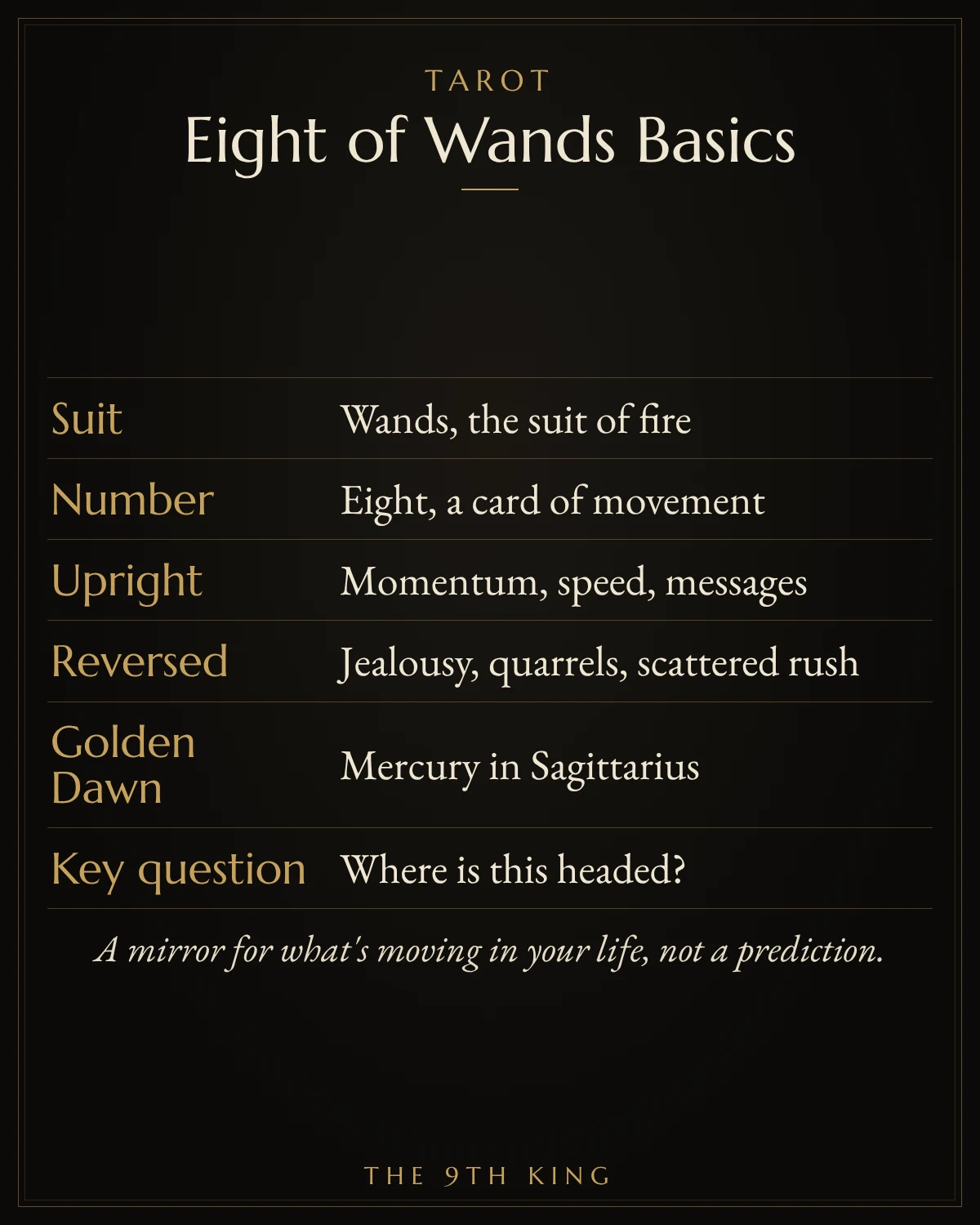
The Eight of Wands at a glance
| Eight of Wands | |
|---|---|
| Arcana | Minor Arcana, a pip (number) card |
| Suit and element | Wands, linked with fire |
| Number | Eight |
| Golden Dawn title | Lord of Swiftness |
| Astrology (Golden Dawn) | Mercury in Sagittarius |
| Upright | Activity, swiftness, hope |
| Reversed | Jealousy, dispute, quarrels |
| Key question | Where is this headed? |
What the Eight of Wands looks like
Most people know this card from the Rider–Waite–Smith deck, published in December 1909 by William Rider & Son of London. A.E. Waite wrote the instructions and Pamela Colman Smith drew the art, and both were members of the Hermetic Order of the Golden Dawn (Wikipedia: Rider–Waite Tarot).
Waite’s description in The Pictorial Key to the Tarot is short (sacred-texts.com: Waite, Eight of Wands), so this section stays close to it.
A flight of wands
Waite says the card shows “motion through the immovable”: a flight of wands passing through open country. No one holds them, and the land beneath stays still. On The 9th King, that contrast is the heart of the card: a lot can move while the ground under you stays steady.
Drawing to the end of their course
Waite adds that the wands are drawing toward the end of their course, and that what they signify is close at hand, perhaps even at the threshold. That’s Waite’s account of the image and what it signifies. On The 9th King, we read his idea of an ending course as direction, not timing: the wands are headed somewhere, and the card asks where. It doesn’t tell you when anything arrives.
On the early Smith card
On the 1909 Smith card (Wikimedia Commons: 1909 Eight of Wands scan), the eight wands run parallel on a slant across the sky, side by side, with small leaves on them, above a landscape with a river. Apart from the flight of wands and the open country, none of this is in Waite’s text.

The Golden Dawn version of the card
The Golden Dawn’s teaching text on the tarot, Book T, as printed by Aleister Crowley in Liber LXXVIII, describes a different design. Four white radiant angelic hands come from clouds, two from each side, clasped in two pairs in the centre. They hold eight wands crossed four with four, with flames rising from the point where they meet, and the symbols of Mercury and Sagittarius sit at the top and bottom for the decan (Liber LXXVIII, sacred-texts.com).
Eight of Wands meaning (upright)
Waite’s upright meanings are a list of motion: activity in undertakings and the path that activity takes, swiftness like that of an express messenger, great haste, great hope, and speed toward a happy end. He sums it up as whatever is on the move, and adds the arrows of love (sacred-texts.com: Waite, Eight of Wands).
Book T names the card the Lord of Swiftness. It lists swiftness, rapidity, courage, boldness, confidence, freedom and a love of open air. It places the card in Hod on the Kabbalistic Tree of Life and adds hasty communications and messages (Liber LXXVIII, sacred-texts.com).
On The 9th King, we read the upright card as momentum with a direction. It has three layers.
Many things in the air
The card can point to a season where several things move at once: emails, plans, projects, conversations. Ask yourself: What’s actually in motion right now, and how many things is that?
Messages and replies
Waite’s express messenger and Book T’s hasty messages both point to communication. The card can point to a time of quick back-and-forth, decisions made by text, or news you’re carrying to someone else. Ask yourself: Am I sending messages I’ve thought through, or just keeping up with the volume?
Hope that moves
Waite pairs great haste with great hope. On The 9th King, that’s the good side of speed: wanting something and moving toward it. Ask yourself: What am I hopeful about, and is my pace serving that hope?
Eight of Wands reversed
Some readers read reversals as the opposite meaning, some as blocked energy, and some don’t use them. Waite’s reversed meanings move from speed to friction: arrows of jealousy, internal dispute, stings of conscience, quarrels, and domestic disputes for married people (sacred-texts.com: Waite, Eight of Wands).
In his additional meanings, Waite gives the Eight of Wands one line, domestic disputes for a married person (sacred-texts.com: Waite, Additional Meanings of the Lesser Arcana). On that page he notes that these extra meanings are “very often in disagreement” with his main ones.
Book T also gives a harsher list for when the card is badly placed, which it calls ill dignified. It opens with a warning: “Too much force applied too suddenly.” It describes a very rapid rush that’s quickly spent, violent but not lasting, and adds words like untrustworthy, insolent and oppressive (Liber LXXVIII, sacred-texts.com). A card can’t tell you what anyone has done or will do, so The 9th King doesn’t read those words as labels for real people.
On The 9th King, the reversed card usually points to one of three patterns, offered as questions, not predictions.
Arrows that sting
Waite turns the arrows of love into arrows of jealousy. The reversed card can point to quick, sharp words: a fast reply that hurts, a jab sent before thinking. Ask yourself: Is there a message I sent, or want to send, that’s moving faster than my judgment?
The internal dispute
Waite also lists internal dispute and the stings of conscience. That can mean an argument inside your own head: part of you racing ahead, part of you uneasy about the direction. Ask yourself: What does the uneasy part of me want me to look at before I keep going?
A rush that burns out
Book T’s warning about force applied too suddenly fits a familiar pattern: going hard at something, then running out of fuel. Ask yourself: Is this pace one I can actually keep, or am I spending everything at the start?
| Pattern | Upright tone | Reversed tone |
|---|---|---|
| Pace | Quick, with a direction | Rushed or scattered |
| Messages | Clear and timely | Sharp, sent too fast |
| Energy | Hope that moves | A burst that’s spent |
| Inner state | Aligned | Divided, uneasy |
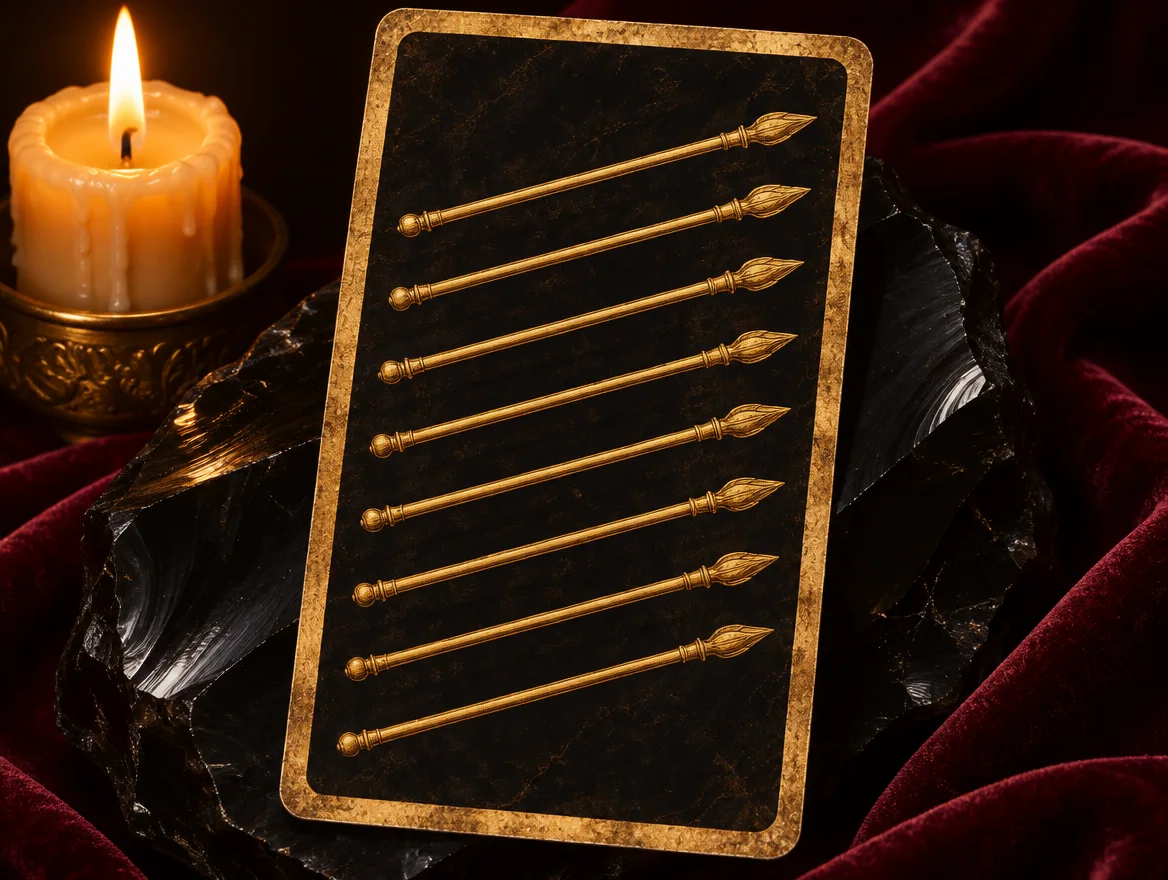
Eight of Wands astrology: Mercury in Sagittarius
The 9th King uses Golden Dawn–derived correspondences, the tradition the Rider–Waite–Smith deck draws on. Other schools use different systems, and not every card maps to a single sign: the court cards and Pages are handled differently. This is one traditional framework, offered as symbolism.
How the number cards get their planets
In the Golden Dawn system, the 36 small cards (Twos through Tens) are matched to the 36 decans of the zodiac: ten-degree thirds of a sign, each given a planet. Book T‘s table lists the Eight of Wands, Swiftness, under Mercury Sagittarius (Liber LXXVIII, sacred-texts.com), and the card’s own entry places the symbols of Mercury and Sagittarius on the card for the decan. In the table it’s the first of the three Sagittarius cards, followed by the Nine of Wands (Moon in Sagittarius) and the Ten of Wands (Saturn in Sagittarius). Liber prints no degrees for it.
The card that comes next in Liber’s table is the Nine of Wands, the Lord of Great Strength.
What Mercury brings
On The 9th King, Mercury is the planet of the mind in motion: messages, words, quick thinking, travel and trade. It’s the traditional ruler of Gemini and Virgo, so our Gemini Personality Traits page shows Mercury’s quick, curious side in a person, and our Virgo Personality Traits page shows its careful, sorting side.
What Sagittarius brings
Sagittarius is mutable fire, the sign of the archer, of distance, belief and the open road. Our Sagittarius Personality Traits page covers its restless optimism and its habit of overshooting. On this card, Sagittarius is the open country and the urge to aim far.
The tension in the pairing
Mercury wants to send the message now. Sagittarius wants to go further than anyone else. Together they make speed with a long aim: thought that travels fast and far. At its best, Sagittarius gives Mercury a destination, and Mercury gives Sagittarius the details it skips.
The 9K reading: momentum or rush?
The card’s tension
The Eight of Wands holds two true things at once: speed can carry you toward what you want and speed can carry you past the point of choosing. Wands in flight can’t easily change course. The card asks whether you aimed before you let go.
The shadow side
The shadow of the Eight of Wands is letting the pace decide for you. It can look like:
- Urgency as a habit. Treating everything as something that must be answered right away, even when no one asked for that.
- Replying to stay ahead. Answering fast so you never have to sit with a question.
- Speed as proof. Measuring a good week by how much moved, not where it went.
- Starting hard, stopping hard. Throwing everything at a beginning, then running out of fuel partway through.
- Jealousy that moves fast. Reacting to what someone else has, or seems to have, before checking what’s true.
Speed isn’t the only shadow; the flip side is watching the wands fly by without choosing a direction. If that rings true, our guide to zodiac shadow work is a related place to look at how your chart’s patterns show up under pressure.
Rest is part of the flight
Slowing down isn’t the shadow of this card. Rest and pacing meet real needs, and exhaustion, illness or grief are real limits even when no one else can see them. The card asks you to notice when speed is running you, not to keep up.
Momentum vs rush: what you can observe
A card can’t measure your pace, but you can look at what’s happening. These checks describe behavior, not how anything feels, and they’re a starting point, not a verdict.
| Momentum | Rush |
|---|---|
| You can name where it’s headed | You can’t say where it lands |
| Deadlines were set by someone, or by you on purpose | Deadlines are assumed, never checked |
| Messages get read before replies go out | Replies go out before messages are read |
| You can pause one thing without the rest collapsing | Nothing gets paused, even briefly |

The self-mastery lesson
The lesson of the Eight of Wands is to aim before you release. You can move fast and still choose the direction. You can answer quickly when it helps, slowly when it matters, and let some things land on their own.
Eight of Wands as feelings, in love and at work
Eight of Wands as feelings
As feelings, readers often take the card as eager energy: excitement, interest that’s picking up speed, wanting to move things forward. A card can’t tell you what someone feels or will do; their words and actions can. About your own feelings, ask: Am I excited about this person or plan, or excited about the speed itself? Both can be true at once.
Eight of Wands love meaning
In a love reading, the upright card can point to Waite’s arrows of love: attraction, fast texts, plans made quickly. The reversed card can point to his arrows of jealousy, quarrels at home, or a relationship moving at a pace one person didn’t choose.
Tarot can’t tell you whether to stay or leave, and this page won’t either. If you don’t feel safe with someone, that comes before any question of pace. Otherwise, useful questions:
- Are we both choosing this speed, in what we say and in what we do?
- When something stings, do we talk about it, or fire back right away?
- When jealousy shows up, do I check what actually happened before I react?
If your pace and a partner’s pace often clash, Fire and Water Relationships looks at one common version of that pull, as reflection, not a verdict.
Eight of Wands at work and with money
None of this is financial or career advice, only reflection.
At work, readers often take the card as a busy stretch: fast projects, lots of messages, decisions that can’t wait long. Ask yourself: Which of these really needs speed, and which just arrived loudly?
With money, the lesson is about pace, not amounts. Ask: Have I thought this through, or am I just moving fast? For actual decisions, talk to a qualified professional.
The Ace of Wands is where the fire suit begins, a single spark before any flight.
Practical exercise: the flight check
A quiet look at what’s moving in your life and who’s setting the pace, not a productivity test. You need twenty minutes and a notebook.

Step 1: What’s in flight
Write down everything that’s moving right now: projects, plans, conversations, messages you owe.
Step 2: Who sets the pace
Next to each item, write who set its pace: someone else set a date, I set a date on purpose, or no date at all. “No date at all” is often where pressure comes from habit, not anyone’s request.
Step 3: Name the landing
For each item, write one line on what “done” looks like. If you can’t say, note that.
Step 4: Check the message
Pick the item that involves another person. Before you reply to anything about it, read what they actually wrote, all of it, and ask what they’re asking for. Reply when you’re ready, or note that you’ll come back to it.
Step 5: Choose one change
Pick one thing to adjust: slow one item down, finish one, or let one land without pushing. If it means talking to someone, that’s your choice, and only if it feels safe and useful.
A worked example (fictional)
Marcus (fictional) draws the Eight of Wands after a week of answering messages until midnight, and does the flight check.
He lists five things in flight: a job application, a group chat planning a trip, a reply he owes his sister, a side project he wants to launch, and his lease renewal.
Finding the pace-setters, he sees that two have dates someone else set: the application deadline and the lease renewal. One has a date he chose on purpose: the side project launch. Two have no date at all: the group chat and his sister’s message. Two, one and two make all five.
Naming the landings, he can say what “done” means for four of them, but not for the side project. He set its launch date before deciding what he’s launching.
His one change: he moves the side project’s launch date until he can describe the finished thing in one sentence. He also answers his sister when he can read her message properly, since nothing about it was urgent.
Journal prompts for the Eight of Wands
- What’s moving fastest in my life right now, and did I choose that speed?
- Where do I reply quickly to avoid sitting with a question?
- Which plan am I hopeful about, and what does that hope want from me?
- When was the last time a fast message I sent caused friction? What was I protecting?
- What would I let land on its own if I trusted it to?
For more, our shadow work prompts go deeper, and Shadow Work, Plainly explains how to start safely.
A warm note: this is reflective practice, not therapy. If you’re dealing with trauma, abuse, thoughts of self-harm or distress that feels overwhelming, please work with a qualified therapist who can walk with you. It’s always fine to stop a prompt that feels like too much.
Myths and misreadings of the Eight of Wands
- “The Eight of Wands means news is coming soon.” No. On The 9th King, tarot doesn’t predict events or timing. Waite describes the wands nearing the end of their course; we read that as a question about direction, not a countdown.
- “Faster is always better with this card.” Book T itself warns about too much force applied too suddenly. The card values momentum with a direction, not speed for its own sake.
- “The reversed card means someone is jealous of you, or lying to you.” A card can’t tell you anyone’s motives. Look at what people actually do and say.
- “Mercury in Sagittarius means this card is about Sagittarius people.” No. The correspondence describes the card’s symbolism in the Golden Dawn tradition. Anyone can draw it, whatever their sign.

Eight of Wands: FAQ
What does the Eight of Wands mean?
The Eight of Wands is a Minor Arcana card in the fire suit. Waite describes a flight of wands moving through open country and lists activity, swiftness, haste and hope among its meanings. Readers commonly take it as momentum, messages and things in motion. On The 9th King, it’s a mirror for what’s moving in your life and who’s setting the pace, not a prediction that news or change is on its way.
What does the Eight of Wands reversed mean?
Reversed, Waite lists arrows of jealousy, internal dispute, stings of conscience and quarrels, including disputes at home. Readers often take it as speed turning into friction: sharp messages, a rush that burns out, or a pace nobody agreed to. Some readers don’t use reversals at all. On The 9th King, treat it as a prompt to look at where fast words or fast choices are causing trouble.
What does the Eight of Wands mean as feelings?
As feelings, readers often take the Eight of Wands as eager energy: excitement, growing interest, or wanting to move something forward. A card can’t tell you what another person feels or will do; their words and actions can. About your own feelings, it can prompt you to ask whether you’re drawn to the person or plan itself, or mostly to the rush of things moving.
What does the Eight of Wands mean in love?
In love, the upright card can point to what Waite calls the arrows of love: attraction, quick plans and fast back-and-forth. Reversed, it can point to his arrows of jealousy or quarrels at home. The card doesn’t tell you to stay or leave. It invites you to look at whether both of you are choosing the pace, and how you handle sharp moments.
What zodiac sign is the Eight of Wands?
In the Golden Dawn system, the tradition The 9th King uses, the Eight of Wands corresponds to Mercury in Sagittarius, the first of the three Sagittarius cards in Book T’s table. The Golden Dawn’s Book T calls the card the Lord of Swiftness. Other schools use different correspondences, so treat this as one traditional framework for symbolism rather than a rule about anyone’s sign.
Does the Eight of Wands predict timing?
Not on The 9th King. Waite describes the wands nearing the end of their flight, but tarot here is for self-reflection, not timing predictions. Instead of asking when something arrives, ask what’s already moving in your life, where each thing is headed, and whether you chose the pace.
Is the Eight of Wands a good or bad card?
Neither, on The 9th King. Waite gives it upright meanings of activity, great hope and speed toward a happy end, but Book T also warns about force applied too suddenly when the card is badly placed. Read it as a mirror for how you handle momentum, not as an omen.

Your next step: do the flight check above, and pick your one change before you close the notebook. Then find where Mercury falls in your own chart with our guide on how to read a birth chart: the planet of messages and quick thinking that the Golden Dawn tied to this card.
Explore Next
- The archer’s restless optimism: Sagittarius Personality Traits
- Mercury’s quick, curious side in a person: Gemini Personality Traits
- The next Sagittarius card, the one who holds the line: Nine of Wands
- Where the fire suit begins: Ace of Wands
- Reading by feel: Intuitive Tarot (Code of Ascension)
- New to the cards: Tarot for Beginners: How Tarot Really Works (Code of Ascension)
- More tarot on The 9th King: Tarot Card Meanings · Minor Arcana · Tarot & the Zodiac · Three-Card Tarot Spread · Eight of Swords
- More cards in this set: Ten of Wands, Eight of Cups, Eight of Pentacles

Final Thought: Aim Before You Release
The wands in the Eight of Wands are already flying, and the country under them doesn’t move. That’s the whole lesson: things can travel fast while you stay steady. Choose the direction, check the message, rest when you need to, and let some things land on their own. Know your nature. Rule your life.
About the Author
King is the founder of The 9th King, where zodiac psychology, relationships and shadow work are explored as tools for self-knowledge rather than fortune-telling. He’s a Libra Sun, and writes about the personal side of astrology on King The Kemist. Astrology on The 9th King is interpretation and self-reflection, not prediction or established fact.
Leave a Reply