

Quick Answer: What Does the Eight of Cups Mean?
The Eight of Cups (also written 8 of Cups) is a Minor Arcana card from Cups, the water suit of feelings, relationships and inner life. In the traditional image, a dejected man walks away from eight cups. On The 9th King, it’s the card of the turning point: the moment something that once filled you stops filling you, and you have to decide what to do about it.
- Keywords: turning away, decline of interest, unfinished success, searching, disappointment, a matter that mattered less than you thought, moving on, looking for more.
- Upright, in one line: a prompt to notice where something no longer satisfies you, if you’re feeling restless, flat or drawn toward something you can’t quite name yet.
- Reversed, in one line: Waite’s reversed meanings are joy and feasting; readers also take it as staying put, second thoughts, or circling back. A prompt to ask what’s keeping you where you are.
On The 9th King, tarot is a mirror for self-knowledge, not fortune-telling. The Eight of Cups doesn’t tell you to leave anything or anyone. It asks what you’re looking for, and which of your options moves you toward it.
Table of Contents

The Eight of Cups at a glance
| Eight of Cups | |
|---|---|
| Arcana | Minor Arcana, a pip (number) card |
| Suit and element | Cups, linked with water |
| Number | Eight |
| Golden Dawn title | Lord of Abandoned Success |
| Astrology (Golden Dawn) | Saturn in Pisces |
| Upright | Decline of interest, turning away |
| Reversed | Joy, feasting; staying, second thoughts |
| Key question | What am I looking for? |
What the Eight of Cups looks like
Most people know this card from the Rider–Waite–Smith deck, first published in London by William Rider & Son in December 1909. A.E. Waite wrote the instructions and Pamela Colman Smith drew the art, and both were members of the Hermetic Order of the Golden Dawn (Wikipedia: Rider–Waite Tarot).
Waite’s description in The Pictorial Key to the Tarot is a single sentence (sacred-texts.com: Waite, Eight of Cups), so this section stays close to it.
The man who turns away
Waite writes: “A man of dejected aspect is deserting the cups of his felicity.” Felicity means happiness. He adds that the cups can also be his enterprise, an undertaking or a previous concern. So the cups aren’t broken in Waite’s sentence; they’re things that once mattered to him. On The 9th King, we read them as anything you’ve put feeling into.
On 9K, the word “deserting”
On The 9th King, we read Waite’s word “deserting” as a choice made in low spirits, not a judgment of the man. The card isn’t a bold, happy exit. It’s someone who has stopped being fed by what he built.
On the early Smith card
On the 1909 Smith card (Wikimedia Commons: 1909 Eight of Cups scan), eight cups stand in the foreground, five in a lower row and three above, with a gap in the upper row. The figure, seen from behind in a red cloak, walks with a staff toward rocky hills, with water between. In the sky is a moon drawn as a crescent with a face, set inside a full disc. Apart from the man, his low spirits and the cups he’s leaving, none of this is in Waite’s text.

The Golden Dawn version of the card
The Golden Dawn’s teaching text on the tarot, Book T, as printed by Aleister Crowley in Liber LXXVIII, describes a different design: a white radiating angelic hand holds a group of lotus or water-lily stems. Only two flowers are shown. They bend over the two central cups and pour white water into them, which runs over into the three lowest cups, not yet filled. The three uppermost cups are quite empty, and the symbols of Saturn and Pisces sit at the top and bottom (Liber LXXVIII, sacred-texts.com).
There’s no walking figure, but the half-filled cups fit the theme of success that stopped partway.
Eight of Cups meaning (upright)
Waite’s upright meaning is unusually candid. He says the surface meaning is obvious, but that other readings are the opposite: joy, mildness, timidity, honour, modesty. In practice, he says, it usually shows the decline of a matter, or that something you thought was important is really of slight consequence, for good or for evil (sacred-texts.com: Waite, Eight of Cups).
Book T is blunter. Under the title Lord of Abandoned Success, it lists temporary success without further results, a thing thrown aside as soon as gained, indolence in success, journeying from place to place, misery and repining without cause, seeking after riches, and instability. Its one-line summary is “Success abandoned; decline of interest” (Liber LXXVIII, sacred-texts.com).
On The 9th King, we read the upright card as the turning point. It has three layers.
Interest that has faded
The card can point to something that used to light you up and now feels flat: a goal, a routine, a group, a plan. Ask yourself: What used to fill me here, and when did I last feel it?
A matter that mattered less than you thought
Waite’s practical reading is gentle: something you thought was a big deal may turn out to be small, which can be a relief as much as a loss. Ask yourself: Is this as important as I’ve been treating it, or has it shrunk while I wasn’t looking?
The search for more
The card can point to restlessness: a pull toward something you can’t fully see yet. On The 9th King, this layer turns the card from “what am I losing?” into “what am I looking for?” Ask yourself: If I could name what’s missing in one sentence, what would it be?
Eight of Cups reversed
Some readers read reversals as the opposite meaning, some as blocked energy, and some don’t use them. Waite’s reversed meanings are short and bright: great joy, happiness, feasting (sacred-texts.com: Waite, Eight of Cups), which fits his note that the card’s readings pull in opposite directions.
On The 9th King, we read the reversed card in three ways, offered as questions, not predictions.
Finding the joy again
Waite’s reading can point to interest returning: the cups fill back up, or you notice they were fuller than you thought. Ask yourself: What changed, and was it the situation or the way I was looking at it?
Staying, and why
The reversed card can point to staying where you are. That can be a sound, considered choice: you weighed it and the cups still hold enough. It can also be staying out of habit or fear of the unknown. A card can’t tell which. Ask yourself: Am I staying because this still feeds me, or because leaving feels harder than being unhappy?
Circling back
Readers also take the reversed card as second thoughts: walking away, then turning around. That isn’t failure. Sometimes distance shows you what you had. Ask yourself: What did I learn from the walk, even if I came back?
| Pattern | Upright tone | Reversed tone |
|---|---|---|
| Interest | Fading | Returning, or never really gone |
| Direction | Turning away | Staying, or circling back |
| The cups | Left behind | Valued again |
| The search | Looking for more | Finding it closer to home |
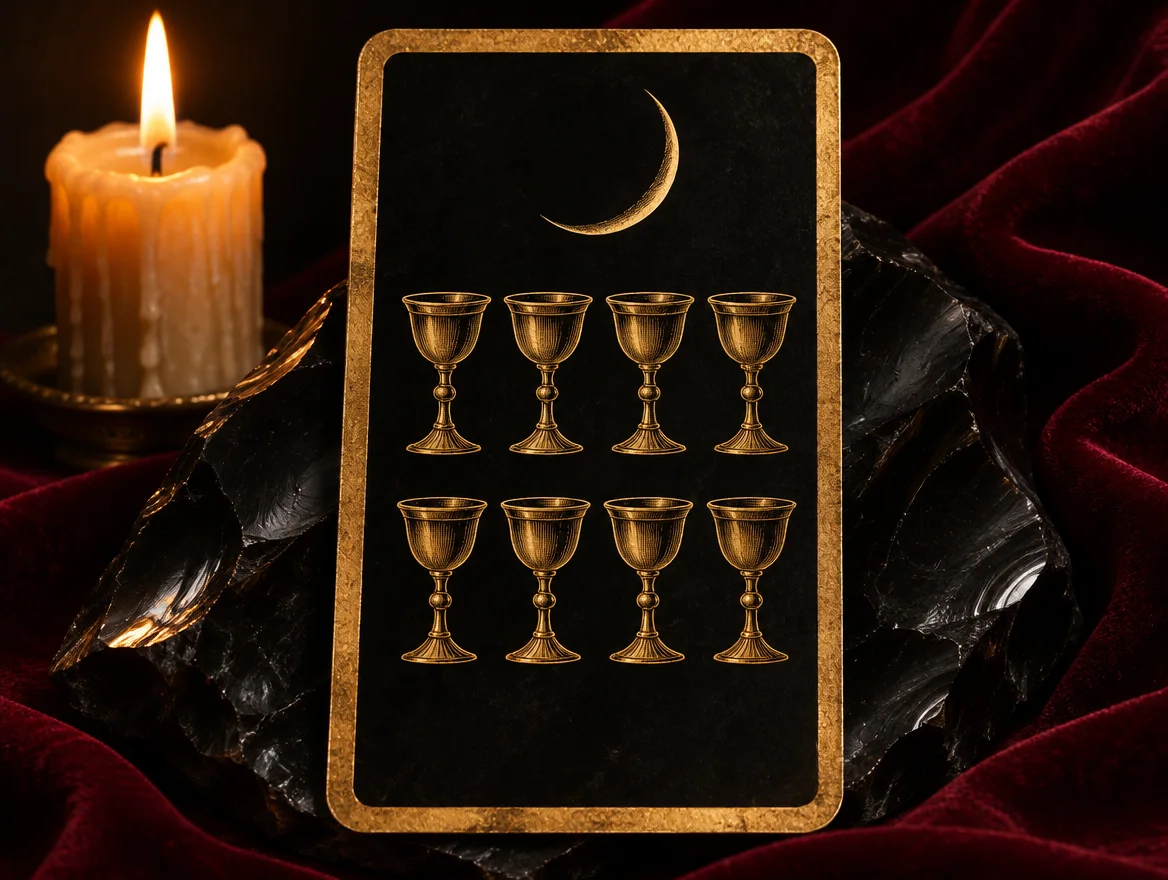
Eight of Cups astrology: Saturn in Pisces
The 9th King uses Golden Dawn–derived correspondences, the tradition the Rider–Waite–Smith deck draws on. Other schools use different systems, and not every card maps to a single sign: the court cards and Pages are handled differently. This is one traditional framework, offered as symbolism.
How the number cards get their planets
In the Golden Dawn system, the 36 small cards (Twos through Tens) are matched to the 36 decans of the zodiac: ten-degree thirds of a sign, each given a planet. Book T‘s table lists the Eight of Cups, Abandoned Success, under Saturn in Pisces (Liber LXXVIII, sacred-texts.com), and the card’s own entry places the symbols of Saturn and Pisces at the top and bottom of the card.
By table order, it’s the first of the three Pisces decans. It comes directly after the Seven of Swords (Moon in Aquarius), and is followed by the Nine of Cups (Jupiter in Pisces) and the Ten of Cups (Mars in Pisces). The table gives no degrees for it.
What Saturn brings
On The 9th King, Saturn is the planet of limits, time, structure and honest endings. It’s the traditional ruler of Capricorn, so our Capricorn Personality Traits page shows Saturn’s patient, serious style in a person. On this card, Saturn is the part of you that says, plainly, this isn’t working the way it used to.
What Pisces brings
Pisces is mutable water: the sign of longing, imagination and the pull toward something beyond the everyday. Our Pisces Traits page covers the Fish’s tenderness and its drifting shadow. On this card, Pisces is the yearning that the cups can no longer satisfy.
The tension in the pairing
Pisces longs for something bigger. Saturn draws a line. The card sits where they meet: a longing that has run into a limit. At its best, Saturn helps Pisces name what’s missing, and Pisces keeps Saturn from cold, all-or-nothing decisions.
The 9K reading: what are you walking toward?
The card’s tension
The Eight of Cups holds two true things at once: what you built still has value and it no longer fills you the way it did. The card doesn’t ask you to pretend either away. It asks what you’ll do while both are true.
Five ways to answer the card
Walking away is the image on the card, but it’s one option among several. On The 9th King, we read the card as a prompt to look at all five:
- Stay and renew. Look for what could fill the cups again.
- Change the terms. Stay, but change something specific: the role, the routine, the amount you give.
- Rest first. Don’t decide anything yet. Tiredness can make everything look empty, and rest is a real need, not a stall.
- Step back partly. Keep some cups and set others down.
- Walk away. Leave a situation, a goal or a role, when you’ve weighed it and that’s your considered choice.
None of these is the right answer by default. Many situations, especially relationships, jobs and family, involve other people, money, safety and obligations a card can’t see.

The shadow side
The shadow of the Eight of Cups is leaving or staying without looking. On either side, it can look like:
- Walking out to avoid a hard conversation. Leaving so you don’t have to say what’s wrong.
- Staying out of fear alone. Remaining because the unknown is scarier, not because anything still holds.
- The restless loop. Leaving each thing as soon as it’s gained, which echoes Book T‘s journeying from place to place.
- Treating every dip as an ending. Reading a flat week as proof that something is over.
- Never naming what you want. Knowing what you don’t want, but not what you’re looking for.
These patterns are often learned early. If that rings true, inner child work is a gentle, related place to look.
Leaving, avoiding and resting
These three can look alike from the outside. The difference shows up in what you actually do, not in how it feels. This table is a starting point, not a test.
| Pattern | What you tend to do |
|---|---|
| Considered leaving | Name the reasons, weigh options, plan the step |
| Avoiding | Skip the conversation, go quiet, leave without a reason you can say |
| Resting | Pause to recover energy, with or without an end date |
Rest is not avoidance. If illness, grief or exhaustion is behind the flatness you feel, pausing meets a real need.
If a situation is unsafe, this isn’t a question of fading interest. Your safety comes first, and responsibility for harm belongs to the person causing it.
The self-mastery lesson
The lesson of the Eight of Cups is to know what you’re walking toward before you decide whether to walk. You can honor what the cups gave you, name what’s missing, and then choose among your real options, including staying. You can feel shaken and still make a considered choice.
Eight of Cups as feelings, in love and at work
Eight of Cups as feelings
As feelings, readers often take the card as restlessness or quiet disappointment: a sense that something isn’t enough anymore. A card can’t tell you what another person feels or what they’ll do; their words and actions can. About your own feelings, ask: Is this flatness about the situation, about me being tired, or both?
Eight of Cups love meaning
In a love reading, the upright card can point to a dip in feeling, a sense that something is missing, or a wish for more depth. The reversed card can point to renewed warmth, choosing to stay, or second thoughts after distance.
Tarot can’t tell you whether to stay or leave, and this page won’t either. A flat season isn’t the same as an ending. If you don’t feel safe with someone, that’s not a question of fading interest: your safety comes first. Otherwise, useful questions:
- What specifically feels missing, in things I can actually see or do?
- Have I said what I’m missing out loud, in a way the other person could act on?
- Which of the five options above have I actually tried?
To see how two people’s needs can differ, synastry for beginners shows how astrologers compare charts, as reflection, not a verdict.
Eight of Cups at work
None of this is career or financial advice, only reflection.
At work, readers often take the card as losing interest in a role, a project that has run its course, or wanting work that means more. It doesn’t tell you to quit. Ask yourself: Is it the work, the conditions, or my energy right now? And what could change in each? For actual decisions, talk to people you trust and a qualified professional where money is involved.
The Ace of Cups is where the water suit begins, and the Seven of Cups, the card before this one, is about choosing among many options.
Practical exercise: the cup inventory
This isn’t a list designed to push you out the door. It’s a look at one situation before you decide anything. You need twenty minutes and a notebook.
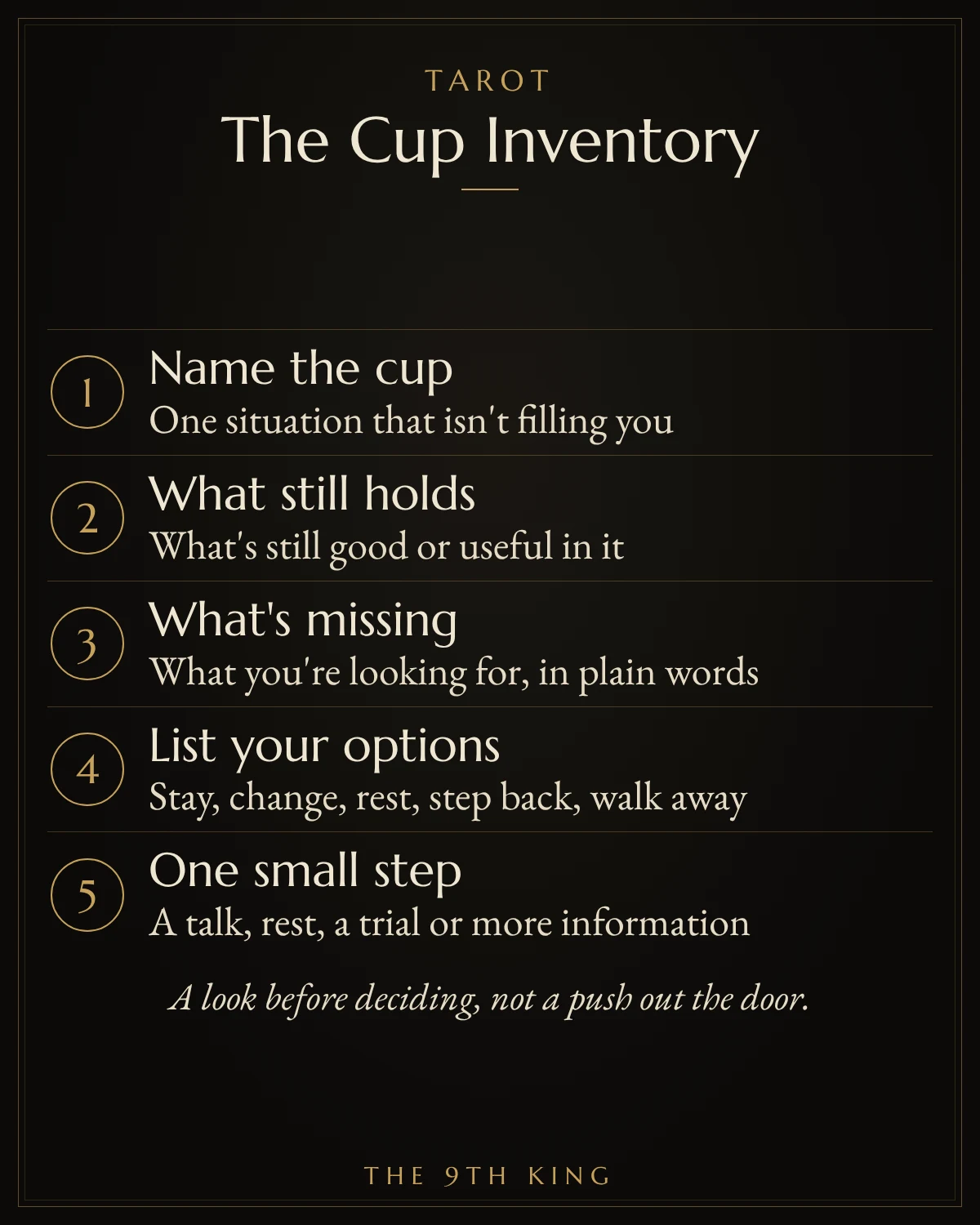
Step 1: Name the cup
Pick one situation that feels flatter than it used to. Write it in one line.
Step 2: What still holds
Write down what’s still good or useful in it: people, skills, comfort, income, history, anything.
Step 3: What’s missing
Now write what you’re looking for, in plain words. “More” isn’t specific enough. Try: more challenge, more closeness, more quiet, more say.
Step 4: List your options
Go through the five ways to answer the card: stay and renew, change the terms, rest first, step back partly, walk away. For each, write one line on what it would look like here. Some may not fit, and that’s fine.
Step 5: One small step
Pick one small, low-risk step: a conversation, rest, a trial change, or more information. If it involves someone else, talking to them is your choice, and only if it feels safe and useful.
A worked example (fictional)
Marcus (fictional) draws the Eight of Cups after six years in a community choir. Lately he dreads rehearsals.
He names the cup: the choir. Under “still holds,” he lists three things: two close friends there, his singing has improved, and Tuesday nights get him out of the house. Under “missing,” he writes two: harder music, and a chance to sing a solo.
Going through the five options, he notes: stay and renew (try a harder piece), change the terms (ask the director about solos), rest first (skip the summer session), step back partly (sing the fall concert, skip the spring season), walk away (leave after the fall concert).
His one small step: he’ll ask the director whether solo auditions are possible.
Journal prompts for the Eight of Cups
- What once filled me that now feels flat? When did I first notice?
- If I could name what I’m looking for in one sentence, what would it be?
- When I’ve walked away before, was I moving toward something or away from something?
- When I’ve stayed before, was it a choice or a default?
For more, our shadow work prompts go deeper, and Shadow Work, Plainly explains how to start safely.
A warm note: this is reflective practice, not therapy. If you’re dealing with trauma, abuse, thoughts of self-harm or distress that feels overwhelming, please work with a qualified therapist who can walk with you. It’s always fine to stop a prompt that feels like too much.
Myths and misreadings of the Eight of Cups
- “The Eight of Cups means you should leave.” No. On The 9th King, walking away is one of five ways to answer the card, and tarot doesn’t decide for you.
- “It means your relationship is over.” No. A card can’t establish facts about the future or about another person’s feelings. Flat seasons happen in lasting relationships too.
- “Walking away is always the brave choice.” Sometimes staying and changing something takes more courage. Waite even notes readings of the card as mildness and modesty.
- “Saturn in Pisces means this card is about Pisces people.” No. The correspondence describes the card’s symbolism in the Golden Dawn tradition. Anyone can draw it, whatever their sign.

Eight of Cups: FAQ
What does the Eight of Cups mean?
The Eight of Cups is a Minor Arcana card in the water suit. Waite describes a dejected man leaving the cups that once made him happy, and says the card usually shows the decline of a matter. Readers commonly take it as fading interest and the search for something more. On The 9th King, it’s a mirror for what you’re looking for, not an instruction to leave anything.
What does the Eight of Cups reversed mean?
Reversed, Waite lists great joy, happiness and feasting, the opposite of the upright card’s low mood. Readers also take it as staying put, second thoughts or circling back after some distance. Some readers don’t use reversals at all. On The 9th King, treat it as a prompt to ask why you’re staying or returning, and whether that’s a choice or a default.
What does the Eight of Cups mean as feelings?
As feelings, readers often take the Eight of Cups as restlessness or quiet disappointment, a sense that something isn’t enough anymore. A card can’t tell you what another person feels or will do; their words and actions can. About your own feelings, it can prompt you to ask whether the flatness comes from the situation, from tiredness, or from both.
What does the Eight of Cups mean in love?
In love, the upright card can point to a dip in feeling or a wish for more depth. Reversed, it can point to renewed warmth or second thoughts. The card doesn’t tell you to stay or leave, and a flat season isn’t the same as an ending. It invites you to name what’s missing and look at all your options, including staying and changing something.
What zodiac sign is the Eight of Cups?
In the Golden Dawn system, the tradition The 9th King uses, the Eight of Cups corresponds to Saturn in Pisces, the first Pisces decan in Book T’s table. The Golden Dawn’s Book T calls the card the Lord of Abandoned Success. Other schools use different correspondences, so treat this as one traditional framework for symbolism, not a statement about Pisces people.
Is the Eight of Cups a yes or no card?
The 9th King doesn’t do yes or no readings, because tarot here is for self-reflection, not fortune-telling. Instead, ask what the card shows you: what has stopped filling you, what you’re actually looking for, and which of your real options, from staying and renewing to walking away, moves you closer to it.
Does the Eight of Cups mean I should quit my job?
No. The card can point to fading interest at work, but it can’t weigh your income, obligations or options. On The 9th King, walking away is one of five ways to answer the card, alongside staying and renewing, changing the terms, resting and stepping back partly. For real career or money decisions, talk to people you trust and a qualified professional.

Your next step: do the cup inventory above, and choose your one small step before you close the notebook. Then find where Saturn falls in your own chart with our guide on how to read a birth chart: the planet of limits and honest endings that the Golden Dawn tied to this card.
Explore Next
- The Fish’s longing and its shadow: Pisces Traits
- Saturn’s style in a person: Capricorn Personality Traits
- Where the water suit begins: Ace of Cups
- The card before this one, the card of many options: Seven of Cups
- A walk inward instead of away: The Hermit
- Reading by feel: Intuitive Tarot (Code of Ascension)
- New to the cards: Tarot for Beginners: How Tarot Really Works (Code of Ascension)
- More tarot on The 9th King: Tarot Card Meanings · Minor Arcana · Tarot & the Zodiac · Four of Cups · Shadow Work Tarot Spread
- More cards in this set: Nine of Cups, Ten of Cups
Final Thought: Know What You’re Walking Toward
The man in the Eight of Cups isn’t a failure for leaving, and he wouldn’t be a coward for staying. What matters is knowing what you’re looking for. Honor what the cups gave you, name what’s missing, and take one small step. Know your nature. Rule your life.
About the Author
King is the founder of The 9th King, where zodiac psychology, relationships and shadow work are explored as tools for self-knowledge rather than fortune-telling. He’s a Libra Sun, and writes about the personal side of astrology on King The Kemist. Astrology on The 9th King is interpretation and self-reflection, not prediction or established fact.
Leave a Reply