

Quick Answer: What Does the King of Cups Mean?
The King of Cups is a court card in the suit of Cups, the Minor Arcana suit linked with the element of water and with emotional life. He’s the suit’s mature figure: someone who can feel the whole sea and still keep his seat.
Keywords: emotional maturity, steadiness, compassion, wise counsel, diplomacy, creative intelligence.
- Upright, in one line: readers often take it as feeling deeply without being run by it: calm that comes from knowing your emotions, not from hiding them.
- Reversed, in one line: the same water out of balance: feelings bottled up behind a calm face, moodiness, or emotional control used on other people.
On The 9th King, tarot is a mirror for self-knowledge, not fortune-telling. The King of Cups doesn’t predict that a kind, wise person will arrive. It asks a harder question: Is my calm real, or is it a lid?
Table of Contents

The King of Cups at a glance
| King of Cups | |
|---|---|
| Arcana | Minor Arcana, court card |
| Suit | Cups (also chalices) |
| Element | Water |
| Upright keywords | Maturity, steadiness, compassion |
| Reversed keywords | Suppression, moodiness, manipulation |
| Shadow side | Calm as a mask |
| Self-mastery lesson | Steady, not shut down |
| Key question | Is my calm real, or is it a lid? |
First come the imagery and the meanings readers commonly use. Then The 9th King’s reading, with prompts and one exercise.
What’s on the card: the traditional imagery
The King of Cups most people picture comes from the Rider–Waite–Smith deck, illustrated by Pamela Colman Smith for the occultist A.E. Waite and first issued in 1909. Both were members of the Golden Dawn (Hyperallergic), which matters for correspondences.
Tarot is much older. Cards were invented in Italy in the 1430s for games and first used for fortune-telling in France around 1780 (Britannica).
A throne on the water
Waite’s description of the King of Cups in The Pictorial Key to the Tarot is short (sacred-texts.com). In paraphrase, he gives us four details:
- A great cup in his right hand. The cup is the suit’s emblem, the vessel that holds feeling.
- A short sceptre in his left. Authority, but a modest one.
- A throne on the sea. In Waite’s words, “his throne is set upon the sea.”
- A ship on one side, a dolphin on the other. One is human-made and steered; the other is wild, playful and at home in the waves.
Waite adds that the cup refers to water, which appears in all the Cups court cards.
How to read the picture
Together the details make one point: the King is steady while the water moves. He isn’t calm because the sea is calm. He’s calm on it.
That’s the difference between maturity and avoidance. Avoidance moves inland, away from the water. Maturity sits on the waves and stays upright. The ship and the dolphin can be read as two ways of meeting feeling: steering through it, and moving with it.
Our Page of Cups page shows the same suit at its youngest, when feeling still arrives as a surprise. The King knows the water now.
If you’re new to reading cards as scenes, Code of Ascension’s Tarot for Beginners: How Tarot Really Works (Code of Ascension) covers the basics.
King of Cups meaning: upright and reversed
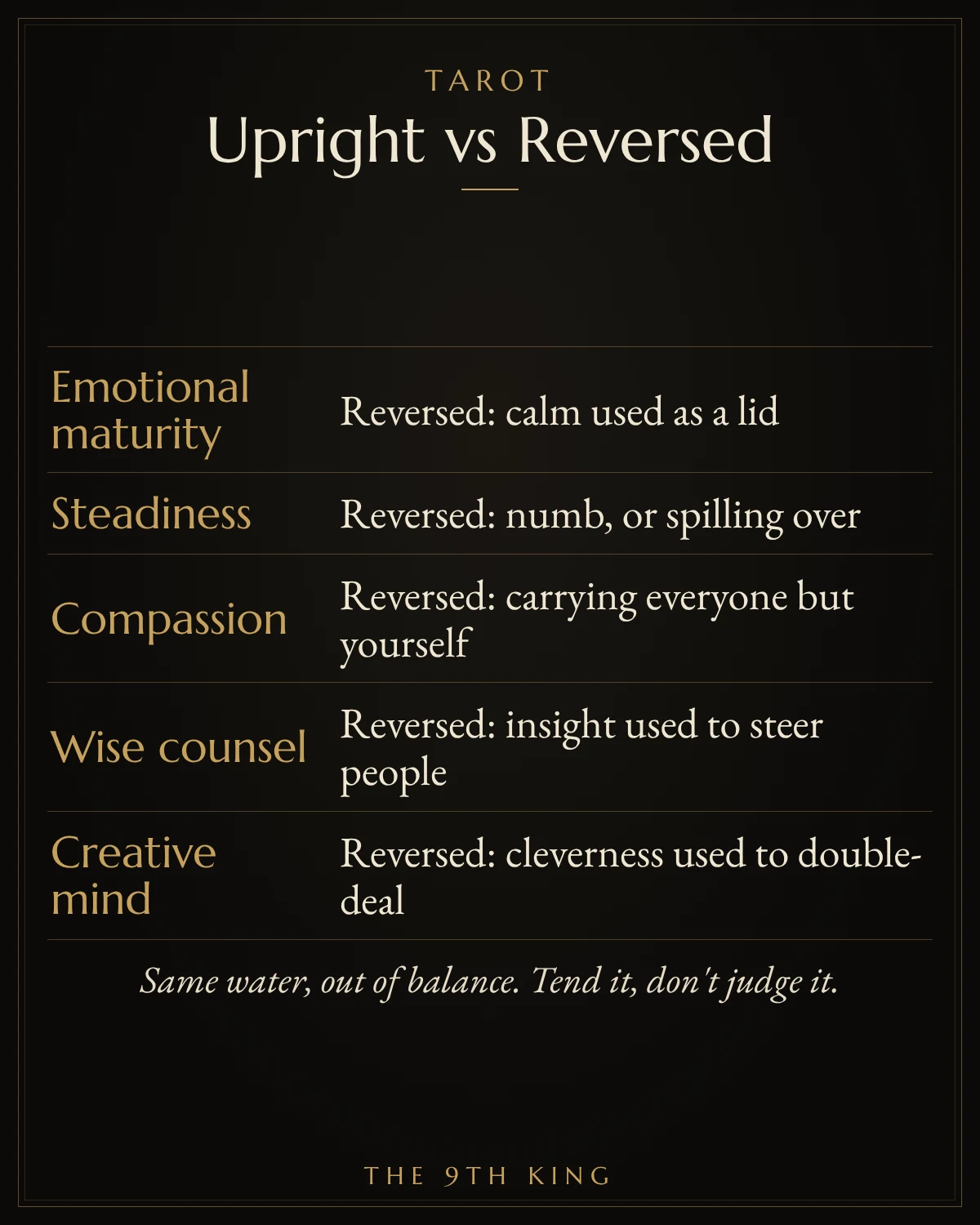
Upright
When the King of Cups appears upright, readers often take it as mature water: feeling that has become wisdom, and wisdom that has become care for others. Waite’s divinatory meanings lean practical. He describes a responsible person, someone disposed to help, and links the card to equity, art, science and creative intelligence (sacred-texts.com).
The upright themes readers commonly use:
- Emotional maturity: knowing what you feel and choosing what to do with it.
- Steadiness: staying present when things get loud.
- Compassion: caring without drowning in other people’s feelings.
- Wise counsel: the friend, mentor or professional people go to when it’s hard.
- Creative mind: feeling turned into art, ideas or good judgment.
A court card works best as a mirror for your own behavior. The upright King can point to a moment where you’re asked to stay steady: to hear something hard without reacting, or to comfort without fixing. Ask yourself: What would I do here if I trusted myself to feel this and still act well?
Readers sometimes take a court card as a person in your life, here someone calm and wise. Hold that lightly, and ask what quality in that person am I being asked to notice or learn?
Reversed
Reversed isn’t a “bad” card. It’s the same water, out of balance. Waite’s reversed meanings are blunt: dishonesty, double-dealing and injustice (sacred-texts.com). Modern readers usually take it more psychologically:
- Water held down: bottled feelings, numbness, calm that’s really a lid.
- Water spilling over: moodiness, sulking, or feelings leaking out sideways as coldness or sarcasm.
- Water used as a tool: using emotional insight to steer people, guilt-tripping, or performing calm to win an argument.
Rather than “someone will deceive me,” try: Where am I holding my feelings down, letting them leak, or using them on someone?
King of Cups in love, at work and as feelings
King of Cups as feelings
“As feelings” usually means how does someone feel about me? Tarot can’t read another person’s mind. It can describe a kind of feeling worth reflecting on.
Upright, readers often take it as feelings that are deep, warm and steady. Reversed, readers may take it as feelings that are real but guarded, or calm that comes with mixed signals. Treat these as interpretations to reflect on, not evidence of what another person secretly feels: a card can’t establish anyone else’s feelings or actions. The part you can actually read is your own: Do I feel safe and seen in this connection, and do I let myself be seen?
King of Cups in love
In love, the upright King can point to patient, emotionally present, generous energy. The challenge is that steady people are often the ones everyone leans on, and they forget to lean back. Ask yourself:
- Do I share my own feelings, or only make space for my partner’s?
- Is my patience a gift, or a way to avoid asking?
Reversed, readers often see emotional distance, moodiness or manipulation. None of that tells you whether to stay or leave; only you can weigh that. And one line matters here: if someone uses calm, guilt or emotional insight to control you, that behavior is theirs to own, not yours to fix. Our guide to privacy without mixed signals covers staying private without leaving a partner guessing.
King of Cups at work
At work, the King of Cups is the steady presence: the manager people trust with bad news, the counselor, the mediator who keeps a tense meeting human. Readers often take it as encouragement to lead with emotional intelligence.
The shadow version: absorbing everyone’s stress and never saying it’s too much. This is reflection, not career or financial advice. The card asks how you hold the room; it predicts nothing about your job or money. A quick check: Do people leave a conversation with me feeling steadier, or just unsure where they stand?
Cups, water and the court-card naming convention
Cups as water
In most modern tarot traditions, Cups correspond to water, the element of emotion, feelings and emotional connection (Wikipedia: Suit of cups). The Golden Dawn’s tarot teaching, Book T, printed by Aleister Crowley as Liber LXXVIII, calls the Ace of Cups the root of the powers of water (Liber LXXVIII, sacred-texts.com).
Golden Dawn–derived correspondences: the tradition The 9th King uses
Astrology links on The 9th King follow Golden Dawn–derived correspondences, the tradition the Rider–Waite–Smith deck draws on. Other schools differ, and not every card maps to a single zodiac sign. Court cards work differently: in the Golden Dawn system, each is read as an element within an element, and Knights, Queens and Kings also rule a stretch of the zodiac that crosses two signs.
The naming convention
The Golden Dawn and the Rider–Waite–Smith deck don’t use the same court titles, so here is the rule this site uses. The 9th King follows the court-card naming in Liber LXXVIII (the Golden Dawn’s Book T): Knights are fire of their suit, Queens water, Kings air, Pages earth. That text lists each Golden Dawn title next to a familiar card name (Liber LXXVIII); applying those pairings to the Rider–Waite–Smith courts is our convention, not something Waite says. Other systems differ: Crowley’s Thoth deck, for example, renames the courts Knight, Queen, Prince and Princess (Wikipedia: Thoth tarot deck).
| Rider–Waite–Smith card | Golden Dawn title | Element pairing |
|---|---|---|
| Knight of Cups | King of the hosts of the sea | Fire of water |
| Queen of Cups | Queen of the thrones of the waters | Water of water |
| King of Cups | Prince of the chariot of the waters | Air of water |
| Page of Cups | Princess of the waters | Earth of water |
So on this site the King of Cups is air of water, just as our King of Wands is air of fire: feeling that has met thought. Air brings perspective; water brings depth. Air of water is stepping back far enough to see a feeling clearly, without stepping out of it.
What Liber LXXVIII says about this Prince
Book T’s portrait is sharper than the gentle modern king. It shows a winged, crowned figure in a chariot drawn by an eagle, with a scorpion on the wheel and a calm, still lake beneath. He holds a lotus in one hand and a cup in the other, and a serpent rises from the cup toward the water. The text calls him subtle, crafty and artistic, “a fierce nature with calm exterior,” and says he is powerful for good or evil, leaning to the worse when power or wisdom only seems to be on offer (Liber LXXVIII).
A calm surface over a fierce depth is exactly the question this card puts to you: Is my calm a choice I’ve made with my depths, or a cover over them?
The span: 20° Libra to 20° Scorpio
The same text says this Prince rules from 20° Libra to 20° Scorpio (Liber LXXVIII). That’s the last third of Libra and the first two thirds of Scorpio. The 9th King applies it to the Rider–Waite–Smith King of Cups using the convention above: one tradition’s map, not a rule that the card “is” a sign.
- Libra traits: balance, fairness and the wish to keep the peace, with the shadow of avoiding conflict to keep things pleasant.
- Scorpio personality traits: depth, intensity and what stays below the surface, with the shadow of control and secrecy.
Libra’s diplomacy on top, Scorpio’s depth underneath. Tarot & the Zodiac lists every court span; the Minor Arcana hub explains the suits.
The water signs, as element links
The card also shares its element with the three water signs, Cancer, Scorpio and Pisces. That’s an element link, not a correspondence. If you have a water Moon, these themes may feel familiar; our Moon sign guide explains why, and how to read a birth chart shows where to look.

The 9K reading: tension, shadow and self-mastery
Here The 9th King’s reading goes past the keywords. The King of Cups teaches one of the deck’s most useful lessons: steadiness without shutting down.
The tension: feeling fully versus staying composed
The King has to do two things at once: feel the whole sea, or he loses the depth that makes him wise, and stay composed enough to act well, or the water takes over. Lean too far toward feeling and you get flooded. Lean too far toward composure and you get the frozen kind of calm: polite, reasonable and sealed off.
Most people learned one side early. Neither is a flaw.
The shadow side
Shadow work means looking at the parts of yourself you’d rather not see. Our zodiac shadow work guide covers the water signs’ shadows, which overlap with this card. The King of Cups carries a crowned version:
- Calm as a mask: looking serene while feelings pile up underneath, unspoken.
- The helper who never needs help: holding everyone else’s water and none of your own.
- Emotional management of others: using what you understand about people to steer them, calm them down or win.
- Numbness mistaken for wisdom: feeling less and calling it maturity.
New to shadow work? Shadow Work, Plainly explains how to begin safely.
| Strength | When it’s overused | One way to rebalance |
|---|---|---|
| Composure | Feelings bottled up | Name one feeling out loud |
| Compassion | Carrying everyone | Ask for one thing you need |
| Insight | Steering people | Say what you see, then let go |
| Diplomacy | Peace at any price | Voice one honest “no” |
| Patience | Waiting out problems | Set a date to raise it |
The self-mastery lesson: steady, not shut down
Real calm and suppressed calm can look identical from outside. Suppressed calm is a lid: the feeling is still there, pushing. Real calm is a keel: the feeling is acknowledged, and you’ve chosen how to move with it.
The King of Cups lesson is to stay seated on the water without pretending the water isn’t there. In practice:
- Name what you feel, at least to yourself, before you decide how to respond.
- Let calm be a response you choose, not a reflex that kicks in so you don’t have to feel.
- Let someone hold your cup sometimes.
- Use what you understand about people to support them, never to manage them.
One caution: no feeling proves your calm is “real.” Peace can sit on something unprocessed; a shaky feeling can come with a sound decision. The exercise below checks over time, not in one moment.
Journal prompts for the King of Cups
- When did I last look calm while feeling something very different? What was I protecting?
- Who do I lean on, and who leans on me? Is that balanced?
- What feeling do I tend to shut down fastest: anger, grief, fear, need or joy?
- When I understand someone well, do I use it to support them or to steer them?
- Is my calm real, or is it a lid?
Our shadow work prompts collection goes deeper.
A short, important note: these prompts are for reflection, not therapy. If you’re dealing with trauma, abuse, thoughts of self-harm or distress that feels overwhelming, please work with a qualified therapist who can support you safely. It’s always fine to stop a prompt that feels like too much.
Practical exercise: the surface and depth check
It takes about ten minutes, once a week, after a moment when you stayed calm under pressure.

- Pick the moment. Write down one recent situation where you stayed calm.
- Write the surface. What could other people see and hear? Your words, your tone, your face.
- Write the depth. What were you actually feeling underneath? Name it plainly: hurt, irritated, scared, tired. More than one is normal.
- Choice or cover? Ask honestly: did I feel this and choose to stay calm, or did I go calm so I wouldn’t have to feel it or deal with it? There’s no score. Just write which seems truer, or “not sure.”
- One honest release. Choose one small way to let some of the depth out: a sentence to the person involved, a journal line, a talk with a friend. If raising it isn’t safe, keeping it private is a valid choice; the point is that you know.
- Repeat weekly. One entry means little. A month of entries shows whether your calm tends to be a choice or a cover, and where.
The aim isn’t to stop being calm. It’s to let your calm rest on something you’ve actually felt. To pair this with a card pull, Code of Ascension’s Intuitive Tarot (Code of Ascension) shows how to combine traditional meanings with first impressions.
Two worked examples (fictional)
Example 1 (fictional): the friend everyone calls. Priya pulls the King of Cups upright and thinks: That’s me, the steady one. Three weeks running, her surface notes say “listened, stayed calm, gave advice.” Her depth notes say “drained,” “resentful,” “lonely.” Her answer to choice or cover? is “cover” every time. Her release: telling one friend she’s having a hard month. The card predicted nothing. It gave her a question.
Example 2 (fictional): the manager who went quiet. Leon pulls the King of Cups reversed after a reorganization he disagreed with. He’s been “professional” for weeks. His depth notes say “angry” and “embarrassed,” and he notices he’s been short with his family at night. His release: asking his director for a meeting to say honestly what didn’t work for his team. His shadow question: Did I stay calm, or did I just stay silent?
Both are reflections to test against real life, not verdicts.
Myths and misreadings about the King of Cups
- “The King of Cups doesn’t feel much.” The opposite: he feels deeply and stays steady anyway. Calm without feeling is the reversed version.
- “Calm means healed.” Not necessarily. Calm can be wisdom, or it can be a habit of shutting down. The card asks you to tell the difference.
- “It means an older man is coming into my life.” Court titles describe energy, not gender or age, and a court card here is a mirror, not a forecast.
- “Reversed means someone is lying to me.” Waite’s reversed meanings mention dishonesty, but the more useful reading is personal: where are your own feelings bottled up or being used?
- “It’s a Pisces card” (or Cancer). It shares the water element with all three water signs, but its Golden Dawn span runs from 20° Libra to 20° Scorpio: two signs, not one.

King of Cups: FAQ
What does the King of Cups mean?
The King of Cups is the mature figure of the suit of Cups, the water suit. Upright, readers often take it as emotional maturity, steadiness, compassion and wise counsel: feeling deeply and still acting well. On The 9th King it’s a mirror, not a prediction. It asks whether your calm comes from knowing your feelings or from shutting them away.
What does the King of Cups reversed mean?
Reversed, the King of Cups usually points to water out of balance: feelings bottled up behind a calm face, leaking out as moodiness, or used to steer other people. A.E. Waite’s reversed meanings mention dishonesty and double-dealing. A useful question: where am I holding my feelings down, letting them spill sideways, or using them on someone?
What does the King of Cups mean as feelings?
Tarot can’t read another person’s mind or establish what they feel or will do, so “as feelings” is a prompt to reflect on, not evidence. Upright, the King of Cups suggests deep, warm, steady care. Reversed, it suggests real feelings that stay guarded or arrive as mixed signals. The part you can read best is your own: do you feel safe and seen here, and do you let yourself be seen?
What does the King of Cups mean in love?
In love, the upright King of Cups is often read as patient, emotionally present, generous energy. The challenge is that steady partners can forget to share their own needs. Reversed, readers often see distance, moodiness or emotional control. The card doesn’t tell you whether to stay or leave. It asks whether both people’s feelings have room.
Is the King of Cups a yes or no card?
The 9th King doesn’t do yes-or-no readings, because tarot here is a tool for self-knowledge rather than prediction. Instead, try a reflective question the King of Cups is good at: “If I let myself feel this fully, what would I still choose to do?” Your answer usually tells you more than a yes or no could.
What zodiac sign is the King of Cups?
In the Golden Dawn naming The 9th King follows, the King of Cups matches Liber LXXVIII’s Prince of the Chariot of the Waters: air of water, ruling from 20° Libra to 20° Scorpio. That span crosses two signs, so the card isn’t tied to one. As a water-suit card it also shares an element with Cancer, Scorpio and Pisces.
Is the King of Cups emotionally unavailable?
Not upright. The upright King feels deeply and stays present, which makes him one of the most emotionally available figures in the deck. Unavailability is closer to the reversed card, where calm becomes a wall. If the card brings a distant person to mind, also ask the mirror question: where might I use composure to keep people at arm’s length?

Your next step: bring the King of Cups into your own chart. Find your Moon sign and any planets between late Libra and mid Scorpio in your birth chart, read the water-sign shadow in our Zodiac Shadow Work guide, then try one surface and depth check this week.
Explore Next
- The shadow side of every sign: Zodiac Shadow Work
- Start shadow work safely: Shadow Work, Plainly
- Balance and keeping the peace: Libra Traits
- Depth below the surface: Scorpio Personality Traits
- Your emotional habits: Moon Sign Meaning
- More tarot on The 9th King: Tarot Card Meanings · Minor Arcana · Tarot & the Zodiac · Page of Cups · King of Wands · Shadow Work Tarot Spread
- More new cards: Queen of Cups · Knight of Cups · Ace of Cups · Six of Cups

Final Thought: Sit on the Water, Not Above It
The King of Cups isn’t asking you to feel less. He’s asking you to feel all of it and still keep your seat. Calm that hides is a lid; calm that knows is a keel. Choose the keel, let someone hold your cup now and then, and let your steadiness rest on the truth. Know your nature. Rule your life.
About the Author
King is the founder of The 9th King, where zodiac psychology, relationships and shadow work are explored as tools for self-knowledge rather than fortune-telling. He’s a Libra Sun, and writes about the personal side of astrology on King The Kemist. Astrology on The 9th King is interpretation and self-reflection, not prediction or established fact.
Leave a Reply