
Quick Answer: What Are the Main Capricorn Personality Traits?
Capricorn is the tenth sign of the zodiac, a cardinal earth sign ruled by Saturn, and its symbol is the Sea-Goat. In tropical astrology the Sun is in Capricorn from roughly December 21 to January 19, starting at the December solstice.
The core Capricorn personality traits, as astrologers read them:
- Responsibility: taking ownership and following through.
- Ambition: wanting to build something that lasts.
- Discipline: doing the work when nobody is watching.
- Patience: thinking in years, not weeks.
- Composure: staying steady when things get hard.
- Integrity: keeping your word, even when it costs you.
The shadow side is the load carried too long: overwork, self-worth tied to output, and a habit of postponing rest, feelings and joy until “later.”
These are symbolic themes, not a personality test. Your Sun is one placement among many, so a Capricorn Moon or Rising can feel more “Capricorn” than a Capricorn Sun.
Table of Contents
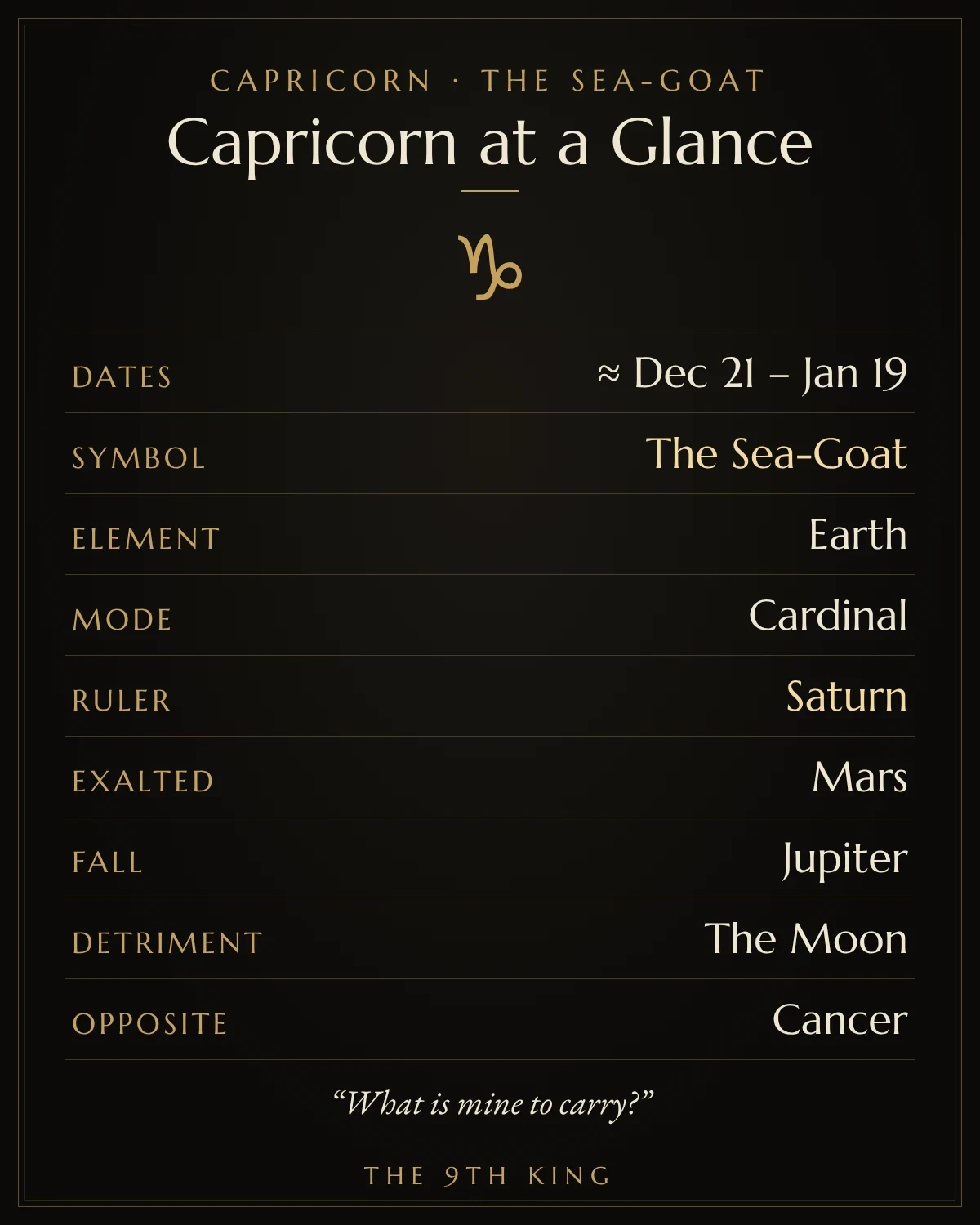
Capricorn at a glance
| Capricorn | |
|---|---|
| Position | 10th sign of the zodiac |
| Dates (tropical) | About December 21 to January 19 |
| Symbol and glyph | The Sea-Goat, ♑ |
| Element | Earth |
| Modality | Cardinal |
| Ruling planet | Saturn |
| Exalted planet | Mars |
| Planet in fall | Jupiter |
| Planet in detriment | The Moon |
| Opposite sign | Cancer |
| House link (modern) | 10th house, career and public standing |
| Key question | What is mine to carry, and what can I put down? |
About the house row: modern astrologers often pair Capricorn with the 10th house, the house of career, reputation and public role. That pairing is a modern teaching convention (the “natural zodiac”), not a rule of every tradition. The sign and the house are different things: your 10th house can hold any sign, and Capricorn can fall in any house of your chart.
Capricorn dates: when is Capricorn season?
In tropical astrology, the system most Western apps use, Capricorn begins at the exact moment of the December solstice, the shortest day of the year in the Northern Hemisphere. This year that moment comes at 10:03 am EST on December 21, 2026. The season straddles the calendar new year: the previous Capricorn season ended when the Sun entered Aquarius at 8:45 pm EST on January 19, 2026 (times from Cafe Astrology’s Sun enters Capricorn 2026 and Sun enters Aquarius 2026 pages).
Date lists can be a day off. If you were born on December 20–23 or January 19–21, check a chart calculated for your exact birth time and place.
Three framework notes clear up most of the confusion:
- Tropical Capricorn is not the constellation Capricornus. Tropical signs are twelve equal 30-degree sections of the Sun’s path, counted from the March equinox. Constellations are unequal regions of sky with official boundaries set by the International Astronomical Union.
- Sidereal astrology anchors its twelve signs to the stars, so its Capricorn dates run about three weeks later.
- Ophiuchus doesn’t change your tropical sign. Code of Ascension’s Ophiuchus guide (Code of Ascension) explains the difference between constellations and signs.
This guide uses the tropical zodiac throughout.
The Capricorn symbol: why the Sea-Goat?
The Capricorn symbol is the Sea-Goat: a goat’s head and forelegs joined to a fish’s tail. The glyph ♑ is usually read as a goat’s horn curling into that tail. Most people picture a mountain goat on a cliff; the older image is an animal built for two worlds, the climb and the deep water.
It is also one of the oldest images in the sky. As Ian Ridpath explains in Star Tales: Capricornus, the constellation evidently began with the Sumerians and Babylonians, who called it SUHUR-MASH-HA, “the goat-fish.” The Greeks named it Aigokeros, “goat-horned,” and linked it with Pan, the goat-legged god of the countryside whose loud shout gave us the word “panic.”
The Greek story Ridpath retells is about a crisis, not a climb:
- The warning. When the monster Typhon attacked, Pan warned the gods and suggested they disguise themselves as animals. Pan jumped into a river, and the part of him under water became a fish. (Hyginus names the river as the Euphrates.)
- The repair. Pan and Hermes later restored Zeus’s sinews. Zeus then defeated Typhon and placed Pan’s image in the sky.
- A second explanation. Eratosthenes linked Pan’s fishy form to the conch shell he blew to help the gods against the Titans. Hyginus says instead that Pan hurled shellfish at the enemy.
Some sky lore from the same page:
- Capricornus is the smallest of the twelve zodiac constellations.
- Its star names are pastoral. Alpha is Algedi, from the Arabic for “the kid”; Delta is Deneb Algedi, “the kid’s tail.”
- The Tropic of Capricorn is named after it. That’s the latitude where the Sun is overhead at noon at the December solstice. In Greek times the Sun stood in Capricornus on that date; precession, a slow wobble of the Earth’s axis, has since moved it into Sagittarius.
What the symbol teaches: the Sea-Goat is the one who stays calm when everyone else panics, and who helps restore strength rather than only spending it. That’s Capricorn at its best: steady in a crisis, adaptable, and as interested in repair as in achievement. The shadow is the goat who only knows how to climb.

Cardinal earth and Saturn: why astrology reads Capricorn this way
The Capricorn personality traits make more sense once you see the ingredients.
Earth: the element of results
Earth (Taurus, Virgo, Capricorn) is read as the element of the practical, the physical and the real. Capricorn’s earth is structural earth: the foundation, the frame, the thing that’s still standing in twenty years.
Cardinal: the mode that begins
Cardinal signs (Aries, Cancer, Libra, Capricorn) open the seasons and are read as initiators. What Capricorn starts is structure: the plan, the system, the business, the first brick of something long-term. It begins at the darkest point of the year and builds toward the light.
Saturn: the planet of time and limits
Capricorn is ruled by Saturn, in traditional and modern astrology alike. (Traditionally, Saturn also rules Aquarius.) Saturn is read as time, structure, responsibility and consequences: the part of the chart that says this is real, and it takes as long as it takes.
That’s why this guide keeps coming back to limits. Saturn is also the planet of boundaries, endings and the word no. A Saturn sign that only hears “work harder” has heard half the message.
Mars exalted, Jupiter in fall, the Moon in detriment
Traditional astrology also names planets that are strong or weak in each sign: tensions and talents, not defects.
| Dignity | Planet in Capricorn | Plain-language reading |
|---|---|---|
| Rulership (domicile) | Saturn | Saturn placed in Capricorn: structure and patience work with the grain. |
| Exaltation | Mars | Mars placed in Capricorn: drive becomes disciplined and strategic. |
| Fall | Jupiter | Jupiter placed in Capricorn: growth and faith feel rationed, or must be earned. |
| Detriment | The Moon | Moon placed in Capricorn: feelings tend to be managed rather than shown. |
Deborah Houlding’s Skyscript glossary gives a clear modern summary of these dignities, which go back to Ptolemy’s Tetrabiblos.
Important: the Sun has no traditional dignity in Capricorn, so none of these rows applies to every Capricorn Sun. They describe planets that are actually placed in Capricorn in someone’s chart. Being a Capricorn Sun doesn’t put your Saturn, Mars, Jupiter or Moon in Capricorn; check where those planets sit in your own chart.
At the level of symbolism, the classic Capricorn traits appear: a nature that wants results (earth), starts structures (cardinal), respects time and consequences (Saturn), channels effort with strategy (Mars exalted), and struggles with easy optimism (Jupiter in fall) and open vulnerability (the Moon in detriment).
Capricorn personality traits: strengths and the shadow side
Each trait below has a strength and an overused version. Naming both shows when the climb is building a life, and when it’s quietly eating one.
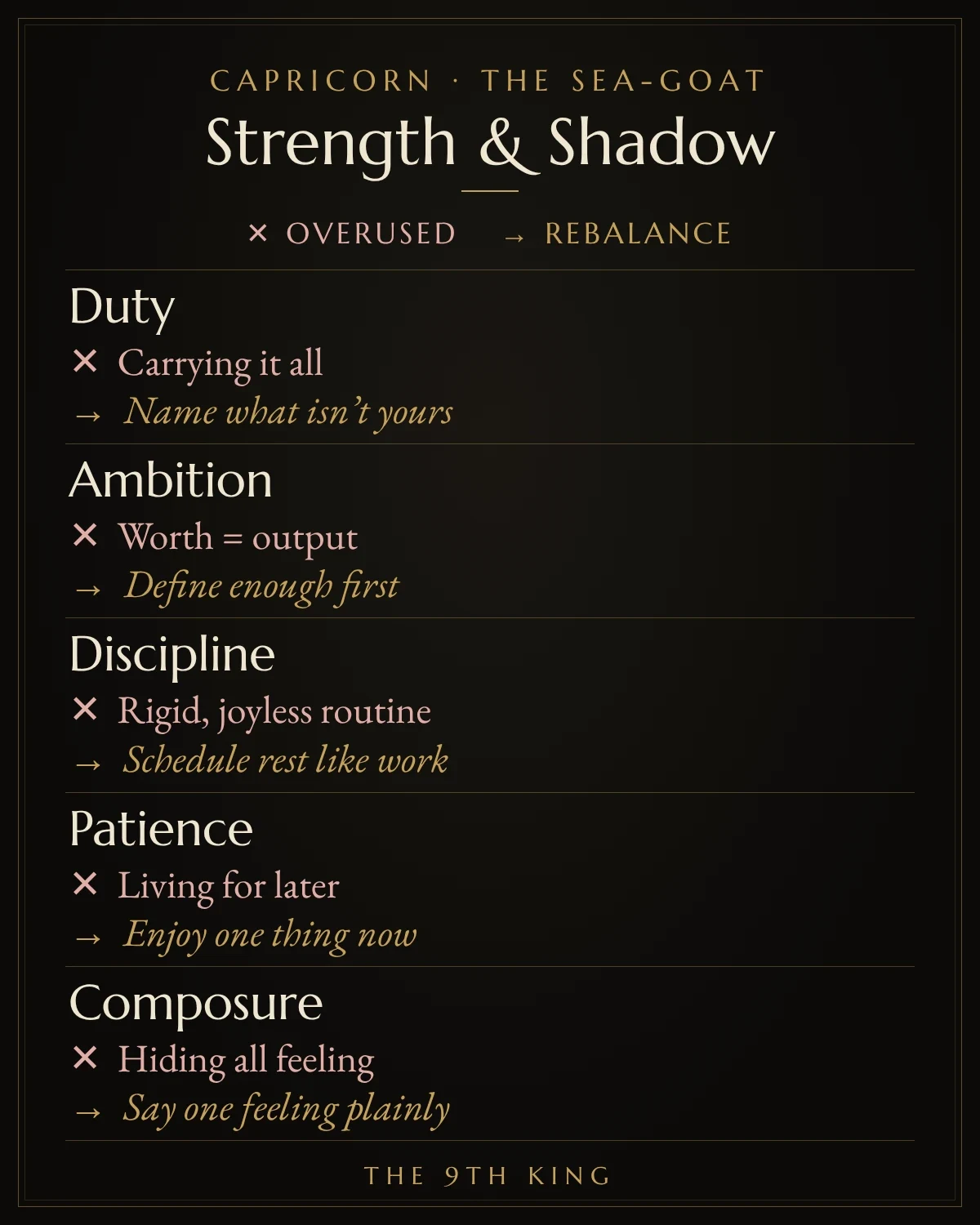
| Strength | When it’s overused | One way to rebalance |
|---|---|---|
| Duty | Carrying everyone’s load | Name what isn’t yours to carry |
| Ambition | Self-worth tied to output | Define “enough” before you start |
| Discipline | Rigid, joyless routine | Schedule rest the way you schedule work |
| Patience | Living for “later” | Enjoy one thing now, on purpose |
| Composure | Hiding every feeling | Say one feeling plainly |
Duty
Capricorn is read as the sign of responsibility: the person who stays late to fix it and does what they said they’d do. Overused, duty means carrying other people’s loads, because it’s faster and because asking for help feels like failing.
Ambition
Capricorn wants to build something that matters and lasts. That isn’t vanity; it’s a desire for work with weight. The shadow is when achievement stops being something you do and becomes the proof that you’re allowed to exist. Then no result is ever enough.
Discipline
Capricorn can keep a routine long after motivation has gone home. Overused, it turns into rules nobody remembers the reason for, and a life where rest has to be earned and is never quite earned.
Patience
Saturn is the planet of time, and Capricorn thinks in long arcs: five-year plans, slow savings, reputations built one promise at a time. The shadow is postponement: I’ll relax when the business is stable. I’ll see friends when the project ships. Later has a way of never arriving.
Composure
Capricorn is often the calm one in a crisis, the Sea-Goat who doesn’t panic. The cost comes when composure becomes concealment: the feeling is managed so well that even you forget it’s there.
Capricorn traits in love and relationships
Love tests Capricorn because it can’t be scheduled or earned, only offered.
What Capricorn symbolism tends to value in love:
- Reliability. Showing up, on time, again and again.
- Respect. A partner who takes your goals seriously.
- Commitment. Building something together that lasts.
- Provision. Love shown through practical care: the fixed shelf, the paid bill, the plan.
Where it can go wrong:
- Love as logistics. Showing care only through tasks.
- Work as the third partner. Every evening and weekend quietly belongs to the job.
- Feelings on a delay. Waiting until the emotion is “sorted” before sharing it. (The Moon is in detriment in Capricorn, so if your own Moon is placed there, this theme may be stronger.)
Sustainable love: a Capricorn choice
The situation: your partner says they feel lonely in the relationship. You’re confused, because you’ve been working hard for both of you.
- Option A: list everything you’ve done. True, and it tells them their feeling is wrong.
- Option B: work harder to fix it. More provision, same distance.
- Option C: put the work down and be present. No plan, just time.
Capricorn at its best picks Option C. A short script for a sign that shows love through doing:
- Acknowledge it: “I hear that you feel lonely.”
- Don’t defend the effort: it’s real, and not the point right now.
- Ask what presence looks like to them: “What would help you feel close to me this week?”
- Protect the time the way you’d protect a meeting.
- Say one feeling out loud: “I’ve been stressed, and I’ve missed you too.”
For Sun-sign pairings, Code of Ascension’s zodiac compatibility chart (Code of Ascension) covers the matches. For a fuller picture of two people, synastry for beginners shows how to compare whole charts, and Moon vs Venus explains the difference between what you need and what you’re drawn to.
Capricorn traits at work and in the long game
At work, Capricorn symbolism points toward roles that reward structure and patience: management, finance, law, engineering, architecture, operations, building a business, anything measured in years. That describes associated skills, not a career prediction.
Capricorn is often the steward at work, trusted with the hard, unglamorous parts. The danger isn’t laziness; it’s keeping going long past the point where it makes sense.
This is where Capricorn parts ways with hustle culture. “Rise and grind” sounds Capricorn, but Saturn is the planet of limits, and a structure that ignores its load limit doesn’t prove its strength. It collapses.
Three workplace choices
Choice 1: your manager asks you to take on another project.
Rather than absorbing it or refusing with guilt, try “I can take this on if X moves to next month. Which matters more?” That keeps your reliability and makes the trade-off visible.
Choice 2: a colleague keeps missing their part, and you keep covering it.
Instead of covering again, say “I’ve picked up this task three times now. Can we sort out who owns it?” Duty includes not hiding a problem.
Choice 3: you hit the big goal, and feel nothing.
Before setting a bigger goal, ask what this one was supposed to give you, then look for that directly. Sometimes the answer was rest, respect or time.
The “enough line”: a sustainable limits practice
- Define enough before you start. What result, by when, counts as success?
- Set a load limit. How much can you carry without cutting sleep or people?
- Name one thing that isn’t yours. Hand it back, delegate it or drop it.
- Schedule recovery first. Put rest in the calendar before the work fills it.
- Review monthly. If you hit enough, pause and notice the view.
The useful question at every step: Am I building this, or is it building a cage around me?
Capricorn Sun, Moon and Rising: what changes
Capricorn traits don’t only belong to Capricorn Suns. The sign shows up differently in each part of the chart.

| Placement | What Capricorn describes there | What to look at next |
|---|---|---|
| Capricorn Sun | Your direction: growing into mastery and responsibility | The house your Sun sits in |
| Capricorn Moon | Your needs: structure, competence, emotional privacy | Aspects to your Moon |
| Capricorn Rising | Your approach: composed, serious, capable | Saturn, which becomes your chart ruler |
| Venus in Capricorn | How you love: loyal, practical, slow to commit | The house Venus sits in |
| Capricorn on the 7th cusp | What you look for in partners: maturity and reliability | Saturn’s sign and house |
Capricorn Sun versus Capricorn Moon is the comparison most people need:
- A Capricorn Sun describes a direction. The Sun has no traditional dignity in Capricorn. Many Capricorn Suns grow into their authority, and the work is learning that rest isn’t a reward to be earned.
- A Capricorn Moon describes needs: feeling competent and useful, with feelings kept private until they’re understood. The Moon is in detriment here, traditionally read as emotions held in rather than shown, which isn’t the same as having none. Our Moon sign guide covers the Capricorn Moon in full.
- A Capricorn Rising makes Saturn your chart ruler, so Saturn’s sign and house become a central story in your chart. Code of Ascension’s Rising Sign Meaning (Code of Ascension) covers the Rising signs, and our birth chart guide shows how to follow a chart ruler.
On timing: the Moon changes sign every two to three days, so your birth date is usually enough to know your Moon sign, unless the Moon changed signs on the day you were born; then your birth time decides it. The Rising sign changes roughly every two hours, so it always needs an accurate birth time.
Two worked examples (fictional charts)
Example 1: Capricorn Sun with a Leo Moon
The chart: Sun in Capricorn, Moon in Leo.
Reading: a direction built on responsibility and lasting work (Capricorn Sun), with needs centred on warmth, play and being seen (Leo Moon). This person may work hard in the background for years, then feel quietly hurt that nobody noticed.
A choice they’ll often face: after a big win, do they (a) move straight to the next goal, (b) wait to be celebrated, or (c) mark the moment and invite people in?
The useful question: Do I let myself be proud of what I’ve built, out loud?
Example 2: Gemini Sun with Capricorn Rising and Saturn in Libra
The chart (fictional, Whole Sign houses): Sun in Gemini in the 6th house, Capricorn Rising, Saturn in Libra in the 10th house.
Reading: a curious, quick core (Gemini Sun) in the house of daily work, meeting the world with composure (Capricorn Rising). Because Capricorn is rising, Saturn is the chart ruler, and here it sits in Libra, where it’s traditionally exalted, in the house of career and public role. The first impression is grown-up and capable; underneath is someone restless who may feel their reputation depends on being fair and professional at all times.
A choice they’ll often face: when they’re offered one more responsibility at work, do they (a) accept to protect their reputation, (b) take it on and scatter their energy, or (c) check it against their load limit first?
The useful question: Am I being responsible, or just afraid of looking unreliable?
Both readings are hypotheses to test against real life, not verdicts.

Capricorn shadow work: when the climb becomes the cage
Shadow work means looking at what you’d rather not see. The Capricorn shadow often hides behind competence. Our zodiac shadow work guide covers all twelve signs; here’s Capricorn up close.
Common Capricorn shadow patterns:
- Worth by output. Feeling valuable only on productive days.
- Control as safety. Running everything so nothing can go wrong.
- The permanent later. Deferring joy and closeness to a future that keeps moving.
- Status as armour. Using achievement to avoid looking ordinary or needy.
- Coldness as competence. Treating feelings as inefficiencies to be managed.
A simple practice, the put-down list: once a week, write down everything you’re carrying: tasks, worries, other people’s problems. Mark each mine, shared or not mine, and put one not mine item down that week.
If you’re new to the idea, Shadow Work, Plainly explains what Jung meant and how to start safely.
Myths about Capricorn personality traits
- “Capricorns are cold.” Composure isn’t coldness. Many Capricorn placements feel deeply and show it through loyalty and action.
- “Capricorns only care about money and status.” Ambition is about building something that lasts. That can be a family, a craft or a reputation for honesty.
- “Capricorns are workaholics.” Overwork is the shadow, not the definition. Saturn rules limits, and a mature Capricorn knows when to stop.
- “Capricorns are no fun.” Capricorn is often credited with a dry, sharp sense of humour.
- “If I don’t relate to Capricorn traits, my chart must be wrong.” The Sun is one placement. Your Moon, Rising and Saturn change the picture.
- “Ophiuchus means I’m not really a Capricorn.” No. Ophiuchus concerns the constellations, and it doesn’t change tropical Capricorn dates.
Five journal prompts for Capricorn traits
- What am I carrying right now that isn’t actually mine?
- What would “enough” look like in my work this year?
- What have I been postponing until “later,” and what would it cost to start now?
- When did I last let someone see me tired, unsure or proud?
- What is mine to carry, and what can I put down?

Capricorn Personality Traits: FAQ
What are the main Capricorn personality traits?
In astrology, Capricorn is associated with responsibility, ambition, discipline, patience, composure and integrity. Its shadow side is overwork, self-worth tied to achievement and postponing rest and feeling.
What are the Capricorn dates?
In tropical astrology, about December 21 to January 19. The dates follow the December solstice and shift slightly each year, so check a calculated chart if your birthday is on the edge.
What element is Capricorn?
Capricorn is an earth sign, along with Taurus and Virgo. It’s also cardinal: it begins a season, winter in the Northern Hemisphere.
What is Capricorn’s ruling planet?
Saturn, in both traditional and modern astrology. Traditionally, Mars is exalted in Capricorn, Jupiter is in fall and the Moon is in detriment.
What does the Capricorn symbol mean?
The Sea-Goat: a goat with a fish’s tail, called “the goat-fish” by the Sumerians and Babylonians and later linked by the Greeks with Pan. The glyph ♑ is usually read as a horn curling into a tail.
Why is it called the Tropic of Capricorn?
In Greek times the Sun stood in front of the stars of Capricornus at the December solstice. The latitude where the Sun is overhead at noon on that day kept the name, even though precession has since moved the solstice point into Sagittarius.
Is a Capricorn Moon different from a Capricorn Sun?
Yes. A Capricorn Sun describes your long-term direction: mastery and responsibility. A Capricorn Moon describes your emotional needs, especially competence, structure and privacy. The Moon is traditionally in detriment in Capricorn.
What is a Capricorn Rising?
It means Capricorn was on the eastern horizon when you were born. It describes a composed, capable first impression and makes Saturn your chart ruler. You need an accurate birth time to know it.
What is Capricorn’s opposite sign?
Cancer. Together they form the axis of public and private, career and home. Capricorn asks what am I building? and Cancer asks who am I building it for?
Is astrology scientifically proven?
No. There’s no evidence that the Sun’s position at birth shapes personality. On The 9th King, astrology is a symbolic language for self-reflection, not established science.
Your next step: find where Capricorn and Saturn sit in your own chart. Pull up your birth chart, then read our How to Read a Birth Chart guide: your Saturn’s sign and house say more about your responsibilities and limits than any Sun-sign list.
Explore Next
- Follow your chart ruler: How to Read a Birth Chart
- Your emotional needs: Moon Sign Meaning
- What you need vs what you’re drawn to: Moon vs Venus
- The 10th house and the rest of the wheel: The 12 Houses in Astrology
- How you speak and negotiate: Mercury Signs and Communication
- The shadow side of every sign: Zodiac Shadow Work
- All twelve signs in one place: Spiritual Meanings of the Zodiac Signs (Code of Ascension)
- The full zodiac series: Aries · Taurus · Gemini · Cancer · Leo · Virgo · Libra · Scorpio · Sagittarius · Aquarius · Pisces · Ophiuchus (the 13th) · All signs and charts
Final Thought: Climb, Then Set It Down
The Sea-Goat climbs, but it was made for deep water too, and its oldest story is about staying calm and restoring strength. Read Capricorn as two skills that belong together: the discipline to build something that lasts, and the wisdom to know your limits so you’re still standing when it’s built. Carry what’s yours, and put the rest down. Know your nature. Rule your life.

About the Author
King is the founder of The 9th King, where zodiac psychology, relationships and shadow work are explored as tools for self-knowledge rather than fortune-telling. He’s a Libra Sun, and writes about the personal side of astrology on King The Kemist. Astrology on The 9th King is interpretation and self-reflection, not prediction or established fact.
Leave a Reply