
Quick Answer: What Does the Ace of Wands Mean?
The Ace of Wands is the first card of the suit of Wands, the tarot suit linked with fire, drive and will. In A.E. Waite’s description, a hand comes out of a cloud and grips a stout wand.
Keywords: spark, new drive, creative impulse, initiative, raw energy, a fresh start.
- Upright, in one line: a surge of energy, desire or creative drive is here, and the card invites you to put it into one real first step.
- Reversed, in one line: the same spark gets smothered, scattered or burned too fast, so the card asks whether you’re stalling, chasing every new idea or running yourself into the ground.
On The 9th King, tarot is a mirror for self-knowledge, not fortune-telling. The Ace of Wands doesn’t promise that a new project will succeed. It points to the moment a fire lights in you, and asks what you’re going to do with it.
Table of Contents

The Ace of Wands at a glance
| Ace of Wands | |
|---|---|
| Arcana | Minor Arcana, the Ace (one) |
| Suit | Wands (fire) |
| Rank | Ace, the first card and root of the suit |
| Golden Dawn title | Root of the Powers of Fire |
| Zodiac span | None (Aces don’t take one) |
| Upright themes | Spark, drive, a fresh start |
| Reversed themes | Stalled, scattered or burned-out drive |
| Key question | What has lit up in me, and what is the first real step? |
What the Ace of Wands shows: the traditional imagery
Most modern readers know the Ace of Wands from the Rider–Waite–Smith deck, first published by William Rider & Son of London in December 1909. A.E. Waite directed it and Pamela Colman Smith painted it; both were members of the Hermetic Order of the Golden Dawn (Wikipedia: Rider–Waite Tarot). Tarot itself is much older. Britannica dates the first tarot decks to Italy in the 1430s and says tarot was first adapted for occult and fortune-telling use in France about 1780 (Britannica: Tarot).
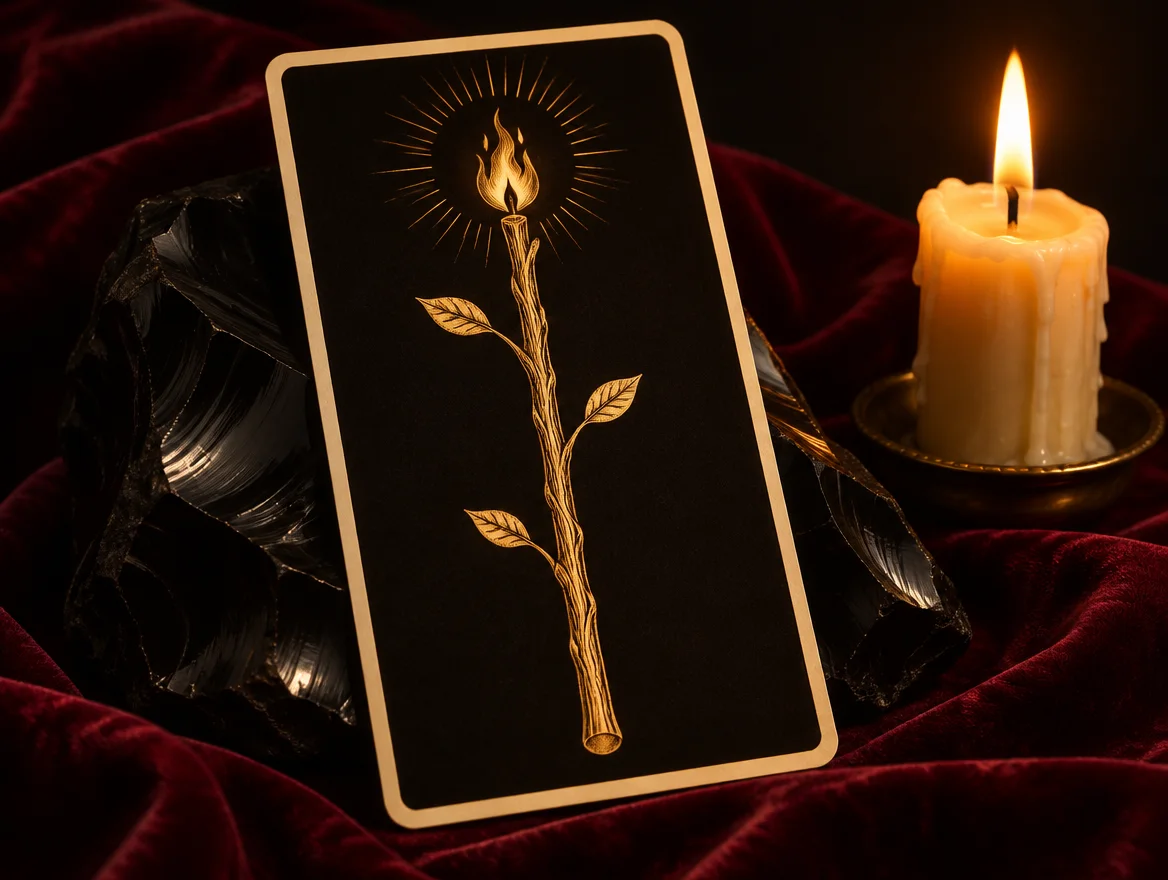
The images below are described in words. The art on this page is an original 9th King line-art interpretation, not a copy of the traditional card.
The hand and the wand
Waite’s description of the card in The Pictorial Key to the Tarot is one sentence long: “A hand issuing from a cloud grasps a stout wand or club” (Waite, Pictorial Key, Ace of Wands, sacred-texts.com).
That’s the whole scene in his words. No one else is in his description; just the hand and its grip on the wand. The plain picture matters most: energy is offered, not finished. A wand is raw material, not yet a tool, a house or a fire.
The leaves and the land
On the 1909 Smith card, the wand is drawn as a living branch with small green leaves sprouting from it, and below there’s a landscape with a castle on a far hill. These details come from the painting, not from Waite’s text. A living branch is a wand still growing, and the distant castle can read as what the spark might one day build. The card shows the start of the road, not the end.
What the Golden Dawn saw in the same card
In Liber LXXVIII, the Golden Dawn’s Book T as printed by Aleister Crowley, a white, radiating angelic hand comes out of clouds and grips a heavy three-branched club. Its branches end in ten flames, which the text ties to the number of the Sephiroth, and twenty-two leaping flames surround it; the text calls the whole thing a great flaming torch (Liber LXXVIII, sacred-texts.com).
The entry says the card symbolizes force, strength, rush, vigor and energy, and that it implies “Natural, as opposed to Invoked, Force.” In plain terms: the fire that rises on its own, not the fire you whip up because you think you should.
Ace of Wands meaning upright
Upright, readers commonly take the Ace of Wands as a beginning powered by drive. Waite’s divinatory meanings center on creation, invention and enterprise, and the powers behind them: principle, beginning, source, birth and origin, and the starting point of new undertakings. He adds that another account reads it as money, fortune and inheritance (Waite, Pictorial Key). Modern readers usually gather these into five themes:
- A spark. A sudden “I have to try this” feeling.
- New drive. Energy coming back after a flat stretch.
- Creative impulse. The first heat of a project you want to make.
- Initiative. Going first instead of waiting for permission.
- A fresh start. A clean beginning in work, play or purpose.
On 9K, we add one thing: the upright card asks for a first step, not a finished plan. A spark you never act on goes out, and a spark you try to turn into an empire overnight burns out. The middle path is one small, real action this week.
Ace of Wands reversed
Waite’s reversed meanings are stark: fall, decline and ruin, with a joy that has clouded over (Waite, Pictorial Key). On 9K, we don’t read that as doom. We read the reversed card through three patterns.
1. The smothered spark
The idea arrives and you put it out yourself. Who am I to do this? I’ll start when things calm down. The card can point to a habit of waiting for perfect conditions. Is that caution still protecting you, or only keeping you small?
2. The scattered spark
You don’t lack ideas. You have too many. Every new spark feels more exciting than the last, so you start a dozen things and finish none: fire with no hearth, plenty of heat and nowhere for it to gather.
3. The burned-out spark
You throw everything at the fire at once: late nights, big promises, total identity. A few weeks in, the tank is empty and the project feels like a weight. Real fire needs fuel and air to keep going.
The check is simple: am I feeding this fire, or smothering, scattering or burning it? Feeding sounds like one step, then the next.
Wands, fire and the Golden Dawn: the card’s correspondences
The correspondences below are Golden Dawn–derived correspondences, the tradition The 9th King uses, which is the system the Rider–Waite–Smith deck draws on. Other schools differ, and not every card maps to a single sign. Aces and court cards work differently from the numbered cards.
Wands are fire
The suit of Wands is commonly linked with fire and the action of the will, with themes of primal energy, inspiration and determination, and a harder side of impulsiveness and lack of direction (Wikipedia: Suit of wands).
The Root of the Powers of Fire
Liber LXXVIII opens its list of card titles with the four Aces, and the very first line names the Ace of Wands the Root of the Powers of Fire (Liber LXXVIII). The text places the Aces first in order and importance and describes them as the radical, or root, forces of their elements.
In plain terms, this card is the source of the whole fire suit. Every other Wands card is that same fire taking a more specific shape.
Why there’s no zodiac span
Many numbered Minor Arcana cards in the Golden Dawn system are tied to a decan, a ten-degree slice of a zodiac sign. Most court cards rule a wider span. The Aces don’t. Liber LXXVIII says the four Aces are placed on the North Pole of the universe, where they revolve and govern its revolution, acting as the connecting link between what it calls Yetzirah and the material universe (Liber LXXVIII).
So the Ace of Wands isn’t tied to any birthday or dates. For how the numbered and court cards map onto signs and decans, see our Tarot & the Zodiac guide.
The Ace and the Page of Wands
Liber LXXVIII says the four Princesses form the thrones of the powers of the four Aces. Its entry for the Princess of the Shining Flame, listed there as “Knave of Wands,” calls her earth of fire and the throne of the Ace of Wands (Liber LXXVIII).
The 9th King follows the court-card naming in Liber LXXVIII (the Golden Dawn’s Book T): Knights are fire of their suit, Queens water, Kings air, Pages earth. Under that convention, the Princess of the Shining Flame is our Page of Wands. Other systems match the titles differently, and our King of Wands guide walks through that naming trap in more detail.
The Ace is the fire arriving; the Page is where it first lands and takes a shape you can work with.
The fire signs, as element links
It can help to read the card alongside the three fire signs. This is an element link, not a claim that the card “is” any of them:
- Aries personality traits: fire as the urge to start, go first and act now.
- Leo personality traits: fire as creative self-expression and heart.
- Sagittarius personality traits: fire as the pull toward the next horizon, the next idea, the next adventure.
Our guide on how to read a birth chart shows how to spot your own fire placements.
The 9th King reading: tension, shadow and self-mastery
The tension: igniting vs. sustaining
The Ace of Wands lives between igniting a fire and sustaining it. Ignition is the rush of a new idea at 1 a.m. and the sudden certainty that this is the thing. Sustaining is the second week, the boring middle, the step that doesn’t feel like anything.
Many people with strong drive love the first part and get restless in the second. Others fear the middle so much they never strike the match. Our Nine of Wands guide is about holding your ground deep into a long effort: the Ace is the spark, the Nine is the stamina.
The shadow side
The card’s shadow shows up in a few familiar shapes:
- The idea chaser. Always starting, rarely finishing.
- The bonfire. Throwing everything at a fresh start until nothing’s left.
- The waiter. Sitting on a real spark until conditions are perfect.
- The borrowed flame. Forcing excitement you think you should feel.
That last one echoes the Golden Dawn line about natural, not invoked, force. If one of these shapes stings, treat it as information, not a verdict. Our zodiac shadow work guide covers the fire signs’ shadows, which overlap with this card.
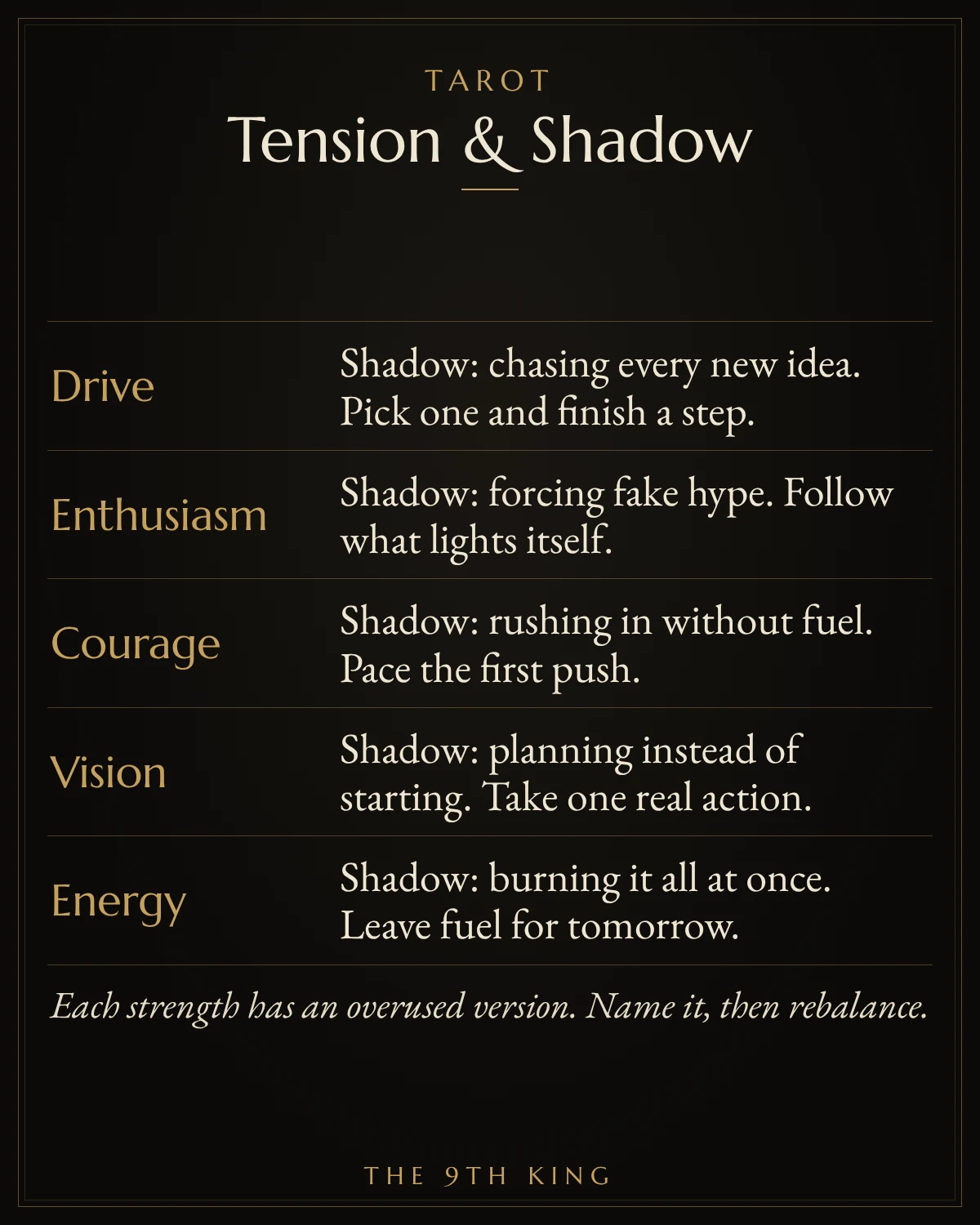
| Strength | Shadow version | The rebalance |
|---|---|---|
| Drive | Chasing every new idea | Pick one and finish a step |
| Enthusiasm | Forcing fake hype | Follow what lights itself |
| Courage | Rushing in without fuel | Pace the first push |
| Vision | Planning instead of starting | Take one real action |
| Energy | Burning it all at once | Leave fuel for tomorrow |
The self-mastery lesson
The Ace of Wands teaches one skill: feed one fire on purpose.
Not forever. Just long enough to see what this spark becomes with steady fuel: a few weeks of small, regular action before you decide whether it’s a calling or a passing flame.
Notice your pattern and work with it. If you scatter, the skill is choosing. If you burn, it’s pacing. If you smother, it’s starting before you feel ready.
Ace of Wands as feelings and in love
“Ace of Wands as feelings” usually means: how does someone feel about me? Here’s the honest 9K answer.
What readers commonly say
Readers often take the Ace of Wands in a feelings position as spark, attraction and excitement: something lit up, fast and strong, not yet tested or defined.
What a card can and can’t tell you
A card can’t read another person’s mind or motives. A more useful question is: What is this card saying about my own feelings?
This is where psychological projection is worth knowing about: in a strong rush, it’s easy to read our own heat into someone else, so go by what they actually say and do. If you want to know how someone feels, you can ask them, kindly and without pressure, if and when that feels safe and right for you.
Ace of Wands in love
In a love reading, readers commonly associate the card with:
- A spark. Strong early attraction or chemistry.
- Renewed passion. Play coming back into a long relationship.
- Initiative. Being the one to make a move.
Fire is wonderful in love and also fast. Our guide to fire and water relationships helps if your spark is with someone who runs on feeling more than heat.
The card doesn’t tell you to stay, leave, commit or wait. It offers a question: Is this a fire I want to tend, and am I being honest about how new it is?
A worked example (fictional)
Dev (fictional) draws the Ace of Wands on a Sunday night. He’s just had an idea for a podcast and wants to buy gear and record five episodes this week. Two projects from last month sit untouched.
Upright reading: the card can point to real, fresh drive. Dev asks: What one step would tell me if this fire has legs? He records one rough episode on his phone before buying anything.
If it had come up reversed: is Dev scattering again, or about to burn a week of late nights on an untested idea? Am I feeding this fire, or scattering it?
Neither reading predicts whether the podcast will work. It helps Dev see his own pattern clearly enough to choose.
Ace of Wands at work and in creative life
At work, readers often take the Ace of Wands as fresh initiative: a new project, or the nerve to pitch the idea you’ve been sitting on. In creative life, it’s the first heat of making something. The risk is the same: the spark is not the work. Make the first small version. One page, one track, one sketch.
Waite noted another account linking the Ace with money and fortune. On 9K, we don’t read that as a forecast of income, only as a reminder that drive is a resource you can invest or waste. None of this is career or financial advice.
Reversed, it often reflects stalled momentum, too many projects or overwork.
Myths and misreadings about the Ace of Wands
- “The Ace of Wands means a new job or business is coming.” A card isn’t a forecast. On 9K, read it as a spark in you now.
- “It’s a yes card.” We don’t give yes-or-no readings.
- “It’s a pregnancy card.” Waite’s list does include birth and virility, but we don’t predict pregnancy, health or any life event from a card.
- “Reversed means your project will fail.” Reversed cards on 9K point to a smothered, scattered or burned-out version of the same energy, not a fixed outcome.
- “The Ace of Wands is an Aries card.” In the Golden Dawn system we use, Aces don’t take a zodiac span. Aries, Leo and Sagittarius are helpful fire-sign links, not official correspondences.
Journal prompts and a practical exercise
The prompts and exercise below are reflective practice, not therapy. If you’re working through trauma, abuse, thoughts of self-harm or distress that feels overwhelming, please work with a qualified therapist. And it’s always fine to stop a prompt that feels like too much and come back another day, or not at all.
Seven journal prompts for the Ace of Wands
- What has lit up in me recently, and what did I do in the first day after I noticed it?
- When a new idea arrives, do I tend to smother it, scatter it or burn it?
- How many projects am I carrying right now that I started and haven’t touched?
- Which of my sparks rose on their own, and which am I forcing myself to feel excited about?
- What does the “boring middle” of a project feel like for me, and what do I usually do there?
- What would one small, real first step look like for the idea I care about most?
- What has lit up in me, and what is the first real step?
For more prompts in this style, see our shadow work prompts. New to shadow work? Shadow Work, Plainly explains how to start safely.
The exercise: the One Torch
A short practice for the moment a new idea or burst of drive shows up, or whenever the card appears.

| Step | What to do | Example (fictional) |
|---|---|---|
| 1. Catch it | Write the new idea down in one line | “A short weekly podcast” |
| 2. Park the rest | List other ideas on a later page | Two old projects, one new app idea |
| 3. Choose one | Pick the spark that rose on its own | The podcast |
| 4. First step | One action you can do this week | One rough episode on a phone |
| 5. Pace it | Set a small, regular time to feed it | Thursday evenings, one hour |
| 6. Review | After a few weeks, keep, change or let go | Keep, and buy a cheap mic |
- Step 2 is not deleting. Parked ideas aren’t dead; you’re just not lighting them all at once.
- Step 3 is the heart of it. Choose the idea that keeps coming back by itself.
- Step 6 can say “let go.” Letting a spark go on purpose isn’t the same as letting it die by neglect.
If you like reading intuitively, Code of Ascension’s guide to intuitive tarot (Code of Ascension) covers pairing card meanings with your first impressions.

Ace of Wands: FAQ
What does the Ace of Wands mean?
The Ace of Wands is the first card of the fire suit. Upright, readers commonly take it as a spark of new drive: a creative idea, fresh energy or initiative. A.E. Waite linked it with creation, invention and enterprise. On The 9th King it’s an invitation to turn a spark into one real first step, not a prediction of success.
What does the Ace of Wands mean reversed?
Reversed, the Ace of Wands often points to drive that gets smothered, scattered or burned out. Waite’s reversed meanings include fall and decline, but on The 9th King a reversed card isn’t a sentence. Ask whether you’re stalling a real idea, chasing too many at once, or spending all your energy in one burst.
What does the Ace of Wands mean as feelings?
In a feelings position, readers often take the Ace of Wands as spark, attraction and excitement: something new and strong that hasn’t been tested yet. A card can’t read another person’s mind or motives, though. Ask what it says about your own feelings first, and if you want to know how someone feels, ask them kindly when it feels safe to.
What does the Ace of Wands mean in love?
In love readings, the Ace of Wands is commonly linked with chemistry, returning passion and the courage to make the first move. It doesn’t tell you to stay, leave, commit or wait; those choices are yours. It asks whether this is a fire you want to tend, and whether you’re honest about how new it is.
What element is the Ace of Wands?
Wands are the fire suit, commonly linked with will, drive and inspiration. In the Golden Dawn system, the tradition The 9th King uses, the Ace of Wands is titled the Root of the Powers of Fire: the source of the whole suit, with every other Wands card the same fire taking a more specific form.
Does the Ace of Wands have a zodiac sign?
Not in the Golden Dawn system. Many numbered Minor Arcana cards are tied to decans of zodiac signs, but the Aces are described as placed on the North Pole of the universe, above the zodiac, as the roots of their elements. Because Wands are fire, Aries, Leo and Sagittarius are useful element links, but none of them is an official sign for this card.
Is the Ace of Wands a yes or no card?
The 9th King doesn’t do yes-or-no readings. The Ace of Wands can feel like an encouraging card, but a single card can’t settle a decision for you. Ask instead what it shows about your question: what has lit up in you, what’s holding you back, and what small step would tell you more.

Your next step: the next time a new idea grabs you this week, run the One Torch above and write down the one first step you chose. Then read the King of Wands to see what that same fire looks like when it has grown into steady, shared vision.
Explore Next
- Fire grown into leadership: King of Wands
- The stamina after the spark: Nine of Wands
- The water suit’s first card: Ace of Cups
- Fire as the urge to start: Aries Personality Traits
- Fire as creative heart: Leo Personality Traits
- Fire as the next horizon: Sagittarius Personality Traits
- New to tarot: Tarot for Beginners: How Tarot Really Works (Code of Ascension)
- More tarot on The 9th King: Tarot Card Meanings · Minor Arcana · Tarot & the Zodiac · Shadow Work Tarot Spread
- More cards in this set: Page of Wands · Knight of Wands · Queen of Wands · Ace of Swords · Ace of Pentacles
Final Thought: Feed One Fire
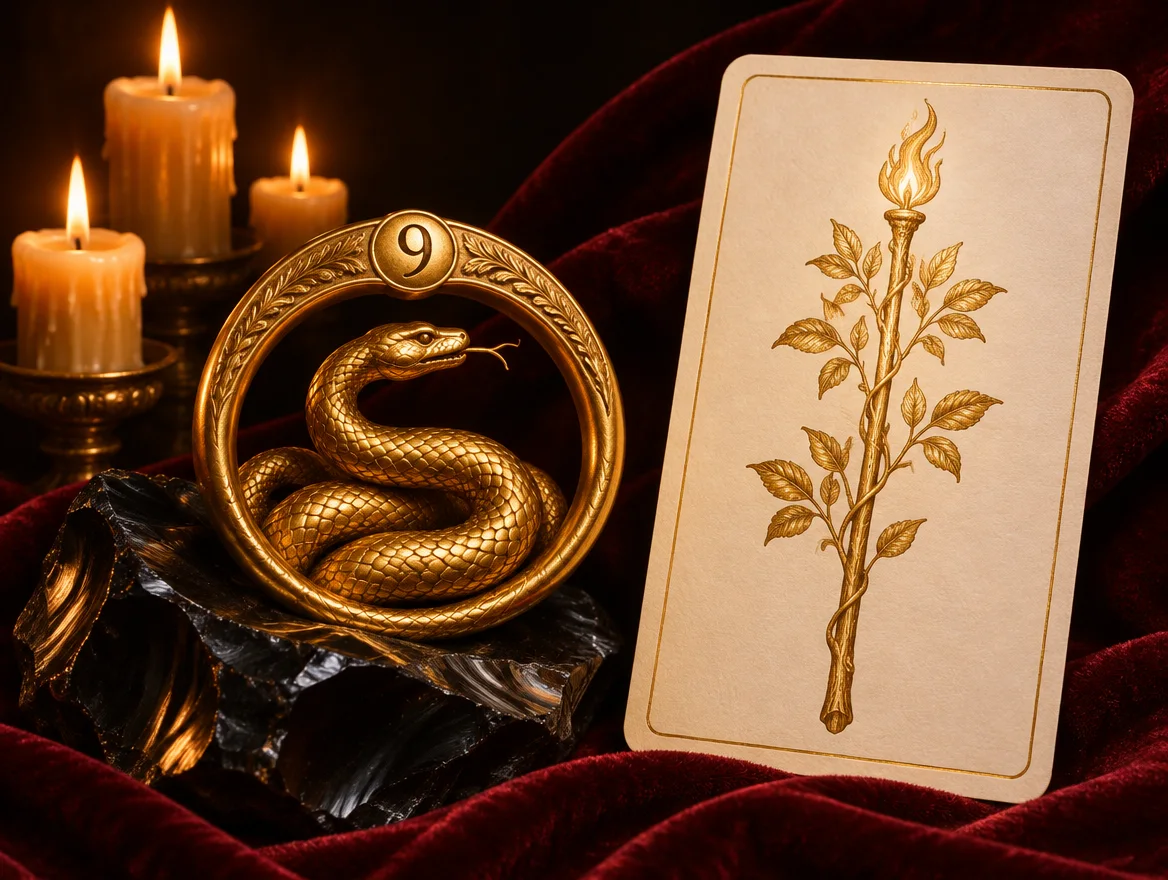
Most of us don’t lack sparks. We lack the patience to tend one. The Ace of Wands shows fire handed to you, raw and alive, and leaves the next part to you. You can smother it, scatter it or burn through it in a week, or you can choose it and feed it a little at a time. Every real enterprise starts this way: one wand, one first step. Know your nature. Rule your life.
About the Author
King is the founder of The 9th King, where zodiac psychology, relationships and shadow work are explored as tools for self-knowledge rather than fortune-telling. He’s a Libra Sun, and writes about the personal side of astrology on King The Kemist. Astrology on The 9th King is interpretation and self-reflection, not prediction or established fact.
Leave a Reply